
How to Create Supporting Points From a Core Idea
By Rakesh Inani, NLP & Mind Transformation Coach
You have an idea you want to share. You can say it in one sentence. Yet, when you sit down to write a blog post or speak in front of a camera, the next words do not come.
So you repeat the idea. Then you explain it in almost the same way. A minute later, you feel stuck.
If this has happened to you, your idea may be clearer than you think. You simply need to find the smaller points inside it.
A core idea gives your content one direction. Supporting points help your reader travel in that direction with you. One point may explain why the idea matters. Another may show how it works. A third may show what it looks like in daily life.
Once you can see those points, a short thought can become a useful article, lesson, video, or talk.
In this guide, I will show you how to create supporting points from a core idea, choose the strongest ones, and explain each point without repeating yourself. We will use simple examples along the way. Then, near the end, you can try the process with an idea of your own.
What Is a Supporting Point? A Quick Answer
A supporting point is a separate thought that helps someone understand your main idea.
Your core idea is the one message you want the reader to remember. Your supporting points answer the questions that message brings up.
Here is the basic shape:
Core idea → Supporting points → Examples and details
For example, imagine your core idea is:
One small step can help you move forward when you are overthinking a routine decision.
You could build three supporting points under it:
- A small step makes it easier to begin.
- A small step can give you new information.
- What you learn can help you choose what to do next.
Each point adds something different. Then, under each point, you can add an example or a short explanation.
That is how one sentence begins to grow into complete content.
Topic, Core Idea, Supporting Point: What Is the Difference?
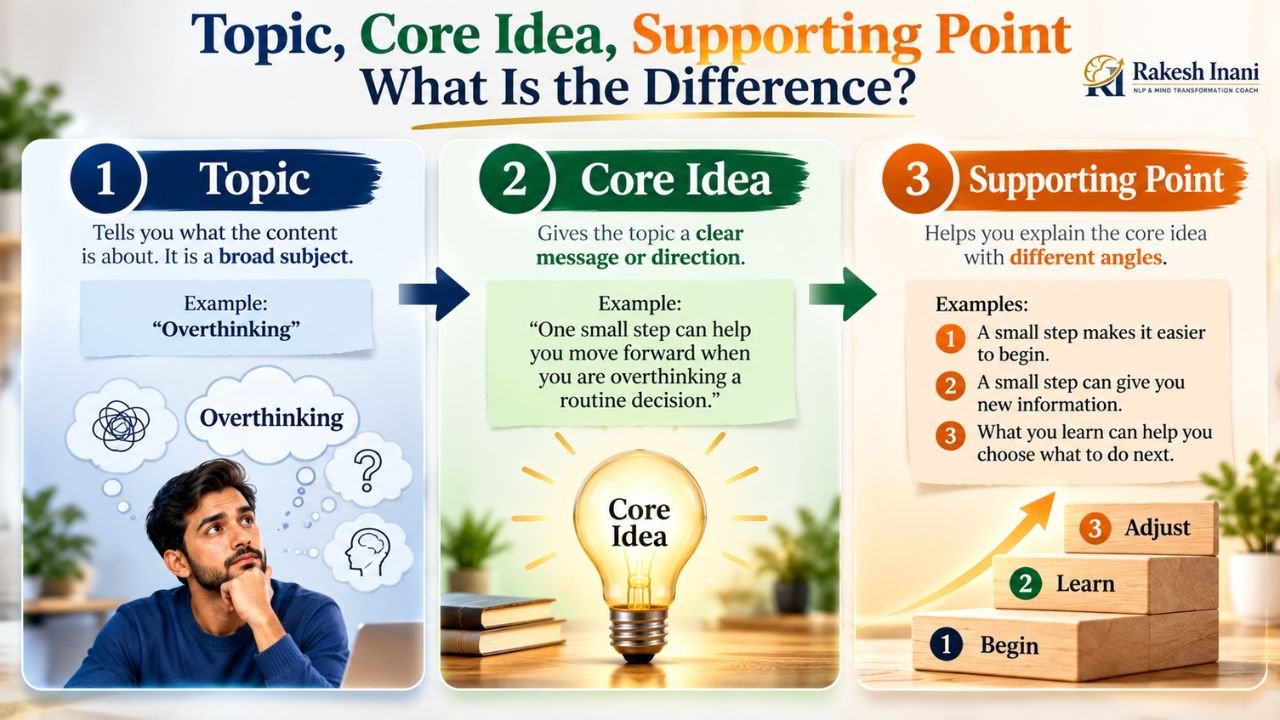
Before you create supporting points, it helps to know what you are building.
These three parts are related, but each has a different job.
A Topic Tells You What the Content Is About
“Overthinking” is a topic.
So are “confidence,” “clear speaking,” and “daily habits.”
A topic gives you a place to begin. However, it is usually too wide to guide a full explanation. If you tell yourself, “I will speak about confidence,” you may still wonder what to say first.
You need to decide what you want to say about confidence.
A Core Idea Gives the Topic a Message
Here is one possible core idea:
Speaking in small situations can help you get used to sharing your thoughts.
Now you have a direction. Your content is about one part of confidence: getting used to speaking through small acts.
A core idea does not need fancy words. In fact, a plain sentence is often easier to develop.
Supporting Points Help You Explain the Message
For that speaking idea, your supporting points might be:
- A small speaking task feels easier to start.
- Each attempt helps you notice what you want to improve.
- Repeating the task gives you more chances to use what you learn.
Notice that each point has its own job. Together, they help explain the core idea.
An example sits one level below a point. For instance, “Share one thought in your next team meeting” is an example of a small speaking task. It helps the reader picture the point.
Whenever you feel confused, return to this question: Am I naming the subject, stating my main message, adding a distinct point, or giving a detail?
Why Do Supporting Points Matter?
You may wonder, “Why can’t I just take my core idea and start talking?”
Sometimes you can. For a very short message, one strong sentence may be enough. However, when you want to teach or explain something, your reader needs more.
They Help You Stop Repeating Yourself
Without supporting points, it is easy to say:
Small actions help you start. Taking small steps helps you begin. If you start with something small, you can get started.
Those sentences sound different, but they make one point.
Now compare this:
A small step helps you begin. It can also show you something you did not know before. Then you can use what you learned to plan your next move.
The thought moves forward. Each sentence gives the reader a new piece.
They Help the Reader Follow You
When you know your points, you can guide the reader one step at a time.
First, you explain the idea. Next, you show why it matters. Then, you give an example. As a result, the reader does not have to guess how your thoughts fit together.
They Help You Speak Without Reading Every Word
Supporting points can also work as speaking prompts.
Instead of trying to remember a full script, you can remember three clear points: begin, learn, adjust. Then you can explain each one in your own words.
That is useful when you teach, record a video, or speak with someone face to face.
Start With One Clear Core Idea
If your main idea is unclear, creating supporting points will feel hard. You may come up with many thoughts, but you will not know which ones belong.
So, before you expand an idea, make it easy to say.
Try the One-Sentence Test
Ask yourself:
Can I tell someone my main message in one simple sentence?
For example, “I want to talk about decisions” names a topic. It does not yet tell us your message.
“Every decision must be made fast” is clear, but it is too broad to be sound advice.
“When a routine decision has low risk, taking one small step may help you learn what to do next” gives you a more useful idea to explore.
You can see who it may help and what it means. You can also see its limit: it is about a routine decision with low risk.
Keep One Main Message at a Time
Sometimes your sentence carries several ideas:
To speak well, you must build confidence, learn stories, control your voice, understand the audience, and practise each day.
You could build an article around each part. Together, though, they may pull one article in too many directions.
Choose one message first:
Practising a short explanation can help you speak about an idea with more ease.
Now you can create supporting points about that message.
You do not have to throw your other ideas away. Save them for another section or another piece of content.
How Do You Find Supporting Points? Ask Seven Questions

Once your core idea is clear, do not pressure yourself to “think of three points.” Instead, ask questions.
A good question gives your mind a place to look. Try the seven questions below, then write short answers. You can decide which answers are useful later.
We will use this core idea as we go:
One small step can help you move forward when you are overthinking a routine decision.
1. Why Might This Idea Help?
This question looks for reasons.
For example, when you are trying to plan ten steps at once, the whole task may feel large. Choosing only the first step gives you one clear thing to do.
That could become a supporting point:
A small step makes the task easier to begin.
You do not need to make a grand claim. Simply explain why the idea may be useful in the situation you are discussing.
2. How Does It Work?
This question helps you explain a process.
Imagine you want to choose a topic for a short video. You have five ideas and keep comparing them. So you draft one opening line for each idea. Now you can hear which one you can explain most clearly.
The step did not make the choice for you. However, it gave you something new to judge.
That gives you another point:
Taking a step can give you useful information.
3. What Happens Before and After?
Here, you look at the change the reader wants to understand.
Before the step, the person may only be imagining possible outcomes. After the step, they may have a question answered, a draft to review, or a small result to examine.
Your point could be:
What you learn from the first step can guide the next one.
Be careful with words such as “always” and “instantly.” A small action may help, but it does not promise a perfect answer.
4. What Does This Look Like in a Normal Day?
A reader may understand your idea in words but still wonder how to use it.
So give them a scene. Perhaps someone is unsure whether to join a new class. Instead of thinking about the whole year, they check the timetable or attend one trial session.
This example makes “one small step” easier to picture.
Ask yourself: Where is my reader? What are they trying to do? What small action could they actually take?
5. When Does This Idea Help Most?
A useful point often has a clear setting.
A small test may help when a choice is easy to change and the cost of trying it is low. For example, you can test a new way to open a video or organise your notes.
By naming the setting, you help the reader use the idea with care.
6. What Might the Reader Question?
Your reader may think, “Should I really act before I feel sure?”
That is a fair question. You can answer it by explaining that a small step might be gathering information, not making the final choice.
For an important health, money, or safety decision, the right next step may be to take more time or seek advice from a qualified person.
Addressing a fair concern makes your explanation more complete.
7. What Can the Reader Do Next?
Finally, turn the idea into action.
You might suggest:
Write down the decision. Then choose one question you need answered before you decide.
This gives the reader a practical way to try the idea. It also gives your content a natural ending.
You may find many answers to these seven questions. That is fine. For now, your goal is to find possibilities. Later, you will choose the points that work best together.
Nine Angles That Can Help You Create Distinct Points
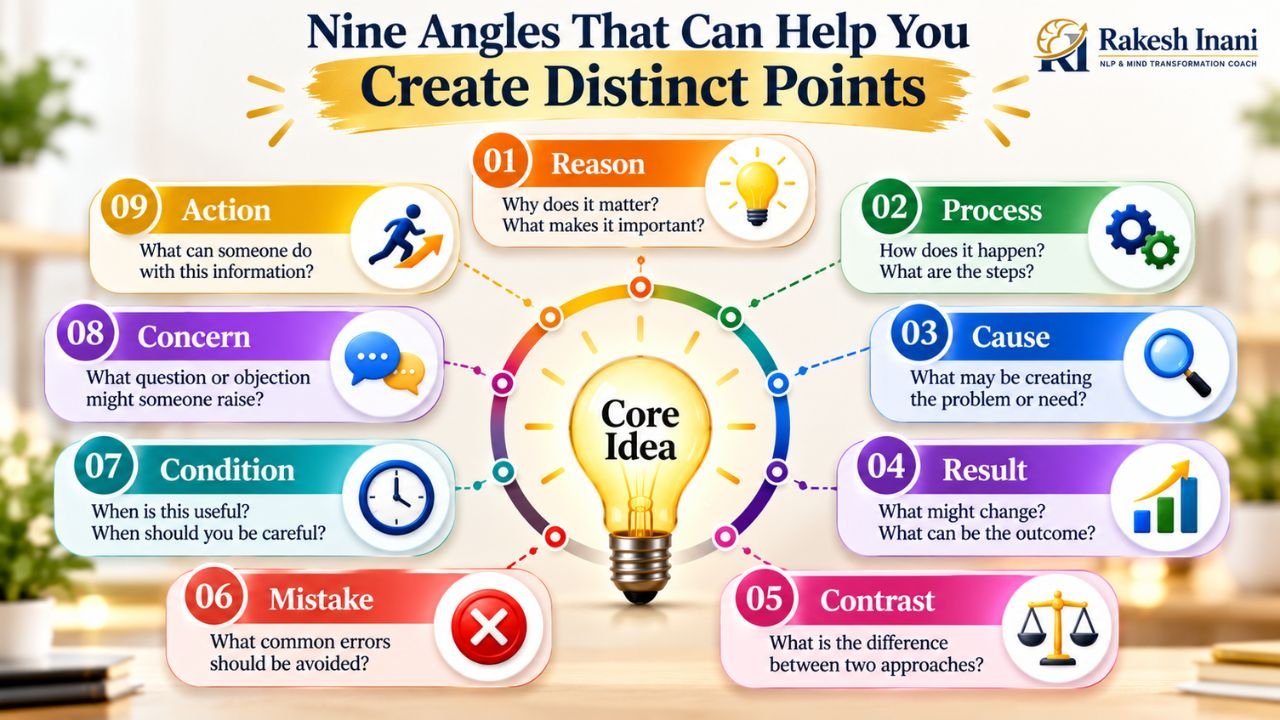
The seven questions help you explore an idea. The angles below help you notice what kind of point you have found.
You do not need all nine in one article. In fact, using only a few strong angles will often give your reader a clearer path.
1. Give a Reason
A reason answers, “Why does this matter?”
Core idea:
Writing down a thought can help you examine it.
Possible supporting point:
When the thought is on a page, you can read its exact words.
Now the reader knows one reason for writing it down.
2. Explain a Process
A process answers, “How does it happen?”
For example:
First, write the thought. Next, ask what you know for sure. Then, mark what you are guessing.
This point shows what the person would do, step by step.
3. Name a Cause
A cause asks what may be creating the problem.
Imagine your core idea is, “A clear plan can make a short talk easier to deliver.”
A possible point is:
Trying to remember too many loose thoughts can make it hard to know what comes next.
That point helps explain why a plan may be useful.
4. Describe a Possible Result
A result answers, “What might change?”
For example:
With three clear points, you can check whether your talk has a beginning, middle, and end.
The word might is useful when the outcome depends on the person and the situation. Keep your promise as careful as your knowledge allows.
5. Show a Contrast
A contrast helps the reader see a difference.
You might compare “writing every word of a talk” with “writing three prompts and explaining them in your own words.”
The contrast is useful because it makes the choice clear. Still, explain when each approach may help. A person may need full notes for a formal or exact message.
6. Point Out a Mistake
Sometimes your reader learns by seeing what does not work.
For this article, one common mistake is treating “easy to start,” “simple to begin,” and “less hard to start” as three supporting points. They are three ways to say one thing.
Once you show the mistake, give the fix: find a point that answers a different question.
7. Name a Useful Condition
An idea may work well in one setting and need care in another.
For example, a quick test can be helpful for a low-risk content idea. It may be less useful when a choice is costly or hard to undo.
A condition helps the reader know when to apply your point.
8. Answer a Concern
Think about what a thoughtful reader might ask.
If you say, “Use examples to make your point clear,” they may ask, “What if I do not have a personal story?”
You can answer:
You can use a simple made-up situation, as long as you make it clear that it is an example and not a real event.
Now you have removed a block that might stop the reader.
9. Give an Action
An action answers, “What can I do with this?”
For example:
Before you write your next post, put your core idea at the top of the page. Under it, write three different questions your reader may have.
A useful action turns your explanation into something the reader can try.
Remember, an angle helps you find a supporting point. After that, you can use an example, story, observation, or trustworthy source to explain it.
A Six-Step Method for Building Supporting Points
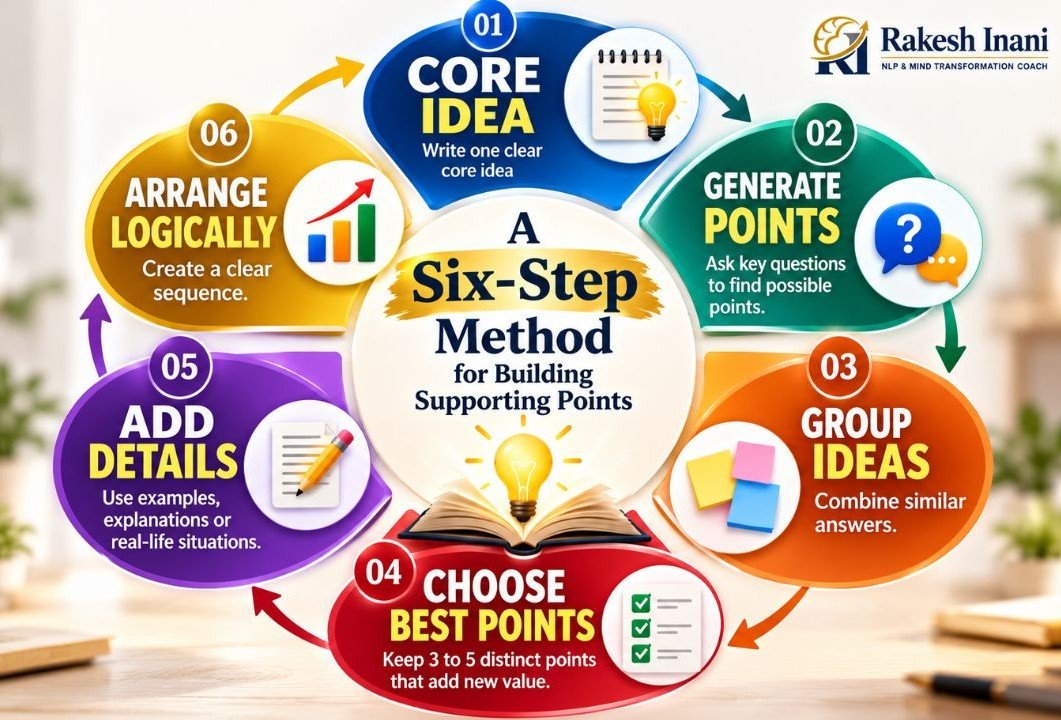
You now have plenty of ways to find ideas. Let us put them into a method you can use each time you write or speak.
Step 1: Write Your Core Idea
Use one sentence.
Do not worry about making it sound impressive. Instead, make sure you know what you want the reader to understand.
For example:
A short daily speaking practice can help you explain familiar ideas with more ease.
If the sentence contains many separate promises, make it smaller.
Step 2: Write Fast Answers to Simple Questions
Under your idea, write:
- Why might this help?
- How could someone do it?
- What problem does it address?
- What example would make it clear?
- What might the reader ask?
- What could they try today?
At this stage, short phrases are enough. You might write “easier to start,” “notice where I get stuck,” and “try again with a clearer example.”
Keep moving. You are collecting material.
Step 3: Put Similar Answers Together
Now read your notes.
Perhaps you wrote “easier to begin,” “less pressure at the start,” and “a smaller first task.” These may all belong under one point.
Circle the shared thought and give it a simple name:
Short practice gives you a manageable place to start.
Then look for thoughts that add something new.
Step 4: Choose Three to Five Different Points
You do not have to use every note you made.
Choose points that support your main message and give the reader different kinds of help. For the speaking example, you might choose:
- A short practice is easy to fit into your day.
- One practice helps you notice where your explanation becomes unclear.
- A later practice gives you a chance to improve that part.
Those points move forward. They do not repeat one another.
Step 5: Add One Helpful Detail Under Each Point
A point may still feel thin when it stands alone. So add a detail.
Under Point 2, you could write:
After speaking for two minutes, you may notice that you can explain why the idea matters but struggle to give an example.
That detail helps the reader recognise the situation. You could then suggest writing one example before the next attempt.
Use details you can explain honestly. If you use someone else’s fact or finding, check it and give the source.
Step 6: Put the Points in a Helpful Order
Finally, ask, “What does my reader need to know first?”
For the speaking example, begin with how to start. Next, explain what to notice. Then, show how to use what was noticed.
You have now turned one idea into a path the reader can follow.
A Complete Example: Build Content From One Core Idea
Let us work through the process from beginning to end.
Imagine you want to create a short blog post or video for someone who keeps delaying a routine choice. You begin with this idea:
When you are overthinking a routine decision, one small, low-risk step can help you move forward.
The message is focused. It names the problem, the possible action, and the kind of decision you mean.
Now let us build the supporting points.
Point 1: A Small Step Makes the Start Manageable
A person may be trying to solve the whole decision at once. That can leave them unsure where to begin.
So, rather than asking for a final answer, invite them to name the first thing they need to know.
For example, someone wants to start making educational videos but cannot choose a topic. Their first step could be to write three topics they can explain to a friend today.
They have not planned a whole channel. However, they have made a start they can look at.
Point 2: A Small Step Can Give You New Information
Thinking is useful. Yet, sometimes you need to check something outside your thoughts.
Our video creator could write a two-sentence opening for each of the three topics. Then they could notice which opening leads naturally to an example.
Now they have more than a guess about which topic feels ready. They have a few lines of work to review.
The point is not that the first try will be perfect. The point is that a small try can show you something.
Point 3: You Can Use What You Learn to Choose the Next Step
Suppose the creator finds that one topic is easy to explain, but the example is weak.
Their next step is clearer: find a better example.
If another topic still feels too wide, they could make it smaller. Instead of “How to be confident,” they might choose “What to say when you lose your words in a meeting.”
The first action helps shape the next one. In this way, progress can become a series of small choices.
Add an Honest Limit
Now ask what your reader may question.
Should you use a quick small step for every decision? No. Some choices need careful review. If a decision affects your health, safety, or finances, gathering sound information or asking a qualified professional may be the best first step.
That limit belongs in the content because it helps the reader use your idea well.
Put It Together
You now have the shape of a complete explanation:
- Hook: “Are you waiting to feel completely sure before you choose a topic?”
- Core idea: “For a routine choice, one small, low-risk step can help you move forward.”
- Point 1: “It makes the start manageable.”
- Point 2: “It gives you information.”
- Point 3: “It helps you choose your next step.”
- Example: “Write an opening for three possible video topics.”
- Limit: “Give higher-stakes choices the care they need.”
- Action: “Choose one question you can answer today.”
The core idea stayed the same. Supporting points made it useful.
Another Example: Build Points for a Short Talk
Let us try a different idea:
A simple structure can make a short talk easier to deliver.
What points could sit under it?
First, a structure gives you a place to begin. Instead of wondering how to say everything, you can open with one question your listener cares about.
Next, it helps you know what comes after the opening. You might plan three prompts: what the idea means, why it matters, and one example.
Finally, it helps your listener follow you. If you move from meaning to reason to example, they can see how the parts fit together.
Now add details. Your opening question might be, “Why do we lose our words even when we know the topic?” Your example could be a short talk about speaking in meetings.
If you were about to record this talk, you could write only these prompts on a card:
Opening question → Meaning → Reason → Example → One action
You would still prepare. Yet, the prompts would give you room to speak in your own voice.
Where Can You Find Original Supporting Points?
You do not have to search for a clever line each time you create content. Often, useful points begin with something you have noticed.
Look at Your Own Experience
Think of a time you tried to explain an idea.
Where did you get stuck? What question helped you continue? Which example made the idea easier to understand?
Your answer may give you a supporting point.
For instance, if you found that writing one sentence helped you spot a gap in your thinking, you could explore that observation. Tell the reader what you noticed and show how they can check it for themselves.
Keep the claim close to the experience. One event can be a helpful example, but it cannot prove that everyone will have the same result.
Listen for Real Questions
When people ask you to explain something again, pay attention to which part they ask about.
“Why would I do that?” may reveal a missing reason.
“What do I do first?” may reveal a missing step.
“Can you give me an example?” may reveal that your point is clear in your mind but hard for someone else to picture.
These questions can guide your next supporting point.
Notice Patterns
If the same question appears across several talks, notes, or drafts, look closely at it.
For example, you may notice that people often understand the what and why of an idea but ask for help with the how. That pattern suggests your content may need a clear process and an everyday example.
Your own way of noticing and explaining a pattern can give your content a voice that feels like yours.
How Do You Choose the Strongest Supporting Points?
After you explore an idea, you may have twelve possible points. You do not need to include them all.
Instead, test each one with four questions.
Does It Support My Core Idea?
If your article is about creating supporting points, a long section on choosing a blog title may be useful somewhere else. It does not help explain your main message here.
Keep notes like that for another post.
Does It Add Something New?
Compare these two points:
- A small step is easier to begin.
- A small step feels simpler to start.
They are very close. You can combine them.
Then add a point that does a different job, such as “A small step gives you information.”
Will My Reader Know Why It Matters?
“Use a contrast” may be a useful instruction. Yet, the reader also needs to know why.
You could explain:
A contrast shows what changes when you use one approach instead of another.
Now the point has a purpose.
Can I Explain It Clearly?
Ask whether you can put an example or detail under the point.
If you cannot explain it yet, it may need more thought. You can set it aside until you know what you mean.
Choose points for clarity, not for a target number. A short piece may need two. A long guide may need more.
What Order Should Supporting Points Follow?
Good points can still feel confusing if they arrive in the wrong order.
The best order depends on what you are teaching. Here are three simple ways to arrange them.
Why → How → What Next
Use this when your reader needs to understand and then act.
For example:
- Why does a small first step matter?
- How can I choose a low-risk step?
- What should I do after taking it?
This order works well for a practical guide.
Problem → Cause → Possible Response
Use this when you want to explain a difficulty.
For example:
- You keep losing your place during a talk.
- Your notes contain many loose ideas with no order.
- You can try grouping the ideas under three prompts.
This gives the reader a path from the problem to something they can try.
Simple → Deeper → Practical
Use this when an idea needs a little teaching.
First, explain the idea in plain words. Next, explore a detail the reader might miss. Finally, give an example or exercise.
Whatever order you choose, guide the reader between points. You might say, “Now that you can see why this matters, let us look at how to try it.”
A transition should help the thought move. It should not be added just to fill space.
How Do You Turn One Point Into a Clear Paragraph?
Finding a point is the first task. Explaining it is the next.
When you are unsure what to write, try this small pattern:
Point → Explanation → Example → Link to the main idea
Here it is in action:
A small step can give you useful information. For example, you may be unsure which topic to choose for a video. So write a short opening for two topics and see which one you can explain more clearly. What you notice can help you choose what to work on next.
The paragraph states the point. Then it explains it with a situation the reader can picture. Finally, it connects back to the core idea of moving forward through a small step.
You do not need to force all four parts into one long paragraph. Keep your paragraphs short when a new thought begins.
If the example needs more space, give it another paragraph. The goal is for the reader to follow you with ease.
Can You Use the Same Points for a Blog, Video, or Speech?
Yes. Your core idea and main points can travel across formats. What changes is how much you explain and how you speak to the audience.
In a Blog Post
Give each major point its own section. Then add a short explanation, a useful example, and any limits the reader needs to know.
A blog gives you room to answer questions that may come up as someone reads.
In a Video
Use your points as prompts. Speak through one point at a time, and choose an example you can tell naturally.
You can prepare an opening and a closing line without trying to memorise every sentence between them.
In a Speech or Lesson
Let each point mark a part of the journey. Before you move on, check that you have explained what the point means and why it matters.
The format may change, but a clear set of points helps you keep your message together.
Common Mistakes When Creating Supporting Points
It is normal to make a rough list before you find your best points. As you review it, watch for these common problems.
Mistake 1: Repeating the Main Idea
Core idea:
Practice can help you explain an idea with more ease.
Weak supporting point:
Practising helps you explain ideas more easily.
The point only repeats the message.
Try this instead: Ask how practice may help. Perhaps it lets you notice where your explanation becomes unclear.
Mistake 2: Adding a Point Because It Sounds Interesting
Suppose your content is about speaking with a simple structure. You may suddenly think of a story about body language.
The story might be interesting. Still, ask whether it helps explain your main idea. If it leads away from the subject, save it.
Try this instead: Keep one line at the top of your notes: “The reader should leave knowing…” Check each point against it.
Mistake 3: Treating Every Example as a New Point
Imagine these notes:
- Share one thought in a meeting.
- Ask one question during a class.
- Record a one-minute video.
They are three examples of small speaking actions. They may fit under one supporting point rather than become three separate sections.
Try this instead: Ask what the examples have in common. That shared thought may be the point you need.
Mistake 4: Using Too Many Points
A long list can make the reader work hard to find your message.
Try this instead: Choose the points that give the clearest path. If two points do nearly the same job, combine them. If a point needs its own deep explanation, consider giving it a separate article.
Mistake 5: Making the Claim Too Strong
A line such as “One small step will stop overthinking” promises too much.
Try this instead: Say what you can explain with care: “For a routine decision, one small step can help you gather information and move forward.”
Clear limits make your advice more useful.
Mistake 6: Making Simple Ideas Hard to Read
A point does not become deeper because its words become longer.
If you mean, “Write one question you need answered,” say that. Then add depth through your explanation and example.
The reader should remember the idea, not struggle to untangle the sentence.
A Five-Minute Exercise: Find Points for Your Own Idea
Let us practise once before you go.
Start with this core idea:
Small daily practice can help you explain familiar ideas with more ease.
Set a timer for five minutes. Then write a short answer to each question:
- Why might a small practice be easier to begin?
- What could someone notice while practising?
- How could they use what they notice?
- What would a practice session look like?
- What is one limit or concern worth mentioning?
Now choose three answers that do different jobs.
Your notes might become:
- Point 1: A short session is easier to fit into a busy day.
- Point 2: Speaking aloud helps you spot the part you cannot yet explain well.
- Point 3: You can focus the next session on that one part.
Next, add one detail under each point.
For Point 2, you could write:
I can explain what the idea means, but I pause when I try to give an example.
That is a detail someone can recognise. It also suggests the next action: prepare one simple example, then try again.
Now use your own idea. Write it in one sentence. Ask the five questions. Choose three different answers. Add one detail under each answer.
You have the start of a useful piece of content.
Frequently Asked Questions
How Many Supporting Points Should a Core Idea Have?
There is no fixed number.
A short video may need two or three points. A detailed blog post may need more. Choose enough points to answer the reader’s main questions, then stop before you begin to repeat yourself.
What If I Can Think of Only One Supporting Point?
Keep the core idea in front of you and ask a different question.
If your first point explains why, ask how. If it explains how, ask what the idea looks like in real life. You can also ask when the idea may help and what someone might question about it.
Give yourself time to write rough answers. You can improve the words later.
How Do I Know Whether Two Points Are Too Similar?
Read them aloud one after the other.
Then remove one. Does the reader lose a separate reason, step, or insight? If not, the points may belong together.
For example, “a small step is easier to start” and “a small step makes beginning simpler” can become one point. “A small step gives you new information” adds a different thought.
Is an Example the Same as a Supporting Point?
Usually, an example is a detail that helps explain a point.
“Practising a short talk lets you notice where you pause” is a supporting point. “Record a one-minute explanation and listen for the place where you lose your words” is an example of how to use that point.
Both matter. They simply have different jobs.
Can One Core Idea Become a Full Blog Post?
Yes, if the idea is useful and you explore it well.
You can explain what it means, why it matters, how it works, where it applies, what readers may misunderstand, and what they can try. Then you can add clear examples under the strongest points.
The aim is to give the reader what they need to understand and use the idea.
What If My Supporting Points Do Not Come in Order?
That is normal. When you first think, your job is to collect possibilities. Afterward, you can group similar notes and arrange the best points.
Ask what the reader needs first. Then choose an order that takes them from the starting question to a useful next step.
Give Your Core Idea Room to Grow
The next time you have a good idea and run out of words, pause before you decide that you have nothing more to say.
Write the idea in one sentence. Ask why it matters, how it works, and what it looks like in real life. Then choose a few answers that add something different. Put one clear example under each point.
You do not need to explain everything at once. You need to help your reader take the next step in understanding.
Now choose one idea you want to share this week. Write three supporting points beneath it, add one real example under each, and turn those notes into your next post, video, or talk. Start with the first sentence today.
Download the Free Guide: Overthinking to Focused Action
Learn practical ways to quiet mental noise, make clearer decisions, and take consistent action.
→ Learn How NLP and Mind Transformation Work
Explore how thinking patterns, beliefs, communication, and mental rehearsal can influence behaviour.
→ Read: How to Stop Overthinking Before Making Important Decisions
Especially useful if decision-making is currently one of your biggest leadership challenges.
