
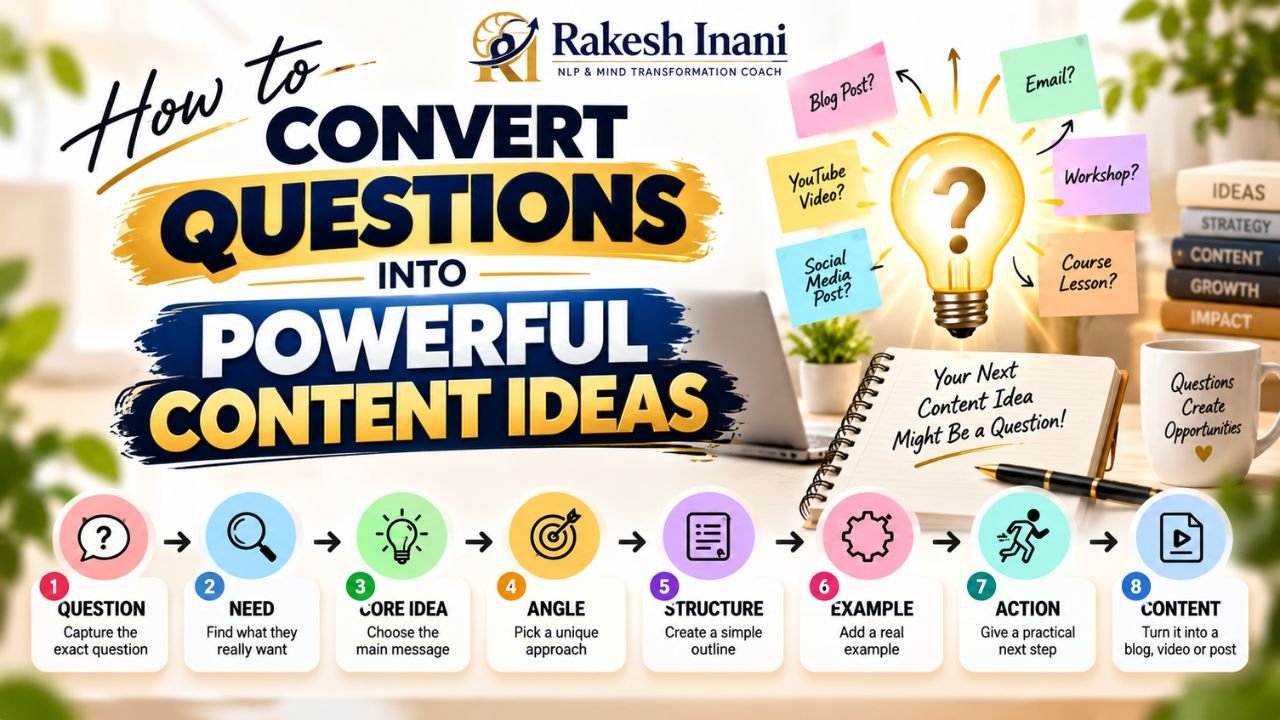
How to Convert Questions Into Powerful Content Ideas
By Rakesh Inani, NLP & Mind Transformation Coach
You open a blank page and ask yourself, “What should I create today?”
Then you wait.
You think about your niche. You look at old posts. You try to find a fresh topic. Yet nothing feels clear enough to write or record.
Meanwhile, someone may have asked you a useful question this morning. Perhaps a client asked it during a call. Perhaps a friend asked it over tea. Or perhaps you asked it yourself while trying to understand something.
That question could become your next blog post, video, email, or lesson. You only need to notice it and develop it.
I know how easy it is to miss these moments. When someone asks us a question, we often answer it and move on. Later, when it is time to create content, we search for a new idea as if we have none.
So, let us build a better habit. In this guide, I will show you how to find questions, see the need behind them, and turn one simple question into content that helps your reader.
How Do You Turn a Question Into a Content Idea?

The short answer is this: write down the question, find what the person really wants to know, give one clear answer, and build your content around that answer.
Then add an example and one useful action. That is enough to begin.
For instance, someone might ask, “Why do I overthink small decisions?”
At first, you may see this as one broad topic: overthinking. However, the person may really want to know why a small choice feels so important. They may worry about making a mistake or hearing someone say they chose badly.
Now you have a more useful content idea: “Why Small Decisions Feel So Hard—and How to Take the Next Step.”
Notice what changed. The original question gave us a starting point. Then we looked for the need beneath it. Finally, we chose an answer we could explain.
A question does not need to become a title exactly as it was asked. It can become an article that answers one part of the question well.
Why Questions Are Such Good Starting Points
Questions show you what people care about
When people ask a question, they show you where they need help. Sometimes they want a fact. Sometimes they want a method. At other times, they want to feel less alone with a problem.
Think about the difference between these two requests:
“What is confidence?”
“How can I speak in a meeting when I feel nervous?”
The first asks for a meaning. The second points to a real moment in someone’s day. Both can inspire content, but the second gives you more to work with. You can explain the situation, share an example, and suggest a small action.
So, when you collect questions for content, do more than count them. Notice the situation inside each question.
Questions give your content a job to do
It is easy to write a post about a broad topic such as “mindset.” It is harder to know where that post should begin and end.
A question gives you a direction. If the question is “How do I stop losing my words while speaking?” your content has a clear job: help the reader understand what may be happening and show them a way to prepare their thoughts.
This also helps you stay focused. When you start adding ideas that do not help answer the main question, you can save them for another piece.
Your answer can show how you think
Many people may answer the same question. Still, your answer can be useful because you bring your own way of explaining it.
Perhaps you use a simple story. Perhaps you draw a comparison that makes the idea easier to see. Or perhaps you give a short exercise the reader can try today.
You do not need to invent a question nobody has ever asked. Instead, you can give a clear and thoughtful answer to a question people already have.
Where Can You Find Questions for Content?
You do not need a complex research system to begin. First, pay attention to the places where people already speak to you.
Listen to the words your audience uses
Look at questions from conversations, comments, emails, messages, workshops, and calls. If you teach or coach, listen for the moment when someone says, “But how do I do that?”
That short sentence can reveal a missing step in your content.
For example, you may often tell people that small action helps them build confidence. Then someone asks, “What small action should I take when I am scared to speak?”
Now you have a new article or video idea. You can show what a small speaking action looks like in a real situation.
Save the person’s wording when you can. Their words often sound clearer and more natural than the title you might invent later.
Notice questions that return
If different people ask you the same question, pay attention. You may have found a topic that deserves a full answer.
However, do not wait for a question to appear many times. One thoughtful question may still reveal something important. Ask yourself whether other people in your audience might face the same situation.
For instance, one person might ask, “Why can I explain my idea alone but go blank on camera?” If you help people speak or create videos, that single question may speak to many readers.
Protect people’s privacy
A private conversation can inspire public content. Still, the person’s story belongs to them.
So, use the general question without sharing names, personal details, or a story that others could recognize. If a specific story matters to your article, ask permission before using it.
Often, you will not need the private story at all. The question itself is enough.
Keep a place to catch questions
Use a notebook, a notes app, or a simple document. Choose the one you will open quickly.
Then record three things:
- What was the question?
- Who might this question help?
- What did the person seem to need?
For example:
Question: “Why do I keep changing my mind after I decide?”
Who it may help: People who overthink choices.
Possible need: They want to trust a decision without reviewing it all day.
This note takes less than a minute. Later, it can save you a long search for a topic.
How to Turn Audience Questions Into Helpful Content

A question is useful, but the first words may not tell the whole story. So, before you write, pause and look a little deeper.
Ask what the person means
Suppose someone asks, “How do I stop overthinking?”
That question could mean many things. They may replay a past conversation. They may worry about tomorrow’s meeting. Or they may struggle to choose between two options.
If you try to answer all of these at once, your post may become too broad. Instead, choose the part you can explain clearly.
You might write, “How to Stop Replaying a Conversation in Your Mind,” or “What to Do When You Keep Doubting a Decision.” Each title gives the reader a clearer reason to read.
Look for the action they cannot take
Sometimes people ask for information when they really need help with a next step.
For example, “How do I become more confident?” may lead to another question: “What do you want to do, but keep putting off?”
Perhaps the person wants to raise a point in a meeting. Now you can create content about preparing and saying one clear sentence in that meeting.
The goal is not to guess what every reader feels. The goal is to find a specific situation you can help them think through.
Answer one part at a time
Imagine a question as a large door with smaller doors behind it.
“How do I create content consistently?” may lead to:
- How do I find ideas?
- How do I choose one idea?
- How do I make time to write?
- How do I finish a draft?
- What do I do when I miss a day?
Each smaller question can become useful content. As a result, one audience question can give you a whole series without forcing every answer into one post.
Use Your Own Questions as Content Ideas
Your audience is a valuable source of questions. Yet you can also learn from the questions you ask yourself.
Notice what you are trying to understand
While reading a book or watching a lesson, you may stop and think, “Why does this work?” Write that question down.
Later, explore it. Read more when needed. Test whether you can explain the answer in simple words. Once you understand it well enough, you may have a helpful piece of content.
For instance, you may ask, “Why is it easier to remember a story than a long list of points?” That question might lead to an article on using stories while speaking.
Your first question does not make you an expert on the answer. It gives you a reason to learn and explain.
Pay attention to what is hard to explain
If you teach, speak, or write, notice where you get stuck.
Perhaps you know a concept, yet you struggle to give an example. Perhaps you can say what to do, but explaining how feels difficult.
That gap can become content. You can work through the idea, find an everyday example, and share the clearer explanation you build.
For example, “Why do I lose my words while recording a video?” can become “How to Organize Your Thoughts Before You Record.” Your own question becomes useful when you connect it to a problem others may also face.
Turn your experience into a shared lesson
Start with “I noticed…” Then ask, “What can my reader learn from this?”
Maybe you noticed that a short outline helped you speak more freely than a full script. That experience could lead to a post comparing the two methods.
Be honest about the difference between an observation and a rule. Your experience can offer a helpful example without claiming that everyone will get the same result.
Ask “Why?” to Find a Deeper Content Angle
A “why” question helps you move below the surface of a topic. It can turn a general idea into a more thoughtful one.
Begin with the problem you can see
Let us say your topic is procrastination. You could write, “How to Stop Procrastinating.” Many readers will understand that title.
However, you may have a more specific question: “Why do I delay a task even when it matters to me?”
Now you can explore possible reasons. Maybe the task feels too large. Maybe the first step is unclear. Maybe the person worries about doing it badly.
Each possibility gives you a different angle. You could write one post about making a task smaller and another about choosing a first step.
Keep asking until you find something useful
Try this simple chain:
Why am I delaying this task?
Because it feels too big.
Why does it feel too big?
Because I am thinking about the whole project at once.
What would help me begin?
I could choose one part I can finish today.
Now the content idea is clear: “When a Task Feels Too Big, Choose the Part You Can Finish Today.”
You do not need to keep asking “why” forever. Stop when you have an idea you can explain and a step the reader can try.
Leave room for different answers
People may delay action for many reasons. Therefore, write with care. Say “one possible reason” when that is what you mean.
This makes your content more useful. Readers can consider whether your example fits their situation instead of being told that you know exactly what is happening inside their mind.
Ask “What If?” to Discover Fresh Ideas
A “what if” question helps you look at a familiar problem from a new side. It can also lead to an exercise your reader can try.
Change one part of the situation
Suppose your topic is getting started. Ask, “What if you had only five minutes?”
Now you can write about choosing a five-minute task: open the document, write the first line, or list three points.
Or suppose your topic is decision-making. Ask, “What if you did not need complete certainty before choosing the next step?” This could lead to an article about making a small choice and reviewing what you learn.
A good “what if” question changes one thing at a time. That way, the reader can follow your thinking.
Explore a possibility the reader can test
“What if I made a video without reading a full script?” is more useful when you can show an alternative.
For example, you could prepare a card with five prompts: the main idea, why it matters, one example, one action, and a closing line. Then you could try recording with that card.
Even if the method needs practice, the content gives the reader something real to test.
Keep your answer connected to daily life
An unusual question may catch attention. Still, ask whether its answer will help the reader.
“What if you never felt fear again?” may sound striking, but it is hard to turn into a practical promise. “What if you took one small step while feeling nervous?” leads to a clearer example and a more useful discussion.
Find the Curiosity Gap Without Using Clickbait
A curiosity gap is the space between what someone knows and what they want to know. It can help you write an opening that invites the reader in.
Find the missing piece
Someone may know that they keep changing their mind. What they do not know is why they revisit a choice after making it.
That missing piece can shape your title: “Why You Keep Doubting a Decision After You Make It.”
The title makes the reader curious because it names a familiar experience and offers an explanation.
Make a promise you can keep
You may be tempted to write, “The Secret That Will Change Every Decision You Make.” Yet a title like that asks your article to deliver much more than it probably can.
Instead, make a smaller, clearer promise. “A Simple Way to Review a Decision Without Starting Over” tells the reader what they will find.
You can still write a strong hook. You simply need to answer the question your hook raises.
Give the answer early, then make it richer
Readers should not have to wait until the final paragraph to learn your main point.
First, give a short answer. Then explain it through examples, a story, common mistakes, or a useful exercise. This helps the reader who needs a quick answer and the reader who wants to understand it more deeply.
My Six-Step Method to Turn a Question Into Content
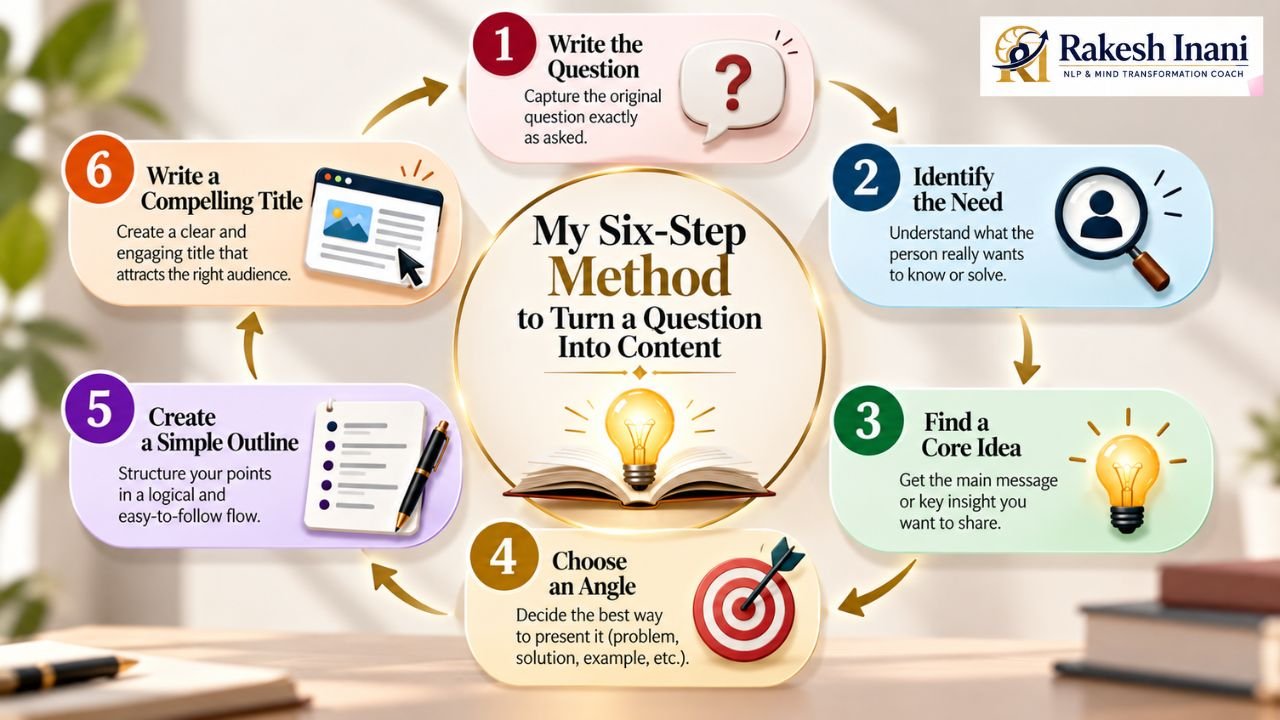
You can use the following method for a blog post, video, email, or lesson. Take one question and move through the steps in order.
Step 1: Write the question as it was asked
Do not improve it yet. Save the words the person used.
For example: “I have many ideas, but why can’t I finish one post?”
Those words tell you something. The person does not need another list of topics. They need help choosing and finishing.
If the question came from your own mind, write it in the way you would ask a friend. Simple wording often reveals the problem more clearly.
Step 2: Find the need behind the question
Ask yourself, “What does this person want to understand, solve, avoid, or do?”
In our example, they may want a way to choose one idea and stop moving between drafts.
Write the need in one sentence: “I want to pick one idea and complete it.”
If you are unsure, write down two possible needs. Then choose one for this piece of content. You can explore the other in a later post.
Step 3: Choose one core idea
A core idea is the main answer you want the reader to remember.
Here is one: “You can finish more easily when you choose one question to answer and save your other ideas for later.”
This sentence gives your content a center. You can return to it whenever your draft starts to wander.
Try to say your core idea aloud. If it takes a full minute to explain, make it simpler. You can add detail after the reader understands the main point.
Step 4: Pick an angle
An angle is the part of the question you will focus on.
You might choose:
- Problem: Why having too many ideas makes it hard to finish.
- Cause: Why a draft grows when its main question is unclear.
- Mistake: Starting three posts before completing one.
- Method: How to choose one question and build an outline.
- Story: What happened when you changed the way you planned content.
- Exercise: A five-minute way to select your next post.
Each angle could become its own piece. Pick the one that will best serve your reader today.
Step 5: Build a small outline
You do not need a long plan before every short post. However, even a simple path helps.
Try this structure:
- Question: Name what the reader is facing.
- Answer: Give your core idea.
- Why: Explain why it matters.
- Example: Show it in a real situation.
- Action: Give one step the reader can take.
For our example, the action might be: “Choose one question from your notes and write a three-part answer before opening another draft.”
This structure also works when you speak without reading a full script. You can put the five words on a small card and talk through them.
Step 6: Write a title that fits the answer
Now look back at your question, need, core idea, and angle. Your title should tell the reader what the piece will help them understand or do.
A title could be: “Too Many Content Ideas? How to Choose One and Finish It.”
Before you publish, check one thing: does the content deliver what that title promises? If not, change the title or strengthen the answer.
How Can One Question Become Many Content Ideas?
When you hear a strong question, do not rush to use it only once. First, see whether it holds several smaller questions.
Take this one: “How do I stop overthinking?”
You could explore different moments in a person’s life:
- “Why Do I Overthink Small Decisions?” — explain a common decision-making pattern.
- “What to Do When You Keep Replaying a Conversation” — focus on thoughts after a social moment.
- “How to Choose a Next Step When You Feel Unsure” — give a practical decision exercise.
- “Three Questions to Ask When Your Thoughts Feel Stuck” — create a short reflection guide.
- “The Mistake of Waiting for Complete Certainty” — discuss a belief that can delay action.
- “What If You Took One Small Step Before You Felt Ready?” — explore an action-based angle.
- “How I Would Explain Overthinking to a Friend” — use a simple, conversational format.
- “Overthinking at Work: How to Prepare for a Difficult Conversation” — focus on a work situation.
- “A Two-Minute Pause Before You Review Your Decision Again” — offer one small practice.
- “What Helps After You Make a Choice?” — address the time after a decision.
These are not ten ways of saying the same thing. Each title answers a different question.
Also, you do not need to create all ten. Save the list. Then choose the idea that best fits what your audience needs now.
A Complete Example: From One Question to a Content Plan
Let us work through a question I often find useful when talking about action:
“Why do I know what to do but still do not take action?”
At first, this looks like a question about motivation. Yet it may hold several different needs. The person might need a smaller first step, a clearer plan, or a way to begin while feeling unsure.
For this example, let us choose one need: “I want to start, but the first move feels too large.”
Find the core idea
Our main answer could be:
Knowing what to do is helpful. Yet if the first step feels too large, you may find it easier to begin by making that step smaller and more specific.
This does not claim to explain every reason a person may feel stuck. Instead, it gives us one useful angle to explore.
Turn the idea into several pieces
From this one question, we could create:
- A “why” article: “Why Knowing What to Do Is Not Always Enough to Get Started”
- A short video: “What If Your First Step Took Only Two Minutes?”
- A mistakes post: “Three Ways We Make a Simple Task Feel Too Big”
- A story: “The Day I Stopped Planning the Whole Project and Started One Part”
- An exercise: “Write Your First Step So Clearly You Can Do It Today”
Each format gives the reader a different way into the same problem.
Outline one finished article
Let us choose: “Why Knowing What to Do Is Not Always Enough to Get Started.”
Hook: “You have a plan. You know the next task. Still, you keep putting it off. What is missing?”
Short answer: “Sometimes the step is clear in your head but still too large to begin in real life.”
Explanation: Show how “create a video” is a much bigger instruction than “write the first three points I want to say.”
Example: Imagine someone who wants to record a ten-minute video. They keep waiting for a free afternoon. Their smaller first step is to write one sentence that explains the video’s main idea.
Action: Ask the reader to write their task, then rewrite it as an action they can take today.
Closing line: “You do not need to finish the whole project in one move. Choose a first move you can actually make.”
Now we have more than a topic. We have a useful article with a clear path from question to action.
Which Question Should You Answer First?
Once you start saving questions, you may have too many to choose from. So, use a short check instead of spending hours ranking them.
Does your audience care about it?
A question is a good choice when it relates to a problem, goal, or situation your readers recognize.
You can use a question even if only one person asked it. Still, consider whether the answer would help more people like that person.
Can you give a useful answer?
You do not need to know everything about a topic. However, you should be able to give a clear answer within the limits of what you know.
If a question needs more research, mark it for later. If it needs a qualified professional’s advice, do not turn a guess into guidance.
Does it fit what you teach?
A question may be interesting but far from the work you want to be known for. That does not make it a bad question. It simply may not be the best one to answer next.
Ask yourself: Does my audience care? Can I answer well? Does it fit my work? If the answer is yes to all three, you have a strong place to start.
Choose the Right Format for the Question
The length of your content should serve the answer. A short question does not always need a short answer, and a broad topic does not always need a long post.
Use a short format for one clear point
If you can answer the question with one idea and one example, consider a short post, email, or video.
For instance, “What should I do before I record a video?” could become a short checklist: choose one core idea, note three points, and decide how you will close.
Use a longer format when readers need several steps
A question such as “How do I build a content system from audience questions?” needs more room. The reader may need help finding questions, storing them, choosing an angle, and publishing.
That is a good fit for a blog post like this one. Each section can answer one smaller question while supporting the main answer.
Show a process when words are not enough
If your reader needs to see how you do something, demonstrate it. Walk through an actual question and show the notes you make.
Likewise, if a personal story helps the reader see a situation more clearly, tell the story. Choose the format that makes the answer easier to use.
Build a Question Bank You Will Actually Use
A question bank is simply a place where you save questions and the ideas they may become. It does not need a special app or a beautiful layout.
Begin with four fields
Make four columns or four lines for each entry:
- Original question
- Need behind it
- Possible content angle
- Next action
Here is a sample entry:
Original question: “How do I speak without reading my script?”
Need: I want to remember my points and sound natural.
Angle: Use a small speaking card with prompts.
Next action: Outline a short video that shows how to make the card.
With this small note, you can return to the idea later without trying to remember your whole thought process.
Make collecting easy
If you hear a question while you are busy, capture only the question. You can add the other fields during your weekly review.
This matters because a system that takes too much effort is easy to leave behind. Keep the first step small enough to do in the middle of a normal day.
Review your bank once a week
Set aside a little time to read what you saved. Then choose one question you can answer well.
Look for related questions too. They may form a series. For example, questions about finding ideas, organizing thoughts, and speaking clearly could become three connected articles.
Finally, move the question you choose into a draft. A question bank is most useful when it helps you create, not when it becomes another list you never open.
Common Mistakes to Avoid
Starting with a topic that is too wide
“Confidence” can mean many things. Before you write, turn it into a question: “How can I share one idea in a meeting when I feel nervous?”
Now you have a reader, a situation, and a clearer answer to build.
Answering five questions at once
You may want to give the reader everything you know. However, a post becomes hard to follow when each paragraph moves to a new problem.
Choose one main question. Then save useful side questions for later pieces. Your reader will get a clearer answer, and you will have more ideas for the future.
Writing a title before you know the answer
A title can sound exciting while the article beneath it remains unclear. So, write your core answer before you settle on the final title.
Then make the title match what your content actually gives the reader.
Giving advice without an example
A sentence such as “Take small steps” may be true, yet it can feel too general to use.
Show the step. “Write one sentence that explains what your video is about” gives the reader a place to begin.
Assuming your answer fits everyone
Your example may help one group of readers and miss another. Use words such as “may,” “can,” and “one possible reason” when you are exploring a pattern rather than stating a fact about every person.
That care can make your writing both clearer and more trustworthy.
A Seven-Day Practice to Create Content From Questions
You can learn this method by using it for one week. Keep each task small. The aim is to build the habit of noticing and answering.
Day 1: Collect
Write down five questions you have heard, asked, or seen recently. Do not judge them yet. Save their original wording.
Day 2: Find the need
For each question, write one sentence about what the person may want to understand or do. If you see more than one possible need, note both.
Day 3: Choose one question
Pick the question that matters to your audience and that you can answer clearly. Set the others aside for later.
Day 4: Write your core idea
Answer your chosen question in one or two plain sentences. Say the answer aloud. Then make it simpler if it feels hard to explain.
Day 5: Choose an angle
Decide whether your reader needs a cause, an example, a story, a method, or an exercise. Build a short outline around that choice.
Day 6: Create
Write the post or record the video. Keep returning to the main question whenever you feel pulled toward another topic.
Day 7: Share and learn
Publish or share your piece. Then notice what people ask next. Their follow-up questions may show you what to explain in your next piece.
At the end of the week, you will have more than one finished item. You will also have a method you can use again.
Frequently Asked Questions
How do I get content ideas from audience questions?
Start by saving the questions people ask in conversations, comments, messages, or teaching sessions. Then choose one question, find the need behind it, and write a clear answer with an example and an action step.
If the question is broad, make it smaller. “How do I become confident?” could become “How do I speak up once in my next meeting?”
What if my audience rarely asks me questions?
Begin with the questions you hear in everyday conversations or ask yourself while learning. You can also look at the points where people seem confused after you explain something.
Then write down what a reader might ask at that moment. As you publish and talk with more people, add their real questions to your list.
Can I use my own questions as content ideas?
Yes. A personal question can be a strong starting point when it points to a problem others may recognize.
First, explore the question well enough to give a useful answer. Then shift the focus from your experience to what the reader can learn or try.
How many content ideas can I create from one question?
There is no fixed number. A broad question may lead to many useful angles, while a narrow one may need only a single clear answer.
For example, “How do I organize my thoughts?” could lead to content about speaking, writing, teaching, and recording videos. Create a new piece when it answers a meaningfully different question.
How do I turn a broad question into a specific blog post?
Choose one reader and one situation. Then ask what part of the broad question matters most in that moment.
Instead of writing “How to Stop Overthinking,” you might write “How to Stop Replaying a Work Conversation.” The second topic gives you a clearer example and a more focused answer.
How do I write an interesting title without using clickbait?
Name a real problem or question, and promise an answer your content gives. Specific titles often create enough interest on their own.
For example, “Why You Keep Changing Your Mind After a Decision” invites curiosity. The article should then explain possible reasons and offer a helpful next step.
Your Next Content Idea May Already Be in Front of You
The next time you face a blank page, pause before searching for a brand-new topic.
Think about what someone asked you this week. Think about the question you could not stop considering. Think about the point you had to explain twice because the first answer was not clear enough.
Choose one of those questions. Find the need behind it. Give one honest, useful answer.
Then turn that answer into a post, video, email, or lesson.
Here is your action for today: Write down one real question. Spend five minutes turning it into a core idea and a simple outline. Then create and share your answer within the next 24 hours.
If you want to begin right here, share your question in the comments. Also tell me what you think the person was really asking. That one small step could become your next powerful content idea.

Transform Your Mind: JOIN MIND TRANSFORMATION COMMUNITY
Learn More:
Real Leaders Know This ONE Secret to Influencing Without Speaking
7 Day Manifestation- NLP Guided Meditation for Success
The Complete Success Formula: 6 Steps to Turn Goals into Consistent Action