
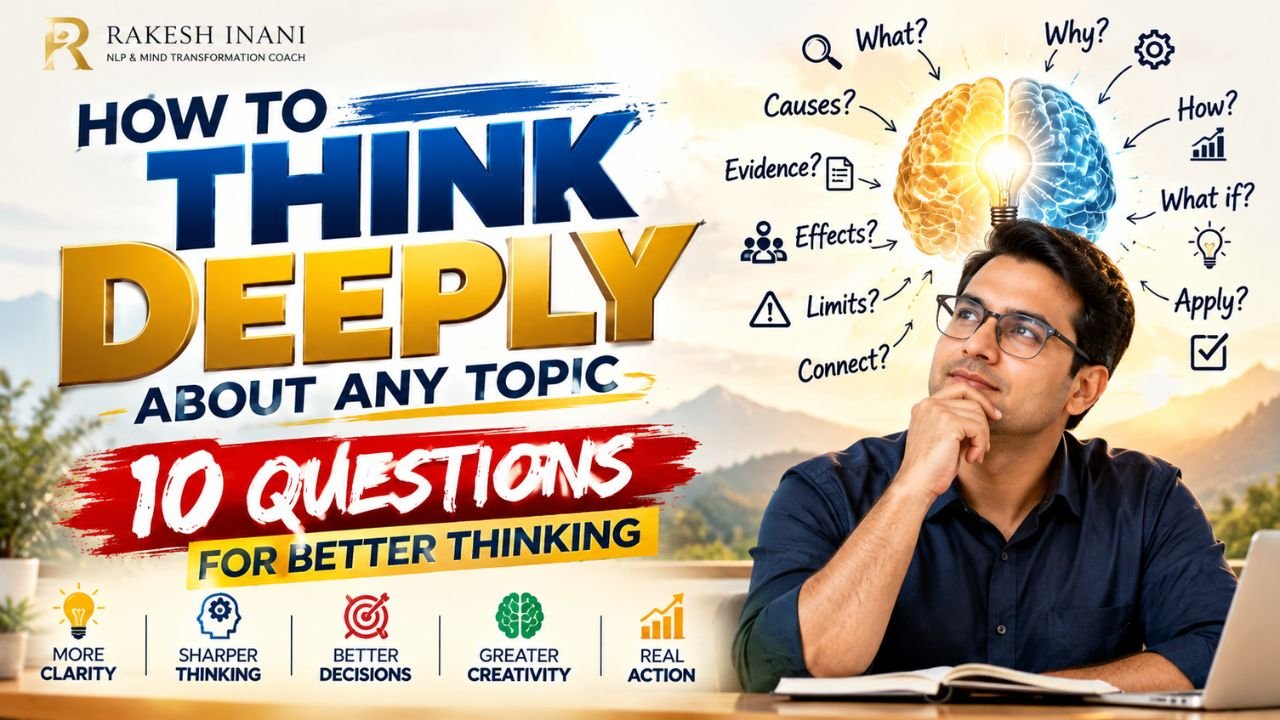
How to Think Deeply About Any Topic: 10 Questions That Improve Your Thinking
Have you ever chosen a topic to write or speak about, but after two or three points, your mind became blank?
Perhaps you wanted to talk about confidence, discipline, success, fear, leadership, communication, or personal growth. You understood the topic. However, you could not find enough meaningful things to say.
You may have thought, “Why can some people speak about one idea for thirty minutes while I run out of points in three minutes?”
The answer is not always knowledge.
Often, the difference is the way a person explores the topic.
A deep thinker does not simply ask, “What do I know about this?” Instead, they look at the idea from many sides. They explore its meaning, causes, effects, hidden assumptions, limits, connections, and practical use.
In other words, deep thinking begins with better questions.
So, if you are searching for how to think deeply about any topic, you do not need to wait for a special idea to enter your mind. You need a simple process that guides your attention.
In this article, I will give you ten practical deep-thinking questions. You can use them for writing, learning, speaking, coaching, content creation, decision-making, and problem-solving.
Most importantly, these questions will help you go deeper without getting trapped in overthinking.
Quick Answer: How Do You Think Deeply About Any Topic?
To think deeply about any topic, explore ten areas:
- What does this really mean?
- Why does this matter?
- What causes this?
- What assumptions am I making?
- What evidence supports or challenges this?
- What happens because of this?
- What if something changed?
- Where does this idea fail?
- What is this connected to?
- How can I apply this?
Each question opens a different layer of the topic.
Together, they help you move from a common idea to a clear, balanced, and useful understanding.
What Does It Mean to Think Deeply?
Deep thinking means looking beyond the first answer.
Usually, the first answer that comes to mind is the most familiar answer. It may be correct, but it is rarely complete.
For example, suppose you ask, “Why do people procrastinate?”
Your first answer may be, “Because they are lazy.”
However, when you think more deeply, you may discover many other possibilities. A person may procrastinate because the task is unclear. They may fear failure. They may want to do the work perfectly. They may feel tired, distracted, or emotionally uncomfortable.
Therefore, deep thinking means staying with an idea long enough to discover what is not visible at first.
It is like looking at a tree.
Surface thinking notices the branches, leaves, flowers, and fruits. Deep thinking also asks about the roots, soil, water, sunlight, seasons, and growth process.
Both views are useful. However, the deeper view gives you a more complete understanding.
Deep Thinking Is Not About Difficult Words
Some people believe deep thinking must sound complex.
However, complicated language does not always mean clear thinking. In fact, when a person truly understands an idea, they can often explain it in simple words.
For example, you do not need to use heavy language to explain confidence.
You can simply say:
Confidence is not the belief that everything will go perfectly. It is the trust that you can respond even when things do not go perfectly.
The words are simple. Yet, the idea is meaningful.
Therefore, do not try to sound intelligent when you think. Instead, try to become clear.
Simple language can carry a deep message.
Deep Thinking Looks for Layers
Almost every meaningful topic has several layers.
For example, you can explore:
- What the topic means
- Why it matters
- What creates it
- How it works
- What it affects
- What people assume about it
- When it is useful
- When it becomes harmful
- How it connects with other ideas
- How it can be applied in real life
When you learn to see these layers, one small topic can produce many valuable ideas.
A Simple Example of Surface and Deep Thinking
Let us take the topic of self-confidence.
A surface-level statement may be:
“Self-confidence is important for success.”
That statement may be true. However, it does not tell us much.
Now, let us go deeper:
- What is self-confidence?
- Does confidence come before action or after action?
- Why can a skilled person still feel unsure?
- Can someone appear confident but feel insecure inside?
- What experiences increase confidence?
- What habits slowly weaken it?
- Can too much confidence become dangerous?
- What is the difference between confidence and arrogance?
- How can someone rebuild confidence after failure?
- What small action can create evidence of progress?
Now, the topic has become richer.
Therefore, deep thinking is not always about finding a new subject. Often, it is about finding new layers inside a familiar subject.
Why Do Most People Struggle to Think Deeply?
If deep thinking is so useful, why do many people find it difficult?
There are several reasons.
Once you understand them, you can stop judging your mind and begin training it.
We Accept the First Answer Too Quickly
The brain likes quick answers because they save energy.
As a result, we often accept the first explanation that feels reasonable.
For example:
- Poor performance means a lack of talent.
- Procrastination means laziness.
- Silence means weakness.
- Failure means inability.
- Confidence means the absence of fear.
However, the first answer may only show one part of the truth.
Deep thinking begins when you ask, “What else could be happening?”
That one question can open many new possibilities.
We Consume More Than We Reflect
Today, we can move from one video to another within seconds.
We read a quote, watch a reel, listen to a podcast, open an article, and then move to the next piece of information.
As a result, information enters the mind, but it does not get enough time to develop into understanding.
Consumption gives you material.
Reflection helps you process that material.
Therefore, if you want to develop deep thinking, create a pause after learning something. Ask what the idea means, whether you agree with it, and how it connects with your life.
We Try to Find the Correct Answer Immediately
Many people become mentally blocked because they put pressure on themselves.
They think, “I need to find the perfect answer.”
However, deep thinking is often an exploration before it becomes a conclusion.
At first, your answers may be incomplete. Some ideas may even be wrong. That is acceptable because you are still examining the subject.
When your mind is forced to be correct immediately, it becomes cautious. When it is allowed to explore, it becomes creative.
Therefore, begin with possible answers, not perfect answers.
We Do Not Know What Questions to Ask
Sometimes, your mind is not empty. It simply does not know where to go.
Imagine entering a large building with many closed doors. If you do not know which door to open, you may remain in the entrance.
A good question acts like a key.
“What causes this?” opens one door.
“What if the opposite were true?” opens another.
“Where does this idea fail?” opens a third.
Therefore, when your mind becomes blank, do not keep demanding more answers. Change the question.
We Confuse Remembering With Thinking
Remembering and thinking are not the same.
Memory brings back something you already learned.
Thinking examines it, tests it, connects it, and takes it forward.
For example, you may remember the statement, “Failure is feedback.”
However, thinking begins when you ask:
- Is every failure useful?
- What turns failure into feedback?
- What if a person keeps failing in the same way?
- When should someone persist?
- When should someone change direction?
Memory brings an idea back. Thinking takes the idea forward.
Deep Thinking vs. Overthinking: What Is the Difference?
Many people avoid deep reflection because they are afraid of overthinking.
However, deep thinking and overthinking are not the same.
The difference is not only how long you think. The real difference is the direction of your thinking.
Deep Thinking Moves Toward Understanding
Deep thinking has a purpose.
You may be trying to understand a problem, make a decision, develop an idea, prepare a lesson, or choose an action.
As you think, you discover something new.
You may find a hidden cause. You may see another point of view. You may correct an assumption. You may identify a practical next step.
Therefore, deep thinking creates movement.
Overthinking Moves in a Circle
Overthinking often repeats the same fear in different forms.
For example:
- What if I fail?
- What if people judge me?
- What if I make the wrong decision?
- What if I regret it?
- What if something goes wrong?
The questions may look different. However, they often return to the same emotional loop.
No new evidence is examined. No clear decision is made. No useful action is chosen.
Therefore, overthinking consumes mental energy without creating enough clarity.
Deep Thinking and Overthinking Compared
| Deep Thinking | Overthinking |
|---|---|
| Explores different angles | Repeats the same fear |
| Looks for facts and evidence | Builds imagined problems |
| Creates greater clarity | Creates greater confusion |
| Leads toward a decision | Delays the decision |
| Has a clear purpose | Often has no stopping point |
| Produces an insight or action | Produces more worry |
| Accepts some uncertainty | Demands complete certainty |
Ask This Quick Question
When you are not sure whether you are thinking deeply or overthinking, ask:
“Am I discovering something new, or am I repeating the same thought?”
If you are discovering new meaning, evidence, choices, or actions, you are probably thinking deeply.
However, if you are repeating the same fear without moving forward, you may be overthinking.
At that point, stop collecting more thoughts. Write down what you know, choose one next step, and return to action.
The 10 Questions That Help You Think Deeply About Any Topic
The following ten questions create a practical deep-thinking framework.
You do not need to answer them perfectly. Also, you do not need to use all ten every time.
Instead, treat each question as a door.
Open the doors that help you understand the topic more clearly.
1. What Does This Really Mean?
Meaning must come before analysis.
If you do not clearly understand what a word or idea means, everything built on top of it may become confusing.
Consider words such as success, confidence, discipline, freedom, happiness, leadership, and purpose.
These words appear simple. However, different people may give them very different meanings.
For one person, success may mean earning more money.
For another, it may mean having freedom over their time.
For someone else, it may mean contribution, peace, respect, learning, or healthy relationships.
Therefore, before discussing a topic, ask:
“What does this really mean?”
Questions That Reveal Meaning
You can go further by asking:
- How would I explain this in simple words?
- How would I explain it to a child?
- What does this idea include?
- What does it not include?
- How might another person define it?
- What is often confused with it?
- What would be a clear example?
- What would not be an example?
These questions make your definition more exact.
Example: What Does Confidence Really Mean?
Confidence does not have to mean feeling powerful all the time.
It does not mean you never feel nervous.
It also does not mean you believe you are better than other people.
A more useful definition may be:
Confidence is the willingness to act while trusting that you can learn, adjust, and respond.
This definition changes the way we approach confidence.
If confidence requires the complete absence of fear, many people will wait forever.
However, if confidence includes acting with some uncertainty, it becomes something we can practise.
Try This Meaning Exercise
Choose one word and complete these sentences:
- “In simple words, ______ means…”
- “It includes…”
- “It does not necessarily mean…”
- “People often confuse it with…”
- “A real-life example would be…”
This exercise is simple. Still, it can reveal how unclear our everyday words sometimes are.
2. Why Does This Matter?
After defining the topic, explore its importance.
Ask:
“Why does this matter?”
This question connects an idea with real life.
Without this question, you may collect information that sounds interesting but has no clear purpose.
Explore Different Levels of Importance
A topic may matter at several levels.
Ask:
- Why does this matter to one person?
- Why does it matter in a family?
- Why does it matter at work?
- Why does it matter in society?
- Who is affected by it?
- What happens when people ignore it?
- What becomes possible when people understand it?
For example, clear communication matters to an individual because it helps them express needs and ideas.
It matters in relationships because it reduces misunderstanding.
It matters at work because it improves teamwork, leadership, and problem-solving.
It matters in society because many conflicts grow when people speak without listening or assume without checking.
Therefore, one question can expand the topic from the personal level to the social level.
Why Is Deep Thinking Important in Daily Life?
Deep thinking is important because daily choices often have hidden causes and long-term effects.
If you react only to what is visible, you may solve the wrong problem.
For example, suppose a team member misses a deadline.
A quick reaction may be, “This person is careless.”
However, deeper thinking may reveal unclear instructions, an unrealistic workload, missing resources, fear of asking for help, or poor planning.
The deeper view does not remove responsibility. Instead, it helps you respond to the real problem.
As a result, deep thinking can improve decisions, communication, learning, and relationships.
Ask “Why Does It Matter Now?”
Timing also creates meaning.
A topic may have always been important, but it may be especially important now.
For example:
- Why does focus matter in a distracted world?
- Why does emotional regulation matter during uncertainty?
- Why does clear communication matter in remote teams?
- Why does critical thinking matter when information spreads quickly?
This question makes an idea more relevant to the reader’s present life.
3. What Causes This?
Many things we notice are results, not causes.
A behaviour may be visible. However, the pattern behind it may be hidden.
Therefore, ask:
“What causes this?”
This question takes you beneath the surface.
Look for More Than One Cause
Important human behaviours rarely have only one cause.
For example, procrastination may be influenced by:
- Fear of failure
- Fear of judgment
- Perfectionism
- Low energy
- Lack of clarity
- Too many choices
- Emotional discomfort
- A task that feels too large
- No clear deadline
- Constant digital distraction
If you choose only one explanation, you may give the wrong solution.
For example, telling a tired person to become more disciplined may not solve the real issue.
Similarly, giving time-management advice to someone who fears judgment may not address their emotional barrier.
Therefore, keep asking:
“What else could be causing this?”
Explore Different Kinds of Causes
You can examine:
- Internal causes
- External causes
- Emotional causes
- Mental causes
- Social causes
- Environmental causes
- Immediate triggers
- Long-term patterns
Suppose someone lacks confidence while speaking.
An internal cause may be harsh self-talk.
An emotional cause may be fear of embarrassment.
A social cause may be past criticism.
An environmental cause may be an unfriendly audience.
A skill-based cause may be lack of preparation.
Now, the problem looks more complete.
Primary and Secondary Causes
It is also useful to separate primary causes from secondary causes.
A primary cause strongly contributes to the problem.
A secondary cause may increase or maintain it.
For example, fear of failure may be a primary cause of procrastination. Phone distractions may then become a secondary cause that helps the person avoid the task.
Both matter. However, they do not play the same role.
Try a Cause-Mapping Exercise
Write your topic in the centre of a page.
Around it, write at least five possible causes.
Next, ask:
- Which cause is strongest?
- Which causes are connected?
- Which cause can I influence?
- Which cause am I only assuming?
- What information would help me confirm it?
This process can turn a vague problem into a clear map.
4. What Assumptions Am I Making?
An assumption is something we treat as true without checking it fully.
Assumptions are not always wrong. In fact, we need some assumptions to function in daily life.
However, hidden assumptions can limit our thinking.
Therefore, ask:
“What am I assuming?”
Hidden Beliefs Shape Visible Conclusions
Suppose someone says:
“I cannot start until I feel confident.”
Behind that statement may be an assumption:
“Confidence must come before action.”
But is that always true?
In many situations, action creates experience. Experience creates evidence. Evidence then builds confidence.
Therefore, the relationship may work in the opposite direction:
Action → Experience → Evidence → Confidence
By questioning one assumption, we discover a more useful idea.
Questions That Expose Assumptions
Ask:
- What am I taking for granted?
- How do I know this is true?
- Where did I learn this belief?
- Did it come from experience, culture, family, or fear?
- Would everyone agree with it?
- What if the opposite were partly true?
- What information might I be missing?
- Am I treating a possibility as a fact?
- Am I using one past experience to predict every future experience?
These questions help you see the mental foundation beneath your conclusion.
Use the “Always True?” Test
Take any strong statement and ask:
“Is this always true?”
For example:
- Successful people never doubt themselves.
- Good leaders always have the answer.
- Failure means I am not capable.
- More options always create more freedom.
- Working longer always creates better results.
Most absolute statements become weaker when tested against real life.
Perhaps successful people feel doubt but continue acting.
Perhaps good leaders sometimes admit they do not know.
Perhaps failure reveals a missing skill rather than a fixed inability.
Therefore, challenging assumptions does not make you negative. It makes your thinking more accurate.
5. What Evidence Supports or Challenges This?
An idea may feel true without being completely true.
Personal experiences, emotions, stories, and repeated messages can create strong beliefs.
Therefore, ask:
“What evidence supports this, and what evidence challenges it?”
This question moves you from opinion toward examination.
What Can Count as Evidence?
Depending on the topic, evidence may include:
- Direct observation
- Personal experience
- Repeated patterns
- Reliable data
- Research
- Expert knowledge
- Real-life examples
- Measurable results
- Feedback from other people
However, not all evidence has equal strength.
One personal story can be meaningful, but it may not prove that the same result applies to everyone.
Similarly, a popular opinion is not automatically a fact.
Examine Both Sides
Do not ask only, “What proves that I am right?”
Also ask:
- What information goes against my view?
- Is there another explanation?
- Is my source trustworthy?
- Is this one example or a repeated pattern?
- Am I ignoring facts that make me uncomfortable?
- What evidence would change my mind?
This protects you from confirmation bias.
Confirmation bias means we naturally notice information that supports our beliefs and overlook information that challenges them.
Example: Does Working Longer Mean Achieving More?
At first, the idea sounds reasonable.
More hours can create more output, especially when a task needs time.
However, other evidence may show that poor focus, low energy, stress, and repeated mistakes reduce the value of those extra hours.
Therefore, a more accurate idea may be:
Working longer can help, but focused effort, useful skills, clear priorities, and proper recovery also shape the result.
The improved statement is not as dramatic. However, it is more balanced and useful.
Separate Facts, Interpretations, and Predictions
When thinking about a situation, divide your thoughts into three parts.
Fact: What can I directly observe or verify?
Interpretation: What meaning am I giving to it?
Prediction: What do I think will happen next?
For example:
- Fact: My manager did not reply to my message today.
- Interpretation: My manager is unhappy with me.
- Prediction: I may lose an opportunity.
The first statement may be verified. The next two are possible meanings, not confirmed facts.
This simple separation can greatly improve clear thinking.
6. What Happens Because of This?
After exploring causes, move in the other direction.
Ask:
“What happens because of this?”
This question helps you study effects and consequences.
Examine Short-Term and Long-Term Effects
Some choices feel good now but create problems later.
Other choices feel difficult now but create value later.
Therefore, ask:
- What happens immediately?
- What happens after one week?
- What happens after one year?
- Who benefits?
- Who may be harmed?
- What habit could this create?
- What unexpected effect could appear?
- What happens if this continues?
For example, avoiding a difficult conversation may provide short-term comfort.
However, over time, it may create confusion, resentment, emotional distance, or repeated conflict.
The short-term effect and long-term effect are very different.
First-Order and Second-Order Thinking
First-order thinking asks:
“What will happen next?”
Second-order thinking asks:
“And what may happen after that?”
Suppose you say yes to every request at work because you want to avoid disappointing people.
The first result may be approval.
However, the next results may include extra work, stress, weak boundaries, frustration, and reduced performance.
Therefore, second-order thinking helps you see beyond the immediate reward.
Use the “Then What?” Exercise
Choose one behaviour or decision.
Ask “Then what?” several times.
For example:
“I keep delaying this task.”
Then what?
“The deadline comes closer.”
Then what?
“I feel more pressure.”
Then what?
“I rush the work.”
Then what?
“The quality may fall.”
Then what?
“I may use the poor result as proof that I am not capable.”
Now, procrastination is no longer just a delay. It becomes a chain that can affect identity and confidence.
This is why consequence-based thinking is so powerful.
7. What If Something Changed?
“What if?” is one of the most creative questions available to us.
It allows the mind to leave the current structure and imagine another possibility.
Therefore, ask:
“What if something changed?”
Use “What If?” for Exploration, Not Fear
Overthinking often uses “What if?” negatively.
- What if I fail?
- What if I am judged?
- What if I make a mistake?
However, balanced thinking includes other possibilities:
- What if I succeed?
- What if I learn?
- What if the mistake is repairable?
- What if the risk is smaller than I imagine?
- What if doing nothing is the bigger risk?
- What if I need progress rather than certainty?
The goal is not blind positivity. The goal is to explore more than one possible future.
Ask Different Types of “What If?” Questions
Try these:
- What if the opposite were true?
- What if the main cause disappeared?
- What if I had fewer resources?
- What if I had unlimited resources?
- What if I had to solve this in one day?
- What if I had to simplify this for a child?
- What if I could take only one action?
- What if everyone followed this advice?
- What if no one followed it?
- What if my current belief is incomplete?
Each version stretches your thinking in a different direction.
Example: What If Failure Were Treated as Feedback?
Imagine that failure did not automatically mean personal rejection.
Instead, it provided information.
You might ask:
- What did I try?
- What happened?
- What did I expect?
- Where did the process break?
- What should I adjust?
- What will I test next?
This view does not make failure pleasant. However, it can make failure useful.
Reverse the Idea
Another helpful exercise is to turn the statement around.
Original idea:
“Confidence creates action.”
Reversed idea:
“Action creates confidence.”
Now examine both.
You may discover that confidence can support action, but small actions can also build confidence.
Therefore, reversing an idea can reveal a two-way relationship that was previously hidden.
8. Where Does This Idea Fail?
Every useful idea has limits.
A principle may work well in one situation and poorly in another.
Therefore, ask:
“Where does this idea fail?”
This question protects you from extreme thinking.
Why Limits Make an Idea Stronger
Finding an exception does not always destroy the idea.
Often, it helps you understand the conditions under which the idea works.
For example, “Never give up” can be motivating.
It may help someone continue through discomfort, slow progress, or temporary failure.
However, it may become harmful when a goal is damaging, the evidence has changed, or the cost has become greater than the value.
A deeper version could be:
Do not quit only because progress feels slow. However, review your direction when the goal, evidence, or cost changes.
This version is more balanced.
Questions That Test the Limits
Ask:
- When does this not work?
- For whom may it not work?
- What conditions are required?
- Can too much of it become harmful?
- What are the risks?
- What exceptions can I find?
- How could someone misunderstand this advice?
- What must be added to make it safer or more accurate?
Example: Is Positive Thinking Always Helpful?
Positive thinking can support hope, motivation, and resilience.
However, it can fail when it is used to deny a real problem.
If someone ignores evidence, avoids grief, or refuses necessary action, positivity may become avoidance.
Therefore, a deeper principle may be:
Think with hope, but look at reality honestly.
This keeps the value of positive thinking without ignoring its limits.
Avoid Absolute Language
Watch for words such as:
- Always
- Never
- Everyone
- No one
- Completely
- Guaranteed
- Only
These words may sometimes be accurate. However, they often signal that an idea needs testing.
Balanced language does not weaken your message. It increases trust.
9. What Is This Connected To?
No meaningful idea exists completely alone.
Confidence connects with action, skill, identity, body language, past experience, and social feedback.
Procrastination connects with fear, clarity, energy, reward, attention, and perfectionism.
Therefore, ask:
“What is this connected to?”
Connections help you build deeper and more original insights.
Look for Different Types of Connections
A topic may connect with:
- A cause
- A consequence
- A similar idea
- An opposite idea
- A personal experience
- A story
- A metaphor
- Another field
- A larger system
- A daily habit
The more meaningful connections you find, the more ways you can understand and explain the topic.
Example: Overthinking and the Need for Certainty
Overthinking is often discussed as “thinking too much.”
However, it may also be connected with the need for certainty.
A person may keep thinking because they want a decision with no risk, no mistake, and no regret.
Yet, many real-life decisions cannot provide complete certainty.
Therefore, the deeper issue may not be the number of thoughts. It may be the person’s relationship with uncertainty.
This connection creates a new insight:
Sometimes, you do not stop overthinking by finding the perfect answer. You stop by learning to act with reasonable clarity and incomplete certainty.
Use Analogies to Build Connections
An analogy connects an unfamiliar idea with something familiar.
For example:
Overthinking can be like pressing the accelerator while the handbrake is still on.
The mind uses a lot of energy, but the person does not move forward.
Similarly, confidence can be compared with physical strength.
You do not build strength by waiting to feel strong. You build it through repeated, manageable effort.
Analogies make abstract ideas easier to understand and remember.
Try a Connection Web
Write your topic in the middle of a page.
Then connect it with:
- Three related ideas
- One opposite idea
- One personal story
- One metaphor
- One practical situation
- One larger social issue
This simple exercise can produce ideas for articles, videos, coaching sessions, and presentations.
10. How Can I Apply This?
Thinking becomes most valuable when it changes something.
It may change your understanding, decision, behaviour, question, or next action.
Therefore, finish by asking:
“How can I apply this?”
Move From Insight to Action
Ask:
- How can I use this today?
- What is the smallest useful action?
- How can I test this idea?
- What habit could I build from it?
- How can I explain it to someone else?
- What should I start doing?
- What should I stop doing?
- What should I continue doing?
- What will I do differently because of this?
These questions prevent deep thinking from becoming endless theory.
Example: Applying the Idea That Action Builds Confidence
If action can build confidence, you do not need to wait for complete readiness.
You could:
- Speak once during a meeting
- Record a two-minute practice video
- Ask one clear question
- Start one small conversation
- Share one idea with a trusted person
- Practise one difficult skill for ten minutes
- Complete one task before judging your performance
Each action creates experience.
Experience gives your mind new evidence.
Over time, that evidence can support greater self-trust.
Turn Every Insight Into an Experiment
You do not need to accept every idea immediately.
Instead, test it.
Use this sentence:
“For the next seven days, I will test this idea by…”
For example:
“For the next seven days, I will test whether planning my first task at night improves my morning focus.”
Now, the idea has become measurable and practical.
The Complete 10-Question Deep-Thinking Framework
Here is the full framework in one place:
| No. | Deep-Thinking Question | What It Helps You Discover |
|---|---|---|
| 1 | What does this really mean? | Meaning and definition |
| 2 | Why does this matter? | Purpose and importance |
| 3 | What causes this? | Roots and triggers |
| 4 | What assumptions am I making? | Hidden beliefs |
| 5 | What evidence supports or challenges this? | Accuracy and truth |
| 6 | What happens because of this? | Effects and consequences |
| 7 | What if something changed? | Possibilities and alternatives |
| 8 | Where does this idea fail? | Limits, risks, and exceptions |
| 9 | What is this connected to? | Relationships and insights |
| 10 | How can I apply this? | Action and real-life value |
You can remember the process in this way:
Define it. Value it. Trace it. Question it. Test it. Follow it. Change it. Challenge it. Connect it. Apply it.
A Complete Example: Thinking Deeply About Self-Confidence
Let us use all ten questions on one topic.
Our topic is self-confidence.
1. What Does Self-Confidence Mean?
Self-confidence means trusting your ability to act, respond, learn, and improve.
It does not mean you know everything.
It also does not mean you never feel afraid.
A person can feel nervous and still behave confidently.
Therefore, confidence may be less about emotional perfection and more about willingness.
2. Why Does Self-Confidence Matter?
Confidence affects whether a person uses their abilities.
A skilled person may remain silent if they do not trust themselves.
Similarly, a knowledgeable person may avoid opportunities because they fear judgment.
Therefore, confidence can influence communication, relationships, leadership, learning, and career growth.
3. What Causes Self-Confidence?
Confidence may grow through:
- Preparation
- Repeated practice
- Small wins
- Supportive feedback
- Skill development
- Keeping promises to oneself
- Learning from mistakes
- Facing manageable challenges
Therefore, confidence is not always a fixed personality trait. Parts of it can be developed.
4. What Assumptions Do We Make About Confidence?
People often assume:
- Confident people never feel fear.
- Confidence is something you are born with.
- You must feel confident before acting.
- Confident people never make mistakes.
- Quiet people are not confident.
These ideas are not always true.
A quiet person may have strong inner confidence. Meanwhile, a loud person may be hiding insecurity.
5. What Evidence Supports or Challenges These Beliefs?
In everyday life, people often become more comfortable after practice.
A new speaker may feel nervous during their first presentation. However, after several attempts, they may speak more naturally.
This suggests that confidence can grow from experience.
At the same time, experience alone does not guarantee confidence. A person may need reflection, useful feedback, and better self-talk to recognise their progress.
6. What Happens When Confidence Is Low or High?
Low confidence may lead to avoidance, hesitation, weak boundaries, or missed opportunities.
Healthy confidence may support action, learning, clear communication, and resilience.
However, excessive confidence without skill or feedback may lead to careless decisions.
Therefore, the goal is not maximum confidence. The goal is grounded confidence.
7. What If We Acted Before Feeling Fully Confident?
If we took small actions first, we could create new evidence.
That evidence could challenge the old belief that we are incapable.
Therefore, action may not always follow confidence. Sometimes, confidence follows action.
8. Where Can Confidence Fail?
Confidence can fail when it is not supported by competence.
It can also become harmful when it rejects feedback or turns into arrogance.
Therefore, healthy confidence needs humility, learning, and reality checks.
9. What Is Confidence Connected To?
Confidence connects with:
- Competence
- Preparation
- Identity
- Emotional state
- Body language
- Past experiences
- Self-talk
- Social support
- Repeated action
This shows that confidence is not created by one thing alone.
10. How Can We Apply This Understanding?
Choose one situation where you normally hesitate.
Next, choose one small action you can take within twenty-four hours.
Do not wait to feel completely ready.
Instead, prepare enough, act carefully, review the result, and learn from it.
The Core Insight
After exploring all ten questions, we reach a deeper conclusion:
Confidence is not always the starting point of action. Often, it is the result of taking action, learning from experience, and building evidence that you can handle what comes next.
This is how a common topic develops into a meaningful core idea.
How to Use These Questions Without Feeling Overwhelmed
Ten questions may appear like a lot.
However, you do not need to answer every question every time.
The right questions depend on your purpose.
Use Three Questions for Quick Thinking
If you have only five minutes, ask:
- What does this mean?
- Why does it matter?
- How can I apply it?
These questions will give you a basic but useful understanding.
Use Five Questions for Content Creation
If you are preparing a short article, video, or speech, ask:
- What does this mean?
- Why does it matter?
- What causes it?
- What is it connected to?
- How can it be applied?
These five questions can create a natural teaching flow.
Use All Ten for Complex Topics
Use all ten when you are:
- Writing a long-form article
- Preparing a detailed workshop
- Making an important decision
- Studying a complex problem
- Building a coaching framework
- Creating a course lesson
- Challenging a strong belief
The complete process helps you avoid one-sided thinking.
Begin With the Most Useful Question
If the topic is unclear, begin with meaning.
If it is a problem, begin with causes.
If it is a belief, begin with assumptions and evidence.
If it is a decision, begin with consequences and alternatives.
If it is advice, ask where it fails.
If it is a lesson, move toward application.
Set a Time Limit
A clear time limit protects deep thinking from turning into overthinking.
You might use:
- Five minutes for a quick idea
- Fifteen minutes for a short piece of content
- Thirty minutes for a difficult problem
- Several focused sessions for a major decision
When the time ends, write your current conclusion and choose the next action.
You can always return later if more thought is truly needed.
How to Use Deep-Thinking Questions for Different Purposes
These questions are not limited to personal reflection.
You can use them in almost every area where ideas matter.
For Writing a Blog Post
Each question can become a section.
Suppose your topic is “How to Build Discipline.”
You could write about:
- What discipline really means
- Why discipline matters
- What creates or weakens it
- Common assumptions about willpower
- Evidence from personal experience
- Short-term and long-term consequences
- What changes when motivation disappears
- Where strict discipline becomes unhealthy
- How discipline connects with identity and environment
- How to practise it daily
Suddenly, one topic becomes a complete article.
For Creating YouTube Videos
You can use the questions to build a natural video structure.
Begin with a relatable problem.
Then define the topic.
Next, explain why it matters and what causes it.
After that, challenge a common assumption.
Use an example or analogy.
Finally, give the audience one practical experiment.
This creates a video that feels clear, deep, and useful.
For Public Speaking
When preparing a speech, use the questions to develop:
- A strong opening
- A clear definition
- A meaningful reason
- A personal story
- A contrasting point
- A surprising exception
- A memorable analogy
- A practical takeaway
Therefore, you do not need to memorise a long script. You can remember the thinking structure behind your message.
For Coaching Conversations
In coaching, thoughtful questions can help a person explore their own pattern.
For example:
- What does success mean to you?
- Why is this goal important now?
- What seems to stop you?
- What are you assuming about yourself?
- What evidence supports that belief?
- What happens if this pattern continues?
- What might become possible if one thing changed?
- Where has your current strategy failed?
- What past experience is connected to this?
- What small action are you willing to take?
These questions can create awareness and movement.
However, coaching is not a replacement for qualified mental-health care. When a person is dealing with serious distress, trauma, or a clinical condition, appropriate professional support may be needed.
For Studying and Learning
Do not only memorise the information.
Ask:
- Why does this happen?
- How does it work?
- What is it connected to?
- What would change the result?
- Where does the rule not apply?
- How would I explain this to another person?
If you can teach an idea simply, you are more likely to understand it deeply.
For Solving Problems
Use the ten questions to create a problem-solving sequence:
- Define the real problem.
- Explain why it matters.
- Find possible causes.
- Check assumptions.
- Collect evidence.
- Study consequences.
- Generate alternatives.
- Test risks and limits.
- Look for connected problems.
- Choose one experiment.
This process reduces the chance of solving only the visible symptom.
For Making Decisions
When comparing choices, ask:
- What does a good result mean to me?
- Why is this decision important?
- What is creating pressure?
- What am I assuming about each option?
- What evidence do I have?
- What may happen in the short and long term?
- What other option have I not considered?
- Where could each option fail?
- What values or goals connect with this decision?
- What is the smallest safe next step?
You may not achieve complete certainty. However, you can reach reasonable clarity.
Common Mistakes That Block Deep Thinking
Knowing the right questions is useful.
Still, a few habits can weaken the process.
Searching for Answers Too Early
Online research can help you learn. However, if you search before thinking, you may borrow someone else’s conclusion before discovering your own questions.
Try this order:
- Think independently.
- Write what you currently understand.
- Identify what you do not know.
- Research reliable sources.
- Compare the new information with your original view.
This approach combines original reflection with informed learning.
Asking Only “Why?”
“Why?” is powerful, but it is not the only deep-thinking question.
If you repeatedly ask why, you may create a long chain of causes while missing evidence, consequences, limits, and application.
Therefore, use a variety of questions.
Depth comes from examining different dimensions, not repeating one word.
Trying to Sound Intelligent
When people try too hard to sound intelligent, their message may become unclear.
They may use long sentences, heavy terms, and abstract language.
However, real depth does not need decoration.
Say exactly what you mean.
Then support it with an example, contrast, reason, or application.
Clarity is not a sign of simple thinking. Often, it is the result of careful thinking.
Treating Every Thought as a Fact
A thought is not automatically true because it feels strong.
For example:
“I made a mistake, so people will no longer trust me.”
The mistake may be a fact.
The prediction about trust may be an interpretation.
Therefore, label your thoughts correctly:
- Fact
- Opinion
- Assumption
- Fear
- Possibility
- Prediction
- Conclusion
This creates mental distance and greater accuracy.
Looking at Only One Side
If you only search for supporting points, your conclusion may become weak.
Ask what a thoughtful person who disagrees with you might say.
You do not need to accept their view. However, understanding it can reveal gaps in your own thinking.
A strong idea is not one that avoids questions. It is one that becomes clearer after questions.
Thinking Without Acting
Reflection can become a comfortable form of delay.
You may keep reading, planning, comparing, and preparing because action feels uncertain.
Therefore, close every thinking session with one of four outcomes:
- A clear conclusion
- A better question
- A small experiment
- A next action
Thinking should eventually create movement.
Expecting a Perfect Answer
Some topics do not have one final answer.
People, relationships, behaviour, and life decisions often involve uncertainty.
Deep thinking does not always remove uncertainty. Sometimes, it helps you understand what is known, what is unknown, and what can be tested.
That is still valuable progress.
A Simple 20-Minute Deep-Thinking Exercise
You can use the following exercise whenever you want to explore an idea.
Step 1: Choose One Topic
Choose something meaningful but specific.
Examples include:
- Discipline
- Self-confidence
- Fear of failure
- Focus
- Leadership
- Happiness
- Communication
- Procrastination
- Success
- Overthinking
Step 2: Write Your First Thoughts
Set a timer for two minutes.
Write everything that comes to mind.
Do not edit your sentences.
This gives you a picture of your current thinking.
Step 3: Answer the Ten Questions
Spend about one minute on each question.
Write short points.
Do not search online yet.
The goal is to see what your own mind can discover.
Step 4: Find the Most Surprising Answer
Read your notes.
Circle the idea that feels new, useful, or unexpected.
Often, this is where your core insight is hiding.
Step 5: Write One Core Insight
Use this sentence:
“I used to think ______, but now I understand ______.”
For example:
“I used to think discipline meant forcing myself, but now I understand that good systems reduce how much force I need.”
Step 6: Choose One Application
Complete this sentence:
“Because of this insight, I will now…”
Choose something specific and manageable.
Step 7: Research What Needs Verification
Now, identify which claims need outside evidence.
Look for trustworthy sources, definitions, examples, or research.
This order helps you preserve original thinking while improving factual accuracy.
How to Train Your Brain to Think More Deeply Every Day
Deep thinking is a skill.
Like any skill, it improves through repeated practice.
You do not need to spend hours each day. A few focused minutes can be enough.
Keep a Question Journal
Write one topic at the top of a page every day.
Choose any three of the ten questions.
Answer them in simple words.
After thirty days, you will have explored thirty ideas and practised ninety thinking questions.
Explain One Idea Simply
Choose one concept you learned.
Explain it as if you were speaking to a ten-year-old child.
If you cannot explain it simply, return to the meaning, causes, and examples.
You may know the words without fully understanding the idea.
Find One Opposite View
Take one belief and ask:
“What would a thoughtful person who disagrees say?”
This trains your mind to move beyond its preferred point of view.
Notice One Real-Life Example
Abstract ideas become clearer through observation.
If you are learning about confidence, notice how people behave before and after practice.
If you are exploring communication, notice how tone changes the meaning of the same words.
Real life provides material for deeper understanding.
Pause After Consuming Information
After reading an article or watching a video, do not move immediately to the next one.
Pause and ask:
- What was the main idea?
- Why did it matter?
- Do I agree with it?
- What evidence was given?
- Where might it fail?
- How can I use it?
This small pause turns passive consumption into active learning.
Review Your Thinking Weekly
At the end of the week, ask:
- Which question helped me most?
- What assumption did I discover?
- Which idea changed my view?
- Did my thinking lead to action?
- Where did I become stuck?
- What topic do I want to explore next?
Reflection on your thinking is called metacognition, or thinking about how you think.
You do not need to remember the term. Simply learn to observe your own mental process.
A Seven-Day Deep-Thinking Practice Plan
Here is a simple one-week challenge.
Day 1: Explore Meaning
Choose one common word, such as success, confidence, discipline, or happiness.
Define what it means and what it does not mean.
Day 2: Explore Causes
Choose one behaviour, such as procrastination or hesitation.
Write at least five possible causes.
Day 3: Challenge an Assumption
Write one belief you often repeat.
Ask whether it is always true.
Find at least one exception.
Day 4: Examine Evidence
Choose one opinion.
Write evidence that supports it and evidence that challenges it.
Day 5: Follow the Consequences
Choose one habit or decision.
Ask “Then what?” five times.
Day 6: Find Limits and Connections
Choose one popular piece of advice.
Ask where it may fail and what other ideas it connects with.
Day 7: Create and Apply One Core Insight
Review your notes from the week.
Choose the strongest insight.
Turn it into one small action you can practise during the next seven days.
How Do You Know When You Have Thought Deeply Enough?
Deep thinking should not continue forever.
At some point, you need to stop exploring and begin deciding, testing, or acting.
Here are a few signs that you have gone deep enough for the current purpose.
You Can Explain the Topic Simply
You understand the main idea without hiding behind complex words.
You Can See More Than One Side
You recognise both the value and the limits of the idea.
You Can Identify Causes and Consequences
You understand what may create the issue and what the issue may create.
You Can Separate Facts From Assumptions
You know what is confirmed, what is interpreted, and what still needs checking.
You Know What You Do Not Know
Deep thinking creates humility.
You become clearer about the limits of your understanding.
You Have Reached a Useful Next Step
You have an insight, decision, experiment, question, or action.
At that point, more thinking may not be necessary right now.
Frequently Asked Questions About Deep Thinking
What Is the Best Way to Think Deeply About a Topic?
Begin by defining the topic clearly. Then explore why it matters, what causes it, what assumptions surround it, and what evidence supports it. After that, examine consequences, alternatives, limits, connections, and practical applications.
This process helps you study the topic from several angles rather than accepting the first answer.
Can Deep Thinking Be Learned?
Yes, deep thinking can be developed through practice.
You can train it by asking better questions, writing your thoughts, comparing viewpoints, testing assumptions, checking evidence, and applying what you learn.
The goal is not to think slowly about everything. The goal is to know when a topic deserves deeper attention.
What Questions Improve Critical Thinking?
Useful critical-thinking questions include:
- What does this claim mean?
- What evidence supports it?
- What assumptions does it depend on?
- Is there another explanation?
- What information is missing?
- Where does this idea fail?
- What would change my mind?
- What are the possible consequences?
These questions improve accuracy, balance, and judgment.
How Can I Think Deeply Without Overthinking?
Give your thinking a clear purpose and a time limit.
Write your thoughts instead of keeping everything in your head. Examine facts and alternatives. Then finish with a conclusion, experiment, or next action.
Deep thinking moves toward clarity. Overthinking keeps searching for impossible certainty.
Why Does My Mind Go Blank When I Think About a Topic?
Your mind may go blank because the topic is too broad, the purpose is unclear, or you do not have a question guiding your attention.
Make the topic smaller. Then ask one clear question, such as:
- What does this mean?
- What causes it?
- Why does it matter?
- Can I think of an example?
A specific question gives your brain a direction.
How Long Should I Think About One Topic?
The right amount of time depends on the purpose.
A simple content idea may need ten or fifteen minutes.
A difficult problem may need thirty minutes or several focused sessions.
A major life decision may require more time, information, and discussion.
However, longer thinking is not always better thinking. Quality depends on direction, evidence, and reflection.
Does Reading More Make You a Deeper Thinker?
Reading gives you knowledge and different viewpoints.
However, reading alone does not guarantee deep thinking.
You also need to pause, question, compare, connect, and apply what you read.
Information becomes understanding when your mind works with it.
Can I Use These Questions for Content Creation?
Yes.
The ten questions can help you create blog posts, YouTube videos, courses, workshops, social media content, speeches, coaching exercises, and newsletters.
Each question can become a heading, teaching point, story, example, exercise, or call to action.
What Is the Difference Between Critical Thinking and Deep Thinking?
Critical thinking focuses strongly on evidence, assumptions, logic, and accuracy.
Deep thinking is broader. It may also explore meaning, imagination, connections, consequences, personal experience, and practical use.
The two skills support each other.
What Is One Simple Daily Exercise for Deeper Thinking?
Choose one idea and answer three questions:
- What does it mean?
- Why does it matter?
- How can I apply it?
Practise this for ten minutes each day.
Over time, your mind will become more comfortable exploring ideas beyond the surface.
Final Thoughts: Better Questions Create Better Thinking
Deep thinking is not reserved for philosophers, researchers, or highly educated people.
It is a practical skill that anyone can develop.
You do not need to have all the answers.
Instead, you need the patience to remain with an idea, the curiosity to explore it from different sides, and the courage to challenge your first conclusion.
Remember the ten questions:
- What does this really mean?
- Why does this matter?
- What causes this?
- What assumptions am I making?
- What evidence supports or challenges this?
- What happens because of this?
- What if something changed?
- Where does this idea fail?
- What is this connected to?
- How can I apply this?
Whenever your mind becomes blank, do not force it to produce more content.
Give it a better question.
Whenever your thinking becomes repetitive, do not keep moving in the same circle.
Change the direction of the question.
Whenever you discover an insight, do not leave it only on the page.
Turn it into an experiment or action.
You do not need to know everything to become a deep thinker.
You need to observe carefully, question honestly, and think with purpose.
So, choose one topic that matters to you.
Write it at the top of a blank page.
Then begin with the first question:
What does this really mean?
One honest answer may open an entirely new way of thinking.
Truly Yours
Rakesh Inani
Transform Your Mind: JOIN MIND TRANSFORMATION COMMUNITY
Learn More:
Real Leaders Know This ONE Secret to Influencing Without Speaking
7 Day Manifestation- NLP Guided Meditation for Success
The Complete Success Formula: 6 Steps to Turn Goals into Consistent Action