
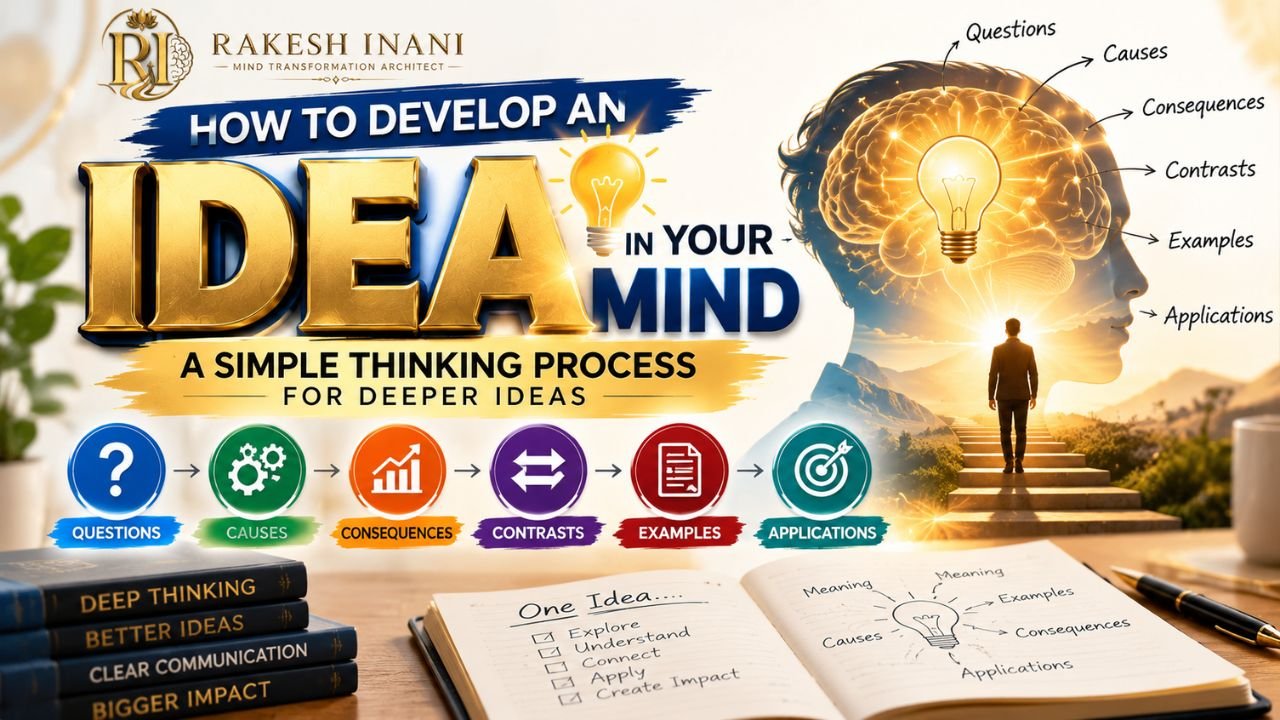
How to Develop an Idea in Your Mind: A Simple Thinking Process for Deeper Ideas
Have you ever had a good idea in your mind but struggled to explain it?
You know the idea is meaningful. You can feel that there is something deeper inside it. However, when you start speaking or writing, you run out of words after one or two minutes.
For example, imagine that you want to talk about this idea:
“Self-confidence grows through action.”
It sounds powerful. It may even feel true to you. But what should you say after this sentence?
You may repeat the same point in different words. You may search online for more information. Or you may leave the idea because you believe you do not know enough about it.
However, the real problem is often not a lack of knowledge. The problem is the lack of a clear thinking process.
Most people have never learned how to mentally explore an idea. They collect information, remember facts, and repeat what others have said. Yet they do not know how to sit with one thought, examine it from different angles, and discover something meaningful inside it.
The good news is that deep thinking is not a special gift. It is a skill. Therefore, you can learn it through a simple process.
In this guide, I will show you how to develop an idea in your mind using six thinking lenses:
- Questions
- Causes
- Consequences
- Contrasts
- Examples
- Applications
These six lenses will help you expand a simple thought into a clear, deep, and useful idea.
You can use this thinking process to write blog posts, create YouTube videos, teach a concept, coach a client, prepare a speech, solve a problem, or understand your own life better.
So, if you often ask, “How can I think deeply about one topic?” or “How do I expand a simple idea?” this guide will give you a practical answer.
Let us begin.
What Does It Mean to Develop an Idea?
Developing an idea means exploring one thought from different angles until you understand its meaning, causes, effects, differences, examples, and practical use.
In simple words, you do not stop at the first thought. Instead, you gently open it.
You ask what it means.
Then, you ask why it happens.
After that, you explore what it creates.
Next, you compare it with other ideas.
Finally, you connect it with real life and decide how it can be used.
That is how a small thought becomes a developed idea.
An Idea Is a Starting Point
An idea is not always a complete answer. Often, it is only a starting point.
Think of an idea as a seed.
A seed looks small. However, a full tree is hidden inside it. The seed needs soil, water, sunlight, and time before its potential becomes visible.
In the same way, a basic thought may look simple. Yet it can contain many lessons, questions, examples, stories, and applications.
Let us return to our example:
“Self-confidence grows through action.”
At first, this is only one sentence. However, we can begin exploring it:
- What is self-confidence?
- Why does action create confidence?
- Why do people wait to feel confident?
- What happens when they avoid action?
- Is confidence different from courage?
- Can action reduce self-doubt?
- Does every action create confidence?
- What kind of action is most helpful?
- Where can we see this idea in real life?
- How can a person apply this idea today?
Now, the original sentence is beginning to grow.
The idea has not changed. Instead, our understanding of it has expanded.
A Topic Is Not the Same as an Idea
Many people confuse a topic with an idea.
A topic is a broad subject. An idea is a clear message about that subject.
For example:
| Level | Example |
| Topic | Self-confidence |
| Basic idea | Self-confidence grows through action. |
| Developed idea | Confidence is often the result of action, not the condition for taking action. |
| Practical lesson | Take one small action before waiting to feel fully ready. |
“Self-confidence” is only a topic. It does not tell us what we want to say.
However, “Self-confidence grows through action” gives us a direction. It tells us the point we want to explore.
Therefore, before trying to develop a topic, turn it into a simple statement.
For example:
- Overthinking grows when we demand complete certainty.
- Fear becomes stronger when we keep avoiding it.
- Clear communication begins with clear thinking.
- Discipline becomes easier when an action is connected with identity.
- A calm state helps us make better decisions.
- Small daily actions can create lasting personal change.
Each statement contains a central message. Therefore, each one can become a developed idea.
Deep Thinking Does Not Require Difficult Language
Some people believe that deep thinking must sound complex.
That is not true.
Using difficult words does not make an idea deep. In fact, if people cannot understand your explanation, your message may lose its power.
Deep thinking means that you can see connections that are not immediately visible.
For example, you may notice:
- What created a behaviour
- What belief is supporting it
- What result the behaviour is producing
- How it is different from a similar behaviour
- Where it appears in daily life
- What can be done to change it
Therefore, depth is not about using bigger words. It is about seeing more clearly.
A truly deep idea can often be explained in very simple language.
Why Do We Struggle to Develop Ideas?
If developing an idea is a learnable process, why do so many people struggle with it?
There are several reasons.
Understanding these reasons is important because they may be blocking your thinking without your awareness.
We Try to Find the Perfect Answer Too Quickly
The moment an idea enters our mind, we often start judging it.
We ask:
- Is this idea good enough?
- Is it original?
- Will people like it?
- What if I say something wrong?
- What if someone disagrees?
- What is the perfect way to explain it?
These questions do not help us explore. Instead, they create pressure.
As a result, the mind becomes careful and closed.
A developing idea needs freedom before it needs correction. First, allow yourself to explore. Later, you can organize, check, and improve your thoughts.
Think of a child playing with building blocks. The child does not demand a perfect building before placing the first block. The child experiments, notices, changes, and builds.
Your mind needs the same permission.
We Collect Information but Do Not Process It
We live in a world full of information.
We watch videos, read books, save posts, listen to podcasts, and attend courses. However, collecting information is not the same as developing understanding.
Suppose you watch ten videos about confidence. You may remember many points. Yet if someone asks, “What is your personal understanding of confidence?” you may still struggle to answer.
Why does this happen?
It happens because the information entered your mind, but you did not process it.
Processing means asking:
- What does this mean to me?
- Do I agree with it?
- Where have I seen this?
- What may be missing?
- How does this connect with something I already know?
- How can I explain it in my own words?
- How can I use it?
Without processing, information stays borrowed.
However, when you question, connect, test, and apply information, it becomes part of your own understanding.
We Reject Simple Ideas Too Early
A powerful idea does not always look powerful in the beginning.
For example:
“Small action creates confidence.”
You may think, “This is too simple. Everyone knows this.”
However, knowing a sentence is not the same as understanding it deeply.
What kind of action creates confidence?
Why do people avoid that action?
What is happening inside the mind before action?
How does one successful action affect future behaviour?
What happens when the action does not produce the expected result?
Suddenly, the “simple” idea contains many layers.
Therefore, do not reject an idea because it looks ordinary. Stay with it for a little longer.
A common idea can become fresh when you explore it honestly and explain it through your own experience.
We Think in Statements Instead of Questions
A statement can close the mind.
A question can open it.
For example, consider this statement:
“People overthink because they are confused.”
If you accept it without questioning it, your exploration may stop.
Now, change it into questions:
- What kind of confusion creates overthinking?
- Does confusion create overthinking, or does overthinking create confusion?
- Can a person overthink even when the right option is clear?
- Is overthinking always about confusion?
- Could fear of consequences be the real cause?
- Is the person searching for clarity or emotional safety?
These questions take the idea deeper.
Therefore, when your mind feels stuck, do not force it to produce more answers. Give it better questions.
We Depend Too Much on Memory
Many people try to speak by remembering complete sentences.
As a result, they become nervous when they forget a line.
However, good thinking does not depend only on memory. It depends on direction.
If you know which angle to explore next, you do not need to remember every sentence.
For instance, you can remember six simple words:
Questions. Causes. Consequences. Contrasts. Examples. Applications.
These words give your mind a path.
Therefore, instead of memorizing a ten-minute explanation, learn how to explore an idea from these six directions.
The Six-Lens Thinking Process
The six-lens thinking process is a simple method for developing any idea.
Each lens helps you see a different part of the idea.
| Thinking Lens | Main Purpose | Core Question |
| Questions | Clarify the meaning | What does this idea really mean? |
| Causes | Find what is behind it | Why does this happen? |
| Consequences | Trace the results | What happens because of it? |
| Contrasts | Create clear differences | What is it different from? |
| Examples | Make it real | Where can we see it? |
| Applications | Make it useful | How can we use it? |
You do not always need to use these lenses in the same order.
Sometimes an example may come first. Sometimes you may notice a consequence before you understand the cause.
That is perfectly fine.
However, when you deliberately explore all six areas, your idea becomes clearer, deeper, and more useful.
Let us understand each lens carefully.
Lens 1: Use Questions to Open the Idea
Questions are the doors through which deeper ideas enter.
When you ask a useful question, your mind begins searching. It looks at your memories, experiences, beliefs, and knowledge. Then, it starts building connections.
Therefore, the first step in developing an idea is not giving an answer. The first step is opening the idea with questions.
Start by Defining the Idea
Before going deeper, make sure you understand your basic statement.
Take this idea:
“Self-confidence grows through action.”
Now, examine the important words:
- What do I mean by self-confidence?
- What do I mean by action?
- What kind of action am I talking about?
- What does “grows” mean?
- Does confidence grow immediately or slowly?
- Does every action create confidence?
- What happens if the action goes badly?
- Is confidence a feeling, a belief, a skill, or a state?
These questions help you remove vague thinking.
For example, after exploring, you may define confidence like this:
Self-confidence is the growing belief that I can face a situation, take action, learn, and handle the result.
This definition is richer than simply saying, “Confidence means believing in yourself.”
Ask “What” Questions for Clarity
“What” questions help you understand the parts of an idea.
You can ask:
- What is happening?
- What is the real issue?
- What is the main message?
- What are the important parts?
- What do people normally believe about it?
- What is often misunderstood?
- What is the hidden pattern?
- What is the most important truth here?
- What does this idea look like in daily life?
- What does it not mean?
For example:
What does “taking action” mean?
It may mean speaking in a meeting, recording a video, starting a conversation, learning a skill, setting a boundary, or making a decision.
Now the idea has become more specific.
Ask “Why” Questions for Depth
“Why” questions help you move below the visible behaviour.
You can ask:
- Why does this happen?
- Why is this important?
- Why do people struggle with it?
- Why do people believe the opposite?
- Why does the problem continue?
- Why should someone care?
- Why does this idea matter in real life?
- Why do some people change while others remain stuck?
Let us apply this to confidence:
Why do people wait for confidence before acting?
Perhaps they believe confidence will protect them from failure.
Why do they want protection from failure?
Perhaps they connect failure with shame, rejection, or personal weakness.
Now, the discussion is no longer only about confidence. It is also about the meaning a person gives to mistakes.
That is how a “why” question creates depth.
Ask “How” Questions for Movement
“How” questions help you understand a process.
Ask:
- How does this pattern begin?
- How does it become stronger?
- How does it affect thoughts and behaviour?
- How can it be changed?
- How can the idea be practised?
- How can I explain it simply?
- How can someone use it today?
- How would I teach it to a child?
For example:
How does action build confidence?
A person takes a small action. That action creates an experience. The experience gives the person real evidence. The mind then updates its belief about what the person can handle.
Therefore, confidence grows through evidence, not only through positive thinking.
Use a Question Chain
A question chain means using one answer to create the next question.
For example:
Question 1: Why do people avoid taking action?
Answer: Because they fear making a mistake.
Question 2: Why does a mistake feel so dangerous?
Answer: Because they believe other people will judge them.
Question 3: Why does judgment have so much power?
Answer: Because they may connect approval with personal worth.
Question 4: What belief is hidden underneath?
Answer: “If people do not approve of me, I am not good enough.”
Notice how the conversation moved from action to fear, from fear to judgment, and from judgment to self-worth.
The first answer is not always the deepest answer.
Therefore, after receiving an answer, gently ask:
- What is behind this?
- Why is that important?
- What makes that feel true?
- What might be underneath it?
- And what happens because of that?
These questions allow your mind to travel beneath the surface.
Lens 2: Explore the Causes Behind the Idea
Every behaviour, emotion, habit, or result has something behind it.
Usually, it does not have only one cause. Several factors may work together.
Therefore, when developing an idea, do not stop at describing what is happening. Explore why it may be happening.
Look for Different Types of Causes
A behaviour may have mental, emotional, social, practical, or environmental causes.
For example, a person may lack confidence because of:
- Limited experience
- Lack of preparation
- Fear of judgment
- Past criticism
- Comparison with others
- Unrealistic expectations
- Perfectionism
- Negative self-talk
- Avoidance of difficult situations
- A lack of clear feedback
- A belief that mistakes are unacceptable
These causes are not the same.
A person who lacks preparation may need practice.
A person who has a fear of judgment may need to change the meaning attached to other people’s opinions.
A person who expects perfection may need to develop a healthier relationship with mistakes.
Therefore, when you explore causes, your explanation becomes more accurate and helpful.
Separate the Trigger From the Root Pattern
A trigger is the event that activates a response.
A root pattern is the deeper belief, fear, memory, or meaning that makes the response likely.
For example, speaking in a meeting may trigger nervousness.
However, the meeting itself may not be the root cause.
The deeper pattern may be:
- “If I say something wrong, people will think I am foolish.”
- “I must speak perfectly.”
- “My value depends on how people respond.”
- “I am not as capable as the others.”
- “One mistake can damage my image.”
When you understand this difference, you stop blaming only the outside situation.
The trigger shows you where the pattern appears. The deeper belief helps you understand why it has so much power.
Ask “What May Be Behind This?”
This is one of the most useful questions for deeper thinking:
“What may be behind this?”
Suppose a person delays starting a YouTube channel.
What may be behind the delay?
At first, the person may say, “I do not have enough time.”
That may be true. However, it may not be the complete truth.
Behind the delay, there may also be:
- Fear of being seen
- Worry about negative comments
- Confusion about the first topic
- A belief that the first video must be excellent
- A lack of confidence in speaking
- Fear that nobody will watch
- Fear that people they know will laugh
The question does not assume that one of these causes must be present. Instead, it invites exploration.
That is important because deep thinking requires curiosity, not quick judgment.
Do Not Force One Cause on Everyone
Two people can show the same behaviour for very different reasons.
Two employees may remain silent in a meeting.
The first may remain silent because he fears judgment.
The second may remain silent because she has not prepared.
The third may remain silent because the meeting does not feel emotionally safe.
The visible behaviour is the same. However, the causes are different.
Therefore, avoid saying:
- “People always do this because…”
- “The only reason is…”
- “Everyone who overthinks has this belief…”
Instead, use balanced language:
- “One possible reason is…”
- “For some people…”
- “This pattern may be connected with…”
- “In many situations…”
- “It is useful to explore whether…”
This approach makes your thinking more mature and trustworthy.
Lens 3: Follow the Consequences of the Idea
Once you have explored what creates a pattern, the next step is to ask what the pattern creates.
In other words:
What happens because of this?
Every thought, belief, decision, and behaviour creates some result.
Sometimes the result appears immediately. At other times, it develops slowly.
Therefore, explore both short-term and long-term consequences.
Ask “What Happens Next?”
Suppose a person avoids speaking because of low confidence.
What happens next?
The person may feel relief because the uncomfortable moment has passed.
However, what happens after that?
The person loses a chance to practise.
What happens then?
The person gains less experience.
And then?
The person has less proof that they can speak effectively.
As a result, self-doubt remains strong.
This creates a consequence chain:
Avoidance → temporary relief → less experience → more self-doubt → greater fear → more avoidance
Now, let us look at the opposite chain:
Small action → real experience → useful feedback → improved skill → stronger self-trust → greater confidence
These chains help us see why a small behaviour can become a long-term pattern.
Examine Short-Term and Long-Term Results
A behaviour that feels helpful today may become harmful over time.
For example:
| Behaviour | Short-Term Result | Long-Term Result |
| Avoiding action | Temporary relief | Lower confidence |
| Waiting for certainty | Feeling protected | Missed opportunities |
| Taking a small risk | Mild discomfort | Greater courage |
| Practising regularly | Effort and mistakes | Better skill |
| Asking for feedback | Temporary nervousness | Faster improvement |
| Making a decision | Fear of being wrong | Greater self-trust |
This comparison reveals an important truth:
What feels safe in the short term may keep us stuck in the long term.
Meanwhile, what feels uncomfortable in the short term may create freedom in the long term.
Explore Positive and Negative Consequences
Balanced thinking does not present only one side.
Taking action can create confidence. However, action can also produce mistakes, disappointment, or unwanted results.
Therefore, the deeper lesson is not that every action will succeed.
The lesson is that useful action gives us experience.
Even when the result is imperfect, we can learn:
- What worked
- What did not work
- What needs improvement
- What we can handle
- What we should try next
Confidence does not always grow because everything goes well. Sometimes it grows because we discover that we can face a difficult result and continue.
That is a much deeper understanding of confidence.
Use Time to Expand the Idea
To examine consequences, ask questions across time:
- What happens immediately?
- What happens after one week?
- What happens after six months?
- What happens if nothing changes?
- Who else may be affected?
- What opportunity may be lost?
- What becomes possible if the pattern changes?
These questions help you move beyond the present moment.
As a result, you can show why the idea matters.
Lens 4: Use Contrasts to Make the Idea Clearer
We understand many things through difference.
We understand light because we know darkness.
We understand movement because we know stillness.
Likewise, an idea becomes clearer when we compare it with its opposite, a common misunderstanding, or a similar concept.
Ask Contrast Questions
You can ask:
- What is the opposite of this?
- What looks similar but is actually different?
- What happens when this quality is missing?
- What do most people believe instead?
- What is the old way of thinking?
- What is the new way of thinking?
- What is the myth?
- What is the reality?
- What is helpful?
- What is harmful?
- What is healthy?
- What is extreme?
These questions create sharp and memorable ideas.
Confidence and Courage Are Not the Same
Confidence says:
“I believe I can handle this.”
Courage says:
“I will move even though I still feel uncertain.”
A person may not feel confident before a first attempt. However, the person can still act with courage.
After repeated action, experience begins to grow. Then, confidence may follow.
Therefore, courage often comes before confidence.
This contrast gives us a stronger version of the original idea:
You do not need full confidence to begin. You need enough courage to take the first step.
Confidence and Certainty Are Different
Many people believe they will act when they feel completely certain.
However, certainty means knowing what will happen.
Confidence means trusting yourself even when the result is not fully known.
You may never be certain that a presentation will go perfectly. Yet you can become confident that you will prepare well, respond calmly, and handle small mistakes.
Therefore, confidence is not complete control over the future. It is growing trust in your ability to respond.
Thinking and Overthinking Are Different
Contrast also helps us understand mental patterns.
| Thinking | Overthinking |
| Moves toward clarity | Moves in circles |
| Uses relevant information | Searches endlessly |
| Accepts reasonable uncertainty | Demands complete certainty |
| Produces a decision | Often creates delay |
| Focuses on useful questions | Repeats fear-based questions |
| Ends with action or acceptance | Often ends with more analysis |
Both thinking and overthinking involve mental activity. However, their direction is different.
Thinking helps us move.
Overthinking often keeps us mentally busy without creating meaningful movement.
Use Myth Versus Reality
Another useful contrast is myth versus reality.
For example:
Myth: Confident people do not feel fear.
Reality: Confident people may feel fear, but they do not always allow fear to make the decision.
Myth: You must feel ready before starting.
Reality: Readiness often grows after you begin practising.
Myth: A mistake proves that you are not capable.
Reality: A mistake gives you information about what to improve.
These contrasts are powerful because they challenge an old belief and replace it with a more useful perspective.
Lens 5: Turn the Idea Into Real Examples
An idea becomes easier to understand when people can see it in real life.
Without examples, even a good explanation can feel distant.
An example gives the idea a body.
It turns an invisible concept into a visible situation.
Use a Personal Example
Ask yourself:
- When have I experienced this?
- When did I learn this lesson?
- What mistake helped me understand it?
- What was I believing at that time?
- What action did I take?
- What changed after that?
- What would I do differently today?
You do not need a dramatic story.
Even a small personal experience can make an idea real.
For instance, perhaps you felt nervous before recording your first video. You may have waited for the right setup, the perfect script, or a more confident voice.
However, once you recorded a few videos, you discovered that confidence did not arrive before practice. It developed because of practice.
That experience supports the idea:
Action creates the evidence from which confidence grows.
Use an Everyday Example
Daily-life examples make your message relatable.
Consider learning to drive.
A person can read about driving, watch other people drive, and understand the rules. Still, that person will not feel fully confident behind the wheel without actual practice.
At first, every movement may require conscious effort.
The person thinks about the mirror, clutch, brake, steering wheel, traffic, and distance.
However, through repeated practice, the mind and body become more familiar with the activity.
Confidence grows because the person has collected real experience.
The same pattern may appear when someone:
- Speaks in a meeting
- Starts exercising
- Learns a new language
- Records a video
- Makes a sales call
- Sets a boundary
- Meets new people
- Gives a presentation
- Makes a difficult decision
Different situations can reveal the same principle.
Use a Coaching Example
Imagine an employee named Amit.
Amit has useful ideas during meetings. However, he rarely shares them.
He tells himself, “I will speak when I become more confident.”
Because he remains silent, he does not get speaking practice. His coworkers also do not get the chance to respond to his ideas.
Over time, Amit starts believing that he is naturally bad at speaking.
Now, imagine that he decides to ask one question in every meeting.
The first attempt feels uncomfortable. The second attempt is slightly easier. After a few weeks, he begins sharing short opinions.
Gradually, his mind receives new evidence:
- “I can speak even when I feel nervous.”
- “People do not expect perfect words.”
- “A small mistake does not destroy my image.”
- “My ideas can be valuable.”
Amit’s confidence grows because his behaviour gives his mind new information.
Use an Analogy
An analogy explains one idea through another familiar idea.
For example:
Confidence is like physical strength.
You do not wait to become physically strong before exercising.
You exercise first. Then, strength develops.
In the same way, you do not always need to wait for confidence before taking action. You take a manageable action, learn from it, and allow confidence to develop.
Another analogy is a dark road.
Imagine driving at night. Your headlights may not show the entire journey. They only show a limited distance ahead.
However, as you move forward, the next part of the road becomes visible.
Likewise, you may not have complete clarity before beginning. Sometimes the next step becomes clear only after you take the present step.
Use a Counterexample
A strong thinker also asks when an idea may not apply.
Does every action build confidence?
Not necessarily.
If someone repeatedly takes action without learning, preparation, or reflection, confidence may not grow.
For example, giving ten presentations without reviewing mistakes may repeat the same weak pattern.
Also, taking a step that is far beyond a person’s present capacity may create overwhelm.
Therefore, a better statement is:
Confidence grows through manageable action, honest feedback, learning, and repetition.
The counterexample did not destroy the original idea. Instead, it made the idea more accurate.
Lens 6: Convert the Idea Into Practical Application
A deep idea should not only sound meaningful. It should help someone see, choose, or do something differently.
Therefore, after exploring the idea, ask:
“How can this be used?”
Application turns understanding into transformation.
Ask Application Questions
You can ask:
- What can the reader do with this idea?
- What behaviour should change?
- What should the person stop doing?
- What should the person begin doing?
- What is the smallest useful step?
- How can this be practised today?
- What might make the action easier?
- How will the person know that progress is happening?
- What can be repeated daily?
- What reflection question can support the process?
For our confidence example, the application is not simply, “Be confident.”
That instruction is too vague.
A useful application would be:
Choose one small action that feels uncomfortable but safe. Complete it, review what happened, and use the experience to choose your next step.
Begin With a Small Action
The first action should be manageable.
For example:
- Ask one question during a meeting.
- Record a two-minute private video.
- Share one honest opinion.
- Start one short conversation.
- Make one small decision without asking five people.
- Practise speaking for three minutes.
- Say “no” to one unnecessary request.
- Post one useful idea online.
- Contact one possible client.
- Complete one task before feeling fully ready.
A small step may look unimportant. However, it can interrupt a large pattern of avoidance.
Use the Action Evidence Exercise
Here is a simple exercise for building confidence through action.
Step 1: Choose One Action
Choose an action that is slightly uncomfortable but realistic.
Do not choose the biggest fear immediately.
Step 2: Notice Your Prediction
Before acting, write what your mind predicts.
For example:
- “People will laugh.”
- “I will forget everything.”
- “I will not know what to say.”
- “I will look foolish.”
- “I will fail completely.”
Step 3: Take the Action
Complete the action without waiting for perfect confidence.
You only need enough willingness to begin.
Step 4: Record What Actually Happened
Compare the real event with your prediction.
Did everything go as badly as your mind expected?
What did you handle better than expected?
Step 5: Collect Evidence
Write down the useful evidence:
- I felt nervous, but I still completed it.
- I made a mistake, but I recovered.
- One person responded positively.
- The discomfort reduced after I began.
- I learned what to improve next time.
Step 6: Choose the Next Action
Repeat the process with a similar or slightly more challenging step.
Over time, the mind receives repeated proof that you can act, learn, and adjust.
Guide Instead of Preaching
When applying an idea, avoid giving shallow advice.
“Stop overthinking.”
“Just be confident.”
“Do not care what people think.”
“Take massive action.”
These statements may sound strong, but they often ignore the person’s real pattern.
Instead, guide the person:
- Notice where the overthinking begins.
- Identify the decision you are avoiding.
- Name the fear underneath the delay.
- Choose the smallest useful action.
- Allow some uncertainty to remain.
- Take the step.
- Review the result.
Guidance respects the difficulty while still creating movement.
How to Connect All Six Lenses
Now you know the six lenses. However, how do you connect them into one clear explanation?
Use the following process.
Step 1: Write the Basic Idea
Write one clear sentence.
For example:
“Self-confidence grows through action.”
Do not try to make it perfect. You only need a direction.
Step 2: Explore the Idea Through Six Lenses
Ask:
Questions: What does this idea truly mean?
Causes: Why do people wait for confidence?
Consequences: What happens when they keep waiting?
Contrasts: How is confidence different from courage and certainty?
Examples: Where can we see this principle in daily life?
Applications: What small action can someone take today?
Step 3: Find the Central Insight
After exploring, ask:
“What is the deepest and clearest lesson I can see now?”
Your answer may be:
“You do not need full confidence before taking action. You need enough courage to take one manageable step. That step gives your mind evidence, and repeated evidence slowly becomes confidence.”
This is your developed idea.
Step 4: Arrange the Idea in a Natural Flow
A useful teaching flow is:
- Present the problem.
- Explore why it happens.
- Identify the belief behind it.
- Explain the consequences.
- Introduce a new perspective.
- Give an example.
- Offer a practical exercise.
- End with a clear action.
This structure works well for articles, videos, presentations, coaching sessions, workshops, and course lessons.
A Complete Example of Developing One Idea
Let us now develop the entire idea from beginning to end.
The Basic Idea
“Self-confidence grows through action.”
The Problem
Many people wait to feel confident before beginning something important.
They may delay recording videos, speaking in meetings, starting a business, meeting new people, or sharing their ideas.
They believe confidence must come first.
The Questions
What is confidence?
Where does it come from?
Why do people wait for it?
Can someone act without feeling confident?
What happens if the result is imperfect?
These questions open the idea.
The Possible Cause
A person may be waiting for confidence because confidence feels like protection.
The person believes:
“If I feel confident, I will not fail.”
However, confidence cannot guarantee success.
Often, the deeper fear is not failure itself. It is the meaning attached to failure:
- “Failure means I am not capable.”
- “A mistake will damage my image.”
- “People will reject me.”
- “I must prove that I am good enough.”
Therefore, the person keeps preparing but does not act.
The Consequence
Avoidance gives temporary relief.
However, because the person does not act, the person does not gain experience.
Without experience, the person has little evidence of capability.
As a result, self-doubt remains.
The strategy used to avoid discomfort becomes the reason confidence does not grow.
The Contrast
Confidence is not certainty.
Confidence does not mean knowing that everything will go well.
Instead, confidence can mean trusting that you will respond, learn, and continue even when everything does not go as planned.
Also, confidence is not the same as courage.
Courage allows you to take the first step while fear is still present.
Confidence often grows later.
The Example
Imagine that you want to create your first YouTube video.
You keep improving the script. You buy better equipment. You watch presentation videos. Still, you do not record.
You believe you need more confidence.
One day, you decide to record a private three-minute video.
Your voice is not perfect. You pause in the middle. You forget one point.
However, you complete the recording.
Now your mind has new evidence:
“I can record a video even when I feel nervous.”
The next day, you record again.
After ten recordings, you speak more naturally.
After twenty recordings, you no longer fear every pause.
Your confidence did not arrive before action. It grew because of action, learning, and repetition.
The Application
Choose one small action you have been postponing.
Do not ask, “How can I become completely confident?”
Instead, ask:
“What is the smallest action I can take with the confidence I already have?”
Complete that action.
Then, review the experience and collect evidence of what you handled well.
The Final Developed Idea
Self-confidence is not always something you find before you begin. Often, it is something you build after you begin. Every manageable action gives your mind real evidence. That evidence teaches you that you can face discomfort, learn from mistakes, and handle uncertain results. Therefore, do not wait for complete confidence. Begin with a small act of courage, and let confidence grow through experience.
This entire explanation came from one short sentence.
That is the power of a clear thinking process.
How to Turn One Developed Idea Into Content
Once you develop an idea, you can use it in many forms.
You do not need a completely new idea for every piece of content.
Instead, you can present the same central insight through different angles and formats.
Turn the Idea Into a Blog Post
A blog post can follow this structure:
- Introduce a relatable problem.
- Present the basic idea.
- Explain what the idea means.
- Explore why the problem happens.
- Show the short-term and long-term consequences.
- Correct a common misunderstanding.
- Give an example or story.
- Provide a practical process.
- Answer common questions.
- End with one clear action.
This structure helps both readers and search engines understand the content.
It also makes the article useful for people searching for questions such as “How do I develop an idea?” or “How can I think deeply about a topic?”
Turn the Idea Into a YouTube Video
For a video, use this simple flow:
Hook:
“Most people wait for confidence before taking action. But what if that waiting is the reason their confidence never grows?”
Relatable situation:
Talk about delaying a video, meeting, decision, or conversation.
Hidden cause:
Explain the fear of mistakes or judgment.
Core idea:
Show that action creates evidence.
Contrast:
Explain confidence versus courage.
Example:
Use a real-life situation.
Exercise:
Give one small action.
Closing message:
“You do not need complete confidence for the first step. The first step is what begins building confidence.”
Turn the Idea Into Social Media Content
One developed idea can produce several short posts:
- A myth-versus-reality post
- A personal story
- A practical exercise
- A powerful question
- A short analogy
- A list of common mistakes
- A before-and-after contrast
- A one-minute video
- A quote with an explanation
- A carousel showing the process
Therefore, if you ask, “How can I turn one idea into multiple pieces of content?” the answer is simple:
Do not keep changing the main idea. Change the angle through which you present it.
Turn the Idea Into a Coaching Conversation
In coaching, use the six lenses as questions.
You may ask:
- What does confidence mean to you?
- Where do you feel least confident?
- What do you fear may happen?
- What is behind that fear?
- What happens when you avoid the action?
- Have you ever acted despite feeling uncertain?
- What did that experience teach you?
- What is one small action you can take now?
The goal is not to force your conclusion on the person.
Instead, help the person discover a useful insight through guided exploration.
Turn the Idea Into a Course Lesson
A course lesson may include:
- The main concept
- A clear definition
- The common problem
- The cause behind the problem
- A model or framework
- A real-life example
- A practical exercise
- Reflection questions
- An action assignment
The same idea now becomes a complete learning experience.
A Simple Idea Development Worksheet
Whenever you want to explore an idea, use the following worksheet.
1. My Basic Idea
The idea I want to explore is:
2. Questions
- What does this idea mean?
- What are the key words?
- What is the main message?
- What is often misunderstood?
- What is the deeper question inside it?
- How would I explain it to a child?
3. Causes
- Why does this happen?
- What may be behind it?
- What belief may support it?
- What fear may be involved?
- What habit keeps it going?
- What past experience may influence it?
- What environmental factor may affect it?
4. Consequences
- What happens immediately?
- What happens over time?
- What happens if nothing changes?
- What opportunities may be lost?
- Who else may be affected?
- What becomes possible if the pattern changes?
5. Contrasts
- What is the opposite?
- What looks similar but is different?
- What is the common myth?
- What is the more useful reality?
- What is the old way of thinking?
- What is the new way of thinking?
6. Examples
- Where have I experienced this?
- Where have I seen it in daily life?
- What personal story can explain it?
- What workplace example can explain it?
- What analogy makes it simple?
- Is there a counterexample?
7. Applications
- What can someone do with this idea?
- What should the person stop doing?
- What should the person begin doing?
- What is the smallest useful action?
- What exercise can I give?
- How can progress be measured?
8. My Final Insight
After exploring the idea, complete this sentence:
“The clearest lesson I can now see is…”
Write the answer in one or two sentences.
That answer will often become the core message of your content.
Common Mistakes While Developing an Idea
A framework gives you direction. However, you should also know what can weaken your thinking.
Here are some common mistakes.
Trying to Sound Intelligent
When people want to sound deep, they sometimes use complex words and long sentences.
However, this can hide the real idea.
Your goal is not to impress the reader with language. Your goal is to help the reader understand something clearly.
If you understand an idea deeply, you should be able to explain it simply.
Therefore, choose clear words.
Use short examples.
Keep one message at the centre.
Adding Too Many Unrelated Points
A developed idea is not a collection of random information.
Suppose your central message is:
“Confidence grows through action.”
You do not need to explain every theory of confidence, motivation, identity, neuroscience, success, and communication.
Choose only the information that supports the main idea.
A focused explanation feels deeper than a crowded explanation.
Repeating the Same Point
Repeating an idea can sometimes help. However, repeating the same sentence with slightly different words does not create depth.
For example:
- Confidence comes from action.
- Taking action makes you confident.
- Action increases confidence.
- You become confident by acting.
These lines repeat one message.
To deepen the idea, add a new angle:
- Why does action build confidence?
- What prevents action?
- What happens when a person avoids action?
- How is courage different from confidence?
- What type of action is most useful?
- How can someone practise this safely?
A new angle creates depth. Simple repetition does not.
Searching Before Thinking
Research is valuable. However, if you search too early, you may fill your mind with other people’s words before discovering your own understanding.
Try this order:
- Write the basic idea.
- Explore it through the six lenses.
- Record your present understanding.
- Research reliable sources.
- Compare what you found with your original thinking.
- Correct or strengthen the idea.
- Rewrite it in your own words.
This process allows research to improve your thinking without replacing it.
Ignoring the Opposite View
If you only search for proof that your idea is correct, your explanation may become weak or one-sided.
Ask:
- When may this idea not work?
- What would someone who disagrees say?
- What am I assuming?
- Is there an exception?
- What condition must be present?
- How can I make the statement more accurate?
For example, “Action creates confidence” sounds useful.
However, after examining the opposite view, you may improve it:
“Manageable action, combined with feedback and learning, helps confidence grow.”
The second version is stronger because it includes an important condition.
Giving Advice Without Explaining the Pattern
People often give advice too quickly.
They say:
- Stop worrying.
- Think positively.
- Take action.
- Believe in yourself.
- Ignore other people.
However, people rarely change because of a command alone.
First, help them understand:
- What pattern is happening
- Why it may be happening
- What it is costing them
- What belief supports it
- What new choice is possible
Then, the advice has meaning.
Ending Without an Application
A beautiful idea may inspire someone for a few minutes. However, without application, it may not create change.
Always ask:
“What can the reader do after understanding this?”
Give one clear and realistic step.
An idea becomes useful when it enters behaviour.
A 15-Minute Daily Practice for Deeper Thinking
You can train your mind to develop ideas.
You do not need hours of free time. Fifteen focused minutes can be enough for daily practice.
Minutes 1–2: Choose One Idea
Choose a simple idea from:
- A book
- A conversation
- A personal experience
- A client question
- A work situation
- A video
- A mistake
- A decision
- A common problem
Write the idea in one sentence.
For example:
“Overthinking grows when we demand complete certainty.”
Minutes 3–5: Ask Questions
Write as many questions as possible.
Do not answer every question immediately.
Your goal is to open the idea.
Ask:
- What does certainty mean?
- Why do we demand it?
- Can certainty ever be complete?
- What fear is hidden behind the demand?
- When does useful thinking become overthinking?
- What decision is being delayed?
Minutes 6–7: Find Possible Causes
List mental, emotional, practical, and environmental causes.
Do not force one final answer.
Remain curious.
Minutes 8–9: Trace the Consequences
Explore what happens in the short term and over time.
Create a consequence chain if possible.
For example:
Need for certainty → more checking → more information → more confusion → delayed decision → lower self-trust
Minutes 10–11: Create Contrasts
Compare:
- Thinking and overthinking
- Clarity and certainty
- Careful decision-making and decision avoidance
- Helpful preparation and endless preparation
Minutes 12–13: Add Examples
Find:
- One personal example
- One daily-life example
- One analogy
- One possible counterexample
Minutes 14–15: Find the Application
Write:
- One practical step
- One reflection question
- One final insight
For example:
“Clarity does not always come before a decision. Sometimes clarity grows after we make a reasonable choice and begin moving.”
If you complete this practice daily, your mind will gradually learn the pattern.
Eventually, you will begin exploring questions, causes, consequences, contrasts, examples, and applications without needing to force the process.
How to Know Whether Your Idea Is Deep Enough
An idea does not need to explain everything.
It needs to explain one meaningful point clearly and usefully.
Before completing your content, ask:
- Is my main message clear?
- Have I explained what it means?
- Have I explored why it happens?
- Have I shown what it creates?
- Have I compared it with a related idea?
- Have I given a relatable example?
- Have I considered another point of view?
- Have I included a practical application?
- Can I explain it in simple words?
- Will this help someone think or act differently?
If you can answer most of these questions, your idea is probably developed enough for the purpose.
Remember, a short social media post needs less exploration than a long blog post or course lesson.
Depth should match the format.
Frequently Asked Questions
How do I develop an idea in my mind?
To develop an idea in your mind, write it as one clear sentence. Then explore it through six lenses: questions, causes, consequences, contrasts, examples, and applications. Finally, identify the clearest lesson and express it in your own words.
How can I think deeply about one topic?
Start by asking what the topic means and why it matters. Then, examine what creates it, what results it produces, how it differs from similar ideas, where it appears in real life, and how it can be applied.
Deep thinking is not about thinking for a very long time. It is about looking at one idea from several useful angles.
How do I expand a simple idea?
Begin with one basic statement.
For example:
“Fear becomes stronger through avoidance.”
Next, ask:
- Why do people avoid fear?
- What relief does avoidance provide?
- What happens over time?
- How is safety different from avoidance?
- Where can we see this pattern?
- What small action can weaken it?
Each answer expands the original idea without taking you away from the central message.
Why does my mind go blank when I try to speak?
Your mind may go blank because you are trying to remember exact sentences, speak perfectly, or manage too many points at once.
Instead of memorizing a full speech, remember a few thinking directions:
- Meaning
- Cause
- Effect
- Difference
- Example
- Action
These keywords can guide your mind from one point to the next.
Also, practise speaking about one idea for two or three minutes before trying to speak for ten or fifteen minutes.
How can I organize my thoughts before speaking?
Write the main idea at the top of a page.
Under it, write six short headings:
- What?
- Why?
- Result?
- Difference?
- Example?
- Action?
Add two or three keywords below each heading.
Do not write a full script unless you truly need one. Keywords help you keep the flow while still speaking naturally.
How can I create more content ideas?
Take one central idea and divide it into different content angles.
For example, from “Confidence grows through action,” you can create:
- Why waiting for confidence keeps you stuck
- Confidence versus courage
- Five small actions that build confidence
- What mistakes teach your mind
- A personal confidence story
- The avoidance-confidence loop
- Why positive thinking alone may not be enough
- A seven-day confidence exercise
- Common myths about confident people
- How to collect evidence of personal progress
Therefore, you may not need more unrelated ideas. You may need to explore the existing idea more deeply.
Can deep thinking be learned?
Yes. Deep thinking can be trained through questions, observation, comparison, reflection, and application.
At first, the process may feel slow. However, with regular practice, your mind begins noticing deeper connections more naturally.
The goal is not to become mentally complicated. The goal is to become more curious, clear, and precise.
Do I need more knowledge to produce deeper ideas?
Knowledge is helpful, especially when the subject involves facts, science, health, law, finance, or technical information.
However, knowledge alone does not create insight.
You also need to process the knowledge.
Ask what it means, how it connects with experience, when it applies, where it may not apply, and how it can be used.
Research gives you material. Thinking helps you understand and organize that material.
How long should I spend developing one idea?
The time depends on the final purpose.
A short social media post may need five to fifteen minutes of exploration.
A YouTube video may need thirty to sixty minutes.
A detailed blog post may require several hours of thinking, research, writing, and editing.
A course lesson may need even more time because it must include teaching, examples, exercises, and assessment.
However, do not measure depth only by time. Measure it by clarity and usefulness.
What should I do if I cannot find an example?
Look in familiar areas:
- Home
- School
- Workplace
- Relationships
- Health
- Money
- Communication
- Technology
- Learning
- Sports
- Travel
- Daily habits
You can also use an analogy.
Ask:
“What else works in a similar way?”
For example, learning confidence may be compared with building muscle, learning to drive, climbing stairs, or lighting a path one step at a time.
How can I make my idea original?
Originality does not always mean saying something nobody has ever said.
Often, originality comes from:
- Your personal experience
- Your way of connecting two ideas
- Your example
- Your language
- Your framework
- Your practical exercise
- Your honest observation
- Your understanding of a specific audience
Do not force yourself to sound completely new.
Instead, understand the idea deeply and express it truthfully in your own voice.
How can I stop overthinking while developing an idea?
Give yourself two separate stages.
During the first stage, explore freely. Write questions, examples, and possible answers without judging them.
During the second stage, organize and edit.
Do not try to explore and perfect the idea at the same time.
Exploration needs openness. Editing needs selection.
Separating them reduces pressure.
Final Thoughts: Do Not Always Search for More Ideas
Many people believe they need more ideas.
They save hundreds of posts, watch more videos, and create long lists of topics. Still, when it is time to speak or write, they feel empty.
The solution is not always more information.
Sometimes you need to stay with one idea long enough to discover what is already inside it.
Take the idea and ask:
- What does it really mean?
- Why does it happen?
- What happens because of it?
- What is it different from?
- Where can I see it?
- How can it be used?
These six questions can turn a simple thought into a complete article, video, lesson, coaching conversation, or personal insight.
More importantly, they can train you to become an independent thinker.
You will no longer depend only on memorized sentences or borrowed information. You will know how to enter an idea, examine it, connect it with life, and explain it in your own words.
Remember this:
A simple idea becomes powerful when you stay with it long enough to understand what it means, why it happens, what it creates, how it differs, where it appears, and how it can improve someone’s life.
Now, choose one idea.
Write it in one sentence.
Then, explore it through questions, causes, consequences, contrasts, examples, and applications.
Do not worry about creating the perfect answer.
Remain curious.
Because when your questions become deeper, your ideas naturally become deeper too.
Truly Yours
Rakesh Inani,
NLP & Mind Transformation Coach
Transform Your Mind: JOIN MIND TRANSFORMATION COMMUNITY
Learn More:
Real Leaders Know This ONE Secret to Influencing Without Speaking
7 Day Manifestation- NLP Guided Meditation for Success
The Complete Success Formula: 6 Steps to Turn Goals into Consistent Action