
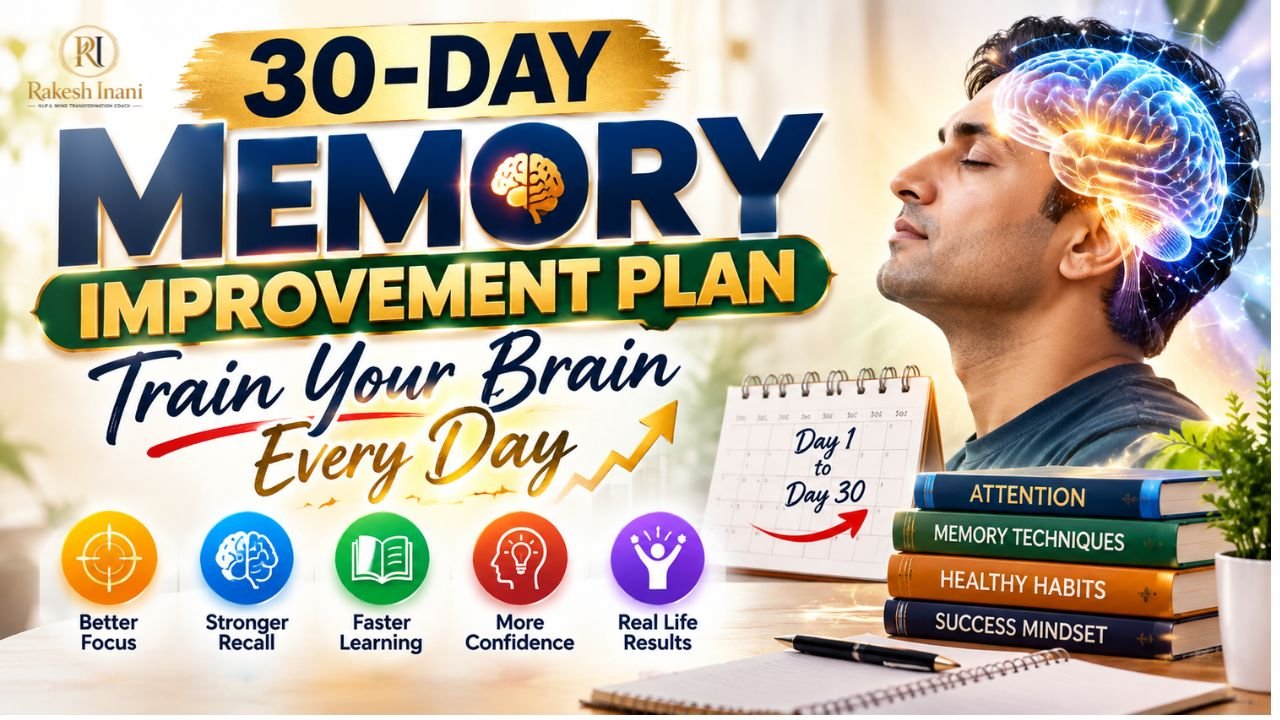
30-Day Memory Improvement Plan: Train Your Brain Every Day
Can you improve your memory in 30 days?
Yes, you can improve many of the habits and skills that support memory. For example, you can train your attention, learn to encode information more deeply, practise active recall, use spaced repetition, reduce distractions, and create a healthier learning routine.
However, thirty days will not give you a perfect memory.
It cannot guarantee that you will remember everything. Moreover, memory exercises cannot diagnose, prevent, or treat dementia, brain injury, attention disorders, depression, sleep disorders, or another medical condition.
Instead, this thirty-day plan will help you build a more reliable way of learning and remembering.
Here is the direct answer:
To improve your memory in 30 days, practise focused attention, meaningful learning, active recall, spaced review, memory techniques, quality sleep, physical activity, balanced nutrition, and mental organisation. Train for 20–30 minutes a day, measure practical progress, and review weak areas instead of repeating everything equally.
This plan brings together everything you learned in the earlier sections.
You will work on:
- Attention
- Concentration
- Encoding
- Association
- Visualisation
- Chunking
- Active recall
- Spaced repetition
- Memory techniques
- Sleep
- Movement
- Nutrition
- Stress
- Daily organisation
- Real-life application
Most importantly, you will not only perform random brain exercises.
You will use memory training for information that matters in your life.
What Can You Realistically Improve in 30 Days?
Thirty days is enough time to create noticeable changes in your process.
For example, you may become better at:
- Paying attention during conversations
- Remembering names
- Recalling what you read
- Organising large topics
- Remembering a short speech
- Learning professional information
- Managing daily responsibilities
- Using active recall
- Reviewing at useful intervals
- Recognising what weakens your memory
- Feeling more confident about learning
Your results will depend on several factors.
These include your starting point, health, sleep, stress, practice quality, existing knowledge, age, environment, and the type of information you are trying to remember.
Therefore, do not compare your results with someone else.
Compare Day 30 with Day 1.
What This Plan Will Not Do
This plan is educational.
It is not a medical test or treatment program.
A ten-word recall exercise cannot tell you whether you have a medical memory problem. Forgetting some words does not mean you have cognitive impairment.
Similarly, improving your score does not prove that your overall cognitive health has changed.
The exercises help you observe your learning habits and practise useful strategies.
If memory problems are sudden, worsening, affecting safety, or interfering with ordinary responsibilities, speak with a qualified healthcare professional.
Choose Your Personal Memory Goal
Before beginning, choose one main goal.
Do not write:
“I want a powerful memory.”
That goal is too broad.
Instead, make your goal specific.
Goal 1: Remember Names Better
You might write:
During the next thirty days, I will practise listening, repeating, associating, and recalling names. My goal is to remember at least four out of five new names the next day.
Goal 2: Remember What You Read
You might write:
During the next thirty days, I will read for twenty minutes daily and recall the main idea, three supporting points, and one application without looking.
Goal 3: Improve Memory for Work
You might write:
I will use keyword notes and post-meeting recall so I can remember decisions, responsibilities, and deadlines more accurately.
Goal 4: Remember a Speech
You might write:
I will learn to speak from a seven-point keyword route instead of memorizing every sentence.
Goal 5: Improve Study Recall
You might write:
I will use active recall and spaced review to remember one professional topic for at least thirty days.
Goal 6: Reduce Daily Forgetfulness
You might write:
I will use a calendar, task list, and environmental cues so that fewer important responsibilities depend only on memory.
Use One Primary Goal and One Supporting Goal
You can have one main goal and one smaller supporting goal.
For example:
- Main goal: Remember what I read.
- Supporting goal: Improve concentration during reading.
This keeps the plan focused.
Prepare Your 30-Day Memory Training Kit
You do not need expensive equipment.
Prepare:
- One notebook or digital document
- A timer
- Ten simple word cards
- A book or learning resource
- A calendar
- A task list
- A quiet learning location
- A weekly scorecard
- Water nearby
- A list of information you genuinely want to learn
You may also use flashcards or a spaced-repetition application.
However, the tool is optional.
The practice is essential.
Set Your Daily Training Time
Choose a time you can maintain.
You may prefer:
- Early morning
- Before starting work
- During a lunch break
- Early evening
- Before your normal reading time
Avoid choosing an ideal time that rarely exists in your real schedule.
If you have only twenty minutes, use twenty minutes well.
Use a Minimum Version
Your normal session may be twenty to thirty minutes.
However, your minimum version should take five minutes.
On a crowded day:
- Focus for thirty seconds.
- Review one idea.
- Recall it without looking.
- Check your answer.
- Record one action.
The minimum version protects continuity.
Take a Simple Starting Assessment
Complete this assessment on Day 1 before training.
Repeat it on Day 30 under similar conditions.
Do not treat it as a diagnosis.
It is only a personal comparison.
Starting Test 1: Ten-Word Recall
Read these words for thirty seconds:
River, glass, mango, chair, tiger, key, candle, train, garden, drum.
Cover the words.
Write everything you remember.
Record:
- Correct words
- Incorrect words
- Repeated words
- Correct positions
- Time taken
Wait twenty minutes.
Then try again without viewing the list.
Record your delayed-recall score.
Starting Test 2: Reading Recall
Choose an unfamiliar passage of approximately 300–500 words.
Read it once at a natural speed.
Close it.
Write:
- The main idea
- Three supporting points
- One example
- One conclusion
Score yourself from 0 to 10.
Use this simple guide:
- 0–2: Very little accurate recall
- 3–4: Some pieces but weak structure
- 5–6: Main idea plus some details
- 7–8: Clear structure and accurate support
- 9–10: Strong, accurate explanation in your own words
Starting Test 3: Name Recall
Create five fictional people by writing a name and role for each person.
For example:
- Kavita—researcher
- Arjun—sales manager
- Neha—accountant
- Rohan—designer
- Meera—teacher
Read the list for one minute.
Cover it and recall the name-role pairs.
Test again after twenty minutes.
Starting Test 4: Focus Duration
Choose one reading or learning task.
Start a timer.
Record how long you work before:
- Checking your phone
- Opening another tab
- Thinking about an unrelated task
- Leaving your seat
- Losing the meaning of what you are reading
Do not judge yourself.
You are collecting information.
Starting Test 5: Lifestyle Check
Rate each area from 1 to 5:
- Sleep quality
- Morning energy
- Daily movement
- Hydration
- Meal regularity
- Stress
- Screen distraction
- Mental clutter
- Learning consistency
- Confidence in your memory
A rating of 1 means very weak.
A rating of 5 means very strong.
Record Your Starting Reflection
Write short answers:
- What do I forget most often?
- When does my memory feel strongest?
- When does it feel weakest?
- What usually distracts me?
- How do I currently study?
- Do I test myself or only reread?
- How well do I sleep?
- What would meaningful improvement look like?
Your answers will guide the next thirty days.
The Daily Memory Training Structure
Most days will use this structure:
Part 1: Prepare for Two Minutes
Remove one distraction.
Take a slow breath.
Choose one goal.
Part 2: Train for Ten Minutes
Complete the day’s main exercise.
Part 3: Recall for Five Minutes
Close the source.
Bring the information back.
Part 4: Check for Three Minutes
Compare your response with the source.
Correct errors.
Part 5: Record for Two Minutes
Write:
- What worked?
- What was difficult?
- What will I repeat?
This structure can be adjusted.
However, always include recall and checking.
Week 1: Build Attention Before Memory
The first week focuses on attention.
You cannot remember clearly what you never noticed clearly.
During this week, you will reduce distractions, practise observation, improve listening, and learn to work on one task at a time.
Day 1: Identify Your Memory Leaks
A memory leak is a habit or condition that may interfere with attention, learning, storage, or recall.
Today, observe your normal day.
Look for:
- Phone notifications
- Multitasking
- Poor sleep
- Skipped meals
- Low water intake
- Mental overload
- Unfinished tasks
- Constant worry
- No review system
- Passive reading
- Too much information
Create three columns:
| Situation | What I forgot | Possible reason |
|---|---|---|
| Morning meeting | One action item | I was answering messages |
| Reading | Main chapter idea | I never paused to recall |
| New contact | Person’s name | I was planning my reply |
At the end of the day, circle your three biggest memory leaks.
Choose only one to address tomorrow.
Day 1 Reflection
Ask:
- Was the information truly stored?
- Was I paying attention?
- Was I mentally overloaded?
- Did I have a reliable external system?
Day 2: Remove One Major Distraction
Choose the distraction you identified yesterday.
For example:
- Put your phone in another room.
- Turn off nonessential notifications.
- Close unused browser tabs.
- Tell others you need twenty uninterrupted minutes.
- Clear unnecessary objects from your desk.
- Use earplugs or suitable background sound.
Now complete one twenty-minute learning session.
Afterward, write:
- How often did I want to check something?
- Did I understand more?
- What did I remember?
- What distraction remained?
Do not try to create a perfect environment.
Remove one important source of interruption.
Day 3: Practise Single-Tasking
Today, select one meaningful task.
It may be:
- Reading
- Writing
- Planning
- Learning
- Listening
- Preparing a presentation
Before starting, write:
For the next twenty minutes, I am only doing __________.
If another thought appears, write it on a small “later” list.
Then return to the task.
At the end, close your source and summarise what you completed.
Single-tasking does not mean your mind will never wander.
It means you notice the wandering and return.
Day 4: Use Active Listening
Choose one conversation today.
During the conversation:
- Stop planning your reply.
- Listen for the main meaning.
- Notice the emotion or concern.
- Ask one clarifying question.
- Paraphrase what you understood.
- Recall the conversation afterward.
Write three keywords after the conversation.
For example:
“Rahul—career change—fear of uncertainty.”
Later in the day, use the keywords to recall the main discussion.
Protect privacy when recording personal or professional details.
Day 5: Complete an Observation Drill
Choose an object, picture, room, or outdoor scene.
Observe it for one minute.
Notice:
- Colours
- Shapes
- Positions
- Numbers
- Textures
- Unusual details
- Relationships between objects
Look away.
Write everything you remember.
Then inspect the scene again.
Mark:
- Correct details
- Missed details
- Details you imagined but were not present
This exercise trains careful observation.
It also reminds you that confident recall can still contain errors.
Day 6: Read and Recall
Choose a 500-word article or two to four pages of a book.
Before reading, ask one question.
Then read in small blocks.
After each block:
- Stop.
- Look away.
- Say the main idea.
- Continue.
At the end, write:
- One central message
- Three key points
- One example
- One application
Check your response.
Do not copy full paragraphs.
Day 7: Review Week 1
Repeat the focus-duration test from Day 1.
Then review your week.
Ask:
- Which distraction was strongest?
- When was my attention best?
- Did single-tasking help?
- Did I listen more carefully?
- What did the observation exercise reveal?
- Could I recall what I read?
- What will I carry into Week 2?
Score your week from 1 to 10.
Do not look for perfection.
Look for one clear improvement.
Week 2: Strengthen Encoding
Encoding is how you process information when you first learn it.
During Week 2, you will add meaning, connections, images, categories, and multiple senses.
The goal is to stop treating learning as passive exposure.
Day 8: Create Associations
Choose ten new items.
They may be:
- Names
- Terms
- Vocabulary
- Definitions
- Products
- Places
- Professional ideas
Connect every new item with something familiar.
For example:
If a new person is named Deepak, connect the name with a glowing lamp.
If you want to remember that attention comes before memory, connect attention with camera focus.
Test every association:
- Does it lead to the correct answer?
- Is it personal?
- Is it respectful?
- Is it specific?
Recall the ten items after ten minutes.
Day 9: Use Visual Images
Choose five ideas.
Turn each idea into a mental picture.
Make the picture:
- Large
- Colourful
- Active
- Unusual
- Emotional
- Connected with the meaning
For example, represent mental overload with a tiny desk covered by falling files.
Represent confidence with a golden crown.
Represent growth with a plant breaking through a roof.
After creating each image, explain what it means.
An image without meaning may become a memorable but useless picture.
Day 10: Practise Chunking
Choose twelve pieces of information.
Place them into three or four groups.
For example, organise memory-supporting habits into:
- Mind: attention, understanding, recall, stress
- Body: sleep, movement, nutrition, hydration
- Method: association, chunking, images, spacing
Give every group a clear label.
Then cover the list.
Recall the group labels first.
Next, open each group in your mind and recall its details.
Day 11: Add Personal Meaning
Choose one topic you are learning.
Ask:
- Why does this matter to me?
- Where have I seen this in my life?
- How could it help my work?
- What problem could it solve?
- What would change if I used it?
- Who could benefit if I taught it?
Write one paragraph connecting the lesson with your experience.
Personal meaning creates more retrieval routes.
However, keep personal interpretation separate from verified facts.
Day 12: Use Multiple Senses
Choose one short lesson.
Process it in several ways:
- Read it
- Say it aloud
- Write it
- Draw it
- Use a hand gesture
- Imagine an example
- Walk while explaining it
You do not need to use every sense for every topic.
Instead, discover which combinations help you.
Afterward, close all sources and teach the lesson for two minutes.
Day 13: Learn by Teaching
Choose one concept from this week.
Teach it as if you are speaking to a beginner.
Use this structure:
- What is it?
- Why does it matter?
- How does it work?
- What is one example?
- How can someone use it?
Record yourself if comfortable.
Then review your explanation.
Notice where you became vague, repetitive, or confused.
Return to the source and correct your understanding.
Day 14: Review Week 2
Recall the seven main activities from Week 2 without looking.
Then test yourself:
- Can I explain association?
- Can I build a clear mental image?
- Can I chunk twelve items?
- Can I connect a lesson with personal meaning?
- Can I teach one idea simply?
Repeat one weak exercise.
Finally, choose the encoding technique that felt most natural.
You will use it during Week 3.
Week 3: Improve Retrieval and Long-Term Recall
This week focuses on bringing information back.
You will use active recall, flashcards, spaced review, stories, pegs, a memory palace, and conversation recall.
Retrieval practice is more than an assessment. Trying to retrieve information can strengthen later retention, especially when you check and correct your answer. PubMed: The critical role of retrieval practice.
Day 15: Begin Active Recall
Choose one short lesson.
Study it for ten minutes.
Then close the source.
Use a blank page and write:
- Main idea
- Important terms
- Steps
- Example
- Application
Do not look at your notes while recalling.
Next, compare your response with the source.
Use a different colour to add missing information.
Mark every point as:
- Strong
- Developing
- Weak
Review the weak points tomorrow.
Day 16: Create Effective Flashcards
Create ten flashcards from yesterday’s lesson.
Use one clear question per card.
Weak card:
Tell me everything about memory.
Better cards:
- What are the three basic stages of memory?
- What does encoding mean?
- Why does attention affect encoding?
- What is retrieval practice?
- How is recall different from recognition?
Keep the answers short enough to check.
Test yourself before turning each card over.
Do not count a vague answer as correct.
Day 17: Use Spaced Review
Review the flashcards from Day 16.
Separate them into:
- Strong
- Developing
- Weak
Review weak cards again soon.
Place strong cards at a longer interval.
Create a basic schedule:
- Today
- Tomorrow
- Three days later
- One week later
- Two weeks later
- One month later
The intervals are flexible.
The main principle is to spread retrieval across time instead of completing all review in one sitting. Educational guidance recommends spacing learning over time, although the ideal schedule depends on the learner and task. Institute of Education Sciences.
Day 18: Use the Story Method
Memorize these ten words:
Book, mango, key, elephant, candle, train, mirror, shoe, cloud, cup.
Create one unusual story.
Make every item interact with the next.
For example:
A book throws a mango at a key. The key unlocks an elephant. The elephant lights a candle. The candle rides a train.
Continue until every item appears.
Recall the words forward.
Then try to recall them backward.
Finally, test again after several hours.
Day 19: Build a Memory Palace
Choose ten fixed locations inside your home or another familiar place.
For example:
- Front gate
- Main door
- Shoe rack
- Sofa
- Television
- Dining table
- Kitchen sink
- Refrigerator
- Bed
- Wardrobe
Learn the route.
Then place one image from yesterday’s list at each location.
Make every image touch, damage, change, or interact with its location.
Walk through the palace.
Recall the items forward, backward, and randomly.
Day 20: Recall a Conversation or Meeting
After an important conversation, do not check your notes immediately.
First, recall:
- Who was involved?
- What was the main topic?
- What problem appeared?
- What decision was made?
- What action did you accept?
- What deadline was mentioned?
- What needs follow-up?
Then check written records.
Correct errors.
Place confirmed commitments in your calendar or task system.
Day 21: Review Week 3
Today, test the information you studied on Days 15–17.
Do not review first.
Begin with recall.
Then repeat the ten-word exercise from Day 18.
Use three methods:
- Ordinary repetition
- Story method
- Memory palace
Compare:
- Which method was fastest?
- Which method preserved order?
- Which method helped random recall?
- Which method lasted longest?
- Which method felt natural?
Choose your preferred recall tools.
Week 4: Build a Memory-Supporting Lifestyle
Memory training does not happen separately from the body.
Sleep, movement, nutrition, hydration, stress, and digital habits can affect how well you concentrate and learn.
However, do not expect one food, supplement, exercise, or breathing technique to transform memory overnight.
The goal is to create supportive conditions.
Day 22: Improve Your Sleep Routine
Sleep supports attention, learning, and the formation of long-term memories. In contrast, sleep deficiency can cause problems with learning, focusing, decision-making, and remembering. National Heart, Lung, and Blood Institute.
Choose two sleep-supporting actions:
- Keep a regular bedtime.
- Keep a regular waking time.
- Reduce bright screens before bed.
- Create a calm evening transition.
- Avoid heavy work immediately before sleep.
- Manage late caffeine.
- Keep the room comfortable.
- Write unfinished thoughts on paper.
- Seek professional advice for lasting sleep problems.
Tonight, complete a short review before your normal wind-down period.
Do not use stressful last-minute cramming.
Day 23: Increase Daily Movement
Physical activity supports general health and can also support thinking, learning, mood, and sleep. Even so, the right activity depends on your health and physical condition. CDC: Physical Activity Boosts Brain Health.
Choose safe movement:
- Brisk walking
- Comfortable cycling
- Dancing
- Yoga
- Mobility work
- Suitable strength exercises
- Stair climbing
- Household activity
Begin with a realistic amount.
During or after your walk, recall yesterday’s main lesson.
Stop if you experience concerning symptoms.
If you have a medical condition, pain, dizziness, or a long period of inactivity, seek suitable professional guidance.
Day 24: Improve Hydration
Notice your normal fluid habits.
Ask:
- Do I begin learning while thirsty?
- Do I forget to drink for several hours?
- Do I depend on excessive caffeine?
- Does my intake fit my climate, activity, and health needs?
Keep water visible and accessible.
Drink according to your needs and professional medical advice.
Do not force extreme amounts.
Today, record:
- Fluids
- Energy
- Headache
- Alertness
- Concentration
Look for patterns without assuming that hydration explains every symptom.
Day 25: Build Balanced Meals
No single food can guarantee a stronger memory.
Instead, aim for a balanced and varied eating pattern suitable for your health.
A vegetarian meal may include:
- Vegetables
- Fruit
- Whole grains
- Dal, beans, or chickpeas
- Paneer, curd, milk, soy, or suitable alternatives
- Nuts and seeds
- Healthy fats
- Adequate protein
- Appropriate fluids
Avoid beginning a difficult learning session after either extreme hunger or an unusually heavy meal if those conditions disturb your focus.
Do not begin random memory supplements because of an advertisement.
If you suspect a nutrient deficiency, seek qualified medical assessment.
Day 26: Reduce Mental Clutter
Take ten minutes for a brain dump.
Write everything occupying your mind:
- Tasks
- Worries
- Decisions
- Ideas
- Calls
- Deadlines
- Unfinished work
- Personal concerns
Next, mark every item as:
- Act
- Schedule
- Delegate
- Discuss
- Store
- Release
Move actions into your task system.
Move dates into your calendar.
Choose one concern that needs support or a conversation.
Your goal is not to solve your entire life in ten minutes.
Your goal is to stop carrying every open loop in working memory.
Day 27: Take a Digital-Distraction Break
Choose one period of thirty to sixty minutes.
During this time:
- Turn off nonessential notifications.
- Keep your phone away.
- Close unused browser tabs.
- Do not switch between apps.
- Complete one meaningful task.
- Recall what you learned afterward.
Notice your urge to check.
Do not judge it.
Simply return to the chosen task.
At the end, ask:
“Did fewer interruptions improve my understanding and recall?”
Day 28: Combine the Complete System
Today, choose one useful topic.
Move it through the complete learning cycle:
- Capture
- Understand
- Organise
- Encode
- Recall
- Check
- Review
- Apply
- Teach
For example:
- Read one short lesson.
- Explain it simply.
- Divide it into three chunks.
- Create one image per chunk.
- Place the images along a route.
- Recall without looking.
- Check the source.
- Use the lesson.
- Teach it in four minutes.
This is your complete memory system.
Day 29: Take the Final Memory Assessment
Repeat the starting tests under similar conditions.
Use a new but comparable ten-word list:
Mountain, plate, orange, bicycle, doctor, window, rabbit, pencil, river, clock.
Complete:
- Immediate word recall
- Twenty-minute delayed recall
- Reading recall
- Name-role recall
- Focus-duration test
- Lifestyle ratings
Do not force the result.
Record it honestly.
Compare Day 1 and Day 29
Ask:
- Did immediate recall improve?
- Did delayed recall improve?
- Did I preserve order more accurately?
- Did my reading summary become clearer?
- Did my focus period change?
- Which lifestyle ratings changed?
- Which method produced the greatest practical benefit?
One score may improve while another remains the same.
That is normal.
Day 30: Reflect, Adjust, and Continue
Today is not the end of memory training.
It is the beginning of your personal system.
Write a complete reflection.
What Improved?
Look for:
- Better attention
- Clearer understanding
- Faster recall
- Stronger delayed recall
- More useful notes
- Better meeting memory
- Greater confidence
- Fewer missed responsibilities
- Improved learning consistency
- Better awareness of distractions
What Remains Difficult?
Write honestly:
- Names
- Numbers
- Long reading
- Technical material
- Distraction
- Sleep
- Stress
- Consistency
- Delayed recall
- Applying knowledge
What Will You Continue?
Choose three daily or weekly habits.
For example:
- Twenty-minute focused learning
- Recall before reviewing
- Weekly memory-system review
What Will You Stop?
Choose one unhelpful habit.
For example:
- Saving content without processing it
- Rereading without recall
- Studying with notifications active
- Cramming
- Trying to memorize every sentence
- Depending only on motivation
What Is Your Next 30-Day Goal?
Choose one specific goal.
Your second month may focus on:
- Names and faces
- Professional knowledge
- Books
- Speaking
- Numbers
- Language learning
- Examination material
- Client conversations
The Daily Memory Scorecard
Use this scorecard throughout the thirty days.
Give each item:
- 0 = Not completed
- 1 = Partly completed
- 2 = Completed well
| Daily behaviour | Score |
|---|---|
| Protected attention | 0–2 |
| Completed learning session | 0–2 |
| Recalled without looking | 0–2 |
| Checked and corrected | 0–2 |
| Completed spaced review | 0–2 |
| Applied or taught one idea | 0–2 |
| Used calendar or task system | 0–2 |
| Supported sleep routine | 0–2 |
| Completed suitable movement | 0–2 |
| Managed mental clutter | 0–2 |
The maximum score is twenty.
However, the number is not your identity.
Use it to notice patterns.
The Weekly Review Scorecard
At the end of each week, answer:
| Review question | Your response |
|---|---|
| What did I learn? | |
| What can I explain without notes? | |
| What did I forget? | |
| Which technique worked best? | |
| Which habit supported my focus? | |
| What distracted me? | |
| What did I apply? | |
| What will I change next week? |
Keep your answers brief and honest.
What If You Miss a Day?
Do not restart the entire program.
Do not complete three long sessions as punishment.
Instead:
- Accept that you missed the day.
- Identify the reason.
- Complete the five-minute minimum version.
- Continue with the current day.
- Move an important missed exercise to your weekly review if needed.
One missed day does not destroy a habit.
However, repeated missed days may reveal that your plan is too large, too vague, or placed at the wrong time.
Adjust the system.
What If You Miss an Entire Week?
Pause and review.
Ask:
- Was the daily session too long?
- Was the goal meaningful?
- Did I choose a difficult time?
- Was I waiting for motivation?
- Did illness, travel, or another responsibility interrupt the plan?
- What is the smallest version I can restart?
Then begin with three days:
- Day A: Attention
- Day B: Recall
- Day C: Review and application
After those three days, return to the longer plan.
How to Stay Consistent Without Forcing Yourself
Consistency does not require constant excitement.
It requires a clear cue and small action.
Use a Fixed Cue
Examples:
- After morning tea
- After breakfast
- Before opening email
- During lunch break
- After evening tea
- Before normal reading time
Prepare the Environment
Keep your notebook, book, and pen ready.
Remove the decision of what to study.
Track Completion
Place a simple check mark after each session.
Do not spend more time decorating the tracker than practising.
Celebrate the Behaviour
Instead of saying:
“I remembered only seven words.”
Say:
“I completed recall, checked my answer, and found the weak links.”
The behaviour creates future improvement.
Signs Your Memory System Is Improving
Memory improvement may appear in small ways.
You Notice Information More Clearly
You hear names during introductions.
You catch the main point of a conversation.
You recognise when your attention has drifted.
You Understand Before Memorizing
You ask questions.
You look for meaning.
You create examples.
You Recall Before Looking
You no longer open your notes immediately.
You give your mind a chance to retrieve.
You Remember More Structure
Even when you forget one detail, you remember the main categories and can rebuild the lesson.
You Recover More Easily
A forgotten word does not create panic.
You use the category, first letter, image, story, or location to search.
You Use Knowledge More Often
You bring ideas into conversations, projects, videos, teaching, and decisions.
You Forget Fewer Responsibilities
Your calendar and task system capture important commitments.
Your mind is no longer responsible for holding every deadline.
You Feel Less Afraid of Forgetting
Confidence grows because you have a process.
You know how to learn, retrieve, check, and review.
Why Memory Scores May Change From Day to Day
Do not expect a straight line.
Your recall may change because of:
- Sleep
- Stress
- Illness
- Noise
- Interest
- Difficulty
- Existing knowledge
- Emotional state
- Time of day
- Distraction
- Testing conditions
Therefore, one poor score does not prove that your memory is becoming weak.
Look for patterns across several days.
When Memory Exercises Are Not Enough
Healthy habits and learning strategies can support memory.
However, they are not substitutes for medical assessment.
Speak with a qualified health professional when memory changes:
- Begin suddenly
- Become progressively worse
- Affect work or ordinary responsibilities
- Create safety problems
- Cause repeated confusion
- Make familiar tasks difficult
- Are noticed by people close to you
- Begin after a head injury
- Appear with major mood or behaviour changes
- Follow the start or change of medication
Seek urgent medical help for sudden confusion or memory difficulty accompanied by symptoms such as:
- Weakness or numbness
- Facial drooping
- Speech difficulty
- Severe new headache
- Loss of balance
- Seizure
- Fainting
- Serious head injury
- Major change in consciousness
The National Institute on Aging explains that memory and thinking can change with age, but persistent or concerning changes deserve proper assessment. National Institute on Aging.
Support Memory Through General Health
Long-term cognitive health is connected with overall health.
Public-health guidance highlights behaviours such as physical activity, balanced eating, avoiding tobacco, managing harmful alcohol use, remaining socially and cognitively active, and managing conditions such as high blood pressure, diabetes, and high cholesterol. These behaviours may help reduce risk, but they do not offer a guarantee against dementia. World Health Organization.
Protect Sleep
Sleep helps learning and long-term memory formation.
If you regularly struggle with insomnia, strong daytime sleepiness, loud snoring, breathing pauses during sleep, or waking unrefreshed, seek appropriate medical advice.
Stay Physically Active
Choose activity appropriate for your age, health, ability, and medical needs.
Start small if you have been inactive.
Consistency matters more than extreme intensity.
Eat a Balanced Diet
Aim for variety, balance, and adequate nutrition.
Do not depend on one “brain food.”
Do not use supplements as automatic solutions.
Stay Socially Connected
Meaningful conversations and relationships can provide mental and emotional engagement.
However, choose connection that feels safe and supportive.
Manage Health Conditions
Follow qualified medical advice for blood pressure, blood sugar, cholesterol, hearing, vision, sleep, and other health concerns.
Do not replace medical treatment with memory exercises.
Common Mistakes During a 30-Day Memory Plan
Trying to Train Everything at Once
Choose one main goal.
A focused plan is easier to measure.
Making Every Session Too Long
Twenty focused minutes can be more useful than two distracted hours.
Using Only Memory Games
A game may train the game.
Use real information from your work, reading, and life.
Rereading Without Retrieval
Close the source.
Recall before checking.
Avoiding Difficult Questions
Weak areas need careful practice.
Do not review only what feels easy.
Practising Without Feedback
Confident errors can become stronger.
Check your answers.
Ignoring Sleep and Stress
Technique alone cannot fully overcome exhaustion or severe mental overload.
Expecting a Perfect Score
Memory is not a moral test.
Use mistakes as information.
Comparing Yourself With Others
Different people begin with different knowledge, health, experience, and practice.
Compare your own Day 1 and Day 30.
Stopping After Thirty Days
Thirty days builds a foundation.
Continue the smallest useful habits.
Frequently Asked Questions
Can I Really Improve My Memory in 30 Days?
You can improve attention habits, learning methods, recall practice, organisation, and confidence in thirty days.
However, the amount of improvement varies.
Thirty days cannot guarantee perfect memory or treat a medical condition.
What Should I Do Every Day to Sharpen My Memory?
Protect your attention, learn one small block, recall it without looking, check your answer, review older information, and apply one idea.
Also, support your learning through suitable sleep, movement, nutrition, and stress management.
How Long Should I Train My Memory Daily?
Begin with twenty minutes.
If your schedule is crowded, use a five- or ten-minute minimum routine.
Quality and consistency matter more than a long session.
What Is the Best Memory Exercise?
There is no single best exercise for every goal.
Use:
- Name association for people
- Active recall for learning
- Spaced review for long-term retention
- Stories for short lists
- Pegs for numbered items
- A memory palace for ordered information
- The Phonetic Major System for digits
- Mind maps for connected topics
Can Memory Games Improve Everyday Memory?
They may improve performance on the game or similar tasks.
However, everyday improvement is more likely when you practise the real activity you want to strengthen.
For example, practise names if you want to remember names.
How Can I Remember What I Read?
Preview the material, ask questions, read in small blocks, pause, recall without looking, check your accuracy, write a short summary, review later, and apply one idea.
Is Active Recall Better Than Rereading?
Retrieval practice can strengthen long-term retention more than repeated studying alone in many learning settings.
However, you still need reading for initial learning, understanding, verification, and correction.
Use both:
Learn → Recall → Check → Correct
How Often Should I Use Spaced Repetition?
Review after increasingly longer gaps.
A simple schedule may include the same day, next day, three days, one week, two weeks, and one month.
Adjust the timing based on your recall and goal.
Can Adults Improve Their Memory?
Adults can improve learning strategies, attention, organisation, and performance on practised memory tasks.
Results vary according to age, health, knowledge, sleep, stress, and practice.
Can Sleep Improve Memory?
Sleep supports learning, attention, and long-term memory formation.
Poor or insufficient sleep can make concentration and recall harder. Persistent sleep problems deserve appropriate professional advice.
Which Exercise Is Best for Brain Health?
There is no single exercise that is best for everyone.
Walking, cycling, dancing, yoga, strength work, and other suitable activities can support overall health.
Choose activity appropriate for your condition and ability.
Do Memory Supplements Work?
Do not assume that a supplement will improve your memory.
Some people may need treatment for a diagnosed deficiency or condition. However, random supplementation can be ineffective, costly, or unsafe.
Discuss symptoms and supplements with a qualified professional.
What If My Memory Becomes Worse During the Plan?
Pause and consider sleep, stress, illness, medication changes, and other factors.
If the change is sudden, persistent, worsening, or affecting everyday function, speak with a qualified healthcare professional.
Your Long-Term Memory Routine After Day 30
Continue with a weekly rhythm.
Daily
- One focused learning block
- One recall attempt
- One practical application
- One review of tomorrow’s commitments
Three Times a Week
- Spaced review
- Flashcards or practice questions
- A short teaching explanation
- Suitable physical activity according to your needs
Weekly
- Review your learning inbox
- Organise useful notes
- Test one important topic
- Review goals and responsibilities
- Select the next learning priority
Monthly
- Repeat one practical memory test
- Review which methods worked
- Remove unused notes
- Update your learning goals
- Choose one topic for deeper mastery
Final Transformation Message
Your memory does not become sharper only because you consume more information.
It becomes more useful when you pay attention, understand, create meaning, organise, retrieve, check, review, and apply.
You do not need to label yourself as someone with a good or bad memory.
Instead, ask:
- Did I pay attention?
- Did I understand?
- Did I create a meaningful connection?
- Did I recall without looking?
- Did I check my answer?
- Did I review later?
- Did I use what I learned?
These questions give you control over the process.
Thirty days will not make you perfect.
However, thirty days can help you become more aware, organised, skilled, and consistent.
Begin with one day.
Protect your attention.
Learn one useful idea.
Close the source.
Bring the idea back.
Then use it.
That is how memory training becomes life training.
I am Rakesh Inani, an NLP and Mind Transformation Coach. My purpose is to help working professionals, entrepreneurs, and growth-oriented adults move from overthinking and inner barriers toward clarity, confidence, and consistent action.
Your mind does not need more pressure.
It needs a clear process, patient practice, and meaningful direction.
Final Call to Action
Begin Day 1 today.
Write your primary memory goal.
Complete the starting assessment.
Identify your three biggest memory leaks.
Then choose one small action you can repeat tomorrow.
If overthinking, distraction, fear of mistakes, or an unhelpful inner pattern continues to block your focused action, you may also explore personalised coaching support with Rakesh Inani.
The goal is not to remember every moment perfectly.
The goal is to become more present, learn with purpose, and use what you know when it matters.
References and Further Reading
- National Institute on Aging: Cognitive Health and Older Adults
- National Institute on Aging: Memory Problems, Forgetfulness, and Aging
- National Heart, Lung, and Blood Institute: Why Sleep Is Important
- CDC: Physical Activity Boosts Brain Health
- World Health Organization: Dementia
- The Critical Role of Retrieval Practice in Long-Term Retention
- Institute of Education Sciences: Organizing Instruction and Study to Improve Learning
Transform Your Mind: JOIN MIND TRANSFORMATION COMMUNITY
Learn More:
Real Leaders Know This ONE Secret to Influencing Without Speaking
7 Day Manifestation- NLP Guided Meditation for Success
The Complete Success Formula: 6 Steps to Turn Goals into Consistent Action