
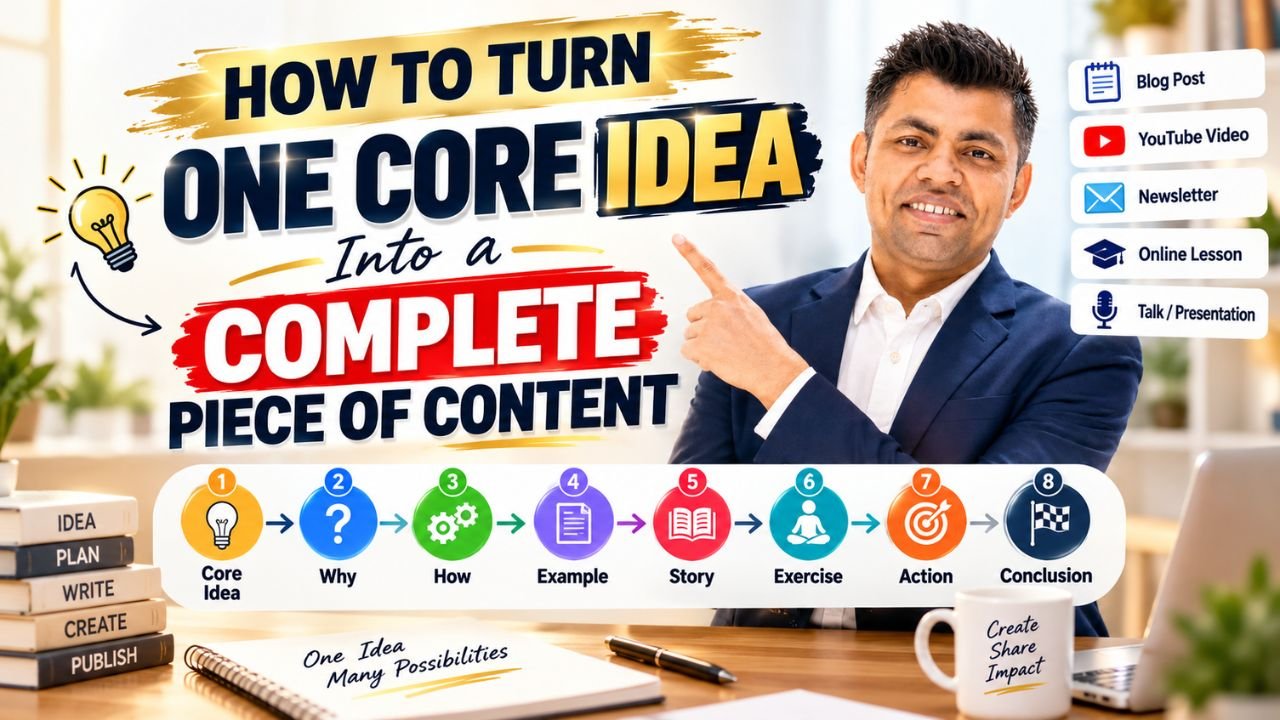
How to Turn One Core Idea Into Content: 8-Step Framework
You have an idea for a blog post.
You know it could help someone. You open a blank page and write your first sentence. Then you add two more sentences.
After that, you stop.
You look at what you have written and ask, “What else can I say?”
If this sounds familiar, the problem may not be your idea. You may simply need a way to develop it.
Many writers think a complete piece of content needs many different ideas. So, when they get stuck, they add more points. Soon, the post moves from confidence to habits, then to fear, then to goal setting. Each point may be useful, but the reader can no longer tell what the piece is about.
You can take a simpler path.
Start with one core idea. Then explore it through eight parts:
Core Idea → Why → How → Example → Story → Exercise → Action → Conclusion
Each part answers a question your reader may have. Together, they turn one short thought into a helpful blog post, video, newsletter, lesson, or talk.
In this guide, I will show you exactly how to do that. We will use one idea throughout the article: Confidence grows through action.
By the end, you will have a clear way to take an idea from your mind and turn it into content your audience can understand, remember, and use.
What Is a Core Idea?
A core idea is the one main message you want someone to take away from your content.
It is more focused than a topic. A topic tells the reader what area you will discuss. A core idea tells them what you want to say about that area.
For example, confidence is a topic. It could lead to hundreds of different posts.
“Confidence grows through action” is a core idea. It gives you a clear message to explain.
Here is another example:
- Topic: Overthinking
- Core idea: Taking one small step can help you find clarity when you feel stuck.
Now your content has a direction. You can explain why people wait for clarity, how a small step may help, and what that step could look like.
Why Does a Core Idea Matter?
Think of your core idea as the destination of a journey.
When you know where you are going, you can choose the right path. You can decide which examples belong in the piece. You can also set aside interesting thoughts that would take the reader somewhere else.
Without a core idea, you may keep adding information. Yet, more information does not always make content more helpful.
Your reader needs to know what the information means and why it matters to them. A clear core idea helps you give them that guidance.
It helps you as a creator, too. When you know your main point, it becomes easier to start, easier to continue, and easier to finish.
How Do You Find a Core Idea Within a Broad Topic?
Begin with the topic. Then ask yourself:
“What is one useful thing I want my reader to understand about this?”
Write your answer as a simple sentence.
If your topic is procrastination, your core idea might be:
A task often becomes easier to start when you make the first step smaller.
If your topic is self-doubt, you might write:
One mistake cannot tell you everything about what you are able to learn.
If your topic is making decisions, you might write:
You do not need every answer before you take a small step that gives you more information.
Notice that each sentence makes one point. You could explain it, show an example, and help someone use it.
That is what makes it a good starting place for content.
How Do You Know If Your Core Idea Is Clear Enough?
Ask these three questions:
- Can I say it in one sentence?
- Does it speak to a problem or question my reader has?
- Can I explain why it matters and what someone could do with it?
If you can answer yes, begin developing the idea.
If you cannot, make the idea smaller.
For example, “Improve your mindset” is very broad. However, “A short pause can help you choose your response during a difficult conversation” gives you a situation and a message.
You can always write another piece about another part of the topic. This piece needs one clear path.
The Eight-Step Content Framework
So, how do you expand one idea into a complete piece of content?
First, state the idea. Then answer the questions that naturally follow it.
| Step | The reader’s question |
|---|---|
| Core Idea | What are you trying to tell me? |
| Why | Why does it matter? |
| How | How does it work? |
| Example | What does it look like in real life? |
| Story | What might someone experience while trying it? |
| Exercise | How does this connect to my life? |
| Action | What can I do next? |
| Conclusion | What should I remember? |
You do not have to give each part the same length. In a short post, an example may be two sentences. In a longer article, the “How” section may take several hundred words.
The framework is a way to think. It helps you see what your reader may need next.
Now, let us build a piece of content with it.
Step 1: State Your Core Idea Clearly
Your reader should be able to find your main message early.
You do not need to begin with a long definition. Instead, start with a situation the reader knows. Then state your idea in plain language.
For example:
You have something useful to say in a meeting. Yet, you stay quiet because you do not feel confident. If this happens often, here is an idea to consider: confidence can grow when you practise speaking, one small step at a time.
The reader can see the situation. They can also see what the content will help them explore.
Speak to One Reader and One Problem
Imagine one person as you write.
Perhaps this person has ideas at work but hesitates to share them. Perhaps they want to record their first video but keep delaying it. Perhaps they would like to ask for help but worry about how the conversation will go.
Choose one situation for your opening. You can bring in other situations later.
When you begin with a clear moment, your reader is more likely to think, “Yes, I know what that feels like.”
Then they are ready to hear your core idea.
Use This Opening Formula When You Feel Stuck
Try writing:
If you struggle with [specific situation], this idea may help: [core idea].
Here is another version:
When [problem] happens, many people try [common response]. Yet, it may help to remember [core idea].
For example:
When a task feels too big, many people wait until they have more energy. Yet, making the first step smaller may help them begin sooner.
You can improve the wording later. For now, the formula helps you connect the reader’s problem to your message.
Keep Your Claim Honest
A clear core idea does not need to sound absolute.
“Confidence always comes after action” may be too broad. People can feel confident for many reasons, and every situation is different.
“Confidence can grow through practice and action” leaves room for real life. It still gives the reader a useful idea to explore.
That kind of care makes your content more trustworthy.
Step 2: Explain Why the Idea Matters
After you state your idea, imagine your reader asking, “Why does this matter to me?”
This is where you develop the Why section.
For our example, you might explore what happens when someone waits to feel completely confident before speaking.
They may stay quiet in meetings. They may avoid asking questions. They may put off sharing a useful suggestion. Over time, they have fewer chances to practise the skill they want to build.
That is the problem your idea speaks to.
Show the Pattern Behind the Problem
Try to describe what happens, one step at a time.
For example:
You want to speak, but you imagine saying something wrong. So, you stay quiet. Staying quiet brings relief for a moment. However, you miss a chance to practise. At the next meeting, speaking still feels unfamiliar.
This short passage gives the reader a pattern they can recognize.
You have moved beyond “Confidence grows through action.” You have shown why a lack of action may keep the problem going.
Explain Without Judging
Be gentle when you describe a problem.
Someone who stays quiet may be worried about making a mistake. They may be new to their role. They may have had a difficult experience before.
If your content makes them feel blamed, they may stop listening.
Instead, you can say:
It makes sense to want to feel ready. Still, waiting for complete comfort may mean you never get the practice that could help.
This approach respects the reader while inviting them to look at the pattern.
Explore What the Idea Could Change
Next, show why the core idea offers a useful direction.
A small action gives someone a real experience. Afterward, they can look at what happened. They may see that they expressed the point well. They may also notice one part they want to improve.
Either way, they now have information from a real attempt.
Of course, one attempt may not change how they feel right away. Yet, it gives them something they can learn from. Then they can choose another step.
Ask Three Questions to Write the “Why” Section
If you are struggling to develop this part, ask:
- What problem does my reader face?
- What may happen if they keep doing the same thing?
- Why could my core idea help them see another path?
Answer in simple sentences. After that, put the answers in an order that is easy to follow.
Your “Why” section is now taking shape.
Step 3: Show How the Idea Works
The “Why” section helps your reader understand the problem. The How section helps them use your idea.
This part often makes the difference between content that sounds inspiring and content that feels useful.
For example, “Take action to build confidence” gives a direction. However, someone who feels nervous may still wonder what to do first.
Your job is to make that first step visible.
Turn Your Idea Into a Small Process
For “Confidence grows through action,” you could offer this process:
- Choose one situation. Where would you like to speak or act with more confidence?
- Pick a small step. What could you do without making the moment too large?
- Prepare briefly. What words or materials would help you begin?
- Take the step. Try it in a real situation.
- Review what happened. What did you learn, and what will you try next?
Now the reader has a path to follow.
They do not need to become a confident speaker by tomorrow. They only need to choose one situation and one step.
Make Each Step Easy to Picture
A good “How” section uses words that point to real actions.
“Improve your communication” is hard to picture.
“Write one question before the meeting, then ask it when the topic comes up” is clear.
Likewise, “Become consistent with content” is broad.
“Choose one core idea on Monday and use this framework to draft a short post” is easier to act on.
Whenever your writing feels vague, ask yourself: “What would this look like on a normal day?”
Your answer can become the next sentence.
Answer the Doubts That May Stop Someone
Your reader may understand the steps and still have concerns.
“What if I feel nervous?”
You might write:
Feeling nervous does not mean you have to begin with a big action. You can start by preparing one sentence or practising it aloud. Then choose a moment when you are ready to try the next step.
“What if I make a mistake?”
You might answer:
Look at the specific mistake. Perhaps your words were unclear, or perhaps you needed more information. Choose one thing to change next time. Try to treat the moment as something you can learn from.
“What if I do not know what step to take?”
You could suggest:
Choose the smallest step that moves you closer to the situation you care about. If you want to speak in meetings, preparing a question may be a useful start.
By answering these doubts, you make your content more complete.
Keep the Process Close to the Main Idea
It is easy to add advice that is only loosely connected.
If your core idea is about building confidence through small actions, a long section on morning routines may distract the reader.
Before adding a step, ask: “Does this help the reader act on my core idea?”
If it does, keep it. If it belongs to another topic, save it for later.
Step 4: Give a Clear, Relatable Example
Your reader has heard the idea and the process. Now help them see it.
An example places your point inside a familiar moment.
Let us use a meeting at work.
Meera often has useful questions during team meetings. However, she worries that people will think her questions are too basic. This week, she writes down one question before the meeting. When the project timeline comes up, she asks it. Her manager answers, and two teammates say they had the same question.
The example shows a situation, a choice, and an action. It also shows what Meera learns: speaking once can give her information she would not have gained by staying silent.
Use the Four-Part Example Pattern
When you need an example, fill in these four parts:
- Situation: What is happening?
- Choice: What does the person decide?
- Action: What do they do?
- Learning: What do they notice afterward?
Let us try the same pattern with content creation.
- Situation: A coach wants to make a video but cannot write a full script.
- Choice: They decide to begin with one idea: “A small action can create clarity.”
- Action: They answer the questions “Why?” and “How?” and share one example.
- Learning: They see that the idea gives them enough material for a short video.
The pattern works because it turns a general message into something the reader can imagine.
Choose an Ordinary Moment
You do not need a life-changing event for every example.
A meeting, a phone call, a first draft, a difficult decision, or a conversation at home can be enough.
In fact, an ordinary example may help more readers see where the idea fits in their own lives.
Ask yourself: “Where would someone meet this problem during a normal week?”
Start there.
Make the Example Match the Point
If your core idea is about small steps, the person in your example should take a small step. If your idea is about asking better questions, show someone asking one useful question.
This may sound obvious. Yet, some content gives an example that is interesting but does not explain the idea.
After writing yours, check: “What does this example show?”
You should be able to answer in one sentence.
Step 5: Use a Short Story to Make the Idea Memorable
You may be thinking, “I already gave an example. Do I also need a story?”
Sometimes you do. Sometimes you do not.
An example can explain a point quickly. A story gives the reader more time with a person as they face a problem, make a choice, and learn from it.
For a short social post, one example may be enough. For a longer article, lesson, or talk, a story can help the reader stay connected.
Build Your Story in Three Parts
Keep the shape simple:
Before → Turning Point → After
In the Before part, show what the person wants and what is stopping them.
At the Turning Point, show the choice they make.
In the After part, show what happened and what they learned.
Here is a fictional story based on our confidence idea.
Arjun wants to create short videos about ideas that have helped him. Each evening, he sets up his phone. Then he starts thinking about his voice, his words, and how people might respond. He records a few seconds and stops.
One day, he changes his goal. Instead of trying to publish a perfect video, he decides to record a one-minute explanation that only he will watch. He chooses one idea and writes three prompts: why it matters, an example, and one action.
His first recording feels awkward. Still, he finishes it. The next day, he tries again and speaks a little more slowly. After a week, he has seven recordings. Now he can hear what he wants to improve.
Arjun has not become an expert speaker in seven days. However, he has begun practising. He has also learned more from those recordings than he learned from imagining every possible mistake.
The story supports the core idea. Arjun takes action, learns from it, and continues.
Let the Story Show Change Without Exaggeration
A story does not need a dramatic ending.
Sometimes the honest ending is that the person feels nervous but takes a step anyway. Sometimes they learn that their first plan needs to change.
These outcomes can still be meaningful.
If every story ends with instant success, readers may find it hard to trust. Let the person learn at a pace that feels real.
Use Real Stories With Care
If you share a client story, protect the person’s privacy. Get permission when needed, or remove details that could identify them.
If you combine situations or invent a person to teach a point, say the story is fictional.
You can write, “Imagine a professional named Arjun…” That tells the reader what kind of story they are reading.
Honesty makes your message stronger.
Step 6: Give the Reader an Exercise
At this point, the reader understands your idea. They have seen a process, an example, and a story.
Now invite them to think about their own life.
An exercise helps a reader move from “I understand” to “Where could I use this?”
It does not need to be long. In fact, a short exercise is easier to try while reading.
Try the “One Small Step” Exercise
Ask your reader to answer these three questions:
- What action am I waiting to feel confident enough to take?
- What is the smallest useful version of that action?
- What could I learn by trying it once?
Then give a sample answer:
Action I am delaying: Sharing an idea in our weekly meeting.
Smallest useful step: Prepare one sentence and say it when we discuss the project.
What I could learn: Whether my point is clear and what questions people have about it.
The exercise connects directly to the core idea. It also prepares the reader for the next step.
Why Include an Exercise in Your Content?
People may read a helpful point and agree with it. Then they return to their day and forget it.
An exercise asks them to pause. It helps them find a situation that matters to them.
For example, a reader may not need to speak in a meeting. They may need to call a potential client, ask for support, or record a first video. The exercise lets them apply the idea to their own situation.
Adapt the Exercise to Your Topic
Suppose your core idea is “A small action can help you gain clarity when you are overthinking.”
Your exercise might ask:
- What decision am I thinking about?
- What do I already know?
- What small action could give me useful information?
If your core idea is “A task becomes easier to start when the first step is smaller,” ask:
- What task am I avoiding?
- What part feels too large?
- What could I do for just five minutes?
Keep the questions simple. Each one should help the reader move closer to a useful answer.
Step 7: Give the Reader One Specific Action
An exercise helps someone think. An action helps them do something with what they found.
For our confidence example, the exercise helped the reader choose a small step. Now you can invite them to take it.
You might say:
Before your next meeting, write one question you want to ask. Read it aloud once. Then, when the right moment comes, ask it.
This action is clear. The reader knows what to prepare and when to use it.
Make the Next Step Small Enough to Try
“Change the way you speak at work” is a large task.
“Ask one prepared question this week” is smaller.
When you write an action prompt, include these details:
- When should the reader do it?
- What should they do?
- What is the smallest useful version?
For example:
Today, spend five minutes writing the first three lines of your blog post.
Or:
Before tomorrow’s call, write down the one point you want the other person to understand.
These actions give the reader a place to begin.
Offer a Smaller First Step If Needed
Some readers will find even your small action difficult.
You can help by offering an earlier step:
If asking the question in a meeting feels too hard right now, begin by writing it down. Practise saying it aloud once. Then choose a meeting where you can try asking it.
You are still guiding the reader toward action. You are simply helping them find a starting point they can manage.
Connect the Action to the Promise of Your Content
If the article promises to help readers turn one idea into content, the final action should ask them to start creating that content.
For example:
Choose one core idea today. Write one sentence under each of the eight steps. By the end, you will have the shape of your first draft.
The action grows out of the lesson. It does not feel like an unrelated request.
Step 8: Write a Conclusion That Brings Everything Together
A conclusion helps the reader leave with the main message clear in their mind.
You do not need to repeat every detail. Instead, return to your core idea and briefly connect it to what the reader can do.
For the confidence example, you might write:
Confidence may grow as you practise, learn, and try again. Choose one small action that matters to you. Take that step, then notice what the experience teaches you.
The ending brings the reader back to the idea. It also gives them a reason to use it.
Ask What You Want the Reader to Remember
Before writing your conclusion, finish this sentence:
“If the reader remembers only one thing, I want it to be…”
For this article, my answer is:
One clear idea can become a complete piece of content when you answer the reader’s next questions.
That is the message the conclusion should leave with you.
Add a Call to Action That Fits
After the conclusion, invite your reader to take a meaningful step.
They might try the exercise, write a first draft, read a related guide, or explore your services.
Choose a call to action that follows naturally from the article.
For example, an article about content creation can ask the reader to build one piece of content. An article about overthinking can invite them to take one small step toward a decision.
A strong call to action tells the reader exactly what to do next.
A Complete Mini-Draft From One Core Idea
Now let us put all eight steps together.
Below is a short piece built from the idea “Confidence grows through action.” Notice how each part adds something new.
Core Idea
You may be waiting to feel confident before you speak up. Yet, confidence can grow while you practise speaking. You can begin with one small step.
Why
When you always stay quiet, you miss a chance to learn how you want to express your thoughts. The next meeting may then feel just as hard. One short contribution gives you a real experience to learn from.
How
Choose one meeting this week. Before it begins, prepare a question or one point you want to share. When a useful moment comes, speak. Afterward, note what went well and one thing you could try differently.
Example
Suppose your team is discussing a deadline. You want to know whether the remaining work has been counted. You write one question: “Can we review the work left before we confirm the date?” During the meeting, you ask it.
Story
Last month, you had a similar question but kept it to yourself. Later, several people found the deadline difficult. This week, you ask early. You still feel nervous, but the team now has a chance to discuss the timeline.
Exercise
Write down one place where you would like to speak more often. Then finish this sentence: “The smallest useful thing I could say is…”
Action
Prepare that sentence today. Practise saying it aloud once. Then choose a real moment to use it.
Conclusion
You do not need to feel completely ready before you begin practising. Let one small action give you something real to learn from.
That is a complete piece of content.
If your audience needs more detail, you can expand the “Why,” “How,” and example sections. If you are writing a short post, you can keep only the strongest lines.
Either way, one idea gives the piece its direction.
How to Use This Framework for a Blog Post
A blog post gives you room to answer your reader’s questions in depth.
Start with the problem they recognize. Then state your core idea. After that, use headings to guide them through why the idea matters and how they can use it.
Add examples where a point feels abstract. Include a story if it helps readers connect with the experience. Near the end, give them an exercise and a clear action.
Turn Reader Questions Into Headings
Headings make a long post easier to follow. They also help you see whether each section has a job.
For a post about confidence, you might use:
- Why Do I Wait to Feel Confident Before Speaking?
- How Can I Start Speaking Up in Small Steps?
- What Does a Small Step Look Like in a Meeting?
- What Should I Do If My First Attempt Feels Awkward?
These are questions a reader might genuinely ask.
When your headings reflect those questions, you can write direct answers underneath them. That keeps the post useful.
Add Depth by Answering, Not Repeating
You may ask, “Can one core idea really become a full blog post?”
Yes, if there are important questions to answer.
You can explain the problem in more detail. You can show how the process works in different situations. You can address doubts the reader may have. You can give more than one example when each example teaches something distinct.
However, do not add length for its own sake.
If a paragraph only repeats what you already said, see whether you can replace it with a useful detail, a clear example, or a question the reader needs answered.
Write for Someone Reading on a Phone
Keep paragraphs short. Give each paragraph one main point.
Also, use headings often enough that someone can see the path of the article while scrolling.
Transition words can help, too. Words such as “first,” “next,” “for example,” and “as a result” show how your points connect. Use them naturally so the writing still sounds like a conversation.
How to Use This Framework for a YouTube Video or Talk
The framework also works when you speak.
Begin with a moment your audience knows:
“Have you ever wanted to share an idea in a meeting, but stopped because you did not feel ready?”
Then state the core idea. Explain why the problem happens and walk through one practical process. Show an example or tell a short story. Finally, offer an exercise and a next step.
Write Prompts Instead of Memorising Every Word
If you find it hard to speak without reading, write a small speaking card.
Put these prompts on it:
Idea → Why → How → Example → Story → Exercise → Action → Conclusion
Then write a few keywords under each one.
For example:
- Idea: Confidence can grow through action.
- Why: Staying quiet means less practice.
- How: Choose, prepare, speak, review.
- Example: One question in a meeting.
- Story: First attempt, second attempt, learning.
- Exercise: What small step could you take?
- Action: Prepare one sentence today.
- Conclusion: Practise and learn from the experience.
Now you have a path for speaking. If you forget an exact sentence, you can still explain the next point in your own words.
Read the Draft Aloud
Written content and spoken content do not always sound the same.
If a sentence is hard to say in one breath, shorten it. If a word feels unlike something you would say to a person, choose a more natural word.
You can also use questions to move between parts:
“So why does this happen?”
“What can you do in that moment?”
“Let me give you an example.”
These transitions help your listener follow you. They can also help you remember what comes next.
How to Use This Framework for a Newsletter or Social Post
A newsletter may feel like a personal note. You can open with a short observation, state your core idea, and share one example.
Then end with a question or action your reader can try.
A social post needs even less space. You may use only some parts of the framework in the final version.
For example:
Waiting to feel confident before you speak can keep you quiet for a long time.
Before your next meeting, write down one question. When the right moment comes, ask it.
Afterward, notice what you learned. That small moment gives you something real to build on.
This short post has an idea, a reason, an example, and an action. The writer may have used all eight questions while thinking, even though the reader sees only three short paragraphs.
Use the framework to make your thinking clear. Then give your audience the amount of content the format needs.
What If You Get Stuck While Expanding an Idea?
Getting stuck often tells you which question you need to answer next.
Here are four common places where that happens.
“I Can State the Idea, but I Cannot Explain Why”
Ask what problem the idea addresses.
If your idea is “A small action can create clarity,” ask what happens when someone waits for perfect clarity. Perhaps they keep reviewing the same options without getting new information.
Now you have a reason to explain.
You can also ask, “Why would my reader care about this today?” That question may lead you to the real-life cost of the problem.
“I Know Why It Matters, but I Cannot Explain How”
Picture one person in one situation.
What would you ask that person to do first? What could they do in five minutes? What would they look for after trying it?
Write those answers as steps.
For example, “Start creating content” is broad. “Choose one idea, write why it matters, and give one example” is a process someone can begin.
“I Cannot Think of an Example or Story”
Look at ordinary life.
Could the idea appear in a meeting, a family conversation, a first video, a difficult task, or a decision someone has delayed?
Then use this pattern:
Someone faces [situation]. They choose [small action]. They learn [useful lesson].
Your first example does not need beautiful writing. It needs to make the idea visible.
“My Content Sounds Repetitive”
Check the job of each section.
Does the “Why” section explain a reason? Does the “How” section show steps? Does the example show those steps in a real moment? Does the exercise help the reader apply the point?
If every section says the same thing, ask a new reader question.
Often, a better question will give you new material.
Common Mistakes That Make One Idea Feel Thin
One core idea can support a complete piece of content. Still, a few mistakes can make the final piece feel less helpful.
Starting With a Topic Instead of a Message
“Overthinking” tells the reader what area you are discussing. It does not tell them what they will learn.
Before you write, finish this sentence:
“The one thing I want my reader to understand about overthinking is…”
Your answer can become your core idea.
Adding More Points Instead of Exploring the Main Point
You may have ten good thoughts about confidence. That does not mean they all belong in one post.
First, explore the one thought you chose. Explain why it matters, how it works, and how someone can use it.
Save the other thoughts as ideas for future pieces.
Giving Advice That Is Too Broad
“Believe in yourself” may feel encouraging. Yet, what should the reader do when they close the page?
Give them a step they can picture.
For example:
Before your next meeting, write one question you want to ask. Practise saying it once.
Now the reader has something to try.
Using a Story That Does Not Support the Idea
A story may be moving, but it should still serve your main point.
Ask yourself what the reader learns from it. If the answer does not connect to your core idea, the story may belong in another article.
Ending With a Summary but No Next Step
A clear summary helps the reader remember. A next step helps them use what they learned.
Try to include both. Remind them of the idea, then invite them to take one action.
Making Every Section the Same Length
The framework does not ask you to write eight equal parts.
Your reader may need a long “How” section and a very short story. That is fine. Let their needs guide the space you give each part.
A Reusable Template: Turn Your Next Idea Into Content
Copy the questions below into a blank document. Then answer them with short notes.
You can turn those notes into a blog post, video, newsletter, lesson, or talk.
1. My Topic
What broad subject am I discussing?
Example: Overthinking
2. My Core Idea
What is the one message I want my reader to remember?
Example: One small action can help you gain clarity when you feel stuck in overthinking.
3. Why
Why does this idea matter? What problem does it address?
Example: If I keep thinking without getting new information, I may go over the same questions again and again.
4. How
How can someone use this idea? What are the small steps?
Example: Name the decision. Write down what you know. Choose one small step that could teach you something. Then review what you learn.
5. Example
What ordinary situation makes the idea clear?
Example: I am unsure whether to teach a workshop topic. Instead of building the whole workshop first, I ask three people what they would want help with.
6. Story
What short journey could help the reader remember the point?
Example: A creator spends weeks planning a course. After one conversation with a potential learner, she sees which lesson people need first.
7. Exercise
What question can help the reader apply this to their own life?
Example: “What am I trying to decide, and what small action could give me useful information?”
8. Action
What one step can the reader take today?
Example: Ask one person a clear question related to the decision you are facing.
9. Conclusion
What should the reader remember?
Example: Thinking helps you explore a decision. When you need more information, a small action may help you see your next step.
You now have the shape of a complete piece of content.
Write one or two sentences under each prompt. Then read the draft from beginning to end. Where would your reader need more help? Expand those parts.
Where does the piece repeat itself? Shorten those parts.
That is a practical way to build depth without losing focus.
Frequently Asked Questions
Can One Core Idea Really Become a Full Blog Post?
Yes. One clear idea can lead to useful questions, explanations, examples, and actions.
For instance, “A small action can create clarity” could become an article about why people wait, how to choose a useful step, what that step looks like in different situations, and how to learn from the result.
The goal is to answer what your reader needs to know. The length should serve that goal.
How Do I Expand an Idea Without Repeating Myself?
Give every section a different job.
The Why section explains the reason. The How section shows the process. The Example makes the idea easy to see. The Exercise helps the reader connect it to their own life.
If a paragraph adds no new answer, you may not need it.
Do I Need Both an Example and a Story?
No. A short post may need one example. A longer lesson may benefit from both.
Use an example when you want to show a point quickly. Use a story when following someone through a moment of change will help the reader understand the experience.
How Long Should Each Part Be?
There is no fixed word count for each part.
Some ideas need more explanation. Others need more practical steps. Your audience and format will help you decide.
Make each part long enough to do its job, then move on.
Can I Use the Same Framework for a YouTube Video or Course Lesson?
Yes. It gives your listener a clear path from idea to action.
In a video, use short spoken sentences and natural transitions. In a course lesson, you may spend more time on the process, examples, and practice exercise.
The questions remain useful in both formats.
What If My Core Idea Is Too Broad?
Bring it closer to a specific person, problem, and takeaway.
Instead of “Communication changes your life,” try “Preparing one clear point before a meeting can help you speak with more purpose.”
The second idea is easier to explain and easier for a reader to use.
How Do I Know My Content Is Complete?
Read it as if you are new to the topic.
Can you find the main point? Do you understand why it matters? Can you picture how to use it? Is there a clear next step?
If you can answer yes, your piece may be ready. You do not need to include every thought you have ever had on the topic.
Final Takeaway: Give One Idea a Clear Path
You do not need a page full of ideas before you begin writing.
Start with one message your audience could use. Then answer the questions that follow it: Why does it matter? How does it work? What does it look like? How can I try it?
Add an example or story when it makes the message clearer. Give the reader an exercise and one next step. Finally, bring them back to the main point.
That is how you turn one core idea into a complete piece of content.
When you feel stuck after your first few sentences, return to the framework:
Core Idea → Why → How → Example → Story → Exercise → Action → Conclusion
Ask the next question. Write a simple answer. Then keep going.
Your Next Step: Create One Piece of Content Today
Choose one idea you believe could help someone. Write it at the top of a blank page in one clear sentence.
Then give yourself 20 minutes. Write a short answer under each part of the framework. Do not stop to make every line perfect. First, give your idea a beginning, a path, and an ending.
When you finish, read it aloud. Keep what helps your reader. Improve what feels unclear. Then share the piece in the format that fits your audience.
Your next useful piece of content can begin with one sentence. Write that sentence today.
If you want support turning your ideas into clear thinking, confident expression, and consistent action, explore my mind transformation resources or connect with me for a one-to-one coaching conversation.
Rakesh Inani, NLP & Mind Transformation Coach
Transform Your Mind: JOIN MIND TRANSFORMATION COMMUNITY
Learn More:
Real Leaders Know This ONE Secret to Influencing Without Speaking
7 Day Manifestation- NLP Guided Meditation for Success
The Complete Success Formula: 6 Steps to Turn Goals into Consistent Action