
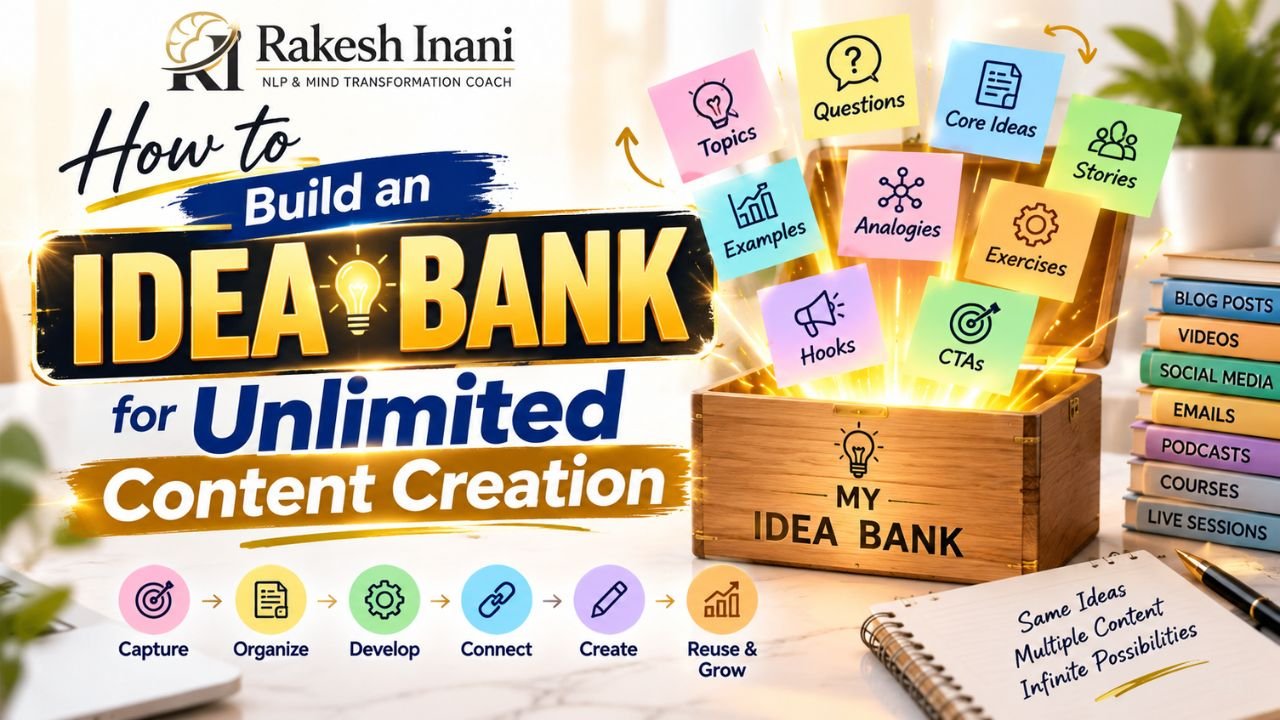
How to Build an Idea Bank for Unlimited Content Creation
You do not run out of content ideas because your mind is empty.
Instead, you run out of ideas because your best thoughts often arrive at the wrong time—and you do not have a trusted place to save them.
A useful idea may come while you are walking, reading, working, coaching someone, or talking with a friend. At that moment, the idea feels clear and powerful.
However, a few hours later, it disappears.
Then, when you finally sit down to write a blog post or record a video, your mind suddenly becomes blank.
You ask yourself, “What should I talk about today?”
Therefore, you start searching for new content ideas. You watch videos, study other creators, scroll through social media, and open many browser tabs.
Yet the real problem is not that you need more ideas.
The real problem is that you do not have a system for capturing, developing, organizing, and using the ideas that are already coming to you.
That is where an idea bank becomes powerful.
An idea bank gives every useful thought a safe home. More importantly, it helps you turn small thoughts into complete blog posts, videos, emails, social media posts, workshops, and coaching lessons.
In this guide, I will show you how to build a simple but powerful idea bank for unlimited content creation.
You will learn how to store topics, questions, core ideas, stories, examples, analogies, exercises, hooks, and calls to action. In addition, you will learn how to connect these pieces so that you never have to create content from an empty page again.
What Is an Idea Bank for Content Creation?
An idea bank is a personal system for capturing, organizing, developing, and connecting useful thoughts.
It is like a library for your content ideas.
However, instead of storing only finished books, this library stores the small building blocks that can become future content.
For example, your idea bank may contain:
- Topics you want to teach
- Questions your audience asks
- Problems people face
- Core ideas you believe
- Personal stories
- Practical examples
- Simple analogies
- Helpful exercises
- Attention-grabbing hooks
- Clear calls to action
Therefore, an idea bank is not only a list of possible titles.
It also stores what you want to say, why it matters, how you can explain it, and what your audience should do after learning it.
A Simple Definition
If someone asks, “What is an idea bank?” you can answer in this simple way:
An idea bank is one trusted place where you save and develop topics, questions, insights, stories, examples, hooks, exercises, and CTAs for future content.
Once these pieces are stored and connected, you can use them to create blog posts, videos, podcasts, emails, social posts, courses, and live sessions.
An Idea Bank Is Not the Same as a Content Calendar
Many people confuse an idea bank with a content calendar.
However, they have different jobs.
An idea bank stores possible content.
A content calendar schedules selected content.
In other words, your idea bank is your kitchen. It contains all your ingredients.
Meanwhile, your content calendar is your weekly menu. It tells you which meal you will prepare and when you will serve it.
For example, your idea bank may contain 50 ideas about overthinking. However, your content calendar may show that you will publish only three of those ideas this week.
Therefore, you need both systems.
First, your idea bank helps you think.
Then, your content calendar helps you publish.
Why Do Creators Run Out of Content Ideas?
If ideas are everywhere, why do creators still struggle to create content consistently?
Usually, the problem comes from five simple mistakes.
They Trust Their Memory
When a good idea arrives, it feels so clear that you believe you will remember it.
You may say, “This is a powerful idea. I cannot forget it.”
However, later in the day, you remember only a few words. Sometimes, you cannot remember the idea at all.
Your mind is excellent at creating connections. Yet it is not designed to hold every passing thought forever.
Therefore, do not ask your memory to become your storage system.
Capture the idea while it is alive.
Their Ideas Are Scattered Everywhere
One idea is in a diary.
Another idea is in a WhatsApp message.
A third idea is inside a voice recording.
Meanwhile, other ideas are hidden in screenshots, email drafts, book highlights, and social media bookmarks.
Technically, the ideas have been saved.
Practically, they are lost.
A saved idea has little value if you cannot find it when you need it.
Therefore, one trusted home is more useful than ten clever tools.
They Save Topics but Not Their Thinking
Suppose you write only one word in your notes:
Confidence
After two weeks, you open that note.
However, you cannot remember what you wanted to say about confidence.
Did you want to discuss low confidence, public speaking, action, fear, preparation, body language, or self-belief?
The note does not tell you.
Instead, write the complete thought:
Many people wait to feel confident before taking action. However, confidence usually grows after small actions create personal evidence.
Now, even if you read this note six months later, you can understand the message.
Therefore, never save only the topic. Save the thought behind the topic.
They Wait for Inspiration
Inspiration feels wonderful.
However, it does not always arrive according to your publishing schedule.
You may feel creative while driving, but not while recording. Similarly, you may get a great idea at night, but feel empty the next morning.
Therefore, professional content creation cannot depend only on your present mood.
An idea bank allows you to use yesterday’s inspiration during today’s creation session.
They Collect Ideas but Never Develop Them
Some creators have hundreds of notes.
Yet they still ask, “What should I post today?”
This happens because collecting and developing are different activities.
A rough idea may not be ready to become content.
First, you must clarify what it means. Then, you must connect it with a question, example, story, exercise, hook, or CTA.
Therefore, the goal is not to collect the highest number of ideas.
The goal is to make your ideas usable.
The Six-Step Idea Bank System
You can build your complete idea bank around this simple six-step process:
Capture → Clarify → Classify → Connect → Create → Compound
Let us understand each step.
1. Capture the Raw Thought
First, save the thought as soon as it appears.
At this stage, do not try to make it perfect.
For example, you may capture:
Fear grows when we keep imagining a negative future.
This sentence may not be ready for a full article. Still, it contains the seed of a useful idea.
Therefore, save it before it disappears.
2. Clarify the Meaning
Next, ask yourself, “What am I really trying to say?”
You may develop the earlier thought into:
Fear often becomes stronger when the mind repeatedly creates a negative picture of something that has not happened. By changing the picture and taking one safe action, we can begin to reduce its control.
Now the meaning is clearer.
3. Classify the Idea
Next, decide what kind of idea it is.
Is it:
- A topic?
- A question?
- A core idea?
- A story?
- An example?
- An analogy?
- An exercise?
- A hook?
- A CTA?
One thought may fit into more than one category. However, choose its main role so that you can find it later.
4. Connect Related Pieces
A core idea becomes more powerful when you connect it with other content assets.
For example:
- Topic: Fear of failure
- Question: Why does fear stop me from taking action?
- Core idea: Fear grows through negative imagination.
- Example: A professional avoids applying for a promotion.
- Analogy: The mind keeps playing a frightening movie.
- Exercise: Replace the worst-case image with a picture of one safe next step.
- Hook: The event may not be stopping you. The movie inside your mind may be stopping you.
- CTA: Choose one delayed action and complete its smallest step today.
Now you are not looking at one loose thought.
Instead, you have the structure of a complete piece of content.
5. Create the Content
Now, select the format.
The same connected idea can become:
- A long blog post
- A ten-minute YouTube video
- A short video
- An Instagram carousel
- An email
- A podcast topic
- A live teaching session
- A coaching exercise
Therefore, you do not always need a new idea for every platform.
You need one clear idea that can be expressed in different ways.
6. Compound the Value
Finally, continue building on what you have already created.
A blog post can give you five short videos.
A coaching question can become an email.
A personal story can support several lessons.
A workshop exercise can become a printable worksheet.
Therefore, your idea bank becomes more valuable with time. Every new entry can connect with several older entries.
This is how a small bank slowly becomes a rich content system.
Where Should You Store Your Content Ideas?
People often ask, “What is the best tool for creating a content idea bank?”
The best tool is not always the tool with the highest number of features.
Instead, the best tool is the one you can open quickly, understand easily, and use regularly.
A Digital Idea Bank
A digital system is useful because it is easy to search, edit, copy, filter, and connect.
You can use:
- A notes application
- A spreadsheet
- A digital document
- A database tool
- A project management tool
However, do not keep changing tools every week.
The value is in your thinking system, not in the software.
A Paper Idea Bank
If handwriting helps you think deeply, you can use a notebook.
Create separate sections for topics, questions, stories, examples, hooks, and exercises.
However, paper can become difficult to search when the bank grows.
Therefore, you may use paper for exploration and transfer the best ideas into a digital master bank.
The One-Inbox Rule
No matter which tool you select, create one main inbox.
Every new thought should first enter this inbox.
Later, during your daily or weekly review, you can clarify and classify it.
This simple rule removes an unnecessary question:
“Where should I save this idea?”
Capture first. Organize later.
The Nine Essential Sections of a Powerful Idea Bank
A complete content idea bank should not contain only titles.
Instead, it should contain different types of creative assets.
Here are the nine sections I recommend.
1. Topic Bank: What Will You Talk About?
A topic is a broad subject.
For example:
- Overthinking
- Self-confidence
- Procrastination
- Communication
- Decision-making
- Emotional control
- Goal setting
- Subconscious patterns
Topics help you create your main content pillars.
However, a broad topic is not yet a complete content idea.
For example, “self-confidence” is too broad for one focused video.
You can make it more useful by narrowing it:
- Self-confidence before public speaking
- Self-confidence after failure
- Self-confidence at work
- Self-confidence while meeting new people
- Self-confidence during decision-making
Therefore, store both the broad topic and its smaller subtopics.
To expand a topic, ask:
- What problem exists inside this topic?
- Who faces this problem?
- When does it appear?
- Why does it become worse?
- What result does the person want?
2. Question Bank: What Does Your Audience Want to Know?
Questions are some of the best content ideas because they show real interest.
People may ask:
- Why do I overthink every decision?
- How can I stop overthinking at night?
- Why does my mind go blank while speaking?
- How can I become confident without pretending?
- Why do I know what to do but still avoid action?
- How do I organize my thoughts before recording a video?
These questions can come from comments, messages, coaching conversations, search queries, community discussions, or your own experience.
Moreover, one spoken question may represent hundreds of silent questions.
If one person asks, “Why can’t I express what I know?” many other people may be searching for the same answer.
Therefore, whenever someone asks you a meaningful question, save the exact words they use.
Those words can later help you create clear, audience-focused content.
3. Core Idea Bank: What Do You Truly Want to Say?
A core idea is the heart of your content.
It is the one message you want your audience to understand and remember.
For example:
- Confidence grows through action, not endless preparation.
- Overthinking becomes stronger when the mind demands complete certainty.
- Clear speaking begins with clear mental structure.
- A small step can create more clarity than another hour of thinking.
- Procrastination often grows when a task feels too large.
A strong core idea usually fits into one sentence.
You can use this formula:
People struggle with [problem] because [cause]. They can begin to improve it through [principle or action].
For example:
People struggle to speak clearly because they try to remember complete sentences. They can speak more naturally by remembering a few connected ideas instead.
Remember, one topic can contain many core ideas.
Therefore, do not create only one note called “overthinking.” Create separate core ideas about its causes, signs, effects, mistakes, and solutions.
4. Story Bank: What Experience Can Carry the Message?
Facts can explain an idea.
However, stories help people feel and remember it.
Your story bank may contain:
- Personal experiences
- Lessons from mistakes
- Small wins
- Client situations with privacy protected
- Workplace experiences
- Family observations
- Historical events
- Everyday moments
You do not need a dramatic life story every time.
Even a two-minute moment can carry a strong lesson.
For example, imagine a professional who wanted to record educational videos. Every week, he prepared more notes. However, he kept delaying the recording because he wanted the first video to be perfect.
Finally, he recorded a simple three-minute video using only three bullet points. The video was not perfect, but it gave him real feedback. More importantly, it proved that he could begin.
The lesson is simple:
Preparation can support action, but it should not replace action.
To save a useful story, note:
- What was the situation?
- What problem appeared?
- What choice was made?
- What changed?
- What lesson came from it?
5. Example Bank: How Can You Make the Idea Easy to See?
A story has a situation, movement, and lesson.
An example is often shorter. It quickly shows how an idea works.
Suppose your core idea is:
Too many choices can increase confusion.
You can explain it with this example:
A person wants to join one online course. At first, he finds three good options. Then, he keeps searching until he has 25 options. Although he has more information, he now feels less able to choose.
This example makes the idea visible.
You can collect examples from:
- Work
- Business
- Relationships
- Health
- Learning
- Parenting
- Public speaking
- Daily decisions
When you store the example, also write which core idea it can support.
As a result, you will not need to search for an example while writing your content.
6. Analogy Bank: How Can You Make a Complex Idea Simple?
An analogy explains an unfamiliar idea through something familiar.
For example:
Making a decision is like driving at night. Your headlights do not show the entire road. However, they show enough road for your next safe move.
This analogy explains why complete certainty is not required before action.
Similarly:
- A thought pattern can be like a path in a field.
- Confidence can be like a muscle.
- Attention can be like sunlight through a magnifying glass.
- A daily habit can be like a small deposit in a bank.
- Mental overload can be like too many open tabs on a computer.
You can find analogies in roads, gardens, cooking, sports, machines, weather, phones, buildings, and nature.
However, use one quality test:
Does this analogy make the idea easier to understand?
If the analogy needs a long explanation, it may create more confusion than clarity.
7. Exercise Bank: What Can the Audience Practise?
Good content should not only inform people.
It should also help them do something.
Therefore, create a bank of simple exercises.
You may store:
- Reflection questions
- Journaling prompts
- Breathing practices
- Observation tasks
- Speaking drills
- Decision exercises
- Visualization practices
- Small action challenges
- Checklists
For example, if your content is about decision paralysis, you can give this exercise:
Choose one decision you have delayed. Write the smallest useful action that can give you new information. Then, complete that action within ten minutes.
A useful exercise should be:
- Clear
- Safe
- Easy to begin
- Connected to the lesson
- Small enough to complete
Most importantly, it should move the reader from knowing to doing.
8. Hook Bank: How Will You Earn Attention?
A hook is the opening line that makes the right person want to continue.
It can create curiosity, show a problem, ask a question, challenge a belief, or promise a useful result.
For example:
- You may not have an idea problem. You may have an idea-storage problem.
- Why does your mind go blank only when you start recording?
- More information may be making your decision harder.
- Before searching for another content idea, check the ideas you have already lost.
- Confidence may not be the starting point you think it is.
Create separate hook categories:
- Question hooks
- Problem hooks
- Story hooks
- Mistake hooks
- Myth hooks
- Contrarian hooks
- Curiosity hooks
- Result hooks
However, never use a powerful hook to make a false promise.
The hook should create interest, while the content should deliver what the hook promised.
9. CTA Bank: What Should the Audience Do Next?
A CTA, or call to action, tells the audience what to do next.
Different content needs different CTAs.
For educational content, you may say:
Save this framework and use it during your next content session.
For engagement, you may say:
Which part of content creation feels hardest for you? Share it in the comments.
For action, you may say:
Choose one idea from this article and develop it before the day ends.
For lead generation, you may say:
Download the free guide to continue this process.
For a coaching offer, you may say:
Book a complimentary clarity session if you need personal guidance.
Therefore, create CTA categories based on different goals:
- Reflect
- Practise
- Comment
- Save
- Share
- Read next
- Subscribe
- Download
- Book
- Buy
Then, when creating content, choose the CTA that matches the reader’s present stage.
What Should Every Idea Card Contain?
Your idea bank should stay simple enough to use.
At the minimum, every important entry should include:
- A clear title
- The type of idea
- One complete thought
- The audience problem
- The main topic
- A possible use
For example:
Title: Confidence comes after action
Type: Core idea
Audience problem: Waiting to feel ready
Main thought: Small actions create evidence, and evidence builds confidence.
Topic: Self-confidence
Possible use: YouTube video, blog section, short video
Later, you can add:
- Search question
- Story
- Example
- Analogy
- Exercise
- Hook
- CTA
- Content format
- Publishing status
- Link to published content
However, do not make every field compulsory.
If your system feels like hard office work, you will stop using it.
Therefore, start with a few useful fields. Add more only when they solve a real problem.
Where Can You Find Fresh Content Ideas Every Day?
When people ask, “How do content creators get ideas?” they often expect a secret source.
However, most useful ideas come from attention.
You find ideas by noticing what people ask, feel, misunderstand, avoid, and try to achieve.
Listen to Real Questions
Pay attention during:
- Coaching sessions
- Sales conversations
- Comments
- Messages
- Workshops
- Office discussions
- Community conversations
Save the person’s exact words when possible.
For example, “I understand everything, but I cannot explain it while speaking” is more useful than a vague note such as “communication problem.”
Notice Repeated Problems
If different people describe the same problem, you may have found a valuable content theme.
For example, people may say:
- “My mind goes blank.”
- “I know the topic, but I lose my words.”
- “I cannot explain my idea in order.”
- “I remember the start but forget the next point.”
Although the words are different, the common problem may be a lack of mental structure.
That common pattern can become your core idea.
Study Your Own Learning
Your struggles can also produce meaningful content.
Ask:
- What was difficult for me?
- What did I misunderstand?
- Which small change helped me?
- What do I understand now that I did not understand earlier?
- What would I tell my past self?
Your learning journey can help someone who is standing where you once stood.
Notice Strong Reactions
Whenever you strongly agree or disagree with something, pause.
Ask yourself why.
Your answer may reveal an original belief, insight, or core idea.
Learn Without Copying
Books, videos, podcasts, and research can inspire ideas.
However, do not simply repeat another person’s words.
Instead, record:
- What did I learn?
- What does it mean to me?
- Where do I agree or disagree?
- What example can I add?
- How can my audience apply it?
Also, record the source when you use someone else’s research or concept.
This protects trust and helps you return to the original material later.
How to Capture an Idea in 30 Seconds
Capturing an idea should be fast.
If the process takes five minutes, you may avoid it when you are busy.
Use this four-part quick capture formula:
- What did I notice?
- What might it mean?
- Who needs this idea?
- Why does it matter?
For example:
I noticed that people keep asking for more information before making a decision. It may mean that information sometimes becomes a way to delay action. Professionals who overthink decisions need this because delay can reduce both clarity and confidence.
That is enough for the capture stage.
Do not correct every sentence.
Do not search for the perfect title.
Do not design the complete post.
Capture first. Develop later.
If typing is difficult, record a short voice note. Say the idea, the reason, one example, and the person who may need it.
Most importantly, add enough context.
“Action and confidence” is too vague.
“Small action gives the mind evidence, and that evidence helps confidence grow” is usable.
How to Turn a Raw Thought Into a Strong Core Idea
A raw thought is a starting point.
To develop it, use this simple path:
Topic → Question → Answer → Principle → Action
Suppose your topic is overthinking.
Turn it into a question:
Why does overthinking make decisions harder?
Now answer it:
Overthinking makes decisions harder because every new possibility can create another doubt.
Next, find the principle:
Clarity does not always come before action. Sometimes, action gives us the information needed for clarity.
Finally, add an action:
Instead of solving the complete decision in your mind, take one small step that gives you real feedback.
You now have a complete core idea.
You can deepen it further by asking seven questions:
- What does this idea mean?
- Why does it matter?
- What causes this problem?
- What happens if it continues?
- What mistake do people make?
- What example can explain it?
- What small action can help?
However, do not force yourself to answer every question at once.
Choose the questions that make the idea clearer and more useful.
How to Combine Idea Bank Assets Into Complete Content
Once your bank contains different assets, content creation becomes a process of selection.
Use this formula:
One topic + one question + one core idea + one story or example + one analogy + one exercise + one hook + one CTA
For example:
- Topic: Overthinking
- Question: Why do I keep delaying important decisions?
- Core idea: Action creates feedback, and feedback creates clarity.
- Story: A professional delays applying for a better role.
- Example: Someone compares courses for weeks but starts none.
- Analogy: Headlights show only the next part of the road.
- Exercise: Take one ten-minute action.
- Hook: More thinking may be making your decision harder.
- CTA: Choose one delayed decision and take its smallest next step today.
Next, arrange these assets in a natural order:
- Begin with the hook.
- Describe the audience’s problem.
- Ask the central question.
- Share the core idea.
- Explain why it matters.
- Give a story or example.
- Use an analogy if needed.
- Offer a practical exercise.
- Summarize the lesson.
- End with the CTA.
Now, instead of asking, “What should I say?” you only need to ask, “Which saved pieces belong together?”
How to Generate Unlimited Content Ideas From One Topic
The word “unlimited” does not mean you must invent endless unrelated thoughts.
Instead, it means one useful topic can keep producing new content when you change the angle, situation, depth, or format.
Use the Ten-Angle Method
Take one topic and explore these ten angles:
- What is it?
- Why does it matter?
- What causes it?
- What are its signs?
- What mistakes make it worse?
- What myths surround it?
- How can someone improve it?
- What story explains it?
- What can it be compared with?
- What exercise helps?
For example, one topic—overthinking—can create:
- What Is Overthinking?
- Why Does Overthinking Feel So Difficult to Stop?
- Seven Hidden Causes of Overthinking
- Five Signs You Are Overthinking a Decision
- Mistakes That Make Overthinking Worse
- Common Myths About a Busy Mind
- How to Stop Overthinking Before Taking Action
- A Story About Waiting for Perfect Clarity
- Overthinking vs. Deep Thinking
- A Five-Minute Exercise to Quiet Mental Noise
You still have one main topic.
However, you now have ten clear pieces of content.
Change the Situation
The same problem may appear in different areas.
For example, overthinking may affect:
- Career decisions
- Relationships
- Sleep
- Public speaking
- Content creation
- Leadership
- Money choices
- Business planning
Therefore, “How to Stop Overthinking” can become “How to Stop Overthinking Before a Job Interview” or “How to Stop Overthinking Before Recording a Video.”
Change the Format
One core idea can become:
- A detailed blog post
- A YouTube lesson
- Three short videos
- A carousel
- An email
- A live session
- A worksheet
- A coaching exercise
Change the Level of Depth
You can create:
- A quick tip
- A beginner explanation
- A step-by-step method
- A detailed case study
- An advanced discussion
- A practical checklist
Therefore, you do not need to search for a completely new subject every day.
You need to understand your existing subjects more deeply.
How to Organize Content Ideas So You Can Find Them Quickly
A large idea bank becomes useful only when you can search it.
Therefore, use a few simple labels.
Label the Main Topic
Examples:
- Overthinking
- Fear
- Confidence
- Communication
- Procrastination
Label the Asset Type
Examples:
- Question
- Core idea
- Story
- Example
- Analogy
- Exercise
- Hook
- CTA
Label the Content Status
Use simple stages:
- Captured
- Clarified
- Connected
- Ready to create
- Drafted
- Published
- Ready to reuse
Label the Audience Stage
You may also mark content as:
- Awareness
- Understanding
- Action
- Decision
However, avoid creating too many labels.
If you need several minutes to decide where an idea belongs, your system is too complex.
How to Choose the Best Content Idea for Today
A large idea bank can create a new problem: too many choices.
Therefore, ask three questions:
- Does my audience need this now?
- Do I have something clear and useful to say?
- Does this idea support my current content or business goal?
If the answer to all three questions is yes, the idea deserves attention.
You can also match the idea to the audience’s stage.
For example:
- Awareness content helps people notice a problem.
- Understanding content explains causes and patterns.
- Action content offers methods and exercises.
- Decision content helps the right person consider an offer.
Then, select a suitable CTA.
An awareness post may invite the reader to follow you.
A practical guide may ask the reader to complete an exercise.
A trust-building article may invite the reader to download a guide.
An offer-focused post may invite the right reader to book a session.
The Daily, Weekly, and Monthly Idea Bank Routine
An idea bank grows through regular care.
However, you do not need to spend hours managing it.
The Five-Minute Daily Routine
Each day:
- Capture new thoughts.
- Add enough context.
- Mark any urgent idea.
- Leave deep organization for later.
The Thirty-Minute Weekly Review
Once a week:
- Open the inbox.
- Remove useless notes.
- Clarify promising thoughts.
- Place them in the right categories.
- Connect related assets.
- Select ideas for the coming week.
The Sixty-Minute Monthly Review
Once a month:
- Notice repeated audience questions.
- Find missing content areas.
- Update old ideas.
- Review published content.
- Select one main monthly theme.
- Mark strong ideas for reuse.
Collecting fills the bank.
Reviewing activates it.
Publishing creates value from it.
Therefore, do not let your idea bank become a silent storage room.
Common Idea Bank Mistakes to Avoid
Making the System Too Complicated
You do not need 50 fields, 30 tags, and a beautiful dashboard on the first day.
Begin with one inbox and the nine basic sections.
Then, improve the system only when necessary.
Using Too Many Apps
Every extra storage place makes retrieval harder.
Choose one main home.
If you capture elsewhere, move the idea into the master bank during your review.
Saving Vague Notes
A note such as “fear and action” will not help you later.
Write one complete sentence that preserves the meaning.
Collecting Without Creating
Saving ideas can feel productive.
However, the goal is not to own the largest idea bank.
The goal is to help people through useful content.
Therefore, regularly move ideas from captured to published.
Copying Other Creators
Use other content to notice questions, gaps, and fresh viewpoints.
However, build your content with your own thinking, language, examples, experience, and applications.
Adding Too Many Tags
Tags should help you find ideas.
If they make saving difficult, reduce them.
Waiting for Perfect Ideas
Most powerful content does not begin as a perfect idea.
It begins as a small observation that becomes clearer through questions, examples, and practice.
Forgetting the Audience
An idea may feel interesting to you but offer little value to your audience.
Always ask:
Which problem does this idea help the reader understand or solve?
Forgetting the Next Step
Even useful content can feel incomplete without direction.
Therefore, add a clear action, reflection question, or CTA.
A Seven-Day Plan to Build Your First Idea Bank
You do not need to complete your entire system today.
Instead, build it in seven simple days.
Day 1: Choose the Home
Select one digital tool, notebook, or hybrid system.
Create:
- One inbox
- Nine idea sections
- Three simple status labels
Do not spend the day decorating the system.
Your goal is to make it usable.
Day 2: Add Topics and Questions
Write ten main topics that connect with your knowledge and audience.
Then, add at least 20 real questions.
Think about what people ask, fear, avoid, misunderstand, or want to achieve.
Day 3: Write Core Ideas
Choose ten questions.
Answer each question in one clear sentence.
Do not try to write complete articles.
Your goal is to create ten strong core ideas.
Day 4: Collect Stories and Examples
Write five short stories and ten practical examples.
For each one, note the lesson it can support.
Keep client and personal details private where needed.
Day 5: Create Analogies and Exercises
Choose five core ideas.
Create one simple analogy and one small exercise for each idea.
Make sure each exercise is easy to understand and begin.
Day 6: Build Hooks and CTAs
Write 20 honest hooks.
Then, write ten CTAs for different goals such as reflection, practice, comments, downloads, subscriptions, and bookings.
Day 7: Connect and Create
Choose three strong core ideas.
Connect each one with:
- A question
- An example or story
- An analogy
- An exercise
- A hook
- A CTA
Now turn one connected set into a complete piece of content.
By the end of seven days, you can have more than 50 useful content assets and at least three ready-to-create content plans.
Simple Content Idea Bank Templates
You can copy these templates into your chosen system.
Quick Capture Template
Raw thought:
What triggered it:
What it might mean:
Who needs it:
Why it matters:
Possible topic:
Core Idea Card
Topic:
Audience question:
Audience problem:
Core idea:
Why it matters:
Story or example:
Analogy:
Exercise:
Hook:
CTA:
Possible format:
Status:
Complete Content Builder
Working title:
Main search question:
Opening hook:
Problem:
Core message:
Point 1:
Point 2:
Point 3:
Story or example:
Practical exercise:
Summary:
CTA:
These templates are useful because they separate thinking from writing.
First, you collect the pieces.
Then, you arrange them.
Finally, you turn them into natural content.
How to Make Your Idea Bank SEO, AEO, and GEO Friendly
Your idea bank can also help you create content that is easy for people, search engines, and AI answer systems to understand.
Save Real Search Questions
Instead of saving only “idea bank,” save natural questions such as:
- How do I build an idea bank?
- Where should I store my content ideas?
- How do I organize content ideas?
- How can I never run out of content ideas?
- What should a content idea bank include?
- How do I turn one idea into many posts?
- What is the best tool for storing content ideas?
These questions reveal clear search intent.
Add a Direct Answer
Under every important question, write a short answer in two to four sentences.
For example:
To build an idea bank, choose one trusted place and create sections for topics, questions, core ideas, stories, examples, analogies, exercises, hooks, and CTAs. Capture ideas quickly, review them weekly, and connect related pieces before creating content.
This improves clarity for readers. In addition, it makes the answer easy to understand and summarize.
Build Topic Clusters
Connect related content instead of publishing isolated articles.
For example, your content-thinking cluster may include:
- How to Convert a Topic Into Core Ideas
- How to Develop an Idea in Your Mind
- How to Think Deeply About Any Topic
- How to Turn One Core Idea Into Complete Content
- How to Generate Multiple Content Ideas From One Topic
- How to Organize Your Thoughts Before Speaking or Writing
Internal links help readers move through these connected lessons.
Add Original Value
Do not write only general definitions.
Add:
- Your own framework
- Practical exercises
- Personal observations
- Clear examples
- Useful comparisons
- Honest experience
- Step-by-step applications
Original value makes your content more helpful and more memorable.
Use Keywords Naturally
Do not repeat the same keyword in every paragraph.
Instead, use natural related phrases such as:
- Content idea bank
- Personal idea library
- Content creation system
- Content planning process
- Idea capture system
- Content organization
- Creative workflow
Write for the reader first.
Then, make the structure easy for search systems to understand.
Frequently Asked Questions About Idea Banks
What is an idea bank for content creation?
An idea bank is one organized place where you save topics, questions, insights, stories, examples, analogies, exercises, hooks, and CTAs. It helps you turn small thoughts into complete pieces of content without starting from zero each time.
How do I start an idea bank?
First, choose one trusted tool or notebook. Next, create an inbox and separate sections for the main idea types. Then, add your existing notes, audience questions, personal lessons, stories, and examples. Finally, review the bank once a week.
What should I include in my content idea bank?
Include anything that can support future content. This may include topics, problems, questions, beliefs, core ideas, stories, examples, research notes, analogies, exercises, titles, hooks, keywords, CTAs, and links to published content.
What is the best tool for storing content ideas?
The best tool is the one you can use quickly and consistently. A notes app, spreadsheet, digital document, database, or notebook can all work. Choose simplicity, searchability, and comfort over advanced features you may never use.
How many ideas should I collect before creating content?
You do not need to wait for a large number. Begin creating as soon as one idea is clear and useful. Your bank should grow while you publish. Otherwise, collecting ideas can become another form of procrastination.
How do I organize hundreds of content ideas?
Use a small number of labels. Mark the main topic, idea type, content status, and audience stage. In addition, connect related questions, stories, examples, and exercises to the same core idea. Avoid creating too many folders.
How often should I review my idea bank?
Capture ideas daily when possible. Then, complete a short review once a week and a deeper review once a month. The weekly review keeps the system active, while the monthly review helps you see larger patterns and content opportunities.
What is the difference between an idea bank and a swipe file?
An idea bank mainly stores your own thoughts and content assets. A swipe file usually stores inspiring examples created by other people. A swipe file may inspire you, but your idea bank helps you build content in your own voice.
Can one idea be used for different content formats?
Yes. One core idea can become a blog post, video, short, carousel, email, podcast topic, workshop lesson, or coaching exercise. However, adapt the depth, opening, examples, and CTA for each format instead of copying everything without change.
How do I generate content ideas when my mind feels blank?
Do not force yourself to invent something completely new. Review audience questions, old notes, personal lessons, repeated problems, previous content, stories, and examples. Then, change the angle, audience situation, depth, or format.
How can I avoid copying other creators?
Record what you learned, but also add your own interpretation, experience, example, framework, and action step. Mention the original source when you use someone’s research or unique concept. Inspiration is useful, but your thinking must remain visible.
Can an idea bank help me speak without reading a script?
Yes. Instead of memorizing complete sentences, store and connect a few key ideas. For example, remember the hook, core idea, three supporting points, example, exercise, and CTA. This structure gives your mind direction while allowing your words to remain natural.
Final Thoughts: Your Best Ideas Should Not Depend on Memory
You do not need to become a person who magically produces a brilliant new idea every morning.
Instead, you need to become a person who notices ideas, captures them, develops them, and uses them well.
That is the real purpose of an idea bank.
It helps you move from random inspiration to consistent creation.
It also helps you turn one topic into many questions, one question into several core ideas, and one core idea into many useful forms of content.
Over time, your bank becomes more than a storage system.
It becomes a map of your thinking.
It shows what your audience needs, what you believe, what you have learned, and what you are ready to teach.
Most importantly, it removes the fear of the empty page.
Therefore, do not wait for your idea bank to become perfect.
Open one note right now and name it My Idea Bank.
Then, add:
- One topic
- One audience question
- One core idea
- One example
- One action step
Your first five deposits can become your next useful piece of content.
And if your ideas feel clear inside your mind but become scattered when you speak or write, book a complimentary one-to-one clarity session with Rakesh Inani, NLP & Mind Transformation Coach.
Together, we can turn your thoughts into a simple structure that helps you communicate with greater clarity, confidence, and purpose.
Start your idea bank today—and allow your next useful thought to become content that genuinely helps someone.
Transform Your Mind: JOIN MIND TRANSFORMATION COMMUNITY
Learn More:
Real Leaders Know This ONE Secret to Influencing Without Speaking
7 Day Manifestation- NLP Guided Meditation for Success
The Complete Success Formula: 6 Steps to Turn Goals into Consistent Action