
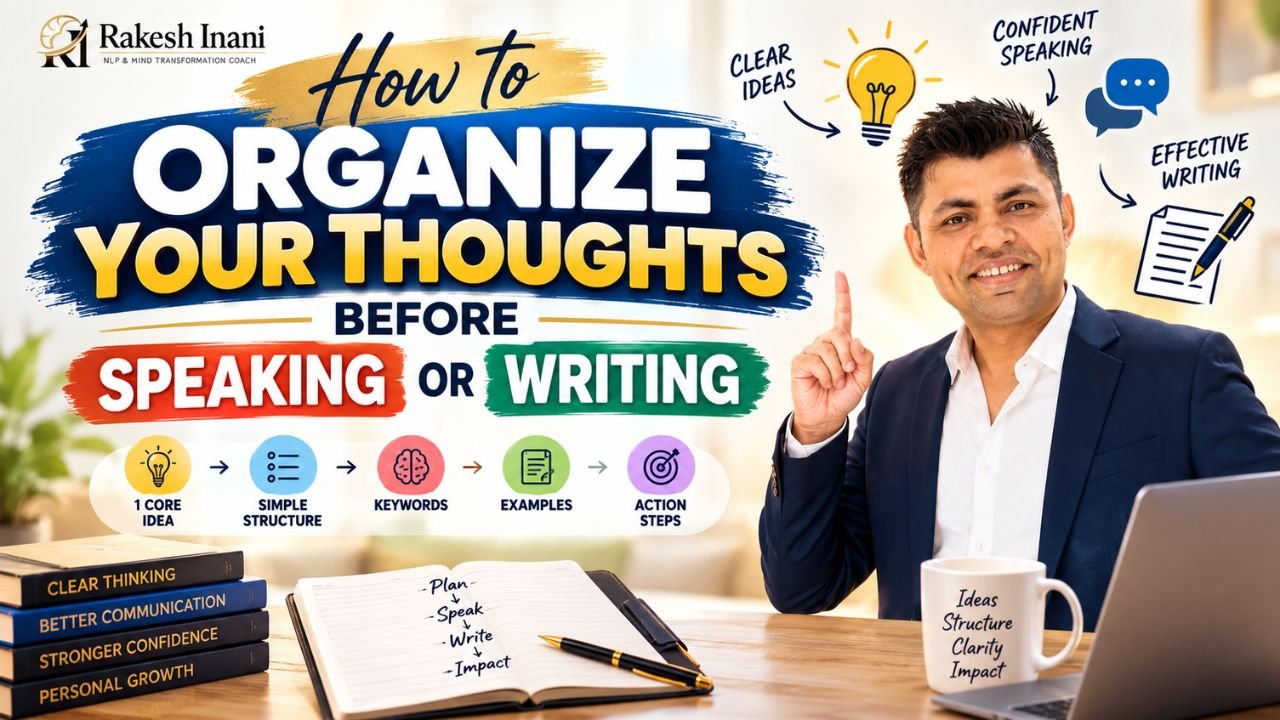
How to Organize Your Thoughts Before Speaking or Writing
You know what you want to say. Then you begin speaking, and the idea seems to disappear.
One thought leads to another. You remember an example too early. You forget the point you wanted to make. Then you start again, hoping the right words will come.
Writing can feel the same way. You sit down with a useful idea, but your first paragraph goes in one direction and your next paragraph goes somewhere else. Soon, you have many words on the page, yet your message still does not feel clear.
If this happens to you, take a breath. You do not have to hold your whole message in your head at once. You need a simple path that helps you move from one thought to the next.
In this guide, I’ll show you how to organize your thoughts before speaking or writing. You’ll learn how to find one main idea, choose a structure, make a short thought map, and recover when you lose your words. You can use these steps for a conversation, a blog post, a lesson, or a video.
Why Do My Thoughts Feel Clear Until I Start Speaking?
A thought can feel complete while it is still inside your mind. After all, you know what you mean.
However, your listener cannot see the links between your thoughts. You have to show those links with words.
For example, you may believe that action builds confidence. The idea feels simple. Yet, when you begin speaking, you may think of a job interview, a school memory, fear of mistakes, and a story about a friend. Each thought relates to confidence, but they do not yet form a clear message.
That is why organizing your thoughts matters. It gives your ideas an order that another person can follow.
Speaking asks you to make many small choices
When you speak, you choose your next word while thinking about your next point. At the same time, you may notice the listener’s face or wonder whether you are making sense.
So, if you lose a word, it does not mean your idea has no value. It may simply mean you have not decided which part comes next.
A small structure can help. Once you know, “First I’ll make my point, then I’ll give a reason, then an example,” you have fewer choices to make while speaking.
Writing has its own version of this problem
Writing gives you more time to think. Still, it is easy to drift.
You may add every related idea because each one seems useful. As a result, the piece grows longer without becoming clearer.
A good outline gives you a place for each idea. It also helps you see which ideas belong in another post.
More notes are not always the answer
You might think, “If I prepare more notes, I won’t forget anything.”
Sometimes notes help. Yet, a full page of small points can be hard to use while you speak. Your eyes search the page, and you lose your place.
Instead, begin with one message, a few supporting points, and a clear ending. That small plan is often easier to remember and easier to share.
What Does It Mean to Organize Your Thoughts?
Organizing your thoughts means deciding what you want to say and placing your ideas in a useful order.
You do not need a complex system. In fact, a simple structure often works best.
Think of your message as a short walk with someone. You choose where to begin, which stops matter, and where you want to end. If you turn down every side street, the other person may lose track of where you are going.
Your words work in the same way.
Start with one core idea
A core idea is the main message you want someone to remember.
It is more useful than a topic alone. “Confidence” is a topic. “Confidence grows when you take small actions” is a core idea.
Likewise, “Overthinking” is a topic. “Overthinking can keep you from taking the small step that would bring clarity” is a core idea.
Once you have that sentence, it becomes easier to decide which examples and points belong.
Put your ideas in a clear order
One easy order is:
Point → Reason → Example → Action
You state your idea. Then you explain why it matters. Next, you make it real with an example. Finally, you give the reader or listener something to try.
You can use this order for a two-minute answer or a longer piece. The length changes, but the path stays clear.
Use keywords as guides
If you are speaking, write a few keywords rather than every sentence.
For example, your card could say:
Confidence → small action → meeting example → try one step
Those words remind you of the path. Then you can explain each part in your own voice.
Of course, there are times when a full script is useful. You may want exact words for an important opening or a detailed lesson. Even then, it helps to know the simple path underneath the script.
Step 1: Choose One Core Idea Before You Begin
Before you ask, “How should I say this?” ask, “What am I trying to say?”
That question can save you a great deal of time.
Suppose your topic is decision making. You could talk about fear, time, advice, mistakes, and confidence. All of those may matter. However, one short talk cannot give each of them equal attention.
So, choose one message:
“A small decision can teach you more than waiting for perfect certainty.”
Now you have a direction. You can explain the idea, give an example, and suggest a first step.
Turn a topic into a sentence
If you find it hard to create a core idea, finish one of these lines:
- “The main thing I want you to understand is…”
- “Many people think ___, but they may be missing ___.”
- “If you want ___, begin with ___.”
- “One reason ___ happens is ___.”
For example:
Topic: Speaking with confidence
Core idea: “You can speak more clearly when you focus on one point at a time.”
Topic: Overthinking
Core idea: “A small action can bring more clarity than repeating the same thought.”
Topic: Writing
Core idea: “Your writing becomes easier to follow when each paragraph has one job.”
You can change the sentence later. For now, its purpose is to give your thoughts a center.
Make your idea specific enough to explain
A broad statement can sound good while giving you little to work with.
Consider, “Mindset is important.” You may agree with it, but what would you explain next?
Now consider, “The way you speak to yourself after a mistake can affect whether you try again.” This idea points toward a reason, an example, and an action.
When your core idea feels vague, ask: What happens? Who experiences it? What could they do?
You do not need to answer all three questions in your sentence. Still, they can help you find a message you can explain.
Try the one-sentence test
Say your core idea aloud.
Can you say it without taking a long detour? Would a listener understand the main point? Can you think of one real example?
If yes, you are ready to build around it.
If not, make the sentence smaller. One clear idea gives you a stronger start than five ideas you cannot yet connect.
Step 2: Choose a Simple Structure for Your Message
Once you know your core idea, choose a path for explaining it.
You do not need to use every structure below. Pick the one that fits what you want to do.
| If you want to… | Use this structure |
|---|---|
| Share a short insight | Point → Reason → Example → Action |
| Help with a common difficulty | Problem → Cause → Solution → First Step |
| Teach a new idea | What → Why → How → Example |
| Share a lesson from experience | Before → Turning Point → After → Lesson |
Let’s look at how each one works.
Structure 1: Point → Reason → Example → Action
Use this when you want to make one idea clear in a conversation, post, short video, or section of an article.
Let’s say your core idea is: “Small actions build confidence.”
Point: Confidence can grow when you take a small action.
Reason: That action gives you an experience you can learn from.
Example: If you want to speak up at work, you might begin by asking one question in a meeting.
Action: Choose one small speaking step you can take this week.
Notice that you do not have to say everything you know about confidence. You have one point and a simple way to explain it.
Structure 2: Problem → Cause → Solution → First Step
Use this when your reader or listener has a clear problem and wants practical help.
For example:
Problem: “I keep thinking about a decision but never make it.”
Possible cause: “I am waiting until I feel completely sure.”
Solution: “I can look for a small, safe step that gives me more information.”
First step: “I’ll write down the next decision I can make today.”
This structure is useful for coaching content because it meets the reader where they are. However, be careful with the word cause. You may not know every reason someone feels stuck. You can say, “One possible reason is…” and then offer a helpful step.
Structure 3: What → Why → How → Example
Use this when you are teaching someone a new concept.
Suppose you want to explain a thought map.
What: “A thought map is a short plan for the ideas you want to share.”
Why: “It helps you see your main point and what comes next.”
How: “Write one core idea, then add three to five keywords in order.”
Example: “For a talk about confidence, your words might be: action, experience, learning, next step.”
This order helps a new learner. First, they understand what the idea is. Then they learn why it matters and how to use it.
Structure 4: Before → Turning Point → After → Lesson
Use this when you want to tell a story with a clear purpose.
Before: What was happening?
Turning point: What changed?
After: What happened next?
Lesson: What can someone learn from it?
For example, you might tell a story about preparing too many notes for a video. You kept stopping to find your next line. Then you tried a card with four keywords. You found it easier to return to your point. The lesson is that a short guide can sometimes support a more natural explanation.
A story becomes stronger when you know its lesson before you tell it. That way, you can leave out details that do not help the reader.
Step 3: Turn Your Structure Into a Small Thought Map
Now you have a core idea and a structure. The next step is to put them where you can see them.
You can use a notebook, a note on your phone, or an index card. The tool matters less than the order of your thoughts.
Write the core idea at the top
Put your main sentence first.
For example:
Core idea: You do not need a perfect plan to take a useful first step.
This line is your return point. If you drift, look at it and ask, “How does my next point help explain this?”
Add a few keywords beneath it
Next, choose three to five words or short phrases.
Your card might look like this:
Core idea: You do not need a perfect plan to take a useful first step.
Keywords: waiting → small step → feedback → next step
You can now speak from this card:
“Many of us wait because we want the full plan. Yet, a small step can show us something we could not learn by waiting. For example…”
The keywords hold the order. You supply the words.
Put your points in the reader’s order
Your mind may find the ideas in a different order from the one your reader needs.
For instance, you may first think of a story. Then you remember the reason it matters. After that, you find your main point. That is a normal way to think while planning.
Before you share it, ask:
- What does this person need to understand first?
- What question might they ask next?
- Which example will make the point clear?
- What should they remember or try?
Then move your notes into that order.
Keep extra ideas for later
Suppose you are writing about organizing your thoughts before a video. You also think of ideas about camera confidence, lighting, editing, and video titles.
Those ideas may be useful. However, they do not all belong in this piece.
Write them on a separate “later” list. That way, you can stay with your message without losing ideas you may want to use another day.
How to Organize Your Thoughts Before Speaking
If you have ever asked, “How can I organize my thoughts before I speak?”, start with a short plan you can see at a glance.
You do not need to prepare every word. Instead, prepare the parts that help you move forward.
Prepare your first sentence
The first sentence is often the hardest because you are moving from silence into speech.
So, make it easy. Begin with a question, a familiar problem, or your main point.
For example:
“Have you ever had a clear idea, then lost it as soon as you began speaking?”
Or:
“Today I want to share one simple way to explain your ideas more clearly.”
Or:
“Here is the main point: a small plan can help you speak with more direction.”
Choose an opening that sounds natural in your voice. Then practice saying it once or twice.
Finish one point before moving to the next
When you speak, a new thought may appear before you have finished the current one. You may want to follow it right away.
Instead, pause and ask, “Have I completed this point?”
You can use a simple bridge:
- “Here’s why that matters.”
- “Let me give you an example.”
- “Now, what can you do with this?”
- “The main lesson is…”
These phrases tell both you and your listener where you are going.
Pause when you need to find your next thought
A pause is allowed. You do not have to fill every second.
If you forget what comes next, stop for a moment. Look at your next keyword if you have a card. Then begin a new sentence.
For example:
“So, the first step is to choose one idea.”
Pause.
“Next, let’s put the supporting points in order.”
You do not have to recover the exact sentence you planned. You only need to continue with the next idea.
Return to your main point at the end
When you close, do not search for an entirely new thought. Come back to the one you began with.
You might say:
“So, if your thoughts feel scattered, begin with one message. Then use a few keywords to guide your next points.”
That ending feels complete because it returns to the purpose of your talk.
How to Organize Your Thoughts Before Writing
Writing lets you stop, move sentences, and start again. That freedom is useful, but it can also make you keep adding more.
A clear writing plan helps you decide what the piece is meant to do.
Write your main point before your introduction
You do not have to write the first paragraph first.
Instead, write one private sentence at the top of your page:
“This article will help the reader turn scattered ideas into a simple plan for speaking.”
Now, when you draft a section, you can ask, “Does this help the reader do that?”
If it does, keep it. If it leads somewhere else, save it for another piece.
Give each paragraph one job
A paragraph is easier to read when it makes one point.
You can build a paragraph like this:
Point → Explanation → Example → Link
For example:
“A speaking card works best when it is short. If it has too many lines, you may spend your time searching for the next one. So, write your core idea and a few keywords. Then you can glance down, find your place, and keep speaking.”
That paragraph has one job: explain why a short card can help.
After that, the next paragraph can cover a new point.
Let headings guide the draft
Headings help your reader, but they also help you write.
Before you draft, try writing the questions your reader may have:
- Why do I lose my words?
- How do I find my main idea?
- Which structure should I use?
- What should I do if I go blank?
Those questions can become your sections. As a result, each part of the article has a purpose.
Move ideas instead of forcing them in
While writing, you may discover an idea that deserves more space. Resist the urge to fit it into a paragraph where it does not belong.
Move it to another section or a later list. Then return to the point you are making now.
This is one of the simplest ways to make a long article feel easy to follow.
How to Stay Clear While Teaching or Recording a Video
Teaching and recording videos bring speaking and planning together. You need to know your topic, but you also need to guide another person through it.
So, begin with what the viewer needs to understand.
Teach in a helpful order
A simple teaching path is:
Relatable situation → Pattern → Clear explanation → Example → Small experiment
For instance, you could begin with a person who keeps changing their mind before posting a video. Next, you could point out the pattern: each new thought sends them back to the beginning. Then you could explain how one core idea and a few keywords create a path.
After that, you could show a sample card. Finally, you could invite the viewer to try it with their own topic.
The order matters. Your audience can follow your lesson more easily when each part prepares them for the next.
Make a five-line speaking card
Before you record, try this card:
Hook: When do people face this problem?
Core idea: What do I want them to remember?
Why: Why does it matter?
Example: What real situation shows the idea?
Action: What can they try today?
For a video about overthinking, your card might say:
Hook: “You have a decision to make, but you keep going over it.”
Core idea: “A small step can bring new information.”
Why: “Thinking alone may keep repeating the same options.”
Example: “Talk to one person or test one part of the plan.”
Action: “Choose one small step for today.”
Now you have enough direction to begin. You can explain each line in your own words.
Use return points in a longer video
A long video has several parts. So, after each main part, say one sentence that brings the viewer back to the lesson.
For example:
“So far, we have chosen one core idea. Now let’s place the supporting points in order.”
That sentence helps the viewer follow you. It also helps you remember where you are.
Record in sections if it helps
You do not have to deliver a long lesson in one perfect take.
You can record the opening, pause, check your next point, and then continue. Over time, you may become more comfortable speaking for longer. For now, a clear explanation matters more than doing everything at once.
What Should You Do When You Lose Your Words?
Even with a good plan, you may lose a word or forget a sentence. It happens.
The key is to return to your message rather than chase the exact words you planned to say.
Let go of the missing sentence
Suppose you wanted to say, “Small actions create useful feedback.” You forget that line halfway through.
You can still say:
“When you take one step, you learn something. Then you can decide what to do next.”
The words changed. The idea stayed.
Your listener usually needs the idea, not a perfect match with your notes.
Ask one guiding question
If your mind feels blank, quietly ask yourself:
- “What is my point?”
- “Why does it matter?”
- “What example can I give?”
- “What can the listener do next?”
Choose one question. Then answer it with a short sentence.
For instance, if you forget an explanation about confidence, ask, “What example can I give?” You might remember the person who asked one question in a meeting. That example can help you move forward.
Use a natural recovery phrase
A short phrase can give you a moment to reset:
- “Let me put that simply.”
- “Here’s the main point.”
- “Think of it this way.”
- “Let me give you an example.”
Then return to your card or core idea.
For example:
“There are many ways we could look at this. Let me put it simply: choose one message before you choose all your words.”
You do not need to announce that you forgot something. Just help the listener find the point with you.
Notice where you tend to get stuck
Afterward, take a minute to review. Were you unsure of your main idea? Did you prepare too many points? Did you understand the point but lack an example?
Each problem has a different fix.
If your main idea was unclear, rewrite it as one sentence. If you had too many points, remove a few. If you could not explain the point, add one everyday example before you try again.
That kind of review makes the next practice more useful.
Common Mistakes That Make Your Thoughts Feel Scattered
A simple structure can help, but it is also useful to notice what pulls you away from it.
Mistake 1: Starting with a topic instead of a message
You decide to speak about “self-confidence.” Then, because the topic is so wide, you do not know which part to explain.
Try this instead: Write one sentence about self-confidence.
For example: “You can build confidence by taking a step small enough to begin today.”
Now your examples have a purpose.
Mistake 2: Trying to share everything you know
You have read, learned, and experienced a lot. Naturally, you want your message to be helpful.
However, adding every related point can make the main one hard to see.
Try this instead: Choose what the reader needs for this message. Save the other ideas for future posts, lessons, or conversations.
Mistake 3: Leaving a point unfinished
You begin explaining why people overthink. Then you remember a story. Halfway through the story, you start talking about confidence.
Your listener has to work hard to follow the path.
Try this instead: Finish the reason, then introduce the story: “Here’s a simple example of what I mean.”
Mistake 4: Memorizing words without knowing the idea
A prepared sentence may sound good. Yet, if you forget one word, the rest of the sentence can feel hard to find.
Try this instead: Learn the meaning first. Practice saying the same idea in two or three different ways.
If you can explain it simply, you can recover even when the planned wording disappears.
Mistake 5: Practicing only in your head
An idea can sound clear while you think about it. Speaking it aloud shows you where you need another link or example.
Try this instead: Speak for one minute and listen back. Then make one small change and try again.
You do not need a polished recording. You need a chance to hear what your listener would hear.
A 10-Minute Practice to Make Your Thoughts Clearer
You can practice organizing your thoughts without making it a long task.
Set a timer for ten minutes. Choose one topic and follow these steps.
Minutes 1–2: Pick one topic and write one core idea
Start with a topic you already know, such as overthinking, confidence, focus, or communication.
Then complete this line:
“The one thing I want to say is…”
Do not search for perfect wording. Write a sentence you understand.
Minutes 3–4: Choose one structure
Pick one path:
- Point → Reason → Example → Action
- Problem → Cause → Solution → First Step
- What → Why → How → Example
If you are unsure, use Point → Reason → Example → Action. It works well for a short practice.
Minutes 5–6: Add keywords and one example
Write a few keywords under your core idea. Then add one situation your reader or listener will recognize.
For example:
Core idea: A small action can help you move through overthinking.
Keywords: repeated thoughts → one step → new information → next choice
Example: Making one call before deciding on a course.
Keep your card short enough to read in a glance.
Minutes 7–8: Speak or write
If you are practicing speaking, talk for two minutes using only your card. You can record yourself if you wish.
If you are practicing writing, draft a short paragraph or two without stopping to edit every line.
Follow your points in order. If a new idea appears, note it for later and continue.
Minutes 9–10: Review and try one part again
Ask yourself:
- Was my main point clear?
- Where did I lose the flow?
- What one change would help next time?
Then repeat the part that felt unclear. You may only need to change your opening, move an example, or remove one point.
This short review helps you practice with purpose. You are improving one small part at a time.
A Complete Example: From Random Thoughts to a Clear Message
Let’s put the full method together.
Imagine you want to speak about overthinking. Your first notes look like this:
“People think too much. Decisions are hard. They want to be sure. They may ask everyone for advice. They feel tired. They need action. Sometimes they are afraid of mistakes. Maybe confidence matters too.”
These thoughts are related. Yet, if you speak from this list, you may jump from one point to another.
So, begin with one core idea.
Choose the core idea
“A small action can give you more clarity than repeating the same thought.”
Now you know which parts of the list support your message.
You may use the wish for certainty and the need for action. You can save the larger topic of confidence for another piece.
Choose a structure
Use Point → Reason → Example → Action.
Point: A small action can bring clarity.
Reason: When you keep repeating the same thoughts, you may not gain new information.
Example: If you are thinking about joining a course, you can read the course details or ask a specific question instead of running through the same worries again.
Action: Choose one step that would help you learn more today.
Make a short speaking card
Core idea: Small action can bring clarity.
Keywords: same thoughts → new information → course example → one step
This card gives you a path without asking you to memorize a paragraph.
Speak from the card
Here is one way the message could sound:
“Sometimes we keep thinking because we want to feel sure before we act. But if we go through the same thoughts again and again, we may not learn anything new.
“For example, you may be unsure whether a course is right for you. You could spend another evening imagining every possible outcome. Or you could read the course plan and ask one clear question.
“That small step may not answer everything. Still, it can give you new information. So, if you are stuck today, ask yourself: What is one action that would help me learn more?”
The words are simple. The message moves in one direction.
Turn the same card into writing
Now look at how the idea can become a short written piece:
A small action can bring clarity when your thoughts keep going in circles. If you repeat the same questions but gather no new information, you may feel busy without moving closer to a choice.
For example, if you are unsure about joining a course, write down what you need to know. Then read the course plan or ask one clear question. That step may help you see what to do next.
So, when you notice yourself thinking about the same choice again, ask: “What small action would give me new information?”
The spoken and written versions are different. However, both come from the same core idea and structure. That is the value of organizing your thoughts first.
Frequently Asked Questions About Organizing Your Thoughts
How can I organize my thoughts quickly before speaking?
Write one sentence that states your main point. Then add three or four keywords in the order you want to cover them.
For a quick answer, use Point → Reason → Example. If you have time, end with an action or takeaway. This gives you a path you can remember without preparing a full script.
What should I do if my mind goes blank while talking?
Pause and return to your main idea. Then ask yourself, “What is the next simple thing I want this person to understand?”
You can also say, “Let me give you an example,” if an example is easier to find than an explanation. You do not need to recover the exact words you planned.
How many points should I prepare for a short talk?
For a short talk, begin with one main idea and two or three supporting points.
The exact number depends on your time and topic. Still, fewer clear points are easier for you to explain and easier for someone else to remember.
Should I write a full script before recording a video?
A full script can help when you need careful wording or feel new to a topic. A short speaking card can help when you know the idea and want to sound more conversational.
You can also combine them. Write your opening and closing in full, then use keywords for the main explanation. Try both methods and see which helps you teach most clearly.
How do I stop jumping from one idea to another?
Decide your core idea before you begin. Then give each supporting point a place in your outline.
If another thought appears while you speak or write, ask whether it helps explain the core idea. If it does, place it in the right section. If it does not, save it for later.
Can I use the same structure for speaking and writing?
Yes. A structure such as Point → Reason → Example → Action can guide both.
When speaking, you may use keywords and natural pauses. When writing, you may add headings and fuller explanations. The format changes, but the order of ideas can stay the same.
How can I explain an idea clearly without sounding rehearsed?
Prepare the meaning and order of your points, then practice saying them in your own words.
You might explain the same idea once with a work example and again with an everyday example. This helps you know the idea well enough to speak naturally, even if your exact words change.
Final Thought: Give Your Ideas a Clear Path
The next time your thoughts feel scattered, do not try to hold every sentence in your mind.
Begin with one question: “What is the one thing I want this person to understand?”
Write the answer as a simple sentence. Then choose a structure, add a few keywords, and place your example where it helps most.
You can use this method before a meeting, a conversation, a blog post, a lesson, or a video. And if you lose a word, you can pause and return to your main idea.
Clear expression grows through practice. So, give yourself a small place to begin.
Choose one idea you want to share today. Write it in one sentence. Add a reason, an example, and one action. Then speak it aloud for two minutes or turn it into a short post.
Your idea deserves to be understood. Give it a clear path to reach someone else.
— Rakesh Inani, NLP & Mind Transformation Coach

Transform Your Mind: JOIN MIND TRANSFORMATION COMMUNITY
Learn More:
Real Leaders Know This ONE Secret to Influencing Without Speaking
7 Day Manifestation- NLP Guided Meditation for Success
The Complete Success Formula: 6 Steps to Turn Goals into Consistent Action