
How to Generate Multiple Content Ideas From One Topic
By Rakesh Inani, NLP & Mind Transformation Coach
You sit down to create a post. You have a topic in mind: overthinking.
Then a thought appears: “I have already talked about overthinking. What new thing can I say?”
So you look for another topic. You scroll through other people’s content. You save a few ideas. Yet, when you return to your own page, you still feel stuck.
If this sounds familiar, I want to show you a simple way to think about content.
You do not always need a new topic. Often, you need a new question about the same topic.
Think about overthinking. One person wants to know why it happens. Another wants to know if careful thinking and overthinking are the same. Someone else wants a small exercise they can use before an important decision.
All three people are interested in one topic. However, each person needs a different piece of content.
That is how one broad topic can become many useful ideas.
In this guide, I will show you how to generate 10 to 20 content ideas from one topic. We will use eight simple angles: problem, cause, myth, mistake, solution, story, comparison, and action.
Then, we will turn those angles into real titles. By the end, you will have a process you can use for your blog, YouTube channel, social posts, newsletter, or coaching content.
What Does It Mean to Generate Content Ideas From One Topic?
A topic is a broad subject. A content idea is one clear point you want to explore within that subject.
For example, confidence is a topic.
“Why does my confidence drop after one mistake?” is a content idea.
Likewise, communication is a topic. “How can I speak up in a meeting when I feel nervous?” is a content idea.
The difference matters because a broad topic can feel too large. You may have many things to say, yet you do not know where to begin. A clear idea gives your mind a direction. It also tells the reader what they will gain.
A topic opens the door; an idea gives the reader a reason to enter
Let us use overthinking as an example.
If you write “Overthinking” at the top of a blank page, you could go in many directions. You might talk about decisions, fear, sleep, work, relationships, or the need to be certain.
Now add one question: “Why do I overthink small decisions?”
Suddenly, the direction is clearer. You can describe what happens when a simple choice starts to feel large. Then, you can explore possible reasons and offer one practical next step.
That one question can become a blog post, a short video, or a conversation with your audience.
So, whenever you struggle to find a content idea, ask yourself: “What question sits inside this topic?”
One topic can serve readers with different needs
People do not arrive at a topic from the same place.
One reader may think, “I know I overthink, but I do not know what sets it off.” That person may want an article about common causes.
Another reader may say, “I understand the pattern. What can I do today?” That person wants a simple exercise.
A third reader may wonder, “Am I overthinking, or am I just being careful?” That person needs a comparison.
As a result, writing about the same topic in different ways can be helpful. You are meeting readers at different points in their journey.
Will my content become repetitive if I cover one topic often?
It can become repetitive if every piece says the same thing.
For example, imagine five posts with different titles that all give one message: “Stop thinking and take action.” A reader may feel that they have read the same post five times.
Now imagine five posts that answer these questions:
- How can I tell when I am overthinking?
- Why do I overthink more when people may judge my choice?
- What is the difference between planning and overthinking?
- What mistake keeps me stuck before I make a decision?
- What small action can I take when I do not feel certain?
These posts share a topic. Still, each one gives the reader something different.
That is the goal: return to an important topic, but answer a fresh and useful question each time.
Start With a Topic Your Audience Cares About
Before you create 20 ideas, choose a topic worth exploring.
You do not need to chase every popular subject. Instead, look at the questions your audience asks again and again.
If you are a coach, you may hear people talk about fear of failure, low confidence, unclear decisions, or difficulty taking action. If you teach communication, people may ask how to speak in meetings or explain their thoughts clearly.
These repeated questions are valuable. They show you where people need help.
Choose a topic linked to a real need
A good starting topic is easy for your audience to recognize.
For instance, “self-confidence” is familiar. Many people understand what it feels like to doubt themselves before speaking, applying for a job, or trying something new.
At the same time, your topic does not have to be a problem. It could be a skill, such as listening, planning, or building a daily writing habit.
To find a strong topic, ask:
- What does my audience often ask me about?
- What problem shows up in their daily life?
- What skill do they want to build?
- What result are they trying to reach?
- What do they find hard to explain in their own words?
Write down a few answers. Then, choose one topic you know well enough to discuss with care and detail.
Make your topic more specific before you expand it
A broad topic gives you room to explore. However, a little focus can make your ideas more useful.
Take the topic overthinking. You could focus on overthinking before decisions, after a mistake, while preparing to speak, or at the end of a workday.
Likewise, confidence could mean confidence in public speaking, confidence after failure, or confidence when setting a boundary.
Ask three short questions:
Who is dealing with this? When does it show up? What do they want to do instead?
For example: “Working professionals overthink before important decisions and want to move forward with more clarity.”
You now have enough focus to create ideas that feel close to real life.
Write one simple topic statement
If your topic still feels unclear, complete this sentence:
I help [person] understand or improve [topic] so they can [desired result].
For example:
I help working professionals understand overthinking so they can make clearer decisions and take small steps forward.
This statement is for you. It gives your content direction. You do not need to put it in every post.
Once your statement is clear, you can begin exploring the topic from different angles.
The Eight Angles That Turn One Topic Into Many Ideas
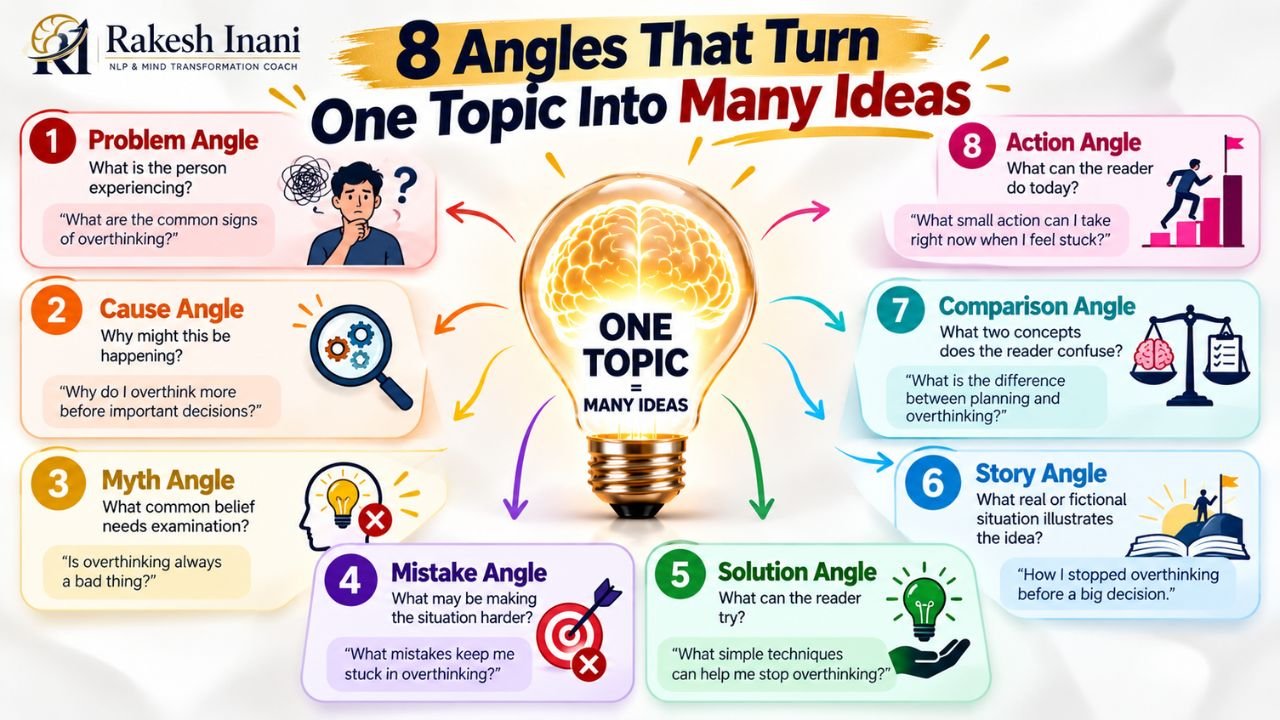
When people ask me how to generate content ideas from one topic, I like to start with questions.
Why? Because a question gives your mind something to search for.
The eight angles below are eight kinds of questions. You do not have to use every angle for every topic. However, they give you a reliable place to start when a blank page feels difficult.
Let us walk through them using overthinking as our main example.
1. The problem angle: What is the person going through?
The problem angle helps readers recognize their experience.
You might describe what the problem looks like, when it appears, or how it affects a normal day. For overthinking, you could explore a person who keeps reopening a decision after they have already made it.
You could also write about someone who spends an hour choosing how to reply to one message. The situation is small, but the mental effort feels large.
A possible title is “7 Signs Overthinking Is Delaying Your Decisions.”
Another is “How Overthinking Turns a Small Task Into a Long Day.”
To find ideas from this angle, ask: “What does this issue look like in real life?”
Then, think about moments your reader would recognize. The more specific the moment, the easier it is for the reader to feel understood.
2. The cause angle: Why might this happen?
Once someone recognizes a problem, they often want to understand it.
That makes the cause angle useful. You can explore what may be feeding a pattern without pretending that everyone has the same reason.
For example, someone may overthink a decision because the outcome matters to them. Another person may worry about being judged. Someone else may have too many options and no clear way to choose.
A possible title is “Why You Overthink More When a Decision Feels Important.”
Another is “Why Fear of Judgment Can Make Simple Choices Feel Hard.”
Ask: “What could be keeping this pattern going?”
Use words such as may, can, and sometimes when they fit. Human experiences are rarely explained by one cause. Your aim is to help the reader examine their own situation, not to tell them exactly what is happening inside their mind.
3. The myth angle: What common belief needs a closer look?
People often pick up ideas that sound true but leave out important detail.
For example, someone may believe that thinking longer always leads to a better decision. Careful thought can be useful. Yet, repeating the same worry without gaining new information may leave the person where they started.
That difference can become a piece of content.
A possible title is “Is Overthinking the Same as Thinking Deeply?”
Another is “Do You Need to Feel Completely Sure Before You Act?”
To use the myth angle, ask: “What belief might be confusing my reader?”
Then, examine the belief with care. There is no need to mock people for holding it. A warm explanation can help someone consider a new view without feeling judged.
4. The mistake angle: What may be making things harder?
Sometimes, a person wants to solve a problem but uses an approach that keeps them stuck.
For example, they may ask five people for advice about the same decision. Each person offers a different view. Now the choice feels even harder.
Or they may wait until they can imagine every possible outcome. Because they cannot know the future, they keep waiting.
These patterns can give you content ideas such as “5 Mistakes That Keep You Stuck Before a Decision” and “Why Asking Everyone for Advice Can Make a Choice Harder.”
Ask: “What does someone often do with good intentions that does not help?”
Keep the tone kind. Most readers are doing their best with the tools they have. When you explain a mistake, give them a clearer step they can try next.
5. The solution angle: What can the reader try?
The solution angle gives the reader a way forward.
Here, you can teach a method, offer a short set of questions, or break a large challenge into smaller steps. The key is to make the advice specific enough to use.
For example, “Be more confident” is broad. “Before your next meeting, write one sentence you want to say” is clear.
For overthinking, a title could be “A Simple Way to Make a Decision When You Are Overthinking.”
Another could be “Three Questions to Ask Before You Change Your Mind Again.”
Ask: “What could help my reader move one step forward?”
You do not need to solve a person’s whole life in one post. Often, one well-explained step is more useful than a long list of vague tips.
6. The story angle: What situation makes the idea easier to understand?
A story helps the reader see an idea in action.
You might share a personal experience. You could describe a common workplace situation. You might also use a fictional example and make it clear that it is fictional.
Suppose your topic is overthinking. You could tell the story of a professional who wants to share one suggestion in a meeting. They rehearse the sentence many times, imagine being judged, and stay silent. Later, they try a smaller step: asking one short question.
That story can show how a pattern appears and what a small change looks like.
A possible title is “The Meeting Where I Learned to Speak Before I Felt Ready.”
Ask: “Where have I seen this topic show up in an ordinary day?”
If you draw from a client conversation, protect the person’s privacy. Change or remove details that could identify them, and never present a made-up story as a real client result.
7. The comparison angle: What two things does the reader confuse?
Some of the most helpful content makes a clear distinction.
For example, people may use planning and overthinking as if they mean the same thing. However, planning usually helps you prepare for a next step. Overthinking may keep you revisiting the same questions without moving closer to a choice.
That distinction can help someone notice what they are doing.
Possible titles include “Planning vs. Overthinking: How to Tell the Difference” and “Caution vs. Avoidance: What Is Keeping You From Acting?”
Ask: “What two ideas does my reader need to separate?”
You could compare two habits, two choices, or two ways of looking at a situation. Just make sure the comparison helps the reader understand what to do next.
8. The action angle: What can the reader do today?
The action angle is about practice.
A reader may understand the problem and agree with your advice. Yet, they may still wonder, “What do I do after I close this page?”
Give them a short exercise, a journal question, a checklist, or a small challenge.
For example, an overthinking exercise could be:
- Write down the choice you are facing.
- Write down what you know today.
- Choose one small step you can take with that information.
A possible title is “A 5-Minute Exercise to Move From Overthinking to Action.”
Ask: “What is one realistic step the reader can try today?”
Keep the step small. A reader is more likely to begin when the action feels clear and possible.
6 Steps to Generate 10–20 Content Ideas From One Topic
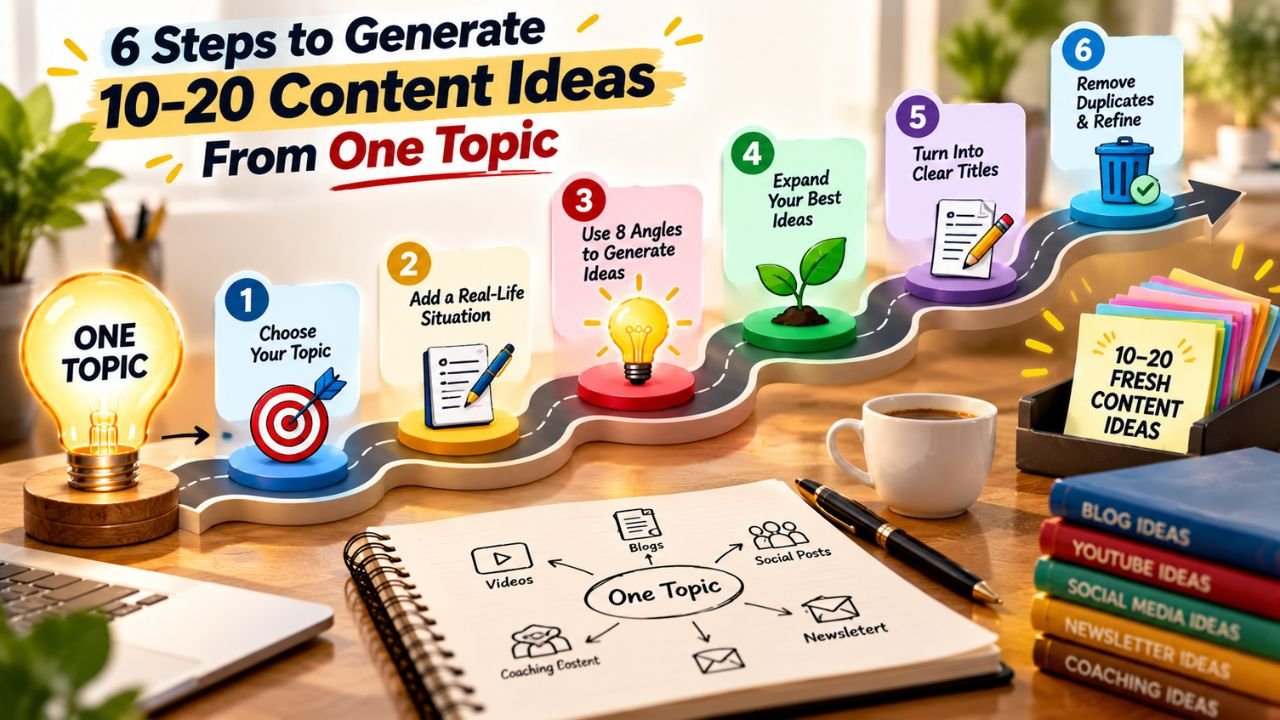
Now that you know the eight angles, let us put them to work.
You can do this with a sheet of paper, a notes app, or a simple document. You do not need a complex content system to begin.
Step 1: Write your broad topic at the top
Start with one or two words.
For our example, write Overthinking.
Do not try to create a perfect title yet. At this stage, you are choosing the subject you want to explore.
If your mind says the topic is too common, set that thought aside for a moment. A common topic can still lead to useful content when you answer a specific question well.
Step 2: Add one real-life situation
Next, connect the topic to a moment in the reader’s life.
For example: overthinking before making a decision at work.
Now you can picture the reader more clearly. Perhaps they need to reply to an important email. Perhaps they have to choose between two projects. Perhaps they want to raise a concern with their manager.
Each situation can lead to different ideas.
If you want more variety later, repeat this step with a second situation. For now, stay with one.
Step 3: Ask the eight angle questions
Write the eight angles down the side of your page.
Then, ask one question for each:
- Problem: What does the reader experience?
- Cause: What may be behind it?
- Myth: What belief needs a closer look?
- Mistake: What might make it harder?
- Solution: What could help?
- Story: What situation shows it clearly?
- Comparison: What does the reader confuse?
- Action: What can they practice today?
Write your first answer to each question. Keep it rough.
At this point, “Why I keep changing my decision” is enough. You can improve the title later. The goal is to collect ideas before you start judging them.
Step 4: Add a second idea to the strongest angles
After your first eight ideas, look for angles that have more to offer.
Perhaps the problem angle gives you three familiar situations. Maybe the comparison angle gives you both “planning vs. overthinking” and “careful thought vs. fear.”
Add a second or third idea where you can.
You can also change the situation. Ask what overthinking looks like before a meeting, after a mistake, or while starting a new project.
Before long, your list may grow from eight ideas to 12, 16, or 20.
You do not need to force a number. A list of 12 strong ideas is more useful than 20 titles that all say the same thing.
Step 5: Turn rough notes into clear working titles
Now make each idea easy to understand.
A rough note such as “work decisions and fear” might become “Why You Overthink Decisions When Other People Will See the Result.”
A note such as “small step” might become “What to Do When You Cannot Decide: Start With One Small Test.”
Notice how each title points to a question or promise. The reader can tell what the piece will discuss.
However, a working title does not have to be final. You can revise it after you write the content.
Step 6: Remove ideas that repeat the same point
Read your list once more.
If two titles would lead you to give the same explanation and the same advice, combine them or change one of them.
For instance, “How to Stop Overthinking a Decision” and “How to Make a Decision Without Overthinking” may turn into the same article. You could keep one and replace the other with a more specific question.
Try changing the situation, the reader’s need, or the action.
This final step makes your idea list stronger. You want a collection of useful answers, not a collection of new names for the same answer.
Complete Example: 20 Content Ideas From “Overthinking”
Here is what the method looks like when we use all eight angles.
You can use this list as a model for your own topic. Notice that some ideas help readers understand their experience, while others help them take action.
| Angle | Content ideas |
|---|---|
| Problem | 1. 7 Signs Overthinking Is Delaying Your Decisions 2. How Overthinking Can Turn One Small Task Into a Long Day |
| Cause | 3. Why You Overthink More When a Choice Feels Important 4. Why Fear of Judgment Can Make Simple Decisions Feel Hard |
| Myth | 5. Is Overthinking the Same as Thinking Deeply? 6. Do You Need to Feel Completely Sure Before You Take Action? |
| Mistake | 7. 5 Mistakes That Keep You Stuck Before Making a Decision 8. Why Asking Too Many People for Advice Can Add to Your Confusion |
| Solution | 9. A Simple Three-Question Check for Your Next Decision 10. How to Choose a Small Next Step When Your Mind Feels Busy 11. What to Do When You Keep Changing Your Mind |
| Story | 12. The Meeting Where I Learned to Speak Before I Felt Ready 13. A Workplace Story About Choosing Progress Over Perfect Certainty |
| Comparison | 14. Planning vs. Overthinking: How to Tell the Difference 15. Caution vs. Avoidance: What Is Really Holding You Back? 16. Reflection vs. Rumination: When Does Looking Back Stop Helping? |
| Action | 17. A 5-Minute Exercise to Move From Overthinking to Action 18. Three Journal Questions to Clear Your Next Decision 19. A 7-Day Small-Action Challenge for People Who Overthink 20. What Is One Step You Can Take Before You Feel Ready? |
These ideas all belong to one topic. Still, they do different jobs.
For example, idea 1 helps a reader recognize a pattern. Idea 4 explores a possible reason. Idea 14 clears up a confusing difference. Idea 17 gives the reader a practice.
Also, you do not have to publish all 20. Treat the list as a bank of possibilities. You can choose the ideas that best fit your audience, your experience, and the questions people are asking now.
How to Turn Each Idea Into a Useful Piece of Content
Finding an idea is a strong start. Next, you need to develop it so the reader gets a clear answer.
A useful piece of content does not need to cover everything you know about a topic. In fact, it is often easier to follow when it stays with one main point.
Give each piece one main message
Let us take the idea “What to Do When You Keep Changing Your Mind.”
Its main message might be:
You may not need another round of thinking. You may need a clear point at which you will decide with the information you have.
Now the content has direction.
You could explain why people keep reopening a choice. You could give an everyday example. Then, you could show the reader how to set a decision time and write down what matters most.
Every paragraph should help explain or apply that main message.
If you discover another interesting point while writing, save it for a new piece. That is one more content idea for your list.
Follow a simple structure
When you are unsure how to develop an idea, use this structure:
Question → Clear answer → Why it matters → Everyday example → Practical step
For example, imagine you are writing about planning and overthinking.
Start with the question: “How can I tell whether I am planning or overthinking?”
Then give a clear answer: “Planning helps you prepare a next step. Overthinking may send you around the same worry again and again.”
Next, explain why the difference matters. If you believe you are preparing, you may continue thinking even when you already have enough information to act.
After that, show an example. A person plans for a meeting by choosing three points to discuss. Later, they replay every possible reaction for an hour. The first part helps them prepare. The second may leave them drained without adding much.
Finally, offer a step: “Write down the next action your thinking has produced. If there is no new action or information, take a short break and return to the choice at a set time.”
That is one complete piece of content built from one idea.
Choose a format that fits the reader’s need
The same topic can work across many formats. However, some ideas need more room than others.
| If the reader needs… | Try this format |
|---|---|
| A quick answer | A short post or FAQ answer |
| A fuller explanation | A blog post or video |
| Clear steps | A guide or carousel |
| A relatable example | A story or speaking video |
| Something to try now | An exercise or checklist |
For example, “What is the difference between planning and overthinking?” could begin as a short post. If your audience asks follow-up questions, you could expand it into a blog article with examples.
Likewise, a five-minute exercise could work well as a short video. You could then turn the same idea into a written checklist for readers who prefer to follow steps at their own pace.
The format can change. The main idea stays clear.
How to Find Fresh Angles When Your Ideas Feel Too Similar

Sometimes, you use the eight angles and still feel that your titles sound alike.
That does not mean you have reached the end of the topic. Usually, you need to change one part of the question.
Here are three easy ways to do that.
Change the situation
A topic can look different in different parts of life.
Overthinking before sending a message may feel different from overthinking a career choice. Confidence while speaking to a friend may feel different from confidence during a job interview.
So, place your topic in a real situation:
- Before a meeting
- After making a mistake
- While starting a new project
- During a hard conversation
- At the end of the day
Then, ask the eight angle questions again.
For example, the topic “confidence” plus the situation “speaking in meetings” could become “What can I say when I have an idea but feel afraid to interrupt?”
Now you have a useful and specific question.
Change the stage of the reader’s journey
A reader who is just noticing a problem needs different content from someone who has been working on it for weeks.
You can create ideas for four simple stages:
Awareness: “What is happening?”
Understanding: “Why might it be happening?”
Action: “What can I try?”
Progress: “How do I keep going?”
Let us use procrastination as an example.
An awareness piece could be “How to Notice When You Are Avoiding a Task.”
An understanding piece could be “Why a Task Feels Harder When You See It as One Huge Job.”
An action piece could be “How to Make the First Step of a Task Smaller.”
A progress piece could be “What to Do When You Miss a Day and Want to Begin Again.”
These ideas work together because each one helps the reader at a different point.
Change the question, not just the title
If you want a fresh idea, changing a few words in the title is not enough.
For example, these titles are very close:
- “How to Stop Overthinking at Work”
- “How to Reduce Overthinking at Work”
Both may lead to the same content.
Instead, change the question you will answer:
- “Why Do I Replay Work Conversations After I Get Home?”
- “How Can I Prepare for a Meeting Without Rehearsing Every Possible Response?”
Now the two pieces have different purposes. One looks at what happens after a conversation. The other helps before a meeting.
Whenever your list feels repetitive, write the question under each title. If the questions are the same, revise one of the ideas.
Listen to the words your audience uses
Your audience can help you find angles you would not think of on your own.
Pay attention when someone says, “I know what I should do, but I cannot start,” or “I keep thinking about what I said yesterday.”
Those sentences can lead to specific pieces of content because they describe a real moment.
You can also review questions in comments, messages, and conversations. Look for words people repeat. They may call an experience “getting stuck,” “going blank,” or “thinking too much.”
Use those words when they help you speak clearly to the reader. However, respect privacy. A private conversation can inspire a general topic without becoming a public story about that person.
Common Mistakes to Avoid When Creating Multiple Ideas
The eight-angle method is simple. Still, a few habits can make the process harder than it needs to be.
Here is what to watch for.
Trying to create 20 perfect titles at once
When you demand a polished title for every thought, your mind may slow down.
Instead, collect rough ideas first. Write phrases such as “fear of wrong decision” or “planning vs worry.” Later, turn the strongest phrases into titles.
Think of the first list as a place to explore. You are allowed to cross things out.
Making every idea too broad
“How to Stop Overthinking” may be a useful guide. Yet, if every post has that level of scope, it can be hard to say something specific.
Try narrowing the question.
For example, “How to Stop Overthinking” could become “How to Stop Reopening a Decision After You Have Made It.”
The second title gives you a clearer path. It also lets the reader know whether the piece is for them.
Giving the same advice under different titles
Look beyond your titles. Ask what you would actually say in each piece.
If every idea ends with “just take action,” the reader may not learn much after the first post.
You can deepen the content by explaining a different situation, showing a useful comparison, or offering a different exercise. If you have only one strong message, say it well once before creating more pieces around it.
Making promises the content cannot support
A strong title gets attention. An honest title builds trust.
Be careful with claims such as “End Overthinking Forever in Five Minutes.” A short exercise may help someone pause, organize their thoughts, or choose a next step. It cannot promise to remove every difficult thought.
Instead, tell the reader what your content can genuinely offer. Clear, realistic language can still be compelling.
Creating ideas without knowing the reader
A long list of titles is useful only when someone needs the answers.
Before you spend time making content, ask: “Who is this for? What are they trying to do? What question would they ask in their own words?”
For example, a working professional may search for “How do I stop overthinking before a meeting?” A creator may ask, “Why do I keep changing my content plan?”
Both involve overthinking, but they call for different examples and actions.
A 15-Minute Exercise to Create Your Own 20-Idea List
Let us turn this article into practice.
You can do the following exercise today. Set a timer for 15 minutes and keep your answers simple.
Minutes 1–3: Choose your topic and reader
Complete these two lines:
My topic is: __________
My reader struggles with or wants to learn: __________
For example:
My topic is: Self-confidence.
My reader wants to speak up at work but worries about making a mistake.
Next, add one everyday situation. You now have a starting point that is clear enough to explore.
Minutes 4–11: Write under the eight angles
Write each angle on its own line. Then, finish these prompts:
- Problem: My reader notices this when…
- Cause: One possible reason is…
- Myth: My reader may believe…
- Mistake: A common habit that may not help is…
- Solution: One useful approach could be…
- Story: A familiar situation is…
- Comparison: My reader may confuse… with…
- Action: One small thing to try today is…
Write at least one idea for each angle.
Then, return to the angles that came easily. Add a second situation, a second question, or a different example. You may reach 12 or more ideas before the timer ends.
If you do not reach 20, that is fine. Save the list and continue later. The exercise is meant to make starting easier.
Minutes 12–15: Pick your first three ideas
Circle the ideas that meet these four checks:
- Clear: Can I explain the idea in one sentence?
- Useful: Does it answer a real question?
- Distinct: Is it different from the other ideas on my list?
- Relevant: Does my audience care about it?
Choose three ideas you could create this week.
Then, write one line under each: “The main message is…”
You have now moved from a broad topic to a practical content plan. More importantly, you know what each piece is meant to say.
Frequently Asked Questions
How do I generate content ideas from one topic?
Start with one topic and one audience situation. Then, ask questions from eight angles: problem, cause, myth, mistake, solution, story, comparison, and action.
Write a rough idea under each angle. After that, explore a second situation or add another question to your strongest angles. Finally, turn the best ideas into clear titles.
How many content ideas can I get from one topic?
You can often find 10 to 20 ideas by asking different questions about one broad topic. However, the number is a guide, not a rule.
Some narrow topics may give you only a few strong ideas. Other topics may lead to many. Focus on ideas that offer the reader a new answer, example, or step.
How can I avoid repeating myself when I cover one topic often?
Write the main question under every proposed title. Then, write the main answer you plan to give.
If two pieces have the same question and answer, combine them or change one. You can look at a different situation, a different stage of the reader’s journey, or a different action.
Should I create content for all 20 ideas?
No. Think of your list as a set of options.
Choose ideas that match what your audience asks, what you can explain well, and what fits your current goal. You may publish some ideas now and save the others for later.
As you hear new questions from your audience, you can update the list.
Can I use the same idea for a blog post, a video, and a social post?
Yes. One clear idea can work in several formats.
For example, you could explain “planning vs. overthinking” in a short social post. Then, you could make a video with two relatable examples. Finally, you could write a longer blog post with questions and a practical exercise.
Adapt the depth and presentation to the format. Keep the central answer easy to find.
What if I cannot think of even one angle?
Begin with an ordinary moment instead of an abstract topic.
Ask, “When does my reader face this?” Picture one scene: a meeting, a difficult message, a choice, or the start of a large task.
Then, describe what the person might ask in that moment. A real-life question is often easier to work with than a broad word on a blank page.
Conclusion: Your Next 20 Ideas May Already Be Inside One Topic
The next time you feel that you have run out of content ideas, return to a topic your audience cares about.
Then, look at it from a new angle.
Ask what problem the reader sees. Explore what may cause it. Examine a myth or a common mistake. Offer a solution. Tell a helpful story. Make a comparison. Give the reader one action they can try.
You do not need to answer every question in one piece of content. Choose one question and one main message. Explain them clearly. Then, let the next question become your next piece.
That is how you can turn one broad topic into a collection of useful articles, videos, and posts.
Here is your next step: Choose one topic today. Write down the eight angles. Give yourself 15 minutes to find your first 10 to 20 ideas. Then, choose one idea and create something that helps your reader take a clear step forward.
If you are working through overthinking, low confidence, or difficulty taking action yourself, explore my other guides for practical exercises you can use. And if you would like personal support, book a complimentary one-to-one conversation with me, Rakesh Inani. Let us find the next clear step you can take.

Transform Your Mind: JOIN MIND TRANSFORMATION COMMUNITY
Learn More:
Real Leaders Know This ONE Secret to Influencing Without Speaking
7 Day Manifestation- NLP Guided Meditation for Success
The Complete Success Formula: 6 Steps to Turn Goals into Consistent Action