
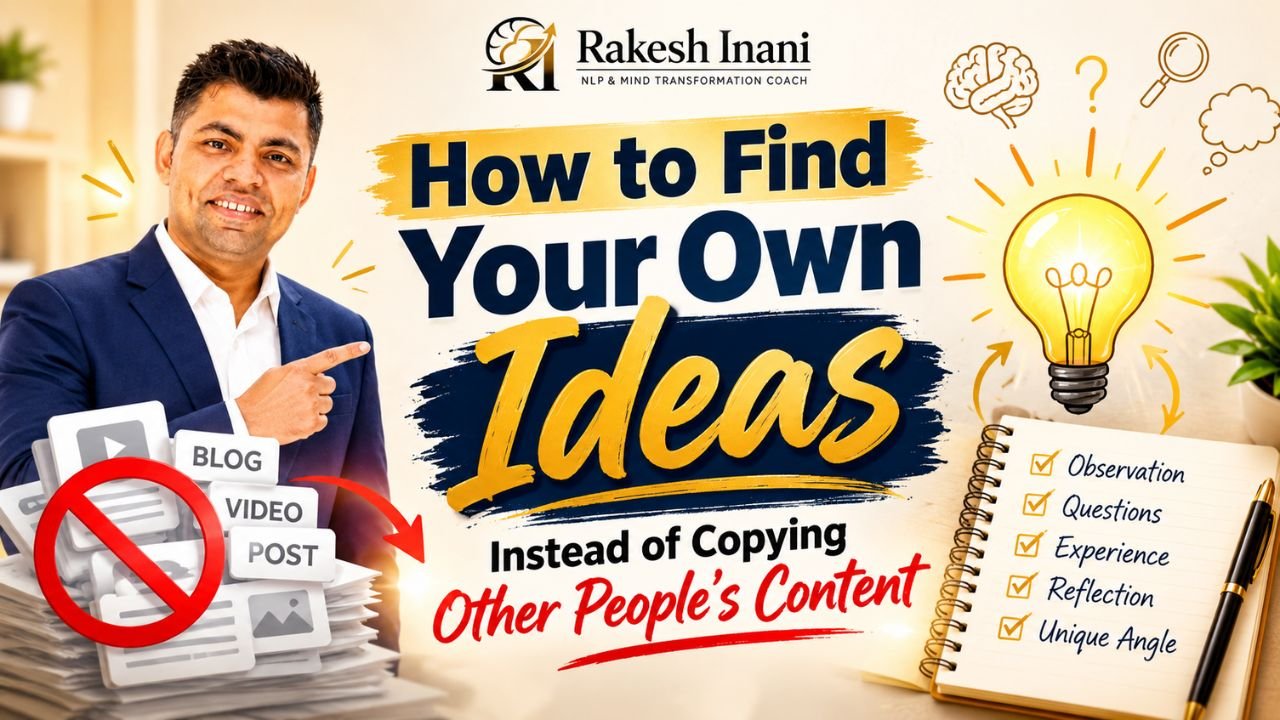
How to Find Your Own Content Ideas Instead of Copying Other People’s Content
By Rakesh Inani, NLP & Mind Transformation Coach
You read one post about your topic. Then you watch three videos. After that, you save a few more ideas for later.
Finally, you sit down to create your own content.
But the page stays blank.
Every line you think of sounds like something you just read. So you search again, hoping the next post will give you a fresh idea. Instead, you find more versions of the same advice.
If this happens to you, I want you to pause for a moment. Your next content idea may be closer than you think. It may be in a question someone asked you, a small problem you noticed, or an experience you have not yet taken time to understand.
You do not need to find a topic that nobody has ever discussed. You need to find something you can see, explain, and make useful for another person.
In this guide, I will show you how to find your own ideas through observation, experience, reflection, questions, pattern recognition, and original examples. You will also see how to turn one small thought into a clear piece of content.
Let us begin with a simple question: What makes an idea your own?
What Does It Mean to Have Your Own Idea?
An original content idea does not always start with a new topic.
Think about overthinking. Thousands of people have written about it. Still, one writer might focus on sleep. Another might focus on hard choices. A third might notice that people rewrite a simple work message many times because they fear being judged.
The topic is the same. Yet the point each writer makes is different.
A Topic Is Not the Same as an Idea
A topic tells you what you will talk about. An idea tells you what you want to say about it.
For example:
- Topic: Overthinking
- General tip: Stop overthinking and take action.
- Focused idea: When you treat a small choice like a test of your worth, the choice can feel much harder than it is.
The focused idea gives you a direction. You can explain why the choice feels heavy, show what it looks like in daily life, and offer one small way to move forward.
So, if you are asking, “How can I make my content original?” start here: Move from a broad topic to a clear point that comes from something you have noticed or thought through.
Your View Matters More Than a New Label
Sometimes creators try to find a new name for a familiar lesson. But a new label alone does not give the reader much help.
Instead, ask yourself, “What have I seen that could help someone understand this problem better?”
Your answer might be simple. That is fine.
A useful idea can begin with a sentence such as, “People often know what step to take, but they keep waiting until they feel ready.” From there, you can explore when that happens, why it matters, and what the reader can try next.
Your voice becomes clearer when you pay close attention and say what you mean.
Why Do We Keep Copying Other People’s Content?
Most people do not sit down with a plan to copy someone. Often, they are trying to learn.
They read articles. They watch videos. They save strong hooks and useful tips. All of that can help. Yet a problem can appear when they try to create right after taking in many other people’s words.
Other People’s Words Are Still in Your Head
Imagine listening to the same song all morning. Later, you may find yourself humming it without trying.
Content can work in a similar way. When you read five posts before writing your own, their phrases may be the first ones that come to mind. You may even agree with those ideas. Still, you have not yet made space for your own thoughts.
So, before you search for more examples, close the tabs. Then write three lines about what you have noticed.
You can research and read again after that. For now, let your own starting point become visible.
We Think Every Idea Must Be Brilliant
Another reason we repeat others is that our own first thought may seem too small.
You notice that people delay replying to messages when they are unsure how their words will sound. Then you think, “That is obvious. Someone must have said it already.”
Maybe they have. But can you explain it through a clear example? Can you show what the person might be worried about? Can you offer one action that makes the reply easier?
The value of an idea often appears while you develop it. Give a small thought the chance to grow.
Start With Observation: What Did You Notice Today?
Observation means paying attention to what people do, say, ask, avoid, or repeat.
You do not need to travel somewhere new to find content ideas. Daily life gives you plenty to work with. A delayed decision, a question at work, or a moment when advice does not help can all be starting points.
The key is to notice a specific moment.
Look for Small Points of Friction
A point of friction is a place where someone wants to do something but gets stuck.
For instance, a person wants to send a short email. They write it, change two words, read it again, and leave it in drafts.
A broad view might say, “They are overthinking.”
A closer view asks, “What part feels hard? Are they trying to be clear? Are they afraid the other person will be upset? Do they think one wrong word will cause a big problem?”
Each answer could lead to a different piece of content.
The same approach works with speaking, learning, money, health habits, or relationships. Notice the exact point where a simple task stops feeling simple.
Write a Three-Line Observation Note
You do not need a long journal entry. Use these three lines:
- What happened? “Someone rewrote a short message many times.”
- What might it mean? “They may be trying to avoid being misunderstood.”
- Why might it matter? “This fear can turn a quick task into a long one.”
Now you have the start of an idea.
Later, you can test whether your reading of the moment is fair. For now, the note helps you remember what stood out.
When the moment involves another person, protect their privacy. You can leave out details, ask permission, or create a clearly imagined example based on a common situation.
Pay Attention to Your Own Day
You are also a source of observations.
Did you put off a task this morning? Did a conversation change your mind? Did you explain something to a friend in a way that made it easier to understand?
Write it down.
You do not have to publish every note. In fact, many notes will stay private. But as you collect them, you will begin to see the questions and situations that keep drawing your attention.
That is often where your strongest content begins.
Use Your Experience, Even If It Feels Ordinary
You may be wondering, “How can I find my own content ideas if I have not done anything special?”
You do not need a dramatic story. You need to look closely at something you tried, learned, changed, or found difficult.
Suppose you wanted to record a video. At first, you planned to wait until you had the perfect script. Then you tried speaking from five short points. Perhaps that made it easier to begin. Perhaps it showed you that your examples still needed work.
Either result gives you something real to explore.
Ask What You Tried and What Happened
Start with four plain questions:
- What was I trying to do?
- What did I expect?
- What happened?
- What would I try next time?
For example, “I thought I needed to remember every sentence before recording. When I used five key points instead, I could speak more naturally. Still, I had to practice my examples.”
That is more helpful than saying, “Just be confident on camera.”
It tells the reader what changed and where the difficulty remained.
Share the Lesson Without Making It a Rule
Your experience can be useful without being true for everyone.
You can say, “This helped me start,” or “You might try this if you face a similar problem.” You do not need to say, “This method works for every person.”
That small change makes your writing more honest. It also helps readers decide whether your lesson fits their lives.
Over time, keep watching what happens when you use the idea again. A new result may help you improve the post, record a follow-up video, or change your view.
Reflect: Turn an Event Into a Useful Lesson
An experience gives you material. Reflection helps you understand it.
For example, “I was nervous before a meeting” is an event. “I kept preparing more notes because I was afraid I could not answer one hard question” begins to show a pattern.
So, after something catches your attention, give yourself a few minutes to think.
Ask Five Reflection Questions
Use these questions in your notebook:
- What happened?
- Why did this stay in my mind?
- What did I believe at the time?
- What do I think now?
- What could another person learn or try?
You may not know every answer at once. That is okay. Even one answer can lead to a strong idea.
Perhaps you believed that being prepared meant knowing every possible answer. Now you think preparation also means knowing how to pause, ask a question, and respond with care.
That change in thought is worth sharing.
Look for the Moment Your View Changed
Many good posts contain a small turning point.
You may have thought, “I need confidence before I speak.” Later, after several practice sessions, you might think, “Speaking while I feel unsure can help me build confidence.”
The post does not need to claim that fear will disappear. Instead, it can show the reader one way to practice while fear is still present.
That is a clear, useful lesson. It came from taking time to understand what changed for you.
Ask Questions That Lead to Better Ideas
Questions can open a topic that feels closed.
If your first idea is “People should take action,” ask, “Why might taking action feel hard?” Then ask, “At what point do they stop?” After that, ask, “What would make the first step smaller?”
Now you are exploring the problem.
Start With Questions People Actually Ask
Listen for the words your audience uses.
Someone may ask, “Why do I know what to do but still delay?” Another may ask, “How do I speak clearly when my mind goes blank?”
Write the questions as they were asked. Their wording can remind you what the person truly wants help with.
Then consider what kind of answer would be useful. Do they need a reason, an example, a process, or a small exercise?
A question can become a post on its own. It can also lead to several related ideas.
Ask One Question Beneath the First
Let us take, “Why do I keep delaying my video?”
You might ask:
- What part of making the video feels hard?
- Is the person unsure what to say, or worried about how they will look?
- What do they do just before they stop?
- What would make the first recording easier?
Notice how these questions move from the label procrastination to a real moment.
If the person keeps writing new scripts but never records, your idea might be about preparing as a way to delay being seen. If they record but never post, you may be looking at a different problem.
Good questions help you find that difference.
Try “What If?” When Advice Feels Too Simple
“What if?” questions can help you see another angle.
What if the reader does not need a bigger goal, but a smaller first step? What if a popular tip works for beginners but stops helping later? What if the person’s problem is not a lack of ideas, but a lack of time to reflect on them?
You do not have to agree with every possible answer. Explore it first. Then use what you have observed to decide whether it is worth writing about.
Add Your Interpretation: What Do You Think It Means?
Two people can see the same event and take away different lessons. Your interpretation is the meaning you draw from what you saw.
Here is a simple way to work with it:
- What I saw: A person delayed choosing between two good options.
- What I think it may mean: They wanted a promise that the choice would turn out well.
- What may help: Instead of seeking a promise, they could decide what they will do if the first step does not work.
The third line turns your thought toward the reader’s needs.
Keep Observation and Interpretation Separate
This matters because you cannot always know why another person acted as they did.
If someone delays replying, they might fear judgment. They might also be busy, tired, or unsure of the facts.
So, write with care. You can say, “One reason this may happen is…” and then explain the idea. You can also invite the reader to ask which reason fits their situation.
That does not weaken your content. It makes your thinking clearer.
Ask Why Your View Helps the Reader
A personal view becomes useful when it changes what the reader can see or do.
Suppose your idea is, “Clarity can grow through action.” That sounds good, but the reader still needs help.
You could explain that a person choosing a workshop does not have to plan their whole future first. They can attend one session, note what they learn, and make the next choice with better information.
Now the idea has an example and an action. The reader can understand how to use it.
Recognize Patterns Across Different Situations
One moment may give you a question. Repeated moments may show you a pattern.
Imagine these three situations:
- A professional keeps editing an email but never sends it.
- A creator records a video but never posts it.
- A student fills in an application but does not submit it.
The tasks are different. Yet all three people may be worried about what will happen once someone else sees their work.
That shared concern could become the heart of a post.
Look for What Repeats
As you review your notes, ask:
- Which questions do I hear again?
- Which task do people often delay?
- Which piece of advice seems to leave a problem unsolved?
- What do I notice in more than one setting?
Do not rush to name the pattern after a single event. Keep gathering examples. The more closely you look, the easier it becomes to tell what is shared and what is different.
Check for Other Explanations
A pattern is a helpful way to think. It is not proof that everyone in those situations has the same reason for delaying.
The email writer might need more information. The creator might face a real privacy concern. The student might have a missing document.
So, ask, “When might my idea fit, and when might it not?”
This question can make your content stronger. You can show readers how to recognize their own situation instead of giving them one answer for every problem.
Make Your Examples Feel Like Real Life
A clear example helps the reader see what your idea means.
Consider the advice, “Take a small step.”
It may be true, but what does “small” look like?
For someone who wants to write a blog post, a small step might be writing one sentence about the reader’s problem. For someone facing a hard conversation, it might be writing down the first question they want to ask.
The example gives the advice a shape.
Choose a Scene the Reader Can Picture
When you create an example, include just enough detail.
“Priya has a meeting at 3 p.m. She knows the point she wants to make. At 2:55, she starts changing her notes again because she wants every sentence to sound perfect.”
That short scene tells us more than “People overprepare.”
You can now explore what Priya needs. Does she need more facts? Or would a simple opening line help her begin?
Build Examples From Familiar Moments
Look at ordinary places: a desk, a kitchen, a meeting room, a phone screen, or a walk home.
A person checks a message but cannot find the right reply. Another starts a new habit on Monday and misses one day on Thursday. A creator has ten titles for a video but cannot say the main point in one sentence.
These scenes help readers recognize the idea in their own lives.
If you invent an example, present it as an example. If you share someone’s real story, respect their privacy. The goal is to help the reader understand, not to make a story sound more dramatic than it was.
How to Find Your Own Content Ideas: A Simple Process
So far, we have looked at several sources of ideas. Now let us put them together.
You can use this process whenever you want to write a blog post, record a video, or create a short social post.
Step 1: Pick One Problem
Start with something your reader wants to understand or do.
For example: “I have useful thoughts, but I cannot explain them clearly when I speak.”
Keep the problem narrow enough to picture. “Communication” is a broad topic. Losing your words during a meeting is a clear situation.
Step 2: Write What You Have Noticed
Before searching online, write down your own notes.
Perhaps you have noticed that a person can explain a point well in private but becomes less clear in a group. Perhaps they try to remember every sentence, lose one line, and then lose their place.
Write what you have seen without trying to make it sound polished.
Step 3: Ask What Might Be Happening
Now ask, “Why might this happen?” and “What else could be true?”
Maybe the person needs a simpler structure. Maybe the group setting adds pressure. Maybe they have too many points and cannot choose which one comes first.
You do not need to solve every possible cause. You need to find one useful point you can explain well.
Step 4: State Your Idea in One Sentence
Try this sentence:
“I have noticed that ___, and this matters because ___.”
For example:
“I have noticed that people often try to remember a full speech word for word, and this matters because losing one line can make them feel as if they have lost the whole message.”
You now have a clear core idea. It tells you what the post is about and why the reader should care.
Step 5: Test the Idea With an Example
Can you show what your sentence looks like in real life?
Imagine a person preparing to introduce a project at work. They have memorized twelve lines. Then someone asks a question before they finish the first part. They know their project well, but they struggle to return to the script.
This example helps you see both the problem and a possible solution.
If you cannot think of an example yet, spend more time with the idea. You may need to make it more specific.
Step 6: Offer One Useful Next Step
For the speaking example, you might suggest preparing three points: the problem, the plan, and the next action.
Then the reader can practice explaining each point in their own words. They do not have to hold twelve exact lines in their mind.
Your step does not need to solve every speaking challenge. It only needs to help the reader make progress with the problem you chose.
Step 7: Rewrite It in Your Natural Voice
Finally, read your draft aloud.
Would you say these words to one person sitting with you? Is there a phrase you borrowed because it sounded impressive? Can you replace it with words you understand and use?
Keep the useful detail. Remove words that hide your point.
That is how your notes begin to sound like your content.
A Full Example: Turn “Stop Overthinking” Into Your Own Idea
Let us work through one familiar topic.
Suppose you want to write about overthinking. You could begin with “How to Stop Overthinking.” Many readers search for that answer. Yet it is still a wide topic, so you need to choose a situation.
Find a Moment You Can Describe
Imagine a person who needs to send a short work message:
“I have finished the first part of the report. Can we review the rest tomorrow?”
They type it. Then they wonder whether “Can we” sounds too direct. They change it to “Would it be possible.” Next, they wonder whether the other person will think they are behind.
Twenty minutes pass. The message is still unsent.
This small scene gives you more to work with than the word overthinking alone.
Ask What the Person Is Trying to Prevent
Perhaps they want to avoid sounding rude. Perhaps they worry that asking for a review will make them look unprepared.
You cannot know the reason in every case. But you can explore a common possibility: the person is trying to remove every chance of a bad reaction before sending a normal message.
That leads to a focused idea:
“Sometimes we delay a simple message because we want to control how another person will read it. We can aim to be clear and kind, but we cannot plan every possible reaction.”
Now you have something you can teach.
Build the Piece Around That Idea
A short post could follow this path:
- Hook: “Have you ever spent twenty minutes writing a two-line message?”
- Problem: Explain what the person keeps changing and why the task grows.
- Core idea: Clear words are within your control; every possible reaction is not.
- Example: Show the draft message and one clear version.
- Exercise: Ask, “Is my message true, clear, and respectful?” If yes, choose when to send it.
- Closing: Invite the reader to try this with one low-risk message today.
Notice what happened. You began with a common topic, studied one moment, added your interpretation, and gave the reader a way to act.
You did not need a brand-new topic. You needed to look more closely at a real problem.
How to Learn From Other Creators Without Copying Them
Other people’s work can teach you a lot. It can show you what readers ask, where an explanation is unclear, and what facts you should check.
The important question is: What will you add?
Read to Learn, Then Return to Your Notes
Before reading, write your own starting thought. After reading, ask:
- What did I learn?
- What do I agree with?
- What would I explain in another way?
- What question still needs an answer?
Then close the source and work from your notes. If you use a fact, quote, or another creator’s distinct idea, return to the source so you can check it and give credit where it belongs.
Simply changing a few words in another post does not create a new explanation.
Add Meaningful Value
You may cover the same subject as someone else. Still, you can help readers through a different example, a clearer step, a question they missed, or a careful look at where common advice may not fit.
For instance, many posts say, “Be consistent.” Your own post could explore what a working parent can do when their schedule changes every week. The new value lies in understanding that situation and giving a useful way forward.
Use AI to Help You Think
If you use AI, give it your own notes first. You can ask it to point out gaps, suggest questions, or help organize a draft.
Then decide which suggestions fit what you have seen. Check any facts it gives you. Replace examples that do not feel true to the reader’s life.
AI can help you work with your ideas. Your judgment is what makes the finished piece useful.
Build a Small Routine for Finding Ideas
You do not need to wait for a perfect hour to think. A few minutes of steady attention can give you material to develop later.
Keep a Ten-Minute Daily Note
At the end of the day, write:
- One thing I noticed
- One question I heard or asked
- One lesson I may want to explore
Some days, you may have only one line. Keep it anyway.
For example:
“I noticed that I explained an idea more clearly when I used one example before giving more advice.”
That line could become a post about teaching, speaking, or writing. You can decide later.
Review Your Notes Once a Week
Read your notes and mark anything that appears more than once.
Maybe three people asked how to start when they feel unsure. Maybe you noticed several examples of people making a task larger in their minds before doing it.
Choose one note that you can explain with care. Then write a core idea in one sentence and find an example to support it.
You do not have to publish every note. Your goal is to spot the ones that can truly help a reader.
Save the Parts of an Idea Together
For each promising note, keep five parts in one place:
- Problem: What is the reader facing?
- Observation: What did I notice?
- Interpretation: What might it mean?
- Example: What will make it clear?
- Action: What can the reader try?
When these parts sit together, writing becomes easier. You are no longer staring at a title and asking your mind to fill a blank page.
Common Mistakes That Make Content Sound Like a Copy
Finding your own ideas takes practice. Along the way, watch for a few common mistakes.
Changing the Words but Keeping the Same Post
If you keep the same point, order, and examples as another creator, new wording will not add much for your reader.
Go back to your observations. Ask what you can teach that is clear, honest, and useful.
Trying to Sound New in Every Sentence
You can say something simple. Readers often come because they want to understand a problem and take a step forward.
A plain sentence supported by a strong example can be more helpful than a clever phrase with no clear meaning.
Sharing a Story With No Lesson
A story can hold attention. Still, ask what the reader should take from it.
After the story, name the point. Then show where the reader may see the same pattern in their own life.
Treating One Experience as Everyone’s Experience
Your story may show one way a problem happens. Another person may face it for a different reason.
Use words that fit what you know. “This can happen when…” often serves readers better than “This always happens because…”
Saving Ideas but Never Developing Them
An idea bank can become a place where thoughts sit untouched.
So, each week, pick one note. Add a question, an example, and a next step. A small finished piece will teach you more about your process than a long list of titles you never use.
Frequently Asked Questions
How Can I Find Original Content Ideas as a Beginner?
Begin with questions and observations. Notice where you get stuck while learning, what explanations help you, and what you still do not understand.
Then share what you can explain honestly. You do not need to present yourself as an expert on a subject you have just started studying.
Is It Okay to Write About a Topic Someone Else Has Covered?
Yes. Readers can benefit from many clear views on the same topic.
Before you write, ask what your piece adds. It might be a closer look at one problem, a real example, or a step that fits your audience’s daily life.
What Is the Difference Between Inspiration and Copying?
Inspiration helps you ask a question or explore a subject. Copying takes another person’s distinct words, structure, story, or idea without adding meaningful work of your own or giving credit where needed.
When you are unsure, name the source and focus on what you have learned, tested, or seen for yourself.
What Should I Do When My Mind Goes Blank?
Do not force yourself to invent a title. Ask three smaller questions instead:
“What did I notice this week?”
“What did someone ask me?”
“What took me longer than I expected?”
Choose one answer and describe the moment. Then ask why it matters.
Do I Need a Personal Story in Every Post?
No. You can use a question, an observation, a pattern, or an example you clearly present as imagined.
The goal is to help the reader see your point. Use the form that explains it best.
Can AI Help Me Create Original Content?
Yes. You can use it to organize your notes, find gaps in your draft, or suggest questions to explore.
But give it something that comes from you first. Then check facts, make your own choices, and keep examples that truly fit your reader.
Your Next Idea Starts With Attention
You do not have to wait until a perfect idea arrives.
Look at a small moment. Ask what happened. Think about why it caught your attention. Then explain what someone else might learn from it.
That is a process you can repeat:
Notice → Question → Reflect → Interpret → Explain → Help.
The next time you feel tempted to open ten more posts before creating your own, pause. Give your thoughts five minutes first.
Write down one thing you noticed today. Add one question about it. Then write one sentence that begins, “I think this matters because…”
From there, build a short post with one clear example and one action your reader can try. Write it in your own words. Share it when it is ready to help someone.
Your next original idea does not need to be far away. Start with what you can see today—and take the time to understand it.
Continue Your Growth Journey
If this article helped you understand yourself at a deeper level, here are a few ways you can continue learning and growing with me:
→ Book a Complimentary 1-to-1 Mind Transformation Session
Identify the thinking, communication, confidence, or behavioural patterns currently limiting your leadership.
→ Download the Free Guide: Overthinking to Focused Action
Learn practical ways to quiet mental noise, make clearer decisions, and take consistent action.
→ Learn How NLP and Mind Transformation Work
Explore how thinking patterns, beliefs, communication, and mental rehearsal can influence behaviour.
→ Read: How to Stop Overthinking Before Making Important Decisions
Especially useful if decision-making is currently one of your biggest leadership challenges.
→ Watch NLP & Mind Transformation Videos on YouTube
→ Connect With Rakesh Inani on LinkedIn
→ Learn More About Rakesh Inani
