
How to Become the Best Version of Yourself: A Complete 12-Step Guide to Transform Your Life
Have you ever looked at your life and thought, “I know I am capable of more”?
You may know that you can think better, speak with more confidence, take better care of yourself, and achieve bigger goals. Still, something may be holding you back.
Perhaps you overthink your decisions. Maybe you start new habits but lose consistency after a few days. You may also have a clear goal, but fear, self-doubt, or confusion stops you from taking action.
If this sounds familiar, you are not alone.
Many people want to improve their lives. However, they do not know where to begin. They try to change their mindset, health, habits, career, confidence, and relationships all at once.
As a result, personal growth starts feeling heavy and confusing.
The good news is that you do not need to transform your entire life in one day. Instead, you need a clear direction, a practical process, and one small step at a time.
What Does It Mean to Become the Best Version of Yourself?
Becoming the best version of yourself means becoming more aware, healthy, emotionally strong, confident, purposeful, and responsible.
It does not mean becoming perfect.
Instead, it means understanding who you are, deciding who you want to become, and making daily choices that support that identity.
Your best self is the version of you who:
- Understands their thoughts and emotions
- Makes decisions with greater clarity
- Takes care of their physical and mental well-being
- Acts even when everything is not perfect
- Communicates honestly and confidently
- Builds healthy habits and relationships
- Learns from mistakes
- Uses personal strengths to create meaningful value
- Continues growing without rejecting the present self
In simple words, becoming your best self is not about becoming someone else. It is about developing the strongest, clearest, and most authentic version of who you already are.
You Do Not Need to Fix Everything About Yourself
When people begin their self-improvement journey, they often begin with the belief that something is wrong with them.
They say:
“I am not confident.”
“I have no discipline.”
“I am too emotional.”
“I am always confused.”
“I never finish what I start.”
However, these statements are not your complete identity. They describe certain patterns that you may have learned and repeated.
A pattern can be changed.
For example, if you often avoid difficult conversations, it does not mean that you are a weak person. It may simply mean that you have not yet learned how to express yourself calmly and clearly.
Similarly, if you procrastinate, it does not always mean that you are lazy. You may be afraid of failure. You may feel overwhelmed by the size of the task. You may also be waiting for perfect clarity before you begin.
Therefore, real transformation does not start with attacking yourself. It starts with understanding yourself.
You do not need to hate your present self to create a better future self.
In fact, lasting change becomes easier when you combine honest self-awareness with self-respect.
Why Do You Feel Capable but Still Remain Stuck?
You may already know many things about personal growth.
You may have watched motivational videos, read self-help books, attended workshops, or created many plans. Still, your daily life may not have changed as much as you expected.
Why does this happen?
Knowledge alone does not create transformation.
Transformation happens when knowledge becomes action, action becomes repetition, and repetition becomes identity.
For example, knowing that exercise is important does not make the body stronger. The body becomes stronger when you exercise regularly.
In the same way, knowing that confidence is important does not automatically make you confident. Confidence grows when you prepare, practise, express yourself, and handle real situations.
This is where many people get stuck. They continue collecting information, but they do not create enough evidence through action.
As a result, they know more but still do not trust themselves.
Throughout this guide, you will learn how to close that gap. You will move from knowing to practising and from practising to becoming.
A Complete Roadmap for Personal Transformation
This guide will take you through 12 important areas of personal growth.
You will learn how to:
- Understand what your best self really means
- Develop deeper self-awareness
- Create a clear vision for your future
- Change limiting beliefs and mental patterns
- Manage difficult emotions
- Improve your physical and mental energy
- Build habits that support your desired identity
- Develop focus, discipline, and consistent action
- Build confidence and communicate clearly
- Improve your relationships and environment
- Find purpose and create meaningful value
- Follow a practical 90-day transformation plan
Each step supports the next one.
First, you will understand yourself. Next, you will choose a direction. Then, you will develop the mindset, emotional strength, habits, and actions needed to move in that direction.
Finally, you will bring everything together in a practical 90-day plan.
The 6R Best-Self Transformation Framework
To make this process easier, I will guide you through my six-step transformation framework:
1. Recognise
Notice your thoughts, emotions, beliefs, triggers, habits, and repeating patterns.
2. Regulate
Calm your mind and body so that you can think clearly before you react.
3. Reframe
Look at the situation from a more balanced, empowering, and useful point of view.
4. Rehearse
Mentally and physically practise the behaviour you want to develop.
5. Respond
Take a conscious action instead of repeating an automatic reaction.
6. Reinforce
Repeat and review the helpful behaviour until it becomes part of your identity.
These six steps are not something you practise only once.
Instead, they form a continuous cycle. Every time you use this cycle, you create new evidence of the person you are becoming.
Now, let us begin with the first and most important question:
What does your best version really look like?
Step 1: Understand What Your Best Self Really Means

Before you try to become the best version of yourself, you must understand what that phrase means to you.
This may sound simple. However, many people never define their best self.
They simply follow what society, family, friends, or social media tells them a successful person should look like.
One person may believe that the best version of themselves must earn more money. Another may believe that they must always remain productive. Someone else may think that they need a perfect body, a powerful position, or the approval of other people.
These goals are not automatically wrong.
However, if they do not match your deeper values, achieving them may still leave you feeling empty.
Therefore, your first task is not to copy someone else’s life. Your first task is to understand the kind of person you genuinely want to become.
Your Best Self Is Not a Perfect Person
Let us begin by removing one of the biggest misunderstandings about personal growth.
Your best self is not a perfect person.
Your best self will still face difficult days. You may still experience fear, confusion, stress, anger, or disappointment. You may still make mistakes and sometimes return to an old pattern.
The difference is not that problems disappear.
The difference is that you learn to respond to those problems with greater awareness, strength, and maturity.
For example, imagine that you make a mistake at work.
An older version of you may spend the whole day thinking:
“What will people think about me?”
“What if I make another mistake?”
“Maybe I am not capable enough.”
Your growing version may still feel uncomfortable. However, instead of attacking yourself, you pause and ask:
“What exactly happened?”
“What can I learn from this?”
“What can I correct now?”
“How can I prepare better next time?”
The event may be the same, but your response is different.
That better response is evidence of personal growth.
Your Best Self Is Different from Someone Else’s Best Self
Comparison can quietly disconnect you from your own journey.
You may see another person who is more successful, confident, healthy, wealthy, or popular. Then, you may begin to believe that you must become like that person.
However, their life is built around their values, strengths, challenges, responsibilities, and goals.
Your life has a different combination.
For one person, becoming their best self may mean building a large business. For another person, it may mean creating a peaceful family life while doing meaningful work.
For one person, growth may mean learning to speak more confidently. For another, it may mean learning to listen more patiently.
One person may need to become more disciplined. Another may need to slow down and recover from years of overwork.
Therefore, there is no single image of the “perfect life” that everyone must follow.
You can learn from other people. You can admire their qualities and study their methods. However, you do not need to copy their identity.
Your goal is not to become a second version of someone else.
Your goal is to become the first and most complete version of yourself.
Your Best Self Is Already Visible in Small Moments
Your best self is not completely hidden from you.
In fact, you may have already seen this version in short moments.
Think about a time when you remained calm during a difficult situation.
Remember a moment when you spoke with confidence, even though you were nervous.
Think about a day when you kept a promise to yourself.
Perhaps you helped someone, solved a difficult problem, completed an important task, or continued working when giving up would have been easier.
These moments matter.
They show that the qualities you want are not completely missing. They may simply need to be recognised, practised, and strengthened.
For example, you may say, “I want to become disciplined.” However, you may already show discipline when you complete your responsibilities for your family.
Similarly, you may say, “I am not confident.” Yet you may speak clearly when discussing a subject that you understand well.
Therefore, do not look only for what is missing. Also look for the qualities that are already present in smaller forms.
Your transformation can begin by expanding those moments.
Your Best Self Is Built Through Daily Choices
A powerful vision is important. However, your daily behaviour determines whether that vision becomes real.
You do not become confident by writing “I am confident” once.
You become more confident when you prepare, practise, speak, receive feedback, and try again.
You do not become healthy by making one perfect meal.
You become healthier through many small choices related to food, sleep, movement, rest, and stress.
In the same way, you do not become emotionally strong by avoiding every difficult emotion.
You become emotionally stronger when you learn to notice, understand, regulate, and express your emotions in a healthy way.
Therefore, becoming your best self is not one large decision. It is a series of small decisions.
Each decision may look unimportant by itself. However, when repeated, those choices begin to shape your identity.
Every time you choose action over unnecessary delay, you strengthen the identity of a person who acts.
Every time you prepare before speaking, you strengthen the identity of a clear communicator.
Every time you keep a small promise to yourself, you strengthen self-trust.
This is why small actions matter so much.
What Does Your Best Version Look Like?
Your best version is not defined only by what you achieve.
It is also defined by how you live.
Consider the following areas.
How Does Your Best Self Think?
Your best self does not believe every negative thought.
Instead, this version of you pauses, examines the thought, and asks whether it is true, useful, or based on fear.
How Does Your Best Self Handle Emotions?
Your best self does not suppress every emotion.
Instead, you notice what you feel, calm your body, understand the message, and choose a healthy response.
How Does Your Best Self Communicate?
Your best self expresses thoughts clearly and respectfully.
You listen carefully, ask useful questions, and do not make every conversation about proving yourself right.
How Does Your Best Self Use Time?
Your best self does not use every minute perfectly.
However, you know what matters and give your best energy to your important priorities.
How Does Your Best Self Treat the Body?
Your best self sees the body as the foundation of energy and performance.
Therefore, you give attention to rest, movement, nutrition, breathing, recovery, and appropriate professional care.
How Does Your Best Self Respond to Mistakes?
Your best self does not use mistakes as proof of personal failure.
Instead, you separate the event from your identity. Then, you learn, correct, and continue.
How Does Your Best Self Treat Other People?
Your best self is kind without becoming weak.
You care for people while maintaining healthy boundaries. You communicate honestly without intentionally hurting others.
How Does Your Best Self Create Value?
Your best self uses knowledge, experience, skills, and personal strengths to make life better for other people.
This contribution may happen through your work, family, community, creativity, leadership, or service.
Achievement Is Only One Part of Becoming Your Best Self
Personal growth is often presented as a race toward bigger results.
Earn more. Work more. Build more. Achieve more.
Achievement is valuable. However, achievement without inner alignment can create success on the outside and conflict on the inside.
For example, you may grow your career but lose your health.
You may achieve a financial goal but damage your relationships.
You may become popular but feel unable to express your real thoughts.
Therefore, your best self must include both achievement and alignment.
Achievement asks:
“What have I created?”
Alignment asks:
“Does the way I am living match the person I want to be?”
You need both.
The goal is not to reject ambition. Instead, the goal is to build success without losing yourself in the process.
Becoming Your Best Self Does Not Mean Rejecting Your Present Self
You may want to change many things about your life. Still, your transformation should not begin with self-hatred.
Your present self has survived challenges, learned lessons, carried responsibilities, and brought you to this point.
Some of your current patterns may no longer help you. However, many of those patterns may have once developed as ways to seek safety, approval, certainty, or control.
For example, overthinking may be your mind’s attempt to avoid mistakes.
People-pleasing may be your attempt to avoid rejection.
Perfectionism may be your attempt to protect yourself from criticism.
This does not mean you must keep these patterns.
It means that you can understand them before changing them.
When you recognise the purpose behind an old pattern, you can develop a healthier way to meet the same need.
That is mature personal transformation.
A Simple Best-Self Reflection Exercise
Take a notebook and complete the following exercise.
Do not try to create perfect answers. Write what feels honest and important.
Question 1: Who Do I Want to Become?
Write five qualities you want to develop.
For example:
- Calm
- Confident
- Disciplined
- Healthy
- Expressive
Question 2: Why Do These Qualities Matter to Me?
Connect every quality with a meaningful reason.
For example:
I want to become a calm person because I want to make better decisions and respond to my family with patience.
Question 3: What Would This Version of Me Do Differently?
Turn each quality into visible behaviour.
For example:
- A calm person pauses before responding.
- A confident person prepares and speaks.
- A disciplined person completes the next important action.
- A healthy person respects sleep, food, movement, and recovery.
- An expressive person organises thoughts and communicates them clearly.
Question 4: Where Am I Already Showing These Qualities?
Find existing evidence.
Perhaps you are disciplined in one area but not another. Maybe you communicate confidently with close friends but become uncomfortable in public.
This question will help you see that growth is often an expansion of existing strengths.
Question 5: What Is One Quality I Can Practise Today?
Choose only one quality and one action.
For example:
Today, I will practise confidence by sharing one idea during a meeting.
That one action may appear small. However, it gives your mind real evidence of a changing identity.
Step 1 Action Plan
Before moving to the next section, complete these five actions:
- Write five qualities of your best self.
- Explain why each quality matters.
- Define one visible behaviour for each quality.
- Identify where these qualities already exist in your life.
- Practise one quality through one small action today.
Do not wait until you feel fully ready.
Clarity grows when you reflect, act, and observe yourself.
If you want to explore this question more deeply, the supporting guide on what it really means to become the best version of yourself will help you create a more complete personal definition.
Key Takeaway
Becoming your best self does not mean becoming perfect, copying someone else, or rejecting who you are today.
Instead, it means recognising your potential, choosing the qualities you want to strengthen, and expressing those qualities through repeated action.
Your best version is not created in one dramatic moment.
It is built every time you make a conscious choice that matches the person you want to become.
Now that you have started defining your best self, the next step is to understand your present self.
In the next section, you will learn why self-awareness must come before lasting personal change.
Step 2: Know Yourself Before You Try to Change Yourself
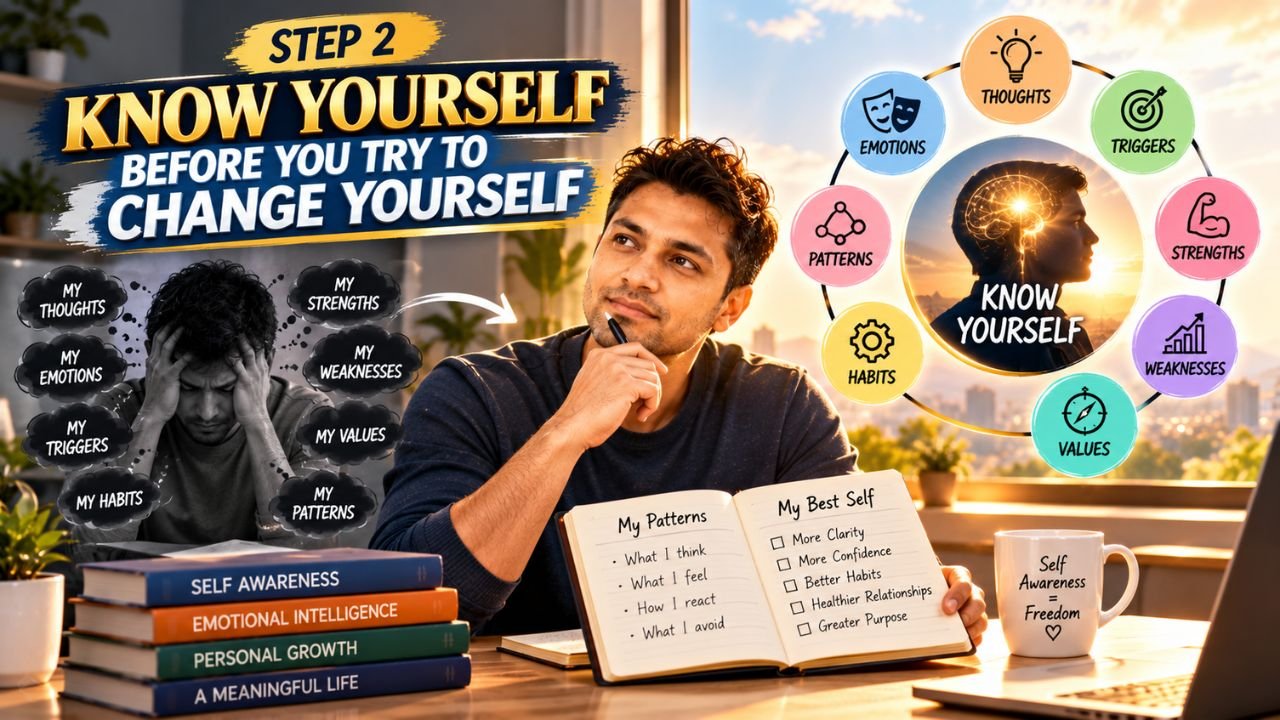
Now that you have started defining your best self, you may feel ready to create new goals, habits, and routines.
However, there is one important step that must come first.
Before you decide how to change yourself, you need to understand yourself.
You need to know where you are today, what is working, what is not working, and what patterns keep repeating in your life.
Without this awareness, you may try to solve the wrong problem.
For example, you may believe that you need more discipline. However, the real problem may be that your goal is unclear.
You may believe that you lack confidence. However, the real problem may be a lack of preparation or practice.
Similarly, you may think you are lazy. Yet you may actually feel overwhelmed, tired, afraid of failure, or disconnected from your goal.
Therefore, self-awareness is the starting point of meaningful personal transformation.
What Is Self-Awareness?
Self-awareness is the ability to notice and understand your thoughts, emotions, beliefs, habits, strengths, weaknesses, needs, and behaviour.
In simple words, self-awareness means being able to observe what is happening inside you and how it affects what you do.
It helps you answer questions such as:
- What am I thinking right now?
- What am I feeling?
- What triggered this emotion?
- Why am I reacting in this way?
- What belief is guiding this decision?
- What am I avoiding?
- What do I truly need?
- Does this behaviour support the person I want to become?
Self-awareness does not mean analysing every thought for hours.
It also does not mean judging yourself for every mistake.
Instead, it means becoming a calm and honest observer of your inner world.
When you can observe a pattern, you create a small space between the pattern and your response.
That space gives you a choice.
Without awareness, you react automatically. With awareness, you can respond consciously.
You Cannot Change a Pattern You Cannot See
Many of your daily actions happen automatically.
You wake up and reach for your phone.
You feel nervous and begin imagining the worst possible result.
You receive feedback and immediately defend yourself.
You face an important task and decide to do it later.
You feel uncertain and keep collecting more information instead of making a decision.
Because these reactions happen quickly, you may not notice the process behind them.
You only notice the final result.
For example, you may notice that you delayed an important task again. However, you may not notice the thought that appeared just before the delay:
“What if I cannot do this well?”
That thought may create anxiety. The anxiety may make the task feel heavier. Then, you may look for temporary relief by checking your phone, watching a video, or doing an easier task.
From the outside, this may look like procrastination.
However, from the inside, it may be a fear-avoidance pattern.
Once you recognise the complete pattern, you can work on its real cause.
That is why awareness comes before change.
Self-Awareness Is Different from Self-Criticism
Some people believe that they are self-aware because they can list everything they dislike about themselves.
They may say:
“I am lazy.”
“I am weak.”
“I am an overthinker.”
“I am not confident.”
“I have no control over my emotions.”
However, these statements are usually judgments, not observations.
A judgment attacks your identity.
An observation describes a specific pattern.
For example:
- Judgment: “I am lazy.”
- Observation: “I delay tasks when I do not know how to begin.”
- Judgment: “I am weak.”
- Observation: “I find it difficult to express disagreement because I fear conflict.”
- Judgment: “I am an overthinker.”
- Observation: “When a decision feels important, I imagine many negative outcomes and delay taking action.”
- Judgment: “I have no confidence.”
- Observation: “I feel less confident when I speak without enough preparation.”
The second version gives you useful information.
When a problem becomes specific, it becomes easier to change.
Therefore, instead of asking, “What is wrong with me?” ask:
“What exactly is happening, and under what conditions does it happen?”
This question replaces shame with curiosity.
Curiosity helps you learn. Shame often makes you hide.
Observe Yourself Without Making an Immediate Judgment
Imagine that you are watching your behaviour like a caring coach.
A good coach does not ignore the problem. At the same time, a good coach does not insult the person.
Instead, the coach observes, asks questions, identifies the pattern, and helps the person choose a better response.
You can begin doing the same for yourself.
Suppose you become angry during a conversation.
Instead of saying, “I am a terrible person,” pause and examine the event.
Ask:
- What was said?
- What meaning did I give to those words?
- What did I feel in my body?
- What emotion appeared?
- How did I respond?
- What result did my response create?
- How would I like to respond next time?
This does not remove your responsibility.
In fact, it increases your responsibility because you are looking directly at your behaviour.
However, you are doing it in a way that supports learning and change.
Understand Your Present Version
Before creating your future identity, you need an honest picture of your present identity.
Your present version includes:
- Your repeated thoughts
- Your emotional triggers
- Your daily habits
- Your current strengths
- Your avoided responsibilities
- Your personal values
- Your fears
- Your standards
- Your relationships
- Your environment
- Your current use of time and energy
This does not mean that your current state will remain permanent.
It simply gives you a starting point.
Think about using a map.
Before a map can guide you to your destination, it must know your present location. In the same way, a personal vision becomes useful only when you understand where you are starting.
Notice Your Repeating Thoughts
Your thoughts shape the way you interpret your experiences.
Therefore, begin by noticing the sentences that repeat in your mind.
They may sound like:
- “I need to be completely sure.”
- “I should not make a mistake.”
- “Other people are ahead of me.”
- “I am not ready yet.”
- “I will start when I have more time.”
- “What if people judge me?”
- “Maybe I cannot handle the result.”
- “I need to learn more before I act.”
Do not fight these thoughts immediately.
First, write them down.
Then ask:
- When does this thought appear?
- What emotion does it create?
- What action does it stop me from taking?
- Is it based on a fact, fear, assumption, or past experience?
- Is this thought helping me grow?
At this stage, your main goal is recognition.
Reframing will come later.
Recognise Your Emotional Triggers
An emotional trigger is a situation, word, memory, person, or thought that creates a strong emotional reaction.
For example, you may feel triggered when:
- Someone criticises your work
- A person does not reply to your message
- You make a small mistake
- Someone disagrees with you
- You need to speak in front of people
- You see another person succeeding
- Your plan suddenly changes
- You feel ignored or misunderstood
- You need to make an uncertain decision
The trigger itself is only one part of the process.
The meaning you give to the trigger also matters.
For example, imagine that someone does not reply to your message.
One person may think, “They must be busy.”
Another person may think, “They are ignoring me.”
A third person may think, “I must have done something wrong.”
The same event can create different emotions because each person gives it a different meaning.
Therefore, when a strong emotion appears, do not ask only, “What happened?”
Also ask:
“What meaning did I give to what happened?”
That question can reveal the hidden belief behind your emotional response.
Identify Your Behaviour Patterns
Your patterns are not random.
They usually follow a sequence.
For example:
- You receive an important opportunity.
- You feel excited.
- You begin thinking about everything that could go wrong.
- You feel anxious.
- You keep planning and researching.
- You delay taking action.
- The opportunity passes.
- You criticise yourself.
- Your self-confidence becomes weaker.
If you look only at the final result, you may say, “I missed another opportunity.”
However, when you examine the sequence, you can see several places where change is possible.
You may interrupt the pattern after the first negative thought.
You may regulate the anxiety.
You may limit research time.
You may take one small action before you feel fully ready.
This is the power of pattern awareness.
You do not need to fight the entire pattern at once. You only need to find a point where you can interrupt it.
Discover Your Strengths
Self-awareness is not only about finding problems.
It is also about recognising your strengths.
Many people can easily describe their weaknesses. However, when asked about their strengths, they become silent.
They may believe that speaking about their strengths is prideful.
However, understanding your strengths is not arrogance. It is useful self-knowledge.
Your strengths may include:
- Listening
- Teaching
- Learning quickly
- Solving problems
- Remaining calm
- Supporting other people
- Organising information
- Creating ideas
- Communicating clearly
- Working with focus
- Recovering after difficulty
- Taking responsibility
- Building relationships
- Seeing patterns
- Showing patience
Some strengths may come naturally to you.
Other strengths may have developed through difficult experiences.
For example, a person who faced many challenges may have developed patience, courage, empathy, or problem-solving ability.
Ask yourself:
- What do people often appreciate about me?
- What type of problem can I solve well?
- What activity feels natural to me?
- When have I performed at my best?
- What difficult experience has made me stronger?
- What do people commonly ask for my help with?
Your best self will not be created only by fixing weaknesses.
It will also be created by using and expanding your strengths.
Understand Your Weaknesses Without Attacking Yourself
A weakness is an area that needs support, skill, awareness, or practice.
It is not proof that you have less value as a person.
For example, you may currently find it difficult to:
- Speak in public
- Manage time
- Say no
- Handle criticism
- Make quick decisions
- Stay consistent
- Control digital distractions
- Express emotions
- Complete long-term projects
- Ask for help
Instead of hiding the weakness, define it clearly.
Then ask:
- Is this a skill gap?
- Is this an emotional pattern?
- Is this a lack of knowledge?
- Is this caused by an unclear system?
- Is this affected by my environment?
- Do I need practice, support, or professional guidance?
This question matters because different problems need different solutions.
A skill gap needs training.
An emotional trigger may need regulation and deeper understanding.
A confusing task may need a better plan.
Low energy may require better sleep, recovery, nutrition, or medical support.
When you correctly understand the problem, you can choose a more useful solution.
Discover Your Core Values
Your values are the principles and qualities that matter deeply to you.
They guide what feels meaningful, right, or important.
Common values include:
- Freedom
- Growth
- Family
- Health
- Honesty
- Contribution
- Learning
- Stability
- Courage
- Creativity
- Spirituality
- Excellence
- Compassion
- Responsibility
- Adventure
You may value many things. However, a few values usually influence your major decisions more strongly.
Problems often appear when your daily life does not match your core values.
For example, you may deeply value family, but your work routine may leave no meaningful time for your family.
You may value health, but your daily habits may not support your body.
You may value growth, but fear may keep you inside the same comfort zone.
You may value freedom, but poor financial decisions may reduce your choices.
This gap between values and behaviour can create inner conflict.
Therefore, ask yourself:
- What matters most to me?
- Where am I living according to my values?
- Where am I living against them?
- What one change would bring my actions closer to my values?
Your best self is not only the person who achieves more.
It is also the person whose actions match their deeper values.
Notice What You Are Avoiding
Avoidance provides important information.
You may be avoiding:
- A difficult conversation
- A health check-up
- A financial decision
- A business idea
- A new learning opportunity
- A public-speaking situation
- A relationship issue
- An unfinished project
- A truth about your current lifestyle
Avoidance often gives temporary comfort.
However, over time, it can increase fear and reduce self-trust.
When you repeatedly avoid something, your mind may learn:
“This situation is too dangerous for me.”
On the other hand, when you approach the situation in small and safe steps, your mind begins to learn:
“I can handle this.”
Ask yourself:
“What am I avoiding that may be important for my growth?”
Do not force yourself into a very intense situation without preparation. Instead, break the avoided action into a smaller and manageable step.
For example, if you are avoiding public speaking, your first step may not be speaking in front of 500 people.
It may be recording a two-minute video for yourself.
Small, repeated exposure can build capacity and confidence.
Conduct a Personal Life Audit
A personal life audit helps you see your life as a complete system.
It allows you to identify areas that are strong, areas that need attention, and areas that you may have been ignoring.
Rate yourself from 1 to 10 in each of the following areas.
A score of 1 means you are deeply dissatisfied or struggling.
A score of 10 means you feel highly satisfied and aligned.
1. Mental Clarity
- Can I organise my thoughts?
- Can I make decisions without endless overthinking?
- Do I know my main priorities?
2. Emotional Well-Being
- Can I understand and regulate my emotions?
- Do I recover from difficult events?
- Can I express my feelings in a healthy way?
3. Physical Health and Energy
- Am I getting enough rest?
- Do my daily habits support my energy?
- Am I giving attention to health concerns?
4. Confidence and Communication
- Can I express my ideas clearly?
- Can I speak even when I feel nervous?
- Do I trust myself to handle feedback?
5. Career or Business
- Am I growing in my work?
- Does my work use my strengths?
- Am I developing skills for my desired future?
6. Financial Well-Being
- Do I understand my income, spending, saving, and financial goals?
- Am I making responsible financial decisions?
- Do I have a plan for growth and stability?
7. Relationships
- Do I have supportive and respectful relationships?
- Can I communicate honestly?
- Do I maintain healthy boundaries?
8. Personal Growth
- Am I learning and applying new ideas?
- Am I improving important skills?
- Am I taking action outside my comfort zone?
9. Purpose and Contribution
- Does my life feel meaningful?
- Am I using my strengths to help others?
- Do I feel connected to a direction greater than short-term comfort?
10. Inner Peace or Spiritual Connection
- Do I make time for reflection?
- Do I feel connected to my deeper values?
- Can I experience moments of calm and gratitude?
After giving each area a score, write one sentence explaining the score.
Do not give yourself the score you think you should have.
Choose the score that honestly describes your present experience.
How to Read Your Life-Audit Results
Once your scores are complete, do not immediately choose the lowest score.
The lowest score is not always the first area you should address.
Instead, ask three questions:
Which Area Is Creating the Most Pain?
This area may need immediate care or support.
Which Area Influences Several Other Areas?
For example, poor sleep may reduce your focus, emotional balance, confidence, and work performance.
Improving sleep may therefore support several parts of your life.
Which Area Is Ready for Change?
Sometimes, you may recognise a serious issue but not yet have the resources or support to address it fully.
In that case, begin with a related area where a useful change is possible.
Choose one main focus and, if needed, one supporting focus.
Trying to improve all ten areas at the same time can create more pressure than progress.
Use the Recognise Step of the 6R Framework
Self-awareness is mainly connected with the first step of the 6R framework:
Recognise
To recognise means to notice what is happening without immediately running from it, fighting it, or becoming identified with it.
You can use this simple recognition process:
- Situation: What happened?
- Thought: What did I tell myself?
- Emotion: What did I feel?
- Body: Where did I feel it physically?
- Response: What did I do?
- Result: What happened because of my response?
- Alternative: What could I do differently next time?
For example:
- Situation: My manager asked me to explain my idea.
- Thought: “I may not explain it properly.”
- Emotion: Fear and self-doubt.
- Body: Tightness in the chest and fast breathing.
- Response: I gave a very short answer and stopped.
- Result: My idea was not understood.
- Alternative: I can pause, take one breath, and explain the idea through one example.
This simple process turns a confusing experience into useful information.
Keep a Seven-Day Pattern Journal
For the next seven days, record one important event each day.
Use this format:
- What happened?
- What did I think?
- What did I feel?
- What did I do?
- What result did I create?
- What would my best self do differently?
You do not need to record every small event.
Choose one situation that created a strong emotion, an old habit, a delayed action, or an important learning.
After seven days, review your notes and look for repetition.
You may notice that the same fear appears in different situations.
You may discover that you become distracted at a certain time of day.
You may realise that criticism triggers an old need to prove yourself.
You may also notice positive patterns, such as greater calm when you prepare in advance.
These observations will help you make your transformation plan more personal and effective.
Common Self-Awareness Mistakes
As you begin observing yourself, avoid these common mistakes.
Trying to Analyse Every Thought
Not every thought has a deep hidden meaning.
Focus on thoughts and patterns that repeat or strongly affect your behaviour.
Turning Reflection into Overthinking
Reflection creates clarity and leads to action.
Overthinking repeats the same questions without reaching a useful next step.
End every reflection session with:
“What is one small action I can take now?”
Using Awareness as an Excuse
Understanding why you behave in a certain way is helpful.
However, understanding is not the same as changing.
Your past may explain a pattern, but you still have responsibility for your next response.
Expecting Immediate Answers
Some patterns become clear quickly. Others need time, observation, feedback, or professional support.
Stay curious and patient.
Looking Only at Weaknesses
Record strengths, successful responses, and signs of progress as carefully as you record problems.
Growth becomes easier when you know what is already working.
Step 2 Action Plan
Complete these actions before moving forward:
- Write down three thoughts that frequently repeat in your mind.
- Identify three situations that trigger strong emotions.
- Describe one behaviour pattern from trigger to result.
- List five personal strengths.
- Choose one weakness or skill gap you want to improve.
- Identify your five most important values.
- Complete the ten-area personal life audit.
- Select one main area for improvement.
- Start a seven-day pattern journal.
- Decide one small action based on what you have learned.
If you want to explore this process in greater depth, the supporting guide on how to develop self-awareness and know yourself better will provide a complete set of questions, exercises, and examples.
Key Takeaway
You cannot build your best future by ignoring your present reality.
Self-awareness helps you understand what you think, what you feel, what you avoid, what you value, and why you behave in certain ways.
However, the purpose of awareness is not to judge yourself.
Its purpose is to give you a conscious choice.
Once you understand where you are, you can choose where you want to go.
In the next section, you will use this awareness to create a clear vision of the person you want to become.
Step 3: Create a Clear Vision of Who You Want to Become

You have now started understanding your present self.
You have looked at your thoughts, emotions, habits, strengths, values, and repeating patterns. You may also have identified the areas of your life that need more attention.
The next step is to decide where you want to go.
Without a clear direction, self-improvement can become a collection of random activities.
You may read books, watch videos, write goals, and try different routines. However, if you do not know the person you want to become, it becomes difficult to decide which activities truly matter.
A clear vision gives your personal growth a direction.
It helps you move from:
“I want to improve my life”
to:
“I understand who I want to become, why it matters, and what I need to practise.”
What Is a Personal Vision?
A personal vision is a clear picture of the person you want to become and the life you want to create.
It describes more than your goals.
It includes:
- How you want to think
- How you want to feel and respond
- How you want to communicate
- How you want to take care of your body
- What kind of work you want to do
- What relationships you want to build
- What values you want to live by
- What contribution you want to make
- What kind of daily life you want to experience
In simple words, a personal vision answers two important questions:
“What kind of life do I want to create?”
and
“Who do I need to become to create that life?”
Both questions matter.
If you focus only on the life you want, you may create a list of wishes.
However, when you also focus on the person you need to become, your vision begins to guide your behaviour.
Why Do You Need a Clear Vision for Your Life?
Imagine that you sit in a vehicle without choosing a destination.
You can continue driving. You can use fuel. You can travel a long distance.
However, movement alone does not guarantee that you are moving in the right direction.
The same is true in life.
You can remain busy without making meaningful progress.
You can complete many tasks without moving closer to your deeper goals.
You can work hard while building a life that does not match your values.
A clear personal vision helps you check whether your actions are taking you in the right direction.
Before saying yes to an opportunity, you can ask:
“Does this support the person and life I want to create?”
Before spending your time, you can ask:
“Is this important for my vision, or is it only keeping me busy?”
Before returning to an old habit, you can ask:
“Does this behaviour belong to my past pattern or my desired identity?”
Your vision will not make every decision easy. However, it gives you a standard for making better decisions.
A Vague Goal Creates Vague Action
Many people have goals such as:
- I want to become successful.
- I want to become confident.
- I want to become healthy.
- I want to earn more.
- I want to improve my communication.
- I want to live a better life.
These desires are meaningful. However, they are too broad to guide daily action.
For example, what does confidence mean to you?
Does it mean speaking during meetings?
Does it mean recording videos?
Does it mean making decisions without seeking approval from everyone?
Does it mean setting boundaries?
Does it mean handling criticism calmly?
Until you define the behaviour, “become confident” remains only an idea.
A clear vision turns an abstract desire into something you can see and practise.
Instead of saying:
“I want to become confident,”
you may say:
“I want to become a calm and prepared communicator who can organise ideas, express them clearly, and remain steady while receiving feedback.”
Now your mind has a clearer direction.
You can practise organising ideas. You can prepare before speaking. You can record yourself. You can ask for feedback. You can gradually enter more challenging speaking situations.
Clarity makes action more visible.
Stop Asking Only, “What Do I Want?”
Goals usually begin with the question:
“What do I want?”
You may want a better career, more income, a healthy body, a peaceful mind, stronger relationships, or a successful business.
These goals are important.
However, there is another question that can create a deeper transformation:
“Who do I need to become?”
Suppose you want to build a successful coaching business.
You may need to become:
- A clear communicator
- A patient listener
- A consistent content creator
- A responsible business owner
- A confident decision-maker
- A person who understands the needs of the audience
- A person who can continue learning and adapting
The result is the business.
The identity is the person capable of building and sustaining that business.
If you focus only on the result, you may feel frustrated when the result takes time.
However, if you also focus on identity, every useful action becomes progress.
Each video strengthens your identity as a communicator.
Each coaching conversation strengthens your identity as a coach.
Each thoughtful article strengthens your identity as an educator.
Each responsible business decision strengthens your identity as an entrepreneur.
The outer result may take time, but the inner transformation begins immediately.
Move from Outcome Goals to Identity Goals
An outcome goal describes what you want to achieve.
An identity goal describes the kind of person you want to become.
Both are useful. However, identity goals often create a stronger foundation for long-term change.
Consider these examples.
Outcome Goal
“I want to lose weight.”
Identity Goal
“I am becoming a person who respects the body through balanced food, daily movement, proper rest, and informed health decisions.”
Outcome Goal
“I want to write a book.”
Identity Goal
“I am becoming a writer who develops ideas and writes consistently.”
Outcome Goal
“I want to stop overthinking.”
Identity Goal
“I am becoming a person who examines thoughts, accepts reasonable uncertainty, and takes the next useful action.”
Outcome Goal
“I want to speak confidently.”
Identity Goal
“I am becoming a calm, prepared, and expressive communicator.”
The identity statement does not replace the measurable goal.
Instead, it shows you how to live while working toward that goal.
Define Your Best-Self Identity
Your identity is the story you repeatedly tell yourself about who you are.
Some identity statements support growth:
- I am a learner.
- I am a responsible person.
- I am becoming a clear communicator.
- I am someone who keeps important promises.
- I can learn from feedback.
- I take action even when I feel some fear.
Other identity statements may keep you stuck:
- I am always confused.
- I am not disciplined.
- I am bad at speaking.
- I never finish anything.
- I cannot handle pressure.
- I am simply an overthinker.
When you repeat a fixed negative identity, your mind begins to look for evidence that supports it.
Therefore, use identity language carefully.
You do not need to make statements that feel completely false. Instead, use growth-based identity statements.
For example, if “I am a powerful public speaker” feels unbelievable today, say:
“I am becoming calmer and more confident every time I practise speaking.”
This statement recognises your current stage while directing you toward growth.
Create Your Identity in the Major Areas of Life
To build a complete personal vision, describe the person you want to become in each important area.
Your Mental Identity
Ask:
- How do I want to think?
- How do I want to make decisions?
- How do I want to respond to negative thoughts?
- What kind of learner do I want to become?
Example:
“I am becoming a clear and flexible thinker. I ask useful questions, separate facts from assumptions, and focus on what I can control.”
Your Emotional Identity
Ask:
- How do I want to handle fear, anger, stress, and disappointment?
- How quickly do I want to recover?
- How do I want to express emotions?
Example:
“I am becoming emotionally aware and steady. I allow myself to feel emotions, but I choose my response with care.”
Your Physical Identity
Ask:
- How do I want to treat my body?
- What kind of energy do I want?
- What daily behaviours will support my health?
Example:
“I am becoming a person who respects the body through rest, movement, balanced food, recovery, and timely professional care.”
Your Communication Identity
Ask:
- How do I want to express my ideas?
- How do I want people to feel when speaking with me?
- How do I want to listen and respond?
Example:
“I am becoming a calm, clear, and engaging communicator. I organise my thoughts, listen carefully, and express my ideas with confidence and respect.”
Your Professional Identity
Ask:
- What kind of work do I want to create?
- What skills do I want to develop?
- What professional standards do I want to follow?
Example:
“I am becoming a trusted professional who creates meaningful value, continues learning, and completes important work with care.”
Your Relationship Identity
Ask:
- What kind of family member, friend, partner, or leader do I want to be?
- How do I want to handle disagreements?
- What boundaries do I need?
Example:
“I am becoming a caring and honest person who listens, communicates needs clearly, and maintains healthy boundaries.”
Your Purpose-Driven Identity
Ask:
- What contribution do I want to make?
- Who do I want to help?
- How can my experience and strengths create value?
Example:
“I am becoming a person who uses knowledge, experience, and compassion to help other people grow.”
Create a Vision That Is Ambitious but Grounded
Your vision should inspire you.
At the same time, it should remain connected to meaningful values and realistic action.
A vision that is too small may not create enough energy.
However, a vision based only on fantasy may not guide daily behaviour.
For example, “I want to become successful” is too unclear.
On the other hand, “Everything in my life will become perfect within 30 days” is unrealistic.
A grounded vision may say:
“Over the next three years, I want to become a trusted expert in my field, build a meaningful body of work, serve a growing community, strengthen my communication skills, improve my health, and create greater financial freedom for my family.”
This vision is ambitious.
However, it also points toward skills, systems, service, health, and responsibility.
Set Personal Standards, Not Only Goals
Goals describe what you want to achieve.
Standards describe how you choose to live.
For example:
Goal
“I want to publish 50 helpful videos.”
Standard
“I prepare and publish useful content consistently, even when every video is not perfect.”
Goal
“I want to improve my health.”
Standard
“I do not repeatedly ignore the needs and warning signs of my body.”
Goal
“I want better relationships.”
Standard
“I communicate respectfully, listen carefully, and do not accept repeated disrespect.”
Goal
“I want to become more confident.”
Standard
“I do not allow fear alone to make every important decision for me.”
Goals may take months or years.
However, you can practise a standard today.
Your standards become the bridge between your vision and your daily behaviour.
Write Your Personal Vision Statement
A personal vision statement is a short description of the life and identity you want to create.
It should feel meaningful, clear, and personal.
It does not need to sound like a corporate statement.
It should sound like you.
Use this simple structure:
“I am becoming a person who ________. I use my strengths of ________ to create ________. I take care of my mind and body by ________. In my relationships, I practise ________. Through my work and contribution, I want to ________. Each day, I move toward this vision by ________.”
Here is an example:
“I am becoming a calm, confident, disciplined, and compassionate person. I organise my thoughts clearly and express my ideas in a way that helps other people grow. I take care of my mind and body through rest, movement, mindful breathing, learning, and balanced daily routines. In my relationships, I listen carefully, communicate honestly, and maintain healthy boundaries. Through my work, I create practical tools that help people move from overthinking to clear and consistent action. Each day, I move toward this vision by learning, practising, serving, and completing one meaningful priority.”
Your statement may be longer or shorter.
What matters is that it feels connected to your values and can guide your actions.
Create a Picture of Your Ideal Day
A personal vision becomes clearer when you imagine how it appears in daily life.
Do not imagine only major achievements.
Imagine an ordinary day lived as your best self.
Ask yourself:
- What time do I wake up?
- What is my first thought?
- How do I care for my body?
- What work do I focus on?
- How do I respond to distractions?
- How do I speak with other people?
- How do I handle an unexpected problem?
- What do I do when I feel tired?
- How do I spend time with my family?
- How do I review my day?
- How do I prepare for sleep?
The purpose is not to design a perfect day with no problems.
Instead, imagine how your best self responds when real life does not follow the plan.
For example, your ideal day may include focused work in the morning. However, imagine that an unexpected responsibility appears.
How would your best self respond?
Would you become angry and give up on the whole day?
Or would you adjust the plan, protect the most important task, and continue?
A useful vision includes both intention and flexibility.
Use Visualization to Rehearse Your Future Behaviour
Visualization is not only about seeing a final reward.
It can also be used to mentally rehearse the process.
For example, if you want to speak confidently, do not visualize only people applauding you.
Visualize yourself:
- Preparing your main ideas
- Standing with a steady posture
- Breathing slowly
- Beginning with a clear opening
- Pausing when needed
- Handling a moment of nervousness
- Answering a question calmly
- Completing your message with confidence
This kind of visualization connects your desired identity with visible behaviour.
Similarly, if you want to become disciplined, visualize yourself beginning an important task even when you do not feel highly motivated.
If you want emotional strength, visualize yourself noticing a trigger, pausing, regulating your breath, and choosing a better response.
If you want better health, visualize yourself following the next helpful behaviour, not only looking at the final result.
Mental rehearsal does not replace physical action.
Instead, it helps you become more familiar with the action you want to take.
After visualization, always ask:
“What is one real action I will take now?”
Do Not Use Your Vision to Escape the Present
A vision should help you improve your present behaviour.
However, some people use future thinking as an escape.
They spend hours imagining success but avoid today’s difficult work.
They create vision boards but do not create daily systems.
They repeat affirmations but do not develop the required skill.
They imagine confidence but avoid speaking opportunities.
A vision becomes powerful only when it influences present action.
Therefore, connect every part of your vision with a behaviour.
For example:
- Vision: Become a clear communicator
Behaviour: Practise speaking for ten minutes. - Vision: Build a healthy body
Behaviour: Follow the next planned meal, movement, rest, or medical step. - Vision: Create a meaningful business
Behaviour: Speak to one potential customer or create one useful piece of content. - Vision: Build emotional strength
Behaviour: Pause and use the 60-second reset during one difficult moment.
Your vision must return you to today.
Keep Your Vision Flexible
Your vision is a guide, not a prison.
As you gain experience, your goals may change.
You may discover new strengths.
Some priorities may become more important. Others may no longer feel meaningful.
Therefore, review your vision without becoming rigid.
You can ask every three to six months:
- Does this vision still feel meaningful?
- Does it reflect my current values?
- What have I learned about myself?
- What needs to be added, removed, or changed?
- Am I moving toward this vision in a healthy way?
Changing your vision does not always mean that you have failed.
Sometimes, it means that you understand yourself better.
Watch for Goals Borrowed from Other People
Not every goal in your mind belongs to you.
Some goals may come from:
- Family expectations
- Social media
- Cultural pressure
- Comparison
- Fear of being left behind
- A desire to prove your value
- A need for approval
Ask yourself:
“If nobody could see this achievement, would it still matter to me?”
This question can reveal whether a goal is connected to your values or mainly to outside approval.
Of course, external recognition can feel good. There is nothing automatically wrong with wanting appreciation.
However, if approval becomes the main reason for your goal, your confidence may remain dependent on other people.
A strong personal vision can include achievement and recognition. Still, it should be connected to deeper values such as growth, freedom, contribution, family, creativity, health, or service.
Turn Your Vision into a Personal Compass
A compass does not walk the journey for you.
However, it helps you check your direction.
In the same way, your vision will not complete your work. It will help you decide what deserves your work.
Use your vision as a filter.
When a new opportunity appears, ask:
- Does this move me toward my desired identity?
- Does it match my values?
- Will it help me develop an important skill?
- Does it support my long-term direction?
- What may I need to give up to accept it?
When a distraction appears, ask:
- Is this helping me recover, or helping me avoid?
- Will I feel good about this choice later?
- What would my best self choose in this moment?
You will not always make the perfect choice.
However, these questions will help you make more conscious choices.
The Best-Self Vision Exercise
Set aside 20–30 quiet minutes for this exercise.
Write your answers instead of keeping them only in your mind.
Part 1: Describe the Person
Complete these sentences:
- My best self thinks…
- My best self believes…
- My best self communicates…
- My best self responds to fear by…
- My best self handles mistakes by…
- My best self takes care of the body by…
- My best self uses time by…
- My best self treats other people by…
- My best self creates value by…
Part 2: Choose Your Core Qualities
Choose five to seven qualities that describe your desired identity.
Examples include:
- Calm
- Confident
- Focused
- Disciplined
- Compassionate
- Courageous
- Healthy
- Expressive
- Creative
- Responsible
- Patient
- Purposeful
Part 3: Convert Qualities into Behaviours
For every quality, write one visible action.
For example:
- Calm → I pause before responding.
- Confident → I express one clear idea even when I feel nervous.
- Focused → I complete one priority before checking unnecessary messages.
- Disciplined → I begin the planned action at the decided time.
- Healthy → I make one choice each day that supports my energy.
- Compassionate → I listen before giving advice.
- Purposeful → I create something useful for another person.
Part 4: Write Your One-Year Vision
Imagine that one year has passed and you have grown steadily.
Write about:
- Your mindset
- Your emotional health
- Your physical energy
- Your habits
- Your confidence
- Your communication
- Your work
- Your relationships
- Your contribution
Describe progress, not perfection.
Part 5: Choose Your Next 90-Day Identity
Do not try to practise every quality immediately.
Choose one central identity for the next 90 days.
For example:
“For the next 90 days, I am becoming a person who takes clear and consistent action.”
Then choose three behaviours that support it:
- I select one important priority each day.
- I begin before I feel completely ready.
- I review what I completed every evening.
This makes your vision practical.
Step 3 Action Plan
Complete these actions before moving to the mindset section:
- Define what a meaningful life looks like to you.
- Choose five to seven qualities of your best self.
- Convert every quality into a visible behaviour.
- Write one identity statement for each major area of life.
- Create your personal vision statement.
- Describe one ordinary day lived as your best self.
- Identify one goal that may be based mainly on comparison.
- Choose one personal standard you can follow today.
- Select one identity to develop over the next 90 days.
- Take one real action that supports that identity.
If you want to go deeper, the supporting guide on how to create a clear vision for your life and future self will help you build a detailed vision statement, future-self identity, and behavioural action map.
Key Takeaway
A clear vision is not simply a picture of what you want to have.
It is a description of who you want to become, how you want to live, and what you want to contribute.
Goals give you a destination.
Identity gives you a way of living.
Standards turn that identity into daily behaviour.
Therefore, do not build your future only around external achievements. Build it around values, qualities, actions, relationships, health, and meaningful contribution.
Once you become clear about the person you want to become, you can begin noticing the beliefs that may be stopping you from becoming that person.
In the next section, you will learn how to recognise limiting beliefs, question unhelpful thoughts, and develop a mindset that supports your growth.
Step 4: Change the Mindset That Keeps You Stuck
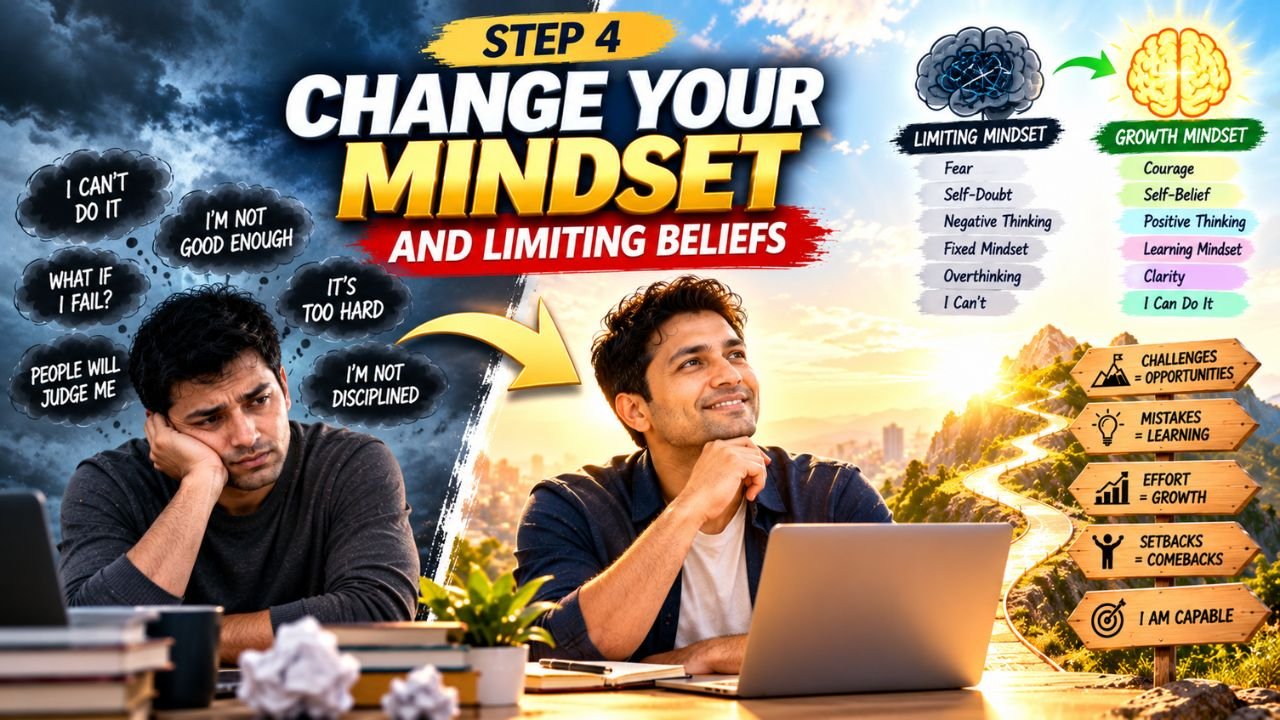
You now have greater awareness of your present patterns and a clearer vision of the person you want to become.
However, knowing where you are and where you want to go is not always enough.
You may still hear an inner voice saying:
“I am not ready.”
“What if I fail?”
“What will people think?”
“I do not have what it takes.”
“Maybe it is too late for me.”
These thoughts can create an invisible wall between your present self and your desired future.
Therefore, the next step is to understand your mindset, recognise the beliefs that keep you stuck, and build a more helpful way of thinking.
What Is Mindset?
Your mindset is the collection of beliefs, expectations, assumptions, and mental habits through which you understand yourself and the world.
In simple words, your mindset affects:
- What you notice
- What you believe is possible
- How you understand challenges
- How you respond to mistakes
- What actions you take
- What actions you avoid
- How long you continue when progress feels slow
Two people may face a similar problem but respond in very different ways.
One person may think:
“This problem proves that I am not capable.”
Another person may think:
“This problem is showing me what I still need to learn.”
The problem may be the same. However, the meaning is different.
That meaning can influence the emotion, action, and final result.
How Your Thoughts Influence Your Results
Your thoughts do not control every part of life.
Real situations, physical health, environment, resources, relationships, and many other factors also matter.
However, your interpretation of an event can strongly influence how you respond to it.
A simple cycle often looks like this:
Situation → Thought or Meaning → Emotion → Action → Result
Imagine that you publish a video and it receives fewer views than expected.
The situation is:
“My video received fewer views.”
You may interpret it as:
“No one is interested in what I teach.”
This thought may create disappointment and self-doubt.
As a result, you may stop publishing.
Then, because you stop publishing, your audience does not get a chance to grow.
Now consider another interpretation:
“This video did not perform as expected. I need to study the topic, title, opening, and audience response.”
This thought may create curiosity instead of defeat.
As a result, you review the video, improve the next one, and continue publishing.
The first interpretation closes the learning process.
The second interpretation opens it.
This is why learning to examine your thoughts is so important.
Your First Thought Is Not Always the Complete Truth
A thought can feel true without being fully accurate.
For example, after making a mistake, you may immediately think:
“I always ruin everything.”
The word “always” makes the mistake feel larger than it is.
Similarly, after one rejection, you may think:
“No one will ever value my work.”
After seeing another person succeed, you may think:
“I am too far behind.”
These thoughts often appear quickly. Therefore, you may accept them before examining them.
However, a thought is a mental event. It is not automatically a fact.
You do not need to fight every thought. Instead, you can pause and ask:
- What exactly happened?
- What story am I telling myself about it?
- Which part is fact?
- Which part is assumption?
- What information may I be missing?
- Is there another reasonable explanation?
These questions create mental flexibility.
What Is a Limiting Belief?
A limiting belief is a deeply accepted idea that reduces what you believe you can do, become, receive, or handle.
It may be a belief about:
- Yourself
- Other people
- Success
- Failure
- Money
- Relationships
- Health
- Age
- Learning
- Change
- The future
A limiting belief often sounds like a fact in your mind.
You may not say, “This is one belief I have.”
Instead, you may say:
“This is simply how life works.”
For example:
- “I am not a confident person.”
- “I am too old to begin.”
- “I cannot learn new skills.”
- “Successful people are naturally talented.”
- “If I make one mistake, people will lose respect for me.”
- “I need everyone’s approval.”
- “I must feel confident before I act.”
- “If I cannot do it perfectly, there is no point in doing it.”
- “My past determines my future.”
- “People like me cannot achieve that.”
These beliefs can influence your decisions before you are fully aware of them.
Where Do Limiting Beliefs Come From?
Limiting beliefs can develop from many experiences.
They may come from:
- Childhood messages
- Family expectations
- Social or cultural beliefs
- Painful experiences
- Repeated criticism
- Embarrassing moments
- Failure
- Rejection
- Comparison
- A lack of support
- Conclusions made during emotional situations
Suppose a child gives an answer in class and other students laugh.
The event lasts only a few moments.
However, the child may create a larger meaning:
“If I speak, people will laugh at me.”
Later, the person may avoid meetings, videos, presentations, or public speaking.
The present fear may be connected to an old meaning.
However, understanding where a belief came from does not mean blaming the past forever.
The purpose is to recognise that a belief was learned.
What was learned can often be examined, updated, and replaced with a healthier response.
Common Limiting Beliefs That Block Personal Growth
Different people carry different beliefs. However, certain beliefs appear frequently during personal transformation.
“I Am Not Good Enough”
This belief makes every challenge feel like a test of your worth.
When something goes wrong, you may not think:
“I need more practice.”
Instead, you may think:
“This proves that I am not capable.”
As a result, you may avoid situations where your ability could be tested.
“I Must Not Make a Mistake”
This belief can create perfectionism and overthinking.
You may continue preparing, researching, correcting, and waiting.
However, because you do not act, you also do not receive the feedback needed to improve.
“I Need Complete Clarity Before I Begin”
Clarity is helpful, but complete certainty is rarely available before action.
Many times, you understand the path more clearly after taking the first step.
“People Will Judge Me”
Some people may judge you. However, fear often makes you imagine that everyone is watching and evaluating every small action.
As a result, you may give other people’s possible opinions more power than your own purpose.
“I Am Too Late”
You may compare your beginning with another person’s progress.
However, comparison does not change your starting point.
It only uses the energy you could invest in your next step.
“I Need to Feel Motivated First”
Motivation can help you begin, but it naturally changes from day to day.
If action always depends on a strong feeling, consistency becomes difficult.
Often, motivation increases after you begin.
“My Past Will Keep Repeating”
Your past can influence you, but it does not need to dictate every future decision.
A pattern continues most easily when it remains unseen and unchallenged.
Awareness and repeated new action can create a different direction.
Limiting Beliefs Often Try to Protect You
A limiting belief may be unhelpful, but it may have developed as an attempt to protect you.
For example:
- “Do not speak” may try to protect you from embarrassment.
- “Do not trust anyone” may try to protect you from emotional pain.
- “Do not start” may try to protect you from failure.
- “Make everything perfect” may try to protect you from criticism.
- “Please everyone” may try to protect you from rejection.
- “Keep analysing” may try to protect you from uncertainty.
When you understand the protective purpose, you can stop treating the belief like an enemy.
Instead, you can ask:
“How can I meet this need in a healthier way?”
If your mind wants protection from embarrassment, you can prepare and practise instead of remaining silent.
If your mind wants protection from failure, you can take a smaller test action instead of avoiding the goal.
If your mind wants certainty, you can gather enough information to make a responsible decision without demanding a guarantee.
This approach creates change without inner conflict.
Positive Thinking Is Not Enough
Changing your mindset does not mean forcing yourself to think positively about everything.
It does not mean saying:
“Everything is perfect.”
“I will never fail.”
“Nothing bad can happen.”
“I can achieve anything without preparation.”
These statements may ignore reality.
A helpful mindset is not blindly positive. It is balanced, honest, and action-oriented.
For example, instead of saying:
“I will definitely succeed,”
you may say:
“I cannot control every result, but I can prepare, act, learn, and improve.”
Instead of saying:
“I have no fear,”
you may say:
“I feel fear, and I can still take one safe and useful step.”
Instead of saying:
“I will never make a mistake,”
you may say:
“I will make thoughtful decisions, and if I make a mistake, I will learn and respond responsibly.”
These thoughts are believable.
More importantly, they support useful action.
Use the Recognise–Reframe Process
Changing a belief begins with recognising it.
Then, instead of immediately replacing it with a positive sentence, examine it carefully.
Use the following process.
Step 1: Recognise the Thought
Write the exact sentence in your mind.
For example:
“I cannot speak confidently.”
Avoid vague descriptions such as, “I feel negative.”
Write the actual thought.
Step 2: Identify the Trigger
Ask:
- When does this thought appear?
- Who am I with?
- What am I trying to do?
- What am I afraid may happen?
Example:
“This thought appears when I need to speak without reading from notes.”
Step 3: Notice the Effect
Ask:
- What emotion does this thought create?
- What happens in my body?
- What action do I take or avoid?
- What result follows?
Example:
“The thought creates fear. My breathing becomes fast. I shorten my answer. Then, I feel disappointed because I did not express the complete idea.”
Step 4: Question the Belief
Ask:
- Is this belief true in every situation?
- What evidence supports it?
- What evidence challenges it?
- Am I confusing lack of practice with lack of ability?
- Am I predicting the future?
- Am I treating one event as a permanent truth?
- What would I say to a friend in the same situation?
You may discover that the belief is too broad.
Perhaps you cannot yet speak confidently in every situation. However, you may already communicate well in familiar situations.
This means the more accurate statement is:
“I currently find unprepared speaking difficult.”
That is a skill-based problem, not a permanent identity.
Step 5: Create a Balanced Reframe
A reframe is a more useful way of understanding the situation.
It should be:
- Honest
- Specific
- Believable
- Helpful
- Connected to action
Original belief:
“I cannot speak confidently.”
Balanced reframe:
“Speaking without preparation is difficult for me right now, but I can improve through structure, repetition, and gradual practice.”
This statement does not deny the current challenge.
However, it creates a path forward.
Step 6: Take One Supporting Action
A new thought becomes stronger when action supports it.
You might:
- Speak for two minutes on a familiar topic
- Record yourself
- Review the recording
- Improve one point
- Repeat the exercise tomorrow
The action gives you new evidence.
Over time, the new evidence helps update the old belief.
Reframe the Meaning, Not the Facts
Reframing does not mean changing facts.
If a project failed, you do not need to pretend that it succeeded.
Instead, you change the meaning you give to the failure.
Unhelpful meaning:
“This failure proves that I am not capable.”
Helpful meaning:
“This result shows that my current approach did not work. I need to understand what happened and improve the next attempt.”
The fact remains:
The project did not achieve the expected result.
However, your interpretation changes from permanent identity failure to useful feedback.
A good reframe respects reality while opening a better response.
Ask Better Questions
Your mind naturally searches for answers to the questions you repeatedly ask.
If you ask:
“Why am I always a failure?”
your mind may collect memories that support the idea of failure.
Instead, ask questions that create clarity and movement.
For example:
- What can I learn from this?
- What part is within my control?
- What assumption am I making?
- What information do I need?
- What is the smallest useful step?
- What would make this easier to begin?
- Which skill would help me handle this better?
- What evidence of progress already exists?
- How would my best self respond?
- What can I do differently next time?
Better questions do not guarantee easy answers.
However, they direct your attention toward learning, choice, and action.
Develop a Growth-Oriented Mindset
A growth-oriented mindset is the belief that many abilities can improve through learning, practice, feedback, strategy, and support.
It does not mean that every person has the same strengths or circumstances.
It also does not mean that every goal is guaranteed.
Instead, it means you do not treat your current level as your permanent limit.
A fixed statement says:
“I am bad at communication.”
A growth-oriented statement says:
“My communication needs practice and structure.”
A fixed statement says:
“I am not a disciplined person.”
A growth-oriented statement says:
“I need a simpler routine, a clearer priority, and more consistent repetition.”
A fixed statement says:
“I failed.”
A growth-oriented statement says:
“This attempt did not work. I need to study the process.”
The language you use matters because it can either close or open the possibility of improvement.
Turn “I Am” into “I Am Learning”
Be careful when attaching a problem directly to your identity.
Instead of saying:
“I am an overthinker,”
say:
“I have developed a habit of overthinking important decisions, and I am learning to move toward clear action.”
Instead of saying:
“I am not confident,”
say:
“I am learning to prepare, express myself, and build confidence through action.”
Instead of saying:
“I am lazy,”
say:
“I delay certain tasks, and I am learning to understand the trigger and begin with a smaller step.”
This does not remove responsibility.
It makes the problem more specific and changeable.
Build Self-Belief Through Evidence
Self-belief is not built only by repeating encouraging statements.
It becomes stronger when you create evidence.
If you want to believe that you are disciplined, keep one small promise to yourself each day.
If you want to believe that you can communicate well, practise explaining one idea clearly.
If you want to believe that you can handle uncertainty, make one responsible decision without demanding complete certainty.
If you want to believe that you can finish what you start, complete one small project.
Each action becomes a piece of evidence.
One action may feel small. However, repeated evidence begins to change your self-image.
Therefore, do not ask only:
“What should I believe?”
Also ask:
“What action would give me evidence for this belief?”
Use Mental Rehearsal to Support a New Response
Once you create a better belief, rehearse how you want to act.
Imagine a situation that usually triggers the old pattern.
See yourself noticing the old thought.
Then imagine yourself pausing, breathing, and using the balanced reframe.
Finally, imagine taking the desired action.
For example:
- Trigger: You are asked to share your opinion.
- Old thought: “My answer may not be good enough.”
- Reframe: “I do not need a perfect answer. I need to express one clear idea.”
- New response: You pause, state your core idea, give one reason, and add one example.
Mental rehearsal helps you prepare.
However, it must be followed by real practice.
What to Do When the Old Belief Returns
An old belief may return even after you have reframed it.
This does not mean that the process has failed.
The old belief may have been repeated for years. Therefore, one new thought may not replace it immediately.
When the belief returns:
- Notice it without panic.
- Name it as an old pattern.
- Use your balanced reframe.
- Take one supporting action.
- Record the evidence.
- Repeat the process.
Over time, the new response can become more familiar.
Transformation is not proven by never hearing the old thought again.
It is proven by allowing that thought to control fewer of your decisions.
The Limiting-Belief Reframing Exercise
Choose one goal that matters to you.
Then complete the following statements:
1. The Goal I Want to Achieve
Example:
“I want to publish one helpful video every week.”
2. The Thought That Stops Me
Example:
“If my video is not perfect, people will judge me.”
3. The Emotion This Thought Creates
Example:
“Fear, pressure, and self-doubt.”
4. The Behaviour That Follows
Example:
“I continue preparing but do not record.”
5. The Result I Create
Example:
“No video is published, and my confidence becomes weaker.”
6. The Evidence for and Against the Belief
For:
“Some people may criticise the video.”
Against:
“Not everyone will judge it. Feedback can help me improve. My first videos do not need to represent my final ability.”
7. My Balanced Reframe
“The video does not need to be perfect. It needs to be useful, honest, and better than my last attempt.”
8. My Supporting Action
“I will record a short version today and review it once before publishing.”
This exercise connects mindset with behaviour.
That connection is essential because a mindset changes more deeply when your actions begin to support it.
Step 4 Action Plan
Complete these actions before moving to emotional regulation:
- Write down three beliefs that may be limiting your growth.
- Identify where each belief may have come from.
- Notice what each belief may be trying to protect you from.
- Choose the belief that currently affects you most.
- Write its trigger, emotion, behaviour, and result.
- Separate the facts from your interpretation.
- Create one balanced and believable reframe.
- Choose one small action that supports the new belief.
- Mentally rehearse yourself taking that action.
- Record the result as new evidence.
If you want to explore this process more deeply, the supporting guide on how to change your mindset and overcome limiting beliefs will include detailed examples, reframing questions, mindset exercises, and a belief-change worksheet.
Key Takeaway
Your mindset is not about pretending that every situation is positive.
It is about learning to see yourself and your challenges in a more accurate, flexible, and useful way.
A limiting belief may have been learned through the past, but it does not need to control your future.
First, recognise the belief.
Next, understand the trigger and protective purpose.
Then, question the belief and create a balanced reframe.
Finally, take an action that gives your mind new evidence.
A new belief becomes stronger when you repeatedly live in a way that supports it.
However, changing a thought is not always enough. Sometimes, your emotional state becomes so strong that clear thinking becomes difficult.
Therefore, in the next section, you will learn how to understand, regulate, and respond to emotions without suppressing them.
Step 5: Manage Your Emotions Without Suppressing Them
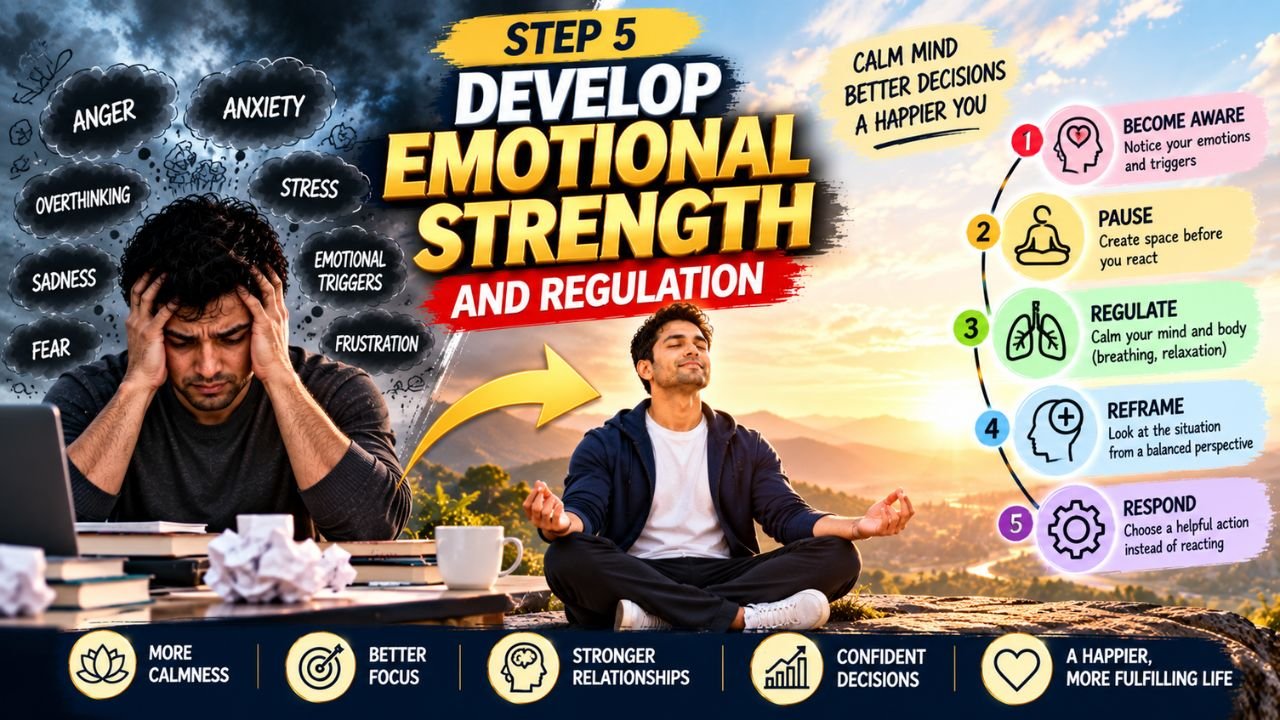
You may understand that a thought is not always a fact.
You may also know how to question an unhelpful belief. However, when an emotion becomes intense, clear thinking can become difficult.
Fear may tell you to escape.
Anger may push you to react.
Shame may make you hide.
Anxiety may make you imagine many negative possibilities.
Disappointment may make you feel that further effort is pointless.
During such moments, you may know what you should do but still find it difficult to do it.
Therefore, becoming the best version of yourself requires more than changing your thoughts. You must also learn how to understand, regulate, and express your emotions in a healthy way.
What Is Emotional Regulation?
Emotional regulation is the ability to notice an emotion, understand what may be causing it, and choose how to respond.
It does not mean that you never feel afraid, angry, sad, worried, or disappointed.
It also does not mean that you must remain calm in every situation.
Instead, emotional regulation means that your feelings do not automatically control every action you take.
For example, you may feel angry without becoming disrespectful.
You may feel fear and still take a safe, useful step.
You may feel disappointed without deciding that your whole journey has failed.
You may feel nervous and still express one clear idea.
The emotion is present. However, you still have some choice in your response.
Emotional Strength Does Not Mean Suppressing Your Feelings
Many people confuse emotional strength with emotional suppression.
They believe that a strong person should not cry, feel afraid, ask for help, or admit emotional pain.
As a result, they try to push every uncomfortable feeling away.
They may say:
“I should not feel this.”
“I need to stay positive.”
“This emotion makes me weak.”
“I will ignore it and continue.”
Ignoring an emotion may provide temporary relief. However, the feeling may return through irritation, physical tension, disturbed sleep, avoidance, or sudden reactions.
On the other hand, expressing every emotion without care can also create problems.
For example, feeling angry does not give you permission to hurt someone.
Feeling afraid does not mean that every situation is dangerous.
Feeling disappointed does not mean that you should abandon every goal.
Healthy emotional regulation lies between suppression and uncontrolled reaction.
You acknowledge the emotion, understand it, and then choose a responsible response.
Your Emotions Are Signals, Not Commands
An emotion gives you information.
Fear may signal possible danger or uncertainty.
Anger may signal that you feel hurt, blocked, disrespected, or treated unfairly.
Sadness may signal loss, disappointment, or the need to slow down.
Guilt may signal that your behaviour did not match your values.
Shame may create the painful belief that something is wrong with you as a person.
Jealousy may reveal something you desire or fear losing.
However, an emotional signal is not always a complete description of reality.
For example, fear may appear before public speaking even when the situation is physically safe.
Anger may appear because you misunderstood another person’s intention.
Guilt may remain even when you made the best decision available to you.
Therefore, emotions deserve attention, but they also need examination.
Ask:
- What is this emotion trying to tell me?
- Does the intensity match the present situation?
- Is this feeling connected only to today?
- What facts do I have?
- What action would be responsible?
This approach respects the emotion without blindly obeying it.
Understand Your Emotional Sequence
An emotional reaction often follows a sequence.
The sequence may happen quickly, but slowing it down can help you understand it.
A common sequence is:
Trigger → Meaning → Body Response → Emotion → Action → Result
Imagine that someone gives you critical feedback.
Trigger
A person says, “This work needs improvement.”
Meaning
You tell yourself, “They think I am not capable.”
Body Response
Your chest becomes tight. Your breathing changes. Your face feels warm.
Emotion
You feel hurt, anxious, or angry.
Action
You defend yourself, stop listening, or remain silent.
Result
You miss useful feedback, and the relationship becomes tense.
Now imagine that you create a different meaning:
“This feedback is about a piece of work. It is not a final judgment of my worth.”
The emotional reaction may not disappear completely. However, its intensity may reduce enough for you to ask:
“Which part needs improvement?”
Understanding this sequence helps you identify where you can make a change.
You may not control the trigger.
However, you may be able to examine the meaning, calm the body, name the emotion, or choose a better action.
Notice How Emotions Appear in Your Body
Emotions are not experienced only as words in the mind.
You may also notice them through physical sensations.
Fear may feel like:
- Fast breathing
- A tight chest
- A heavy stomach
- Shaking
- Restlessness
- An urge to escape
Anger may feel like:
- Heat in the face
- Tight shoulders
- A clenched jaw
- Faster speech
- An urge to argue
Sadness may feel like:
- Low energy
- Heaviness
- Tears
- Slower movement
- A desire to withdraw
Everyone experiences emotions differently.
Therefore, learn your own early signs.
Ask yourself:
- Where do I feel this emotion?
- What changes in my breathing?
- Which muscles become tense?
- What urge appears?
- What happens just before I react?
The earlier you notice the signal, the more opportunity you have to pause.
Name the Emotion More Clearly
Sometimes, you may say, “I feel bad.”
However, “bad” can describe many different experiences.
You may feel:
- Worried
- Rejected
- Embarrassed
- Disappointed
- Lonely
- Guilty
- Overwhelmed
- Frustrated
- Confused
- Powerless
- Jealous
- Hurt
A more accurate label can help you understand what you need.
For example, if you feel overwhelmed, you may need to reduce the task into smaller steps.
If you feel lonely, you may need meaningful connection.
If you feel guilty, you may need to correct an action or apologise.
If you feel embarrassed, you may need to place the event in a more balanced perspective.
Therefore, instead of saying, “I feel bad,” try:
“I feel disappointed because the result did not match my expectation.”
Or:
“I feel anxious because I am imagining that I may make a mistake.”
Clear emotional language creates clearer choices.
Create a Pause Between the Trigger and Your Response
The pause is one of the most important skills in emotional regulation.
A pause does not mean avoiding the situation forever.
It simply gives your mind and body enough space to choose a response.
During the pause, you might:
- Stop speaking for a moment
- Take a slow, comfortable breath
- Relax your shoulders
- Place both feet on the floor
- Take a drink of water
- Ask for a few minutes before replying
- Write the message but wait before sending it
- Move to a quieter place if it is safe to do so
A short pause can prevent a temporary emotion from creating a long-term problem.
For example, if you receive an upsetting message, your first urge may be to reply immediately.
Instead, you can read it again after a short pause.
You may then notice that your first response was based more on emotion than intention.
The goal is not to become emotionally cold.
The goal is to respond in a way that you will respect later.
Use the 60-Second Mind Reset
When you feel emotionally activated, use this short process.
It may not remove the entire emotion. However, it can help you interrupt an automatic reaction and return attention to the present moment.
Step 1: Pause
Stop the immediate reaction if the situation allows it.
Say silently:
“I am having a strong emotional response. I do not need to act on it immediately.”
Step 2: Breathe Comfortably
Take a few slow, comfortable breaths.
Do not force a very deep breath if it makes you uncomfortable or light-headed.
Allow the exhalation to feel easy and unhurried.
Relax your jaw and shoulders as you breathe.
Relaxation and breathing exercises are among the self-care practices suggested by the National Institute of Mental Health, although different practices may work for different people.
Step 3: Ground Yourself
Bring attention to the present environment.
Notice:
- Three things you can see
- Two sensations you can physically feel
- One sound you can hear
For example:
“I can see the table, the window, and a blue notebook.”
“I can feel my feet on the floor and the chair supporting my back.”
“I can hear the fan.”
This simple exercise can help shift attention away from an imagined future or replayed past and back toward the present moment.
Step 4: Name the Emotion
Say:
“I am feeling anxious.”
or:
“I am feeling hurt and angry.”
Notice the difference between:
“I am angry”
and:
“I am experiencing anger.”
The second sentence can help you remember that the emotion is an experience, not your entire identity.
Step 5: Choose the Next Response
Ask:
- What is within my control?
- What response will help rather than harm?
- Do I need to act now?
- What would my best self do next?
Your next response may be speaking, waiting, asking a question, setting a boundary, leaving an unsafe situation, seeking support, or taking a small practical action.
How to Respond to Fear
Fear is an important protective emotion.
It helps you notice possible danger. However, fear can also appear when you face uncertainty, change, visibility, or a new challenge.
Before responding to fear, ask:
“Is this situation dangerous, or is it uncomfortable because it is unfamiliar?”
If there is real danger, protect yourself and seek appropriate help.
If the situation is safe but uncomfortable, break the action into a smaller step.
For example, if you fear public speaking, begin with:
- Speaking alone for two minutes
- Recording yourself
- Speaking to one trusted person
- Speaking to a small group
- Gradually increasing the challenge
Courage does not mean removing fear before action.
Often, courage means preparing well and taking a reasonable step while some fear is still present.
How to Respond to Anger
Anger can signal hurt, unfairness, frustration, or a crossed boundary.
However, anger can also reduce your ability to listen carefully.
When you feel angry:
- Avoid making the situation more harmful.
- Pause before speaking or sending a message.
- Notice what is underneath the anger.
- Separate the facts from your assumptions.
- Express the concern clearly and respectfully.
- State what you need or what boundary has been crossed.
Instead of saying:
“You never respect me,”
you might say:
“When I was interrupted several times, I felt that my point was not being heard. I would like to complete my thought before we respond.”
Assertive expression is different from aggression. The goal is to communicate the problem without attacking the person.
How to Respond to Guilt
Guilt can be useful when it helps you notice that your behaviour did not match your values.
Healthy guilt asks:
“What do I need to correct?”
If you made a mistake, you may need to:
- Accept responsibility
- Apologise
- Repair what you can
- Learn from the event
- Change the behaviour
However, endless guilt does not always create better behaviour.
Once you have taken responsible action, ask:
“Am I learning from this mistake, or am I using it to punish myself?”
Responsibility supports growth.
Continuous self-punishment can keep you emotionally stuck.
How to Respond to Shame
Guilt says:
“I did something wrong.”
Shame often says:
“I am wrong.”
This difference matters.
When shame appears, separate your behaviour from your entire identity.
You may have made a poor decision. You may have failed. You may have reacted badly.
However, one action does not describe every part of who you are.
Ask:
- What exactly am I ashamed of?
- What responsibility do I need to take?
- What lesson is available?
- Who is a safe and trustworthy person I can talk to?
- What action would reflect my values now?
If shame is severe, persistent, or connected to trauma or abuse, professional support may be especially important.
How to Respond to Sadness and Disappointment
Not every difficult feeling needs to be quickly fixed.
Sometimes, sadness needs time, rest, care, or connection.
Disappointment may need you to accept that reality did not match your hope.
During such moments:
- Allow the feeling without making it your permanent identity.
- Speak with someone trustworthy.
- Continue basic self-care.
- Reduce unnecessary pressure.
- Identify what is lost and what still remains.
- Take the next step when you have enough capacity.
You do not need to force productivity during every painful moment.
At the same time, remain aware if sadness becomes severe, continues for a long period, or makes normal daily functioning difficult.
How to Respond to Overthinking
Overthinking often feels like problem-solving.
However, it usually repeats possibilities without producing a useful decision.
To interrupt overthinking, ask:
- What is the exact problem?
- What facts do I know?
- What am I assuming?
- Is there an action I can take now?
- If no action is possible now, when will I review this?
You can also place a limit on thinking time.
For example:
“I will think and write about this decision for 20 minutes. Then I will select the next reasonable action.”
The goal is not to eliminate careful thinking.
It is to stop thinking from becoming a substitute for action.
Build Emotional Resilience
Emotional resilience is the ability to adapt, recover, and continue after difficulty.
It does not mean that difficult events do not affect you.
Instead, it means that the event does not permanently remove your ability to move forward.
Emotional resilience grows when you:
- Accept what has happened
- Allow reasonable emotional processing
- Ask for support
- Take care of basic physical needs
- Look for the lesson without denying the pain
- Focus on what is within your control
- Restart with a manageable action
- Remember previous evidence of recovery
You may not return to exactly who you were before a difficult experience.
Sometimes, resilience means building a wiser and more capable version of yourself after the experience.
Use the Regulate Step of the 6R Framework
This section mainly relates to the second step of the 6R framework:
Regulate
Regulation means helping your mind and body become steady enough to choose a useful response.
The process can be simple:
- Recognise: “I am emotionally activated.”
- Pause: Stop the automatic reaction.
- Breathe: Use slow, comfortable breathing.
- Ground: Return attention to the present.
- Name: Identify the emotion.
- Check: Separate facts, meanings, and assumptions.
- Choose: Take the next responsible action.
You do not need to wait until the emotion disappears completely.
You only need enough space to choose rather than react.
Know When Self-Help Is Not Enough
Breathing, grounding, journaling, movement, rest, social support, and reframing can be useful self-care tools.
However, they are not substitutes for professional care when symptoms are severe, persistent, or affecting daily life.
Consider speaking with a qualified mental-health professional or doctor if emotional difficulties:
- Continue for an extended period
- Make it hard to sleep, eat, work, or complete daily responsibilities
- Create severe anxiety or panic
- Lead to frequent uncontrolled anger
- Cause withdrawal from normal life
- Are connected to trauma, abuse, or major loss
- Make you feel unsafe
- Include thoughts of harming yourself or someone else
The National Institute of Mental Health advises seeking professional help for severe or distressing symptoms that persist or interfere with usual activities.
Seeking appropriate support is not weakness.
It is a responsible action.
The Emotional Trigger Journal
For the next seven days, record one emotional event each day.
Use this format:
1. Trigger
What happened?
2. Meaning
What did I tell myself about the event?
3. Body Response
What did I notice physically?
4. Emotion
What emotion did I feel, and how intense was it from 1 to 10?
5. Automatic Urge
What did I immediately want to do?
6. Actual Response
What did I do?
7. Result
What result did my response create?
8. Better Response
What could I try next time?
Do not use the journal to attack yourself.
Use it to identify patterns.
At the end of the week, ask:
- Which trigger appeared most often?
- Which meaning increased the emotion?
- Where did I feel it in my body?
- What response helped?
- What response made the situation worse?
- What skill do I need to practise?
Step 5 Action Plan
Complete these actions:
- Identify your three most common emotional triggers.
- Notice how each emotion appears in your body.
- Replace “I feel bad” with a more accurate emotional word.
- Practise the 60-second mind reset during a mild emotional moment.
- Write down the meaning you gave to one difficult event.
- Separate the facts from your interpretation.
- Choose one healthier response for a repeating trigger.
- Begin the seven-day emotional trigger journal.
- Identify one trustworthy person you can contact for support.
- Seek qualified professional help if symptoms are severe, persistent, or affecting normal life.
If you want to explore this process more deeply, the supporting guide on how to manage difficult emotions and build emotional strength will include specific strategies for fear, anger, guilt, shame, disappointment, anxiety, and emotional recovery.
Key Takeaway
Emotional strength does not mean that you stop feeling difficult emotions.
It means that you learn to notice, understand, regulate, express, and respond to those emotions with greater awareness.
Your feelings are important signals.
However, they do not need to become automatic commands.
Pause.
Breathe comfortably.
Ground yourself.
Name the emotion.
Check the meaning.
Then choose the next responsible response.
As you develop this ability, you create more space between what happens to you and what you do next.
However, emotional regulation becomes more difficult when your body is exhausted and your energy is constantly low.
Therefore, in the next section, you will learn how physical health, recovery, daily energy, and mental well-being support your personal transformation.
Step 6: Strengthen Your Body, Energy, and Mental Well-Being
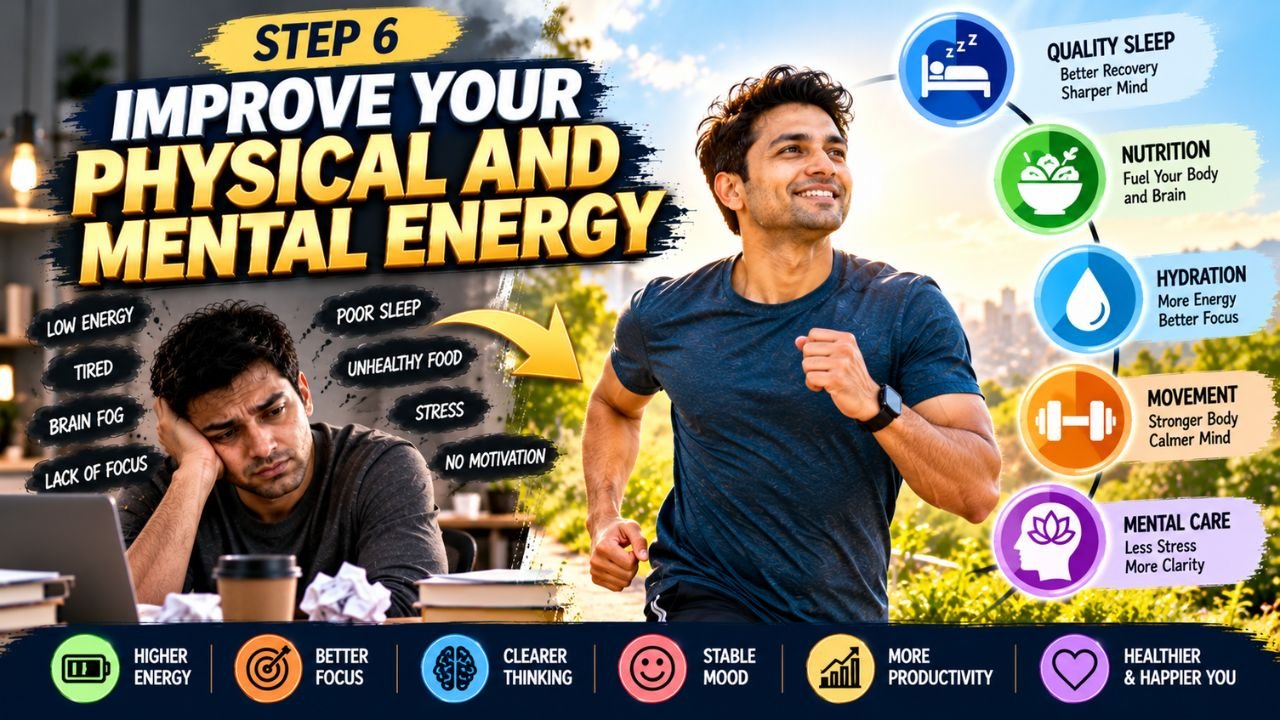
You may have a clear vision, a growth-oriented mindset, and a strong desire to change.
However, it becomes difficult to practise these qualities when your body is constantly tired and your mind is overloaded.
Low energy can make a simple task feel difficult.
Poor sleep can reduce your ability to focus.
Continuous stress can make you more emotionally reactive.
Long periods of sitting can leave your body feeling heavy.
Irregular meals or inadequate nutrition may also affect how you feel and function.
Therefore, becoming the best version of yourself is not only a mental process.
Your mind and body work together as one system.
If you want clear thinking, emotional balance, confidence, and consistent action, you also need to support the body that makes those experiences possible.
Personal Growth Begins with Physical Support
Self-improvement is often presented as a question of willpower.
You may hear:
“Work harder.”
“Be more disciplined.”
“Stop making excuses.”
“Push yourself.”
However, not every lack of action is a lack of discipline.
Sometimes, your body needs rest.
Sometimes, you need better nourishment.
Sometimes, your nervous system has been under pressure for too long.
Sometimes, a health condition may be affecting your energy, concentration, sleep, or mood.
This does not mean that you should use low energy as an excuse to avoid every responsibility.
Instead, it means that you should understand what your body needs before judging yourself.
Ask:
- Am I physically tired or mentally resistant?
- Have I been sleeping well?
- Am I eating regularly and in a balanced way?
- Have I moved my body today?
- Have I had any time to recover?
- Is this low energy temporary or persistent?
- Could a health issue require professional attention?
These questions help you respond more wisely.
Low Energy Can Feel Like Low Motivation
Imagine that you slept poorly for several nights.
During the day, you struggle to focus. You delay important work. You become irritated easily. Then, you tell yourself:
“I have lost my motivation.”
However, motivation may not be the only issue.
Your body may be asking for recovery.
Similarly, if you work for many hours without breaks, remain seated for most of the day, and consume constant digital information, your mind may begin to feel heavy.
You may then believe:
“I cannot think clearly anymore.”
The real problem may be that your system has not received enough rest, movement, silence, or recovery.
Therefore, before labelling yourself as lazy or unmotivated, look at your physical and mental foundation.
Sometimes, the next step is not more pressure.
It is better support.
Make Sleep a Priority
Sleep is not wasted time.
It is a basic need that supports physical health, emotional well-being, attention, memory, and daily functioning.
The amount of sleep a person needs can vary by age and individual circumstances. As a general reference, the U.S. Centers for Disease Control and Prevention states that adults aged 18–60 usually need at least seven hours of sleep, while needs can vary in older age groups.
However, sleep quality matters as well as sleep duration.
You may spend many hours in bed but still wake up feeling tired if your sleep is repeatedly interrupted.
Therefore, notice both:
- How long you sleep
- How refreshed you feel after sleeping
Build a Simple Sleep Routine
You do not need a complicated sleep system.
Begin with a few consistent actions.
Keep a Regular Sleep and Wake Time
Try to go to bed and wake up at roughly similar times.
Your routine does not need to be perfect every day. However, greater consistency can make it easier to prepare for sleep.
Create a Short Wind-Down Period
Before sleeping, reduce highly stimulating activities.
You might:
- Lower bright lights
- Put away unnecessary work
- Reduce phone use
- Read something calming
- Practise slow breathing
- Write tomorrow’s priorities
- Spend a few quiet minutes in reflection or prayer
The CDC includes regular sleep times, a quiet sleep environment, reduced electronic-device use before bed, regular exercise, and attention to caffeine among habits that can support better sleep.
Keep the Sleep Space Supportive
As much as possible, make the room:
- Comfortable
- Quiet
- Dark
- Clean
- Suitable in temperature
You may not control every part of your environment. However, improve what you can.
Notice Your Evening Inputs
Pay attention to how late meals, caffeine, alcohol, stressful work, and screen use affect your sleep.
Different people respond differently.
The goal is to study your pattern rather than follow a rigid rule without awareness.
Know When a Sleep Problem Needs Attention
Occasional poor sleep can happen because of stress, travel, work, illness, or a change in routine.
However, speak with a qualified healthcare professional if you regularly:
- Struggle to fall asleep
- Wake many times during the night
- Wake feeling unrefreshed
- Feel extremely sleepy during the day
- Snore heavily or experience breathing concerns
- Depend on substances to sleep
- Find that sleep problems affect normal life
A sleep problem is not always solved by becoming more disciplined.
Sometimes, professional evaluation is the responsible next step.
Move Your Body Regularly
Movement supports far more than appearance.
It can support physical health, daily function, energy, and well-being.
However, many people make exercise so difficult that they never begin.
They believe that movement counts only if they:
- Join a gym
- Complete a long workout
- Lift heavy weights
- Run for many kilometres
- Follow an intense plan every day
As a result, they do nothing.
A better starting belief is:
“Some movement is better than no movement.”
The World Health Organization emphasises that all physical activity counts and that any amount is better than none. It also recommends limiting long periods of sedentary behaviour.
Choose Movement You Can Continue
Your movement plan should match your:
- Age
- Health
- Current fitness
- Physical limitations
- Schedule
- Environment
- Professional medical guidance
Movement may include:
- Walking
- Yoga
- Cycling
- Swimming
- Dancing
- Stretching
- Strength training
- Playing a sport
- Climbing stairs
- Active household work
- Short movement breaks during work
You do not need to begin at your final level.
Start at a level that feels safe and manageable.
Then, build gradually.
If you have a medical condition, injury, pain, pregnancy-related needs, or a long period of inactivity, ask a qualified professional what type and amount of activity is suitable for you.
Reduce Long Periods of Sitting
Even if you exercise at one time of day, you may still spend many hours sitting.
Therefore, look for simple ways to break long periods of inactivity.
For example:
- Stand while taking a short phone call
- Walk for a few minutes between work blocks
- Stretch after completing a task
- Use stairs when appropriate
- Walk after a meal if suitable for you
- Place useful items slightly farther away
- Set a reminder to change position
These actions may appear small.
However, they help make movement part of your normal life instead of one separate event.
Eat to Support Your Body, Not to Punish It
Food advice can become confusing.
One source says to remove a food. Another says to add it. A new diet appears every few months.
As a result, people may move between restriction, guilt, overeating, and confusion.
A healthier starting point is balance, variety, suitability, and consistency.
A balanced eating pattern generally includes a variety of foods that provide energy, protein, fibre, healthy fats, vitamins, and minerals.
Depending on your dietary preferences and individual needs, this may include:
- Vegetables
- Fruits
- Whole grains
- Beans and pulses
- Nuts and seeds
- Dairy or suitable alternatives
- Other appropriate protein sources
- Healthy fats
- Adequate fluids
The NHS Eatwell guidance also highlights variety across food groups and notes that people with special dietary or medical needs may need personalised advice from a registered dietitian.
Avoid the All-or-Nothing Food Mindset
One meal does not make you healthy.
One less-balanced meal does not destroy your health.
What you do repeatedly matters more than one isolated choice.
Therefore, instead of asking:
“Was this meal perfect?”
ask:
- Was it reasonably balanced?
- Did it provide nourishment?
- Does it fit my health needs?
- How did I feel after eating it?
- What can I improve in the next meal?
This approach replaces food guilt with awareness.
Pay Attention to Your Individual Needs
There is no single meal plan that is perfect for everyone.
Your needs may depend on:
- Age
- Activity level
- Body size
- Health conditions
- Medications
- Allergies
- Digestion
- Pregnancy
- Religious or ethical choices
- Personal preferences
- Access and budget
Therefore, avoid copying a strict diet simply because it worked for someone online.
If you have persistent fatigue, digestive problems, major weight changes, food restrictions, a known medical condition, or concerns about nutrient deficiencies, speak with a qualified doctor or registered dietitian.
Responsible personal growth includes knowing when personalised guidance is needed.
Stay Adequately Hydrated
Water supports normal body functions.
However, hydration needs can change based on weather, activity, illness, pregnancy, diet, and individual health.
Instead of forcing an extreme amount of water, build a simple habit of drinking fluids regularly throughout the day.
You may:
- Begin the day with water
- Keep a bottle nearby
- Drink around meals
- Increase fluids during hot weather
- Replace some sugary drinks with water
- Notice signs that you may not be drinking enough
Public-health guidance often provides general fluid targets, but these are guides rather than rules for every person. The NHS notes that fluid needs may rise with activity, hot weather, pregnancy, breastfeeding, illness, or recovery.
If a medical professional has advised you to limit fluids because of a health condition, follow that personalised advice.
Get Natural Light and Fresh Air
When possible, spend some time outside.
Natural light, a change of environment, and gentle movement can help break the mental heaviness created by remaining indoors and looking at screens for long periods.
You might:
- Sit near natural light in the morning
- Take a short outdoor walk
- Work near a window
- Spend a few minutes in a garden or open area
- Combine a break with gentle movement
You do not need to turn this into another difficult routine.
Even a short period outside can become a helpful reset in your day.
Take appropriate precautions for weather, heat, air quality, and sun exposure.
Protect Your Mental Energy
Your body can be sitting still while your mind is working continuously.
Every notification, video, message, headline, conversation, and unfinished task asks for attention.
When this input continues throughout the day, your mind may have little space to process what you have already received.
You may then experience:
- Mental heaviness
- Difficulty choosing
- Reduced focus
- Irritation
- Constant comparison
- The urge to consume more information
- Difficulty sitting quietly
Therefore, managing energy also means managing input.
Create Information Boundaries
You do not need to know everything immediately.
Choose when and how you receive information.
For example:
- Turn off unnecessary notifications
- Avoid checking messages during focused work
- Select a limited time for news
- Unfollow content that repeatedly creates comparison
- Stop collecting information once you can take the next action
- Keep the phone away during meaningful conversations
- Create one quiet period each day
A boundary is not a punishment.
It protects your attention for what matters.
Understand the Difference Between Rest and Escape
Rest helps you recover.
Escape delays what you need to face.
They may look similar from the outside.
For example, watching a film after completing meaningful work may help you relax.
However, watching one video after another to avoid an important task may leave you more tired and guilty.
Ask:
- Will this activity restore me or numb me?
- Am I choosing this break, or am I avoiding something?
- How do I usually feel after this activity?
- Can I decide when the break will end?
Healthy rest leaves you more able to return.
Avoidance often makes returning more difficult.
Use Different Types of Recovery
Rest does not always mean sleep.
You may need different forms of recovery.
Physical Recovery
- Sleep
- Gentle movement
- Stretching
- Relaxing tense muscles
- Taking a suitable break
Mental Recovery
- Reducing information
- Writing down unfinished thoughts
- Focusing on one task
- Spending time without screens
Emotional Recovery
- Speaking with someone trustworthy
- Journaling
- Allowing yourself to feel
- Seeking professional support when needed
Social Recovery
Depending on your needs, this may mean meaningful connection or some time alone.
Creative Recovery
- Music
- Drawing
- Gardening
- Cooking
- Reading
- Spending time in nature
- Enjoying a low-pressure hobby
Do not wait until you are completely exhausted to recover.
Small recovery periods can be built into normal life.
Create a Supportive Morning Routine
A morning routine should help you begin the day with intention.
It does not need to begin at 4:00 a.m.
It also does not need to include ten different activities.
A simple routine may include:
- Wake up at a suitable time.
- Drink water if appropriate for you.
- Spend a few minutes in quiet breathing, prayer, or reflection.
- Move your body gently.
- Review your main priority.
- Avoid unnecessary digital input during the first few minutes.
Choose a routine that fits your responsibilities.
The best morning routine is not the most impressive one.
It is the one you can practise consistently and that helps you begin the day well.
Create a Recovery-Based Evening Routine
Your evening routine should help you close the day.
You might:
- Review what you completed.
- Write down unfinished tasks.
- Select tomorrow’s first priority.
- Reduce unnecessary screen exposure.
- Prepare your sleeping space.
- Practise gratitude, reflection, or calming breathing.
- Go to bed at a reasonably consistent time.
Writing down unfinished tasks can help you stop carrying every reminder in your mind.
Your evening routine tells your system:
“The working part of the day is ending. It is time to recover.”
Build an Energy-Aware Workday
You do not have the same level of energy throughout the entire day.
Therefore, notice when you usually feel:
- Most alert
- Most creative
- Most social
- Most tired
- Most distracted
When possible, place important thinking work during your higher-energy period.
Use lower-energy periods for simple tasks, routine work, or recovery.
For example:
- High energy: writing, planning, learning, important decisions
- Medium energy: meetings, communication, review
- Lower energy: organising, administration, simple follow-ups
You may not control your entire schedule.
However, even a small adjustment can improve how you use your energy.
Stop Treating Exhaustion as a Sign of Success
Hard work is valuable.
However, constant exhaustion is not proof that your life is meaningful.
If your growth plan repeatedly damages your sleep, health, relationships, and peace, the plan may need adjustment.
Your best self is not the person who can tolerate unlimited pressure.
Your best self knows when to work, when to pause, when to recover, and when to ask for help.
Sustainable performance includes recovery.
Know When to Seek Professional Support
Lifestyle habits are important, but they cannot solve every health problem.
Persistent low energy, sleep changes, unexplained pain, major changes in appetite or weight, breathing problems, severe stress, or difficulty completing normal activities may need professional evaluation.
Do not assume that every symptom is caused by mindset.
Similarly, do not use motivational advice as a substitute for appropriate medical or mental-health care.
Speak with a qualified professional when:
- Symptoms are severe
- A problem continues or becomes worse
- Daily functioning is affected
- You are unsure whether activity is safe
- You have a known health condition
- You suspect a nutritional deficiency
- Sleep problems are frequent
- Emotional symptoms remain distressing
- You feel unsafe
Seeking help is an act of self-respect.
The Seven-Day Energy Audit
For the next seven days, observe your energy without trying to change everything immediately.
Record:
- Sleep and wake time
- Sleep quality from 1 to 10
- Morning energy from 1 to 10
- Meals and how you felt afterward
- Water and fluid habits
- Physical movement
- Screen and information load
- Stressful events
- Recovery activities
- Evening energy from 1 to 10
At the end of the week, ask:
- What seems to increase my energy?
- What seems to reduce it?
- When do I think most clearly?
- Which habit affects several areas?
- What pattern needs professional attention?
- What is one realistic improvement for next week?
Do not use this audit to become overly worried about every small change.
Use it to notice broad patterns.
Step 6 Action Plan
Complete the following actions:
- Review your average sleep duration and quality.
- Choose one habit that can support better sleep.
- Add one manageable form of movement to your day.
- Break one long period of sitting.
- Review whether your meals are varied and reasonably balanced.
- Build a simple hydration reminder.
- Remove one unnecessary digital distraction.
- Create one short recovery period.
- Begin the seven-day energy audit.
- Seek qualified care for persistent or concerning symptoms.
If you want to explore this foundation more deeply, the supporting guide on how to improve your physical energy and mental well-being will include a complete energy audit, morning and evening routines, recovery practices, and a personal well-being plan.
Key Takeaway
Your body is not separate from your personal-growth journey.
Sleep, food, movement, hydration, recovery, health care, and mental input all influence how well you can think, feel, and act.
Therefore, do not ask only:
“How can I become more disciplined?”
Also ask:
“How can I give my mind and body the support they need?”
When your physical and mental foundation becomes stronger, it becomes easier to practise the qualities of your best self.
However, knowing what supports you is only the beginning.
You must turn those helpful actions into repeated behaviour.
In the next section, you will learn how to build habits that support your desired identity and remain consistent even when motivation changes.
Step 7: Build Habits That Support the Person You Want to Become
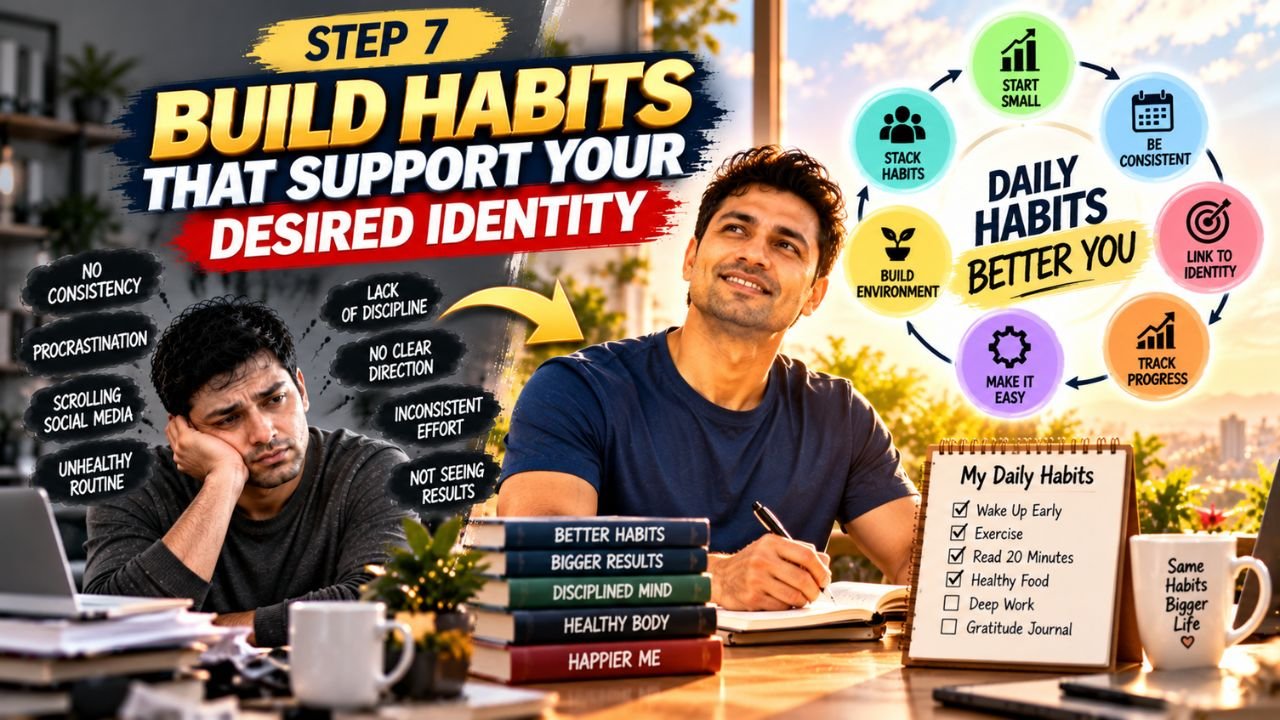
You now understand that your body, mind, and energy need regular support.
However, knowing what is good for you does not guarantee that you will do it consistently.
You may know that movement is helpful but still remain inactive.
You may know that sleep matters but continue using your phone late at night.
You may know that speaking practice will improve your confidence but keep postponing it.
This gap between knowing and doing is where habits become important.
A habit turns a useful action from something you occasionally remember into something you repeat more naturally.
Therefore, if you want to become the best version of yourself, do not depend only on big goals or temporary motivation.
Build small habits that make your desired identity visible in daily life.
What Is a Habit?
A habit is a behaviour that becomes connected with a familiar situation or cue through repetition.
For example:
- You may brush your teeth after waking up.
- You may check your phone when you hear a notification.
- You may drink tea at a particular time.
- You may open social media when work becomes difficult.
- You may begin worrying when you need to make an important decision.
Some habits support your growth.
Others may reduce your focus, health, confidence, or peace.
The important point is that many habits are not conscious decisions made from the beginning every time.
A familiar cue can begin to trigger a familiar response.
Research on habit formation describes repetition in a consistent context as an important part of making behaviour more automatic over time.
Therefore, changing a habit requires more than saying, “I will use more willpower.”
You need to understand the cue, behaviour, environment, and result connected with it.
Your Habits Are Repeated Evidence of Your Identity
Your identity is not shaped only by what you say about yourself.
It is also shaped by what you repeatedly do.
If you repeatedly prepare and practise before speaking, you create evidence that you are becoming a committed communicator.
If you regularly move your body, you create evidence that you care for your health.
If you begin important work at the planned time, you create evidence that you can trust yourself.
One action does not completely change your identity.
However, each repeated action becomes a small piece of evidence.
Think of every useful habit as a vote for your desired self.
One vote may not decide the result. However, repeated votes create a clear direction.
Therefore, when choosing a new habit, do not ask only:
“What result do I want?”
Also ask:
“What kind of person would practise this behaviour?”
For example:
- A healthy person takes regular care of the body.
- A focused person protects important work from distraction.
- A learner reviews and applies useful ideas.
- A confident speaker practises expressing thoughts.
- A calm person creates a pause before reacting.
- A responsible person completes important commitments.
This identity connection gives the habit a deeper meaning.
Start with the Identity, Not Only the Behaviour
Suppose you want to write for 30 minutes every day.
You can treat this only as a task:
“I need to write today.”
Or you can connect it to an identity:
“I am becoming a writer who develops and expresses ideas consistently.”
The behaviour is the same. However, the second statement connects the action with the person you want to become.
When the habit feels difficult, remind yourself:
“This action is not only about today’s result. It is evidence of the person I am becoming.”
This does not mean that you must repeat grand affirmations.
It means that you understand why the habit matters.
Understand the Basic Habit Pattern
A simple habit pattern can be understood through four parts:
- Cue
- Desire or need
- Behaviour
- Result
Imagine that you feel mentally tired while working.
Cue
The task becomes difficult.
Desire or Need
You want quick relief.
Behaviour
You open social media.
Result
You receive temporary entertainment or distraction.
Because the action gives quick relief, the pattern may repeat the next time work feels difficult.
Now consider a positive habit.
Cue
You finish breakfast.
Desire or Need
You want to build speaking confidence.
Behaviour
You practise speaking for five minutes.
Result
You feel a small sense of progress and record the completed practice.
Over time, breakfast can become connected with speaking practice.
Understanding this pattern helps you build helpful habits and change unhelpful ones.
Choose One Habit That Matters
When people feel inspired, they often create a long list of new habits.
They decide to:
- Wake up very early
- Exercise every day
- Meditate
- Read
- Journal
- Eat perfectly
- Learn a new skill
- Stop social media
- Build a business
- Sleep on time
This plan may feel exciting for a few days.
However, it can quickly become too heavy.
When one part fails, the person may abandon the entire routine.
Instead, begin with one habit that can create a meaningful effect.
Ask:
- Which area currently needs the most support?
- Which habit may improve several areas?
- Which behaviour is small enough to repeat?
- Which habit supports my main 90-day identity?
For example, if your main identity is “a person who takes clear and consistent action,” your first habit may be:
“Every morning, I will write and begin my most important task before checking unnecessary messages.”
One focused habit is often more useful than ten weak intentions.
Make the Habit Small Enough to Begin
Many habits fail because the starting action is too large.
You may plan to exercise for one hour, read 50 pages, meditate for 30 minutes, or write 2,000 words every day.
These goals may be possible later.
However, if the action feels too difficult at the beginning, you may avoid starting.
Create a minimum version of the habit.
For example:
- Read one page
- Walk for five minutes
- Write one paragraph
- Meditate for two minutes
- Practise speaking for three minutes
- Organise one small area
- Review one key idea
- Complete one focused work block
The minimum version should feel easy enough to perform even on a difficult day.
This does not mean you must stop after the minimum.
If you have time and energy, continue.
However, the smaller version protects continuity.
Use the Two-Minute Starting Point
When resistance is high, reduce the habit to the first two minutes.
Do not ask:
“Can I complete the whole task?”
Ask:
“Can I begin for two minutes?”
For example:
- Open the document and write the title.
- Put on your walking shoes.
- Place the book in front of you and read one paragraph.
- Sit in the practice space and speak for two minutes.
- Write the first step of the plan.
Starting reduces the mental size of the task.
Once you begin, continuing may feel easier.
Even if you stop after two minutes, you have strengthened the habit of beginning.
That matters because many important actions fail before they start.
Define the Habit Clearly
A vague habit is difficult to follow.
For example:
“I will read more.”
This statement does not tell you when, where, or how much.
A clearer habit is:
“After dinner, I will read five pages at my desk.”
Use this simple formula:
After or before [existing event], I will [specific behaviour] at [location] for [minimum amount].
Examples:
“After my morning tea, I will practise speaking for five minutes in my workroom.”
“Before checking social media, I will complete one 25-minute focus block.”
“After lunch, I will walk for ten minutes if it is suitable for my health and schedule.”
A clear habit removes some daily decision-making.
Connect the New Habit with an Existing Routine
An existing routine can act as a reminder for a new habit.
This is sometimes called habit stacking.
You choose something that already happens and attach the new behaviour to it.
For example:
- After brushing my teeth, I will drink water.
- After sitting at my desk, I will write my main priority.
- After finishing breakfast, I will practise one speaking structure.
- After closing my workday, I will review what I completed.
- Before going to bed, I will prepare tomorrow’s first task.
Choose an existing routine that happens reliably.
Then, keep the new action small and clear.
If the existing cue is inconsistent, the new habit may also become inconsistent.
Design Your Environment for Better Behaviour
Your environment can make a behaviour easier or harder.
For example, if your phone remains beside you during focused work, checking it requires very little effort.
If it is placed in another room, the same distraction requires more effort.
Similarly:
- A visible book reminds you to read.
- Prepared exercise clothes make movement easier.
- A clean desk reduces visual distraction.
- A written checklist makes the next action clear.
- Healthy food that is prepared and available is easier to choose.
- A speaking-practice prompt placed near your desk reminds you to practise.
Do not depend on memory alone.
Let your environment remind and support you.
Ask:
“How can I make the helpful action easier to begin?”
Then ask:
“How can I make the unhelpful action slightly more difficult?”
Small environmental changes can reduce the amount of willpower required.
Reduce Friction for Helpful Habits
Friction is anything that makes a behaviour harder to begin.
For example, if you want to exercise but need to search for clothes, select a routine, clear a space, and find equipment every time, the habit has high friction.
Reduce the number of steps.
You might:
- Prepare clothes the night before
- Choose the workout in advance
- Keep equipment ready
- Select a fixed location
- Decide the minimum version
Similarly, if you want to write:
- Keep one document ready
- Decide the topic in advance
- Leave a note showing the next point
- Remove distracting tabs
- Set a clear starting time
Your goal is to make the first action obvious.
Increase Friction for Unhelpful Habits
If an action is too easy, you may perform it without thinking.
Therefore, add small barriers to habits you want to reduce.
For example:
- Turn off non-essential notifications
- Log out of distracting apps
- Keep the phone away from the work area
- Remove saved payment details for impulse buying
- Avoid keeping tempting items in immediate reach
- Use a website blocker during focus time
- Decide a specific time for social media
You do not need to make the behaviour impossible.
You only need enough space to make a conscious choice.
Replace an Unhelpful Habit Instead of Leaving an Empty Space
Many unhelpful habits meet a real need.
Social media may provide relief from boredom.
Emotional eating may provide comfort.
Avoidance may provide temporary safety.
Constant checking may provide a feeling of control.
If you remove the behaviour without addressing the need, the old habit may return or be replaced by another unhelpful one.
Therefore, ask:
- What triggers this habit?
- What feeling or need appears?
- What reward does the behaviour provide?
- What healthier action could meet part of the same need?
For example:
- Need: Mental break
Replacement: A short walk or stretch - Need: Connection
Replacement: Send a message to a trusted person - Need: Relief from a difficult task
Replacement: Take a timed break, then return to a smaller step - Need: Emotional comfort
Replacement: Journaling, breathing, music, conversation, or appropriate professional support
The replacement does not need to feel exactly the same.
However, it should respond to the real need.
Use Immediate Satisfaction Carefully
Many valuable habits provide delayed rewards.
Exercise may support long-term health.
Saving money may support future stability.
Practising communication may build confidence over time.
However, the effort happens now while the larger reward comes later.
Therefore, create a small immediate sign of completion.
You might:
- Place a check mark on a tracker
- Say, “I kept my promise today”
- Record one sentence about progress
- Enjoy a suitable break
- Share progress with an accountability partner
- Notice how you feel after completing the action
The reward should support the habit rather than work against it.
For example, completing a workout does not need to be rewarded with a choice that conflicts with your health goal.
Often, the most useful reward is visible evidence of consistency.
Track the Habit Simply
Habit tracking can make progress visible.
However, do not make tracking more difficult than the habit itself.
Use a simple method:
- A tick on a calendar
- A notebook
- A habit-tracking app
- A weekly checklist
- A short daily journal
Track whether you completed the minimum behaviour.
For example:
| Habit | Minimum Version | Completed? |
| Speaking practice | 5 minutes | Yes/No |
| Movement | 10-minute walk | Yes/No |
| Focus | One distraction-free block | Yes/No |
| Reflection | Write one learning | Yes/No |
The tracker is information, not a tool for self-punishment.
If you miss several days, study what happened.
Do not simply stare at the empty boxes and criticise yourself.
There Is No Universal Number of Days
You may have heard that every habit takes 21 days to form.
However, habit formation is not that fixed.
The time can vary based on:
- The complexity of the behaviour
- How often it is repeated
- How stable the context is
- Personal circumstances
- Motivation
- Environment
- The type of habit
- Interruptions and life events
A systematic review of health-related habit research found that the time required for habits to develop varies rather than following one universal number.
Therefore, do not ask only:
“How many days will this take?”
Ask:
“How can I repeat this behaviour in a stable and sustainable way?”
Focus on consistency and learning rather than a magical deadline.
What to Do When You Miss a Day
Missing one day does not destroy a habit.
However, the meaning you give to the missed day can create a problem.
You may think:
“I broke the routine. There is no point continuing.”
This is all-or-nothing thinking.
Instead, ask:
- Why did I miss the habit?
- Was the action too large?
- Was the cue unclear?
- Did my schedule change?
- Was I tired or unwell?
- Did the environment create difficulty?
- What is the smallest version I can restart?
Then, restart as quickly as reasonably possible.
The goal is not a perfect record.
The goal is returning.
Create a Difficult-Day Version
Plan for days when your time, energy, or circumstances are limited.
For example:
| Normal Version | Difficult-Day Version |
| Walk for 30 minutes | Walk for 5 minutes |
| Write 500 words | Write one paragraph |
| Practise speaking for 15 minutes | Speak for 2 minutes |
| Read 20 pages | Read one page |
| Meditate for 10 minutes | Take five slow breaths |
| Complete three focus blocks | Complete one 10-minute block |
The difficult-day version helps you protect the identity and continuity of the habit.
However, it should not become a permanent excuse to avoid reasonable growth.
Use it when needed, then return to the normal version.
Review the Habit Every Week
A habit is not a test that you pass or fail.
It is a system that you improve.
At the end of each week, ask:
- How many times did I complete the habit?
- Which cue worked best?
- What created resistance?
- Was the habit too large?
- Did the environment support me?
- What result did I notice?
- What should I adjust next week?
This review turns failure into feedback.
For example, you may discover that evening speaking practice does not work because you are tired.
Instead of deciding that you lack discipline, you may move the practice to the morning.
That is not failure.
It is intelligent adjustment.
Use the Respond and Reinforce Steps of the 6R Framework
Habit building connects strongly with two steps of the 6R framework.
Respond
Respond means taking the desired action instead of following the old automatic pattern.
For example:
- Old pattern: Feel uncertainty and keep researching.
- New response: Gather enough information and take the next reasonable step.
Reinforce
Reinforce means repeating the helpful response until it becomes more familiar.
You reinforce a habit by:
- Repeating it
- Keeping the cue stable
- Making progress visible
- Noticing the benefit
- Reviewing mistakes
- Returning after interruptions
- Gradually increasing the challenge
One successful action shows possibility.
Repeated action builds identity.
Create Your Best-Self Habit Scorecard
List the habits that are already part of your day.
Do not judge them at first.
Simply record them from morning to night.
For example:
- Wake up
- Check phone
- Drink tea
- Prepare for work
- Travel
- Begin work
- Check messages
- Eat lunch
- Return home
- Watch videos
- Prepare for sleep
Next to each habit, mark:
- + if it supports your desired identity
- – if it works against your desired identity
- = if it is neutral
Then choose:
- One positive habit to strengthen
- One negative habit to replace
- One neutral habit that can become a cue
For example:
- Strengthen: Morning walk
- Replace: Unplanned social-media checking
- New cue: After tea, practise speaking for five minutes
Do not redesign your entire day at once.
Choose one useful change.
The 30-Day Identity Habit Plan
Use the following plan for one habit.
My Desired Identity
Who am I becoming?
Example:
“I am becoming a clear and confident communicator.”
My Habit
What will I do?
“I will practise speaking on one idea.”
My Cue
When will I do it?
“After morning tea.”
My Location
Where will I do it?
“At my desk.”
My Minimum Version
What is the smallest version?
“Speak for three minutes.”
My Normal Version
What is the expected version?
“Speak for ten minutes.”
My Difficult-Day Version
What will I do when energy or time is limited?
“Speak for one minute using a simple structure.”
My Tracking Method
How will I record completion?
“Place a tick on my calendar.”
My Weekly Review
When will I study and improve the system?
“Every Sunday evening.”
This plan makes the habit specific, visible, and repeatable.
Step 7 Action Plan
Complete these actions:
- Choose one identity you want to strengthen.
- Select one habit that supports that identity.
- Define the minimum, normal, and difficult-day versions.
- Connect the habit with an existing routine.
- Choose a clear time and location.
- Remove one point of friction.
- Add one environmental reminder.
- Make one unhelpful habit slightly harder.
- Track the habit with a simple method.
- Review and improve the system every week.
If you want to explore this process in greater depth, the supporting guide on how to build better habits and stay consistent every day will include habit worksheets, environment-design examples, replacement strategies, and a complete 30-day consistency plan.
Key Takeaway
You do not become your best self through occasional moments of motivation.
You become your best self through behaviours that you repeat.
Start with identity.
Choose one small habit.
Connect it with a clear cue.
Make the action easy to begin.
Design the environment to support it.
Then, repeat, review, and adjust.
You do not need perfect consistency.
You need the ability to return.
However, habits alone are not enough if your important goals continue getting lost in distraction, procrastination, and unclear priorities.
Therefore, in the next section, you will learn how to develop focus, discipline, and consistent action.
Step 8: Develop Focus, Discipline, and Consistent Action
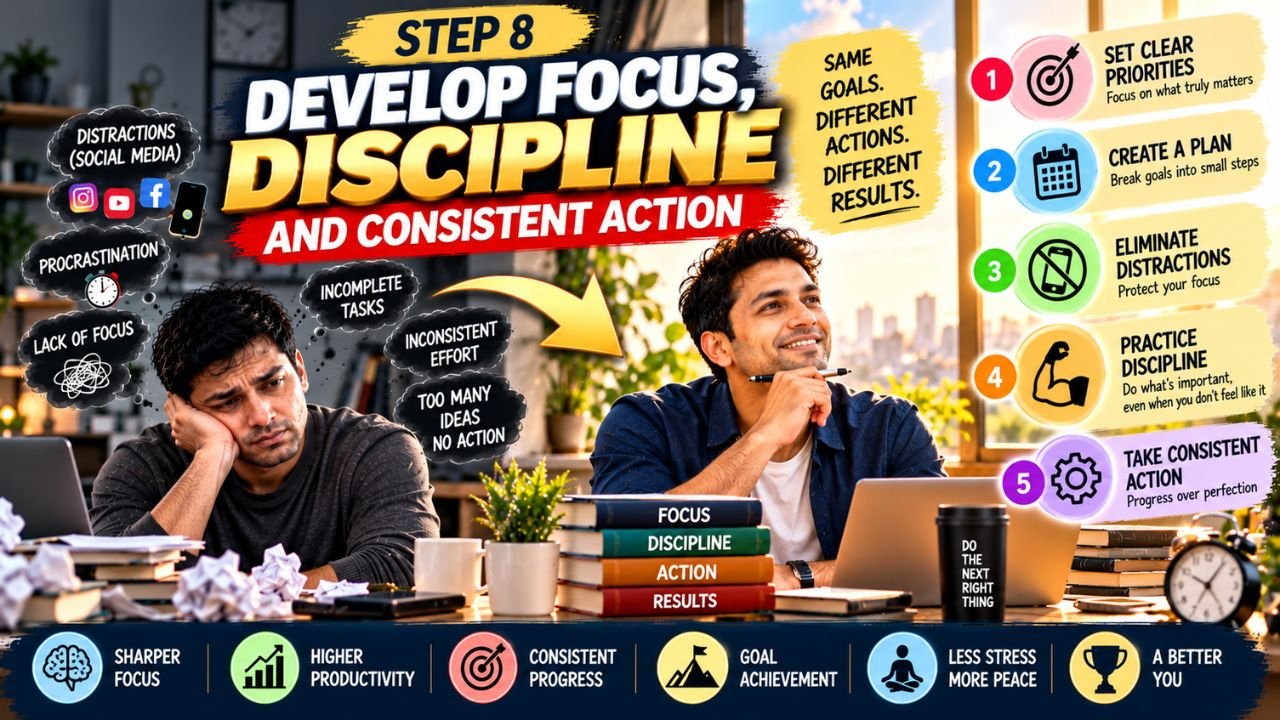
You may understand yourself, have a meaningful vision, and build several helpful habits.
However, personal transformation remains incomplete until you take action on the things that matter.
Many people do not have a knowledge problem.
They already know what they should do.
They know they should begin the project, publish the content, practise the skill, have the difficult conversation, or make the important decision.
Still, they delay.
They wait for more motivation, more confidence, more information, or a perfect time.
As a result, their ideas remain inside their minds instead of becoming visible results.
Therefore, becoming the best version of yourself requires you to move from intention to action.
You need focus to know where to direct your energy.
You need discipline to continue when your feelings change.
Finally, you need a practical system that makes action easier to begin and repeat.
Knowledge Does Not Transform Your Life Until You Apply It
Learning is valuable.
Books, courses, videos, mentors, and articles can expand your understanding.
However, information creates transformation only when you use it.
For example, you may learn ten communication techniques. Still, your speaking will not improve until you practise expressing ideas.
You may learn how to create a business. However, the business will not grow until you understand people’s needs, create an offer, communicate its value, and serve customers.
Similarly, you may study emotional regulation. Yet the real test comes when you use the method during an emotional moment.
Knowledge shows you what may be possible.
Action creates evidence.
Therefore, after learning something useful, ask:
“How will I apply this within the next 24 hours?”
This question helps you convert information into behaviour.
What Is Procrastination?
Procrastination means delaying an important action even when you know the delay may create a problem.
It does not always mean that you are lazy.
You may procrastinate because:
- The task feels too large
- You do not know how to begin
- You fear failure
- You fear judgment
- You want the result to be perfect
- You feel emotionally uncomfortable
- The reward feels too far away
- The task does not feel meaningful
- You are mentally or physically tired
- You have too many options
- Your environment is distracting
- You do not have a clear deadline
- You are avoiding an important decision
Because the causes are different, the solution must match the real cause.
Telling yourself to “work harder” may not solve a task that is unclear.
A motivational video may not solve physical exhaustion.
A time-management tool may not solve fear of judgment.
Therefore, before forcing action, understand the reason for the delay.
Identify the Real Reason You Are Delaying
Choose one task that you have been postponing.
Then ask:
Is the Task Clear?
Can you explain the next physical action?
“Work on my business” is unclear.
“Write the headline for my landing page” is clear.
Is the Task Too Large?
Are you trying to complete an entire project in one sitting?
If yes, divide it into smaller parts.
Am I Afraid of the Result?
Are you worried about failure, criticism, rejection, or making a mistake?
If yes, reduce the emotional risk by taking a smaller test action.
Am I Waiting for Perfection?
Are you trying to create the final version before allowing yourself to create the first version?
If yes, separate drafting from editing.
Do I Have Enough Energy?
Are you genuinely tired, unwell, or overloaded?
If yes, you may need recovery, support, or a schedule adjustment.
Is the Task Connected to My Goal?
Do you understand why the task matters?
If the action has no meaningful connection with your vision, you may need to question whether it should remain on your list.
Once you identify the reason, you can choose a more useful response.
Turn a Big Goal into the Next Visible Action
A goal tells you where you want to go.
However, a next action tells you what to do now.
Suppose your goal is:
“Launch my online coaching program.”
This goal may feel exciting but overwhelming.
Break it down.
Goal
Launch the coaching program.
Major Milestones
- Understand the audience
- Define the transformation
- Design the offer
- Create the program
- Build the landing page
- Create the marketing plan
- Invite the first participants
Current Milestone
Understand the audience.
Current Task
Interview five potential clients.
Next Visible Action
Write five interview questions and contact the first person.
The next visible action should be clear enough that you can begin without further planning.
Instead of:
“Create content,”
write:
“Write three possible titles for tomorrow’s video.”
Instead of:
“Improve my health,”
write:
“Schedule the health appointment.”
Instead of:
“Learn public speaking,”
write:
“Record a three-minute explanation of one familiar topic.”
Clarity reduces resistance.
Use the Goal-to-Action Ladder
For every important goal, create the following ladder:
- Vision: What larger life direction does this support?
- Goal: What result do I want?
- Milestone: What major stage comes next?
- Weekly Target: What should move forward this week?
- Daily Priority: What matters today?
- Next Action: What can I physically do now?
For example:
- Vision: Become a trusted mind-transformation coach
- Goal: Build an educational YouTube channel
- Milestone: Publish the first 20 useful videos
- Weekly target: Create and publish one video
- Daily priority: Prepare the video structure
- Next action: Write the core idea in one sentence
When the next action is clear, beginning becomes easier.
Choose One Main Priority
One reason people lose focus is that everything feels important.
They create long task lists with no clear order.
Then, they spend the day moving between small tasks while the most meaningful work remains incomplete.
Every day, ask:
“If I complete only one meaningful task today, which task will create the most useful progress?”
This is your main priority.
You may still have other responsibilities.
However, selecting one main priority helps you protect time and attention for what matters most.
A useful priority is:
- Connected to an important goal
- Specific
- Possible to begin
- Appropriate for your available time and energy
- More valuable than the other available tasks
Do not confuse urgent noise with important progress.
Create a Daily Focus Plan
Use a simple daily plan with three levels.
One Main Priority
The task that creates the most meaningful progress.
Two Supporting Tasks
Smaller tasks that support your work or responsibilities.
Necessary Maintenance Tasks
Messages, administration, household duties, and routine work.
Complete or begin the main priority during your strongest available focus period whenever possible.
If you give your best energy only to minor tasks, you may remain busy without moving forward.
Work in Focus Blocks
A focus block is a planned period in which you work on one defined task with unnecessary distractions removed.
The block does not need to be extremely long.
Depending on the task and your current ability, you might begin with:
- 15 minutes
- 25 minutes
- 45 minutes
- 60 minutes
Before beginning, decide:
- What exact task will I work on?
- What result do I want from this block?
- How long will I work?
- What distractions will I remove?
- What will I do if another thought appears?
During the block:
- Keep only the required materials open.
- Put your phone away or silence unnecessary notifications.
- Avoid switching between unrelated tasks.
- Write distracting thoughts on a separate list.
- Continue until the block ends or the defined result is complete.
After the block, take a short, suitable break.
Then decide whether to continue, review, or move to the next task.
Use a Distraction List
While focusing, you may suddenly remember:
- A message you need to send
- Something you want to search
- A product you want to buy
- Another task
- An idea for a future project
If you act on every thought, your focus block will break.
Instead, keep a small distraction list.
Write the thought in a few words and return to the current task.
For example:
- Reply to Amit
- Check book title
- Buy notebook
- Research microphone
- Add video idea
After the focus block, review the list.
Some items will be important.
Others may no longer feel necessary.
This method allows you to remember the thought without immediately following it.
Stop Multitasking Important Work
Multitasking often feels productive because you are constantly doing something.
However, when you repeatedly switch between tasks, you lose attention and mental continuity.
You may be:
- Writing while checking messages
- Listening to a meeting while reading email
- Learning while scrolling social media
- Speaking with family while looking at your phone
- Planning one project while worrying about another
Instead, practise intentional single-tasking.
When writing, write.
When listening, listen.
When resting, rest.
When speaking with someone, be present.
You may not be able to control every interruption. However, you can reduce the unnecessary ones.
Understand What Discipline Really Means
Discipline is often imagined as harsh force.
People believe discipline means ignoring emotions, working without rest, and demanding perfect performance.
However, healthy discipline is better understood as the ability to act according to your values and commitments, even when your temporary feelings change.
Discipline may mean:
- Beginning when you do not feel fully motivated
- Stopping work when recovery is needed
- Saying no to a distraction
- Completing the promised minimum action
- Returning after a missed day
- Choosing a long-term benefit over short-term comfort
- Asking for help instead of pretending everything is fine
Discipline is not self-punishment.
It is a form of self-respect.
Keep Small Promises to Yourself
Every time you make a promise and repeatedly ignore it, your trust in yourself may weaken.
You begin to think:
“I say many things, but I do not follow them.”
Therefore, make smaller and clearer commitments.
Instead of promising:
“I will completely change my life from tomorrow,”
promise:
“Tomorrow at 8:00 a.m., I will practise speaking for ten minutes.”
Then follow through.
A small completed promise can build more self-trust than a large promise that is repeatedly broken.
As your consistency improves, you can increase the challenge.
Do Not Wait for Motivation
Motivation is helpful, but it changes.
Some days you may feel inspired.
Other days you may feel tired, uncertain, or uninterested.
If your action depends only on motivation, your progress will also keep changing.
Create a process that can work even when motivation is low.
For example:
- Use a fixed cue
- Prepare materials in advance
- Define the minimum version
- Work for a short focus block
- Track completion
- Use accountability
- Review progress weekly
Motivation may help you start a journey.
A system helps you continue.
Use the Five-Minute Entry
When a task feels emotionally heavy, make a five-minute agreement with yourself.
Say:
“I will work on this for five minutes. After five minutes, I can decide whether to continue.”
During those five minutes, do not evaluate the whole project.
Only begin.
For example:
- Write the first paragraph
- Review the first page
- Make the first phone call
- Record the first minute
- Organise the first group of files
- Complete the first small exercise
Often, resistance is strongest before the task begins.
The five-minute entry helps you cross the starting point.
If you still need to stop after five minutes, you have at least created movement and information.
Take Imperfect Action
Perfectionism often hides behind high standards.
High standards ask:
“How can I do this well?”
Perfectionism often asks:
“How can I make sure that no one can find any fault?”
The first question supports improvement.
The second can make action impossible.
Your first attempt does not need to show your final ability.
The first attempt gives you something to review.
For example:
- The first draft gives you material to edit.
- The first video gives you feedback about delivery.
- The first offer gives you information about the audience.
- The first conversation reveals what people need.
- The first practice session shows which skill is weak.
Without the first version, improvement remains theoretical.
Therefore, use this sequence:
Create → Review → Learn → Improve → Repeat
Do not try to reverse it by becoming excellent before you begin.
Separate Creation from Correction
Trying to create and judge at the same time can slow you down.
While writing, you may stop after every sentence.
While recording, you may restart after every small mistake.
While planning, you may keep changing the structure.
Instead, separate the stages.
Creation Stage
Produce the first version.
Allow it to be incomplete.
Review Stage
Look for what works and what needs improvement.
Correction Stage
Improve the most important parts.
Completion Stage
Decide when the work is useful and ready.
This process supports both quality and progress.
Define “Done” Before You Begin
A task can continue forever if you do not define completion.
Before starting, ask:
“What will count as done for this version?”
For example:
- A blog outline is done when it has the title, introduction promise, main headings, and conclusion direction.
- A practice video is done when you speak for ten minutes and review it once.
- A landing-page draft is done when the main sections have complete copy.
- A research session is done when you have three trusted sources and can take the next decision.
Defining “done” prevents endless polishing.
You can always create a better version later.
Use Time Limits for Decisions
Some decisions need careful thought.
However, unlimited thinking can increase confusion.
For a reversible decision, set a reasonable time limit.
You might say:
- “I will research this for 30 minutes.”
- “I will compare three options.”
- “I will decide by Friday.”
- “I will test this approach for two weeks.”
A decision does not always need to be permanent.
You may be able to choose, test, learn, and adjust.
This reduces the pressure of finding one perfect answer.
For major health, legal, financial, or safety decisions, take appropriate professional advice rather than rushing.
Protect Your Attention
Attention is a limited resource.
If you begin the day by giving it to notifications, headlines, other people’s priorities, and random content, less attention may remain for your own meaningful work.
Therefore, create attention boundaries.
You may decide:
- No unnecessary phone checking during the first focus period
- Messages reviewed at selected times
- Social media used intentionally
- Notifications turned off during deep work
- One workspace for one type of activity
- Important work completed before low-value browsing
You do not need to remove every enjoyable activity.
You need to decide when it belongs.
Use Accountability Wisely
Accountability can help you follow through.
You may share a commitment with:
- A coach
- A mentor
- A friend
- A colleague
- A study partner
- A supportive community
A useful accountability check includes:
- What did you plan?
- What did you complete?
- What stopped you?
- What did you learn?
- What will you do next?
The purpose is not public shame.
It is honest review and support.
Choose someone who helps you remain responsible without creating unnecessary fear.
Review Results, Not Only Effort
Effort matters.
However, you should also check whether your effort is creating useful progress.
At the end of the week, ask:
- What meaningful result did I create?
- Which action had the greatest effect?
- Where did I spend time without enough value?
- What did I keep postponing?
- Which distraction appeared most often?
- What should I stop, continue, or improve?
- What is next week’s main priority?
This review helps you become more effective, not only busier.
Use the Respond Step of the 6R Framework
This section is strongly connected with the fifth step of the 6R framework:
Respond
Respond means choosing a useful action after recognising the pattern, regulating the emotion, reframing the thought, and rehearsing the desired behaviour.
The full process may look like this:
- Recognise: “I am delaying because I fear criticism.”
- Regulate: Pause and calm the immediate emotional reaction.
- Reframe: “This work needs to be useful, not perfect.”
- Rehearse: Imagine beginning and handling feedback calmly.
- Respond: Create and share the first version.
- Reinforce: Review the result and repeat the behaviour.
Action completes the learning cycle.
Without response, awareness remains only observation.
The Daily Focus and Action Plan
Use this short template every day.
My Main Priority
What is the most meaningful task today?
Why It Matters
Which goal or identity does it support?
My Next Visible Action
What can I physically do first?
My Focus Time
When will I begin, and how long will I work?
Distractions I Will Remove
What may interrupt me?
My Minimum Completion
What is the smallest useful result?
My Definition of Done
How will I know this version is complete?
My End-of-Day Review
- What did I complete?
- What did I learn?
- What needs to happen next?
This plan should take only a few minutes.
Its purpose is to create clarity, not more planning work.
Step 8 Action Plan
Complete these actions:
- Choose one important task you have been delaying.
- Identify the real reason for the delay.
- Connect the task with a meaningful goal.
- Break it down to the next visible action.
- Decide what “done” means for the first version.
- Schedule one focus block.
- Remove one major distraction.
- Use the five-minute entry if resistance appears.
- Complete an imperfect first version.
- Review the result and define the next action.
If you want to explore this process in greater depth, the supporting guide on how to stop procrastinating and develop focus and discipline will include a procrastination diagnosis, goal-to-action worksheets, focus-block systems, and a weekly execution plan.
Key Takeaway
Personal transformation requires more than good intentions.
You must convert your vision into goals, goals into milestones, milestones into weekly targets, and weekly targets into the next visible action.
Focus tells you what deserves your attention.
Discipline helps you act when motivation changes.
Imperfect action gives you the feedback required for improvement.
Therefore, do not wait for perfect confidence, clarity, or conditions.
Identify the next useful step and begin.
As you take action consistently, you create evidence that you can trust yourself.
That self-trust becomes the foundation of confidence.
In the next section, you will learn how to build genuine confidence, organise your thoughts, communicate clearly, and create healthy personal boundaries.
Step 9: Build Confidence and Communicate Clearly
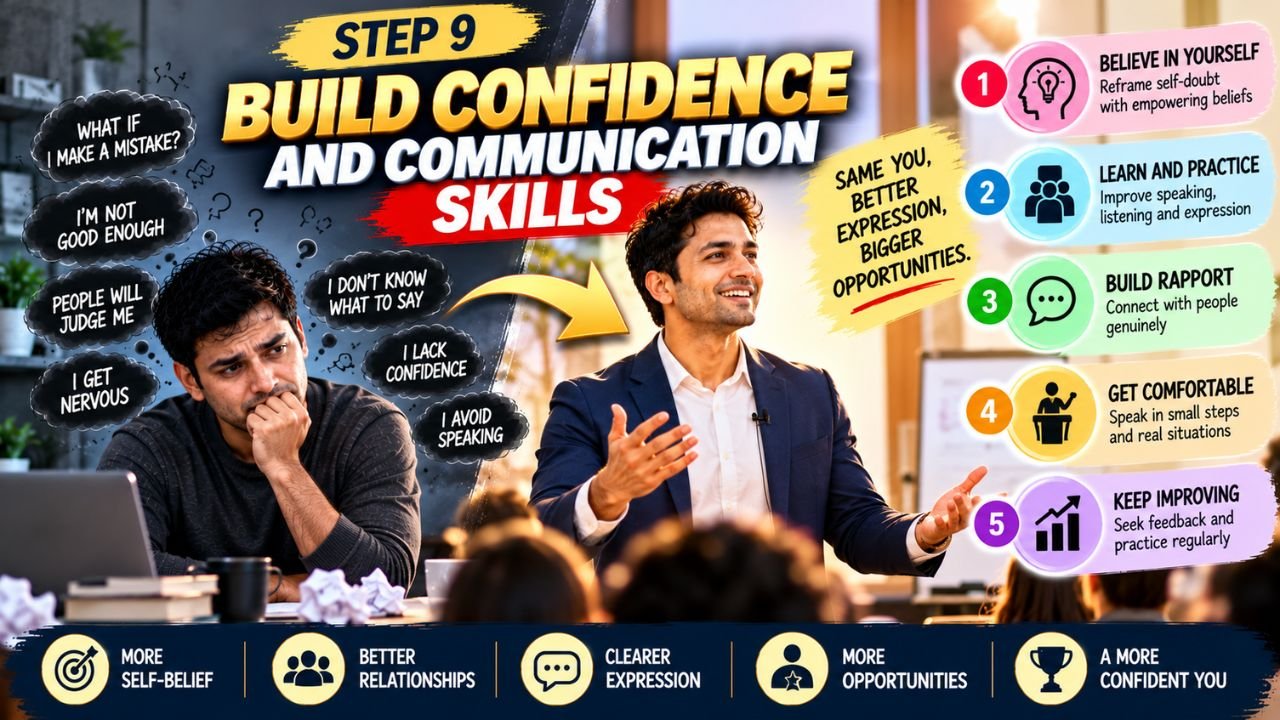
As you begin taking consistent action, something important starts to change.
You begin creating evidence that you can trust yourself.
You complete tasks that you once delayed.
You express ideas that you once kept inside.
You handle situations that previously felt too difficult.
This evidence becomes the foundation of real confidence.
Confidence is not only a feeling that appears before action.
In many situations, confidence grows after you prepare, practise, take action, and discover that you can handle the result.
Therefore, you do not need to wait until you feel completely confident.
You can begin building confidence through small and courageous actions today.
What Is Real Confidence?
Real confidence is a balanced trust in your ability to prepare, act, learn, adapt, and recover.
It does not mean believing that you will always succeed.
It means believing that you can respond responsibly, even when the result is uncertain.
A confident person can say:
- “I do not know, but I can learn.”
- “I feel nervous, but I can still speak.”
- “I made a mistake, and I can correct it.”
- “I respect your opinion, but I see this differently.”
- “I need help with this.”
- “This behaviour is not acceptable to me.”
- “I may not be perfect, but I am prepared to begin.”
Confidence gives you permission to be a learner.
It does not require you to pretend that you have every answer.
Confidence Is Not Loudness
Some people believe that confident people always speak loudly, dominate conversations, or attract attention.
However, confidence can also be quiet.
A calm person who listens carefully, speaks clearly, and does not need to prove something in every conversation may be deeply confident.
On the other hand, loudness can sometimes hide insecurity.
Therefore, do not copy someone else’s style to appear confident.
You can be calm, thoughtful, warm, and still communicate with strength.
Your goal is not to become the loudest person in the room.
Your goal is to become clear, present, and authentic.
Confidence Does Not Mean the Absence of Fear
You may feel nervous before a presentation.
You may feel uncertain before making a decision.
You may feel uncomfortable while setting a boundary.
These feelings do not automatically mean that you lack confidence.
Confidence can exist with nervousness.
The important question is:
“Can I take the next useful action even though I feel some discomfort?”
For example, your voice may shake slightly during a presentation.
However, you continue and express the main message.
That is confidence in action.
You may feel worried about saying no.
However, you communicate your limit calmly.
That is confidence in action.
You may not know whether your new project will succeed.
Still, you prepare carefully and test the idea.
That is confidence in action.
Confidence Comes from Self-Trust
Self-trust means believing that you will respond to yourself with honesty and responsibility.
It grows when you:
- Keep small promises
- Prepare before important situations
- Act according to your values
- Admit mistakes
- Learn from feedback
- Protect healthy boundaries
- Ask for help when needed
- Return after setbacks
- Avoid abandoning yourself to please everyone
Every time you act in a way that matches your values, you strengthen self-trust.
Every time you repeatedly ignore your own important commitments, self-trust may weaken.
Therefore, if you want more confidence, begin by building a better relationship with yourself.
Do not make ten promises.
Make one clear promise and keep it.
Build Confidence Through Evidence
Positive statements can be helpful when they direct your attention toward growth.
However, confidence becomes stronger when your mind can see evidence.
Suppose you want to become confident on camera.
You might begin with the statement:
“I am becoming a calm and engaging speaker.”
Next, create evidence:
- Record a one-minute video.
- Watch it without attacking yourself.
- Identify one thing you did well.
- Choose one point to improve.
- Record another video.
- Repeat the process.
After several practice sessions, your mind has more than an affirmation.
It has proof that you can prepare, speak, review, and improve.
Use this formula:
Preparation + Practice + Action + Reflection = Growing Confidence
Confidence is often the result of this cycle.
Create a Confidence Evidence Journal
At the end of each day, record one piece of evidence that shows growth.
For example:
- I shared my opinion during a meeting.
- I completed a task that I had been delaying.
- I asked a useful question.
- I said no respectfully.
- I remained calm during a difficult conversation.
- I recorded a practice video.
- I accepted feedback without attacking myself.
- I asked for help.
- I made a decision within the available information.
- I restarted after missing my routine.
The evidence does not need to be dramatic.
Small examples matter because they show that your identity is changing through behaviour.
Confidence Is Specific, Not Universal
You may feel confident in one situation and nervous in another.
For example, you may speak comfortably with friends but feel anxious during a formal presentation.
You may be confident in your technical knowledge but less confident while selling your service.
You may lead a team well but find it difficult to discuss personal emotions.
Therefore, avoid saying:
“I have no confidence.”
Ask:
“In which exact situation do I need more confidence?”
Then identify the required skill.
Perhaps you need:
- More subject knowledge
- Better preparation
- A speaking structure
- Emotional regulation
- Repeated exposure
- Feedback
- Stronger boundaries
- Experience handling questions
A specific confidence problem creates a specific practice plan.
Communication Is More Than Speaking
Clear communication includes:
- Understanding your own message
- Organising your thoughts
- Expressing the idea simply
- Listening carefully
- Observing the other person’s response
- Asking useful questions
- Clarifying misunderstandings
- Adjusting your explanation
- Respecting boundaries
- Choosing the right time and tone
Speaking more does not always mean communicating better.
Sometimes, the best communication is a short and clear sentence.
Sometimes, it is a thoughtful question.
Sometimes, it is remaining silent long enough to understand the other person.
Why Do You Struggle to Express What You Know?
You may understand a topic deeply but still find it difficult to explain.
This can happen when:
- Too many ideas appear at once
- You have not identified the main point
- You do not have a speaking structure
- You try to say everything
- You fear forgetting something
- You try to sound impressive
- You monitor every word while speaking
- You have not practised retrieving ideas without notes
- You fear other people’s judgment
The solution is not always learning more.
Sometimes, you need to organise what you already know.
Use the Topic → Core Idea → Structure → Expression Method
This four-step method can help you move from mental knowledge to clear communication.
1. Topic
Identify the broad subject.
Example:
Overthinking
A topic can contain many ideas. Therefore, the topic alone is not enough for clear expression.
2. Core Idea
Choose the one main message you want the listener to remember.
Example:
“Overthinking delays action and makes small problems feel larger.”
This core idea gives your communication a direction.
3. Structure
Organise the core idea into a simple sequence.
For example:
- What is it?
- Why does it happen?
- How does it affect us?
- What can we do?
- What is one example?
A structure prevents your thoughts from moving in too many directions.
4. Expression
Now explain the organised idea in your natural words.
You do not need to remember every sentence.
You only need to remember the core idea and its structure.
This creates freedom within order.
Use a Simple Four-Part Speaking Structure
For everyday speaking practice, use:
Core Idea → Reason → Example → Action
Suppose your topic is confidence.
Core Idea
“Confidence grows through action.”
Reason
“When you act, you create evidence that you can handle the situation.”
Example
“A person may feel nervous before recording a video. However, after recording ten videos, speaking begins to feel more familiar.”
Action
“Choose one small speaking situation and practise it today.”
This structure can be used for:
- Meetings
- Videos
- Coaching
- Teaching
- Interviews
- Social content
- Everyday explanations
Once this structure becomes natural, you can learn more advanced structures.
However, begin with one.
Make Your Message Easy to Understand
Clear communication does not require difficult words.
In fact, simple language often shows deeper understanding.
Before speaking, ask:
- What is my main message?
- Why does it matter?
- What example will make it clear?
- What should the listener do or remember?
Remove information that does not support the main message.
If the listener needs more detail, you can add it later.
The purpose of communication is not to show how much you know.
It is to help the other person understand.
Use Examples to Make Ideas Real
An abstract idea can be difficult to remember.
An example gives it a visible form.
For example, instead of saying:
“Perfectionism reduces performance,”
you might say:
“Imagine that you want to publish a video. You record it five times because every version has a small mistake. Finally, you publish nothing. Your high standard has now stopped the learning process.”
The example shows what the idea looks like in real life.
When creating an example, ask:
- Where does this happen?
- Who is involved?
- What is the problem?
- What thought appears?
- What action follows?
- What result is created?
A simple example can make a deep idea easy to understand.
Listen Before You Respond
Confidence is not only the ability to speak.
It is also the ability to listen without becoming defensive.
When another person is speaking:
- Give attention
- Avoid preparing your reply too early
- Listen for the main concern
- Notice emotions without assuming
- Ask for clarification
- Repeat the key point in your own words
- Then respond
You might say:
“If I understand correctly, you are concerned about the delay. Is that right?”
This gives the person an opportunity to confirm or correct your understanding.
Good listening reduces unnecessary conflict.
It also helps you respond to the real issue instead of the issue you imagined.
Ask Better Questions
Questions can improve both understanding and connection.
Instead of asking only closed questions, use open questions where appropriate.
For example:
- “What is your main concern?”
- “What result are you hoping for?”
- “What part feels most difficult?”
- “What have you already tried?”
- “What would make this easier?”
- “What do you need from me?”
- “Can you give me an example?”
A useful question can reveal information that a long explanation may miss.
However, do not turn every conversation into an interview.
Use questions naturally and listen to the answers.
Express Disagreement Without Disrespect
You do not need to agree with everyone to communicate respectfully.
A healthy disagreement can follow this process:
- Acknowledge what you heard.
- State your view clearly.
- Explain your reason.
- Avoid attacking the person.
- Invite useful discussion.
For example:
“I understand why you prefer that approach. I see it differently because our current priority is speed. I suggest that we test the simpler option first and review the result.”
This response is clear without becoming aggressive.
Confidence allows you to disagree without needing to defeat the other person.
Stop Depending on Everyone’s Approval
The desire for approval is human.
You want people to understand, accept, and appreciate you.
However, if every decision depends on other people’s approval, you may slowly disconnect from your values.
You may:
- Avoid expressing your opinion
- Say yes when you want to say no
- Change your goals to impress others
- Hide important parts of yourself
- Avoid visible action
- Feel deeply affected by small criticism
Ask:
“Am I making this decision from my values or from fear of disapproval?”
You can respect other people’s views without allowing every opinion to control you.
Not everyone will understand your path.
Not everyone needs to.
Separate Feedback from Identity
Feedback can be useful, but it does not define your complete worth.
Suppose someone says:
“Your presentation was difficult to follow.”
You can interpret it as:
“I am a terrible speaker.”
Or you can interpret it as:
“My presentation needs a clearer structure.”
The first attacks identity.
The second identifies a skill to improve.
When receiving feedback:
- Pause before defending yourself.
- Ask for a specific example.
- Identify what is useful.
- Separate the message from the tone.
- Decide what to apply.
- Leave what is inaccurate or harmful.
Not every piece of feedback is correct.
However, rejecting all feedback protects your ego at the cost of growth.
Learn to Set Healthy Boundaries
A boundary is a clear limit that protects your time, energy, values, responsibilities, and well-being.
Boundaries help you define:
- What you can give
- What you cannot give
- What behaviour you will accept
- What behaviour you will not accept
- When you are available
- What belongs to your responsibility
- What belongs to another person
A boundary is not a punishment.
It is a form of clarity.
Why Is Saying No Difficult?
You may struggle to say no because you fear:
- Disappointing someone
- Looking selfish
- Creating conflict
- Losing approval
- Damaging the relationship
- Missing an opportunity
- Being judged
As a result, you may say yes while feeling angry, tired, or resentful.
However, an unwilling yes is not always kinder than an honest no.
A respectful no can protect both your energy and the quality of your commitments.
How to Say No Calmly
You do not always need a long explanation.
You can say:
- “Thank you for asking, but I cannot commit to this right now.”
- “I am not available at that time.”
- “I cannot take on another responsibility this week.”
- “That does not work for me.”
- “I can help for 20 minutes, but I cannot manage the entire task.”
- “I need time to think before I answer.”
A clear boundary may feel uncomfortable at first.
However, discomfort does not mean that the boundary is wrong.
Communicate Needs Without Blame
Use this structure:
When [specific event] happens, I feel [emotion or impact]. I need or request [clear action].
For example:
“When our meeting continues beyond the agreed time, I struggle to manage my next responsibility. I would like us to finish on time or agree on an extension in advance.”
This is more useful than saying:
“You never respect my time.”
Focus on the specific behaviour and the requested change.
Practise Confidence Gradually
Confidence grows through manageable challenges.
Create a confidence ladder.
Suppose your goal is to speak to a large audience.
Your ladder might be:
- Speak alone for two minutes.
- Record a five-minute video.
- Share the video with a trusted person.
- Speak during a small meeting.
- Conduct a short live session.
- Speak to a larger group.
- Deliver a full presentation.
Each level prepares you for the next one.
The challenge should be slightly uncomfortable but manageable.
You do not need to begin with the most difficult situation.
Use Rehearse and Respond from the 6R Framework
Confidence and communication strongly involve the fourth and fifth steps of the 6R framework.
Rehearse
Before an important situation:
- Organise your core message
- Visualise yourself speaking calmly
- Practise the opening
- Prepare examples
- Consider possible questions
- Rehearse your desired body language and pace
Respond
During the actual situation:
- Ground yourself
- Focus on the listener
- Use your structure
- Express one idea at a time
- Pause when needed
- Complete the message
Afterward, move to Reinforce:
- Identify what worked
- Choose one improvement
- Practise again
This cycle turns every speaking experience into training.
The Daily Confidence and Communication Practice
Use this ten-minute practice:
Minute 1: Choose the Topic
Select one familiar topic.
Minute 2: Define the Core Idea
Write one sentence.
Minutes 3–4: Create the Structure
Use:
- Core idea
- Reason
- Example
- Action
Minutes 5–8: Speak Without Reading
Look only at the structure if needed.
Do not restart after every mistake.
Minutes 9–10: Review
Ask:
- Was my core idea clear?
- Did I follow the structure?
- Was my example useful?
- Did I speak naturally?
- What one improvement will I make tomorrow?
Do not judge ten things at once.
Choose one improvement and repeat the practice.
Step 9 Action Plan
Complete these actions:
- Identify one situation where you want greater confidence.
- Define the skill required in that situation.
- Create a small confidence ladder.
- Take the first manageable action.
- Record one piece of confidence evidence every day.
- Practise Topic → Core Idea → Structure → Expression.
- Use Core Idea → Reason → Example → Action for one explanation.
- Ask one useful question in a conversation.
- Set one respectful boundary.
- Review one piece of feedback without turning it into an identity judgment.
If you want to explore this process more deeply, the supporting guide on how to build self-confidence and communicate clearly will include confidence ladders, speaking structures, expression exercises, boundary scripts, and a complete communication-practice plan.
Key Takeaway
Real confidence is not a performance.
It is the growing trust that you can prepare, act, communicate, learn, and handle the result.
You do not need to become loud or fearless.
You need to become clear, prepared, honest, and willing to practise.
When speaking, move from:
Topic → Core Idea → Structure → Expression
When building confidence, move from:
Preparation → Practice → Action → Reflection
Each time you express yourself, keep a promise, set a boundary, or respond to feedback with maturity, you create evidence of your stronger identity.
However, your confidence and growth do not develop in isolation.
The people, conversations, spaces, and digital inputs around you also influence your behaviour.
Therefore, in the next section, you will learn how to improve your relationships and create an environment that supports your growth.
Step 10: Improve Your Relationships and Create a Growth-Supporting Environment

You do not develop your best self in complete isolation.
The people around you influence what you believe, discuss, expect, and practise.
Your physical space influences how easily you can focus.
Your digital environment influences what enters your mind.
Your relationships influence your emotional energy and sense of support.
Therefore, personal transformation is not only about changing what is inside you.
It is also about creating an environment that makes healthy growth easier.
This does not mean that you must leave everyone who thinks differently.
It means that you should become more conscious of what surrounds you and how it affects your behaviour.
Your Environment Is Always Influencing You
An environment is more than the room where you live or work.
You are influenced by several connected environments.
Physical Environment
The spaces where you live, work, sleep, eat, and practise.
Social Environment
The people you spend time with and the conversations you repeatedly have.
Digital Environment
The videos, messages, social accounts, news, apps, and online communities that receive your attention.
Emotional Environment
The level of safety, respect, pressure, support, and honesty in your relationships.
Learning Environment
The books, mentors, communities, and ideas that influence your development.
These environments can either support or weaken your desired habits.
For example, you may want to focus deeply. However, if your phone remains beside you with constant notifications, your digital environment is working against your goal.
You may want to become more confident. However, if people around you repeatedly insult every new effort, your social environment may make that growth more difficult.
You may want to improve your health. However, if your daily environment makes movement, rest, and balanced food difficult, you may need to redesign the system.
Personal responsibility still matters.
However, changing the environment can make responsible action easier.
Your Physical Space Shapes Your Behaviour
Look at the space where you spend most of your time.
What behaviour does that space make easy?
Does your desk support focused work?
Is your phone always visible?
Are your learning materials easy to reach?
Does your room remind you of your priorities or fill your mind with distraction?
A supportive environment does not need to be expensive or perfectly designed.
It needs to make the next helpful action clear.
For example:
- Keep your notebook and pen ready for reflection.
- Place your speaking-practice structure near your desk.
- Keep only the materials needed for the current task visible.
- Prepare your exercise clothes in advance.
- Keep water available if appropriate for you.
- Create a fixed place for important items.
- Remove objects that repeatedly pull your attention away.
Small changes can reduce the effort required to begin.
Create Different Zones for Different Activities
If possible, give different activities a clear location.
For example:
- One area for focused work
- One chair for reading
- One open space for movement
- One quiet place for reflection
- One location for family conversations
You may not have a large home or separate rooms.
That is not necessary.
Even a small change can create a mental signal.
For example, clearing the table before focused work can tell your mind:
“This space is now for concentration.”
At the end of the task, putting the materials away can signal completion.
The purpose is not a perfect interior.
The purpose is a clear behavioural cue.
Reduce Visual and Digital Clutter
Clutter can keep reminding you of unfinished tasks.
Similarly, many open tabs, notifications, files, and messages can create mental noise.
You do not need to organise everything in one day.
Choose one small area:
- Your desk
- Your phone’s home screen
- Your computer desktop
- Your email inbox
- Your browser tabs
- Your learning materials
- Your daily task list
Remove what you no longer need.
Group what belongs together.
Make the most important item easier to find.
Organisation is useful when it supports action.
It should not become another form of procrastination.
Study Your Social Environment
The people around you can influence your standards, language, mood, and expectations.
Some people may:
- Encourage you
- Tell you the truth respectfully
- Support your learning
- Celebrate your progress
- Challenge you to grow
- Listen during difficult moments
- Respect your boundaries
Other people may repeatedly:
- Mock your goals
- Create unnecessary conflict
- Discourage every new idea
- Demand your attention without respecting your needs
- Use guilt to control you
- Ignore your boundaries
- Make you feel that growth is a betrayal
Most relationships are not completely positive or completely negative.
A person may support you in one area and misunderstand you in another.
Therefore, avoid placing people into simple labels too quickly.
Instead, study the repeated pattern.
Ask:
- How do I usually feel after spending time with this person?
- Can we disagree respectfully?
- Does this person respect my boundaries?
- Can I be honest in this relationship?
- Do we take responsibility after conflict?
- Is support moving in both directions?
- Am I becoming stronger, smaller, calmer, or more fearful in this relationship?
These questions can help you see the relationship more clearly.
Not Everyone Will Understand Your Growth
When you change, the people around you may need time to adjust.
You may become more disciplined.
You may set new boundaries.
You may stop joining certain conversations.
You may spend more time learning.
You may choose a new professional direction.
Some people will support this change.
Others may feel confused, threatened, or left behind.
Their discomfort does not automatically mean that you are doing something wrong.
At the same time, your growth does not give you permission to become arrogant or disrespectful.
Communicate your needs clearly.
Listen to genuine concerns.
Then decide whether the concern is useful feedback or resistance to your change.
Build Relationships That Support Growth
A growth-supporting relationship does not mean that the other person agrees with everything you say.
In fact, a person who always agrees may not help you grow.
A healthy relationship may include:
- Respect
- Honest communication
- Emotional safety
- Mutual responsibility
- Healthy disagreement
- Encouragement
- Clear boundaries
- Space for individuality
- Repair after conflict
- Support without unhealthy control
You should be able to receive care without becoming dependent on constant approval.
You should also be able to give support without losing yourself.
Become the Supportive Person You Want to Meet
It is easy to ask:
“Why do I not have supportive people?”
Also ask:
“Am I becoming a supportive person?”
Consider whether you:
- Listen without interrupting
- Respect other people’s time
- Keep private matters confidential
- Celebrate progress without comparison
- Give honest feedback kindly
- Apologise when needed
- Ask before giving advice
- Respect another person’s no
- Offer help without trying to control the result
Your relationships improve not only when you choose better people.
They also improve when you develop better relationship skills.
Listen to Understand
Many conflicts grow because both people are preparing replies instead of trying to understand.
During an important conversation:
- Give the person your attention.
- Listen for the main message.
- Notice the emotion without assuming its cause.
- Ask a clarifying question.
- Repeat what you understood.
- Then express your own view.
You might say:
“What I hear is that you felt unsupported when I changed the plan without telling you. Is that correct?”
The person can then confirm or correct your understanding.
Understanding does not always mean agreement.
It means that you have listened carefully enough to know what the other person is trying to communicate.
Communicate Expectations Clearly
Unspoken expectations often create disappointment.
You may expect someone to understand what you need without being told.
Then, when they do not respond as expected, you may feel hurt.
Instead, communicate clearly.
For example:
- “I need 30 minutes of quiet time to complete this task.”
- “Please tell me in advance if the plan changes.”
- “I would like you to listen before offering advice.”
- “I can help today, but I cannot take full responsibility for this.”
- “I need us to discuss this without shouting.”
Clear requests do not guarantee that the other person will agree.
However, they reduce confusion.
Repair Conflict with Maturity
Conflict does not always mean that a relationship is unhealthy.
People can misunderstand one another.
They can react emotionally.
They can make mistakes.
The important question is whether the conflict can be repaired safely and respectfully.
A repair process may include:
- Calm down before continuing.
- Describe the specific event.
- Acknowledge your part.
- Listen to the other person’s experience.
- Apologise without defending the harmful action.
- Agree on a better response.
- Follow the agreement through behaviour.
A useful apology might sound like:
“I interrupted you several times and did not allow you to complete your point. That was disrespectful. I am sorry. Next time, I will pause and listen before responding.”
Avoid apologies such as:
“I am sorry you felt that way.”
This places the entire problem on the other person’s feelings.
A mature apology takes responsibility for the specific behaviour.
Maintain Boundaries Without Unnecessary Anger
A boundary becomes useful when it is clearly communicated and consistently followed.
For example:
“I am willing to discuss this, but I will not continue the conversation while we are shouting. We can return to it when we are calmer.”
A boundary is not an attempt to control another person.
It describes what you will do to protect your well-being or values.
You cannot force someone to speak respectfully.
However, you can decide whether you will remain in a disrespectful conversation.
You cannot force someone to respect your work time.
However, you can communicate your availability and reduce interruptions where possible.
Boundaries require both words and action.
Know the Difference Between Difficulty and Harm
Every relationship can have difficult moments.
However, repeated abuse, threats, violence, coercive control, stalking, serious intimidation, financial control, or forced isolation are not normal communication problems.
Do not assume that better mindset or better speaking alone can make an unsafe relationship safe.
If you feel unsafe:
- Prioritise immediate safety.
- Contact a trusted person.
- Seek qualified local support.
- Use emergency services when required.
- Avoid confronting a dangerous person in a way that increases risk.
- Create a safety plan with appropriate professional guidance.
Personal growth does not require you to tolerate abuse.
Safety comes first.
Choose Your Digital Environment Carefully
Your digital environment can influence you for many hours each day.
Ask:
- What type of content enters my mind repeatedly?
- Does it educate, inspire, inform, entertain, or disturb me?
- Does it support action or endless consumption?
- Does it create useful awareness or constant fear?
- Does it help me learn or make me compare?
- Do I choose the content, or does an algorithm choose for me?
You do not need to remove all entertainment or social media.
Instead, use them intentionally.
You might:
- Unfollow accounts that repeatedly harm your focus
- Follow trustworthy educational sources
- Turn off unnecessary notifications
- Create a separate list for useful learning
- Set a time for social media
- Avoid consuming content during focused work
- Stop watching once you have enough information to act
What you repeatedly consume can influence what you repeatedly think about.
Avoid Constant Comparison
Digital platforms can show you the best moments of thousands of people.
You may see someone’s achievement without seeing their years of work.
You may see their confidence without seeing their practice.
You may see their result without seeing their failures, resources, support, or circumstances.
As a result, you may compare their visible outcome with your private struggle.
When comparison appears, ask:
- What exactly am I admiring?
- Is there a skill I can learn from this person?
- Am I turning inspiration into self-criticism?
- What progress have I made from my own starting point?
- What is my next useful action?
Use comparison as information, not as a weapon against yourself.
Find Mentors, Coaches, and Teachers
You do not need to solve every problem alone.
The right guide can help you:
- See a pattern you have missed
- Learn a tested method
- Avoid common mistakes
- Create accountability
- Receive feedback
- Build confidence
- Move faster with greater clarity
However, choose guidance carefully.
A trustworthy mentor or coach should not need to make you feel powerless to prove their value.
Look for:
- Relevant knowledge or experience
- Clear ethical boundaries
- Respectful communication
- Realistic promises
- A method you can understand
- Willingness to admit limits
- No false guarantees
- Encouragement of appropriate professional care
- A focus on your growth rather than dependency
The right support should increase your awareness and capability.
Join a Growth-Supporting Community
A healthy community can give you:
- Shared learning
- Encouragement
- Accountability
- New perspectives
- Opportunities to practise
- A sense that you are not alone
However, a community should not require blind agreement.
Look for spaces where people can:
- Ask honest questions
- Disagree respectfully
- Share progress without showing off
- Admit difficulties without shame
- Give practical support
- Protect confidentiality
- Celebrate action and learning
A strong community does not carry you.
It helps you continue walking.
Create a Small Inner Circle
You do not need hundreds of close relationships.
A small inner circle of trustworthy people can be deeply valuable.
Your circle may include:
- A family member
- A close friend
- A mentor
- A coach
- A colleague
- A health professional
- A community member
Different people may support different areas.
One person may understand your business goals.
Another may support your emotional well-being.
Someone else may guide your health or skill development.
Do not expect one person to meet every need.
Perform a Relationship and Environment Audit
Review the following areas from 1 to 10.
Physical Space
Does my space support focus, rest, health, and organisation?
Digital Environment
Does my online input support clarity and growth?
Close Relationships
Do I experience respect, honesty, care, and healthy boundaries?
Professional Network
Do I have people who support learning, opportunity, and accountability?
Learning Environment
Do I regularly receive useful and trustworthy ideas?
Emotional Safety
Can I express important thoughts without repeated fear, control, or disrespect?
Community
Do I have a place where I can learn, contribute, and connect?
After rating each area, ask:
- What is already supporting me?
- What is draining me?
- What needs a boundary?
- What needs an honest conversation?
- What needs professional help?
- What can I improve this week?
Use the Recognise–Respond–Reinforce Process
Your environment can be improved through three parts of the 6R framework.
Recognise
Notice which people, spaces, and digital inputs affect your behaviour.
Respond
Make one conscious change.
You might clear the desk, silence notifications, communicate a boundary, join a learning community, or ask for support.
Reinforce
Repeat and protect the change.
A boundary stated once but never followed may remain weak.
A clean desk that becomes cluttered every day needs a simple reset habit.
A supportive community becomes useful when you participate consistently.
Your environment changes through repeated choices.
The Seven-Day Environment Reset
Use this simple plan.
Day 1: Physical Space
Clear one small area that affects your focus.
Day 2: Digital Space
Remove unnecessary notifications and one source of repeated distraction.
Day 3: Relationship Awareness
Notice how you feel before and after important interactions.
Day 4: Honest Communication
Express one clear need or expectation.
Day 5: Support
Contact one trustworthy person, mentor, or community.
Day 6: Contribution
Offer useful support to someone without trying to control them.
Day 7: Review
Ask what made healthy behaviour easier and what still needs attention.
The goal is not to redesign your entire life in seven days.
It is to prove that your environment can be shaped consciously.
Step 10 Action Plan
Complete these actions:
- Clear one physical area that affects your focus.
- Remove one digital distraction.
- Identify three people who support your growth.
- Notice one relationship that regularly drains you.
- Decide whether that relationship needs communication, a boundary, distance, or qualified support.
- Express one expectation clearly.
- Practise listening without preparing an immediate reply.
- Contact one mentor, coach, teacher, or supportive community if needed.
- Offer meaningful support to one person.
- Begin the seven-day environment reset.
If you want to explore this topic more deeply, the supporting guide on how your relationships and environment influence personal growth will include a complete relationship audit, boundary examples, communication scripts, digital-environment tools, and a support-network plan.
Key Takeaway
Your environment does not completely control you.
However, it continually influences what feels easy, normal, acceptable, and possible.
Therefore, create spaces that support focus.
Choose digital inputs that support clarity.
Build relationships that allow honesty, responsibility, and growth.
Set boundaries where needed.
Ask for help when the situation requires it.
At the same time, become the kind of supportive, honest, and respectful person you want in your own life.
Once your environment begins supporting your growth, an even deeper question may appear:
“What do I want to do with the person I am becoming?”
In the next section, you will explore how to find purpose, use your strengths, and create meaningful value through your life and work.
Step 11: Find Your Purpose and Create a Meaningful Life
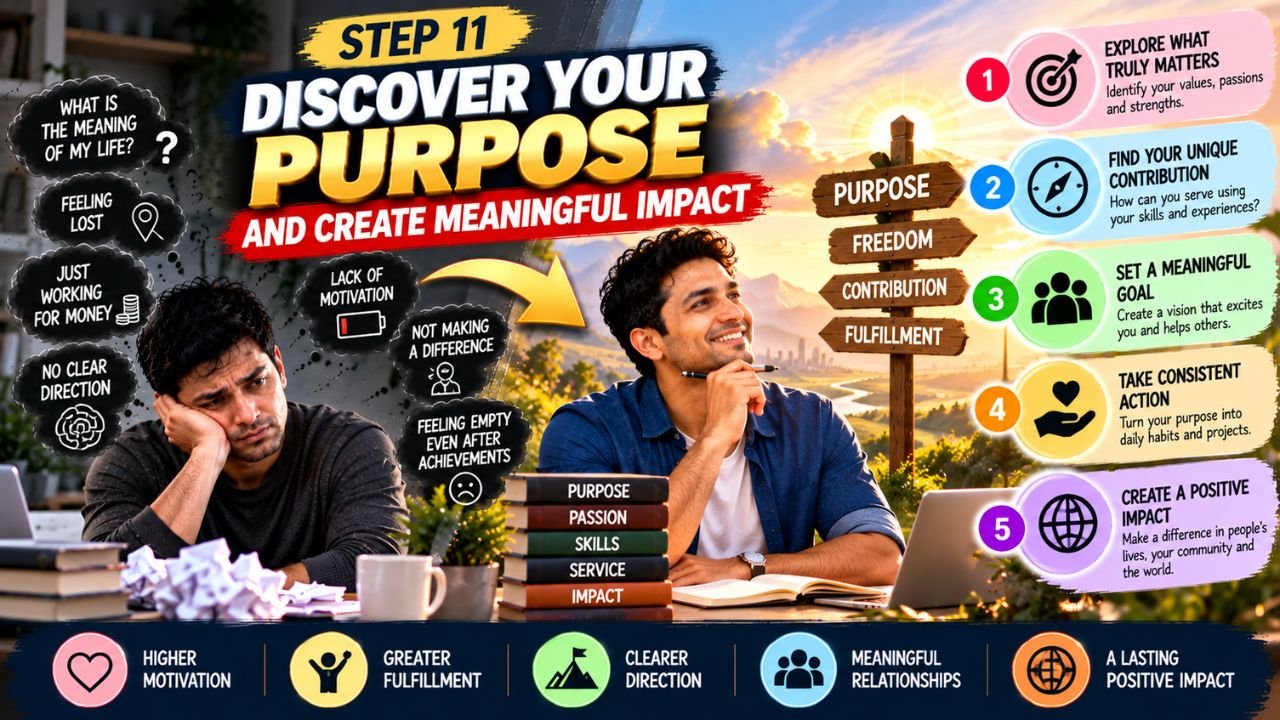
As you become more aware, confident, healthy, and consistent, a deeper question may begin to appear:
“What am I developing myself for?”
Personal growth is not only about becoming more productive.
It is not only about earning more money, looking better, or gaining recognition.
These goals can be meaningful. However, many people also want to know that their life and work have a deeper direction.
They want to feel that their strengths are being used.
They want to create something meaningful.
They want to contribute to other people.
They want their daily effort to be connected to a purpose.
However, the word “purpose” can create pressure.
You may believe that there is one perfect purpose hidden somewhere and that you must discover it before you can move forward.
As a result, you may keep searching but never begin.
The good news is that purpose does not always appear as one sudden answer.
In many cases, purpose becomes clearer as you understand yourself, develop your strengths, solve real problems, serve people, and take meaningful action.
What Is Life Purpose?
Life purpose is a meaningful direction that connects your values, strengths, experiences, and contribution.
It helps you answer:
- What matters deeply to me?
- What kind of person do I want to become?
- What problems do I care about?
- What strengths can I use?
- Who do I want to help?
- What value do I want to create?
- How do I want to live while doing it?
Purpose gives direction to your effort.
However, it does not always give you a complete map.
You may know the general direction before you understand the exact job, business, project, or role through which you will express it.
For example, your purpose may be to help people learn.
You may express that purpose as a teacher, writer, coach, parent, trainer, leader, or content creator.
The purpose is the meaningful direction.
The role is one way of expressing it.
Purpose Is More Than a Job Title
Your job can be connected with your purpose.
However, your purpose is not always limited to your profession.
You may live your purpose through:
- Your work
- Your family
- Your community
- Your creative expression
- Your service
- Your leadership
- Your spiritual path
- The way you support other people
- The problems you choose to solve
For example, a person may work in technology but also mentor young students.
Another person may care for a family while building a small community project.
Someone may express purpose by creating employment.
Another may express it through healing, teaching, art, research, or public service.
Therefore, do not reject your entire life because your current job does not feel like your final calling.
Instead, ask:
“How can I express more meaning through the life I have while building the life I want?”
This question allows purpose to begin now.
Purpose Is Not Always One Permanent Answer
You may have different expressions of purpose during different stages of life.
At one stage, your main purpose may involve learning and building skills.
At another stage, it may involve creating financial stability.
Later, it may involve leadership, teaching, contribution, or legacy.
Your deeper values may remain stable while the form of your work changes.
For example, the value of contribution may first appear through helping colleagues.
Later, it may become coaching, writing, speaking, or building an organisation.
Therefore, you do not need to force one permanent answer for your whole life.
Choose a meaningful direction for your present stage.
Then, allow experience to refine it.
Purpose Is Often Built Through Contribution
Many people ask:
“What will make me feel fulfilled?”
This is an important question.
However, purpose becomes clearer when you also ask:
“What useful value can I create for other people?”
Contribution does not mean ignoring your own needs.
It does not require you to work without payment.
It means connecting your growth with something larger than personal comfort.
You may contribute by:
- Solving a problem
- Teaching a skill
- Creating a useful product
- Supporting emotional well-being
- Improving a system
- Caring for people
- Creating beauty
- Protecting something valuable
- Sharing knowledge
- Building a community
- Creating opportunities
- Leading change
Meaning often grows when your strengths meet a real human need.
Look for Clues in What Matters to You
Your purpose may leave clues throughout your life.
Start by looking at the subjects, problems, and activities that repeatedly attract your attention.
Ask:
- What topics can I discuss for a long time?
- What problems make me feel concerned?
- What kind of change do I want to see?
- What work feels meaningful even when it is difficult?
- What injustice, pain, or limitation do I want to reduce?
- What type of growth do I want to help people experience?
Do not judge your answers too quickly.
A repeated interest may be showing you an important direction.
For example, if you repeatedly study confidence, communication, emotional health, or mindset, there may be a deeper reason.
Perhaps you want to overcome a personal struggle.
Perhaps you want to understand people.
Perhaps you want to help others avoid the pain you experienced.
Your interests do not automatically reveal a complete career.
However, they provide useful clues.
Look at Your Personal Experiences
Your difficult experiences can also influence your sense of purpose.
You may have experienced:
- Fear
- Failure
- Rejection
- Confusion
- Illness
- Career change
- Financial difficulty
- Low confidence
- Relationship challenges
- Loss
- Overthinking
- A lack of direction
After working through a challenge, you may develop knowledge, empathy, and insight that can help someone else.
However, personal pain alone does not automatically qualify you to guide others.
You may still need:
- Training
- Ethical boundaries
- Supervised experience
- Professional qualifications
- Evidence-based knowledge
- Clear limits
Your experience can give you compassion and direction.
Skill and responsibility help you serve well.
Notice What People Ask You for Help With
Other people may recognise your strengths before you do.
Ask:
- What type of advice do people request from me?
- What problems do they trust me to solve?
- What do they say I explain well?
- In which situations do people feel supported by me?
- What work do others believe comes naturally to me?
Perhaps people ask you to:
- Explain difficult ideas
- Listen without judgment
- Solve technical problems
- Organise plans
- Motivate a team
- Improve communication
- Create content
- Make decisions
- Handle conflict
- Teach a skill
Do not assume that every request must become your purpose.
However, repeated requests may reveal where your abilities create value.
Identify the Work That Gives You Meaningful Energy
Some activities leave you tired but satisfied.
Others leave you tired and empty.
This difference can provide a clue.
Ask:
- Which activities make me feel deeply engaged?
- When do I lose track of time in a healthy way?
- Which difficult tasks still feel worth doing?
- What type of result gives me genuine satisfaction?
- What would I continue learning even if no one forced me?
Purposeful work is not always easy or exciting.
Even meaningful work includes routine, uncertainty, administration, and difficult days.
The question is not:
“Do I enjoy every moment?”
The better question is:
“Does this effort feel connected to something that matters?”
Connect Strengths, Values, and Service
A practical way to explore purpose is through the intersection of three areas:
Strengths + Values + Service
Strengths
What can you do well, or what are you willing to develop deeply?
Values
What principles and outcomes matter to you?
Service
Who can benefit from your strengths and values?
For example:
- Strength: Clear explanation
- Value: Growth
- Service: Helping professionals understand and apply personal-development tools
Possible purpose direction:
“Help working professionals create greater clarity and consistent action through simple and practical education.”
This statement may later be expressed through coaching, courses, articles, videos, workshops, or a community.
Add the Problem You Want to Solve
You can make the purpose direction even clearer by adding a specific problem.
Use this formula:
I use my [strengths] to help [people] move from [problem] to [desired result] in a way that reflects [values].
Example:
“I use coaching, communication, and practical mindset tools to help working professionals move from overthinking and inner barriers to clarity, confidence, and consistent action.”
This statement includes:
- Strengths
- Audience
- Problem
- Transformation
- Values
It creates a clearer direction than saying only:
“I want to help people.”
Purpose Needs a Person, Problem, and Transformation
If you want to express purpose through professional work, define three elements.
Person
Who do you want to help?
For example:
- Working professionals
- Entrepreneurs
- Students
- Parents
- Coaches
- Leaders
- People experiencing a specific challenge
Problem
What difficulty are they facing?
For example:
- Overthinking
- Lack of confidence
- Communication problems
- Poor focus
- Emotional stress
- Lack of direction
- Inconsistent action
Transformation
What result do you want to help them create?
For example:
- Clear decisions
- Confident communication
- Better emotional regulation
- Focused action
- Healthier habits
- Greater self-awareness
- Meaningful professional growth
The clearer these elements become, the easier it becomes to design useful work.
Purpose Is Discovered Through Action
You cannot think your way to complete purpose while remaining disconnected from real life.
Purpose becomes clearer when you:
- Try different roles
- Help real people
- Build skills
- Create useful work
- Receive feedback
- Notice what gives meaning
- Learn what problems you can solve
- Discover what type of service suits you
Suppose you believe that teaching may be part of your purpose.
Do not wait for complete certainty.
Teach one idea to one person.
Write one article.
Record one educational video.
Conduct one small session.
Then ask:
- Did this feel meaningful?
- Did the person find it useful?
- What part did I enjoy?
- What part was difficult?
- What skill do I need next?
Action gives you information that imagination cannot provide.
Separate Purpose from Recognition
Purposeful work may bring recognition.
However, recognition should not become the only measure of meaning.
You may publish useful content that receives little attention at first.
You may help one person before you help thousands.
You may do important work that is not visible online.
If your sense of purpose depends only on views, applause, income, titles, or praise, your direction may change every time external feedback changes.
Ask:
“Would this still matter if growth were slower than expected?”
This does not mean you should ignore results.
Results help you understand whether your work is effective.
However, recognition is different from contribution.
Contribution asks whether genuine value was created.
Purpose and Money Do Not Need to Be Enemies
Some people believe that purpose must be unpaid.
Others believe that work matters only if it creates high income.
Both views are incomplete.
Money can support:
- Stability
- Family responsibilities
- Health
- Education
- Freedom
- Business growth
- Employment
- Wider contribution
If your purposeful work creates genuine value, earning from it is not automatically selfish.
At the same time, not every meaningful activity needs to become a business.
You may express purpose through paid work, unpaid service, family responsibilities, creative projects, or community contribution.
The important questions are:
- Am I creating real value?
- Is the exchange honest?
- Are my promises responsible?
- Does the work respect the people I serve?
- Can this model support my life sustainably?
Purpose becomes stronger when service and sustainability support each other.
Balance Purpose with Practical Responsibility
You may discover a meaningful new direction while still having financial, family, health, or professional responsibilities.
Do not assume that following your purpose requires one sudden and reckless decision.
You can build a bridge.
For example:
- Clarify the direction.
- Develop the required skills.
- Test the work on a small level.
- Understand the people you want to serve.
- Create evidence of value.
- Build income gradually if relevant.
- Review risks and responsibilities.
- Make larger changes when the foundation is stronger.
A bridge allows you to move forward without denying present responsibilities.
Courage is important.
So is wise planning.
Avoid the Pressure to Make Everything Your Purpose
Not every action needs to feel deeply meaningful.
Some tasks are simply necessary.
You may need to manage accounts, organise files, reply to messages, travel, clean, or complete routine work.
These tasks can support your larger purpose even if they do not feel inspiring.
For example, administration may not feel like coaching. However, it may allow your coaching work to reach more people.
Rest may not look like contribution. However, it may protect the energy required for long-term service.
Do not reject necessary support activities because they do not feel powerful.
A meaningful life still includes ordinary work.
Use Your Purpose as a Decision Filter
A clear purpose can help you decide what to pursue.
When a new opportunity appears, ask:
- Does this match the people I want to serve?
- Does it solve a problem I care about?
- Does it use or develop my strengths?
- Does it reflect my values?
- Will it move me toward my long-term direction?
- What will I need to stop doing if I say yes?
Not every good opportunity is the right opportunity.
Purpose helps you choose what fits your direction.
Create a Personal Purpose Statement
Your purpose statement does not need to be perfect.
It needs to be useful.
Use this structure:
“My purpose is to use my strengths in [strengths] to help [people] overcome [problem] and create [transformation], while living according to [values].”
Example:
“My purpose is to use coaching, communication, and practical mind-transformation tools to help professionals overcome overthinking and inner barriers so they can build clarity, confidence, and consistent action, while living with growth, integrity, and contribution.”
You may revise this statement as your experience grows.
The purpose statement is a compass, not a permanent contract.
Turn Purpose into a Practical Mission
Purpose gives direction.
Mission gives the direction a measurable form.
For example:
Purpose
Help people transform their mindset and take meaningful action.
Mission
Help one million people develop a growth-oriented mindset through practical education, coaching, content, and community.
A mission helps you think about scale, method, and contribution.
However, do not become so focused on a large number that you forget the person in front of you.
One million people are still reached one person, one message, one tool, and one transformation at a time.
Use the Purpose-to-Action Path
Move through the following sequence:
Purpose → People → Problem → Transformation → Method → Action
Purpose
Why does this matter to me?
People
Who do I want to help?
Problem
What challenge do they face?
Transformation
What change do I want to support?
Method
How can I help?
Your method may include:
- Coaching
- Teaching
- Writing
- Speaking
- Technology
- Products
- Leadership
- Community
- Research
- Service
Action
What can I create or test now?
This final step prevents purpose from remaining only a beautiful idea.
Use the 6R Framework to Move Toward Purpose
Your purpose journey can follow the complete 6R process.
Recognise
Notice your strengths, values, interests, experiences, and recurring concerns.
Regulate
Manage the fear and uncertainty that can appear when considering a new direction.
Reframe
Replace “I must discover my perfect purpose” with:
“I can develop a meaningful direction through exploration and contribution.”
Rehearse
Imagine yourself performing the behaviours connected to that direction.
Respond
Take one real action.
Teach, write, volunteer, test, create, or serve.
Reinforce
Review what you learned and continue building evidence.
Purpose becomes clearer through this cycle.
The Purpose Discovery Exercise
Set aside quiet time and answer the following questions.
Values
- What matters most to me?
- What would I want my life to stand for?
- What do I refuse to sacrifice for success?
Strengths
- What do I do well?
- What am I willing to master?
- What do people ask me for help with?
Experience
- What challenges have shaped me?
- What have I learned that may help someone else?
- What personal experience gives me deeper empathy?
People
- Who do I understand?
- Who do I feel drawn to help?
- Which group’s challenges feel meaningful to me?
Problems
- What problem do I want to solve?
- Why does this problem matter?
- What happens if it remains unsolved?
Contribution
- What change can I help create?
- What method suits my strengths?
- What useful action can I take this week?
Look for repeated themes.
Do not force an answer in one sitting.
Conduct a 30-Day Purpose Experiment
Choose one possible direction and test it for 30 days.
For example, if you believe teaching may be part of your purpose:
- Week 1: Choose one problem and study it deeply.
- Week 2: Create a simple teaching structure.
- Week 3: Share the lesson through an article, video, or small session.
- Week 4: Collect feedback and reflect on the experience.
At the end, ask:
- Did I create real value?
- Did the work feel meaningful?
- Did people respond to the problem?
- What strength did I use?
- What skill needs improvement?
- Do I want to continue, adjust, or test another direction?
A purpose experiment reduces pressure.
You are not making a permanent decision.
You are gathering meaningful evidence.
Step 11 Action Plan
Complete these actions:
- Identify your five core values.
- List five strengths you can use or develop.
- Write three life experiences that have shaped you.
- Identify the people you feel drawn to help.
- Choose one problem you care about solving.
- Define the transformation you want to support.
- Select one method through which you can create value.
- Write your first personal purpose statement.
- Design a 30-day purpose experiment.
- Take the first real action within the next 24 hours.
If you want to explore this process in greater depth, the supporting guide on how to find your purpose and create a meaningful life will include a complete purpose map, mission-statement templates, meaningful-work exercises, and a 30-day purpose experiment.
Key Takeaway
Purpose is not always a hidden answer waiting to be discovered.
It is often a meaningful direction that becomes clearer through self-awareness, skill development, service, and action.
Look at your strengths.
Listen to your values.
Study your experiences.
Understand the people you want to help.
Choose a problem worth solving.
Then create one useful action.
You do not need to know your entire life path today.
You need enough clarity to take the next meaningful step.
You have now explored awareness, vision, mindset, emotions, health, habits, action, confidence, relationships, and purpose.
The final step is to bring all these areas together in a practical transformation plan.
In the next section, you will create a 90-day roadmap to begin living as the best version of yourself.
Step 12: Follow a 90-Day Plan to Become the Best Version of Yourself
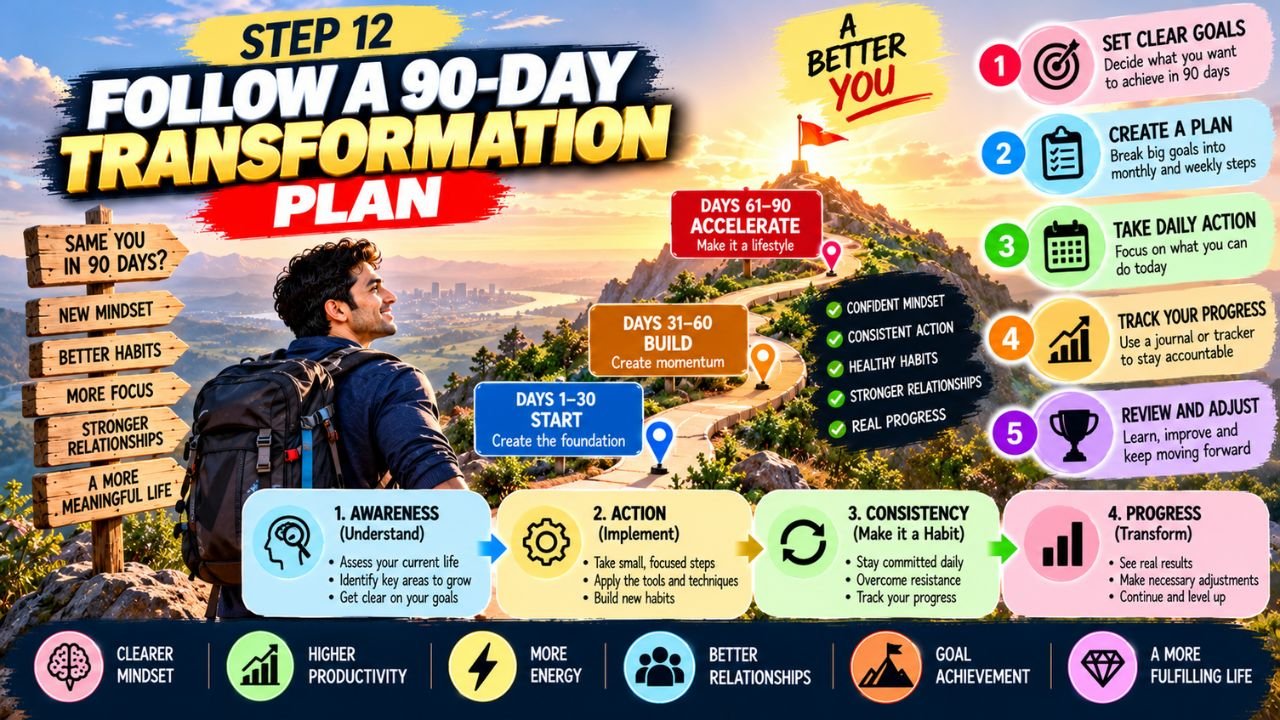
You have now explored 11 important parts of personal transformation.
You have learned about self-awareness, vision, mindset, emotional regulation, physical well-being, habits, action, confidence, relationships, environment, and purpose.
However, reading about these areas is not the same as changing them.
Transformation begins when you turn useful ideas into repeated action.
At this point, you may feel excited to improve everything.
You may want to create a new morning routine, change your mindset, exercise every day, start a business, improve your communication, repair relationships, and discover your purpose at the same time.
However, trying to transform your entire life at once may create pressure, confusion, and inconsistency.
Therefore, the purpose of this 90-day plan is not to make your whole life perfect.
Its purpose is to help you create meaningful progress in one main area while building a strong foundation for continued growth.
Can You Become the Best Version of Yourself in 90 Days?
You cannot complete your personal growth in 90 days.
There is no final day on which you become perfect and never face another problem.
However, 90 days can be enough time to:
- Understand your main patterns
- Define a clearer identity
- Build one or two helpful habits
- Reduce one repeated obstacle
- Develop greater emotional awareness
- Improve an important skill
- Complete a meaningful project
- Create evidence of self-trust
- Build a system for continued progress
Therefore, do not treat 90 days as the end of your journey.
Treat it as a focused transformation cycle.
At the end of the cycle, you will review what changed and begin the next level.
Do Not Try to Improve Every Area at Once
Your life contains many connected areas.
However, they do not all require equal attention at the same time.
Choose:
- One primary transformation area
- One supporting area
- One maintenance area
Primary Transformation Area
This is the main result you want to create.
Examples:
- Develop consistent action
- Improve communication
- Build emotional regulation
- Improve physical energy
- Launch a meaningful project
- Reduce procrastination
- Build confidence
Supporting Area
This area makes the primary transformation easier.
For example:
- Primary: Improve communication
- Supporting: Reduce fear of judgment
Or:
- Primary: Build consistent action
- Supporting: Improve sleep and energy
Maintenance Area
This is an important part of life that you do not want to neglect while focusing on your main goal.
For example:
- Family time
- Basic health care
- Financial responsibilities
- Spiritual practice
- Existing professional work
This structure protects focus without ignoring the rest of your life.
Choose a 90-Day Identity
Your plan should not begin only with a target.
It should begin with an identity.
Ask:
“Who do I need to become during the next 90 days?”
Examples include:
- I am becoming a person who takes clear and consistent action.
- I am becoming a calm and confident communicator.
- I am becoming a person who respects the body and manages energy wisely.
- I am becoming a disciplined creator who completes meaningful work.
- I am becoming an emotionally aware person who responds rather than reacts.
- I am becoming a professional who creates useful value every week.
Choose one central identity.
Then write it where you can see it regularly.
Define Your 90-Day Outcome
Your identity gives direction.
Your outcome gives you a visible result.
A useful outcome should be specific enough to measure but flexible enough to adapt.
For example:
Unclear Outcome
“I want to become confident.”
Clearer Outcome
“Over the next 90 days, I will complete 60 speaking-practice sessions and deliver four live or recorded presentations.”
Unclear Outcome
“I want to become productive.”
Clearer Outcome
“Over the next 90 days, I will complete and publish one useful long-form article every week.”
Unclear Outcome
“I want to improve my health.”
Clearer Outcome
“Over the next 90 days, I will work with appropriate professional guidance, improve my sleep routine, and complete my planned movement practice on at least five days each week.”
Your outcome should include behaviour that is within your control.
You cannot fully control audience growth, income, praise, or another person’s response.
However, you can control many parts of your preparation, practice, creation, communication, and review.
Set a Starting Point
Before beginning the plan, record your present state.
Otherwise, you may improve but fail to notice it.
For example, if your focus is speaking, record:
- Current comfort level from 1 to 10
- Average practice sessions per week
- Current speaking duration
- Common difficulties
- A short sample video
If your focus is consistent action, record:
- Number of meaningful tasks completed each week
- Common reasons for delay
- Daily distraction time
- Current planning method
- One unfinished priority
If your focus is emotional regulation, record:
- Common triggers
- Frequency of reactive responses
- Recovery time
- Strategies currently used
- Situations you avoid
This becomes your baseline.
At the end of 90 days, compare your progress with your own starting point, not someone else’s result.
Divide the Journey into Three Phases
The 90-day plan will follow three phases:
Days 1–30: Recognise and Reset
Understand your patterns, simplify your environment, define your direction, and begin one small habit.
Days 31–60: Regulate, Reframe, and Rehearse
Develop emotional steadiness, challenge limiting beliefs, build skills, and practise your desired response.
Days 61–90: Respond and Reinforce
Take more visible action, increase the challenge, collect evidence, review results, and strengthen the new identity.
Each phase builds on the previous one.
Phase 1: Days 1–30 — Recognise and Reset
The first 30 days are about clarity.
Do not rush to change everything.
First, understand your current patterns and create a stable starting system.
Week 1: Complete Your Best-Self Assessment
During the first week:
- Complete the personal life audit
- Rate major life areas from 1 to 10
- Identify your primary, supporting, and maintenance areas
- Write your five core values
- List your strengths
- Identify repeated thoughts and triggers
- Record your starting baseline
Ask:
- Where am I now?
- What is working?
- What is creating the most difficulty?
- Which area influences several other areas?
- What change matters most during the next 90 days?
At the end of Week 1, choose your central 90-day identity.
Week 2: Define Your Vision and Outcome
During Week 2:
- Write your personal vision statement
- Describe your 90-day identity
- Define your measurable outcome
- Choose three supporting behaviours
- Decide what you will not focus on yet
- Explain why the goal matters
Use this format:
Over the next 90 days, I am becoming ________. I will create evidence of this identity by ________, ________, and ________. By Day 90, I aim to complete or improve ________.
For example:
Over the next 90 days, I am becoming a calm and confident communicator. I will create evidence by practising for ten minutes, recording myself, and speaking in progressively more challenging situations. By Day 90, I aim to complete 60 practice sessions and four public or recorded presentations.
Week 3: Design Your Environment
During Week 3:
- Create a fixed practice or work area
- Remove one major distraction
- Prepare the required materials
- Set a clear habit cue
- Decide your focus time
- Tell one supportive person about your plan
- Create a simple progress tracker
Ask:
“What can I change around me to make the desired action easier?”
Do not depend only on willpower.
Let your environment support the behaviour.
Week 4: Begin the Minimum Habit
During Week 4, focus on repetition rather than intensity.
Choose a minimum version.
Examples:
- Speak for three minutes
- Walk for ten minutes
- Write one paragraph
- Complete one focus block
- Practise the mind reset once
- Read two pages
- Contact one potential client
- Create one small piece of useful content
Complete the habit at a stable time or after a stable cue.
Track it simply.
At the end of Week 4, ask:
- Was the habit easy to understand?
- Was the starting point clear?
- What created resistance?
- Should I make the habit smaller or adjust the cue?
- What early evidence of progress exists?
Phase 1 Milestone
At the end of Day 30, you should have:
- A clear starting point
- One central identity
- One measurable outcome
- One primary habit
- A supportive environment
- A simple tracking method
- Greater awareness of your thoughts and triggers
Do not expect dramatic external results yet.
The main result of Phase 1 is clarity and stability.
Phase 2: Days 31–60 — Regulate, Reframe, and Rehearse
The second phase is about building inner and practical capability.
Now that the basic habit exists, you will begin working more directly with emotional triggers, limiting beliefs, and skill development.
Week 5: Identify the Main Inner Barrier
Choose the belief or emotional pattern that most affects your goal.
For example:
- “I must be perfect.”
- “People will judge me.”
- “I do not have enough time.”
- “I am not ready.”
- “If I fail once, I should stop.”
- “I need complete certainty.”
Write:
- The trigger
- The thought
- The emotion
- The automatic behaviour
- The result
- The healthier response
Create one balanced reframe.
For example:
“I do not need to perform perfectly. I need to practise, create value, and improve through feedback.”
Use the reframe when the old thought appears.
Week 6: Practise Emotional Regulation
During Week 6, focus on creating a pause.
Use the 60-second reset:
- Pause
- Breathe comfortably
- Ground yourself
- Name the emotion
- Check the meaning
- Choose the response
Record at least one emotional event each day.
Ask:
- What triggered me?
- What did I feel?
- What did I tell myself?
- What response did I choose?
- What would I try next time?
The goal is not to remove all uncomfortable emotions.
The goal is to become less automatic in your response.
Week 7: Rehearse the Desired Behaviour
During Week 7, practise the skill connected with your identity.
For speaking:
- Select a topic
- Define the core idea
- Create the structure
- Express it without reading
- Review one improvement
For focused action:
- Choose the main priority
- Define the next action
- Use a focus block
- Record completion
- Review the distraction pattern
For boundaries:
- Write the sentence
- Rehearse your tone
- Imagine the possible response
- Practise remaining calm
- Communicate the boundary
Mental rehearsal prepares you.
Real practice develops you.
Use both.
Week 8: Increase the Challenge Gradually
During Week 8, make the habit slightly more challenging.
For example:
- Increase speaking from five to ten minutes
- Share a practice video with one person
- Increase one focus block to two
- Move from planning to publishing
- Have the conversation you have been preparing for
- Increase movement with suitable guidance
- Create a real offer instead of only studying business
Do not jump from the easiest level to the hardest level.
Use a confidence ladder.
The next step should stretch you without becoming reckless.
Phase 2 Milestone
At the end of Day 60, you should have:
- Greater awareness of your main limiting belief
- A balanced reframe
- A regulation practice
- A clearer skill-building routine
- More experience facing manageable discomfort
- Stronger evidence of capability
- A refined habit system
The main result of Phase 2 is growing capacity.
Phase 3: Days 61–90 — Respond and Reinforce
The final phase is about visible action.
You have observed, prepared, reframed, regulated, and practised.
Now you must use the new behaviour in real situations.
Week 9: Take One Courageous Action
Choose an action that matters but that you have been avoiding.
It might include:
- Publishing your work
- Recording a full video
- Speaking during a meeting
- Presenting an offer
- Asking for feedback
- Applying for an opportunity
- Setting a boundary
- Beginning an important health conversation
- Asking for professional help
- Completing a delayed decision
Prepare carefully.
Then act.
The goal is not to guarantee a perfect result.
The goal is to prove that fear does not need to make every decision.
Week 10: Create Value for Someone Else
Personal transformation becomes stronger when it creates contribution.
Use your developing skill to help someone.
For example:
- Teach one useful concept
- Share a practical guide
- Support a colleague
- Solve a customer problem
- Create a helpful video
- Mentor someone
- Improve a family routine
- Volunteer your skill appropriately
- Create a resource for your community
Ask for feedback:
- What was useful?
- What remained unclear?
- What result did it create?
- What should I improve?
Contribution turns private growth into meaningful value.
Week 11: Strengthen What Is Working
Review the actions that created the greatest progress.
Ask:
- Which habit remained most consistent?
- Which cue worked best?
- Which reframe helped most?
- Which environment change had the strongest effect?
- Which action created real value?
- Which activity should I stop?
- Which practice should I continue?
Remove unnecessary complexity.
Strengthen the few behaviours that work.
Week 12: Complete and Deliver
Choose one meaningful result to finish.
For example:
- Publish the article
- Deliver the presentation
- Complete the first course module
- Finish the 30-day practice series
- Launch the simple offer
- Complete the planned health evaluation
- Conduct the workshop
- Submit the application
- Finish the personal project
Completion matters.
Many people repeatedly begin but rarely finish.
Finishing creates confidence, feedback, and closure.
Define what “done” means for this version and complete it.
Final Days 85–90: Review and Reinforce
Use the final days to review your complete journey.
Compare Day 90 with your starting baseline.
Ask:
- What changed in my thinking?
- How do I respond differently?
- What skill improved?
- Which behaviour became more natural?
- What result did I create?
- What evidence of confidence exists?
- What remains difficult?
- What needs professional or external support?
- What will I continue for the next 90 days?
Celebrate progress without pretending that the journey is finished.
Then choose the focus of your next cycle.
Phase 3 Milestone
At the end of Day 90, you should have:
- Completed a meaningful action or project
- Faced at least one important fear
- Created value for another person
- Collected evidence of personal growth
- Strengthened one important identity
- Identified the next area for development
- Built a repeatable growth system
The main result of Phase 3 is embodied evidence.
Use the Complete 6-Step Transformation Process
The entire 90-day journey follows the six-step process introduced earlier.
1. Recognise
Notice:
- Current patterns
- Emotional triggers
- Limiting beliefs
- Strengths
- Values
- Environmental influences
- The gap between intention and action
Recognition gives you a clear starting point.
2. Regulate
Help your mind and body become steady enough to choose.
Use:
- A pause
- Comfortable breathing
- Grounding
- Movement
- Rest
- Emotional naming
- Appropriate support
Regulation creates space.
3. Reframe
Question the unhelpful meaning.
Ask:
- Is this a fact or an assumption?
- Is this true in every situation?
- What am I learning?
- What is within my control?
- What would be a balanced interpretation?
Reframing creates a more useful direction.
4. Rehearse
Practise the new behaviour before and during real situations.
Use:
- Mental rehearsal
- Role play
- Written structures
- Small practice sessions
- Gradual challenges
- Feedback
Rehearsal builds readiness.
5. Respond
Take the conscious action.
Speak.
Write.
Publish.
Ask.
Decide.
Move.
Set the boundary.
Seek help.
Begin the next step.
Response creates evidence.
6. Reinforce
Repeat the behaviour.
Track progress.
Review results.
Notice benefits.
Correct mistakes.
Return after interruptions.
Increase the challenge gradually.
Reinforcement helps the new response become part of your identity.
Your Daily Best-Self Routine
Your daily system should be simple enough to continue.
Morning: Direction
Ask:
- Who am I choosing to become today?
- What is my most important action?
- What thought or distraction may stop me?
- When will I complete my focus block?
- How will I support my physical and mental energy?
During the Day: Conscious Response
When a trigger appears:
- Recognise the pattern
- Regulate the emotion
- Reframe the meaning
- Remember the rehearsed behaviour
- Take the next useful action
Evening: Reinforcement
Ask:
- What did I complete?
- Where did I act like my desired self?
- What triggered an old pattern?
- What did I learn?
- What is tomorrow’s first action?
This review can take five minutes.
It should create clarity, not pressure.
Your Weekly Best-Self Review
Complete a deeper review once each week.
Progress
- What meaningful action did I complete?
- What result did I create?
- What evidence of growth appeared?
Patterns
- What did I repeatedly delay?
- Which thought or emotion appeared?
- What environmental trigger affected me?
Adjustment
- What should I continue?
- What should I stop?
- What should I simplify?
- What needs a different strategy?
Direction
- What is next week’s main priority?
- What is the next visible action?
- When will I begin?
A weekly review prevents a small problem from continuing unnoticed for several months.
Create a Best-Self Scorecard
Track a few meaningful behaviours.
Do not measure everything.
For example:
| Area | Weekly Target | Result |
| Primary habit | 5 days | 4 days |
| Focused work | 5 blocks | 5 blocks |
| Skill practice | 4 sessions | 3 sessions |
| Emotional reset | Use when needed | 3 uses |
| Courageous action | 1 action | Completed |
| Weekly review | 1 review | Completed |
Use the scorecard as information.
Do not use it as proof that you are worthy or unworthy.
If a score remains low, study the system.
What to Do When You Return to an Old Pattern
At some point, you may:
- Miss several days
- Avoid an important task
- React emotionally
- Break a personal commitment
- Lose motivation
- Return to overthinking
- Become distracted
- Feel that you have failed
Expecting perfect progress makes these moments more dangerous.
You may think:
“I am back at the beginning.”
However, returning to an old pattern does not erase what you have learned.
Use this recovery process.
1. Stop the Story
Avoid saying:
“I always fail.”
Describe what happened specifically.
2. Identify the Trigger
What changed?
Were you tired, stressed, unwell, travelling, emotionally activated, or overloaded?
3. Reduce the Habit
Return to the minimum version.
4. Remove One Barrier
Adjust the time, cue, environment, or task size.
5. Restart Today
Do not wait for Monday, next month, or perfect motivation.
6. Record the Lesson
Write what will help you respond differently next time.
The ability to return is part of consistency.
Measure Progress in More Than One Way
Do not measure growth only through external results.
Measure:
Behaviour
Did you take the planned action?
Skill
Did your ability improve?
Emotional Response
Did you recover more quickly?
Self-Awareness
Did you notice the pattern earlier?
Courage
Did you act despite discomfort?
Consistency
Did you return after interruption?
Contribution
Did your action create value?
Alignment
Did your behaviour match your values?
External results matter.
However, these internal and behavioural results often appear first.
Keep Your Plan Flexible but Not Optional
Your exact method may need adjustment.
Your schedule may change.
A habit may need to become smaller.
A goal may need to become more realistic.
Professional advice may change your health plan.
New information may improve your strategy.
Flexibility allows intelligent adjustment.
However, flexibility should not become a way to avoid all commitment.
Keep the direction steady while improving the method.
The 90-Day Best-Self Plan Template
Complete the following template.
My 90-Day Identity
I am becoming:
My Main Transformation Area
My Supporting Area
My Maintenance Area
My 90-Day Outcome
By Day 90, I will:
My Three Supporting Behaviours
My Minimum Daily Action
My Main Weekly Action
My Most Likely Barrier
My Balanced Reframe
My Support System
My Tracking Method
My Weekly Review Time
My Day-90 Completion Result
Step 12 Action Plan
Begin with these ten actions:
- Choose one primary transformation area.
- Select one supporting area and one maintenance area.
- Write your 90-day identity.
- Define one visible outcome.
- Record your starting baseline.
- Choose three supporting behaviours.
- Define the minimum daily action.
- Create a simple scorecard.
- Schedule your weekly review.
- Begin the first action within the next 24 hours.
If you want a deeper, step-by-step implementation system, the supporting guide on the complete 90-day best-self transformation plan will provide weekly worksheets, daily check-ins, progress scorecards, review questions, and reset strategies.
Key Takeaway
You do not become the best version of yourself through one emotional decision.
You build that version through a repeatable process.
First, recognise your patterns.
Next, regulate your state.
Then, reframe the meaning and rehearse the desired behaviour.
After that, respond through conscious action.
Finally, reinforce the action until it becomes part of your identity.
Your 90-day goal is not perfection.
It is evidence.
Evidence that you can understand yourself.
Evidence that you can change a pattern.
Evidence that you can keep a meaningful promise.
Evidence that you can act through discomfort.
Evidence that you can create value.
Start with one area.
Choose one identity.
Take one small action.
Then repeat the process.
The next part of this guide answers the most common questions people ask about becoming the best version of themselves.
Frequently Asked Questions About Becoming the Best Version of Yourself
1. What does it mean to become the best version of yourself?
Becoming the best version of yourself means developing the strongest, clearest, healthiest, and most authentic expression of who you are.
It does not mean becoming perfect or copying another person.
Instead, it means becoming more aware of your thoughts, emotions, values, strengths, and behaviour. Then, you use that awareness to make choices that support your desired identity.
Your best self is the version of you who keeps learning, takes responsibility, protects well-being, builds meaningful relationships, and creates value.
Therefore, becoming your best self is not one final achievement. It is a continuing process of awareness, alignment, action, and growth.
2. What is the first step to changing your life?
The first step is to understand your present reality.
Before creating a new routine or setting a big goal, ask:
- What is working?
- What is not working?
- What pattern keeps repeating?
- What am I avoiding?
- What matters most to me?
- Which area needs attention first?
This self-awareness helps you identify the real problem.
For example, you may believe that you lack discipline. However, the deeper problem may be fear, low energy, confusion, or an unclear goal.
Once you understand your starting point, you can choose a more useful next step.
3. Where should I begin if every area of my life needs improvement?
Do not try to improve everything at once.
Start by completing a simple life audit. Rate your health, emotions, mindset, confidence, work, finances, relationships, habits, and purpose from 1 to 10.
Then ask:
- Which area is creating the most pain?
- Which area influences several other areas?
- Which area is ready for change?
Choose one primary area and one supporting area.
For example, improving sleep and energy may also support focus, emotional balance, and productivity.
Focused progress in one important area is usually more sustainable than weak effort across ten areas.
4. How can I improve myself every day?
Begin with one small daily action connected with your desired identity.
For example:
- Read and apply one useful idea.
- Practise speaking for five minutes.
- Complete one focused work block.
- Take a short walk.
- Pause before an emotional reaction.
- Write one reflection.
- Keep one small promise to yourself.
- Express one thought clearly.
- Ask one useful question.
- Help one person.
At the end of the day, ask:
“Where did I act like my best self today, and what will I improve tomorrow?”
Daily improvement does not need to be dramatic.
Small, repeated actions can create meaningful change over time.
5. How long does it take to become the best version of yourself?
There is no universal timeline.
Some changes may become visible within a few days or weeks. Other patterns, skills, habits, and life results may take months or years.
The time depends on:
- Your starting point
- The behaviour you want to change
- The complexity of the skill
- Your environment
- Your health and energy
- The support available
- The consistency of your practice
- Unexpected life events
Instead of asking only, “How long will it take?” ask:
“What process can I continue long enough to create real change?”
Personal growth is not a race.
Your goal is to create a direction and a system you can sustain.
6. Can I completely transform myself in 90 days?
You can create meaningful change in 90 days, but you should not expect to complete your entire personal-growth journey.
Within 90 days, you may be able to:
- Understand a repeating pattern
- Build a helpful habit
- Improve an important skill
- Reduce procrastination
- Become more emotionally aware
- Complete a meaningful project
- Increase your confidence
- Create stronger self-trust
Treat 90 days as a focused transformation cycle.
Choose one main identity, one visible outcome, and a few supporting behaviours.
At the end, review your progress and begin the next cycle.
7. What habits can help me become a better version of myself?
The most useful habits are the ones that support your personal goals, values, health, and responsibilities.
Helpful habits may include:
- Regular sleep and wake times
- Physical movement
- Balanced eating and hydration
- Daily reflection
- Focused work
- Reading and application
- Speaking or skill practice
- Emotional regulation
- Weekly planning
- Meaningful connection
- Gratitude
- Digital boundaries
However, do not begin all these habits at once.
Choose one habit that supports your most important identity.
Make it small, connect it with a stable cue, and repeat it consistently.
8. Why do I keep returning to my old habits?
Old habits may return because they are connected with familiar cues, emotions, environments, and short-term rewards.
You may also return to an old behaviour when you are:
- Tired
- Stressed
- Overloaded
- Emotionally triggered
- Out of your normal routine
- Surrounded by familiar temptations
- Trying to change too much at once
Returning to an old pattern does not mean that all your progress is lost.
Identify the trigger, reduce the new habit to its minimum version, adjust the environment, and restart.
Consistency does not mean never missing.
It means returning before the interruption becomes permanent.
9. How can I remain motivated during personal transformation?
Do not depend only on motivation.
Motivation changes from day to day.
Instead, create a system that includes:
- A meaningful reason
- A clear next action
- A fixed cue
- A minimum version
- A supportive environment
- A progress tracker
- Weekly review
- Accountability
- Rest and recovery
Also, record small evidence of progress.
When you can see that your actions are creating change, motivation may become easier to renew.
Most importantly, remember that action can sometimes create motivation. You do not always need to feel motivated before you begin.
10. How do I stop comparing myself with other people?
Begin by noticing what exactly you are comparing.
You may be comparing your beginning with someone else’s advanced stage.
You may also be comparing your complete life with one visible part of their life.
When comparison appears, ask:
- What quality do I admire?
- What skill can I learn?
- What information am I missing?
- What progress have I made from my own starting point?
- What is my next useful action?
Use another person’s success as information or inspiration.
Do not use it as proof that you are behind or unworthy.
Your best self should be measured against your values, potential, progress, and responsibilities—not another person’s timeline.
11. How do I become more confident?
Confidence grows through preparation, practice, action, feedback, and reflection.
First, identify the exact situation in which you lack confidence.
Then ask which skill is required.
For example, if you feel nervous while speaking, you may need:
- Better subject preparation
- A simple structure
- Repeated practice
- Gradual exposure
- Emotional regulation
- Useful feedback
Do not wait for complete confidence.
Take a manageable action and record the evidence.
Every time you handle a situation, keep a promise, express an idea, or recover from a mistake, you strengthen self-trust.
12. What should I do when I am afraid of failure?
First, define what failure means in that situation.
Then ask:
- What is the realistic risk?
- What can I prepare for?
- Is the decision reversible?
- What can I learn even if the result is not ideal?
- What is the smallest safe test?
- What would happen if I never tried?
Reduce the action to a manageable experiment.
For example, instead of launching a large program immediately, test the idea with a small group.
Instead of speaking to a large audience, begin with a short recorded video.
Fear does not always need to disappear before action.
Preparation and gradual action can help you move forward responsibly.
13. What if my family or friends do not support my growth?
First, communicate your direction clearly.
Sometimes, people resist change because they do not understand what you are doing or how it may affect them.
Listen to their concerns. Some concerns may contain useful information.
However, also notice whether the response is genuine care, fear of change, or repeated disrespect.
You may need to:
- Explain your goal
- Set realistic expectations
- Protect focused time
- Create boundaries
- Find additional support
- Join a growth-oriented community
- Work with a mentor or coach
You do not need everyone’s approval.
However, continue treating people respectfully while protecting your meaningful direction.
14. Do I need a coach or mentor to transform my life?
You can create meaningful progress through self-reflection, learning, practice, supportive relationships, and consistent action.
Therefore, a coach or mentor is not required for every person or every goal.
However, the right guide may help you:
- See hidden patterns
- Create a clear plan
- Receive feedback
- Build accountability
- Learn a skill
- Avoid common mistakes
- Move through confusion more quickly
Choose support carefully.
A coach should not diagnose or treat medical or mental-health conditions unless appropriately qualified. Similarly, severe or persistent emotional, physical, legal, or financial problems may require a suitably licensed professional.
15. How do I know whether I am making real progress?
Progress is not measured only by large external results.
Look for changes in:
- Awareness
- Behaviour
- Skill
- Emotional recovery
- Decision-making
- Confidence
- Consistency
- Relationships
- Contribution
- Alignment with values
For example, you may still feel nervous, but now you speak.
You may still experience an old thought, but you no longer automatically believe it.
You may still miss a habit, but you restart quickly.
These are meaningful signs of progress.
Record your starting point, review your behaviour weekly, and compare yourself with your earlier state.
16. Is personal growth ever complete?
Personal growth does not have one final endpoint.
As your life changes, new roles, responsibilities, opportunities, and challenges will appear.
You may master one skill and discover another area that needs attention.
You may also need to revisit an old lesson at a deeper level.
However, this does not mean that you should remain dissatisfied forever.
You can appreciate who you are today while continuing to grow.
Healthy personal development combines two ideas:
“I accept and respect myself now.”
and
“I am still willing to learn, improve, and expand.”
Conclusion: Your Best Version Is Built One Choice at a Time
Becoming the best version of yourself is not about creating a perfect personality or a flawless life.
It is not about becoming more impressive than other people.
It is not about removing every fear, mistake, difficult emotion, or uncertain moment.
Instead, it is about becoming more conscious of how you think, feel, choose, act, and contribute.
Your best self begins with awareness.
You recognise your present patterns without attacking yourself.
Next, you create a clear vision.
You decide which qualities, values, behaviours, and contributions will define the person you want to become.
Then, you examine your mindset.
You learn to separate facts from assumptions and replace limiting beliefs with balanced, useful perspectives.
After that, you develop emotional strength.
You notice what you feel, regulate your state, and create a pause between a trigger and your response.
You also care for your physical and mental foundation.
You support your body through appropriate sleep, food, movement, hydration, recovery, and professional care when needed.
Next, you build habits that make your desired identity visible.
You start small, use clear cues, design your environment, and learn to return after missing a day.
You then convert your intentions into action.
You choose a priority, define the next visible step, protect your focus, and create an imperfect first version.
As you continue acting, your confidence grows.
You organise your thoughts, communicate clearly, listen carefully, receive feedback, and set healthy boundaries.
You also improve the environment around you.
You choose supportive inputs, build healthier relationships, seek guidance, and protect yourself from repeated harm.
Finally, you connect your growth with purpose.
You use your strengths, values, experiences, and skills to create meaningful value for other people.
These 12 steps are not separate pieces.
They work together.
The Complete Transformation Path
Your journey can be understood through this simple sequence:
Self-Awareness → Vision → Mindset → Emotional Regulation → Energy → Habits → Focused Action → Confidence → Relationships → Purpose → Reinforcement
Self-awareness shows you where you are.
Vision shows you where you want to go.
Mindset shapes how you understand the journey.
Emotional regulation helps you remain steady.
Physical well-being supports your energy.
Habits make helpful behaviour repeatable.
Focus and discipline move you forward.
Confidence grows through action.
Relationships and environment influence your growth.
Purpose gives the journey meaning.
Reinforcement helps the new behaviour become part of your identity.
Use the Six-Step Transformation Process
Whenever you face an old pattern, return to these six steps:
Recognise
What am I thinking, feeling, or repeating?
Regulate
How can I become calm and steady enough to choose?
Reframe
What is a more balanced and useful meaning?
Rehearse
How do I want to respond?
Respond
What conscious action will I take now?
Reinforce
How will I repeat and strengthen this behaviour?
You do not need to complete all six steps perfectly.
You need to keep using the process.
Each cycle creates greater awareness and stronger evidence.
Do Not Wait for a Perfect Time
You may be tempted to wait.
You may think:
“I will begin when I have more time.”
“I will begin when I feel confident.”
“I will begin when I have complete clarity.”
“I will begin when my situation becomes easier.”
However, the perfect time may never arrive.
Your life may continue giving you responsibilities, challenges, uncertainty, and unexpected events.
Therefore, begin within your present reality.
Choose a small action that fits your current ability and circumstances.
Your first step does not need to transform your whole life.
It only needs to move you in the right direction.
Choose One Action Today
Before leaving this guide, answer these three questions:
- Which area of my life needs the most meaningful improvement?
- Who do I need to become in that area?
- What is one action I can complete within the next 24 hours?
Your action might be:
- Completing the life audit
- Writing your personal vision
- Identifying a limiting belief
- Practising the 60-second mind reset
- Scheduling a health appointment
- Beginning a small habit
- Completing one focus block
- Recording a practice video
- Setting a respectful boundary
- Contacting a mentor
- Writing your purpose statement
- Creating your 90-day plan
Choose one.
Write it down.
Decide when you will do it.
Then begin.
You Are Not Starting from Nothing
Remember that your best qualities are not completely absent.
You have already shown courage in some situations.
You have already solved problems.
You have already learned difficult things.
You have already handled challenges.
You have already supported people.
You have already created moments of clarity, confidence, discipline, patience, or strength.
Your task is to recognise these qualities and develop them more consciously.
You are not trying to manufacture a completely different person.
You are learning to access, strengthen, and express your highest qualities more consistently.
Progress Is More Important Than Perfection
You will not follow every routine perfectly.
You may return to an old pattern.
You may make a poor decision.
You may feel confused again.
You may lose motivation.
These moments do not remove your progress.
They give you another opportunity to practise awareness, regulation, reframing, response, and reinforcement.
Your success will not be determined by whether you ever fall.
It will be shaped by how you understand the fall, what you learn, and how you return.
Begin Your Journey from Overthinking to Focused Action
If overthinking, self-doubt, or fear of making a wrong decision is stopping you from acting, begin with a smaller and more focused process.
Download my free guide:
Overthinking to Focused Action: 5 Secrets to Quiet Your Mind, Make Clear Decisions, and Take Consistent Action
Inside the guide, you will learn practical tools to:
- Recognise an overthinking loop
- Calm mental and emotional pressure
- Separate facts from fearful assumptions
- Make clearer decisions
- Take the next useful action
[Download the Free Overthinking to Focused Action Guide]
Take the Next Step with Guided Support
If you want to move beyond reading and begin practising these ideas with structure, you can join the:
5-Day Overthinking to Action Challenge
During the challenge, you will begin converting mental confusion into clarity, confidence, and focused action through simple daily exercises.
[Join the 5-Day Overthinking to Action Challenge]
If you need more personal support, you may also book a complimentary clarity conversation to understand your main pattern and identify a practical next direction.
[Book a Complimentary Clarity Conversation with Rakesh Inani]
Final Message
Your best version is not waiting for you at the end of a perfect journey.
That version begins to appear each time you make a conscious choice.
It appears when you pause instead of reacting.
It appears when you act instead of endlessly overthinking.
It appears when you practise instead of waiting for confidence.
It appears when you learn from a mistake instead of using it to attack yourself.
It appears when you protect your health, express your truth, keep a meaningful promise, or create value for another person.
Therefore, do not ask only:
“When will I finally become my best self?”
Ask:
“What would the best version of me choose in this moment?”
Then take that one step.
Repeat it tomorrow.
That is how transformation begins.
That is how self-trust grows.
And that is how you become the best version of yourself.
Written by Rakesh Inani
NLP & Mind Transformation Coach
Helping professionals move from overthinking and inner barriers to clarity, confidence, and consistent action.
Continue Your Growth Journey
If this article helped you understand yourself at a deeper level, here are a few ways you can continue learning and growing with me:

→ Book a Complimentary 1-to-1 Mind Transformation Session
Identify the thinking, communication, confidence, or behavioural patterns currently limiting your leadership.
→ Download the Free Guide: Overthinking to Focused Action
Learn practical ways to quiet mental noise, make clearer decisions, and take consistent action.
→ Learn How NLP and Mind Transformation Work
Explore how thinking patterns, beliefs, communication, and mental rehearsal can influence behaviour.
→ Read: How to Stop Overthinking Before Making Important Decisions
Especially useful if decision-making is currently one of your biggest leadership challenges.
→ Watch NLP & Mind Transformation Videos on YouTube