How Your Mental State Determines Your Performance: Change Your State, Change Your Results
Have you ever prepared well for an important task but still performed poorly?
Perhaps you knew exactly what to say. However, when you stood in front of people, your mind suddenly went blank.
Maybe you studied hard for an exam. Still, as soon as you saw the question paper, you could not remember the answers.
Or perhaps you planned to record a video, contact a client, exercise, or finish an important project. Yet, one negative thought changed your mood, and you delayed the task again.
Why does this happen?
The answer may not be a lack of knowledge, talent, or ability. Instead, the real problem may be the mental state from which you are trying to perform.
What you know is certainly important. However, your ability to access and use that knowledge at the right moment depends heavily on your mental and emotional state.
In simple words:
Your ability shows what you can do. Your mental state influences what you actually do in a particular moment.
Therefore, if you want to improve your performance, you should not focus only on learning more. You must also learn how to manage the state from which you think, decide, communicate, and act.
In this article, I will help you understand how mental state affects performance. Moreover, you will learn a simple five-step method to shift from fear, confusion, or overthinking toward calm and focused action.
What Is a Mental State?
A mental state is the temporary condition of your mind and body at a particular moment.
It includes several connected elements:
- Your thoughts
- Your emotions
- Your breathing
- Your physical posture
- Your focus
- Your inner dialogue
- Your mental pictures
- Your readiness to act
Therefore, a mental state is more than a mood.
For example, when you feel confident, your body may be upright. Your breathing may feel open and comfortable. In addition, your voice may sound clear, and your mind may focus on possibilities.
On the other hand, when you feel anxious, your muscles may become tense. Your breathing may become quicker or shallow. Meanwhile, your attention may move toward possible mistakes, danger, or rejection.
You are still the same person in both situations. Your education, experience, and intelligence have not disappeared.
However, your state has changed. As a result, your available performance has also changed.
Mental State vs Mood
A mood mainly describes how you feel. For instance, you may feel happy, sad, irritated, or excited.
A mental state is broader. It includes your mood, but it also includes your thoughts, body signals, attention, and behaviour.
Suppose you say, “I am nervous.”
This nervous state may include:
- A thought that something will go wrong
- An image of yourself failing
- Tightness in your chest or stomach
- Fast breathing
- Attention focused on other people’s opinions
- A desire to avoid the situation
Therefore, changing a mental state may require more than telling yourself to “think positively.” You may need to work with your body, breathing, attention, inner language, and actions together.
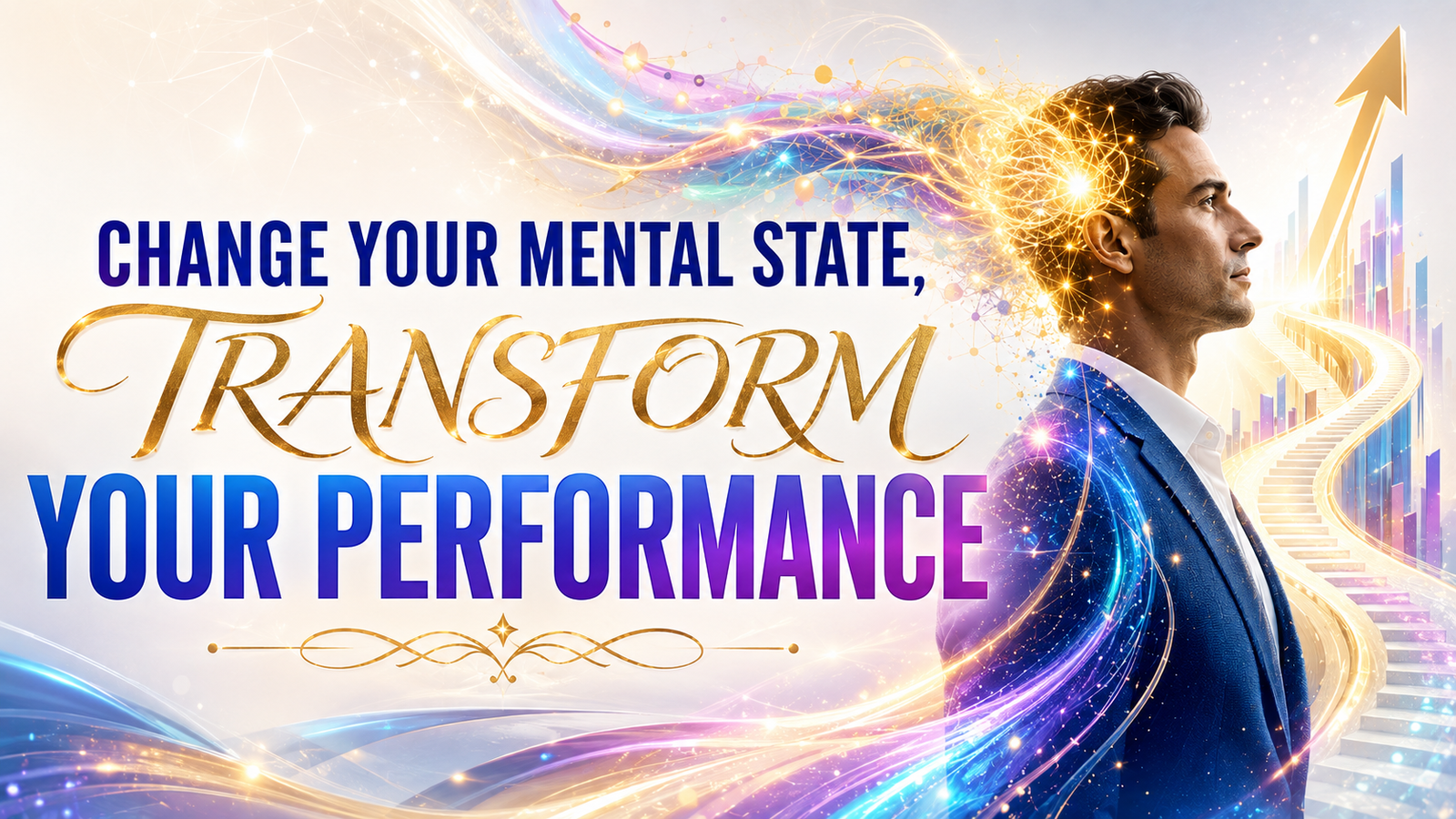
How Does Mental State Affect Performance?
Your mental state affects how you use your existing ability.
You may have the right knowledge. You may also have the necessary skills and experience. However, if fear, anger, confusion, or self-doubt becomes too strong, using those abilities can become more difficult.
A simple way to understand this is:
Performance = Ability × Mental State × Action
Let us understand each part.
Ability
Ability includes your knowledge, training, natural talent, experience, and learned skills.
For example, if you have learned public speaking, you may know how to structure a speech, use stories, and explain an idea.
Mental State
Your mental state influences how easily you can access and express your abilities at that moment.
For instance, in a calm and focused state, your words may flow naturally. In a fearful state, however, you may forget the same words.
Action
Finally, ability and a helpful state must lead to action.
You may know what to do and even feel motivated. Nevertheless, unless you begin, there will be no visible result.
This is why mental state and performance are closely connected. Your state influences your action, and your action creates your result.
Why Does Your Mind Go Blank Under Pressure?
One of the most common questions people ask is, “Why does my mind go blank even when I am prepared?”
Consider a person who can speak comfortably with family and friends. At home, the person explains ideas clearly and confidently.
However, when asked to speak on stage, a different thought appears:
“What if people judge me?”
Immediately, the person’s focus shifts.
Instead of thinking about the value of the message, the person begins thinking about possible embarrassment. In addition, the body may become tense, breathing may change, and the inner voice may say, “I cannot do this.”
As a result, words become harder to find.
After leaving the stage, the pressure reduces. Then, all the missing ideas suddenly return.
The knowledge did not disappear. Instead, the person’s mental state temporarily made it harder to access and express that knowledge.
Therefore, if your mind goes blank under pressure, do not quickly decide that you are incapable.
A difficult performance is an event. It is not your permanent identity.
There is a major difference between these two statements:
“I did not perform well in that situation.”
And:
“I am a poor performer.”
The first statement describes one experience. The second statement turns that experience into an identity.
Your performance can improve. Therefore, avoid using one difficult moment as proof of who you are.
Why Knowledge Alone Does Not Create Results
Most people already know many of the actions that could improve their lives.
They know they should exercise regularly.
They know they should study consistently.
They know they should record videos, contact clients, practise communication, or complete important projects.
However, knowing what to do is not the same as doing it.
Between knowledge and action, there may be an invisible emotional gap.
That gap may contain:
- Fear of failure
- Fear of judgment
- Perfectionism
- Self-doubt
- Confusion
- Emotional resistance
- Overthinking
- Fear of rejection
As an NLP and Mind Transformation Coach, I often notice this pattern while studying human behaviour and working with people.
In many cases, people do not lack information. Instead, an old emotional or thinking pattern becomes active exactly when they need to take action.
For example, a person may know how to record a helpful video. However, just before recording, the mind may say:
“What if nobody watches it?”
“What if people criticize me?”
“What if I do not sound professional?”
“What if another expert has already explained this topic better?”
Therefore, the person begins preparing again. They change the script, adjust the background, watch another tutorial, or plan a new content strategy.
Preparation is useful. However, endless preparation can become a safe way to avoid uncomfortable action.
When Preparation Becomes Avoidance
How do you know whether you are preparing or avoiding?
Ask yourself one honest question:
“Is this activity moving me closer to the real action, or is it helping me delay the action?”
For example, if your goal is to publish a video, learning how to improve your audio may be useful.
However, if you have spent three weeks comparing microphones without recording even one video, preparation may have become avoidance.
Similarly, if you want to start a coaching business, learning about offers and marketing is helpful. Nevertheless, if you never speak to a possible client, knowledge alone will not create a business.
Sometimes, overthinking looks like intelligent planning. Yet, it may be fear wearing professional clothes.
Therefore, before collecting more information, check your internal state.
You may not need another strategy. You may need a more useful state and one small act of courage.
Three Main Controllers of Your Mental State
Your mental state may feel automatic. However, several parts of it can be influenced consciously.
Three important controllers are your body, your focus, and your internal language.
1. Your Body and Breathing
Your mind and body continuously influence each other.
Notice what happens when someone feels discouraged.
The shoulders may drop. The head may move downward. Movement may decrease. Furthermore, the breath may feel less open.
Now, notice a person who feels confident.
The body may appear more open. The person may look forward, breathe more freely, and move with greater purpose.
This does not mean that changing your posture will solve every emotional problem. However, your body can help move your system toward a more useful state.
Perform a Quick Body Check
Pause for a moment and notice:
- Are your shoulders relaxed or tight?
- Is your jaw tense?
- Are you holding your breath?
- Is your body upright or collapsed?
- Are your feet firmly placed on the ground?
- Have you been sitting without movement for too long?
Now, gently relax your face and shoulders.
Then, take a slow and comfortable breath.
Finally, sit or stand in a stable, upright position.
Notice whether this small adjustment changes your experience, even slightly.
The goal is not to force confidence. Instead, the goal is to give your mind and body a more supportive starting point.
2. Your Focus and Attention
What you repeatedly focus on becomes a major part of your present experience.
Suppose you are about to give a presentation.
If you focus on possible mistakes, your fear may increase.
You may ask:
“What if I forget something?”
“What if people disagree with me?”
“What if I look nervous?”
These questions guide your attention toward danger.
However, you can ask different questions:
“What value can I give?”
“What is the one message I want people to remember?”
“What can I control right now?”
“What is my next small step?”
These questions do not magically remove every fear. Nevertheless, they give your attention a more useful direction.
Shift from Self-Protection to Contribution
Many people struggle on camera because their attention remains on themselves.
They think:
“How do I look?”
“How does my voice sound?”
“Will people judge my language?”
“Will this video get views?”
Naturally, this creates self-consciousness.
Instead, imagine one person who genuinely needs your message. Then, speak to that person.
Ask:
“How can I make this idea easier for this person?”
“What example will help this person understand?”
“What small action can this viewer take today?”
When your attention moves from self-protection to contribution, communication often becomes more natural.
3. Your Internal Language and Mental Pictures
You do not respond only to external events. You also respond to how you represent those events inside your mind.
For example, before an important conversation, you may repeatedly imagine the other person rejecting you.
You may hear an inner voice saying:
“You will make a mistake.”
“You are not ready.”
“You are not good enough.”
Although the actual conversation has not happened, your body may begin reacting to the negative mental movie.
Therefore, pay attention to the pictures, sounds, and words you create inside.
Ask yourself:
- What am I imagining?
- What am I saying to myself?
- Am I mentally practising success or failure?
- Is my inner voice supporting me or attacking me?
From an NLP perspective, becoming aware of these internal patterns is important. Once you notice how you are representing an experience, you can begin creating a more helpful representation.
For example, you can imagine yourself handling the first step calmly.
You can change “I must be perfect” into “I only need to be present and useful.”
You can change “I cannot make a mistake” into “I can adjust and continue.”
This is not about denying reality. Instead, it is about preparing your mind to respond with greater flexibility.
If you enjoy practical ideas like these, you can also explore the free videos on my YouTube channel. There, I regularly share simple lessons about NLP, overthinking, confidence, emotional patterns, and mind transformation.
How Negative Mental States Reduce Performance
Every emotion has a purpose. Therefore, we should not label every uncomfortable emotion as bad.
Fear can alert us to danger. Anger may show that a boundary has been crossed. Sadness may ask us to slow down and process a loss.
However, when an emotional state becomes too strong, lasts too long, or appears in the wrong situation, it may reduce performance.
Fear Narrows Your Attention
Fear can direct your attention toward possible threats.
As a result, you may notice everything that could go wrong while ignoring possible solutions.
For instance, before launching a new project, you may see criticism, failure, and loss. Meanwhile, you may ignore learning, support, opportunity, and growth.
Anxiety Can Affect Clear Thinking
When anxiety increases, it may become harder to concentrate, recall information, make decisions, or remain present.
This is why a student may forget an answer during an exam but remember it later.
Similarly, you may think of the perfect response after a difficult conversation has ended.
Once the pressure reduces, your state changes. Consequently, clear thinking may become easier again.
Anger Can Change Your Decisions
In an angry state, you may speak quickly, interrupt someone, misunderstand their intention, or make a decision you later regret.
Therefore, the best time to solve a problem may not be the moment when your emotions are at their highest level.
Sometimes, a short pause can protect a relationship and improve a decision.
Overthinking Delays Action
Overthinking often creates the feeling that you are working on a problem. In reality, however, you may be repeating the same thoughts without moving forward.
This can lead to:
- Decision paralysis
- Mental tiredness
- Repeated doubt
- Delayed action
- Loss of confidence
- Reduced productivity
The longer you delay, the more difficult the task may appear. Therefore, the solution is not always more thinking. Sometimes, the solution is a smaller action.
How Can You Change Your Mental State?
You cannot control every emotion immediately. Moreover, you should not expect yourself to feel positive all the time.
However, you can learn to influence your state.
For this purpose, I use a simple five-step process called the S.T.A.T.E. Reset Method.
It stands for:
- S — Stop and Observe
- T — Take Control of Your Breathing
- A — Align Your Body
- T — Target Your Attention
- E — Execute One Small Action
Let us explore every step.
S — Stop and Observe
Before changing a state, you must first notice it.
Pause and ask:
- What am I feeling right now?
- What am I thinking?
- What am I afraid may happen?
- Where do I feel tension in my body?
- What am I saying to myself?
While observing, avoid judging yourself.
Do not say, “Why am I so weak?”
Instead, use neutral language:
“I am experiencing nervousness right now.”
“My attention has moved toward failure.”
“My body is feeling tense.”
“My mind is trying to protect me.”
This language creates a helpful distance between your identity and your temporary experience.
You are not anxiety. You are experiencing an anxious state.
You are not confusion. You are experiencing confusion at this moment.
A temporary state can change. Therefore, do not turn it into a permanent identity.
T — Take Control of Your Breathing
Next, bring attention to your breathing.
Take three to five slow and comfortable breaths.
Breathe in gently through your nose. Then, without forcing yourself, allow the breath to leave slowly.
As you breathe, repeat a helpful sentence:
“I am here.”
“I can handle one step at a time.”
“I do not need to solve everything now.”
“I only need to take the next step.”
The purpose is not to fight your body. Instead, you are helping it move toward a calmer condition.
However, if intense anxiety continues, causes severe distress, or regularly affects your daily life, do not depend only on a self-help exercise. Consider speaking with a qualified mental-health professional.
A — Align Your Body
Now, adjust your body.
Sit or stand in a comfortable, upright position.
Relax your shoulders.
Release unnecessary tension from your face and jaw.
Place your feet firmly on the ground.
If possible, walk for a minute or gently move your arms and legs.
Then, ask:
“If I felt calm and confident, how would I sit?”
“How would I breathe?”
“Where would I look?”
“How would I begin speaking?”
Do not wait for complete confidence before changing your posture.
Instead, let your body begin moving in the direction of confidence.
Many people believe, “When I feel confident, I will take action.”
However, sometimes the process works in the opposite direction.
You begin a confident behaviour, take a small action, and then confidence starts growing.
T — Target Your Attention
Now, guide your attention toward something useful.
Ask:
“What is my real objective?”
“What can I control?”
“What is the next step?”
“How can I be useful?”
“What result can I create in the next five minutes?”
Suppose you need to make a sales call.
Instead of thinking, “What if this person rejects me?” shift your attention toward curiosity:
“What can I learn about this person?”
“What problem is this person trying to solve?”
“How can I understand the situation clearly?”
Likewise, before recording a video, replace “Will people like me?” with “How can I make this message useful?”
Your focus gives direction to your mental energy. Therefore, choose a direction that supports action.
E — Execute One Small Action
Finally, act immediately.
The action does not need to be big.
If you want to record a video, record only the introduction.
If you need to study, read the first page.
If you need to exercise, put on your shoes and begin the first movement.
If you need to write, complete the first sentence.
If you need to contact a client, open the number and make the call.
A small action breaks the thinking loop.
Moreover, it gives your mind new evidence:
“I can move even when I do not feel completely ready.”
“I can take action while feeling uncomfortable.”
“I do not need perfect confidence to begin.”
This evidence is more powerful than repeating a positive sentence without taking action.
Build a Five-Minute Pre-Performance Ritual
You should not wait for a crisis before practising state management.
Instead, create a short ritual before important tasks.
Your five-minute pre-performance ritual could look like this:
- Take three slow and comfortable breaths.
- Align your body.
- Remember the purpose of the task.
- Imagine yourself completing the first step calmly.
- Begin before overthinking returns.
You can use this ritual before:
- Studying
- Recording a video
- Speaking on stage
- Meeting a client
- Making a sales call
- Exercising
- Writing
- Having a difficult conversation
When you repeat the same process, it gradually becomes more familiar. As a result, accessing a useful state may become easier.
Use a Past Success as a Mental Resource
Think about a time when you felt confident, calm, focused, or brave.
The situation does not need to be dramatic. Perhaps you solved a difficult problem, spoke clearly in a meeting, helped someone, completed a challenging project, or made a strong decision.
Now, remember the experience in detail.
What did you see?
What did you hear?
How did your body feel?
What were you saying to yourself?
How were you breathing?
This memory is evidence that the resourceful state already exists within your experience.
You are not trying to create something completely unknown. Instead, you are learning to access a state you have experienced before and bring it into a new situation.
Keep a Mental State Journal
A simple journal can help you understand your repeated patterns.
At the end of each day, answer three questions:
What was my most helpful mental state today?
Perhaps you felt focused, curious, peaceful, confident, or determined.
What event changed my state?
Identify the trigger without judging yourself.
Maybe it was criticism, bad news, a difficult conversation, physical tiredness, comparison, or an unexpected problem.
What helped me return to a useful state?
Perhaps walking, breathing, talking to someone, changing your focus, resting, writing, praying, or taking a small action helped.
Over time, this journal can reveal important patterns.
Once you see a pattern clearly, you can prepare for it more consciously.
To make this process easier, you can download my free 5-Minute Mental State Reset Guide. It can help you identify your current state, discover what may be influencing it, and choose your next small action. You can place the download link in the description, at the end of this article, or in your website’s resource section.
You Do Not Need to Feel Perfect Before Acting
Many people wait for the perfect emotional state.
They say:
“I will start when I feel motivated.”
“I will record when I feel confident.”
“I will make the decision when all my doubt disappears.”
“I will take action when I stop feeling afraid.”
However, that perfect moment may never come.
You do not always need confidence before taking action. Sometimes, action is what begins to build confidence.
You do not need to remove every doubt. You only need enough clarity to take the next step.
Similarly, you do not need to control every emotion. You need to become flexible enough to move in your chosen direction, even when some discomfort is present.
Mind transformation does not mean that you will never experience fear, sadness, anger, or self-doubt again.
Instead, transformation means that you begin to recognize your patterns sooner. You create space between an automatic reaction and a conscious response. Then, you learn how to return to a useful direction.
This is one of the main principles I share through my work as an NLP and Mind Transformation Coach.
My aim is not simply to tell people to think positively. Instead, I help them understand how their internal patterns influence their emotions, choices, and actions—and how they can develop greater response flexibility through awareness and practical tools.
If you would like to explore these ideas more deeply, you can join my free webinar or beginner course on mental state, overthinking, and consistent action. It will help you turn these ideas into a daily practice.
Final Thoughts: Change Your State, Change Your Performance
Your mental state does not define your full potential. However, it strongly influences how much of that potential you can use in a particular moment.
Therefore, remember these three lessons:
First, one poor performance does not make you a poor performer.
Second, your ability and your current state are not the same thing.
Third, you can learn to influence your state through awareness, breathing, body alignment, focused attention, and small action.
Whenever you feel stuck, use the S.T.A.T.E. Reset:
- Stop and observe
- Take control of your breathing
- Align your body
- Target your attention
- Execute one small action
You may not control every event around you. Nevertheless, you can learn to influence the state from which you respond.
So, ask yourself one final question:
“What state do I need for my next important action?”
Then, do not wait for the entire state to appear perfectly.
Adjust your body. Guide your focus. Take one breath. Choose one small step.
And begin.
Frequently Asked Questions
Does mental state really affect performance?
Yes. Your mental state can influence your concentration, memory, communication, decisions, and willingness to act. A calm and focused state may help you use your abilities more effectively. In contrast, intense fear, anger, or confusion may make clear performance more difficult.
Why does my mind go blank under pressure?
Pressure can shift your attention from the task toward fear, judgment, or possible failure. Your body may also become tense, while your breathing changes. As a result, recalling and expressing information can become harder, even when you know the subject well.
Can I change my mental state quickly?
You may not be able to change every emotion instantly. However, you can often influence your state by slowing your breathing, adjusting your posture, changing your focus, using supportive inner language, and taking one small action.
How can I improve my mental state before studying?
First, remove unnecessary distractions. Next, take a few comfortable breaths and decide on one clear study target. Instead of thinking about the entire syllabus, choose one chapter, one page, or one question. Then, begin with a short, focused study session.
How can I feel more confident before public speaking?
Prepare and practise your opening lines. Then, align your body, slow your breathing, and focus on helping the audience rather than impressing them. Finally, remember that you do not need to be perfect. You only need to be present, clear, and useful.
How can I stop overthinking and take action?
Write down the decision or task clearly. Separate what you can control from what you cannot control. Then, choose the smallest useful action you can complete now. Action may not remove every doubt, but it can break the repeated thinking loop.
Is a negative mental state a mental illness?
Not necessarily. Temporary fear, sadness, stress, or frustration can be a normal part of life. However, if difficult thoughts or emotions are intense, persistent, or seriously affecting your daily life, relationships, sleep, or safety, seek support from a qualified mental-health professional.
JOIN MIND TRANSFORMATION COMMUNITY
Learn More:
7 Day Manifestation- NLP Guided Meditation for Success
Why Some People Succeed While Others Stay Stuck: The 6-Step Success Process