
Why Some People Succeed While Others Stay Stuck?
Almost everyone wants to become successful.
You may want more money. You may want a better career. You may want to build a business, become a confident speaker, improve your relationships, or create a peaceful life.
However, wanting success and achieving success are two different things.
Many people have big dreams. They read books, watch videos, attend seminars, make plans, and collect knowledge. Still, after months or even years, they find themselves standing in almost the same place.
Therefore, an important question arises:
Why are some people successful while others remain stuck, even when both want a better life?
The simple answer is that success does not come from desire alone. It comes from following the right process for a long enough time.
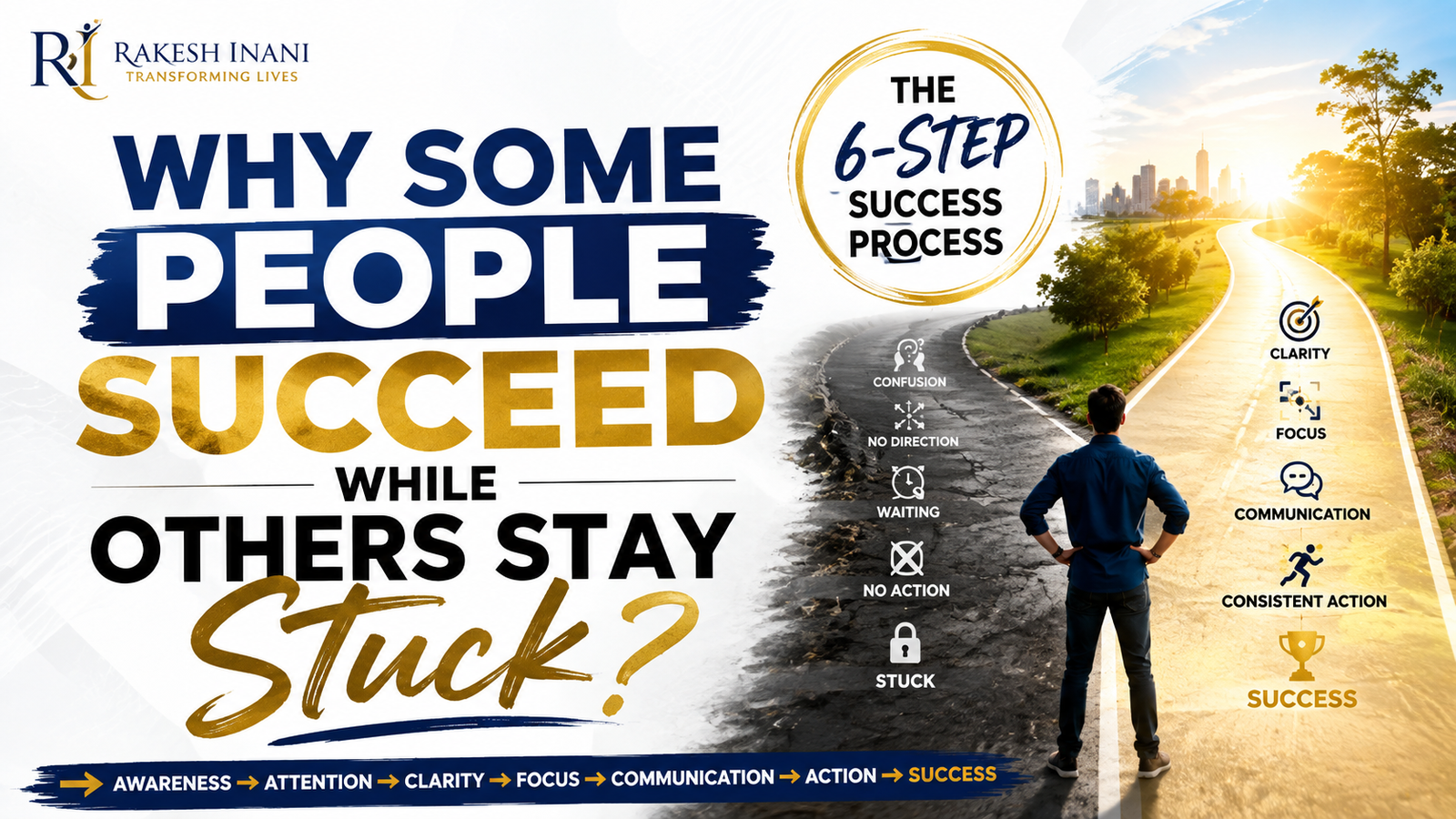
You must become aware of your current patterns. Then, you must give attention to the right things. After that, you need clarity, focus, communication, and consistent action.
This is the foundation of the success formula you will learn throughout this guide.
What Is the Real Reason Some People Succeed?
Successful people are not always the smartest, most talented, or most fortunate people.
Instead, they often become successful because they learn how to move from an idea to action and from action to repetition.
They know what they want. Moreover, they understand what the goal requires from them. Then, instead of waiting for perfect conditions, they begin working with what they have.
Of course, they also face fear, confusion, rejection, delays, and failure. However, they do not treat every difficult moment as a signal to quit.
They observe what happened. Next, they learn from it. Finally, they improve their next action.
In simple words, successful people do not always know everything before they begin. However, they continue learning while moving forward.
People who remain stuck often follow a different pattern.
They may think deeply, but act very little. They may start many things, but complete very few. They may change their goal every time the journey becomes uncomfortable.
Therefore, the true difference is often not desire. The difference is the process a person follows after deciding what they want.
Everyone Wants Success, but Few Understand the Process
Let me ask you a simple question.
Have you ever said any of these things?
“I want to become financially free.”
“I want to build a successful business.”
“I want to become confident.”
“I want to grow my coaching career.”
“I want to improve my health.”
“I want to speak in front of thousands of people.”
These are meaningful goals. However, they are still only desires until you connect them with a clear process.
For example, imagine that you want to earn ₹1 lakh per month.
That is your desired outcome. However, the goal itself does not tell you what to do today.
To achieve it, you may need to learn a valuable skill. You may need to understand a specific audience. Moreover, you may need to create an offer, communicate its value, speak with potential clients, handle rejection, and improve your service.
Therefore, “I want to earn ₹1 lakh per month” is not the complete plan. It is only the destination.
You still need a road.
This is where many people become stuck. They keep looking at the destination, but they do not build the bridge between their present situation and their desired future.
Why Wanting Success Is Not Enough
Desire is important because it gives you a reason to begin.
However, desire without direction can turn into frustration.
You may want something with your whole heart. Yet, if you do not understand the skills, behaviours, resources, and actions required, your desire cannot automatically create the result.
For instance, a person may strongly want to become a confident public speaker. Still, confidence will not appear only because the desire is strong.
That person may need to practise speaking every day. They may need to improve their voice, storytelling, body language, emotional control, and understanding of the audience.
Similarly, a person may want to build a successful coaching business. However, knowledge of coaching alone may not be enough.
The person may also need to learn marketing, sales, content creation, client communication, program design, and business management.
Therefore, every meaningful goal asks you to become a new version of yourself.
The goal does not only ask, “What do you want?”
It also asks, “Who must you become to achieve it?”
The Difference Between Desire and Direction
Desire says, “I want a better life.”
Direction says, “This is the next step I will take.”
Desire says, “I want to become successful.”
Direction says, “I will develop this skill, solve this problem, and complete this action every day.”
Desire creates emotional energy. In contrast, direction gives that energy a useful path.
Think about sunlight.
Sunlight spreads everywhere. However, when the same light is focused through a lens, it becomes much more powerful.
Your mental energy works in a similar way.
If your energy is spread across ten different goals, you may remain busy without making meaningful progress. However, when your energy moves in one clear direction, your actions become stronger.
Therefore, if you have been asking, “Why am I not successful yet?” do not judge yourself too quickly.
Instead, ask a better question:
Do I have only a desire, or do I also have a clear direction?
That question can reveal more than hours of random motivation.
Why Hard Work Does Not Always Produce Results
You may have heard that hard work is the key to success.
Hard work certainly matters. However, hard work alone does not guarantee the right result.
You can work very hard in the wrong direction.
You can also repeat an ineffective method for years. You may become tired, but you may not move closer to your goal.
For example, suppose you are creating content every day, but you do not understand your audience’s real problems. You may work for many hours, yet your content may receive little response.
The problem is not always a lack of effort.
The problem may be a lack of clarity.
Similarly, you may speak with many potential clients, but if your message is confusing, they may not understand how you can help them.
Again, the problem is not effort alone. The missing piece may be communication.
Therefore, smart progress requires more than hard work. It requires awareness, feedback, learning, and correction.
This does not mean that you should avoid effort. Instead, it means that you should regularly ask whether your effort is producing learning and movement.
Hard work becomes more powerful when it is connected to the right goal, the right skill, and the right action.
Are You Busy or Are You Really Moving Forward?
Being busy can feel like progress.
You may reply to messages, watch training videos, make lists, organize files, change your website, design new plans, and research new tools.
At the end of the day, you may feel tired. However, did you complete the action that directly supports your main goal?
That is the real question.
Activity and progress are not always the same.
Activity means you did something.
Progress means you did something that moved you closer to a meaningful result.
For example, if your goal is to get your first coaching client, watching five hours of motivational content may keep you busy. However, speaking with one suitable potential client may create more progress.
Similarly, changing the colours of your presentation may feel productive. However, practising the presentation may be the action that improves your speaking ability.
Therefore, before beginning any task, ask:
Will this action move me closer to my main goal, or is it helping me avoid a more important action?
This question may feel uncomfortable. Still, it can protect your time and energy.
Sometimes we stay busy because the important action feels difficult.
We research because we are afraid to publish.
We plan because we are afraid to begin.
We improve small details because we are afraid to face the market.
In these moments, busyness becomes a safe hiding place.
Real progress begins when you gently notice this pattern and choose the important action anyway.
The Hidden Difference Between Successful and Unsuccessful People
The words “successful” and “unsuccessful” should not be used as permanent labels.
A person may be successful in one area and struggling in another. Moreover, a person who is stuck today may create remarkable progress tomorrow.
Therefore, the real difference is not identity. It is the pattern being repeated.
A growth-producing pattern may look like this:
- Choose a meaningful goal.
- Identify what the goal requires.
- Take a practical action.
- Observe the result.
- Learn from the feedback.
- Improve the approach.
- Repeat the process.
On the other hand, a stuck pattern may look like this:
- Choose an exciting goal.
- Make a big plan.
- Take action for a few days.
- Face difficulty.
- Lose motivation.
- Switch to a new goal.
- Repeat the same cycle.
Notice that both people may begin with excitement.
However, one person learns how to continue after the excitement becomes weaker. The other person depends on excitement to keep moving.
That is why consistent action is so powerful.
Motivation may help you start. Nevertheless, a system helps you continue.
Why Knowing More Does Not Guarantee Success
Knowledge is valuable. However, knowledge that is never applied cannot transform your life.
You may know how to communicate, but do you practise it?
You may know how to create content, but do you publish consistently?
You may know the importance of exercise, but do you exercise regularly?
You may understand goal setting, but do you review your goal every day?
This is the difference between information and transformation.
Information enters your mind.
Transformation changes your behaviour.
Many intelligent people remain stuck because they continue collecting information instead of converting knowledge into action.
They believe they need one more book, one more course, one more strategy, or one more perfect plan.
Of course, learning is useful. However, learning can also become a form of delay.
At some point, you must stop asking, “What else should I know?”
Instead, you must ask, “What will I do with what I already know?”
That is where transformation begins.
A simple idea, applied consistently, can create more value than one hundred ideas that remain inside a notebook.
What Does Success Really Mean?
When people search for “how to become successful,” they often imagine money, status, recognition, or freedom.
These can certainly be parts of success. However, success is personal.
For one person, success may mean building a profitable company.
For another person, it may mean having enough time for family.
For someone else, success may mean overcoming fear, becoming emotionally peaceful, improving health, or serving society.
Therefore, before you chase success, you must define it.
Otherwise, you may spend years climbing a ladder only to discover that it was placed against the wrong wall.
A useful definition is:
Success is the steady movement toward a meaningful result while becoming the person capable of creating and sustaining that result.
This definition has three important parts.
First, success involves movement. You do not need to have reached the final destination to recognize progress.
Second, the result must be meaningful to you. It should not be chosen only to impress other people.
Third, you must become capable of sustaining the result. If you create money but lose your health, peace, or relationships, you may need to reconsider what complete success means.
Therefore, true success is not only about getting something.
It is also about growing into someone.
Why Do I Feel Stuck in Life?
If you feel stuck, it does not always mean that you are lazy or incapable.
Sometimes you are stuck because the goal is unclear.
Sometimes you are trying to do too many things at once.
Sometimes you do not yet have the required skill.
Sometimes fear is silently controlling your decisions.
At other times, your environment may be full of distractions.
You may also be expecting a big result from small or irregular action.
Therefore, “I am stuck” is not a complete explanation. It is only a signal that something needs to be examined.
Instead of saying, “Nothing is working,” become more specific.
Ask:
- What exactly is not working?
- What result did I expect?
- What action did I take?
- How often did I take it?
- What feedback did I receive?
- What skill may be missing?
- What am I avoiding?
- What can I improve next?
Specific questions create useful answers.
Vague frustration creates more confusion.
Therefore, if you feel stuck, do not attack yourself. Investigate the pattern.
Your present result is not a final judgement about your potential. It is feedback about your current method, skill level, behaviour, or direction.
Success Is a Process, Not a Lucky Event
From the outside, success can look sudden.
You may see someone launch a business, publish a popular book, build a large audience, or achieve an impressive income.
However, you usually see only the visible result.
You do not see the years of learning behind it. You do not see the failed attempts, private doubts, repeated practice, small improvements, difficult conversations, and ordinary days of work.
As a result, you may compare your beginning with another person’s advanced stage.
That comparison can make you feel late.
However, success is rarely one magical moment. It is usually the result of many small actions working together over time.
A tree does not become large on the day it appears above the ground.
First, the seed opens beneath the soil. Then, the roots begin to grow. For some time, very little is visible.
Still, important progress is happening.
Your growth may work in the same way.
When you practise a skill, improve your message, understand your audience, strengthen your habits, or manage your emotions, the immediate result may look small.
However, these actions are building roots.
Therefore, do not measure progress only by the final outcome. Also measure the strength you are developing beneath the surface.
The Six Forces That Move You Toward Success
Throughout this guide, I will take you through six connected forces.
The first is awareness.
You must notice what is happening in your mind, behaviour, and environment. Without awareness, you may repeat the same pattern without understanding it.
The second is attention.
Many things will ask for your time and energy. Therefore, you must decide what deserves your attention.
The third is clarity.
You need to know what you want, why it matters, and what the journey requires.
The fourth is focus.
Once you choose a direction, you must stay with it long enough to make meaningful progress.
The fifth is communication.
You must communicate well with yourself and with the people you want to serve, lead, help, or influence.
The sixth is consistent action.
Finally, you must repeat the right action even when motivation is low and results are slow.
Together, these stages create a practical path:
Awareness → Attention → Clarity → Focus → Communication → Consistent Action → Success
Each stage supports the next one.
Without awareness, you may not see the problem.
Without attention, your energy may move everywhere.
Without clarity, you may choose the wrong action.
Without focus, you may keep changing direction.
Without communication, people may not understand your value.
Without consistent action, your plan may remain only an idea.
A Simple Example of the Success Formula
Imagine that you want to build a coaching business.
First, awareness helps you notice that you spend most of your time learning but very little time speaking with potential clients.
Next, attention helps you stop chasing every new course, tool, and business idea.
Then, clarity helps you define one audience, one problem, one offer, and one outcome.
After that, focus helps you work on this offer without creating five other programs at the same time.
Communication helps you explain the problem, build trust, understand potential clients, and present your solution clearly.
Finally, consistent action helps you create content, start conversations, improve your offer, and follow up regularly.
Now your goal is no longer only a dream.
It has become a process.
This same formula can be applied to health, career development, communication, relationships, learning, personal growth, and many other areas.
The details may change. However, the basic process remains useful.
Your First Success Reflection
Before moving to the next section, take a few minutes to answer these questions.
Do not try to create perfect answers. Instead, write what feels honest.
What Does Success Mean to Me?
Complete this sentence:
Success means ____________________________________.
Do not copy someone else’s definition.
Think about the life you truly want to create.
What Is My Most Important Goal?
Complete this sentence:
The one result I want most right now is __________________________.
Choose one result, not ten.
You can have many dreams. However, this exercise is about identifying your present priority.
Why Does This Goal Matter?
Complete this sentence:
This goal matters to me because ________________________________.
Your reason gives emotional meaning to your goal.
However, be honest. Is the goal truly yours, or are you trying to prove something to someone?
How Long Have I Been Trying?
Complete this sentence:
I have wanted this result for approximately ______________________.
This helps you see whether the goal is new or whether you have been carrying it without a clear process.
What Have I Actually Done?
Complete this sentence:
The actions I have taken consistently are ________________________.
Notice the word “consistently.”
Do not write what you planned to do. Write what you repeatedly did.
What May Be Missing?
Rate yourself from 1 to 10:
- Awareness: ___
- Attention: ___
- Clarity: ___
- Focus: ___
- Communication: ___
- Consistent action: ___
Your lowest score may reveal the first part of the success formula that needs your attention.
The Most Important Lesson from This Section
If you have been working hard but are still not getting the result you want, do not immediately conclude that success is not meant for you.
Instead, pause and examine your process.
Maybe you need more clarity.
Perhaps your attention is divided.
Maybe a missing skill is creating a barrier.
Perhaps your communication is not showing people the true value you provide.
Or maybe you are taking action, but not consistently enough for the action to produce a result.
The good news is that each of these areas can be improved.
You are not permanently stuck.
However, progress begins when you stop looking only at the destination and start understanding the road.
Therefore, do not ask only:
“Why am I not successful?”
Ask:
“Which part of my success process needs to become stronger?”
That question moves you from helplessness to awareness.
It also prepares you for the next important truth: failure is not the enemy of success. In many situations, failure is the feedback that shows you what must change.
In the next blog post, we will explore why success and failure are two sides of the same coin—and how you can turn setbacks into practical lessons instead of allowing them to define your future.
Learn More About Success: How To Optimize Your Daily Life: 7 Success Optimization Techniques