
The Six-Step Success Formula: How to Turn Your Goals Into Real Results
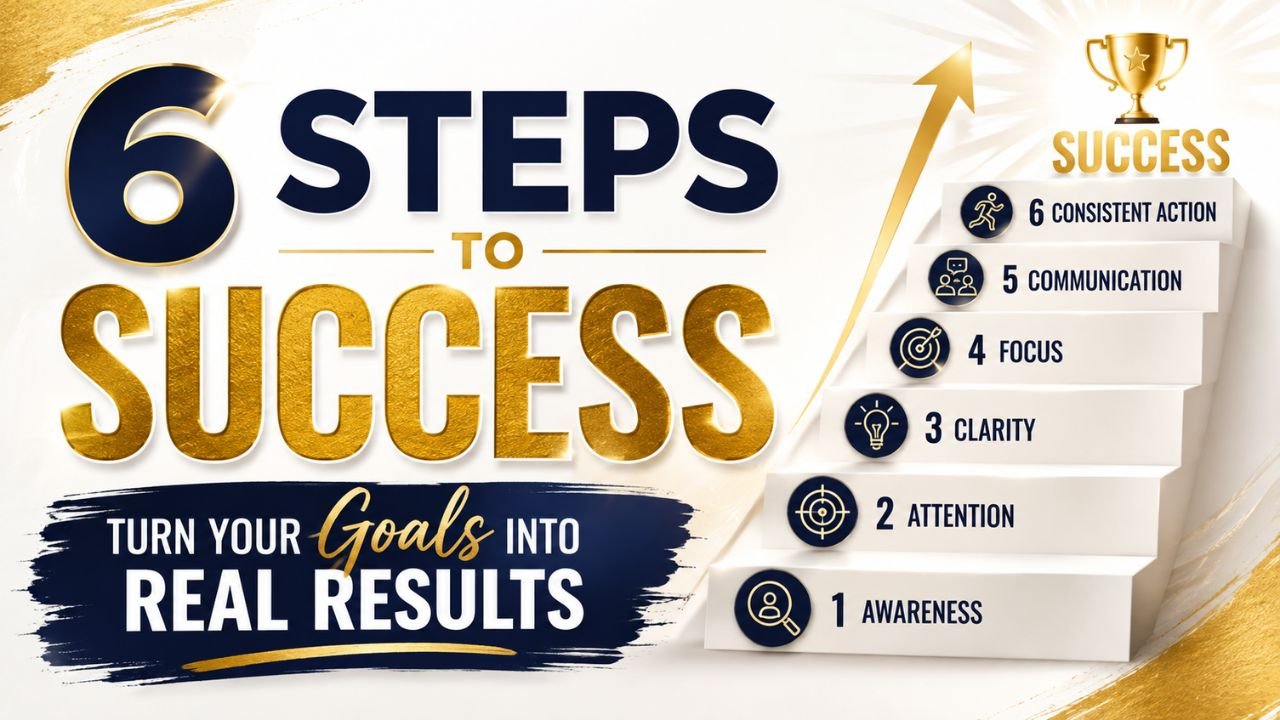
Awareness → Attention → Clarity → Focus → Communication → Consistent Action → Success
You may have a dream.
You may want to build a successful business, earn more money, improve your health, become more confident, strengthen your relationships, or simply create a life that feels more meaningful.
And perhaps you are willing to work hard for it.
But here is the question that changes everything:
Why do some people work hard for years without creating the results they want, while others seem to move forward with greater clarity and consistency?
The answer is rarely just motivation.
It is usually the process between intention and execution.
A goal is only a destination. It does not automatically tell you how to get there.
To turn a goal into a result, you need to understand where you are, decide what deserves your energy, define where you are going, protect your attention, communicate effectively, and repeatedly take the actions that move you forward.
This creates a powerful success sequence:
Awareness → Attention → Clarity → Focus → Communication → Consistent Action → Success
This is more than a motivational formula.
It is a practical framework for understanding why you get stuck—and what you can change.
What Is the Six-Step Success Formula?
The Six-Step Success Formula is a practical personal growth framework designed to help you move from desire to direction and from direction to consistent action.
The six steps are:
- Awareness — See your current reality.
- Attention — Decide what deserves your energy.
- Clarity — Define exactly what you want.
- Focus — Stay committed to the chosen priority.
- Communication — Align your inner and outer communication.
- Consistent Action — Repeat the right behaviours long enough to create results.
The formula does not promise instant success.
Instead, it explains what needs to happen between saying:
“I want this.”
and being able to say:
“I created this.”
You can apply this framework to almost any meaningful goal:
- Building a business
- Growing a coaching practice
- Increasing your income
- Improving confidence
- Overcoming procrastination
- Creating healthier habits
- Learning a new skill
- Improving relationships
- Becoming a better communicator
- Creating content consistently
- Developing financial discipline
- Completing an important project
- Building a more meaningful life
The goal may change.
The process remains surprisingly similar.
The Six Steps to Success at a Glance
| Step | What It Does | Key Question |
|---|---|---|
| Awareness | Helps you understand your present reality | What is really happening? |
| Attention | Directs your mental energy | What deserves my attention now? |
| Clarity | Defines your desired outcome | What exactly do I want? |
| Focus | Protects your chosen direction | What will I stay committed to? |
| Communication | Creates understanding and alignment | How will I express, understand, and connect? |
| Consistent Action | Turns intention into progress | What will I keep doing? |
Think of it this way:
Awareness helps you see.
Attention helps you select.
Clarity helps you decide.
Focus helps you concentrate.
Communication helps you connect.
Consistent action helps you create.
Why the Order of These Success Steps Matters
Imagine that you want to travel to a city you have never visited.
Before choosing a road, you need to know where you are starting.
That is awareness.
Then you need to determine which information and roads deserve your attention.
That is attention.
Next, you choose your exact destination and route.
That is clarity.
Once you choose your route, you stop changing directions every few minutes.
That is focus.
During the journey, you may need to ask for directions, understand signs, communicate with people, and adjust when necessary.
That is communication.
And finally, you have to keep travelling until you arrive.
That is consistent action.
Now imagine removing one of these steps.
You could have tremendous energy but no destination.
You could have a clear destination but keep changing roads.
You could have a perfect plan but never execute it.
You could work consistently but communicate your value poorly.
You could know exactly what to do but constantly allow distractions to consume your attention.
Success becomes easier when the entire chain works together.
Step 1: Awareness — See Your Present Reality Clearly
The first step toward meaningful change is not action.
It is awareness.
Awareness means developing the ability to observe what is actually happening within you and around you.
This includes becoming aware of:
- Your thoughts
- Your emotions
- Your habits
- Your decisions
- Your strengths
- Your weaknesses
- Your triggers
- Your environment
- Your distractions
- Your opportunities
- Your repeated behaviours
- Your current results
Why does this matter?
Because you cannot consistently change a pattern that you cannot see.
Imagine someone saying:
“I don’t have enough time.”
They may genuinely believe it.
But after observing their day honestly, they discover:
- 90 minutes on social media
- 45 minutes responding to unnecessary messages
- 30 minutes repeatedly checking notifications
- Frequent task switching
- Several hours spent on low-value activities
The problem suddenly becomes visible.
The person did not necessarily need more time.
They needed awareness of where their time was going.
Awareness Turns Confusion Into Information
Perhaps you believe you lack confidence.
But what if the deeper pattern is that you avoid situations where you might be judged?
Perhaps you believe you lack discipline.
But what if your goals are vague and your environment constantly triggers distraction?
Perhaps you believe you need more knowledge.
But what if you already know enough and are simply afraid to act?
Awareness helps you distinguish between:
The problem you think you have
and
the pattern that is actually creating your result.
That distinction can transform everything.
Awareness Is Not Self-Judgement
One of the biggest mistakes people make is confusing awareness with criticism.
Suppose you planned to work for one hour but opened social media after ten minutes.
You could say:
“I am lazy.”
Or you could say:
“I planned to work for one hour, but after ten minutes I became distracted and opened social media.”
The first statement attacks your identity.
The second describes a behaviour.
Behaviours can be studied. Behaviours can be changed.
Therefore, practice observing yourself without immediately labelling yourself.
Instead of:
“I am a failure.”
Ask:
“What happened?”
Instead of:
“I have no discipline.”
Ask:
“At what point did I stop following my plan?”
Instead of:
“I always procrastinate.”
Ask:
“What usually happens immediately before I procrastinate?”
These questions turn self-judgement into self-understanding.
Questions That Increase Self-Awareness
Ask yourself:
- What results am I currently getting?
- Which behaviours repeatedly create those results?
- What do I consistently avoid?
- What usually happens before I procrastinate?
- Which emotions appear before I give up?
- What distracts me most?
- What am I already doing well?
- Which problem keeps returning?
- What feedback have I been ignoring?
- What uncomfortable truth am I avoiding?
You do not need to analyse yourself endlessly.
The goal is simple:
See reality clearly enough to make a better decision.
Step 2: Attention — Choose What Deserves Your Energy
Awareness shows you what exists.
Attention determines what you do with what you see.
Once you become aware of your situation, you may discover ten different problems that need improvement.
But you cannot solve ten problems with equal intensity at the same time.
Your mental energy is limited.
Your time is limited.
Your attention is limited.
That is why attention is one of the most valuable resources in personal growth.
Your Attention Is Being Competed For
Every day, your attention is pulled in multiple directions:
- Social media
- Notifications
- Messages
- News
- Other people’s expectations
- New opportunities
- New ideas
- Unfinished tasks
- Fear
- Worry
- Comparison
- Entertainment
The danger is not always distraction itself.
The deeper danger is fragmented attention.
You may spend the entire day doing things without giving enough uninterrupted attention to the one thing that could actually change your situation.
You become busy.
But not necessarily productive.
Awareness vs Attention
These two concepts are closely connected but different.
Awareness asks:
“What is happening?”
Attention asks:
“What deserves my energy?”
For example, you may become aware that your business has five potential weaknesses:
- Marketing
- Content
- Sales
- Website
- Product development
Awareness identifies the landscape.
Attention helps you choose the bottleneck.
Perhaps you already have enough leads but struggle to convert them.
In that situation, improving your sales communication may deserve more attention than redesigning your website.
This is the power of attention:
It helps you stop treating every problem as equally important.
Use the Attention Filter
Before saying yes to a task, idea, or opportunity, ask:
- Does this support my most important goal?
- Is it important right now?
- Will it create meaningful progress?
- Am I choosing it because it matters—or because it feels exciting?
- What important task will lose time if I choose this?
- Can this wait?
These questions help you distinguish between opportunity and distraction.
Because not everything interesting deserves your attention.
Step 3: Clarity — Know Exactly What You Want
You cannot build a focused life around a vague destination.
“I want success.”
“I want more money.”
“I want to become confident.”
“I want to grow my business.”
These statements may express genuine desires.
But they are not yet sufficiently clear to guide consistent behaviour.
Clarity converts a wish into an outcome.
Instead of:
“I want to become successful.”
Try:
“I want to enrol 10 clients into my coaching program within the next 90 days.”
Now you have something measurable.
But real clarity goes deeper.
You also need to understand:
- What you want
- Why you want it
- How success will be measured
- When you want it
- What skills are required
- Which actions are within your control
- What your first milestone is
- What you need to stop doing
- How you will review your progress
Why Do People Struggle With Clarity?
Sometimes the problem is too many goals.
You want to:
- Start a business
- Build a YouTube channel
- Learn a new skill
- Improve your health
- Travel
- Earn more
- Read more
- Build relationships
All of these may be valuable.
But when everything becomes a priority, nothing receives enough priority.
Another reason is comparison.
You may think you want someone else’s life because it looks impressive from the outside.
But success becomes much more meaningful when the goal actually belongs to you.
A third reason is fear.
Sometimes you know exactly what you want—but committing to it feels frightening.
Because choosing one path means temporarily saying:
“Not this other path.”
That uncertainty can create indecision.
But clarity often requires a decision before you have complete certainty.
Turn a Wish Into a Clear Goal
Use this structure:
By [date], I will achieve [specific outcome], measured by [measurement], because [reason].
For example:
By 31 December, I will build a coaching business generating ₹2 lakh per month in collected revenue, measured monthly, because I want to create greater financial freedom while helping people transform their lives.
Then define the process:
To move toward this outcome, I will strengthen one core offer, create useful content, have meaningful conversations with potential clients, improve my sales process, and review my progress every week.
Now the goal has both:
Outcome + Process
That is far more useful than simply saying:
“I want to be successful.”
Clarity Also Tells You What to Ignore
This is one of the most underrated benefits of clarity.
When you know your priority, decisions become easier.
You can ask:
“Does this support what I have decided to create?”
If yes, give it appropriate attention.
If no, you can:
- Delay it
- Delegate it
- Reduce it
- Remove it
Clarity does not merely tell you what to do.
It tells you what not to do.
Step 4: Focus — Stay With the Right Thing Long Enough
Clarity chooses the destination.
Focus keeps you moving toward it.
Focus means deliberately directing your attention and effort toward a chosen priority for a defined period.
It does not mean having only one responsibility in life.
You may have:
- Family
- Health
- Career
- Business
- Relationships
- Personal responsibilities
But within a specific working period, focus means:
One important thing at a time.
The Start–Struggle–Switch Cycle
Many people unknowingly live inside the same loop:
New idea → Excitement → Start → Difficulty → Discomfort → New idea → Switch → Start again
The beginning feels wonderful.
Everything is possible.
Then reality arrives.
The work becomes difficult.
Progress becomes slower.
You experience confusion, boredom, rejection, or uncertainty.
Suddenly another opportunity appears.
And the mind says:
“Maybe this is better.”
So you switch.
The problem is that the new path eventually reaches the same stage.
Again:
Start → Struggle → Switch.
Years can pass while you remain busy but never stay with one meaningful direction long enough to develop mastery.
Why Does the Mind Want to Switch?
Because imagination is usually easier than execution.
A new idea has:
- No mistakes yet
- No rejection yet
- No boredom yet
- No difficult clients yet
- No technical problems yet
- No evidence of failure yet
The existing project, meanwhile, contains all of those things.
So the mind compares:
A difficult reality
with
an effortless imagination.
Naturally, the new option looks attractive.
But every meaningful path eventually contains a difficult middle.
If you constantly escape discomfort, you may never reach the other side of it.
How to Strengthen Focus
You can begin with simple practices:
- Choose one primary goal.
- Define one important outcome for the day.
- Work in a fixed focus block.
- Keep your phone away.
- Close unnecessary browser tabs.
- Create a “Not Now” list for new ideas.
- Finish the planned work before switching.
- Review your strategy weekly rather than emotionally every hour.
- Reduce unnecessary decisions.
- Protect your best mental hours for important work.
And remember:
Focus is not the absence of distraction.
Focus is the ability to notice distraction and return.
Step 5: Communication — Turn Intention Into Connection
You may have an excellent idea.
You may have valuable knowledge.
You may have a powerful product or service.
But if people cannot understand it, your knowledge may never create the impact you want.
That is why communication is an essential part of success.
Communication is not simply speaking well.
It is the ability to create understanding, connection, trust, and movement.
Communication With Other People
You communicate through:
- Words
- Voice
- Tone
- Body language
- Facial expressions
- Listening
- Questions
- Writing
- Stories
- Presentations
- Content
- Behaviour
A coach needs communication to understand a client’s real problem.
A leader needs communication to explain a vision.
An entrepreneur needs communication to explain value.
A professional needs communication to express ideas and resolve disagreements.
A creator needs communication to turn knowledge into content people can understand.
Therefore:
Great communication is not about saying more. It is about creating better understanding.
Communication With Yourself
There is another conversation happening throughout your life:
The conversation you have with yourself.
Your internal dialogue might say:
“I can learn this.”
Or:
“I will probably fail.”
It might say:
“Let me take the next step.”
Or:
“I will start when I feel ready.”
These statements can influence your emotional state and behaviour.
This does not mean that positive thinking magically creates results.
It means your internal language can influence how you interpret situations and what action you take next.
Instead of:
“I have to finish everything today.”
Try:
“What is the next important step?”
Instead of:
“I am not capable.”
Try:
“What skill do I need to develop?”
Instead of:
“I failed.”
Try:
“What did this experience teach me?”
This is not about lying to yourself.
It is about replacing destructive self-talk with truthful, constructive, action-oriented thinking.
Your Actions Communicate Too
You communicate with yourself through your behaviour.
Suppose you repeatedly make promises to yourself and break them.
Over time, your actions may teach you:
“My own commitments are negotiable.”
Now consider the opposite.
You make a small promise.
You complete it.
Then another.
Then another.
Gradually, you create evidence that:
“When I say I will do something, I can rely on myself.”
That is how self-trust grows.
Not through a single motivational speech.
Through repeated evidence.
Step 6: Consistent Action — Turn Intention Into Results
The final step is where many goals either become reality or remain ideas.
Action.
You can understand yourself.
You can protect your attention.
You can create a beautiful goal.
You can develop tremendous focus.
You can communicate effectively.
But eventually, you have to do the work.
And one action is rarely enough.
One workout does not transform your health.
One sales call does not build a business.
One speaking practice does not create mastery.
One meditation session does not permanently change your mental state.
One video does not build a YouTube channel.
Results emerge from repeated actions.
Why Motivation Is Not Enough
Motivation feels powerful at the beginning.
A new goal creates excitement.
You imagine the future result.
You feel inspired.
You begin.
But then the novelty disappears.
The work becomes ordinary.
Progress feels slow.
Doubt appears.
And motivation drops.
This is normal.
The problem begins when your entire system depends on motivation.
A stronger approach is to build a system that can function even when motivation is low.
For example:
- Fixed working time
- Clearly defined next action
- Small daily minimum
- Progress tracker
- Weekly review
- Support or accountability
- Recovery plan after setbacks
The goal is not to feel motivated every day.
The goal is to make the right action easier to repeat.
Create a Minimum Action Rule
Define the smallest meaningful action you will complete even on a difficult day.
Complete this sentence:
“Even on a difficult day, I will at least ______.”
For example:
- Write 200 words.
- Practise speaking for five minutes.
- Contact one potential client.
- Read two pages.
- Exercise for ten minutes.
- Meditate for five minutes.
- Review one important goal.
- Create one content idea.
The action should be:
Small enough to complete.
Meaningful enough to matter.
Simple enough to repeat.
This protects momentum.
Consistency Does Not Mean Perfection
You will have difficult days.
You may miss a workout.
You may fail to publish.
You may procrastinate.
You may lose focus.
You may make the wrong decision.
That does not mean the process has failed.
The important question is:
How quickly do you return?
A useful principle is:
Never allow one missed day to become a new identity.
One missed action is an event.
Repeated avoidance becomes a pattern.
So when you fall off track, don’t spend another week punishing yourself.
Return.
Restart.
Take the next useful action.
How the Six-Step Success Formula Works in Real Life
Imagine you want to build a successful YouTube channel.
1. Awareness
You notice that you spend hours researching video ideas but publish very few videos.
You discover that research is sometimes helping you avoid the discomfort of publishing.
2. Attention
You decide that publishing useful videos deserves more attention than endlessly researching new editing techniques.
3. Clarity
You choose:
- One audience
- One core problem
- One content direction
- One initial series of 30 videos
Now your goal is concrete.
4. Focus
Instead of jumping between ten unrelated topics, you create one video at a time around the chosen audience and problem.
5. Communication
You explain the topic in simple language.
You speak directly to the viewer’s problem.
You use stories, examples, questions, and clear takeaways.
6. Consistent Action
You publish on a realistic schedule.
You study viewer response.
You improve your titles, thumbnails, hooks, storytelling, and delivery.
Then you repeat.
The result may not appear immediately.
But now your actions are connected.
The system is moving in one direction.
What Happens When One Step Is Missing?
Each step solves a different problem.
| Missing Step | What Can Happen |
|---|---|
| Awareness | You repeat patterns without understanding them |
| Attention | Distractions control your energy |
| Clarity | You remain busy but uncertain |
| Focus | You start many things but finish few |
| Communication | People fail to understand your ideas or value |
| Consistent Action | You begin strongly but fail to create momentum |
This gives you an important diagnostic tool.
If you know exactly what you want but constantly change direction, your challenge may be focus.
If you work hard but are unsure what you are working toward, you may need clarity.
If you know what to do but constantly get distracted, your attention may need strengthening.
If people do not understand your value, communication may be the bottleneck.
If you have a good plan but repeatedly fail to execute it, consistent action may be the missing piece.
Find Your Weakest Success Skill
You do not need to improve all six areas simultaneously.
Instead, identify your current bottleneck.
Rate yourself from 1 to 10.
Awareness
How clearly do I understand my thoughts, habits, behaviours, strengths, weaknesses, and present results?
Score: ___ / 10
Attention
How well do I protect my time and direct my mental energy toward what matters?
Score: ___ / 10
Clarity
How clearly have I defined my goal, reason, measurement, deadline, and next step?
Score: ___ / 10
Focus
How well do I stay with one priority without constantly changing direction?
Score: ___ / 10
Communication
How effectively do I communicate with myself and the people I want to understand or serve?
Score: ___ / 10
Consistent Action
How regularly do I complete the behaviours required to move toward my goal?
Score: ___ / 10
Now look at your lowest score.
That may be your current success bottleneck.
And here is an important principle:
You do not always need more motivation. Sometimes you need to strengthen the weakest link in your process.
The Six-Step Success Action Plan
You can apply the framework today.
Step 1: Awareness
Complete:
I have noticed that ________________________________.
Identify one behaviour or pattern that is limiting your progress.
Step 2: Attention
Complete:
The most important area for my attention right now is ________________________________.
Choose one.
Not ten.
One.
Step 3: Clarity
Complete:
By __________, I will achieve ________________________________.
Then define how you will measure success.
Step 4: Focus
Complete:
For the next 30 days, my primary focus will be ________________________________.
This becomes your anchor when new ideas appear.
Step 5: Communication
Complete:
I need to communicate clearly with __________________ about __________________.
This could be:
- Yourself
- Your partner
- Your team
- Your client
- Your audience
- Your manager
- Your family
Step 6: Consistent Action
Complete:
Every day/week, I will ________________________________.
Make the action specific and measurable.
Then decide:
My first action will be completed by __________________.
Do not wait for the perfect moment.
Give the intention a date.
A Simple Daily Success Formula
You can also compress the entire framework into six questions.
Every morning, ask:
1. Awareness:
What is happening in my life right now?
2. Attention:
What deserves my energy today?
3. Clarity:
What result am I trying to create?
4. Focus:
What is the one important thing I need to work on?
5. Communication:
Who do I need to understand, speak with, help, or influence?
6. Consistent Action:
What action will I complete before the day ends?
This takes only a few minutes.
But it can dramatically change the quality of your decisions.
Frequently Asked Questions About Success
What Is the Best Formula for Success?
There is no universal formula that guarantees every desired outcome.
However, a practical success process is to develop awareness, direct attention, create clarity, maintain focus, communicate effectively, and take consistent action.
The framework improves the quality of your process while the exact strategy must be adapted to your goal.
What Is the First Step Toward Success?
Awareness.
Before changing your behaviour, understand your current reality.
What are you doing?
What are you avoiding?
What patterns are producing your current results?
The better you understand the starting point, the better you can choose the next step.
What Is the Difference Between Attention and Focus?
Attention chooses what deserves your mental energy.
Focus keeps that energy directed toward the chosen priority.
Attention is selection.
Focus is sustained concentration.
What Is the Difference Between Clarity and Focus?
Clarity answers:
“What exactly am I trying to create?”
Focus answers:
“Can I stay with this direction long enough to make progress?”
You need both.
Clarity without focus creates good plans that remain unfinished.
Focus without clarity creates intense effort in the wrong direction.
Why Is Communication Important for Success?
Because most meaningful goals involve other people.
Communication helps you:
- Understand others
- Express ideas
- Build trust
- Solve problems
- Influence ethically
- Explain value
- Create relationships
- Lead
- Serve
It also includes your internal communication, which can influence how you interpret challenges and choose your next action.
Why Is Consistent Action More Important Than Motivation?
Motivation naturally fluctuates.
A system based entirely on motivation becomes fragile.
Consistent action creates a structure that allows you to continue even when enthusiasm decreases.
You don’t need to feel powerful every day.
You need to know what to do next—and keep returning to it.
Can This Success Formula Work for Any Goal?
The framework can be applied to many personal and professional goals.
However, the specific strategy will change.
Building a business requires different actions from improving health, learning a language, or strengthening a relationship.
The six steps provide the process, not a universal strategy for every situation.
How Long Does It Take to Achieve Success?
There is no universal timeline.
Results depend on:
- The goal
- Your starting point
- Your skills
- Your strategy
- Your resources
- Your environment
- The difficulty of the outcome
- The consistency and quality of your actions
The formula does not guarantee a specific result within a specific time.
What it does is help you create a better process for moving toward the result.
The Deeper Lesson: Success Is a Process of Alignment
Perhaps the most important lesson is this:
Success is not created only by what you want.
It is created by the alignment between:
What you see.
What you choose.
What you decide.
What you focus on.
What you communicate.
What you repeatedly do.
Think about it.
If you say you want financial growth but constantly give your attention to distractions, there is misalignment.
If you say you want confidence but consistently avoid every situation that challenges you, there is misalignment.
If you say you want to build a business but constantly switch strategies, there is misalignment.
If you say you want to become healthier but repeatedly design routines that your lifestyle cannot sustain, there is misalignment.
Your goal may be correct.
But your process may be contradicting your goal.
That is why transformation often begins not with a bigger dream—but with a better alignment between intention and behaviour.
The Complete Six-Step Success Formula
Remember the sequence:
Awareness → Attention → Clarity → Focus → Communication → Consistent Action → Success
Awareness
See clearly.
Attention
Choose wisely.
Clarity
Decide precisely.
Focus
Stay intentionally.
Communication
Connect meaningfully.
Consistent Action
Execute repeatedly.
And eventually:
Progress becomes visible.
Final Reflection: Which Step Is Weakest in Your Life?
Take a moment before moving to the next article, video, task, or notification.
Ask yourself:
“Which step is weakest in my life right now?”
Maybe you need more awareness.
Maybe your attention is scattered.
Maybe you have too many goals and need clarity.
Maybe you know exactly what you want but keep changing direction.
Maybe you need to communicate more effectively.
Or maybe you already know what to do—but you simply need to do it consistently.
Whatever your answer is, don’t try to fix everything today.
Find the weakest link.
Strengthen it.
Take one practical action.
Then repeat.
Because your transformation does not begin when you finally become perfect.
It begins when you become aware enough to see, clear enough to choose, focused enough to continue, and consistent enough to act.
Your next breakthrough may not require a completely new dream.
It may require a stronger process for turning the dream you already have into reality.
See it. Choose it. Define it. Focus on it. Communicate it. Act on it. Repeat.
That is how intention begins to become transformation.
Learn More: 7 Day Manifestation- NLP Guided Meditation for Success
Why Some People Succeed While Others Stay Stuck: The 6-Step Success Process