
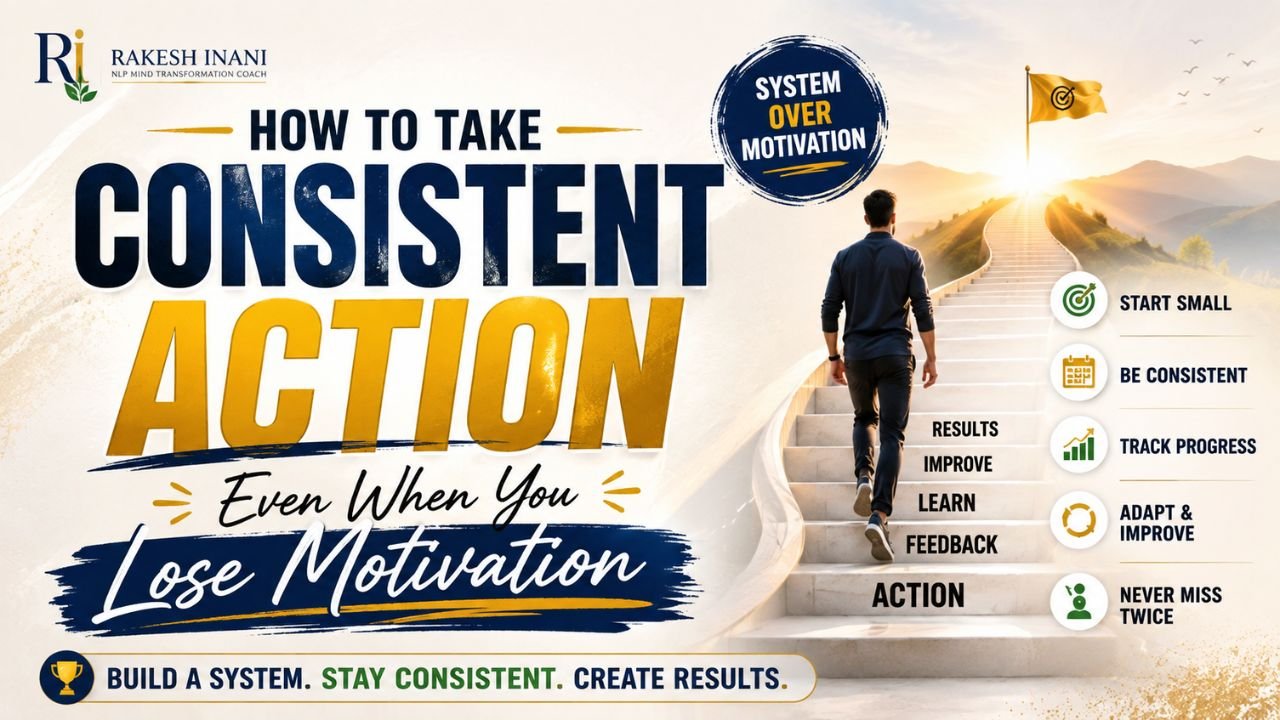
How to Take Consistent Action Even When You Lose Motivation
You know what you need to do.
You may need to exercise, create content, practise speaking, contact potential clients, study, write, or work on your business.
You may even begin with great excitement.
On the first day, you feel powerful.
On the second day, you still feel motivated.
However, after a few days, the excitement becomes weaker. The work starts feeling difficult, ordinary, or boring.
Moreover, the result you expected may not appear quickly.
As a result, you begin missing days.
Soon, one missed day becomes an entire week. Finally, you return to your old routine and wait for another wave of motivation.
This pattern does not always mean that you are lazy.
It may mean that you are depending on motivation instead of building a system for consistent action.
Consistent action means repeating the right behaviour at a realistic level for long enough to create learning, progress, and results.
Consistency is not about being perfect.
It is about returning to the action again and again.
Why Is Taking Action Once Not Enough?
One action can start a journey.
However, most meaningful goals need repeated action.
One workout does not create a healthy body.
One sales conversation does not build a business.
One video does not create a trusted audience.
One speaking practice does not build mastery.
One healthy meal does not completely change your health.
The first action matters because it breaks inaction.
Still, the repeated action creates the deeper change.
Each attempt gives you experience.
Each experience gives you feedback.
Each piece of feedback helps you improve.
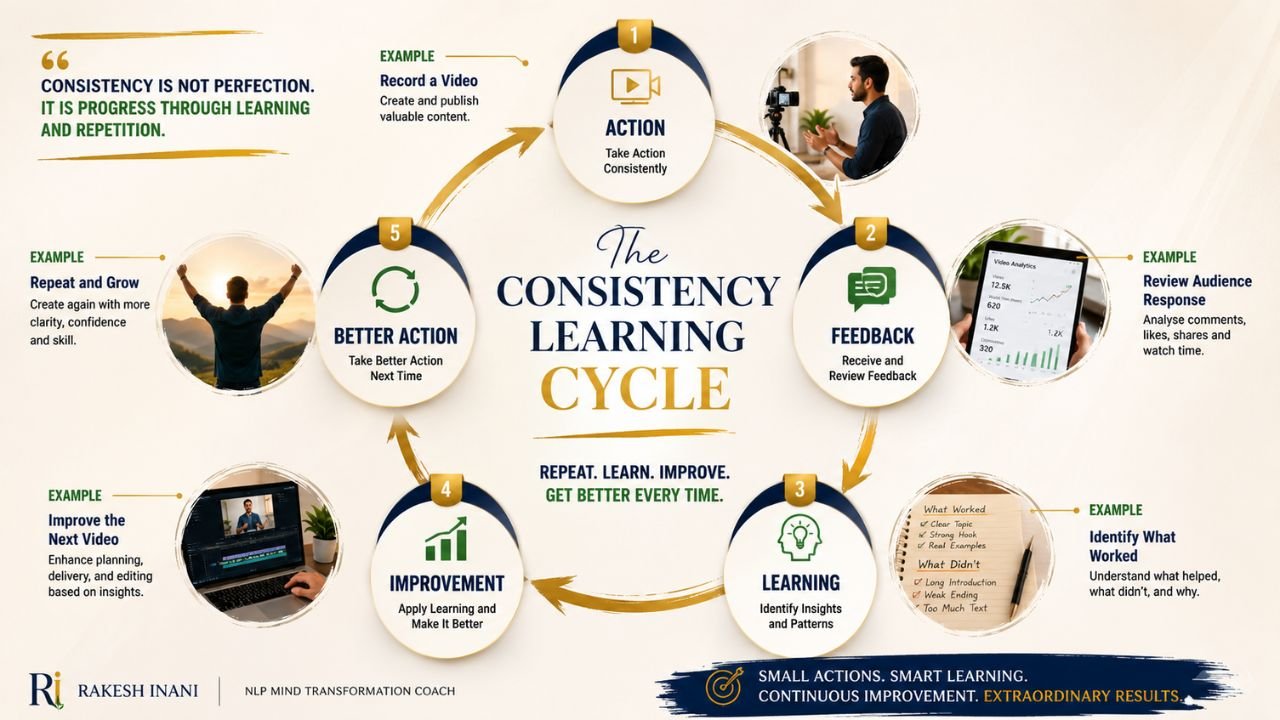
Therefore, consistent action creates a learning cycle:
Action → Feedback → Learning → Improvement → Better Action
Without repetition, you may never collect enough information to understand what works.
You may stop after one attempt and incorrectly decide that the entire goal is impossible.
Action Versus Consistent Action
Action means doing something.
Consistent action means repeating a useful behaviour according to a planned rhythm.
For example:
Action: Record one video.
Consistent action: Publish one useful video every week for three months and review audience feedback.
Action: Call one potential client.
Consistent action: Begin five suitable conversations each working day and improve your communication through weekly review.
Action: Exercise for one hour.
Consistent action: Complete a realistic exercise plan several times each week.
The important word is not only “repeated.”
The action must also be useful.
Repeating a poor strategy without learning is not powerful consistency.
Therefore, consistency needs both commitment and correction.
Why Does Motivation Disappear?
Motivation changes because human energy and emotions change.
You may feel highly motivated when:
- The goal is new
- The reward feels exciting
- You watch an inspiring video
- You attend a live event
- You make a fresh plan
- Someone encourages you
- You imagine your future success
However, the work soon becomes real.
You discover that the goal requires time, practice, uncertainty, repetition, and discomfort.
The reward is still in the future, but the effort is happening now.
Therefore, the emotional energy becomes weaker.
This is normal.
The problem begins when your plan works only on highly motivated days.
A strong system should also help you act on ordinary days.
Why Do People Quit After a Few Days?
People stop for different reasons.
Therefore, you need to understand your own pattern.
The Daily Action Is Too Large
You may create a plan based on your most excited state.
For example:
“I will wake up at 5:00 a.m., exercise for one hour, meditate, read 50 pages, create two videos, contact ten clients, and write 2,000 words every day.”
This plan may feel powerful on paper.
However, it may not fit your real responsibilities, energy, or present ability.
When you cannot maintain it, you may conclude that you lack discipline.
The problem may be the size of the plan.
The Action Is Not Clearly Defined
“Work on my business” is unclear.
Your mind does not know where to begin.
A clearer action would be:
“Write the first draft of my coaching offer from 10:00 to 10:45 a.m.”
The Goal Depends on Mood
You tell yourself:
“I will do it when I feel ready.”
However, readiness may not arrive automatically.
As a result, the action keeps moving to tomorrow.
The Environment Creates Distraction
Your phone is beside you.
Notifications are active.
Your workspace is not prepared.
Therefore, every action requires a fresh fight with the environment.
You Expect Quick Results
You publish three videos and expect a large audience.
You make four calls and expect several clients.
You exercise for one week and expect a complete body transformation.
When the visible result does not appear, you assume the action is useless.
You Miss One Day and Abandon the Plan
One missed action creates guilt.
Then, guilt creates avoidance.
Soon, the entire routine disappears.
The problem is no longer the missed day.
It is the failure to return.
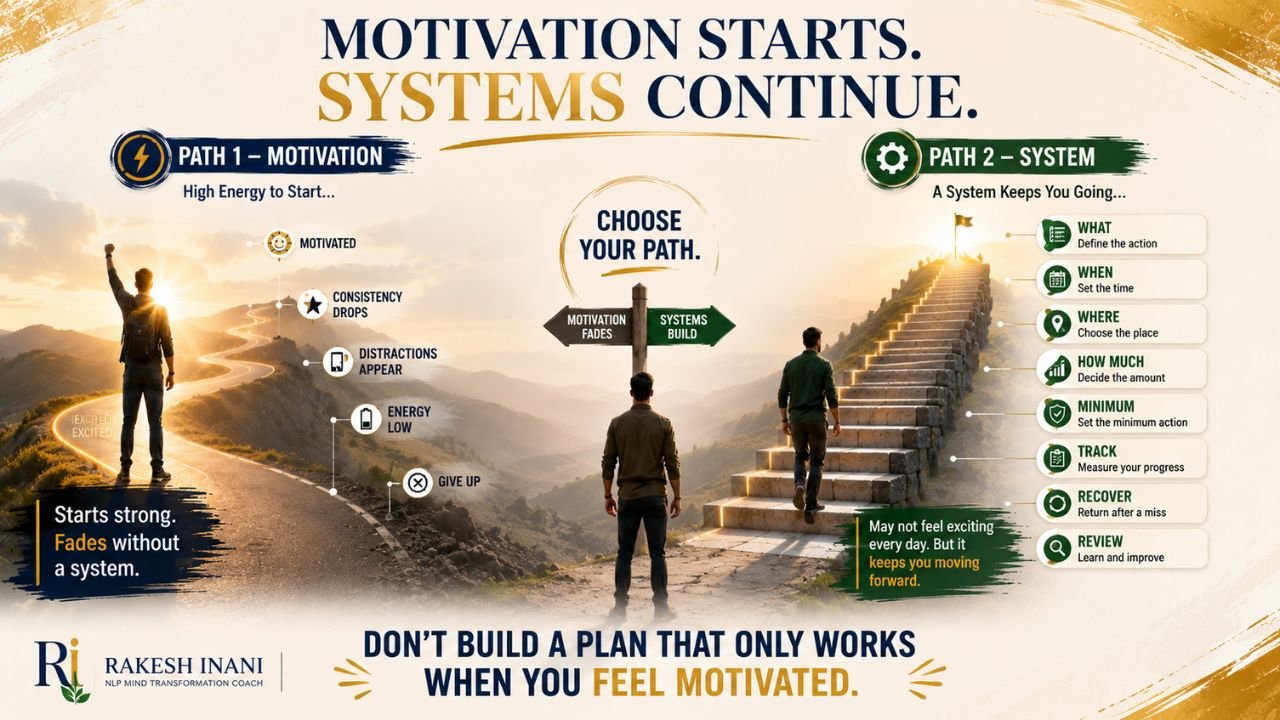
Motivation Starts the Journey, but a System Maintains It
Motivation is useful.
It can create energy and help you begin.
However, a system gives your action a place in daily life.
A simple action system answers:
- What will I do?
- When will I do it?
- Where will I do it?
- How much will I do?
- What is the minimum version?
- How will I track it?
- What will I do after missing a day?
- When will I review the strategy?
When these decisions are made in advance, you do not need to negotiate with yourself every day.
Instead of asking:
“Do I feel like doing this?”
You ask:
“What is today’s version of the action?”
Create a Minimum Daily Action
A minimum daily action is the smallest useful version of a behaviour that you commit to completing even on a difficult day.
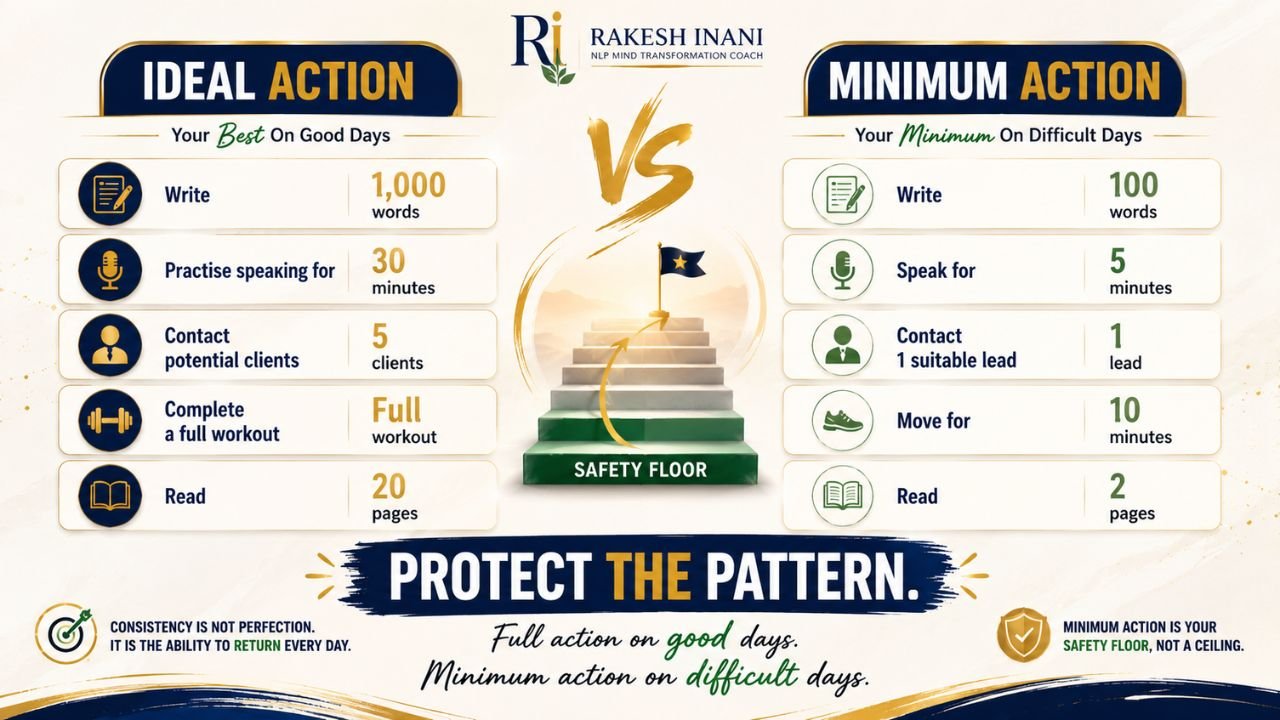
For example:
| Goal | Ideal action | Minimum action |
|---|---|---|
| Write a book | Write 1,000 words | Write 100 words |
| Improve speaking | Practise for 30 minutes | Speak for five minutes |
| Build a business | Contact five leads | Contact one suitable lead |
| Improve fitness | Complete a full workout | Move for ten minutes |
| Read regularly | Read 20 pages | Read two pages |
| Create content | Publish a complete post | Draft one useful idea |
| Meditate | Meditate for 20 minutes | Sit quietly for three minutes |
The minimum action keeps your connection with the goal alive.
It also makes restarting easier.
However, the minimum should not become your permanent ceiling.
Use it as a safety floor.
On good days, complete the full action.
On difficult days, protect the pattern with the minimum version.
Start Small but Repeat Regularly
A small action can feel too simple.
You may think:
“How will five minutes change anything?”
The five minutes may not create the complete result.
However, they can help create several important changes.
First, a small action reduces resistance.
Second, it gives you a clear starting point.
Third, it creates evidence that you can follow through.
Finally, it provides a foundation that can grow.
For example, if you cannot maintain 60 minutes of daily speaking practice, begin with five minutes.
After the routine becomes stable, increase it to ten minutes.
Then, add structure, feedback, and real speaking opportunities.
Do not underestimate an action because it looks small.
A small action repeated is often more useful than a large action repeatedly postponed.
Use a Fixed Time or Trigger
A vague plan creates daily confusion.
“I will write sometime today” leaves the action open.
A clearer plan is:
“After breakfast, I will write for 30 minutes at my desk.”
This connects the behaviour with a time, place, or existing event.
You can use triggers such as:
- After waking up
- After brushing your teeth
- After breakfast
- Before opening email
- After returning from work
- Before dinner
- After putting your child to bed
- At the start of your planned work block
The trigger should fit your real life.
Do not choose a time simply because it sounds disciplined.
Choose a time you can protect.
Prepare the Environment
Consistency becomes easier when your environment supports the action.
Suppose you want to record videos.
If you must arrange the camera, lights, background, microphone, notes, and software every time, beginning may feel difficult.
However, if the basic setup remains ready, the first step becomes easier.
You can prepare by:
- Keeping exercise clothes ready
- Opening the writing document in advance
- Placing the book on your desk
- Charging the recording equipment
- Preparing a list of content topics
- Turning off notifications
- Keeping the phone outside the room
- Scheduling calls in advance
- Removing tempting distractions
Do not expect willpower to solve every problem.
Make the right action easier to begin.
Build a “Start Ritual”
A start ritual is a short sequence that tells your mind it is time to work.
For example:
- Put the phone away.
- Fill a glass of water.
- Open the required file.
- Read the goal for the session.
- Set a timer.
- Begin with the smallest step.
Repeat the same sequence regularly.
Over time, the ritual can reduce the number of decisions needed before action.
Keep it simple.
A start ritual should help you begin, not become another form of delay.
Stop Waiting for the Perfect Mood
You will not always feel confident before speaking.
You will not always feel creative before writing.
You will not always feel energetic before exercising.
You will not always feel courageous before making an important call.
Sometimes the useful emotional state appears after you begin.
Therefore, use this rule:
Do not ask whether you feel ready. Ask whether you can complete the first five minutes.
Once you begin, you may continue.
If you still feel low after the minimum action, you can stop without breaking the pattern.
Focus on the Process Before the Result Appears
Results are often delayed.
You may take useful action today, but the visible effect may appear much later.
For example, one piece of content may not create a client immediately.
However, regular useful content can build:
- Communication skill
- Audience understanding
- Trust
- Visibility
- A content library
- Feedback
- Confidence
Therefore, measure both outcome and process.
Outcome Measures
These show the result.
Examples include:
- Revenue
- Clients
- Weight change
- Views
- Subscribers
- Projects completed
- Leads generated
Process Measures
These show what you did.
Examples include:
- Sales conversations
- Exercise sessions
- Videos published
- Words written
- Practice minutes
- Follow-ups completed
- Focus blocks finished
Outcome measures tell you whether the strategy is producing results.
Process measures tell you whether you are executing the strategy.
You need both.
Track Progress Without Becoming Obsessed
Tracking makes behaviour visible.
However, tracking should support action rather than create pressure.
Use a simple method:
- A calendar
- A checklist
- A notebook
- A habit tracker
- A spreadsheet
- A weekly scorecard
Record whether the planned action was completed.
You may also track the amount, quality, or result where useful.
For example:
| Date | Planned action | Completed? | Result or learning |
|---|---|---|---|
| Monday | Contact 3 leads | Yes | One call booked |
| Tuesday | Contact 3 leads | No | Time not scheduled |
| Wednesday | Contact 3 leads | Yes | Message needs improvement |
The final column is important.
It helps you learn instead of only counting.
Consistency Is Not Perfection
Perfection says:
“I must complete the full action every day without failure.”
Consistency says:
“I will follow the plan as regularly as possible and return quickly after disruption.”
Life includes:
- Illness
- Travel
- Family needs
- Unexpected work
- Low-energy days
- Emergencies
- Changing responsibilities
A useful routine must be flexible enough to survive real life.
Therefore, do not destroy a good system because one day went badly.
A missed day is an event.
It does not need to become a new identity.
What to Do After Missing a Day
Use this recovery process.
Step 1: Remove the Drama
Do not say:
“I have ruined everything.”
Say:
“I missed one planned action.”
Keep the event specific.
Step 2: Find the Cause
Ask:
- Was the task too large?
- Did I forget?
- Was the time unsuitable?
- Did an emergency appear?
- Was I avoiding discomfort?
- Was the environment distracting?
- Did I lack energy?
Step 3: Adjust if Necessary
If the same problem keeps returning, improve the system.
Perhaps you need a smaller action, different time, reminder, or prepared environment.
Step 4: Complete the Minimum Version
Return as soon as reasonably possible.
Do not wait for next Monday or next month.
Step 5: Protect Against a Second Miss
A useful rule is:
Avoid missing twice in a row whenever reasonably possible.
This is not a punishment.
It is a recovery strategy.
Build a Recovery Plan Before You Need It
Write your recovery plan in advance.
For example:
“If I miss my morning writing session, I will complete the minimum 100 words before dinner.”
“If I cannot complete my full workout, I will walk or move for ten minutes.”
“If I miss one content day, I will publish the prepared backup post.”
“If travel interrupts my routine, I will use the portable minimum version.”
A recovery plan reduces guilt and confusion.
You already know how to return.
Use Accountability Wisely
Accountability can support consistency.
You may share your commitment with:
- A coach
- A mentor
- A friend
- A colleague
- A study partner
- A small group
However, accountability should not make another person responsible for your entire goal.
The purpose is to create visibility, reflection, and support.
A useful accountability check-in may include:
- What did I plan?
- What did I complete?
- What stopped me?
- What did I learn?
- What will I do next?
Avoid accountability systems based only on shame or punishment.
You want to build responsibility, not fear.
Review Your Strategy, Not Only Your Discipline
Sometimes you are consistent, but the strategy is weak.
For example, you may publish content regularly, but the topics do not match your audience’s problems.
You may contact people daily, but your message is confusing.
You may study for hours, but your learning method does not include recall or practice.
Therefore, a lack of results does not always mean that you need more discipline.
You may need a better method.
Use a weekly review.
Ask:
- Did I complete the planned action?
- What result did it produce?
- What feedback did I receive?
- What worked?
- What failed?
- Which skill needs improvement?
- What one change will I test next week?
Do not change everything at once.
Improve one important part and continue collecting evidence.
How Long Should You Continue Before Changing the Plan?
There is no single answer for every goal.
The right period depends on:
- The type of goal
- The quality of the action
- The number of attempts
- The feedback available
- Your present skill
- External conditions
- The cost and risk
For example, two sales conversations may not be enough to judge an entire offer.
Similarly, three videos may not be enough to judge a complete content strategy.
However, continuing the same ineffective method for years without review is not wise consistency.
Therefore, define a review window.
For example:
“I will follow this content plan for eight weeks and review topics, audience response, retention, enquiries, and my execution every two weeks.”
This gives the plan time while keeping you responsive to evidence.
Consistency and Identity
Your repeated actions influence the way you see yourself.
Every time you practise speaking, you are strengthening the identity of a speaker.
Every time you write, you are acting like a writer.
Every time you complete an important commitment, you build evidence that you can rely on yourself.
However, do not use identity as a rigid label.
You may have an inconsistent week and still return to your practice.
A useful identity statement is:
“I am becoming a person who returns to important actions.”
This statement allows growth.
It also recognizes that consistency is built through practice.
Common Consistency Mistakes
Starting with Maximum Intensity
A plan created during emotional excitement may be difficult to maintain.
Start with a sustainable level.
Tracking Too Many Habits
Trying to change ten behaviours at once divides your attention.
Choose one or two important behaviours first.
Depending on Memory
Use a fixed schedule, trigger, calendar, or reminder.
Making the Routine Too Complex
If the routine needs many steps, it becomes easier to avoid.
Simplify the beginning.
Punishing Yourself After a Miss
Shame can create more avoidance.
Review honestly and return quickly.
Measuring Only Outcomes
Track the actions under your control as well as the final results.
Refusing to Improve the Strategy
Consistency should include learning.
Do not continue an ineffective method without review.
The 30-Day Consistent Action System
Step 1: Choose One Goal
My 30-day goal is __________________________.
Step 2: Choose One Lead Action
A lead action is a behaviour likely to move the goal forward.
My lead action is __________________________.
Step 3: Decide the Frequency
I will complete it every __________________________.
Choose a realistic rhythm.
Step 4: Choose the Time and Place
I will do it at __________________ in __________________.
Step 5: Define the Ideal Version
On a normal day, I will complete __________________________.
Step 6: Define the Minimum Version
On a difficult day, I will complete at least __________________________.
Step 7: Prepare the Environment
Before the action, I will prepare __________________________.
Step 8: Choose a Tracker
I will record progress using __________________________.
Step 9: Create a Recovery Rule
If I miss the action, I will __________________________.
Step 10: Set a Weekly Review
I will review progress every __________________________.
The Consistency Contract
Complete and sign this statement:
For the next 30 days, I will work toward __________________________.
The repeated action that supports this goal is __________________________.
I will complete it at __________________________.
My ideal version is __________________________.
My minimum version is __________________________.
I will track it through __________________________.
If I miss one session, I will return by __________________________.
I will review my strategy every __________________________.
I understand that consistency does not require perfection. It requires honest effort, learning, and a quick return after disruption.
Name: __________________________
Date: __________________________
Frequently Asked Questions About Consistent Action
How Can I Become More Consistent?
Choose one clear behaviour, make it realistic, connect it with a fixed trigger, prepare the environment, track completion, and create a recovery rule.
Why Do I Lose Motivation After a Few Days?
The excitement of a new goal naturally changes when the work becomes difficult or repetitive.
A system helps you continue when motivation becomes low.
Is Discipline More Important Than Motivation?
Motivation can help you start.
Discipline and supportive systems help you act when motivation changes. However, the plan must also be realistic and connected with recovery.
How Can I Take Action Every Day?
Define a small minimum action, choose a clear time, reduce distractions, and track completion.
However, not every goal requires daily action. Choose a rhythm that fits the task and allows healthy rest.
What Should I Do If I Break My Routine?
Do not wait for a perfect restart date.
Find the cause, adjust the plan if needed, and return with the minimum version as soon as reasonably possible.
How Long Does It Take to Become Consistent?
There is no universal number of days.
Consistency develops through repeated practice, supportive conditions, and recovery after interruptions. Focus on strengthening the system instead of chasing a fixed timeline.
How Do I Know Whether My Action Is Working?
Track both execution and results.
Review feedback regularly. If you are consistent but not progressing, improve the strategy, skill, message, or process.
Can Rest Be Part of Consistency?
Yes.
A sustainable system includes suitable rest and recovery. Consistency means following the planned rhythm, not forcing maximum effort every day.
Final Thoughts: The Person Who Returns Keeps Growing
Many people can begin.
They begin when the goal feels exciting.
They begin when motivation is high.
They begin when the calendar shows a fresh Monday or a new month.
However, lasting progress belongs to the person who learns how to continue.
More importantly, it belongs to the person who learns how to return.
You will have difficult days.
You may miss a planned action.
You may discover that your strategy needs improvement.
None of these events must end the journey.
Reduce the action when necessary.
Improve the system when evidence requires it.
Rest when your body genuinely needs recovery.
Then, return.
Remember:
Consistency is not doing everything perfectly. It is continuing to take useful action, learn from feedback, and come back after interruption.
Choose one goal.
Define one repeated action.
Create a minimum version.
Protect a time and place.
Track what you complete.
Review what you learn.
Then, allow small actions to build on each other.
Success rarely comes from one extraordinary day.
More often, it grows from many ordinary days in which you complete the next useful action.
JOIN MIND TRANSFORMATION COMMUNITY
Learn More:
7 Day Manifestation- NLP Guided Meditation for Success
Why Some People Succeed While Others Stay Stuck: The 6-Step Success Process