How Memory Works: Understand Your Brain to Remember More
You meet someone at a business event. They smile, shake your hand, and tell you their name. Just thirty seconds later, the name is gone.
You open a new browser tab. Then you stop and wonder, “What did I come here to search for?”
You read three pages of a useful book. However, when you close it, you cannot explain the main idea.
At such moments, you may quickly say, “My memory is weak.”
But is that really true?
In many cases, the problem is not that your brain failed to keep a memory. Instead, the information may never have received enough attention to become a clear memory in the first place.
At other times, the information was stored, but you did not have the right cue to bring it back.
Therefore, if you want to know how to sharpen your memory, your first step is not to collect ten clever memory tricks. Your first step is to understand what memory actually does.
Here is the short answer.
Memory is a group of mental processes that helps you take in information, keep it over time, and use it later.
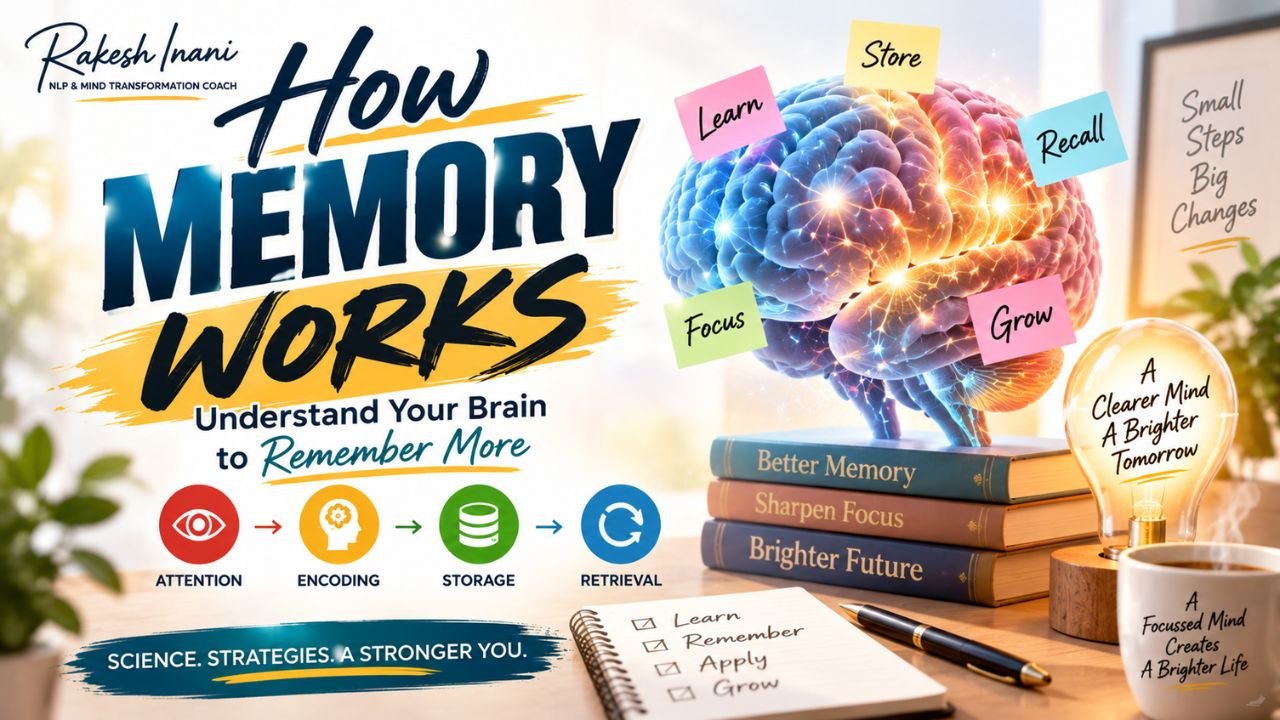
These three broad functions are called encoding, storage, and retrieval. Attention, meaning, emotion, context, practice, and useful cues can all shape how well this process works.
That simple answer changes the whole conversation.
Memory is not a single box that is either strong or weak. It is a living process. Different parts of that process can work well or poorly at different times.
For example, you may remember faces very well but struggle with names.
You may remember stories but forget numbers.
You may understand a lesson today but fail to recall it during a stressful presentation tomorrow.
So, rather than asking only, “Is my memory good or bad?” ask a better question:
“At which stage is my memory process breaking down?”
That is what we will discover in this guide.
Why Do You Forget Things So Easily?
You forget because your mind cannot preserve every sight, sound, thought, message, and detail that reaches you.
Forgetting is not always proof of failure. Often, it is part of how the mind manages a huge amount of information.
Think about everything around you right now.
Perhaps you can hear a fan, traffic, a voice, or the soft sound of a computer.
You can see colours, shapes, light, shadows, and objects.
You may also feel the chair under you, the temperature of the room, and the position of your feet.
However, before I named these things, you may not have been thinking about most of them.
Your senses received the information. Yet your attention selected only a small part of it.
This selection is useful. Otherwise, your conscious mind would be flooded by every small detail.
The problem begins when something important is treated like background noise.
Suppose your colleague says, “The client call has moved from 3:00 p.m. to 4:30 p.m.”
At the same time, you are reading a WhatsApp message, thinking about an unpaid bill, and opening a spreadsheet.
Later, you join the call at 3:00 p.m. and say, “I completely forgot.”
However, the message may never have been clearly encoded. Your ears heard it, but your attention did not fully receive it.
Therefore, the phrase “I forgot” can hide several different problems.
You may not have noticed the information.
You may have noticed it but not understood it.
You may have understood it but not connected it to anything meaningful.
You may have stored it but lacked the right cue to recall it.
Or, you may have been tired, worried, overloaded, or distracted when you needed to use it.
Each problem needs a different response.
If attention is weak, repeating the information more loudly may not help.
If understanding is weak, a flashcard may only help you repeat words without meaning.
If retrieval is weak, rereading the answer may create familiarity but not the ability to recall it independently.
So, before you judge your memory, slow down and examine the moment.
Is It Really a Memory Problem?
Not every forgetting experience begins with memory.
Sometimes it begins with attention.
Sometimes it begins with confusion.
Sometimes it begins with overload.
Let us separate these possibilities.
You Did Not Pay Full Attention
Imagine that you place your car keys on a table while speaking on the phone.
Your hand completes the action, but your mind stays inside the conversation.
Later, you search the entire house.
This may feel like a memory problem. However, you never created a clear mental record of placing the keys there. The action happened on autopilot.
Similarly, a person may introduce himself while you are preparing your own reply.
Because you are focused on what you will say next, his name does not receive enough attention.
The practical lesson is simple:
If an action matters later, be present while it happens now.
You Did Not Understand the Information
You can read a paragraph three times and still fail to remember it.
Why?
Because the words passed through your eyes, but the meaning never became clear.
This is common when the material uses new terms, long sentences, or ideas that have no link to your existing knowledge.
For instance, you may memorise the definition of “encoding” word for word.
Yet if you cannot explain it in your own language, your learning remains shallow.
Understanding gives information structure. It tells your mind what the information means, why it matters, and where it belongs.
Therefore, when you forget what you read, do not only ask, “How many times did I read it?”
Also ask, “Could I explain it simply without looking?”
The Information Was Not Stored Strongly
Some information matters for only a few seconds.
You look at a one-time password, type it, and let it go. That is normal.
However, if you need information next week, one quick exposure may not be enough.
The idea usually needs stronger encoding, useful connections, active recall, and review over time.
For example, hearing a new employee’s name once in a crowded room creates a fragile memory.
Repeating the name, linking it to the person’s role, and using it naturally in conversation creates more routes back to it.
Storage is not like pressing a perfect “save” button.
Memories can become stronger, weaker, updated, or mixed with later information.
The Information Is Stored, but You Cannot Recall It
Have you ever struggled to remember a name and then suddenly recalled it later while taking a shower or walking?
That experience suggests that the information was not completely gone.
You had a temporary retrieval problem.
The familiar “tip-of-the-tongue” feeling is a good example.
You know that you know the word. You may remember its first letter or rhythm. However, the full answer does not arrive.
Then someone gives you one clue, and the memory returns.
In such cases, a cue can make the difference.
The cue may be a place, a face, a smell, a category, a question, or the beginning of a story.
Your Working Memory Is Overloaded
Working memory is the small mental workspace you use right now.
You use it to hold a phone number for a few seconds, follow a set of directions, compare two options, or understand the end of a sentence in light of its beginning.
Because this workspace is limited, too many open tasks can crowd it.
Suppose you are trying to calculate a price, listen to a customer, remember three errands, and respond to phone notifications.
Even if each task is simple, the total load can become heavy.
As a result, information slips away before you use it.
This is one reason mental overload can feel like poor memory.
The system may not be broken. It may simply be carrying too much at once.
Your State Is Affecting Your Performance
Memory does not work in a vacuum.
Sleep, stress, mood, pain, illness, medicines, and other conditions can affect attention and recall.
For example, if you are deeply worried before a meeting, your attention may stay locked on the fear of making a mistake.
Then you miss part of the discussion.
Later, you may believe your memory failed, even though worry took up the space needed for listening.
This does not mean every memory concern is “just stress.” It means context matters.
In addition, new, sudden, worsening, or daily-life-disrupting memory changes deserve medical attention.
The U.S. National Institute on Aging explains that memory problems can have many causes, including medical conditions and medication effects.
Therefore, a blog post or self-help exercise should never replace a proper assessment when memory changes are concerning.
What Is Memory?
Memory is the set of processes that allows you to encode information, retain it, and retrieve it later.
In easier words, memory helps you:
- Take information in.
- Keep some part of it.
- Bring it back when you need it.
This description is simple, but it is important.
It shows that memory is not only about the past.
Memory also helps you function in the present and prepare for the future.
You use memory when you follow a recipe, remember a promise, learn a skill, recognise a friend, avoid a past mistake, speak without reading every word, or decide what to do next.
The American Psychological Association describes memory in terms of retaining information or a representation of past experience through processes that include learning or encoding, retention, retrieval, and recognition.
Similarly, the open-access OpenStax Psychology text presents memory as processes used to encode, store, and retrieve information across time.
These definitions point to one key idea:
Remembering is an activity, not merely a possession.
Memory Is a Process, Not a Storage Box
People often speak about memory as though the brain contains one large cupboard.
In that picture, experiences are files.
Learning puts a file into the cupboard.
Remembering opens the cupboard and takes out the exact same file.
This picture is useful at a basic level. However, it can also mislead you.
Human memory is not a perfect video recording.
You do not always store every detail exactly as it happened.
When you remember, your mind can rebuild an experience using stored pieces, meaning, expectations, emotions, and present cues.
That is why two people can attend the same meeting and later remember different details.
Each person noticed different things.
Each connected the event with different past knowledge.
Each may also rebuild the event from a different point of view.
Therefore, confidence is not always proof of perfect accuracy.
A memory can feel clear and still contain errors.
This fact is not a reason to distrust every memory. Instead, it is a reason to use good systems when accuracy matters.
For example, write down key decisions after a meeting.
Repeat an appointment time.
Confirm important instructions.
Use a checklist for safety-critical work.
These tools support memory; they do not insult it.
Moreover, memory is influenced by meaning.
Imagine that I give you this sequence:
1, 9, 4, 7.
You can repeat it as four separate digits.
However, if 1947 connects with Indian independence in your knowledge, the sequence becomes one meaningful unit.
The digits did not change.
Your relationship with them changed.
Likewise, a random name becomes easier to remember when you connect it to a role, a conversation, or a clear image.
A lesson becomes easier to recall when you apply it to your work.
A speech becomes easier when you remember its route of ideas instead of every sentence.
So, memory grows through more than repetition.
It grows through attention, meaning, connection, organisation, practice, and retrieval.
Memory Is Not Located in One Tiny “Memory Spot”
You may also imagine that one small place in the brain stores every kind of memory.
In reality, memory depends on networks and multiple brain systems.
Different brain areas contribute to different memory tasks.
For example, the hippocampus has an important role in forming certain new declarative and episodic memories.
The amygdala helps process emotional importance, especially in emotionally arousing situations.
The cerebellum and other systems contribute to learned skills and habits.
The OpenStax overview of brain areas involved in memory offers a useful beginner-friendly introduction to these roles.
However, you do not need to memorise brain anatomy to improve daily learning.
The practical point is enough:
Memory is not one muscle, one switch, or one box. It is a set of connected functions.
The Three Basic Stages of Memory
The easiest way to understand how human memory works is to begin with three broad stages:
- Encoding
- Storage
- Retrieval
These stages are not always perfectly separate in real life.
They can affect one another, and modern memory models are more detailed than a simple three-step line.
Still, this framework is extremely useful.
It helps you find the weak link in a real situation.
Let us look at each stage.
Stage 1: Encoding
Encoding is the process of taking in information and changing it into a form your memory system can work with.
In simple words, encoding is how an experience begins to become a memory.
Suppose you are introduced to a woman named Kavita at a professional event.
The sound “Kavita” reaches your ears.
However, sound alone does not guarantee memory.
If you are distracted, you may barely notice it.
If you pay attention, repeat the name, connect it with her face, and learn that Kavita is a content writer, the information gains structure.
Now you have several links:
- The sound of the name.
- The visual details of the face.
- The meaning of her role.
- The place where you met.
- The topic you discussed.
Those links improve the quality of encoding.
Encoding can happen with little deliberate effort.
For instance, you may remember where you sat at breakfast without trying to learn it.
However, complex learning often needs effort.
A new technical idea, speech structure, client process, or language word usually demands active attention.
The quality of encoding depends partly on what you do with the information.
Do you only look at it?
Do you think about its meaning?
Do you connect it to something you know?
Do you form a picture?
Do you ask where you can use it?
Do you explain it in your own words?
These actions make the information more mentally useful.
Consider two people reading the same paragraph about confidence.
The first person highlights five sentences and moves on.
The second person pauses and says:
“The main idea is that confidence often grows after action, not before it. This connects with the time I became comfortable on camera only after recording daily.”
The second person has created meaning and personal relevance.
As a result, the idea has more retrieval routes later.
Therefore, if you ask, “Why do I forget information after reading?” inspect your encoding.
Perhaps you saw the words, but you did not work with the idea.
A Quick Encoding Test
After reading one page, close the book and answer these questions:
- What was the main idea?
- Why does it matter?
- What example can I give?
- How does it connect with something I already know?
- Where can I apply it?
If you cannot answer, do not shame yourself.
Simply return to the material and encode it more deeply.
Stage 2: Storage
Storage means retaining encoded information over time.
That time may be very short, such as holding a number long enough to type it.
Or it may be very long, such as remembering the layout of your childhood home decades later.
However, storage is not a single shelf.
Different information can be held in different ways and for different periods.
Some information fades quickly.
Some becomes more stable through meaning, rehearsal, sleep, use, and repeated retrieval.
Some remains available but becomes difficult to access without the right cue.
Let us use a simple business example.
A client tells you three important facts during a call:
- Her main challenge is overthinking at work.
- She has a presentation on Friday.
- She wants one simple action plan.
If you are fully present, you encode these facts.
Then, if you summarise them in your own words and note three keywords, you support retention.
Later, when you see the client’s name or your notes, those cues help reactivate the information.
By contrast, if you listen while checking email and immediately take another call, the memory may remain fragile.
Storage is also affected by interference.
For instance, if you meet six people in quick order, the names can compete.
The newer names may disturb recall of the earlier names.
Similarly, the earlier names may keep coming to mind when you try to remember the newer ones.
Therefore, stronger storage is not only about more input.
Sometimes it requires space, organisation, and later review.
Storage Does Not Mean Permanent and Perfect
People often assume that once something enters long-term memory, it stays unchanged forever.
That is too simple.
Some long-term memories remain strong.
Others weaken.
Some become easier to recall through practice.
Others change as new experiences are added.
Moreover, remembering can itself update a memory.
When you bring an event back to mind, you may combine it with later knowledge or present emotion.
So, do not think of storage as a locked bank vault.
Think of it as a changing network of information and connections.
Stage 3: Retrieval
Retrieval is the process of bringing stored information back so you can use it.
Retrieval is what you need during an exam, client call, speech, conversation, or decision.
You may know something, yet struggle to access it at the right time.
For example, you can recognise an actor when you see a list of names, but you cannot recall the name without the list.
Recognition gives you a cue.
Free recall gives you fewer cues.
That difference matters.
Rereading a page can create the feeling, “Yes, I know this.”
But that feeling may be recognition, not independent recall.
If you must explain the concept tomorrow without the page, you need retrieval practice today.
Close the book.
Ask yourself a question.
Try to answer.
Then check the source.
Even an imperfect attempt teaches you what is available and what needs strengthening.
Retrieval Depends on Cues
A cue is anything that helps lead you back to stored information.
A cue can be:
- A question.
- A keyword.
- A picture.
- A location.
- A person’s face.
- A smell.
- A first letter.
- A category.
- A physical action.
- An emotion or situation.
Suppose you cannot remember the points of a presentation.
If you tried to memorise every sentence, one forgotten line may make the whole sequence collapse.
However, if you organised the talk around five clear keywords—problem, cost, story, method, action—each keyword becomes a retrieval cue.
Now you do not need to reproduce a script.
You only need to follow the route.
Retrieval Can Fail Under Pressure
You may notice that you remember an answer after the exam or after the meeting ends.
Pressure can narrow attention.
Fearful self-talk can take up working-memory space.
As a result, access becomes harder.
This does not prove that the information was never learned.
It shows that performance depends on both knowledge and state.
Therefore, good preparation includes more than reading.
It includes practising recall in conditions similar to the real task.
If you need to speak, practise speaking.
If you need to write, practise writing.
If you need to answer questions, practise answering questions.
This makes retrieval more specific and useful.
Different Types of Memory
“Memory” is one word, but it covers several systems and functions.
This is why saying “I have a bad memory” is often too broad.
You may have strong memory for skills but weak memory for names.
You may remember emotional events but forget routine details.
You may know a fact in long-term memory but struggle to hold several instructions in working memory.
Researchers use more than one model to describe these differences.
The categories below offer a practical beginner-friendly map.
They are helpful, but they should not be treated as perfectly separate boxes.
Sensory Memory
Sensory memory briefly holds traces of what you see, hear, touch, smell, and taste.
It lasts for a very short time.
Much of it disappears unless your attention selects it for further processing.
Imagine moving a sparkler in the dark.
You may see a brief trail even though the point of light is moving.
Or imagine asking someone a question, hearing them say something, and replying, “What?”
Then, before they repeat it, the words suddenly become clear in your mind.
These examples show how sensory information can remain available for a moment.
Sensory memory is useful because the world does not arrive as perfectly separated snapshots.
Your system needs a brief hold so that sights and sounds feel continuous.
However, sensory memory is not the same as deliberate learning.
You can look at a slide full of words without creating a lasting memory.
You can hear a person’s name without retaining it.
The information entered through the senses, but it did not receive enough attention and meaning.
The practical takeaway is simple:
Seeing is not the same as encoding, and hearing is not the same as learning.
Working Memory
Working memory is the limited mental workspace that keeps information available while you use or change it.
You use working memory when you:
- Calculate a total in your head.
- Follow spoken directions.
- Compare two plans.
- Hold the start of a sentence while understanding the end.
- Prepare a reply during a conversation.
- Reorder a short list.
Think of working memory as a small desk.
You can place a few important items on the desk and work with them.
However, if you throw ten files, three phones, two cups, and a pile of papers onto it, useful work becomes harder.
In the same way, working memory has a limited capacity.
Research reviews describe it as holding a small amount of information in a readily accessible form and supporting activities such as comprehension, reasoning, planning, and learning.
For a detailed scientific overview, see Nelson Cowan’s review on working memory and learning.
The exact capacity is not one magical number for every person and task.
It changes with the kind of material, prior knowledge, attention, and the way information is grouped.
For instance, the letters N, L, and P may feel like three separate items to a beginner.
To someone familiar with Neuro-Linguistic Programming, “NLP” becomes one meaningful chunk.
Knowledge helps you organise information more efficiently.
Working Memory in Daily Life
Suppose your manager says:
“Please send the revised proposal to Meera, copy Arun, change the price on page four, and ask for confirmation by Tuesday.”
If you immediately receive another message, someone walks into your office, and your phone rings, part of the instruction may fall away.
This does not mean you lack intelligence.
It means your mental desk became crowded.
A simple response is to repeat the key points aloud or write four keywords:
Meera, Arun, price, Tuesday.
External notes protect working memory so that it can do the thinking instead of carrying every detail.
Short-Term Memory
Short-term memory refers to the brief holding of a limited amount of information.
For example, you may hold a six-digit code long enough to enter it.
If you do not repeat or use the code, it may disappear quickly.
People sometimes use “short-term memory” and “working memory” as if they mean exactly the same thing.
However, many modern explanations make a useful distinction.
Short-term memory mainly refers to temporary holding.
Working memory includes temporary holding plus active mental work, such as updating, comparing, arranging, or calculating.
Imagine a kitchen.
Short-term memory is like keeping ingredients on the counter for a moment.
Working memory is like using those ingredients to prepare a dish.
The two functions are closely related, but the second includes active processing.
Nelson Cowan’s research review, What Are the Differences Between Long-Term, Short-Term, and Working Memory?, explains why these terms should be separated carefully rather than treated as simple synonyms.
Long-Term Memory
Long-term memory refers to information retained over longer periods—from hours and days to years.
It includes many kinds of knowledge and experience.
For example, long-term memory helps you remember:
- The meaning of common words.
- Events from your life.
- Facts you learned.
- People you know.
- Skills you practised.
- Places you visited.
- Rules and routines.
Long-term memory does not mean that every detail is always easy to recall.
Information can be present but difficult to access.
It can also become weaker, compete with similar information, or change over time.
Moreover, different long-term memories have different forms.
You may consciously remember your first day at a job.
That is different from automatically knowing how to tie your shoelaces.
You may know that New Delhi is India’s capital.
That fact is different from remembering your personal visit to India Gate.
So, long-term memory is not one single type.
It includes facts, personal events, skills, habits, and more.
Explicit and Implicit Long-Term Memory
Explicit memory involves information you can consciously bring to mind and often describe in words.
It includes semantic memory, such as facts and concepts.
It also includes episodic memory, such as personal experiences tied to a time and place.
Implicit memory influences behaviour without always requiring conscious recall.
Learned skills and habits are common examples.
You do not need to explain every small movement when you ride a bicycle. Practice has shaped the action.
This difference explains a familiar experience:
You may know how to do something but struggle to explain every step.
Procedural Memory
Procedural memory is long-term memory for learned actions and skills.
It helps you type, cook a familiar meal, use a tool, drive on a known road, perform a yoga posture, or play a musical pattern.
At first, a new skill can demand intense attention.
Think about learning to drive.
You consciously check the mirror, gear, clutch, brake, road, and traffic.
Every action feels separate.
With guided practice, many steps become smoother and more automatic.
That change frees attention for the wider situation.
Procedural learning shows why practice must match the desired performance.
You cannot become a confident speaker only by reading about speaking.
You must practise speaking.
You cannot build coaching skill only by memorising models.
You must listen, ask, observe, respond, and reflect.
Knowledge can guide practice.
However, repeated performance builds the procedure.
Emotional Memory
People often use “emotional memory” to describe memories shaped by strong feelings or the learned emotional responses connected with past experiences.
This phrase is useful in everyday language.
However, emotional memory is not one single, neat memory box.
Emotion can influence attention, encoding, consolidation, and retrieval across different kinds of memory.
For example, you may remember a proud achievement, painful criticism, or joyful family celebration with unusual clarity because it carried strong personal meaning.
At the same time, strong emotion does not guarantee perfect detail.
An emotional memory can feel vivid without being a complete or exact recording.
The amygdala plays an important part in processing emotional significance.
Meanwhile, other brain systems help form and retrieve the wider event.
Therefore, it is safer to say that emotion shapes memory than to say that every emotional event is stored perfectly.
Why Emotion Can Help or Disturb Recall
Moderate interest and personal meaning can make information stand out.
However, extreme pressure can also narrow your attention.
You may remember the embarrassing moment in a presentation yet forget what the audience said afterward.
Similarly, fear of forgetting can become a distraction itself.
You stand up to speak and think:
“What if my mind goes blank?”
“What if I forget?”
“What will people think?”
Now part of your working memory is busy monitoring danger instead of following your ideas.
Therefore, emotional regulation is not separate from memory performance.
A calmer state can help you direct attention and use what you know.
Still, if distressing memories, trauma symptoms, panic, or serious anxiety are affecting daily life, seek support from a qualified mental health professional.
General memory coaching is not a replacement for mental health treatment.
Why Attention Comes Before Memory
If your mind does not notice something clearly, it cannot remember it clearly.
This is one of the most useful principles in memory training.
Before information can become a useful memory, it must win some share of your attention.
Yet modern life keeps dividing that attention.
You read an article while notifications appear.
You watch a lesson while checking comments.
You speak with your daughter while planning tomorrow’s work.
You attend a meeting while replying to an email.
Later, you say, “I heard it, but I do not remember it.”
The missing bridge was attention.
Research does not treat attention and memory as the same thing.
However, the two are closely connected.
A scientific review on working memory and attention notes broad agreement that working memory is closely related to attention, even though researchers use different models to explain the exact relationship.
For daily life, you do not need to settle every academic debate.
You only need to see the practical pattern:
What receives weak attention usually creates a weak memory.
Attention Is the Entry Gate
Imagine that your memory system is a conference hall.
Many people are waiting outside.
However, the door is narrow.
Attention acts like the person at the door, deciding what enters.
If an important guest never enters the hall, you cannot later complain that the guest was not seated inside.
Likewise, if you never truly attend to a name, number, instruction, or idea, you cannot expect a rich memory of it later.
This is why “pay attention” is more than a teacher’s old instruction.
It is a core part of encoding.
However, attention does not mean staring harder.
It means directing your mental resources toward one useful target.
Divided Attention Creates Thin Learning
Many people believe they can learn while doing several mentally demanding tasks.
For simple, well-practised actions, some overlap may be possible.
You can walk on a safe path while having a conversation.
You can fold clothes while listening to familiar music.
However, two demanding tasks compete for limited resources.
Reading a new report and answering messages both need language processing.
Listening carefully to a client and writing an unrelated email both need active thought.
Switching between them creates breaks in the learning process.
As a result, you may complete both tasks with less depth.
Then the problem appears later.
You cannot recall the report, and you miss an important detail from the client.
So, multitasking does not train a magical, unlimited memory.
Often, it trains frequent switching.
The Name-Remembering Example
When someone tells you their name, what do you normally do?
You may be thinking about your own introduction.
You may be looking around the room.
You may be judging whether your handshake felt right.
The name arrives at the exact moment your attention leaves.
Try a different process.
First, look at the person with natural attention.
Next, listen to the name as a separate piece of information.
Then repeat it respectfully:
“Nice to meet you, Sandeep.”
After that, connect the name with one meaningful fact:
“Sandeep works in logistics.”
Finally, use it once more before the conversation ends.
This process works because you improved attention and encoding.
You did not suddenly change your genes.
The Reading Example
Suppose you want to remember a chapter.
You can read for twenty minutes while your phone lies face-up beside you.
Every notification pulls your mind away for a second.
Even if you do not open the message, part of your attention wonders who sent it.
Or, you can place the phone away, choose one question, and read to find the answer.
The question gives your attention a target.
For example:
“What are the three main causes of this problem?”
Now your mind is not only moving across words.
It is searching, selecting, and organising.
After two pages, stop and explain the answer without looking.
This short process creates much deeper learning than passive reading for the same amount of time.
The Conversation Example
Memory problems can also damage relationships.
Your spouse says something important.
You nod while looking at your phone.
Later, you forget the request.
The other person may feel, “You do not care.”
You may reply, “My memory is bad.”
Yet the real issue was presence.
Active listening supports both memory and trust.
Pause the other task.
Look at the person.
Hear the complete message.
Repeat the key point in your own words.
If action is needed, write it in a trusted place.
This is not complicated.
However, it is powerful.
A 30-Second Attention Ritual
Use this before a name, lesson, instruction, or meeting that matters.
- Stop other inputs.
- Take one easy breath.
- Ask, “What matters here?”
- Give the answer your full attention.
- Repeat or summarise it once.
You are teaching your mind that this information deserves processing.
Attention Is Not Endless
You cannot force perfect focus for every minute of the day.
Attention changes with sleep, interest, stress, hunger, pain, environment, and task difficulty.
Therefore, the goal is not endless concentration.
The goal is deliberate attention at important moments.
Choose what deserves memory.
Then create the conditions to notice it.
This removes a great deal of pressure.
You do not need to remember everything.
You need to identify what matters, attend to it, and give it useful structure.
Can Memory Be Improved at Any Age?
Yes, adults can often improve how they learn and remember by strengthening attention, using better learning methods, practising retrieval, organising information, and supporting general health.
However, results vary.
Age can affect some abilities, and no exercise can promise perfect memory or prevent every disease.
That balanced answer matters.
One extreme says:
“After a certain age, memory can only become worse.”
The other extreme says:
“Use this trick and completely rewire your brain in seven days.”
Neither message is responsible.
Age-related changes are real.
For example, processing speed or quick recall may become slower for some people.
A name may take longer to appear.
Learning unfamiliar material may need more time and structure.
However, slower does not mean impossible.
Adults continue to learn languages, technologies, roles, instruments, routes, ideas, and skills.
Prior knowledge can also become a major advantage because new information has more possible connections.
A research review on neuroplasticity and the aging mind found evidence that older brains retain the capacity for change and that cognitive training can improve trained abilities.
At the same time, the review warns that improvement does not always transfer widely to unrelated skills.
That final point is important.
If you practise remembering number sequences, you may improve at similar number tasks.
However, that does not automatically make you brilliant at remembering names, speeches, or complex business ideas.
Training should match the real goal.
Improve the Skill You Actually Need
If you want to remember names, practise name attention and association.
If you want to remember books, practise summarising and recalling ideas.
If you want to speak without memorising a script, practise speaking from a clear idea map.
If you want to remember appointments, build strong cues and use a trusted calendar.
If you want to learn professional knowledge, practise retrieving and applying that knowledge in realistic situations.
Specific practice produces useful progress.
Strategy Can Improve Even When Speed Changes
Perhaps you cannot learn as quickly as you did at eighteen.
Or perhaps you only believe that because your adult mind now carries work, family, money, and health concerns that were not present then.
Either way, strategy can improve.
You can learn to:
- Remove distractions before learning.
- Break information into clear chunks.
- Connect new ideas with existing knowledge.
- Use examples and mental pictures.
- Test yourself instead of only rereading.
- Review over spaced intervals.
- Sleep and recover before important performance.
- Use notes and reminders wisely.
These actions do not make you superhuman.
They make learning more deliberate.
Experience Can Become a Memory Advantage
An experienced coach may learn a new coaching idea faster than a complete beginner because the idea fits into an existing map.
An experienced business owner may remember a new sales concept because it connects with ten past client situations.
A parent may remember advice about communication because it immediately links with a recent family conversation.
Therefore, do not see age only as loss.
Experience creates patterns, language, stories, and meaning.
These can support learning when you use them actively.
Hope Without Hype
You can strengthen habits and skills that support memory.
You can improve your method.
You can often become better at the tasks you practise.
However, be careful with anyone who promises that one app, supplement, course, or trick will give everyone a photographic memory or stop cognitive decline.
Human memory is complex.
Health conditions are complex.
Improvement should be measured in real life, not only in marketing claims.
When Improvement Efforts Are Not Enough
Occasional forgetfulness is common.
However, memory changes should not be dismissed when they are sudden, steadily worsening, or interfering with everyday independence.
For example, seek medical advice if a person:
- Repeatedly gets lost in familiar places.
- Cannot manage familiar tasks.
- Forgets important recent information repeatedly.
- Becomes unusually confused.
- Shows serious changes in thinking or behaviour.
The National Institute on Aging’s guide to memory loss and forgetfulness explains the difference between occasional age-related forgetfulness and problems that may need evaluation.
It also notes that some causes of memory problems may be treatable.
If memory change follows a head injury or appears with sudden confusion, weakness, difficulty speaking, a severe headache, seizure, loss of consciousness, or other urgent symptoms, seek immediate medical care.
Self-training is for skill development.
It is not a diagnosis or treatment.
Common Myths About Memory
Memory myths create two problems.
First, they can make you feel helpless.
If you believe memory is fixed, you may stop practising.
Second, they can make you easy to mislead.
If you believe one pill can solve every memory concern, you may ignore the real cause or delay proper care.
Let us replace common myths with more useful ideas.
Myth 1: “You Either Have a Good Memory or a Bad Memory”
This statement treats memory as one permanent score.
In reality, memory performance changes across tasks and situations.
You may remember every detail of a client story but forget the client’s phone number.
You may recall faces but not names.
You may perform well in a calm room and struggle under pressure.
Moreover, the memory process has different stages.
A difficulty with attention is not the same as a difficulty with retrieval.
A better belief is:
“My memory has strengths, weak points, and trainable processes.”
This belief invites observation and action.
Myth 2: “Memory Always Gets Worse With Age”
Some memory and processing abilities can change with age.
However, change is not the same for every person, every ability, or every stage of life.
Knowledge, vocabulary, expertise, and meaningful patterns may stay strong or grow.
Older adults can still learn and improve trained skills.
At the same time, serious memory changes should not be dismissed as normal aging.
If daily function is affected, a medical assessment matters.
A better belief is:
“Age may change how I learn, but useful learning remains possible.”
Myth 3: “Intelligent People Automatically Remember Everything”
Intelligence and memory are related in complex ways, but they are not identical.
A highly capable person can forget a name because they were distracted.
A creative thinker can miss appointments because they lack a reliable system.
A student can understand a difficult concept and still fail to recall a formula without practice.
In addition, expertise often looks like amazing memory because experts organise information into meaningful chunks.
A chess expert does not merely see separate pieces.
The expert sees familiar patterns.
A skilled coach does not only hear separate sentences.
The coach notices beliefs, emotions, goals, and repeated language patterns.
A better belief is:
“Understanding and organisation help memory, but everyone still needs attention and retrieval cues.”
Myth 4: “Repeating Something Many Times Is Always Enough”
Repetition can help, especially for short material.
However, mindless repetition may produce only temporary familiarity.
You can read a definition ten times and still fail to explain it.
Why?
Because your eyes repeated the words, but your mind did not build meaning.
More useful learning combines repetition with:
- Understanding.
- Personal connection.
- Examples.
- Organisation.
- Active recall.
- Feedback.
- Later review.
A better belief is:
“Repetition works best when I think, retrieve, and apply.”
Myth 5: “If I Recognise It, I Know It”
Recognition is not the same as recall.
When you reread your notes, every line may look familiar.
Therefore, you feel prepared.
Then someone asks a question without showing the notes, and your mind becomes blank.
The problem is not dishonesty.
Familiarity creates a real feeling of knowing.
However, the actual task may require independent retrieval.
Test yourself in the form you will need.
If you need to speak, close the notes and speak.
If you need to answer, hide the answer and retrieve it.
If you need to apply the information, solve a realistic problem.
A better belief is:
“Recognition feels easy; retrieval shows what I can use.”
Myth 6: “Multitasking Trains My Brain”
Switching rapidly can make you feel active.
However, activity is not the same as deep learning.
When two tasks need active thought, they compete.
Each switch can break context and reduce the attention available for encoding.
This does not mean you must perform every daily action in silence.
It means that important learning deserves protected attention.
A better belief is:
“I can combine simple tasks, but I single-task when understanding and memory matter.”
Myth 7: “A Memory Supplement Can Fix Every Problem”
There is no universal supplement for every kind of forgetfulness.
Memory concerns can relate to:
- Attention.
- Sleep.
- Stress.
- Depression.
- Medication effects.
- Hearing or vision problems.
- Vitamin deficiencies.
- Thyroid problems.
- Neurological conditions.
- Other health factors.
Therefore, the right response depends on the cause.
Supplements can also interact with medicines or create side effects.
“Natural” does not automatically mean safe, effective, or suitable for you.
The U.S. Food and Drug Administration warns consumers about products promoted with unproven claims for serious memory disorders.
Likewise, the National Institute on Aging’s supplement guidance advises discussing supplements with health professionals because risks and interactions can vary.
A better belief is:
“I should understand the cause and seek qualified guidance before using a product as a solution.”
Myth 8: “Forgetting Means the Information Is Gone Forever”
Sometimes information is lost.
At other times, it is difficult to access.
A cue may bring it back.
You may forget a song title until someone hums the tune.
You may forget a person’s name until you remember the office where you met.
You may forget a lesson until you see the example used by the teacher.
A better belief is:
“A retrieval failure is not always a storage failure.”
This belief helps you search for cues instead of panicking.
Myth 9: “A Vivid Memory Must Be Completely Accurate”
Strong emotion can make a memory feel bright and certain.
Yet vividness is not proof of exact detail.
Memory is reconstructive.
Present beliefs, later conversations, repeated stories, and suggestions can influence what you recall.
Therefore, use written records when exact details matter.
This is especially important for agreements, dates, instructions, financial decisions, and medical information.
A better belief is:
“Confidence and accuracy are not always the same.”
Myth 10: “Using Notes Makes My Memory Weak”
Notes can become a problem if you record everything and never process anything.
However, useful notes reduce mental load and create reliable cues.
You do not need to remember every appointment without a calendar.
You need to remember to check and trust your calendar.
You do not need to hold twelve open tasks in working memory.
You need a clear system that lets your mind focus on the present task.
A better belief is:
“I use external tools to support thinking, not replace understanding.”
A Simple Self-Assessment: Where Is Your Memory Process Breaking Down?
You cannot improve a problem clearly until you describe it clearly.
So, stop saying only, “My memory is weak.”
Instead, use this self-assessment to identify your likely bottleneck.
This is not a medical test.
It is a practical reflection tool.
Area 1: Attention
Ask yourself:
- Do I often listen while checking my phone?
- Do I read the same line again because my mind wandered?
- Do I place objects down without noticing where?
- Do I begin learning without removing distractions?
- Do I think about my reply instead of hearing the speaker?
If you answered yes often, the main issue may begin before storage.
Your first training target is attention.
Try this response:
Pause, remove one distraction, name the information you want to retain, and repeat it once in your own words.
Area 2: Understanding
Ask yourself:
- Can I explain the idea without using the original words?
- Do I know why the information matters?
- Can I give one simple example?
- Can I connect it with something I already know?
- Am I memorising words I do not truly understand?
If the answer is no, the information lacks meaning.
Try this response:
Ask, “What does this mean in simple language?”
Then create your own example.
Area 3: Encoding
Ask yourself:
- Did I do anything active with the information?
- Did I organise it into a pattern?
- Did I create an image, example, or connection?
- Did I repeat the key idea with full attention?
- Did I decide where I would use it?
If not, your encoding may be shallow.
Try this response:
Connect the information with meaning, a personal example, a picture, and a question.
Area 4: Storage and Review
Ask yourself:
- Did I expect one exposure to last for weeks?
- Did I review the idea after a delay?
- Did I sleep properly after learning?
- Did similar information interfere with it?
- Did I use the idea again?
If you never returned to the information, it may not have become durable.
Try this response:
Schedule a short review tomorrow and then again after a few days.
During each review, recall before looking.
Area 5: Retrieval
Ask yourself:
- Can I recognise the answer but not produce it?
- Does one clue suddenly bring the memory back?
- Do I mostly reread instead of testing myself?
- Do I practise in a different form from the real task?
- Does pressure make my mind go blank?
If yes, retrieval practice may be missing.
Try this response:
Use questions, keywords, mock situations, or verbal explanations without notes.
Area 6: Mental Load
Ask yourself:
- Am I carrying many unfinished tasks in my head?
- Do notifications break my thoughts every few minutes?
- Am I switching between many tabs and projects?
- Do I try to remember appointments, tasks, and ideas without a system?
- Does my mind feel full before I begin learning?
If yes, your working memory may be overloaded.
Try this response:
Move tasks into a trusted list.
Close unused tabs.
Choose one next action.
Area 7: Stress and Emotional State
Ask yourself:
- Do I worry about forgetting while trying to remember?
- Does my mind go blank mainly under pressure?
- Is overthinking consuming my attention?
- Am I emotionally exhausted?
- Has a recent life event changed my focus or sleep?
If yes, state regulation may need attention alongside memory practice.
Try this response:
Take a brief pause.
Breathe gently.
Relax your shoulders.
Name the next small task.
If anxiety, depression, trauma, or emotional distress is persistent or severe, speak with a qualified professional.
Area 8: Lifestyle and Health
Ask yourself:
- Am I sleeping poorly?
- Has my energy changed?
- Did my memory change after a new medicine or illness?
- Do I have hearing or vision difficulty?
- Is the change sudden, worsening, or affecting daily life?
If these questions raise concern, do not depend only on memory exercises.
Try this response:
Keep a short record of what changed, when it began, and how it affects daily life.
Then discuss it with a qualified healthcare professional.
Your Memory Bottleneck Score
Now choose the one area that creates the most trouble:
- Attention.
- Understanding.
- Encoding.
- Storage and review.
- Retrieval.
- Mental load.
- Emotional state.
- Lifestyle or health.
Do not choose all eight.
Pick the strongest current bottleneck.
Then complete this sentence:
“My first memory goal is not to remember everything. My first goal is to improve __________.”
For example:
“My first goal is to improve attention when people tell me their names.”
Or:
“My first goal is to recall what I read without looking at the page.”
Specific goals create specific practice.
Section Action Exercise: The Three Forgetting Moments Audit
This exercise will help you stop labelling yourself and start seeing patterns.
You will study three recent moments when you forgot something.
Choose ordinary examples, such as:
- Forgetting a person’s name.
- Missing an appointment.
- Losing an object.
- Forgetting what you read.
- Going blank during a talk.
- Missing part of an instruction.
- Forgetting why you entered a room.
Step 1: Describe the Moment Without Judgment
Write only what happened.
Weak description:
“My memory is terrible.”
Useful description:
“Yesterday, I met a new supplier. Ten minutes later, I could not recall his name.”
Facts help.
Labels hide the process.
Step 2: Rebuild the Context
Ask:
- Where was I?
- What else was happening?
- What was I thinking about?
- Was I tired, rushed, worried, or distracted?
- Did I understand the information?
- Did I repeat or use it?
For the supplier example, you may notice that you were also checking a call from your office.
Now the event looks less mysterious.
Step 3: Identify the Likely Stage
Choose one main cause:
- Attention failure.
- Understanding failure.
- Weak encoding.
- No review.
- Retrieval failure.
- Mental overload.
- Emotional pressure.
- A possible lifestyle or health factor.
Do not aim for a perfect scientific diagnosis.
You are looking for a useful working idea.
Step 4: Find the Missing Action
Ask:
“What small action would have helped?”
Examples include:
- Put the phone away.
- Repeat the name.
- Ask for clarification.
- Write one keyword.
- Connect the idea to an example.
- Review the information later.
- Practise recalling without notes.
- Use a calendar reminder.
Step 5: Rehearse the Better Response
Imagine the situation happening again.
See yourself performing the new action.
For example, imagine meeting the supplier, hearing his name clearly, repeating it, and connecting it with his company.
This is not magic.
It is mental preparation for more useful behaviour.
Step 6: Test the Response in Real Life
Use the action during the next relevant situation.
Then ask:
- Did I pay better attention?
- Did the information feel clearer?
- Could I recall it later?
- What should I adjust next time?
Memory improvement becomes real when reflection changes behaviour.
A Simple Memory Audit Table
| Forgetting moment | What was happening? | Likely weak stage | One better action |
|---|---|---|---|
| Forgot a new name | Thinking about my reply | Attention and encoding | Repeat the name and connect it with the person’s role |
| Forgot book content | Read without pausing | Understanding and retrieval | Close the book and explain the main idea |
| Missed an appointment | Kept it only in my head | Mental load and cue failure | Add a calendar reminder immediately |
Complete three rows of your own.
Then look for the repeated pattern.
That pattern—not the label “bad memory”—is your starting point.
Common Mistakes When Trying to Improve Memory
Once people decide to sharpen their memory, they often work very hard in the wrong direction.
Avoid these common mistakes.
Trying to Remember Everything
Not every detail deserves long-term memory.
Choose the information that supports your goals, responsibilities, relationships, and decisions.
Selective memory is not laziness.
It is intelligent attention.
Collecting Techniques Without Practising
Reading about a memory palace is not the same as building one.
Watching videos about active recall is not the same as closing the book and recalling.
Choose one method and use it on real information today.
Blaming Memory Before Checking Attention
If you are learning with five distractions, begin there.
A better memory technique cannot fully repair information you never noticed.
Using Only Rereading
Rereading can support review.
However, it should not be your only method.
Look away.
Retrieve.
Explain.
Apply.
Then check.
Practising Easy Material Only
It feels good to review what you already know.
Yet growth often sits inside the weak areas.
Spend more time on ideas you cannot explain or retrieve.
Expecting Instant, Total Change
Memory improvement is usually a pattern of small gains.
You notice names more carefully.
You remember the main idea of a chapter.
You rely less on repeated reading.
You enter a meeting with a clearer mind.
These gains matter.
Ignoring Sleep, Stress, or Health Changes
Memory techniques cannot replace sleep or medical care.
If your memory has changed in a concerning way, seek assessment instead of trying to out-train the problem.
How to Use This Knowledge Today
You now understand the basic map.
However, knowledge becomes valuable only when it changes your next action.
Use this five-part process today.
1. Choose One Thing Worth Remembering
It may be a name, lesson, instruction, or one idea from this article.
Do not choose ten things.
Choose one useful target.
2. Give It Full Attention
Remove one distraction.
Look, listen, or read with a clear purpose.
Tell yourself:
“This information matters.”
3. Add Meaning
Ask:
“Why does this matter to me?”
Then connect it with something you already know.
Create an example from your work, family, learning, or daily life.
4. Recall It Without Looking
Wait a few minutes.
Then bring the information back in your own words.
Do not worry about saying it perfectly.
First, discover what you can retrieve.
Then check what you missed.
5. Use It
Say the name.
Apply the instruction.
Teach the idea.
Add the action to your schedule.
This short cycle respects the way memory works:
Attention creates the opening.
Meaning strengthens encoding.
Review supports retention.
Retrieval builds access.
Application gives the memory a purpose.
Key Takeaways
Memory is not one box that is either good or bad.
Instead, it is a set of processes that helps you encode, store, and retrieve information.
Many everyday forgetting moments begin with weak attention, shallow understanding, overload, or missing retrieval cues.
They do not necessarily mean that your memory system is damaged.
Sensory memory briefly holds incoming sights and sounds.
Short-term memory holds limited information for a short period.
Working memory holds and actively uses a small amount of information.
Long-term memory supports facts, experiences, skills, and other learning over longer periods.
Moreover, procedural memory supports learned skills, while emotion can shape what you notice, store, and recall.
Adults can improve learning strategies and trained memory skills.
However, improvement is specific, results vary, and no simple trick guarantees perfect memory.
Most importantly, stop calling yourself a person with a bad memory.
Ask a better question:
“Was the problem attention, understanding, encoding, storage, retrieval, overload, emotional state, or health?”
Once you identify the stage, you can choose the right action.
Frequently Asked Questions About How Memory Works
How Does Human Memory Work?
Human memory works through connected processes.
First, the mind encodes information.
Next, some information is retained over time.
Later, retrieval brings stored information back for use.
Attention, meaning, emotion, context, practice, and cues can affect each part of this process.
Why Do I Forget Things So Quickly?
You may forget quickly because you were distracted, did not understand the information, encoded it weakly, never reviewed it, or lacked a useful retrieval cue.
Tiredness, stress, mental overload, medicines, and health conditions can also affect memory.
Sudden or worsening memory changes should be discussed with a healthcare professional.
Is Poor Concentration Causing Poor Memory?
It can.
If concentration breaks while information is arriving, the information may not be encoded clearly.
Therefore, the later problem feels like forgetting, even though the process began with attention.
Improving focus at the moment of learning can make memory more reliable.
What Are the Three Main Processes of Memory?
The three broad processes are encoding, storage, and retrieval.
Encoding takes information in and gives it a usable form.
Storage retains information over time.
Retrieval brings it back into awareness when you need it.
What Is the Difference Between Short-Term Memory and Working Memory?
Short-term memory mainly describes the brief holding of limited information.
Working memory includes brief holding plus active use, such as comparing, calculating, updating, or arranging information.
The terms are closely related, but many researchers do not treat them as identical.
Can Memory Power Be Increased?
People can often improve specific memory skills and learning performance through better attention, meaningful encoding, active recall, spaced review, practice, and healthy routines.
However, “memory power” is not one single ability.
Results vary, and improvement in one trained task may not transfer to every other task.
Can Adults Improve Their Memory?
Yes.
Adults can learn more effective ways to notice, organise, retrieve, and apply information.
The most useful training matches the real goal.
For example, practise names if you want to remember names.
Similarly, practise spoken recall if you want to deliver presentations without reading.
Age may change speed, but learning remains possible.
Does Emotion Make Memory Stronger?
Emotion can make some information more noticeable and memorable.
However, strong emotion does not guarantee perfect accuracy.
It may strengthen central parts of an experience while narrowing attention or weakening memory for other details.
Is Forgetfulness a Normal Part of Aging?
Occasional forgetfulness can happen with normal aging.
However, repeated memory problems that disrupt everyday tasks, independence, communication, judgment, or familiar routines need professional assessment.
Do not assume every serious change is normal aging.
When Should I Worry About Forgetfulness?
Speak with a healthcare professional when memory changes are new, worsening, or interfering with daily life.
Seek urgent care for sudden confusion or memory change with symptoms such as weakness, speech difficulty, severe headache, seizure, or loss of consciousness.
Your Next Step
For the next twenty-four hours, do not try to remember more.
Instead, notice how you remember.
When you forget something, pause before judging yourself.
Ask which part of the process was weak.
Then choose one better action.
Perhaps you will repeat a name.
Perhaps you will close the book and explain the idea.
Perhaps you will put your phone away during a conversation.
Perhaps you will add an appointment to your calendar.
Small actions create a more trustworthy memory system.
I am Rakesh Inani, an NLP & Mind Transformation Coach.
My work helps working professionals and entrepreneurs move from overthinking and inner barriers toward clarity, confidence, and consistent action through practical and responsible mind-transformation tools.
If this article helped you understand your memory, continue with the next guide:
Why Is My Memory Getting Worse? 15 Possible Causes
It will help you identify the habits, pressures, lifestyle factors, and health issues that may be weakening your attention and recall.
You can also explore these upcoming guides in the complete memory series:
- How to Improve Concentration and Memory in a Distracted World
- How to Remember What You Learn Using Deep Encoding
- Active Recall and Spaced Repetition: Remember What You Learn
- How Sleep Improves Memory, Learning and Mental Clarity
- 10 Powerful Memory Techniques to Remember Almost Anything
- 30-Day Memory Improvement Plan: Train Your Brain Every Day
Remember this final line:
Your memory does not begin when you try to recall.
It begins when you decide what deserves your attention.

References and Further Reading
- American Psychological Association: Learning and Memory
- OpenStax Psychology 2e: How Memory Functions
- OpenStax Psychology 2e: Parts of the Brain Involved With Memory
- National Institute on Aging: Memory Loss and Forgetfulness
- National Institute on Aging: Memory Problems, Forgetfulness, and Aging
- Cowan: What Are the Differences Between Long-Term, Short-Term, and Working Memory?
- Cowan: Working Memory Underpins Cognitive Development, Learning, and Education
- Oberauer: Working Memory and Attention—A Conceptual Analysis
- Park and Bischof: The Aging Mind—Neuroplasticity in Response to Cognitive Training
- National Institute on Aging: Dietary Supplements for Older Adults
- U.S. Food and Drug Administration: False Promises About So-Called Alzheimer’s Cures
Transform Your Mind: JOIN MIND TRANSFORMATION COMMUNITY
Learn More:
Real Leaders Know This ONE Secret to Influencing Without Speaking
7 Day Manifestation- NLP Guided Meditation for Success
The Complete Success Formula: 6 Steps to Turn Goals into Consistent Action