
20 Powerful Questions, Beliefs & Affirmations to Reprogram Your Mind and Transform Your Life
Author: Rakesh Inani, NLP & Mind Transformation Coach
The Quality of Your Inner World Shapes the Quality of Your Life
When you want to change your life, you may look for a new plan, a new course, or a new source of motivation.
However, real change often starts in a quieter place.
It may begin with one honest question.
It may begin when you notice an old belief that has been guiding you without your awareness.
Or, it may begin when you choose a healthier way to speak to yourself.
Your inner world affects how you understand a problem. It affects what you notice, what you ignore, and what you expect. As a result, it can also affect the choices you make each day.
For example, imagine that you want to apply for a better job. One inner voice may say, “What if I fail?” Another voice may ask, “What useful step can I take today?” The situation is the same. Yet, the second question opens a door that the first question may keep closed.
This is why better questions matter.
At the same time, questions alone are not enough. You also need to reflect on your patterns. Then, you need beliefs that support useful action. Finally, you need repeated self-talk and daily behaviour that make your new direction real.
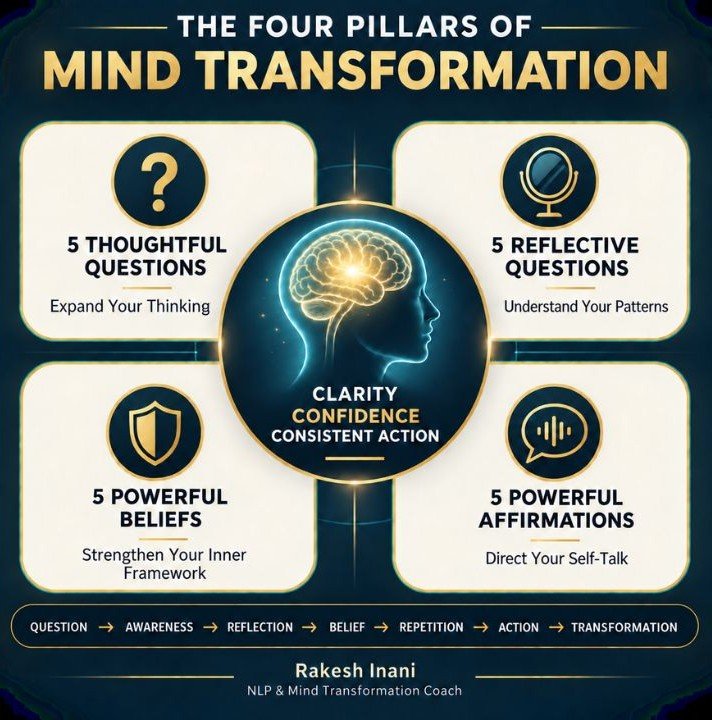
In this guide, I will walk with you through four simple groups:
- 5 thoughtful questions to expand your thinking
- 5 reflective questions to understand yourself better
- 5 powerful beliefs to build a stronger inner foundation
- 5 powerful affirmations for clarity, confidence, and action
Together, these 20 prompts follow a natural path:
Question → Awareness → Reflection → Belief → Repetition → Action → Transformation
You do not need to use all 20 items in one day. In fact, that may become another form of pressure. Instead, choose one idea, stay with it, and use it well.
Most importantly, do not search for a perfect answer. Search for an honest answer that helps you take the next useful step.
What Are Powerful Self-Reflection Questions?
Powerful self-reflection questions are questions that help you pause, examine your thinking, and notice patterns that may normally run on autopilot. They do not tell you what to think. Instead, they create space for a clearer and more useful response.
Many people search online for “deep questions to ask yourself,” “questions to change your mindset,” or “self-reflection questions for personal growth.” Usually, they are not looking for clever words. They are looking for clarity.
Therefore, a powerful question should do at least one of three things:
- help you see the situation from a new angle;
- help you notice your role in a repeated pattern; or
- help you move from mental noise toward a useful action.
Still, self-reflection is not the same as self-criticism.
Self-criticism says, “What is wrong with me?”
Healthy self-reflection asks, “What is happening here, what can I learn, and what can I do next?”
That small change in language can create a very different inner experience.
Part 1: 5 Thoughtful Questions That Can Change the Way You Think
Why Thoughtful Questions Matter
Thoughtful questions expand your thinking. They interrupt quick assumptions and invite you to look again.
Sometimes, your first thought is useful. At other times, it comes from fear, habit, past hurt, or incomplete information. Therefore, when you ask a better question, you give yourself a chance to respond with more choice.
You do not need an instant answer. Instead, let each question sit in your mind for a little while. Write what comes up. Then, look for a small action hidden inside your answer.
Question 1: What Would I Do Differently If I Knew I Could Handle the Outcome?
This question is not asking you to believe that everything will go perfectly.
Rather, it asks you to remember your ability to respond.
Often, fear does not come only from the event. It also comes from the belief that you will not be able to handle what follows. You may think, “What if they reject me?” “What if I make the wrong choice?” or “What if I feel embarrassed?”
Because of that fear, you may wait for certainty. However, complete certainty rarely comes before an important action.
Now, ask yourself:
If I trusted my ability to learn, adjust, ask for help, and recover, what would I do differently?
Perhaps you would finally share your idea in a meeting.
Perhaps you would have the honest conversation you have been delaying.
Perhaps you would begin your YouTube channel, apply for the role, start exercising, or book a session with a coach.
The purpose of this question is not to remove all fear. Instead, it changes your focus from “Can I control the outcome?” to “Can I support myself through the outcome?”
That is a more useful question because your response is often more controllable than the result.
A Simple Way to Answer It
Divide a page into three parts:
- What outcome am I afraid of?
- If it happened, what could I do?
- What small step would I take if I trusted myself?
For example:
- Fear: My idea may be rejected.
- Possible response: I can ask for feedback, improve it, and present it again.
- Next step: I will share a short version with one trusted person today.
As a result, fear becomes more specific. Once fear is specific, you can work with it more calmly.
Question 2: Am I Solving the Real Problem, or Only Reacting to the Most Visible Symptom?
Many problems have a visible layer and a deeper layer.
For instance, you may say, “I need better time management.” Yet, the deeper problem may be fear of starting, unclear priorities, or difficulty saying no.
You may say, “I need more confidence.” However, the deeper issue may be that you expect yourself to perform perfectly before you allow yourself to feel confident.
Likewise, you may say, “I keep overthinking.” Yet, under that overthinking, there may be a strong need for certainty, fear of judgment, or worry about making a mistake.
Therefore, before you rush to fix what you can see, pause and ask:
What might this visible problem be protecting me from, helping me avoid, or trying to tell me?
This does not mean every problem has a hidden meaning. Sometimes, you simply need rest, information, support, or a practical system. Still, the question helps you avoid treating every issue at the surface level.
Symptom Versus Pattern
Suppose you delay making a business call.
The visible symptom is procrastination.
The deeper pattern may be fear of hearing “no.”
If you only use a new to-do list, the fear may remain. On the other hand, if you notice the fear and practise making low-pressure calls, you work with both the action and the pattern.
So, ask yourself:
- What exactly happens before the problem appears?
- What do I think in that moment?
- What feeling follows that thought?
- What do I do next?
- What short-term benefit do I get from that response?
- What long-term cost does it create?
This line of inquiry can help you find the real place where change needs to begin.
Question 3: What Am I Repeatedly Giving My Attention To, and What Is That Attention Creating?
Your attention is valuable.
Where attention goes, mental energy often follows. Then, what you repeatedly notice can start to feel bigger, closer, and more important.
For example, if you spend the day looking for signs that people do not respect you, you may notice every delayed reply and every small disagreement. At the same time, you may miss kindness, support, and neutral facts.
Similarly, if you keep replaying one mistake, your mind may begin to treat that moment as proof of who you are. Yet, a mistake is one event. It is not your full identity.
Therefore, ask:
What am I feeding with my daily attention?
Are you feeding fear?
Are you feeding comparison?
Are you feeding resentment?
Or, are you feeding learning, gratitude, skill, connection, and useful action?
This question is not asking you to ignore real problems. In fact, clear attention can help you address them. However, there is a difference between giving a problem useful attention and giving it endless mental repetition.
Try an Attention Audit
For one day, notice your common mental loops.
Each time you catch one, write a few words. For example:
- comparing myself with someone online;
- replaying an old conversation;
- planning without starting;
- looking for proof that I am behind;
- thinking about what I can practise today.
At the end of the day, ask, “If I repeat this focus for six months, what will it strengthen?”
Then choose one new point of attention. You may focus on the next task, one thing you can learn, one person you can help, or one thing that is already working.
Your attention will move away again. That is normal. The practice is simply to notice and return.
Question 4: What Possibility Am I Unable to See Because of My Current Way of Thinking?
When you look at a situation through one frame, certain answers become easy to see while others disappear.
For example, if your frame is “I must choose the perfect path,” every option may feel dangerous. However, if your frame becomes “I can choose a useful path and adjust as I learn,” more options may appear.
If your frame is “They disagreed with me because I am not good enough,” you may feel hurt and shut down. Yet, another frame could be, “Their feedback may show me what needs clearer communication.”
Reframing does not mean pretending that a painful event is wonderful. Instead, it means exploring whether another true and useful meaning is also available.
So, ask yourself:
- What else could this situation mean?
- What fact might I be missing?
- How would a calm mentor view this?
- What would I advise a close friend to do?
- What becomes possible if I stop demanding perfection?
These are powerful mindset questions because they loosen rigid thinking.
The Three-Perspective Exercise
Write about your situation from three views:
- My current view: What do I believe is happening?
- Another person’s view: How might they understand it?
- A neutral observer’s view: What facts would they notice without adding a story?
Then ask, “Which useful possibility becomes visible now?”
Perhaps the conversation is not a final rejection. Perhaps it is a request for more detail. Perhaps you do not need a bigger plan. Perhaps you need a smaller first step.
New perspectives do not guarantee easy outcomes. Nevertheless, they often improve the quality of your choices.
Question 5: If I Continue Thinking and Behaving This Way for the Next Three Years, Where Will It Take Me?
Daily patterns can look small. However, when they are repeated, they create direction.
One delayed decision may not change much. Yet, a pattern of delaying every important decision can slowly limit your career, health, relationships, or confidence.
In the same way, one ten-minute practice may seem small. Still, ten minutes of focused practice repeated for three years can build meaningful skill.
This question helps you step out of the present moment and look at the path you are creating.
Ask yourself:
If nothing changes, what may my life look like three years from now?
Then ask:
If I make one helpful change and repeat it, what may become possible?
Do not use this question to frighten or shame yourself. Use it to make direction visible.
Think in Paths, Not Predictions
You cannot predict the future with certainty. Yet, you can notice where a current pattern is likely to lead.
For example:
- avoiding difficult talks may create more distance;
- waiting for perfect confidence may keep you silent;
- comparing yourself daily may reduce joy and focus;
- practising one communication skill may improve expression;
- taking one meaningful action daily may build trust in yourself.
Therefore, the real question becomes, “Is this pattern taking me toward the person I want to become?”
If the answer is no, do not try to rebuild your whole life tonight. Choose one repeated behaviour and change its direction.
How to Use These Thoughtful Questions
Choose one thoughtful question for a full week.
Read it in the morning. Then, write for five to ten minutes without judging your answer. During the day, notice when the question becomes relevant. Finally, review what you learned at night.
You can use this simple format:
- What is my first answer?
- What is a deeper answer?
- What fact supports my answer?
- What assumption may be shaping it?
- What one action can I take?
Remember, the goal is not to produce a beautiful journal page. The goal is to become more aware and more able to choose.
Part 2: 5 Reflective Questions to Understand Yourself Better
Thoughtful Questions and Reflective Questions: What Is the Difference?
Thoughtful questions help you explore new angles. Reflective questions help you examine your own experiences, choices, and repeated patterns.
In simple words, thoughtful questions widen the view. Reflective questions turn the light inward.
Both are useful. However, reflection must be honest and kind. If you use it to attack yourself, you may become defensive or hopeless. If you use it with curiosity, you can learn.
The following reflective questions to ask yourself are not a test. There are no perfect answers. Instead, each one is an invitation to notice what is already happening.
Reflective Question 1: What Situation Keeps Repeating in My Life, and What Might I Be Contributing to That Pattern?
Repeated situations can carry valuable information.
Perhaps you often feel unheard in conversations. Perhaps you begin many projects but rarely finish. Perhaps you agree to too much, feel tired, and then become upset with others. Or, perhaps you keep entering the same kind of conflict at work.
It is easy to focus only on what other people are doing. Sometimes, they truly are behaving poorly. Even so, one useful question remains:
What part of this pattern is within my influence?
This is not about taking blame for everything. You are not responsible for another person’s choices. However, you can examine your own boundaries, communication, expectations, timing, and responses.
For example, if you often feel overloaded, you may notice that you say yes before checking your time. If you often feel ignored, you may notice that you hint at your needs instead of expressing them clearly. If you often abandon goals, you may notice that your plans are too large and too strict.
Look for the Repeating Sequence
Write the pattern as a short sequence:
Trigger → Thought → Feeling → Response → Result
For example:
A new task arrives → “I must do it perfectly” → pressure → delay → rushed work
Now you can see that the task itself is only one part of the pattern. The rule “I must do it perfectly” may be increasing the pressure.
Next, create one new response:
A new task arrives → “I can create a rough first version” → manageable effort → begin for ten minutes → early progress
The purpose is not to blame the old response. It may once have tried to protect you. The purpose is to create more choice now.
Reflective Question 2: What Am I Currently Avoiding That I Know Needs My Attention?
Avoidance can feel helpful for a short time.
When you delay a hard task, you may feel quick relief. When you avoid a difficult conversation, the tension may drop for an hour. When you do not look at your finances, you do not have to feel worried in that moment.
However, the problem often remains. In some cases, it grows.
Therefore, ask yourself:
What am I avoiding, and what is that avoidance costing me?
Your answer may be a task, a truth, a feeling, a boundary, a decision, or a request for help.
Then ask a second question:
What is the smallest safe step I can take toward it?
If you are avoiding an email, open it and write the first line.
If you are avoiding a health concern, arrange an appointment with a qualified professional.
If you are avoiding a conversation, write the main point you want to express calmly.
If you are avoiding a large project, work for ten focused minutes.
Make the Step Smaller Than the Fear
Sometimes, people try to defeat avoidance with one huge action. That may work for a while, but it can also create more fear.
Instead, make the first step small, clear, and real.
Do not write, “Fix my career.” Write, “List three roles I want to explore.”
Do not write, “Become confident.” Write, “Ask one question in tomorrow’s meeting.”
Do not write, “Solve the relationship.” Write, “Choose a calm time and share one concern without blame.”
Small steps are not weak. They help your mind gather new evidence: “I can face this. I can begin. I can continue.”
Reflective Question 3: Which Fear Influences More of My Decisions Than I Would Like to Admit?
Fear is not always loud.
Sometimes, it appears as overplanning. Sometimes, it appears as perfectionism. At other times, it appears as the need to please everyone, remain invisible, or wait for more information.
Common fears include:
- fear of failure;
- fear of rejection;
- fear of judgment;
- fear of conflict;
- fear of uncertainty;
- fear of success and new responsibility;
- fear of disappointing people.
The question is not, “How do I remove every fear?”
The better question is, “Which fear is quietly making choices for me?”
Perhaps fear of judgment stops you from sharing your work. Perhaps fear of failure keeps you in endless preparation. Perhaps fear of conflict makes you agree when you want to say no.
Once you name the fear, you can separate it from the decision.
Ask Fear for Its Message
Try this short written dialogue:
- Fear says: “Do not take this step because…”
- Fear is trying to protect me from…
- The facts I know are…
- The support I can use is…
- A careful but courageous step is…
This does not make fear the enemy. Instead, it gives fear a seat in the room without giving it control of the whole meeting.
You can listen to the warning, check the facts, prepare wisely, and still choose according to your values.
Reflective Question 4: What Have My Biggest Challenges Taught Me About Myself?
A challenge can hurt and teach at the same time.
This does not mean that every painful event was necessary or good. It simply means that, after an event, you may be able to carry forward something useful.
Perhaps a difficult year showed you that you can adapt.
Perhaps a failed project taught you to ask for feedback sooner.
Perhaps a relationship struggle taught you the value of clear boundaries.
Perhaps a period of self-doubt helped you understand how deeply your inner language affects your action.
Therefore, ask:
- What strength did I discover?
- What warning sign do I understand now?
- What boundary became important?
- What support should I have asked for?
- What would I do differently today?
- What wisdom can I carry forward?
Turn the Event Into Learning
You can use this sentence frame:
“That experience was difficult. It does not define my whole life. What I choose to learn from it is…”
Then finish the sentence honestly.
Your lesson may not be inspiring. It may be practical: “I need a written agreement,” “I need to rest earlier,” or “I need to ask questions before I assume.” Practical lessons can still be powerful.
Reflection becomes useful when it improves a future response. Otherwise, it can turn into replaying the past.
So, once you have found the lesson, ask, “Where can I practise this lesson now?”
Reflective Question 5: Who Am I Becoming Through the Choices I Make Every Day?
Identity is not built only through big moments.
It is also shaped by small, repeated choices.
When you keep one promise to yourself, you practise being dependable. When you speak honestly and respectfully, you practise courage. When you return to your work after a difficult day, you practise consistency.
On the other hand, when you repeatedly avoid what matters, you may slowly weaken trust in yourself.
Therefore, instead of asking only, “What do I want to achieve?” ask:
Who do I need to practise becoming?
If you want to become a confident speaker, your daily practice may be speaking for five minutes on camera.
If you want to become a calm leader, your practice may be taking one breath before answering under pressure.
If you want to become a focused creator, your practice may be finishing one important task before checking messages.
Use Identity as a Direction
Choose one identity statement:
“I am becoming a person who…”
Then complete it with a behaviour you can see.
For example:
- I am becoming a person who communicates needs clearly.
- I am becoming a person who starts before feeling fully ready.
- I am becoming a person who learns from feedback.
- I am becoming a person who chooses progress over perfection.
Next, ask, “What would this person do today?”
Your answer should be small enough to complete. Identity grows through evidence, and behaviour creates that evidence.
A Simple Reflection Practice for Daily Life
If you want a self-reflection exercise that is easy to remember, use these six steps:
1. What Happened?
Describe the facts. Keep the story separate for a moment.
2. What Did I Think?
Write the words that appeared in your mind. Do not clean them up.
3. What Did I Feel?
Name the emotion as simply as you can: worried, hurt, angry, ashamed, sad, excited, or confused.
4. What Did I Do?
Describe your response. Did you speak, hide, delay, agree, argue, or take action?
5. What Can I Learn?
Look for a useful lesson without attacking yourself.
6. What Will I Do Differently?
Choose one small response you can practise next time.
This practice turns a confusing experience into a clear sequence. As a result, you can notice where you have influence.
Part 3: 5 Powerful Beliefs to Strengthen Your Mind
What Is a Powerful Belief?
A powerful belief is not a magical promise that life will always go your way.
Instead, it is a useful idea that helps you think, respond, and act with greater flexibility.
For example, “Nothing bad will ever happen to me” is not a realistic belief. Yet, “I can ask for support and take the next useful step” is grounded and actionable.
Beliefs act like inner rules. They can affect what you attempt, how you explain results, and whether you continue after difficulty.
However, repeating a new belief once may not remove years of old learning. Therefore, practise it with patience. Look for evidence. Use it in real situations. Most importantly, connect it with behaviour.
Belief 1: I May Not Control Everything That Happens, but I Can Influence How I Respond
You cannot control every outcome, every opinion, every delay, or every change.
Trying to control all of it can create great pressure.
Still, you may have influence over your preparation, words, boundaries, attention, effort, and next step.
That is why this belief is powerful. It moves you away from helplessness without pretending that you control the world.
Imagine that a meeting does not go as planned. You cannot erase what happened. However, you can review the facts, ask for feedback, correct an error, and prepare differently next time.
Likewise, you cannot force someone to understand you. Yet, you can communicate clearly, listen, and decide what boundary you need.
Put the Belief Into Practice
Draw two circles.
In the first circle, write Outside my control.
In the second circle, write Within my influence.
Place each part of your problem into one of the circles.
Then give most of your energy to the second circle.
This does not remove pain. Nevertheless, it can reduce wasted struggle and return your attention to a useful response.
Belief 2: I Do Not Need Complete Certainty Before Taking the Next Useful Step
This belief is especially helpful when overthinking creates decision paralysis.
You may believe that you need to know the whole path before you begin. However, many answers only appear after action.
For example, you may not know whether a content idea will connect with your audience until you publish and listen to feedback. You may not know whether you enjoy a new skill until you practise it. You may not know the perfect business offer before speaking with real people.
Therefore, instead of asking, “How can I become completely certain?” ask, “What is the next useful step that gives me more information?”
That step could be a short test, one conversation, a small draft, or a limited trial.
Use Reversible Decisions
Not every decision carries the same risk.
Some decisions are difficult to reverse. Those deserve care, expert advice, and enough time.
However, many daily decisions are adjustable. You can test them, learn, and change direction.
So, ask:
- Is this choice truly permanent?
- What is the real risk?
- What information do I need now?
- What can I learn only by taking action?
- What is a safe first test?
The goal is not careless action. The goal is thoughtful movement without demanding impossible certainty.
Belief 3: A Mistake Is Information, Not a Definition of Who I Am
When a mistake becomes an identity, learning becomes difficult.
For example, “I made an error in that presentation” describes an event. However, “I am a failure” turns one event into a total label.
That label can create shame. Then, shame may lead to hiding, avoiding feedback, or refusing to try again.
Instead, treat the mistake as information.
Ask:
- What did I expect?
- What actually happened?
- What part worked?
- What needs improvement?
- What will I test next?
This approach does not remove responsibility. In fact, it can help you take responsibility more clearly because you are examining the action instead of attacking your worth.
Change the Sentence
Replace identity labels with specific descriptions.
Instead of “I am terrible at speaking,” say, “I lost my structure during this talk, so I will practise a three-point outline.”
Instead of “I never make good decisions,” say, “I rushed this choice and did not check the facts I needed.”
Instead of “I am lazy,” say, “I have delayed this task because it feels unclear and too large.”
Specific language creates specific solutions.
Belief 4: My Current Patterns Can Change Through Awareness, Practice, and Repetition
A repeated pattern can feel permanent simply because it is familiar.
You may say, “This is just how I am.” Yet, many ways of thinking and responding are learned patterns, not fixed identities.
Change is rarely instant. Still, with awareness and repeated practice, you can build different responses over time.
The first step is to recognize the pattern.
The second step is to regulate yourself enough to create a pause.
The third step is to choose a more useful thought or frame.
The fourth step is to rehearse and use the new response.
Finally, you reinforce it by repeating it in daily life.
This does not mean every issue can be solved by positive thinking. Some problems need professional mental health care, medical support, safety planning, or major changes in the environment. Yet, in everyday habits and responses, practice can create meaningful improvement.
Track Repetitions, Not Perfection
Suppose you want to respond calmly during disagreement.
At first, you may remember only after the conversation. That is awareness.
Next, you may notice during the conversation but still react. That is progress.
Later, you may pause once before responding. That is a new repetition.
Eventually, the pause may become easier.
Therefore, do not ask only, “Did I do it perfectly?” Ask, “Did I notice sooner, recover faster, or practise one better response?”
Belief 5: Small Actions Repeated Consistently Can Create Meaningful Transformation
People often wait for a powerful mood before taking action.
However, motivation changes. A small system can keep you moving when the mood is low.
One page a day can become a manuscript.
Ten minutes of speaking practice can improve fluency.
One honest boundary can begin to change a relationship pattern.
One short walk repeated regularly can support a healthier routine.
The action may look small, but repetition gives it weight.
Choose Your Minimum Useful Action
A minimum useful action is the smallest step that still moves the goal forward.
For example:
- write 100 words;
- practise one opening hook;
- make one follow-up call;
- read two pages and note one insight;
- breathe slowly for one minute before responding;
- prepare tomorrow’s first task tonight.
On a strong day, you can do more. On a difficult day, complete the minimum. In this way, consistency becomes easier to protect.
Beliefs Become Powerful When They Influence Behaviour
A belief is not valuable only because it sounds good.
It becomes valuable when it changes the action you are willing to take.
If you believe a mistake is information, you may ask for feedback.
If you believe you do not need complete certainty, you may run a small test.
If you believe you can influence your response, you may pause before reacting.
Therefore, after choosing a belief, ask:
“If I truly practised this belief today, what would I do differently?”
Then do one visible action. That action becomes evidence for the belief, and the belief supports further action.
Part 4: 5 Powerful Affirmations for Clarity, Confidence, and Action
What Are Affirmations, and How Should You Use Them?
Affirmations are short statements that help direct your attention toward a chosen way of thinking or behaving.
They are not magic words. They cannot guarantee an outcome, remove every difficult emotion, or replace practical action.
However, an affirmation can be useful when it is believable enough to engage with, emotionally meaningful, and linked to behaviour.
This is the formula I recommend:
Affirmation + emotional connection + mental rehearsal + aligned behaviour = stronger practice
If a statement feels completely false, soften it.
For example, “I am confident in every situation” may create inner resistance. Instead, “Every day, I am becoming more confident in expressing who I am” leaves room for growth.
Say the words slowly. Understand what they mean. Imagine one situation where you want to live them. Then take one matching action.
Affirmation 1: “I Am Learning to Respond With Clarity Instead of Reacting From Fear.”
Use this affirmation when emotions are high and you feel an urgent need to answer, decide, or defend yourself.
The words “I am learning” are important. They do not demand perfection. They remind you that a calmer response is a skill you can practise.
Before repeating the line, place both feet on the floor. Relax your shoulders. Then breathe gently and make your exhale a little longer than your inhale, as long as that feels comfortable.
Now say:
“I am learning to respond with clarity instead of reacting from fear.”
Next, ask, “What do I know for sure, and what am I only assuming?”
Finally, decide whether you need to answer now or whether a short pause would help.
Your matching action may be as simple as saying, “I want to think about this and reply tomorrow.”
Affirmation 2: “I Trust Myself to Take the Next Best Step With the Information I Have.”
This is a useful affirmation for overthinking and decision paralysis.
It does not say that your step will be perfect. It says you can use the information available now, choose carefully, and adjust when new information comes.
Repeat it before a decision:
“I trust myself to take the next best step with the information I have.”
Then ask three practical questions:
- What facts do I have?
- What matters most in this choice?
- What next step is useful and reasonably safe?
For example, if you are unsure about starting a project, your next best step may not be a full launch. It may be interviewing five people, creating a small sample, or testing one offer.
Trust grows when you see yourself making thoughtful choices, learning, and adjusting.
Affirmation 3: “Every Day, I Am Becoming More Confident in Expressing Who I Am.”
Confidence does not always arrive before expression. Often, it grows through expression.
You speak once. Then you learn.
You share an idea. Then you discover that you can handle the response.
You set a small boundary. Then you feel more aligned with yourself.
Therefore, use this affirmation before a conversation, recording, meeting, or presentation:
“Every day, I am becoming more confident in expressing who I am.”
As you say it, imagine yourself speaking at a calm pace. See your shoulders relaxed. Hear your voice becoming clear. Then choose one message you truly want to express.
Your action might be:
- asking one question;
- sharing one opinion;
- recording a one-minute video;
- saying no respectfully;
- telling someone what support you need.
Confidence becomes more believable when it has behavioural evidence.
Affirmation 4: “I Release the Need for Perfect Certainty and Choose Meaningful Action.”
This affirmation does not ask you to become careless.
It asks you to release an impossible condition: the need to know everything before moving.
Use it when you notice repeated research, endless comparison, or constant changes to the plan.
Say:
“I release the need for perfect certainty and choose meaningful action.”
Then define “meaningful action” clearly.
It may be publishing the useful version instead of waiting for the perfect version.
It may be asking the question instead of assuming the answer.
It may be making a decision after checking the few facts that truly matter.
It may also be choosing not to act yet because expert advice or safety information is genuinely needed. Meaningful action can include a wise pause. The key is that the pause has a clear purpose and end point.
Affirmation 5: “My Thoughts Can Guide Me, but They Do Not Have to Control Me.”
Thoughts are mental events. Some are useful signals. Some are old habits. Some are guesses, fears, memories, or unfinished stories.
You do not need to fight every thought. At the same time, you do not need to obey every thought.
Use this affirmation when your mind is producing the same worry again and again:
“My thoughts can guide me, but they do not have to control me.”
Then ask:
- Is this thought a fact, a prediction, or an assumption?
- Is there a real action needed?
- If yes, what is it?
- If no action is possible now, where do I want to return my attention?
You may write the thought down, schedule a time to review it, and return to the present task.
This approach respects the thought without handing it control of your day.
Positive Affirmations for Confidence Work Best With Action
Many people ask, “Do affirmations really work?”
The most honest answer is that repeating words alone is unlikely to create a full life change. Yet, a well-chosen affirmation can act as a reminder, focus cue, or rehearsal prompt when it is paired with emotion and action.
For example, if you repeat an affirmation for confident speaking but never speak, your mind gets little new evidence. However, if you repeat it, imagine a calm delivery, and record a short practice video, the statement becomes connected to experience.
Therefore, after every affirmation, complete this sentence:
“Today, I will support these words by…”
Then name one action.
Part 5: How to Turn These 20 Statements Into a Daily Mind Practice
Do Not Just Read Them—Practise Them
Reading can give you a useful idea. Practice helps you carry that idea into real life.
This is where many people get stuck. They collect powerful quotes, save affirmations, and watch motivational videos. For a short time, they feel inspired. However, their daily response remains the same.
The missing link is often application.
Therefore, instead of trying to remember all 20 statements, build a short daily practice around only a few of them.
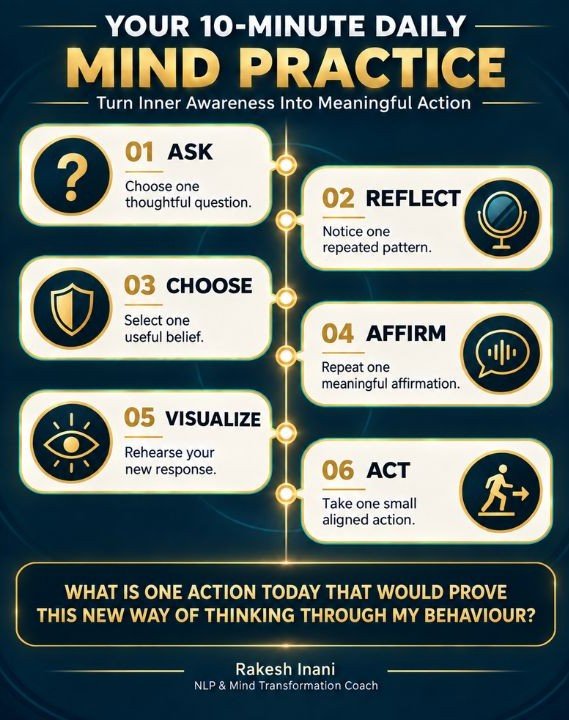
The following 10-minute mind practice is simple enough for a busy morning. You can also use it at night as a self-reflection routine.
A 10-Minute Mind Reprogramming Ritual
Step 1: Ask One Thoughtful Question
Choose one of the five thoughtful questions.
Read it slowly. Then notice your first answer.
Do not correct it. Your first answer shows you what is already active in your mind.
Next, ask, “What else could be true?”
Spend about two minutes writing freely.
For example, you may choose, “What possibility am I unable to see because of my current way of thinking?” Your first answer may be, “There is no other option.” Yet, after a minute, you may remember a person you can call, a smaller test you can run, or a different time frame.
Step 2: Answer One Reflective Question
Now select one reflective question.
Bring one real situation to mind. Then write what you notice about your thoughts, feelings, and response.
Be specific.
Instead of writing, “I always overthink,” write, “Yesterday, after my manager asked for a revision, I assumed my work was poor. I delayed replying for three hours.”
Specific reflection makes the pattern easier to understand. It also reduces vague self-labels.
Spend about two minutes here.
Step 3: Choose One Belief to Strengthen
Select the belief that would help you respond more usefully today.
For example, if you are waiting for certainty, choose:
“I do not need complete certainty before taking the next useful step.”
Then look for one true piece of evidence from your past. Perhaps you once began a project without knowing every answer and learned along the way. Perhaps you managed a difficult event better than you expected.
Evidence makes the belief more grounded.
Spend about one minute here.
Step 4: Repeat One Affirmation Meaningfully
Choose one affirmation that fits the day.
Say it three to five times at a calm pace. However, do not rush through the words. Pay attention to their meaning.
If the statement feels too strong, adjust it.
For example, change “I trust myself completely” to “I am learning to trust myself with the next step.”
The goal is not to force agreement. The goal is to create a useful direction your mind can practise.
Spend about one minute here.
Step 5: Visualize the New Response
Close your eyes if that is comfortable and safe.
Imagine one situation you are likely to face today. See yourself using the chosen belief and affirmation.
Notice your posture. Hear your voice. Imagine the first useful action.
Keep the scene realistic. You do not need to imagine perfect success. Instead, imagine yourself responding well even if the moment is slightly uncomfortable.
For example, see yourself feeling nervous before a meeting, taking one breath, and sharing your point clearly.
Spend about two minutes here.
Step 6: Take One Aligned Action
Finish with this question:
“What is one small action today that would prove this new way of thinking through my behaviour?”
Write the action in a clear form.
“Work on my goal” is too broad.
“At 10:00 a.m., I will draft the first three points for my presentation” is clear.
Your action connects the inner practice with the outer world. Without this step, the ritual may remain pleasant but passive.
Step 7: Review at Night
At the end of the day, ask:
- What did I notice?
- Where did I practise the new response?
- What made it easier?
- What will I repeat tomorrow?
This review does not need to take more than one minute.
The full process is short. Yet, when repeated, it can help you become more aware of your mental patterns and more intentional in your actions.
A One-Page Journal Template
Use the following template in a notebook or digital note:
Today’s thoughtful question:
My honest answer is…
Today’s reflective question:
The pattern I notice is…
Today’s useful belief:
One piece of evidence for it is…
Today’s affirmation:
These words matter because…
Today’s mental rehearsal:
I see myself…
Today’s aligned action:
At ___, I will…
Night review:
Today I noticed… Tomorrow I will…
Keep your answers short. A practice you can repeat is more useful than a beautiful practice you abandon.
Part 6: A 5-Day Self-Reflection and Mind Transformation Challenge
How the Five-Day Challenge Works
If you are wondering how to start self-reflection, this five-day challenge gives you a clear path.
Each day has one theme. You will use one thoughtful question, one reflective question, one belief, and one affirmation. Then you will complete one small action.
Set aside ten to fifteen minutes. You may write in the morning and take the action during the day.
At night, end with one question:
“What did I notice about myself today?”
Do not try to create a major transformation in five days. Instead, use the challenge to notice one pattern and create one better direction.
Day 1: Awareness
Thoughtful Question
What would I do differently if I knew I could handle the outcome?
Write down one action you have been avoiding because you fear the result.
Then, list two ways you could support yourself if the result were difficult. You may ask for help, gather feedback, make a second attempt, or give yourself time to recover.
Reflective Question
What situation keeps repeating in my life, and what might I be contributing to that pattern?
Look for your part without taking blame for someone else’s behaviour.
Perhaps you wait too long to speak. Perhaps you agree before checking your needs. Perhaps you create goals that are too large to begin.
Belief
I may not control everything that happens, but I can influence how I respond.
Write one thing outside your control and one thing within your influence.
Affirmation
“I am learning to respond with clarity instead of reacting from fear.”
Repeat it before one situation that normally makes you react quickly.
Day 1 Action
Pause for one slow breath before your next important response.
At night, ask: “What changed when I created even a small pause?”
Day 2: Courage
Thoughtful Question
Am I solving the real problem, or only reacting to the most visible symptom?
Choose one problem. Then write the visible symptom and the possible deeper pattern.
For example, the symptom may be delay. The deeper pattern may be fear of doing imperfect work.
Reflective Question
What am I currently avoiding that I know needs my attention?
Name it clearly. Then reduce the first step until it feels possible.
Belief
I do not need complete certainty before taking the next useful step.
Ask what information you can gain through action rather than more thinking.
Affirmation
“I trust myself to take the next best step with the information I have.”
Say it slowly, and then name the step.
Day 2 Action
Spend ten minutes on the task you have been avoiding.
At night, ask: “Was beginning as difficult as my mind predicted?”
Day 3: Confidence
Thoughtful Question
What am I repeatedly giving my attention to, and what is that attention creating?
Notice where your attention goes when you feel unsure. Do you compare, predict failure, replay criticism, or search for approval?
Reflective Question
Which fear influences more of my decisions than I would like to admit?
Name the fear without shame. Then ask what small choice you would make if that fear were present but not in charge.
Belief
A mistake is information, not a definition of who I am.
Remember one mistake that taught you something useful.
Affirmation
“Every day, I am becoming more confident in expressing who I am.”
Imagine yourself speaking one clear sentence that matters.
Day 3 Action
Express one honest idea, question, preference, or boundary with respect.
At night, ask: “What evidence did I create that I can express myself?”
Day 4: Action
Thoughtful Question
What possibility am I unable to see because of my current way of thinking?
Write your current view. Then write two other possible views.
Reflective Question
What have my biggest challenges taught me about myself?
Choose one practical lesson that can improve a current response.
Belief
My current patterns can change through awareness, practice, and repetition.
Identify one new response you want to rehearse.
Affirmation
“I release the need for perfect certainty and choose meaningful action.”
Repeat it while imagining yourself beginning.
Day 4 Action
Complete a small test, draft, practice session, or conversation that gives you useful information.
At night, ask: “What did action teach me that thinking could not?”
Day 5: Identity and Future
Thoughtful Question
If I continue thinking and behaving this way for the next three years, where will it take me?
Write two short future pictures: one if the current pattern continues and one if a healthier pattern grows.
Reflective Question
Who am I becoming through the choices I make every day?
Complete this sentence: “I am becoming a person who…”
Belief
Small actions repeated consistently can create meaningful transformation.
Choose one minimum useful action you can repeat for the next seven days.
Affirmation
“My thoughts can guide me, but they do not have to control me.”
Notice one thought. Label it as a fact, prediction, memory, or assumption. Then choose your action.
Day 5 Action
Create a seven-day promise that is small enough to keep.
For example, “For seven days, I will speak on camera for five minutes,” or “For seven days, I will write my top priority before checking social media.”
At night, ask: “What kind of person will this repeated action help me practise becoming?”
What to Do After the Five-Day Challenge
Review your notes and circle three things:
- one pattern you understand better;
- one belief you want to continue practising; and
- one action that created useful evidence.
Then repeat only those three elements for another week.
Depth matters more than quantity. One belief practised in ten real moments can be more useful than twenty beliefs read once.
Part 7: 5 Mistakes People Make With Questions, Beliefs, and Affirmations
Mistake 1: Repeating Affirmations Mechanically
If you repeat words while your attention is somewhere else, the practice becomes empty.
Slow down. Choose one line. Understand what it means. Connect it with one real situation and one behaviour.
Instead of saying ten affirmations fifty times, use one affirmation before the moment where you need it.
For example, say, “I trust myself to take the next best step,” before you make a thoughtful decision. Then make the step.
Mistake 2: Using Positive Statements to Avoid Real Problems
Positive language should not hide facts.
If a situation is unsafe, affirmations are not a replacement for protection and qualified help. If you need medical care, legal advice, financial guidance, or mental health support, speak with an appropriate professional.
Likewise, if a relationship lacks respect, repeating “Everything is perfect” may keep you from addressing the real issue.
A healthier statement may be, “I can face the facts and take a wise next step.”
Useful mindset work helps you engage with reality more clearly.
Mistake 3: Looking for Perfect Answers to Reflective Questions
Self-reflection can become overthinking when you demand a final, complete answer.
You may ask the same question again and again, hoping for absolute certainty. However, reflection should lead to learning and action.
Set a time limit. Write for ten minutes. Choose the most useful insight available. Then test it gently in life.
You can return to the question later with new experience.
Mistake 4: Trying to Change Too Many Beliefs at Once
When you try to work on everything, your attention becomes divided.
Choose one belief that relates to your current challenge.
If you are overthinking a decision, practise the belief about taking the next step without complete certainty.
If a mistake has damaged your confidence, practise the belief that a mistake is information rather than identity.
Stay with one belief for at least a week. Look for moments where the old belief appears. Then practise the new belief through a specific response.
Mistake 5: Thinking Mindset Work Can Replace Action
Mindset can influence action, but thinking about change is not the same as changing.
You may understand why you procrastinate and still need to begin the task.
You may repeat an affirmation for communication and still need to practise speaking.
You may believe in consistency and still need a realistic daily system.
Therefore, every question, belief, and affirmation in this guide should eventually lead to behaviour.
Use this final bridge:
“Because I am choosing this thought, what will I do now?”
Part 8: How Questions, Beliefs, and Affirmations Work Together
Questions Create Awareness
A question interrupts the usual mental path.
It helps you notice what you are focusing on, what you are assuming, and what you may be avoiding.
Without awareness, a pattern can feel like the only possible response.
Reflection Creates Understanding
Reflection helps you see the sequence behind the pattern.
You begin to understand what triggers it, what thought appears, what feeling follows, and what action you take.
This understanding can reduce confusion and show you where to practise change.
Beliefs Create an Inner Framework
A useful belief gives you a healthier rule for responding.
For example, “I must know everything before I begin” creates delay. “I can take a careful first step and adjust” creates movement.
The belief does not do the work for you. However, it can make the work feel possible.
Affirmations Direct Daily Attention
An affirmation reminds you of the response you want to practise.
When used before a real moment, it can help you bring that response back into awareness.
Action Creates Evidence
Finally, action gives your mind real experience.
You take the small step. You survive the discomfort. You learn something. Then your new belief has evidence.
This is why the process is not simply positive thinking. It is a cycle of awareness, choice, rehearsal, action, and learning.
Part 9: Frequently Asked Questions
What Are the Best Self-Reflection Questions to Ask Yourself?
The best self-reflection questions are the ones that help you notice a real pattern and choose a useful response. Start with: “What situation keeps repeating in my life?” “What am I avoiding?” “Which fear is influencing my decisions?” “What have my challenges taught me?” and “Who am I becoming through my daily choices?”
Do not answer all of them at once. Choose the question that connects with your present situation.
How Can I Reprogram My Mind With Questions?
You can use questions to interrupt automatic thinking and direct attention toward new choices. First, notice the old thought. Next, ask a question that opens another view, such as, “What else could this mean?” or “What is the next useful step?” Then, support the new view with repeated practice and action.
The word “reprogram” should not be understood as pressing a switch. In everyday personal growth, it is better understood as practising a new mental and behavioural response until it becomes more familiar.
What Are Some Powerful Questions for Personal Growth?
Useful questions for personal growth include:
- What would I do if I trusted myself to handle the outcome?
- What am I repeatedly giving my attention to?
- What possibility am I not seeing?
- What fear is making choices for me?
- What action would match the person I want to become?
Each question should lead to a specific observation or next step.
What Is the Difference Between a Belief and an Affirmation?
A belief is an idea you accept as true or useful, and it can shape how you interpret events. An affirmation is a statement you repeat intentionally to direct your attention toward a chosen belief, identity, or response.
For example, “Mistakes are information” is a belief. “I can learn from this mistake without defining myself by it” is an affirmation based on that belief.
How Often Should I Repeat Affirmations?
There is no magic number.
Use an affirmation often enough to remember it in the situation where it matters. You may repeat one line three to five times in the morning, visualize the matching behaviour, and then use it again before a real challenge.
Quality matters more than speed or quantity.
Why Do Some Affirmations Feel Fake?
An affirmation may feel fake when it is too far from your present experience.
If “I am completely fearless” feels untrue, choose a growth-based statement such as, “I am learning to take useful action even when fear is present.”
The second statement is easier to connect with because it allows both your current feeling and your desired direction.
Can Affirmations Stop Overthinking?
An affirmation may help interrupt an overthinking loop, but it is not a complete solution by itself.
Pair it with a practical process: name the thought, separate fact from prediction, decide whether an action is needed, set a time limit for the decision, and return attention to the present task.
If overthinking is severe, persistent, or strongly affecting sleep, work, safety, or daily life, consider speaking with a qualified mental health professional.
Should I Journal in the Morning or at Night?
Both can work.
Morning journaling can help you choose a direction for the day. Night journaling can help you review patterns and learning. If possible, use two minutes in the morning for intention and five minutes at night for reflection.
However, the best time is the time you can repeat consistently.
How Long Does It Take to Change a Belief?
There is no fixed time for every person or belief.
Some beliefs shift after one powerful insight. Others are tied to years of experience and need longer practice, support, and new evidence.
Instead of counting days, track signs of change: noticing the old pattern sooner, creating a pause, choosing a different response, and recovering faster after a setback.
Can Self-Reflection Become Overthinking?
Yes. Reflection becomes unhelpful when it repeats the same analysis without producing new understanding or action.
To prevent this, set a short time limit, write down the main lesson, and choose one next step. If no action is possible, decide when you will review the issue again and return to the present.
What If I Cannot Answer a Reflective Question?
That is okay.
Write, “I do not know yet,” and then ask a smaller question. For example, instead of “Why am I like this?” ask, “What happened just before I reacted?”
You can also notice body sensations, emotions, recent events, and exact thoughts. Clarity may come slowly.
Can These Questions Replace Counselling or Therapy?
No. These questions are tools for everyday self-reflection and personal growth. They do not diagnose or treat a mental health condition, and they are not a replacement for therapy, medical care, or crisis support.
If you feel overwhelmed, unsafe, unable to function, or deeply distressed, seek qualified professional support in your area.
Part 10: One Final Question to Take With You
Who Are You Consciously Choosing to Become?
You have now explored 5 thoughtful questions, 5 reflective questions, 5 powerful beliefs, and 5 affirmations.
Yet, one question brings all of them together:
If your thoughts, beliefs, and daily actions are shaping the person you are becoming, who are you consciously choosing to become?
Pause here.
Do not search for an impressive answer.
Perhaps you are choosing to become someone who speaks honestly.
Perhaps you are choosing to become someone who takes action without waiting for perfect certainty.
Perhaps you are choosing to become someone who learns from mistakes, treats themselves with respect, and returns to what matters.
Whatever your answer is, make it visible through one action.
You do not need to transform yourself overnight.
Begin with one question.
Notice one pattern.
Choose one stronger belief.
Practise one useful affirmation.
Take one aligned action.
Then repeat.
That is how inner change becomes daily change.
Ready to Move From Overthinking to Clarity and Action?
If you understand your problem but still find it difficult to change the pattern alone, guided support can help you see what is keeping the loop active and what to practise next.
My work is focused on helping working professionals, entrepreneurs, and growth-oriented people move:
From Overthinking and Inner Barriers → Clarity, Confidence & Consistent Action
You can begin in one of two ways:
- Download my free guide to learn a simple process for calming mental noise and moving toward clear action.
- Book a complimentary 1-to-1 session to explore your present pattern, your desired outcome, and the gap that may be keeping you stuck.
You do not need every answer before you begin.
You only need the next useful step.
Quick Reference: All 20 Questions, Beliefs, and Affirmations
5 Thoughtful Questions
- What would I do differently if I knew I could handle the outcome?
- Am I solving the real problem, or only reacting to the most visible symptom?
- What am I repeatedly giving my attention to, and what is that attention creating?
- What possibility am I unable to see because of my current way of thinking?
- If I continue thinking and behaving this way for the next three years, where will it take me?
5 Reflective Questions
- What situation keeps repeating in my life, and what might I be contributing to that pattern?
- What am I currently avoiding that I know needs my attention?
- Which fear influences more of my decisions than I would like to admit?
- What have my biggest challenges taught me about myself?
- Who am I becoming through the choices I make every day?
5 Powerful Beliefs
- I may not control everything that happens, but I can influence how I respond.
- I do not need complete certainty before taking the next useful step.
- A mistake is information, not a definition of who I am.
- My current patterns can change through awareness, practice, and repetition.
- Small actions repeated consistently can create meaningful transformation.
5 Powerful Affirmations
- “I am learning to respond with clarity instead of reacting from fear.”
- “I trust myself to take the next best step with the information I have.”
- “Every day, I am becoming more confident in expressing who I am.”
- “I release the need for perfect certainty and choose meaningful action.”
- “My thoughts can guide me, but they do not have to control me.”
About the author: Rakesh Inani is an NLP & Mind Transformation Coach who helps working professionals, entrepreneurs, and growth-oriented adults reduce overthinking, overcome inner barriers, and move toward clarity, confidence, and consistent action through NLP-informed coaching and practical mind-transformation tools.
Transform Your Mind: JOIN MIND TRANSFORMATION COMMUNITY
Learn More:
Real Leaders Know This ONE Secret to Influencing Without Speaking
7 Day Manifestation- NLP Guided Meditation for Success
The Complete Success Formula: 6 Steps to Turn Goals into Consistent Action