
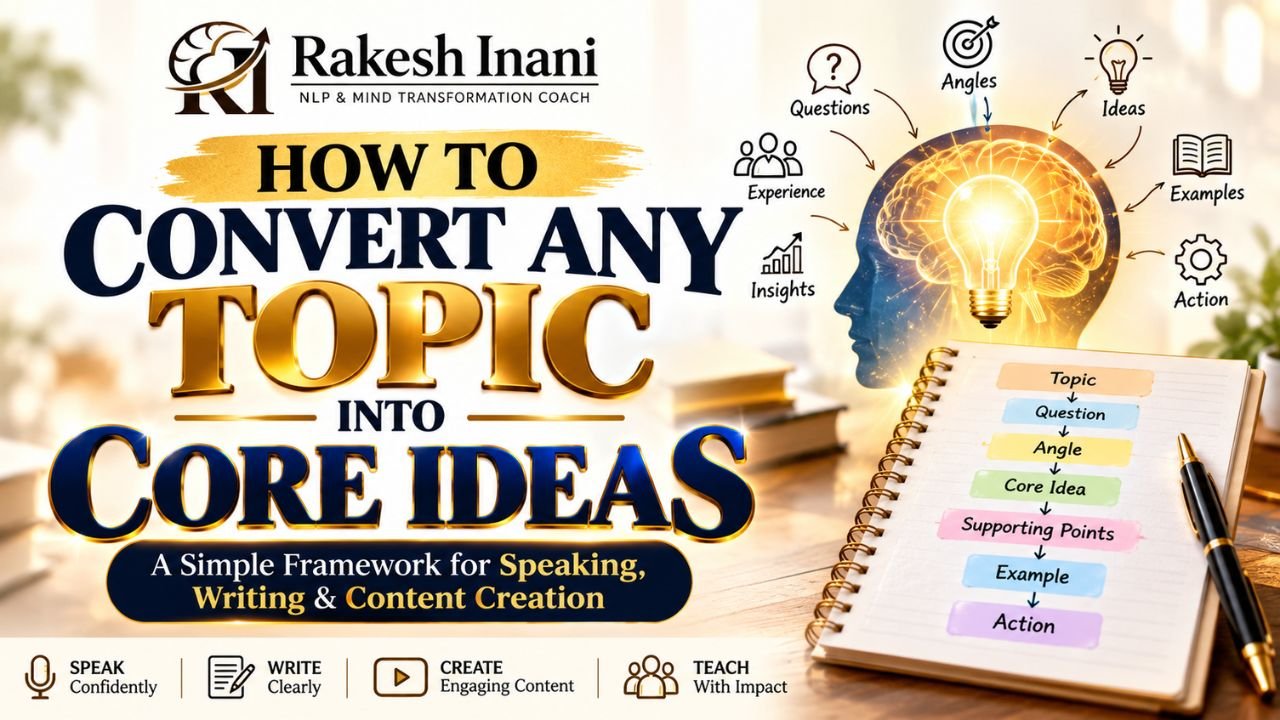
How to Convert Any Topic Into Core Ideas: A Simple Framework for Speaking, Writing & Content Creation
Have you ever chosen a topic, opened your notebook, and then suddenly wondered:
“Now what should I actually say about this?”
Maybe your topic is self-confidence.
You understand confidence. You may have read books about it. You may have watched videos about it. You may even have personal experience with it.
Still, when you try to speak for 10 minutes, write a blog post, record a YouTube video, or teach someone about confidence, your mind suddenly feels blank.
This happens to many people.
The problem is usually not that you do not have enough knowledge.
The real problem is that you are trying to speak directly from a topic instead of first converting that topic into a core idea.
That one change can make content creation much easier.
For example:
Topic: Self-Confidence
This is too broad.
However, when I say:
Core Idea: Self-confidence grows when you take action, not when you keep waiting to feel confident.
Now I have something meaningful to talk about.
I can explain why action matters.
I can explain how action builds confidence.
I can share an example.
I can give an exercise.
I can ask a reflective question.
And suddenly, one simple sentence can become a complete video, article, coaching lesson, podcast, workshop section, or speech.
So, in this guide, I am going to show you exactly how to convert any topic into core ideas.
More importantly, I will give you simple frameworks that you can use again and again.
By the end of this article, you will understand this process:
Topic → Question → Angle → Core Idea → Supporting Points → Example → Action
Let us begin.
What Is a Topic?
A topic is simply the subject you want to talk about.
For example:
- Self-confidence
- Overthinking
- Fear
- Communication
- Leadership
- Procrastination
- Decision-making
- Relationships
- Motivation
- Discipline
- Focus
- Productivity
These are all topics.
However, a topic only tells you what area you are talking about.
It does not tell you exactly what you want your audience to understand.
That is why simply choosing a topic is often not enough.
A Topic Tells You “What”
Suppose I tell you:
“Speak for 10 minutes about confidence.”
Your brain may immediately start searching for information.
What should I say first?
Should I define confidence?
Should I talk about fear?
Should I explain body language?
Should I talk about self-belief?
Should I share an example?
Suddenly, the topic feels too big.
However, imagine I change the instruction.
I say:
“Speak for 10 minutes about this idea: confidence grows through action.”
Now your mind gets direction.
You can explain:
- Why action matters
- How action builds confidence
- Why waiting for confidence can keep us stuck
- How small actions create small wins
- How small wins create stronger self-belief
Therefore, the topic is only your starting point.
The core idea gives direction to the topic.
What Is a Core Idea?
A core idea is the main message you want your audience to remember.
It may be a belief.
It may be an insight.
It may be a lesson.
It may be an observation.
It may be a principle.
It may even be a question that makes people think differently.
For example:
Topic: Self-Confidence
Possible core ideas could be:
Confidence grows through action.
You do not need complete confidence before you begin.
Small wins create evidence that you can trust yourself.
Confidence is not the absence of nervousness.
Preparation builds competence, and competence can support confidence.
Notice what happened.
One topic created many different ideas.
That means a topic is like a tree.
The core ideas are the branches.
You do not need to talk about the whole tree every time.
You can choose one branch and explore it deeply.
Topic vs Core Idea: What Is the Difference?
This difference is simple but powerful.
Topic = What are you talking about?
Core idea = What are you saying about it?
Let us take another example.
Topic: Overthinking
This is broad.
Now look at these core ideas:
Not every thought deserves your attention.
Thinking becomes overthinking when it stops helping you move forward.
More thinking does not always create more clarity.
Sometimes action gives you the information that thinking cannot.
Trying to achieve 100% certainty can create more mental confusion.
All these core ideas come from the same topic.
However, each one can become a separate video, blog article, social media post, workshop lesson, or coaching conversation.
This is why learning how to develop core ideas from a topic is such a valuable skill.
Why Do We Struggle to Find Core Ideas?
Before learning the method, let us understand why people get stuck.
Usually, there are a few common reasons.
You Try to Speak Directly From the Topic
This is probably the most common mistake.
You choose:
“Communication Skills.”
Then you immediately try to create a 10-minute speech.
But communication is huge.
It includes:
- Listening
- Speaking
- Body language
- Voice
- Confidence
- Questions
- Empathy
- Storytelling
- Clarity
- Persuasion
- Conflict
- Feedback
Therefore, your brain does not know which direction to take.
Instead, narrow it down.
For example:
Topic: Communication Skills
Angle: Listening
Core Idea: Good communication is not only about expressing yourself clearly. It is also about making the other person feel heard.
Now you have direction.
You Try to Find Too Many Ideas at Once
Sometimes we think good content must contain ten big ideas.
Usually, the opposite is true.
One strong idea explained clearly is often more useful than ten ideas explained poorly.
For example, instead of saying:
“Confidence depends on mindset, body language, action, preparation, communication, self-belief, habits and motivation…”
Choose one message:
“Confidence grows through repeated action.”
Then go deeper.
Depth creates value.
You Try to Find a Perfect Idea
Many people reject simple ideas because they think:
“This is too basic.”
“This has already been said.”
“This does not sound intelligent.”
“This is not unique enough.”
However, useful ideas do not always need to be complicated.
A simple truth explained beautifully can be more powerful than a complex statement nobody understands.
For example:
You do not have to feel ready before you start.
This is a simple idea.
But if you explain it through a story, psychology, personal experience, an analogy and a practical exercise, it can become very meaningful.
So do not ask:
“Is this idea impressive?”
Ask:
“Is this idea useful?”
You Consume More Than You Think
Another common problem is constant consumption.
We read.
We watch videos.
We listen to podcasts.
We scroll social media.
We collect information.
However, we rarely stop and ask:
“What do I think about this?”
Consumption gives you information.
Reflection develops your own ideas.
Therefore, if you want to create better core ideas, give yourself time to think.
The Simplest Formula: Topic + Question = Core Idea
Here is one of the easiest strategies you can use.
Instead of looking at the topic and asking:
“What should I say?”
Start asking questions about the topic.
Because questions open your thinking.
The formula is:
Topic + Question = Possible Core Idea
Let us take:
Topic: Self-Confidence
Now ask:
Why is confidence important?
How does confidence grow?
What destroys confidence?
Why do people lose confidence?
What do people misunderstand about confidence?
Does confidence come before action or after action?
Can someone act even when they do not feel confident?
How does preparation affect confidence?
What role does failure play in confidence?
What role does comparison play?
Look at what is happening.
We started with one word:
Confidence
But questions created many directions.
Now take one question.
Does confidence come before action or after action?
Think about it.
A possible answer is:
Many people wait for confidence before taking action, but confidence often develops because we take action.
That answer becomes your core idea.
Therefore, whenever your mind feels blank, do not force yourself to generate answers.
First generate questions.
Questions are often easier to create than ideas.
And answers to good questions naturally become core ideas.
The 7 Core Questions That Can Unlock Almost Any Topic
You do not need hundreds of questions.
In fact, seven basic question types can help you explore almost any topic deeply.
Let us go through them.
1. WHAT — What Is It Really?
The first question is:
What is this really about?
Ask:
What does this topic mean?
What is it?
What is it not?
What do people misunderstand about it?
How would I explain it simply?
For example:
Topic: Confidence
Ask:
What is confidence?
You may answer:
Confidence is not the absence of fear. It is your willingness to move even when some uncertainty is present.
Now you have a core idea.
Another answer could be:
Confidence is often built from evidence that you can handle situations.
That is another core idea.
So, the WHAT question helps you define the subject more clearly.
2. WHY — Why Does It Matter?
Now ask:
Why is this important?
Why should people care?
Why does this problem happen?
Why does this behaviour continue?
For example:
Topic: Self-Confidence
Question:
Why does action matter for confidence?
Possible answer:
Action matters because action gives your mind evidence. Every time you do something difficult and survive it, your brain learns that you may be more capable than you previously believed.
Now you have an idea worth teaching.
Similarly:
Topic: Procrastination
Why does procrastination happen?
Possible core idea:
Sometimes procrastination is not about laziness. It happens because starting a task creates discomfort, uncertainty or fear.
Again, one question creates one useful message.
3. HOW — How Does It Work?
This question helps you explain a process.
Ask:
How does this happen?
How does this problem develop?
How can someone improve it?
How does one step lead to another?
For example:
Topic: Confidence
Question:
How does action build confidence?
Possible explanation:
You act.
Then you gain experience.
Experience creates evidence.
Evidence changes your self-belief.
Your new self-belief makes the next action easier.
Now your core idea could become:
Confidence grows when repeated action creates repeated evidence of capability.
That is deeper than simply saying:
“Take action.”
4. WHAT STOPS IT — What Is the Barrier?
Now explore obstacles.
Ask:
What prevents people from improving?
What keeps someone stuck?
What mistake are people making?
What belief is blocking progress?
For example:
Topic: Confidence
A common barrier is waiting.
Someone may think:
“I will speak when I feel confident.”
“I will make the video when I feel ready.”
“I will start the business when I stop feeling scared.”
However, if confidence is partly developed through action, then waiting for confidence creates a loop.
Your core idea could be:
Waiting to feel completely confident can prevent you from doing the very things that would help build confidence.
That is a powerful teaching point.
5. WHAT IF — What Happens If Nothing Changes?
Now explore consequences.
Ask:
What happens if this pattern continues?
What happens if someone avoids the problem?
What happens after one year?
What happens after five years?
For example:
Topic: Fear
Suppose a person keeps avoiding public speaking because of fear.
Avoidance gives short-term relief.
However, every time they avoid speaking, the brain may learn:
“Speaking is dangerous.”
Therefore, the fear may remain strong.
A possible core idea becomes:
Avoidance can feel safe today while making tomorrow’s challenge feel even bigger.
Now you have a meaningful angle.
6. WHAT WORKS — What Is the Better Approach?
Now move toward solutions.
Ask:
What helps?
What is a more useful strategy?
What can someone do differently?
For example:
Topic: Confidence
Instead of forcing yourself to deliver a one-hour speech immediately, you could take progressive steps.
First, speak to yourself for one minute.
Then record a two-minute video.
Then speak to three people.
Then join a small group.
Then take a larger speaking opportunity.
The core idea could become:
Confidence often grows more naturally when you increase difficulty step by step instead of expecting yourself to handle the biggest challenge immediately.
Now the audience has both insight and direction.
7. WHAT NOW — What Can I Do Today?
This is one of my favourite questions because it converts knowledge into action.
Ask:
What is the smallest next step?
What can someone do in the next five minutes?
What can they practise today?
For example:
Instead of asking:
“How do I become a confident speaker?”
Ask:
“What is one small speaking action I can take today?”
Maybe the answer is:
Record a two-minute video on your phone.
That action is small.
But it moves the person from thinking to doing.
A possible core idea becomes:
Big confidence often starts with a small action repeated consistently.
The Topic-to-Core-Idea Funnel
Now let us put everything into one clear process.
Think of it like a funnel.
At the top, the topic is broad.
As you move down, the idea becomes more focused.
Let us use Self-Confidence as our example.
Level 1: Topic
Self-Confidence
Level 2: Angle
Self-Confidence and Action
Level 3: Question
Does confidence come before action, or can action create confidence?
Level 4: Core Idea
Confidence often develops after we start taking action rather than before it.
Level 5: Supporting Points
Why does action matter?
How does action create confidence?
What small action should someone take?
Level 6: Example
Stage speaking.
A person may wait to feel completely confident before going on stage.
However, the confidence usually develops after repeated speaking experiences.
Level 7: Application
Ask:
“What is one small uncomfortable action you can take today?”
This is the complete transformation.
Topic → Angle → Question → Core Idea → Supporting Points → Example → Action
Whenever you are confused about what to say, go through this funnel.
First Choose an Angle Before Choosing the Core Idea
A topic can contain many angles.
This is important because you do not always need a new topic.
Sometimes you simply need a new angle.
Let us take:
Topic: Overthinking
Possible angles include:
- Overthinking and decision-making
- Overthinking and fear
- Overthinking and sleep
- Overthinking and perfectionism
- Overthinking and relationships
- Overthinking and self-confidence
- Overthinking and past mistakes
- Overthinking and future uncertainty
- Overthinking and action
- Overthinking and control
Now let us choose:
Overthinking and Action
Ask:
How are overthinking and action connected?
Possible core idea:
Thinking becomes a problem when it keeps replacing action instead of supporting action.
Another possible idea:
Sometimes clarity does not come before action. Sometimes action creates clarity.
Notice how a broad topic suddenly becomes focused.
This is why one of the best answers to the question “How can I get more content ideas from one topic?” is:
Do not search for more topics.
Search for more angles.
10 Powerful Angles You Can Apply to Almost Any Topic
Whenever you need content ideas, run your topic through these ten angles.
1. Meaning Angle
Ask:
What does this really mean?
Example:
Confidence is not always feeling powerful. Sometimes it is simply being willing to try.
2. Problem Angle
Ask:
What problem does this topic create?
Example:
Low confidence can make capable people stay silent even when they have something valuable to say.
3. Cause Angle
Ask:
Why does this happen?
Example:
Fear of judgment can make us focus more on how we look than on what we want to communicate.
4. Mistake Angle
Ask:
What mistake do people commonly make?
Example:
A common confidence mistake is waiting to feel ready before practising.
5. Myth Angle
Ask:
What common belief may be incomplete?
Example:
Confidence does not always mean being fearless.
6. Solution Angle
Ask:
What can help?
Example:
Small repeated exposure can make challenging situations feel more familiar over time.
7. Process Angle
Ask:
How does improvement happen?
Example:
Practice creates experience, experience creates evidence, and evidence can strengthen confidence.
8. Story Angle
Ask:
What story demonstrates this idea?
You could share the story of someone who feared public speaking but slowly became comfortable by taking small speaking opportunities.
9. Contrarian Angle
Ask:
What looks true but may not always be true?
Example:
You may think you need confidence to take action, but sometimes you need action to develop confidence.
10. Action Angle
Ask:
What should someone do now?
Example:
Choose one small action that makes you slightly uncomfortable and complete it today.
Now imagine doing this with any topic.
You immediately have ten possible directions.
Use the “Because” Technique to Go Deeper
One of the easiest ways to develop deeper ideas is to use the word:
Because.
Start with a simple statement.
For example:
Self-confidence is important.
Now add:
because…
Self-confidence is important because it affects your behaviour.
Go deeper.
Why does it affect behaviour?
Because when you doubt yourself, you may avoid opportunities.
Why does that matter?
Because avoiding opportunities gives you less experience.
Why is that important?
Because less experience gives you less evidence that you can handle challenges.
Now you have gone from a basic statement to a deeper insight.
Your final core idea might become:
Confidence influences action, but action also influences confidence because every experience creates new evidence about what you can handle.
The simple word because forces your brain to explain.
And explanation creates depth.
Use the “So What?” Technique to Make Ideas Stronger
Another powerful technique is asking:
So what?
Let us begin with:
Practice improves confidence.
So what?
Practice makes a situation more familiar.
So what?
When something becomes familiar, uncertainty often reduces.
So what?
When uncertainty reduces, taking action may feel easier.
Now rewrite the idea:
Practice can strengthen confidence because repeated exposure turns unfamiliar situations into more familiar experiences.
That is a much stronger thought.
Whenever your statement feels too basic, ask:
So what does this mean?
Then ask again.
And again.
Usually, after two or three levels, you reach a more useful insight.
Use Contrast to Create Memorable Core Ideas
Contrast is another excellent way to create strong messages.
Use this formula:
Most people think X, but Y may be more useful.
For example:
Most people think they need confidence before taking action, but action itself can help create confidence.
Another:
People often wait for clarity before making a move, but sometimes movement creates clarity.
Another:
We often try to remove nervousness before speaking, but learning to speak while slightly nervous may be more useful.
Contrast works because it creates tension.
The brain notices the difference between two ideas.
Therefore, contrast can make your message more memorable.
Convert Problems Into Core Ideas
Problems contain ideas.
Whenever you notice a problem, use this simple process:
Problem → Cause → Insight
For example:
Problem
I hesitate to speak in meetings.
Cause
I am afraid people will judge what I say.
Insight
I am spending more attention on how I may be judged than on the value I want to communicate.
Now your core idea could be:
Fear of judgment grows when your attention moves from your message to yourself.
Or:
A useful speaking shift is moving your attention from “How do I look?” to “How can I contribute?”
This is how everyday problems can become useful teaching ideas.
Convert Personal Experience Into Core Ideas
You do not always need a book, study or expert quote to begin thinking.
Your own experiences can also reveal useful lessons.
Ask yourself:
What happened?
What did I notice?
What surprised me?
What did I learn?
What changed?
What would I do differently next time?
Where else might this lesson apply?
For example, suppose you recorded your first video.
You felt nervous before recording.
However, after recording three videos, you noticed that the nervousness reduced.
Your observation might become:
Repetition does not always remove fear immediately, but it can make the situation feel more familiar.
That becomes a core idea.
Then you can teach it.
Convert Stories Into Core Ideas
A story becomes powerful when it contains a lesson.
A simple story structure is:
Situation → Challenge → Decision → Result → Lesson
Suppose someone is invited to speak on stage.
They feel nervous.
Their first thought is:
“I am not confident enough.”
However, instead of cancelling, they prepare for five minutes and speak.
The speech is not perfect.
But they survive.
Next time, they feel slightly more comfortable.
After several experiences, they realize something:
They did not wait for confidence.
Confidence grew after repeated action.
The lesson becomes:
Sometimes confidence is the result of courageous action, not the condition required before action.
That lesson is your core idea.
Convert Questions Into Core Ideas
Questions can become complete pieces of content.
Consider these questions:
Why do intelligent people overthink?
Why do people procrastinate on important tasks?
Why do we lose confidence after one mistake?
Why do we compare ourselves with other people?
Why does motivation disappear?
Why do we sometimes know what to do but still avoid doing it?
Why do some conversations become difficult?
Why do we fear judgment?
Each question could become:
- A YouTube video
- A blog post
- A Reel
- A podcast
- A coaching discussion
- A workshop activity
- A newsletter
- A course lesson
Therefore, if you want to generate more content ideas, build a habit of collecting questions.
Convert Observations Into Core Ideas
Another powerful sentence starter is:
“I noticed that…”
For example:
“I noticed that people often prepare for a long time but still feel nervous if they never practise publicly.”
Now ask:
Why might this happen?
One possible answer:
Preparation gives knowledge.
Practice gives experience.
Then your core idea becomes:
Preparation gives you information, but performance gives you evidence.
That is a strong, simple message.
Similarly:
“I noticed that people often overthink more when they want complete certainty.”
Possible core idea:
The stronger your demand for certainty, the harder some decisions may feel.
Observations are everywhere.
Train yourself to notice patterns.
The 3-Level Core Idea Method
Sometimes your idea feels too shallow.
Use three levels.
Level 1: Simple Idea
Action builds confidence.
This is useful, but basic.
Level 2: Explanation
Action builds confidence because action gives you experience.
Now the idea is clearer.
Level 3: Deeper Insight
Repeated action can build confidence because every successful attempt creates evidence that you can handle the situation.
Now the idea has depth.
Therefore, whenever you create a core idea, ask:
Can I explain this one level deeper?
How to Turn One Topic Into 10 Core Ideas
Let us take Self-Confidence.
Here are ten different core ideas.
1. Confidence and Action
Confidence often grows after action begins.
2. Confidence and Preparation
Preparation cannot guarantee confidence, but preparation can reduce unnecessary uncertainty.
3. Confidence and Self-Talk
The way you interpret your mistakes can influence how confidently you approach the next attempt.
4. Confidence and Experience
Experience gives you evidence that imagination alone cannot provide.
5. Confidence and Failure
One failed attempt does not define your ability. It only gives you information about one attempt.
6. Confidence and Comparison
Constant comparison can weaken confidence because your attention stays on someone else’s progress instead of your own growth.
7. Confidence and Competence
As your skill improves, confidence often has more evidence to stand on.
8. Confidence and Fear
You can feel fear and still behave confidently.
9. Confidence and Small Wins
Small wins can gradually change the story you tell yourself about what you are capable of doing.
10. Confidence and Consistency
Confidence becomes more stable when your actions are repeated instead of occasional.
One topic.
Ten core ideas.
And each core idea could become one full piece of content.
How Do You Know Whether a Core Idea Is Good?
Use the CLEAR Test.
C — Clear
Can a person understand it quickly?
Weak:
Confidence is a multidimensional cognitive-emotional construct developed through behavioural integration.
Clear:
Confidence grows when you repeatedly prove to yourself that you can act.
Simple language wins.
L — Limited
Does the idea focus on one main message?
If your core idea includes confidence, communication, productivity, leadership and relationships at the same time, it is probably too broad.
Narrow it.
E — Explainable
Can you explain why you believe it?
If you cannot answer:
“Why?”
“How?”
or
“What does this mean?”
then the idea may need more thinking.
A — Applicable
Can someone do something with the idea?
A good teaching idea should usually lead toward:
Reflection.
Understanding.
A decision.
A behaviour.
An exercise.
An action.
R — Rememberable
Can someone remember the message after your content ends?
For example:
Action creates evidence. Evidence builds confidence.
That is easier to remember than a long complicated explanation.
Topic, Core Idea, Title and Supporting Point Are Not the Same
These terms can become confusing.
Let us separate them.
Topic
Self-Confidence
Core Idea
Confidence grows through action.
Title
Stop Waiting to Feel Confident: Take Action First
Supporting Points
- Why action matters
- How action creates evidence
- Why small actions are useful
- How to begin today
So remember:
The topic gives the category.
The core idea gives the message.
The title attracts attention.
The supporting points explain the message.
Core Idea vs Main Point: Is There a Difference?
People often use these words in similar ways.
However, I like to make a simple distinction.
The core idea is the central message of your content.
The main points are the important ideas you use to explain that message.
For example:
Core Idea
Small actions build confidence.
Main Points
Why small actions matter.
How repetition builds familiarity.
Why evidence changes self-belief.
How to choose the next small action.
This makes your content easier to structure.
How Many Core Ideas Should One Piece of Content Have?
There is no fixed rule.
However, one strong central idea is usually easier for the audience to remember.
Short Video
Usually one core idea.
Social Media Post
Usually one idea.
10-Minute YouTube Video
One main core idea with two to four supporting points.
Blog Post
One central theme with several related sub-ideas.
Workshop
Several connected ideas arranged in sequence.
Course
Many core ideas organized into modules and lessons.
The key principle is:
Do not overload the audience.
Give them enough depth to understand the message.
How to Turn a Core Idea Into Supporting Points
Once you have your core idea, use three simple questions:
Why?
How?
What now?
For example:
Core Idea
Self-confidence grows through action.
Why?
Why is action important?
Because action gives you real experience.
How?
How does action build confidence?
Action creates experience.
Experience creates evidence.
Evidence can change what you believe about yourself.
What Now?
What should you do?
Choose one small action that challenges you slightly.
This structure is simple and powerful.
The Core Idea Speaking Card
If you want to speak without memorizing a complete script, create a small speaking card.
Use this format:
Topic
Self-Confidence
Core Idea
Confidence grows through action.
Why?
Action gives real experience.
How?
Experience creates evidence.
Evidence strengthens self-belief.
What Now?
Choose one small action.
Example
Stage speaking.
Audience Question
What is one small action you can take right now?
Exercise
Record a two-minute video.
Closing Line
Small actions prepare you for bigger actions, and bigger actions can build stronger confidence.
Now you do not need to memorize every sentence.
You only need to remember the flow.
Complete Example: Turning “Self-Confidence” Into a Speaking Idea
Let us build the complete content step by step.
Topic
Self-Confidence
Angle
Confidence and Action
Question
Does confidence create action, or can action create confidence?
Core Idea
Self-confidence does not come only from positive thinking. It also grows when you take action and create evidence that you can handle the situation.
Supporting Point 1: Why Action Matters
You cannot learn everything through imagination.
At some point, you need experience.
If you want to become a confident speaker, thinking about public speaking may help you prepare.
However, speaking creates the experience.
Supporting Point 2: How Action Builds Confidence
Every completed action creates data.
You speak.
You notice what went well.
You notice what needs improvement.
You discover that mistakes are survivable.
Therefore, the next attempt feels different.
Supporting Point 3: Start Small
You do not need to begin with a stage of 1,000 people.
Start with a two-minute recording.
Then speak to a friend.
Then speak to a small group.
Increase the challenge gradually.
Example
Imagine someone preparing for a stage speech.
They keep saying:
“I am not confident.”
So they keep delaying.
But because they delay, they never collect speaking experience.
Instead, if they practise repeatedly, confidence gets new evidence.
Audience Question
What is one small action I can take right now?
Closing Thought
Small actions prepare you for bigger actions, and bigger actions can create bigger evidence of what you are capable of doing.
That is a complete speaking idea created from one simple topic.
Another Example: Turning “Overthinking” Into Core Ideas
Let us use another topic.
Topic
Overthinking
Possible core ideas:
Not every thought needs an answer.
Thinking becomes overthinking when it stops helping useful action.
Trying to find complete certainty can create more questions.
Sometimes action gives you clarity that thinking cannot.
The goal is not to stop thinking. The goal is to think in a useful direction.
Now choose one.
For example:
Sometimes action gives you clarity that thinking cannot.
You could build a complete video around that one line.
Why?
Because some information only appears after you start.
How?
You act, observe feedback and adjust.
What now?
Take a small reversible step instead of solving the entire future in your head.
Again, one core idea gives you a full structure.
Another Example: Turning “Procrastination” Into Core Ideas
Topic:
Procrastination
Now ask:
Why do people procrastinate?
A common answer is:
“They are lazy.”
But ask deeper questions.
What if the task feels uncertain?
What if the person fears failure?
What if the task feels too big?
What if they want perfection?
What if they do not know where to begin?
Now a deeper core idea might be:
Procrastination is not always a time-management problem. Sometimes it is a discomfort-management problem.
That idea opens many directions.
You can explain:
Why difficult tasks create discomfort.
How avoidance creates temporary relief.
Why temporary relief reinforces delay.
How breaking the task into a smaller first step can help.
This is how you move from a common topic to a useful insight.
What to Do When Your Mind Feels Completely Blank
Sometimes you sit down to create and nothing comes.
Use these sentence starters.
Write your topic first.
Then complete:
I believe…
I noticed…
Most people think…
The real problem is…
One common mistake is…
The reason this happens is…
A better way to think about this is…
One thing people forget is…
A useful example is…
The lesson is…
The first step is…
Let us try it.
Topic: Decision-Making
I believe…
I believe many decisions feel difficult because we demand certainty before making them.
That could become your core idea.
Topic: Communication
One common mistake is…
One common communication mistake is preparing your reply while the other person is still speaking.
Again, core idea.
These sentence starters help your brain move.
The 5-Minute Core Idea Exercise
Here is a practical daily exercise.
You can use it for writing, speaking or content creation.
Minute 1: Write the Topic
Example:
Fear of Failure
Do not think too much.
Just write the topic.
Minute 2: Write Five Questions
Why do people fear failure?
What does failure mean to people?
How does fear of failure affect action?
What do people misunderstand about failure?
What can reduce fear of failure?
Minute 3: Write Five Quick Answers
Do not try to sound perfect.
Write naturally.
For example:
People fear failure because they connect failure with identity.
Fear of failure can create avoidance.
Avoidance reduces experience.
Failure can give feedback.
Small experiments may reduce the pressure to be perfect.
Minute 4: Choose the Strongest Answer
Choose the idea that feels:
Clear.
Useful.
Relevant.
Easy to explain.
For example:
People suffer more when they interpret failure as proof of who they are instead of information about what happened.
Minute 5: Add Why, How and What Now
Why does this matter?
How does this pattern work?
What can someone do differently?
Done.
You now have enough structure to speak or write.
Why Simple Core Ideas Are Often More Powerful
People sometimes believe deep thinking must use difficult language.
It does not.
Depth comes from the quality of your thinking.
Not from difficult words.
For example:
A mistake is an event. It is not your identity.
Simple language.
Deep message.
Another:
You do not need to control every thought. You need to choose which thoughts deserve action.
Again, simple.
Your goal is not to make people say:
“Wow, that sounded complicated.”
Your goal is to make people say:
“I understand.”
Better still:
“I never thought about it like that.”
That is powerful communication.
How to Make a Core Idea More Original
At some point, you may think:
“Everything has already been said.”
In one sense, that may feel true.
People have talked about confidence for centuries.
People have talked about fear, discipline, relationships, success and habits for a very long time.
However, originality does not always mean discovering a truth nobody has ever seen.
Originality can come from:
Your angle.
Your experience.
Your example.
Your analogy.
Your framework.
Your story.
Your language.
Your audience.
Your questions.
Your way of connecting ideas.
For example, the statement:
“Take action.”
is not new.
But you could explain it through this framework:
Action → Experience → Evidence → Self-Belief → Confidence
Now you have created a useful teaching model.
Therefore, instead of asking:
“Has anyone said this before?”
Ask:
“Can I explain this in a way that is useful, clear and relevant to my audience?”
How to Develop Deeper Thinking Around Any Topic
Core ideas become easier when thinking becomes a habit.
Take one topic every day.
Then ask five questions.
1. What do I believe about this?
Write your personal view.
2. Why do I believe it?
Find the reasoning.
3. Where have I seen this?
Find examples.
4. When might this not be true?
Challenge your own thinking.
5. How can someone use this?
Make it practical.
For example:
Topic:
Motivation
What do I believe?
Motivation changes.
Why?
Energy, emotions and circumstances change.
Where have I seen this?
People often feel motivated after watching a video but lose motivation later.
When is this not true?
Some people maintain strong motivation when a goal has deep personal meaning.
How can someone use this?
Build routines that do not depend entirely on motivation.
Core idea:
Motivation can help you start, but systems help you continue when motivation changes.
That is the result of structured thinking.
Common Mistakes When Creating Core Ideas
Let us look at mistakes that can weaken your content.
Making the Idea Too Broad
Weak:
Confidence is important in life.
Better:
Confidence in speaking grows when you repeatedly practise expressing your ideas.
Specific ideas are easier to explain.
Putting Five Ideas Into One Sentence
Do not try to teach everything at once.
Choose one message.
Then use supporting points.
Using Complicated Words
Complex language does not automatically create authority.
Clarity creates trust.
Say what you mean simply.
Creating a Statement You Cannot Explain
If someone asks:
“Why?”
and you have no answer, the idea needs more work.
Always build reasoning behind your message.
Giving Advice Without Explaining Why
“Just take action.”
“Stop thinking.”
“Be positive.”
“Believe in yourself.”
These lines may sound encouraging, but they are incomplete.
Explain the mechanism.
Why should someone take action?
What happens when they act?
How should they begin?
Explanation turns advice into teaching.
Confusing Examples With Core Ideas
An example supports your message.
It is not the message itself.
For example:
“My first stage speech was difficult.”
That is an experience.
The core idea might be:
Early attempts often feel uncomfortable because the situation is still unfamiliar.
Now the story supports the insight.
Trying to Sound Intelligent Instead of Being Clear
Your audience should not need a dictionary to understand your message.
Use simple words.
Explain one thought at a time.
Then go deeper through examples.
How Core Ideas Improve Your Speaking Skills
If you are learning to speak without reading scripts, core ideas can help tremendously.
Instead of memorizing paragraphs, remember ideas.
Suppose your speaking card contains:
Core Idea: Confidence grows through action.
Point 1: Action creates experience.
Point 2: Experience creates evidence.
Point 3: Start small.
Example: Stage speaking.
Question: What small action can you take today?
That may be enough to speak for five or ten minutes.
Because now you are expressing thoughts.
You are not reciting sentences.
Over time, this can help you:
Organize thoughts faster.
Reduce word loss.
Stay on topic.
Develop examples naturally.
Speak more conversationally.
Build stronger transitions.
Improve spontaneous speaking.
Therefore, core idea practice is not only a content creation skill.
It is also a thinking and communication skill.
How Core Ideas Improve Content Creation
Core ideas make content creation scalable.
Imagine your main topic is:
Overthinking
You generate 20 core ideas.
Now each core idea can become:
One YouTube video.
One blog section.
One LinkedIn post.
One Instagram carousel.
Several short-form videos.
One email.
One coaching exercise.
One live session topic.
One podcast discussion.
Suddenly, you do not have one topic.
You have an entire content ecosystem.
The process becomes:
One Topic → Many Core Ideas → Many Content Pieces
This is a much better system than constantly asking:
“What should I post today?”
How to Build Your Own Core Idea Bank
Create a simple notebook, spreadsheet or notes file.
Use these columns:
Topic
Question
Core Idea
Example
You can also add:
Supporting Points
Story
Analogy
Exercise
CTA
Content Format
For example:
Topic: Confidence
Question: Does confidence come before action?
Core Idea: Action can build confidence.
Example: Stage speaking.
Supporting Point: Experience creates evidence.
Exercise: Record a two-minute video.
Content Format: YouTube video.
As you collect ideas, you build your own intellectual library.
After several months, content creation becomes much easier because you are no longer starting from zero.
A Universal Core Idea Generator Template
Whenever you have a topic, complete these sentences.
My topic is __________.
People often believe __________.
The real problem may be __________.
This happens because __________.
What people sometimes miss is __________.
A better way to think about it is __________.
One example is __________.
One practical step is __________.
Then complete:
Therefore, my core idea is: __________.
Let us try it quickly.
Topic:
Overthinking
People often believe:
More thinking creates more certainty.
The real problem may be:
Some questions do not have completely certain answers.
This happens because:
Life contains uncertainty.
What people sometimes miss:
Action creates information.
A better way:
Think enough to make a reasonable next decision, then learn from action.
Core idea:
You do not need complete certainty to take the next useful step.
Simple.
Practical.
Clear.
25 Questions You Can Ask About Any Topic
Whenever you need more ideas, use these questions.
- What is this topic really about?
- Why does it matter?
- Why does this problem happen?
- What causes it?
- What makes it worse?
- What makes it better?
- What do people misunderstand about it?
- What is the biggest mistake people make?
- What is one common myth?
- What is the first step?
- What happens if nothing changes?
- What happens when someone improves?
- What have I personally noticed?
- What story represents this?
- What analogy explains it?
- What is the opposite of this idea?
- What do beginners need to understand?
- What do experienced people understand differently?
- What can someone do today?
- What should someone stop doing?
- What question should someone ask themselves?
- What belief may be holding someone back?
- What one idea could simplify this topic?
- How would I explain this to a 10-year-old?
- What is the one sentence I want my audience to remember?
These 25 questions can generate hundreds of ideas over time.
Frequently Asked Questions About Finding Core Ideas
How Do You Turn a Topic Into a Core Idea?
Start with your broad topic.
Then choose one angle.
Ask a focused question about that angle.
Answer the question in one clear sentence.
That answer becomes your possible core idea.
For example:
Topic: Confidence.
Question: How does confidence grow?
Core idea: Confidence often grows through repeated action and evidence.
How Do I Find the Main Idea for My Content?
Ask:
“What is the one thing I want my audience to understand after consuming this content?”
Your answer is usually close to your core idea.
Then make it clear, specific and easy to remember.
What Is an Example of a Core Idea?
Topic:
Procrastination
Core idea:
Procrastination is not always a lack of discipline. Sometimes we delay because a task creates emotional discomfort.
The topic is broad.
The core idea gives a clear message about the topic.
What Is the Difference Between a Topic and a Core Idea?
A topic is the subject.
A core idea is the message you want to communicate about that subject.
For example:
Topic: Communication
Core idea: Good communication begins with understanding before responding.
How Can I Generate Multiple Ideas From One Topic?
Use different angles.
Explore:
Meaning.
Problem.
Cause.
Mistake.
Myth.
Solution.
Process.
Story.
Contrast.
Action.
One topic can easily produce ten or more useful core ideas.
How Do I Know Whether My Core Idea Is Strong?
Use the CLEAR test.
Is it:
Clear?
Limited?
Explainable?
Applicable?
Rememberable?
If yes, you probably have a strong starting point.
Can One Topic Have Multiple Core Ideas?
Yes.
In fact, almost every useful topic contains many possible core ideas.
For example, confidence can be explored through action, preparation, fear, comparison, competence, failure, self-talk, habits and experience.
Each direction can create a separate core idea.
How Many Core Ideas Should a YouTube Video Have?
For many educational YouTube videos, one main core idea supported by two to four points works well.
This keeps the video focused.
However, longer videos may contain several connected ideas under one larger theme.
How Can I Develop Ideas for Speaking?
Instead of memorizing full scripts, create a speaking card.
Write:
Topic.
Core idea.
Why.
How.
What now.
Example.
Question.
Closing line.
Then practise speaking from the structure.
What Should I Do When I Know a Topic but Do Not Know What to Say?
Do not immediately search for more information.
First, ask questions about the topic.
Write five questions.
Then answer them in simple language.
Usually, one of those answers will become your core idea.
How Can I Organize My Thoughts Before Speaking?
Use this sequence:
Core Idea → Why → How → Example → What Now
This gives your mind a clear path.
You do not have to remember every sentence.
You only need to remember the direction.
Can This Method Be Used for Blogs, Videos, Coaching and Courses?
Yes.
The same thinking process can be used for:
Blogs.
YouTube videos.
Social media.
Podcasts.
Courses.
Coaching.
Counselling conversations.
Presentations.
Workshops.
Webinars.
Newsletters.
The format changes.
The thinking process remains similar.
Final Framework: Topic → Question → Angle → Core Idea → Content
Let us bring everything together.
Whenever you choose a topic, follow these seven steps.
Step 1: Choose Your Topic
Example:
Self-Confidence
Step 2: Ask Questions
Why does confidence matter?
How does confidence grow?
What reduces confidence?
What do people misunderstand?
Step 3: Choose One Angle
Confidence and action.
Step 4: Write One Clear Core Idea
Confidence often grows through action.
Step 5: Ask Why, How and What Now
Why does action matter?
How does action create confidence?
What small action can someone take?
Step 6: Add an Example or Story
Use stage speaking.
Use a personal experience.
Use a client-style scenario.
Use an analogy.
Step 7: End With Action or Reflection
Ask:
“What is one small action you can take today?”
That is your complete content flow.
Remember the formula:
Topic → Question → Angle → Core Idea → Supporting Points → Example → Action
Conclusion: Stop Asking “What Should I Say?”
The next time you choose a topic and your mind goes blank, do not keep asking:
“What should I say about this?”
Instead, ask:
“What do I want someone to understand about this topic?”
That question changes everything.
Your topic gives you a direction.
Your questions open your thinking.
Your angle creates focus.
Your core idea gives your message meaning.
Your supporting points create structure.
Your stories make it relatable.
Your examples make it clear.
And your action step makes it useful.
So, if your topic is confidence, do not try to explain everything about confidence.
Choose one idea.
If your topic is overthinking, do not try to solve the entire subject in one video.
Choose one angle.
If your topic is communication, do not talk about every communication skill at once.
Choose one message.
Then go deeper.
The goal is not to say more.
The goal is to say one useful thing clearly enough that your audience understands it, remembers it and can use it.
And once you master this skill, you will stop depending so heavily on ready-made scripts.
You will become better at generating your own thoughts.
You will become better at organizing ideas.
You will become better at speaking.
You will become better at writing.
And most importantly, you will begin turning simple topics into meaningful messages.
So whenever you feel stuck, remember this simple formula:
TOPIC → QUESTIONS → ANGLE → CORE IDEA → WHY → HOW → WHAT NOW → EXAMPLE → ACTION
Start with one topic.
Ask one good question.
Find one useful insight.
And build from there.
Transform Your Mind: JOIN MIND TRANSFORMATION COMMUNITY
Learn More:
Real Leaders Know This ONE Secret to Influencing Without Speaking
7 Day Manifestation- NLP Guided Meditation for Success
The Complete Success Formula: 6 Steps to Turn Goals into Consistent Action