
How to Memorize Numbers and Digits Using the Phonetic Major System
Numbers can be difficult to remember.
A word such as “mango” creates a clear image. You can see its colour, imagine its taste, and feel its shape.
However, a number such as 731946 does not naturally create a picture.
It looks like a dry line of digits.
This is why you may easily remember a person’s face but forget their phone number. You may understand an important statistic during a presentation but fail to recall it the next day.
Fortunately, you can make numbers more memorable by converting them into sounds, words, and mental images.
This method is known as the Phonetic Major System, the Major Memory System, the Phonetic Number System, or sometimes simply the Phonetic System.
Here is the direct answer:
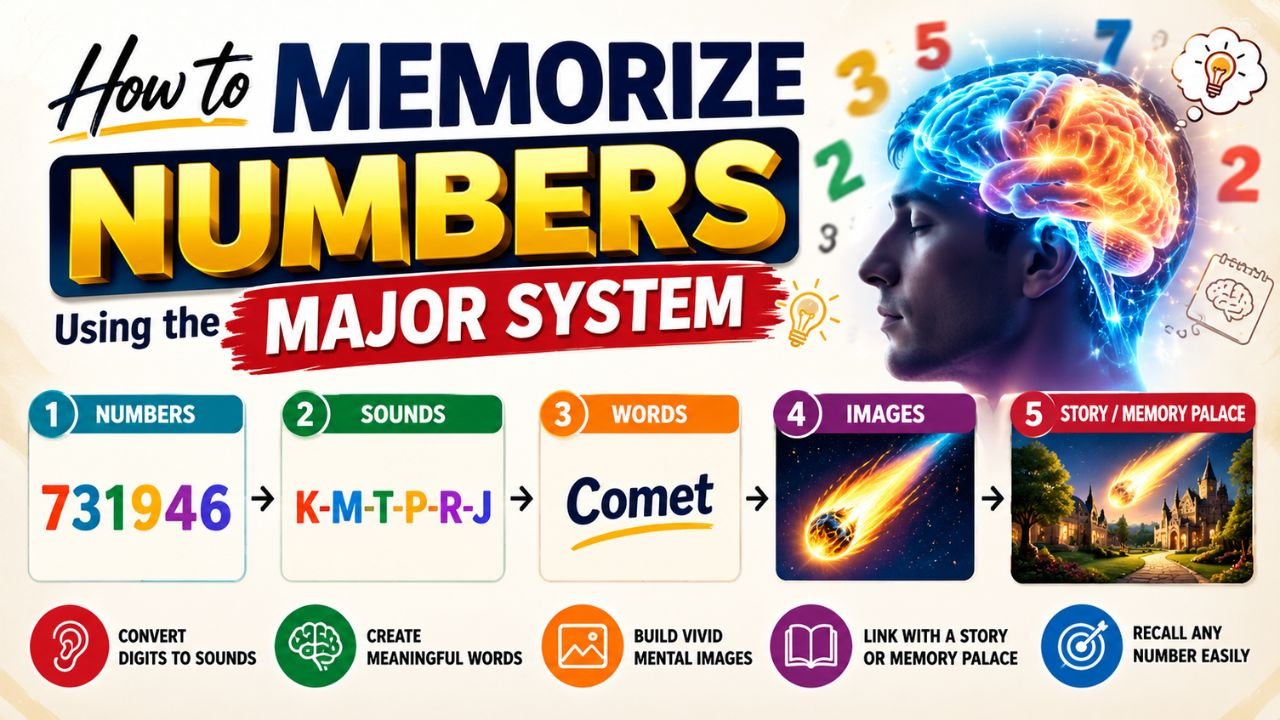
The Phonetic Major System is a memory technique that converts each digit from 0 to 9 into a consonant sound. You add vowels to these sounds to create words. Next, you turn the words into vivid mental images, stories, or locations. Later, you decode the images to recover the original number.
For example, the number 32 can become the consonant sounds M and N.
By adding the vowel sounds “oo,” you can create the word moon.
You can easily picture a huge moon.
Therefore:
32 → M-N → Moon → Mental image
When you later recall the moon, you remove the vowel sounds and convert M-N back into 3-2.
This may sound complicated at first.
However, once you learn the ten sound codes, the system becomes logical and flexible.
Is It Called the Peg System or the Phonetic System?
The two methods are connected, but they are not exactly the same.
What Is the Number-Rhyme Peg System?
In the basic number-rhyme peg system, each number is connected with a rhyming word:
- One is a bun
- Two is a shoe
- Three is a tree
- Four is a door
- Five is a hive
- Six is sticks
- Seven is heaven
- Eight is a gate
- Nine is a vine
- Ten is a hen
You attach information to these permanent pegs.
For example, if the fifth item on your list is tea, you might imagine bees drinking tea from a hive.
The basic peg system is excellent for remembering ordered lists. However, it does not directly encode a long number such as 24193857.
What Is the Phonetic Major System?
The Phonetic Major System gives every digit one or more consonant sounds.
You use those sounds to build words.
For example:
- 2 becomes N
- 4 becomes R
- 1 becomes T or D
Therefore, 241 can become N-R-T.
By adding vowels, you could form the word narrate.
The exact word you choose will depend on how you pronounce it. What matters is the sequence of consonant sounds.
How Are the Two Systems Connected?
The Major System can be used to create a much larger set of pegs.
Instead of having only ten rhyming pegs, you can create a permanent image for every number from 00 to 99.
For example:
- 00 = sauce
- 01 = seed
- 02 = sun
- 03 = sumo
- 04 = zero
- 05 = seal
You can then use these images as number pegs.
Therefore, the Major System is both:
- A method for converting long numbers into words
- A method for creating permanent number pegs
In this section, I will focus on the Phonetic Major System because it is more powerful for memorizing actual numbers and digits.
Why Are Numbers So Difficult to Remember?
Numbers are abstract.
The number 8 does not have a smell, colour, sound, or emotion. It only has meaning when it is connected with something.
For example:
- ₹8 may represent a price.
- 8:00 may represent a meeting time.
- 8 September may represent a birthday.
- Room 8 may represent a location.
- Eight steps may represent a process.
Without context, the digit remains weak.
Moreover, one digit may look similar to another when you are reading quickly. Long number strings can also overload your working memory.
Consider this number:
7319462085
You may repeat it several times. Still, one interruption may cause the whole number to disappear.
Now imagine converting it into five images:
73 | 19 | 46 | 20 | 85
Using the Major System, these pairs could become:
- 73 = comb
- 19 = tub
- 46 = roach
- 20 = nose
- 85 = file
You can now create a strange scene:
A giant comb jumps into a tub. A roach climbs out and sits on your nose while reading a file.
The number has become a visual story.
Later, the story helps you recover the digits.
How Does the Phonetic Major System Work?
The complete method has five stages:
- Convert digits into consonant sounds.
- Add free vowel sounds to create words.
- Turn the words into clear mental images.
- Connect the images through a story or memory palace.
- Decode the images to recover the number.
The method is phonetic.
That means sound matters more than spelling.
For example, the letter C can have different values:
- C in “city” sounds like S, so it represents 0.
- C in “cat” sounds like K, so it represents 7.
- C in some “ch” sounds represents 6.
Therefore, listen to the sound instead of counting written letters.
The Complete Phonetic Major System Code
Memorize this table before trying to use the full system.
| Digit | Main consonant sounds | Common letters | Easy memory clue |
|---|---|---|---|
| 0 | S, Z | s, z, soft c | Zero begins with Z |
| 1 | T, D | t, d | T and D have one main downward stroke |
| 2 | N | n | N has two downward strokes |
| 3 | M | m | Lowercase m has three downward strokes |
| 4 | R | r | Four ends with the R sound |
| 5 | L | l | L is the Roman numeral for 50 |
| 6 | J, SH, CH, soft G | j, sh, ch, soft g | A written J can look like a turned 6 |
| 7 | K, hard G | k, hard g, hard c, q | K can look like two small 7s |
| 8 | F, V | f, v, ph | A handwritten f may have two loops like 8 |
| 9 | P, B | p, b | P and b can look like a turned 9 |
Different teachers sometimes use small variations.
For example, some include the TH sound under number 1. Some also handle the NG sound differently.
As a beginner, choose one version and use it consistently.
For this guide, the central code is:
0—S/Z, 1—T/D, 2—N, 3—M, 4—R, 5—L, 6—J/SH/CH, 7—K/G, 8—F/V, 9—P/B
How to Memorize the Sound Code
At first, the code may look like another list you must memorize.
However, several simple clues can help.
Remember 0 as S or Z
The word zero begins with Z.
Moreover, both S and Z have a similar sound.
Examples:
- Zoo = 0
- Sea = 0
- Sew = 0
The vowels do not count.
Remember 1 as T or D
A capital T has one main downward stroke.
A lowercase printed d can also be imagined with one tall line.
T and D are produced in similar areas of the mouth. One is unvoiced, while the other is voiced.
Examples:
- Tie = 1
- Tea = 1
- Day = 1
Remember 2 as N
A lowercase n has two main downward strokes.
Examples:
- Noah = 2
- Knee = 2
- Hen = 2
The silent K in “knee” does not count because you do not hear it.
Remember 3 as M
A lowercase m has three downward strokes.
Examples:
- Ma = 3
- Home = 3
- Ham = 3
Remember 4 as R
The word “four” ends with the R sound in accents that pronounce it.
Examples:
- Row = 4
- Arrow = 4
- Ray = 4
Remember 5 as L
L is the Roman numeral for 50.
Examples:
- Law = 5
- Lily contains two separate L sounds, so it can represent 55
- Whale = 5
Remember 6 as J, SH, CH, or Soft G
A handwritten J can look like a turned 6.
These sounds belong to one sound family.
Examples:
- Shoe = 6
- Jaw = 6
- Chair = 64 because CH is 6 and R is 4
- Gem = 63 because soft G is 6 and M is 3
Remember 7 as K or Hard G
A capital K can look like two small number sevens placed together.
Hard G belongs to the same sound family.
Examples:
- Key = 7
- Cow = 7
- Go = 7
- Cake = 77 because it contains two separate K sounds
Remember 8 as F or V
A handwritten lowercase f may have an upper and lower loop like an 8.
F and V are similar sounds. The difference is mainly whether the voice is active.
Examples:
- Ivy = 8
- Fee = 8
- View = 8
- Fife = 88
Remember 9 as P or B
The letter P can look like a reversed 9.
A lowercase b can look like a turned 9.
Examples:
- Pie = 9
- Bee = 9
- Boy = 9
- Pipe = 99 because it contains two P sounds
Which Sounds Are Free?
Vowel sounds normally have no number value in the Major System.
This means you can add A, E, I, O, and U sounds wherever you need them.
The sounds represented by H, W, and Y are also commonly treated as free sounds.
You use these free sounds to turn a difficult consonant pattern into a natural word.
For example:
- 32 gives you M-N.
- Add “oo” between the sounds.
- M-N becomes moon.
The vowels make the word pronounceable, but they do not change the number.
Similarly:
- 15 gives you T-L or D-L.
- You can create tail, tile, towel, or doll, depending on pronunciation.
- Each word contains the important sounds T/D and L.
However, not every word is equally useful.
Choose a word that creates a clear mental image.
“Towel” is easier to picture than an abstract word with the same code.
Sound Matters More Than Spelling
This is the most important rule in the Phonetic Major System.
Do not code the written letters.
Code the sounds you hear.
Example: Soft C and Hard C
“City” begins with an S sound.
Therefore, the C represents 0.
“Cat” begins with a K sound.
Therefore, the C represents 7.
Example: Soft G and Hard G
“Gem” begins with a J sound.
Therefore:
- J sound = 6
- M sound = 3
- Gem = 63
“Game” begins with a hard G sound.
Therefore:
- Hard G = 7
- M = 3
- Game = 73
Example: PH
The PH in “phone” creates an F sound.
Therefore, it represents 8.
The word “phone” contains:
- F = 8
- N = 2
So, “phone” represents 82.
Example: Silent Letters
The word “knee” begins with a silent K.
You only hear the N sound.
Therefore, “knee” represents 2, not 72.
Example: Double Letters
A double letter does not automatically create two digits.
What matters is whether you hear one sound or two separate sounds.
For example, the word “bell” has one clear L sound at the end.
Therefore:
- B = 9
- L = 5
- Bell = 95
It does not become 955 simply because L is written twice.
Example: The Letter X
X often creates two sounds: K and S.
Therefore, it may represent 70.
This can create confusion for beginners.
For that reason, avoid complicated X words until the basic system feels automatic.
How to Convert a Number Into a Word
Let us begin with a two-digit number.
Suppose the number is:
32
Step 1: Convert Each Digit Into a Sound
- 3 = M
- 2 = N
Therefore:
32 = M-N
Step 2: Add Free Vowel Sounds
Possible words include:
- Moon
- Mine
- Mane
- Menu, depending on pronunciation
Step 3: Choose the Clearest Image
“Moon” creates a very clear object.
Therefore:
32 = Moon
Step 4: Visualize the Word
Do not picture a weak, distant moon.
Imagine a giant silver moon filling your room and pushing against the walls.
Step 5: Decode the Image
When you remember the moon:
- M = 3
- N = 2
Therefore, moon returns you to 32.
How to Convert a Word Back Into a Number
Decoding is the reverse process.
Suppose your image is a lion.
Ignore the vowels.
The main consonant sounds are:
- L = 5
- N = 2
Therefore:
Lion = 52
Now consider map:
- M = 3
- P = 9
Therefore:
Map = 39
Now consider chair:
- CH = 6
- R = 4
Therefore:
Chair = 64
You must practise both directions:
- Number to word
- Word to number
If you only practise creating words, you may remember the image but struggle to recover the digits.
Start With Single-Digit Images
Before creating a list from 00 to 99, learn one basic image for each single digit.
| Digit | Sound | Suggested image |
|---|---|---|
| 0 | S or Z | Sea |
| 1 | T or D | Tie |
| 2 | N | Noah |
| 3 | M | Ma |
| 4 | R | Rye |
| 5 | L | Law |
| 6 | SH, CH, or J | Shoe |
| 7 | K or hard G | Cow |
| 8 | F or V | Ivy |
| 9 | P or B | Bee |
These images are only starting suggestions.
You may replace them with images that are clearer for you.
The sound code must remain stable, but the object may be personal.
For example, you may prefer:
- 0 = zoo
- 1 = tea
- 2 = hen
- 3 = home
- 4 = arrow
- 5 = whale
- 6 = jaw
- 7 = key
- 8 = hoof
- 9 = pie
Choose one image and use it consistently.
Build a Permanent 00–99 Number Peg List
Once you know the sound code, you can create one permanent image for every two-digit number from 00 to 99.
This gives you one hundred mental pegs.
You do not need to memorize all one hundred pegs on your first day.
Begin with 00–09. Next, learn 10–19. Continue in groups of ten.
The following list gives you a practical starting vocabulary.
Pronunciation can vary, so say each word aloud and confirm that it matches the intended consonant sounds in your accent.
Major System Pegs From 00 to 09
| Number | Peg word | Main sounds |
|---|---|---|
| 00 | Sauce | S-S |
| 01 | Seed | S-D |
| 02 | Sun | S-N |
| 03 | Sumo | S-M |
| 04 | Zero | Z-R |
| 05 | Seal | S-L |
| 06 | Sash | S-SH |
| 07 | Sock | S-K |
| 08 | Sofa | S-F |
| 09 | Soap | S-P |
Major System Pegs From 10 to 19
| Number | Peg word | Main sounds |
|---|---|---|
| 10 | Toes | T-S |
| 11 | Dad | D-D |
| 12 | Tin | T-N |
| 13 | Tomb | T-M |
| 14 | Tire | T-R |
| 15 | Towel | T-L |
| 16 | Dish | D-SH |
| 17 | Dog | D-G |
| 18 | Dove | D-V |
| 19 | Tub | T-B |
Major System Pegs From 20 to 29
| Number | Peg word | Main sounds |
|---|---|---|
| 20 | Nose | N-S |
| 21 | Net | N-T |
| 22 | Nun | N-N |
| 23 | Name | N-M |
| 24 | Near | N-R |
| 25 | Nail | N-L |
| 26 | Notch | N-CH |
| 27 | Neck | N-K |
| 28 | Knife | N-F |
| 29 | Knob | N-B |
Major System Pegs From 30 to 39
| Number | Peg word | Main sounds |
|---|---|---|
| 30 | Mouse | M-S |
| 31 | Mat | M-T |
| 32 | Moon | M-N |
| 33 | Mummy | M-M |
| 34 | Mirror | M-R |
| 35 | M-L | |
| 36 | Match | M-CH |
| 37 | Mug | M-G |
| 38 | Movie | M-V |
| 39 | Map | M-P |
Major System Pegs From 40 to 49
| Number | Peg word | Main sounds |
|---|---|---|
| 40 | Rose | R-Z |
| 41 | Rat | R-T |
| 42 | Rain | R-N |
| 43 | Ram | R-M |
| 44 | Roar | R-R |
| 45 | Rail | R-L |
| 46 | Roach | R-CH |
| 47 | Rock | R-K |
| 48 | Roof | R-F |
| 49 | Rope | R-P |
Major System Pegs From 50 to 59
| Number | Peg word | Main sounds |
|---|---|---|
| 50 | Lace | L-S |
| 51 | Light | L-T |
| 52 | Lion | L-N |
| 53 | Lime | L-M |
| 54 | Lure | L-R |
| 55 | Lily | L-L |
| 56 | Leash | L-SH |
| 57 | Lock | L-K |
| 58 | Leaf | L-F |
| 59 | Lip | L-P |
Major System Pegs From 60 to 69
| Number | Peg word | Main sounds |
|---|---|---|
| 60 | Cheese | CH-Z |
| 61 | Sheet | SH-T |
| 62 | Chain | CH-N |
| 63 | Jam | J-M |
| 64 | Chair | CH-R |
| 65 | Jail | J-L |
| 66 | Judge | J-J |
| 67 | Chalk | CH-K |
| 68 | Chef | CH-F |
| 69 | Ship | SH-P |
Major System Pegs From 70 to 79
| Number | Peg word | Main sounds |
|---|---|---|
| 70 | Case | K-S |
| 71 | Cat | K-T |
| 72 | Coin | K-N |
| 73 | Comb | K-M |
| 74 | Car | K-R |
| 75 | Coal | K-L |
| 76 | Cage | K-J |
| 77 | Cake | K-K |
| 78 | Coffee | K-F |
| 79 | Cap | K-P |
Major System Pegs From 80 to 89
| Number | Peg word | Main sounds |
|---|---|---|
| 80 | Vase | V-S |
| 81 | Feet | F-T |
| 82 | Fan | F-N |
| 83 | Foam | F-M |
| 84 | Fire | F-R |
| 85 | File | F-L |
| 86 | Fish | F-SH |
| 87 | Fig | F-G |
| 88 | Fife | F-F |
| 89 | VIP | V-P |
Major System Pegs From 90 to 99
| Number | Peg word | Main sounds |
|---|---|---|
| 90 | Bus | B-S |
| 91 | Bat | B-T |
| 92 | Pen | P-N |
| 93 | Beam | B-M |
| 94 | Bear | B-R |
| 95 | Bell | B-L |
| 96 | Peach | P-CH |
| 97 | Book | B-K |
| 98 | Beef | B-F |
| 99 | Pipe | P-P |
Should You Use This Exact 00–99 List?
Not necessarily.
A peg image must be easy for you to see, hear, feel, or imagine.
For example, I suggested “fife” for 88 because it contains F-F sounds. However, if you do not know what a fife is, it will be a poor image for you.
You could replace it with another word containing two F or V sounds.
Similarly, “VIP” for 89 may work if you immediately picture a famous person walking on a red carpet.
The three rules are:
- The sound code must be correct.
- The image must be clear.
- The word should remain consistent once selected.
Do not change your peg for 32 every week.
If 32 is moon, continue using moon until the connection becomes automatic.
How to Memorize Your 00–99 Peg List
Learning one hundred images may look difficult.
However, you can learn them in groups.
Learn Ten Pegs at a Time
Begin with 00 to 09.
Read each number and say the word aloud:
- 00—sauce
- 01—seed
- 02—sun
- 03—sumo
- 04—zero
- 05—seal
- 06—sash
- 07—sock
- 08—sofa
- 09—soap
Next, cover the words and recall them from the numbers.
Then cover the numbers and decode the words.
Use Active Recall
Do not only reread the table.
Ask yourself:
- What is the image for 07?
- Which number is represented by sofa?
- What is the peg for 03?
- Which digits are inside the word “seal”?
Active recall shows you which connections are weak.
Test in Random Order
Forward order can create a chain.
You may think you know that 08 is sofa, but perhaps you only know that sofa comes after sock.
Therefore, test random numbers:
- 05
- 01
- 09
- 03
- 08
Later, test all one hundred pegs randomly.
Practise in Both Directions
For every peg, practise:
Number → image
and:
Image → number
For example:
- 52 → lion
- Lion → L-N → 5-2
Both directions are essential.
Review at Increasing Intervals
Review the pegs after:
- A short break
- Later the same day
- The next day
- Three days
- One week
- Two weeks
- One month
You can adjust the schedule according to your recall.
Spend more time on weak pegs and less time on strong ones.
How to Memorize a Four-Digit Number
Suppose you want to remember:
3141
Divide it into pairs:
31 | 41
From the peg list:
- 31 = mat
- 41 = rat
Now create one image:
A giant rat is rolling up a red mat.
However, keep the order clear.
Because 31 comes first, begin with the mat:
A mat jumps from the floor and wraps itself around a rat.
Later:
- Mat = M-T = 31
- Rat = R-T = 41
Therefore:
Mat–rat = 3141
How to Memorize Six Digits
Suppose the number is:
314159
Divide it into pairs:
31 | 41 | 59
Convert each pair:
- 31 = mat
- 41 = rat
- 59 = lip
Now create a connected scene:
A flying mat wraps around a giant rat. The rat opens its mouth, and one enormous red lip jumps out.
Later, decode:
- Mat = 31
- Rat = 41
- Lip = 59
Therefore:
314159
This is the beginning of the number commonly used for pi.
However, the technique works because of the sound-image code, not because you already understand pi.
Detailed Example: Memorizing a Date
Suppose you want to remember:
15-08-1947
Divide it into pairs:
15 | 08 | 19 | 47
Use the peg list:
- 15 = towel
- 08 = sofa
- 19 = tub
- 47 = rock
Create a story:
A giant towel covers a sofa. The sofa jumps into a tub, and the tub lands on a huge rock.
Now connect the story with the meaning of the date.
Imagine the Indian flag rising above the final rock.
The complete cue now includes:
- The numerical sequence
- A visual story
- The meaning of the date
Later, decode:
- Towel = T-L = 15
- Sofa = S-F = 08
- Tub = T-B = 19
- Rock = R-K = 47
Therefore:
15-08-1947
Because the date has cultural meaning, that meaning provides an additional retrieval cue.
Detailed Example: Memorizing a Phone Number
Suppose the practice number is:
9876543210
Do not use this example as a real contact number.
Divide it into pairs:
98 | 76 | 54 | 32 | 10
Convert each pair:
- 98 = beef
- 76 = cage
- 54 = lure
- 32 = moon
- 10 = toes
Now build a clear story:
A giant piece of beef is trapped inside a golden cage. A fishing lure pulls the cage toward the moon. The moon grows ten giant toes and kicks the cage back to Earth.
If you prefer vegetarian imagery, replace “beef” with a different personal word that correctly represents 98.
For example, you might use “puff” if your pronunciation gives you P-F.
The important point is to choose an image that is clear, comfortable, and accurate for you.
Later, replay the story:
- Beef = 98
- Cage = 76
- Lure = 54
- Moon = 32
- Toes = 10
The complete number returns as:
9876543210
Connect the Number With Its Owner
If the number belongs to a person, include that person in the story.
For example, if the practice number belongs to a fictional person named Rahul, imagine Rahul opening the cage or standing on the moon.
This helps you avoid remembering a number without knowing whose number it is.
Detailed Example: Memorizing an Important Statistic
Suppose you need to remember that a report showed a 38% increase.
Convert 38:
- 3 = M
- 8 = F or V
The peg word is movie.
Imagine watching a movie in which a graph rises by 38%.
Make the number 38 glow on the cinema screen.
Now connect the statistic with the topic.
If the statistic concerns employee participation, imagine employees cheering inside the cinema as the graph rises.
Your complete cue becomes:
“Employee participation—rising graph—movie—38%.”
However, always verify important statistics before publishing or presenting them.
A mnemonic helps you retrieve a number. It does not confirm whether the source, date, population, or interpretation is correct.
Detailed Example: Memorizing a Price
Suppose a program price is ₹14,950.
You could divide it as:
14 | 95 | 0
Possible images are:
- 14 = tire
- 95 = bell
- 0 = sea
Create a story:
A giant tire rolls into a golden bell. The bell falls into the sea, and ₹14,950 appears above the water.
Alternatively, you could encode the full number using another grouping if it creates clearer words.
However, keep the place value clear.
₹14,950 is not the same as ₹1,495 or ₹149,500.
For money, dates, medical values, and legal figures, confirm the number with a written source.
How to Memorize Numbers Longer Than Ten Digits
Long numbers require structure.
Do not create one endless image containing twenty unrelated objects.
Instead, follow this process.
Step 1: Divide the Number Into Pairs
Suppose the number contains twenty digits.
Divide it into ten two-digit pairs.
Each pair becomes one image.
Step 2: Create a Clear Image for Every Pair
Use your permanent 00–99 peg list.
Do not create a different word for 32 every time.
Automatic images improve speed.
Step 3: Place the Images Along a Memory Palace
Choose ten fixed locations.
For example:
- Front gate
- Main door
- Shoe rack
- Sofa
- Television
- Dining table
- Kitchen sink
- Refrigerator
- Bed
- Wardrobe
Place the first number image at the front gate.
Place the second image at the main door.
Continue in order.
Step 4: Make Every Image Interact With Its Location
If 32 is moon and it belongs at the sofa, imagine the moon crushing the sofa.
If 95 is bell and it belongs at the refrigerator, imagine a giant bell ringing inside the refrigerator.
Interaction makes the location-image link clearer.
Step 5: Recall and Decode
Walk through the palace.
At each location:
- Recall the image.
- Say the word.
- Extract the consonant sounds.
- Convert the sounds into digits.
Step 6: Check the Original Number
Compare every pair with the original source.
Correct weak or inaccurate images immediately.
The Major System and the Memory Palace
The Major System and memory palace perform different jobs.
The Major System converts numbers into images.
The memory palace keeps those images in the correct order.
Therefore:
Major System = Number to image
Memory Palace = Image to location and sequence
Together, they can support much longer number sequences.
For example, imagine that you must remember these five pairs:
32 | 95 | 17 | 84 | 60
Convert them:
- 32 = moon
- 95 = bell
- 17 = dog
- 84 = fire
- 60 = cheese
Place them inside your home:
- Front gate—moon
- Main door—bell
- Shoe rack—dog
- Sofa—fire
- Television—cheese
Now walk through the route.
At the front gate, a giant moon blocks your entry.
At the door, a bell rings loudly.
At the shoe rack, a dog steals every shoe.
On the sofa, a fire burns without causing damage.
On the television, melted cheese covers the screen.
Later, decode the five images into the ten-digit sequence:
3295178460
How to Remember the Exact Number of Zeros
Zeros can easily disappear from a long number.
For example:
- 5,000
- 50,000
- 500,000
These values are very different.
If you use the Major System, encode every zero.
Suppose you want to remember 50,000.
Written without commas:
50000
You might divide it as:
5 | 00 | 00
Your images could be:
- 5 = law
- 00 = sauce
- 00 = sauce
Now make the two sauces clearly different.
For example:
A giant law book pours red sauce into one silver bowl and green sauce into another.
The two sauce images represent two separate pairs of zeros.
Alternatively, preserve the number through meaningful place-value chunks:
“Fifty thousand.”
For important calculations, use written records and mathematical verification.
The Major System should support accurate recall, not replace proper numerical work.
Can You Use the Major System in Hindi?
Yes, because the system is based on sound rather than English spelling.
However, you must use one stable sound map.
For example:
- 1 = T or D sound
- 2 = N sound
- 3 = M sound
- 4 = R sound
- 5 = L sound
- 6 = CH, SH, or J sound
- 7 = K or hard G sound
- 8 = F or V sound
- 9 = P or B sound
- 0 = S or Z sound
You may create Hindi, English, or Hinglish words as long as the consonant sounds correctly represent the digits.
For example:
Number 12
The sounds are T/D and N.
A Hindi-friendly word could be tan or धन, depending on how you assign and pronounce the starting consonant.
If you use “धन,” decide whether your version places the DH sound under 1. Then remain consistent.
Number 34
The sounds are M and R.
You may use मोर, meaning peacock.
This creates a bright and easy image.
Therefore:
34 → M-R → मोर
Number 52
The sounds are L and N.
You could use लोन, meaning loan, if that word creates a clear image for you.
Perhaps you imagine a giant loan document chasing you.
Number 75
The sounds are K/G and L.
You might use गोल, meaning round or goal, depending on pronunciation and context.
Imagine a giant football entering a goal.
The greatest advantage of bilingual encoding is personal meaning.
However, the greatest risk is inconsistency.
Do not code the same sound as 6 one day and 7 the next day.
Create your personal dictionary and follow it.
How to Create Strong Number Images
A correct word is not automatically a memorable image.
The image must be clear.
Prefer Concrete Nouns
Concrete objects are usually easier to picture.
For example:
- Moon
- Lion
- Chair
- Cake
- Book
- Bell
- Shoe
Abstract words may be harder.
For example, “truth” or “freedom” may require an additional symbol.
Add Movement
Do not imagine a still lion.
Imagine the lion jumping through your window.
Do not imagine a bell resting on a table.
Imagine the bell ringing so loudly that the table shakes.
Increase the Size
A normal coin may be easy to miss.
A coin larger than your house is harder to ignore.
Add Sensory Detail
Ask:
- What colour is it?
- What sound does it make?
- Is it hot or cold?
- Is it smooth or rough?
- Is it moving fast or slowly?
You do not need to answer every question.
One or two strong details may be enough.
Make Images Interact
If your words are moon, bell, dog, and fire, do not imagine four separate objects floating in empty space.
Create one connected event:
The moon rings a bell. A dog jumps from the bell and breathes fire.
The interaction preserves the sequence.
How to Prevent Number Reversals
A common problem is recalling the correct images in the wrong order.
For example, you may remember moon and lion but decode 5232 instead of 3252.
Use these safeguards.
Begin With a Clear Starting Point
Place the first image at a fixed location.
For example, always begin at the front gate.
Make One Image Act on the Next
If moon comes before lion, let the moon hit the lion with a beam of light.
Do not let the lion attack the moon unless that direction remains clear to you.
Use a Fixed Memory-Palace Route
Walk through locations in the same order every time.
Recall in Pairs
Say:
“32—moon. 52—lion.”
Do not rush directly from the complete story to one long digit string.
Write and Verify
After recalling the number, write it down.
Compare it digit by digit with the original.
Common Major System Mistakes
Mistake 1: Coding Letters Instead of Sounds
The system is phonetic.
Listen to the word.
Do not count silent letters or assume that one letter always has one value.
Mistake 2: Counting a Double Letter Twice
“Bell” has one L sound at the end.
Therefore, bell is 95, not 955.
Mistake 3: Forgetting That Vowels Are Free
Vowels help you create words, but they do not add digits.
Moon remains 32 because only M and N carry number values.
Mistake 4: Using a Weak Word
A correct but abstract word may be difficult to imagine.
Choose a concrete object whenever possible.
Mistake 5: Changing Peg Words Constantly
If 32 is moon today, mine tomorrow, and menu next week, retrieval may slow down.
Choose one permanent image for your 00–99 peg list.
Mistake 6: Creating Passive Images
A file beside a chair is weak.
A chair angrily eating a file creates interaction.
Mistake 7: Forgetting the Owner or Meaning
You may remember a phone number but forget whose number it is.
Include the person, business, event, or purpose in the scene.
Mistake 8: Ignoring Leading Zeros
The code 0072 is not the same as 72.
Encode both leading zeros.
For example:
00 | 72 = Sauce | Coin
Mistake 9: Failing to Practise Decoding
Creating a clever word is only half the work.
You must be able to turn the word back into digits.
Mistake 10: Trusting Memory for High-Stakes Numbers
Always verify:
- Bank information
- Medical values
- Legal references
- Prices
- Dates
- Password-related information
- Safety codes
- Research statistics
Memory can support you, but important records still need secure and accurate storage.
A Step-by-Step Practice Program
Level 1: Learn the Ten Sound Codes
Write the digits from 0 to 9.
Beside each digit, write its sound.
Test yourself until the response becomes quick.
Ask:
- What sounds represent 4?
- Which digit represents M?
- What number is SH?
- What sounds belong to 9?
Level 2: Decode Simple Words
Decode these words:
- Tie
- Noah
- Moon
- Map
- Lion
- Chair
- Cake
- Bell
- Pipe
- Soap
Answers:
- Tie = 1
- Noah = 2
- Moon = 32
- Map = 39
- Lion = 52
- Chair = 64
- Cake = 77
- Bell = 95
- Pipe = 99
- Soap = 09
Level 3: Create Words From Numbers
Create one image word for:
- 21
- 34
- 47
- 52
- 63
- 74
- 85
- 97
Possible answers:
- 21 = net
- 34 = mirror or mor
- 47 = rock
- 52 = lion
- 63 = jam
- 74 = car
- 85 = file
- 97 = book
Your words may differ.
The important test is whether the consonant sounds match.
Level 4: Learn Your First Twenty Pegs
Learn 00 through 19.
Test number to image and image to number.
Level 5: Memorize Four Digits
Break four digits into two pairs.
Create two images and connect them.
Level 6: Memorize Eight Digits
Break eight digits into four pairs.
Create four images and one connected story.
Level 7: Use a Memory Palace
Place ten two-digit images at ten fixed locations.
This allows you to practise a twenty-digit sequence.
Level 8: Test After a Delay
Test immediately, after one hour, the next day, and later in the week.
Fix weak images.
Seven-Day Phonetic Major System Challenge
Day 1: Learn Digits 0–4
Learn:
- 0—S/Z
- 1—T/D
- 2—N
- 3—M
- 4—R
Create one single-digit image for each number.
Day 2: Learn Digits 5–9
Learn:
- 5—L
- 6—J/SH/CH
- 7—K/G
- 8—F/V
- 9—P/B
Mix all ten digits and test randomly.
Day 3: Practise Decoding Words
Take twenty simple words.
Remove the vowels and free sounds.
Convert the remaining consonant sounds into digits.
Day 4: Create Words From Numbers
Choose twenty two-digit numbers.
Create one concrete image for each.
Do not worry about speed yet.
Focus on accuracy.
Day 5: Learn Pegs 00–19
Practise both directions.
Mark each peg as:
- Strong
- Developing
- Weak
Day 6: Memorize Short Number Sequences
Practise three four-digit numbers and two eight-digit numbers.
Turn each one into a story.
Day 7: Combine the Major System With a Memory Palace
Choose ten locations.
Convert a twenty-digit practice number into ten images.
Place one image at each location.
Recall, decode, and check.
How Fast Should You Expect to Become?
At first, converting numbers into words may feel slow.
This is normal.
You are learning a new code.
Imagine learning to type. At first, you search for every key. Later, your fingers begin to find the letters automatically.
The Major System can develop in a similar way.
Your progress normally moves through four stages:
- You remember the chart with effort.
- You slowly convert digits into sounds.
- Familiar two-digit images begin to appear automatically.
- You connect images into stories or locations with greater speed.
Do not judge the system after one short practice session.
Give yourself time to learn the code.
However, do not assume that more complicated always means better.
For a short date with strong personal meaning, ordinary chunking may be enough.
Use the Major System when it adds real value.
Can the Phonetic Major System Improve General Memory?
The system trains several useful skills:
- Attention to sound
- Association
- Visualisation
- Ordered recall
- Active retrieval
- Mental flexibility
However, improvement may be strongest for tasks that resemble the practice.
Learning the Major System does not automatically guarantee better memory in every part of life.
Research on memory training often finds that people improve at trained or related tasks, while broad transfer can vary. Number mnemonics are recognized memory strategies, but results depend on training, task, age, and study design. A meta-analysis of memory-training interventions discusses number mnemonics as phonetic or digit-consonant systems used in memory training. Read the research review.
Therefore, use this method for its real purpose:
To make numbers easier to encode, organise, and retrieve.
For lasting learning, combine it with:
- Understanding
- Active recall
- Error checking
- Spaced review
- Real application
Frequently Asked Questions
What Is the Best Technique for Memorizing Numbers?
The Phonetic Major System is one of the most flexible methods for memorizing long numbers. It converts digits into consonant sounds, words, and images.
For short numbers, meaningful chunking may be enough. For long sequences, combine the Major System with a memory palace.
Is the Major System the Same as the Peg System?
No, but they can work together.
A basic number-rhyme peg system connects positions with words such as one-bun and two-shoe.
The Major System converts actual digits into consonant sounds. It can also create a larger permanent peg list from 00 to 99.
Why Is It Called a Phonetic System?
It is called phonetic because it uses sounds instead of spelling.
The C in “city” and the C in “cat” receive different values because they make different sounds.
Do Vowels Represent Numbers?
No.
Vowels are normally free sounds in the Major System.
You insert them to create useful words.
For example, M-N can become moon, mine, or mane. Each word can represent 32.
How Can I Memorize a Phone Number?
Divide the number into two-digit pairs.
Convert every pair into a permanent image.
Connect the images through a story or place them along a memory-palace route.
Include the owner of the number in the scene, and always verify the final digits.
How Can I Memorize Dates?
Separate the date into day, month, and year.
Convert the digits into images.
Then connect the images with the meaning of the historical or personal event.
Meaning plus phonetic encoding creates more retrieval cues.
Must I Memorize All 100 Peg Words?
No.
You can use the sound code to create words when needed.
However, a permanent 00–99 list makes number conversion faster because you do not have to invent a new word every time.
Begin with twenty pegs and build gradually.
Can I Create My Own Peg Words?
Yes.
In fact, personal images may be stronger.
Make sure the word follows the sound code, creates a clear image, and remains consistent.
Can I Use Hindi and English Words Together?
Yes, if you follow one stable phonetic map.
The system is based on sound.
Therefore, Hindi, English, or Hinglish words can work. However, inconsistent pronunciation or changing sound rules can create errors.
Can This System Help Me Memorize Passwords?
It can help you remember number-based information, but password security requires additional care.
Do not use public examples, birthdays, names, or easily guessed facts as passwords.
Use a secure password manager and follow current security guidance. Do not rely only on a mnemonic for critical account access.
How Long Does It Take to Learn the Major System?
You can understand the code in one session.
However, fast and accurate use requires regular practice.
Learning a permanent 00–99 peg list may take days or weeks, depending on your practice and desired speed.
Why Do I Remember the Image but Forget the Digits?
You may be practising only number-to-image conversion.
Practise the reverse direction:
Image → consonant sounds → digits.
Also, check whether your chosen word has a clear and unchanging code.
Can the Major System Help Me Memorize Pi?
Yes.
Divide the digits into pairs or other manageable groups. Convert the groups into image words and place the images inside a story or memory palace.
However, begin with short sequences and expand gradually.
Final Major System Exercise
Memorize this practice number:
3295178460
Step 1: Divide It Into Pairs
32 | 95 | 17 | 84 | 60
Step 2: Convert the Pairs Into Words
- 32 = Moon
- 95 = Bell
- 17 = Dog
- 84 = Fire
- 60 = Cheese
Step 3: Build a Story
A giant moon rings a golden bell.
A barking dog jumps out of the bell.
The dog breathes bright blue fire.
The fire melts a mountain of cheese.
Step 4: Replay the Story
Recall:
Moon, bell, dog, fire, cheese.
Step 5: Decode the Images
- Moon = M-N = 32
- Bell = B-L = 95
- Dog = D-G = 17
- Fire = F-R = 84
- Cheese = CH-Z = 60
Step 6: Write the Complete Number
3295178460
Step 7: Check Your Answer
Compare it with the original number.
If one pair is wrong, repair only that image or connection.
Step 8: Test Later
Recall the number after one hour.
Then test it the next day.
This delayed test will show whether the images created useful retrieval cues.
Final Summary
The Phonetic Major System turns abstract numbers into memorable experiences.
Its central code is:
- 0—S or Z
- 1—T or D
- 2—N
- 3—M
- 4—R
- 5—L
- 6—J, SH, CH, or soft G
- 7—K or hard G
- 8—F or V
- 9—P or B
First, convert the digits into consonant sounds.
Next, add vowels to create words.
Then turn the words into active mental images.
Connect the images through a story or place them inside a memory palace.
Finally, decode the images and check the original number.
The most important rule is simple:
Numbers become easier to remember when you stop treating them only as numbers. Give them sounds, images, movement, meaning, and a clear place to live.
Still, memory is not a perfect recording system.
Use this method to support recall, but verify important financial, legal, medical, security, and professional information.
I am Rakesh Inani, an NLP and Mind Transformation Coach. My goal is to help you use your attention, imagination, and mental patterns with greater purpose.
You do not need to call yourself “bad with numbers.”
Instead, learn a stable code, practise it step by step, and give every important number a memorable identity.
References and Further Reading
- Number mnemonics and memory-training interventions
- Mnemonic Major System overview and phonetic mapping
- Working-memory training as learning new cognitive skills
Transform Your Mind: JOIN MIND TRANSFORMATION COMMUNITY
Learn More:
Real Leaders Know This ONE Secret to Influencing Without Speaking
7 Day Manifestation- NLP Guided Meditation for Success
The Complete Success Formula: 6 Steps to Turn Goals into Consistent Action