
How to Stop Overthinking and Calm Your Mind: 9 Practical Steps
It is 11:47 at night.
You have already read the message five times. It sounded polite when you sent it, but now you are wondering whether it sounded rude. Perhaps the other person misunderstood you. Perhaps you should send another message. Perhaps sending another message will make the situation worse.
Nothing new has happened. Yet your mind has created ten new problems.
This is how overthinking often works. It presents itself as preparation, protection, or problem-solving. But instead of moving you towards a decision, it keeps returning you to the same uncertain point.
You do not need to force your mind to become completely silent. You need to recognize the loop, calm your system, examine what is true, and decide what deserves your attention.
The nine steps in this guide will help you do that.
Key takeaways
- Overthinking is repetitive thought that produces little new clarity or action.
- You can interrupt the loop without trying to eliminate every thought.
- Calm the body before attempting to reason with an activated mind.
- Separate facts, interpretations, possibilities, and controllable actions.
- Persistent worry that disrupts daily life deserves qualified professional support.
Table of Contents
- What overthinking really means
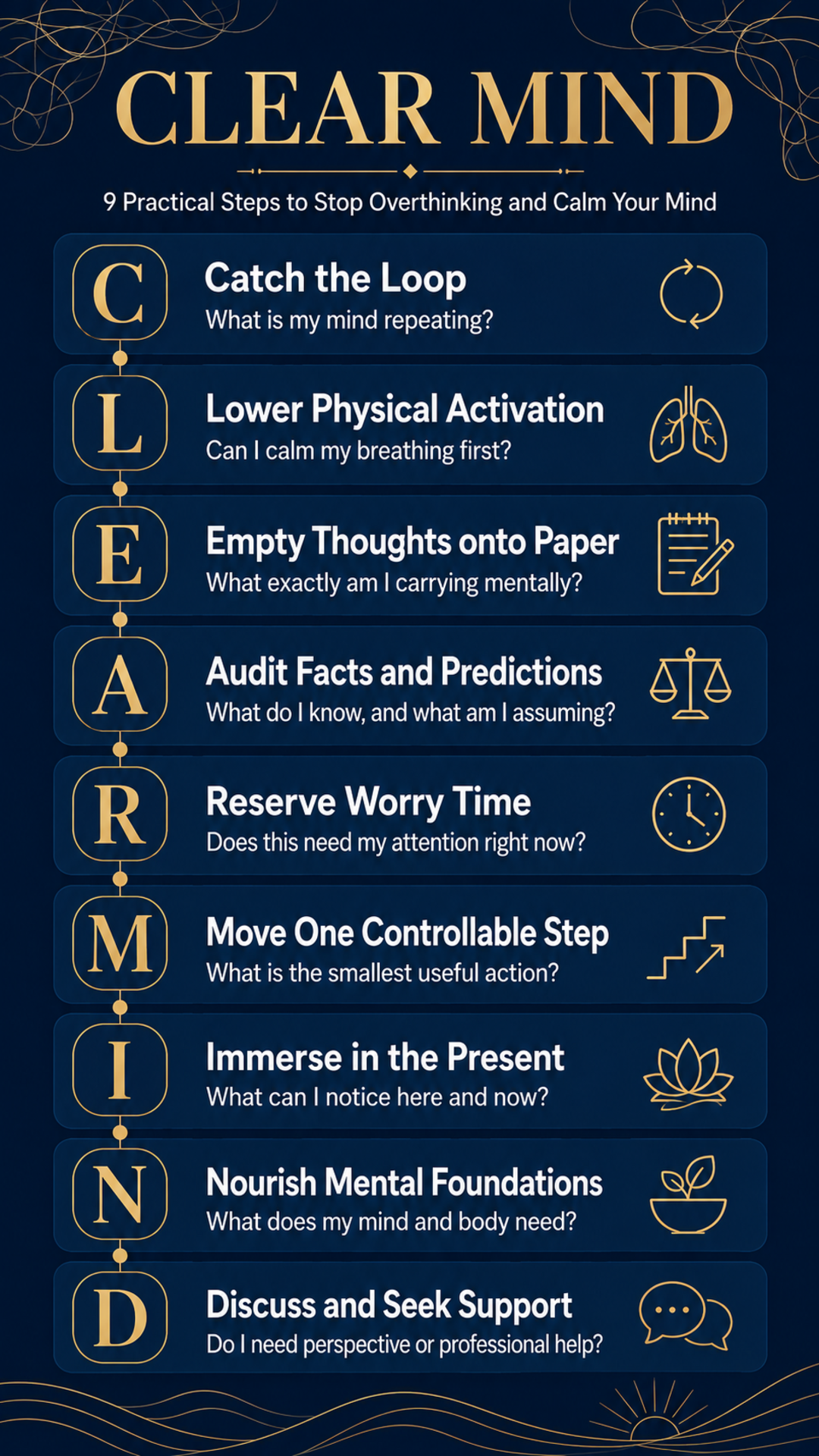
- The CLEAR MIND framework
- Nine practical steps
- Common mistakes
- Seven-day action plan
- When to seek professional help

What Overthinking Really Means
“Overthinking” is an everyday term, not a diagnosis. It can describe several mental patterns, including:
- replaying past events;
- worrying about future outcomes;
- trying to predict what another person thinks;
- repeatedly checking a decision;
- imagining every possible problem;
- looking for perfect certainty before acting.
Psychologists often use more specific terms. Rumination usually refers to repetitive thinking about distress, its causes, and its consequences. The American Psychiatric Association explains that this pattern can intensify negative emotions and make productive problem-solving more difficult. Rumination can also be associated with anxiety and depression, although occasional overthinking does not automatically mean you have a mental-health disorder. American Psychiatric Association
Worry is commonly directed towards what might happen in the future. Rumination often returns to what has already happened. Both can become forms of repetitive negative thinking.
A 2025 transdiagnostic meta-analysis covering 55 studies found that cognitive-behavioural interventions reduced repetitive negative thinking. A 2026 correction changed some subgroup estimates but stated that the conclusions were unaffected. This supports using structured thought-examination methods while reminding us that a simple article is not a replacement for therapy.
Productive thinking versus overthinking
Ask yourself:
“Is this thinking producing new information, a decision, or a useful next action?”
Productive thinking usually moves forward:
Problem → options → decision → action or acceptance
Overthinking moves in a circle:
Problem → uncertainty → more analysis → more uncertainty → same problem
The goal is not to stop caring or thinking carefully. The goal is to notice when thinking is no longer serving its purpose.
How to Stop Overthinking With the CLEAR MIND Framework
Use these nine steps whenever you notice that your thoughts are repeating without helping you move forward.
| Letter | Step | Immediate question |
|---|---|---|
| C | Catch the loop | What is my mind repeating? |
| L | Lower physical activation | Can I calm my breathing first? |
| E | Empty thoughts onto paper | What exactly am I carrying mentally? |
| A | Audit facts and predictions | What do I know, and what am I assuming? |
| R | Reserve worry time | Does this need my attention right now? |
| M | Move one controllable step | What is the smallest useful action? |
| I | Immerse in the present | What can I notice here and now? |
| N | Nourish mental foundations | What does my mind and body need? |
| D | Discuss and seek support | Do I need perspective or professional help? |
1. C — Catch the Thought Loop
You cannot change a pattern you have not noticed.
Begin by naming what is happening without criticizing yourself:
- “I am replaying that conversation.”
- “I am predicting the worst outcome.”
- “I am trying to know what another person thinks.”
- “I am looking for certainty that is not available.”
Use the phrase:
“I am noticing the thought that…”
For example, replace “I am going to fail” with “I am noticing the thought that I might fail.”
This small language change does not prove the thought wrong. It creates space between you and the thought. The thought becomes something you are observing—not an unquestionable command.
2. L — Lower Physical Activation
When you feel tense, hurried, or threatened, more analysis may produce more alarming thoughts. Calm your breathing before trying to solve the entire situation.
Try this gentle exercise:
- Place both feet on the floor.
- Relax your jaw and shoulders.
- Breathe in gently through your nose.
- Breathe out slowly without forcing it.
- Continue for two to five minutes.
The NHS recommends comfortable abdominal breathing, with a gentle count during the inhale and exhale if that feels helpful. Its current guidance suggests practising for at least five minutes, without forcing the breath. NHS breathing guidance
The aim is not to make every thought disappear. It is to become calm enough to choose your next response.
3. E — Empty the Thoughts Onto Paper
Thoughts feel larger when they remain vague.
Open a notebook or notes app and create four short columns:
| Thought | Known fact | Possible action | Later or release |
|---|---|---|---|
| “What if the meeting goes badly?” | The meeting is Friday | Prepare three talking points | Other people’s reactions |
| “Why has she not replied?” | No reply for four hours | Wait until tomorrow | Guessing her reason |
The NHS recommends writing worries down because externalizing them can make concerns easier to consider one at a time. NHS Every Mind Matters
Do not try to write a perfect journal entry. Your job is simply to turn a mental cloud into visible sentences.
4. A — Audit the Facts and Predictions
Overthinking often mixes facts, interpretations, memories, and imagined outcomes into one story.
Examine one important thought using these questions:
- What happened?
- What am I feeling?
- What is the automatic thought?
- What evidence supports it?
- What evidence does not support it?
- What is a more balanced explanation?
- What do I want to do next?
This resembles a CBT thought record, which helps people examine evidence and develop a more realistic or neutral perspective. NHS thought-record exercise
Relationship scenario: Someone close to you has not replied. Your mind says, “They are angry with me.”
The fact is that you have not received a reply. Anger is one possible explanation, but work, travel, fatigue, family responsibilities, or a silent phone are also possible.
A balanced thought might be:
“I do not know why they have not replied. If the matter is important, I can check in once and then allow them time.”
From an NLP coaching perspective, changing rigid language can also create flexibility. Compare “They are definitely angry” with “I am currently interpreting the silence as anger.” This is a coaching reflection tool—not a medical treatment or proof that your interpretation is false.
5. R — Reserve Worry Time
Trying to answer every worry the moment it appears teaches your mind that every thought is an emergency.
Instead, choose a daily 10–15-minute worry period.
When a non-urgent worry appears, write one line about it and tell yourself:
“I have recorded this. I will consider it during my worry time.”
During that period:
- review what you wrote;
- identify problems you can solve;
- schedule appropriate actions;
- acknowledge what you cannot currently control;
- stop when the allotted time finishes.
The NHS specifically recommends a short daily worry period as a way to keep worry from occupying the entire day. NHS worry-time technique
If doing this close to bedtime makes you more alert, move the exercise to the afternoon or early evening.
6. M — Move One Controllable Step
Overthinking asks, “How can I control the whole outcome?”
Clear action asks, “What can I influence next?”
Sort the concern into one of three categories:
- Act now: There is a useful action you can complete immediately.
- Schedule: Action is possible, but not at this moment.
- Release: The matter depends on circumstances or people you cannot control.
Career scenario: You have an important presentation and keep imagining questions you may not be able to answer.
You cannot control every question. You can:
- create the first slide;
- write three key points;
- practise the opening aloud;
- prepare an honest response for questions requiring follow-up.
Your next action does not need to remove all uncertainty. It only needs to improve your position.
7. I — Immerse Yourself in the Present
Overthinking pulls attention into an imagined future or a repeatedly edited past. Grounding brings attention back to what is actually happening now.
Try this short sensory reset:
- Notice three things you can see.
- Notice two physical sensations.
- Notice one sound.
- Take one slow breath.
- Ask, “What matters in the next ten minutes?”
Mindfulness is not the practice of having no thoughts. It is the practice of noticing experience without automatically following each thought.
A systematic review published in JAMA Internal Medicine found moderate evidence that mindfulness-meditation programs improved anxiety in some populations, while benefits varied and were not consistently better than every active alternative. Goyal and colleagues
Start with one minute. Consistent, realistic practice is more useful than forcing yourself through a long session.
If guided explanations help you practise, explore Rakesh Inani’s YouTube content on overthinking, focus, emotional clarity, and mind transformation: RI Mindset Transformation
8. N — Nourish Your Mental Foundations
A useful technique can be harder to apply when you are exhausted, physically inactive, overstimulated, or constantly consuming alarming information.
Support your mind with simple foundations:
- take a short walk or stretch;
- protect a consistent sleep routine;
- reduce unnecessary notifications;
- avoid checking messages repeatedly;
- create short periods without news or social media;
- notice whether caffeine increases restlessness;
- complete one task at a time where possible.
The World Health Organization reports that regular physical activity provides mental-health benefits and can reduce symptoms of anxiety and depression. It also emphasizes that some movement is better than none. WHO physical-activity guidance
Sleep matters as well. The CDC recommends at least seven hours for most adults aged 18–60 and notes that sufficient sleep supports mood, attention, and memory. CDC sleep guidance
These habits do not solve every source of overthinking. They make it easier to use the other tools effectively.
9. D — Discuss and Seek Support
Overthinking becomes louder in isolation.
Speak with someone trustworthy, but tell them what kind of support you need:
- “I need you to listen for five minutes.”
- “Can you help me separate facts from assumptions?”
- “Please help me identify one next action.”
- “I am not looking for reassurance; I need perspective.”
A supportive conversation can help you organize your thoughts. However, friends, family members, coaching, and online content do not replace clinical care.
The National Institute of Mental Health advises seeking professional help when anxiety begins causing problems in everyday life, including work, school, relationships, or family functioning. NIMH guidance
Common Mistakes to Avoid
Trying to eliminate every thought
A calm mind is not an empty mind. Measure progress by how quickly you recognize the loop and return to useful action.
Arguing with every uncomfortable thought
Not every thought needs a courtroom. Some can simply be noticed, recorded, and released.
Seeking unlimited reassurance
Repeatedly asking others whether everything will be fine may provide temporary relief without developing your ability to tolerate uncertainty.
Journaling without direction
Writing can help, but repeatedly describing the same fear without examining it or choosing an action may continue the loop. End with a balanced perspective or next step.
Using distraction all day
A brief walk, conversation, or change of activity can interrupt a spiral. Constant distraction can prevent you from addressing a solvable problem.
Expecting one exercise to work immediately
These are skills. Practise them when your distress is mild so they are easier to use when your mind feels overloaded.
Your Seven-Day CLEAR MIND Action Plan
| Day | Practice |
|---|---|
| Day 1 | Record three moments when overthinking appears. Label each as replaying, predicting, mind-reading, or perfection-seeking. |
| Day 2 | Practise five minutes of gentle breathing at a calm time. |
| Day 3 | Complete one four-column brain dump: thought, fact, action, later/release. |
| Day 4 | Audit one thought using evidence for, evidence against, and a balanced alternative. |
| Day 5 | Set one 10–15-minute worry period and postpone non-urgent worries until then. |
| Day 6 | Choose one delayed task and complete the smallest useful action. |
| Day 7 | Use the complete CLEAR MIND sequence on one current concern. |
At the end of the week, reflect:
- Which situations trigger my overthinking most often?
- Which step helps me regain perspective?
- What do I repeatedly try to control that is not mine to control?
- What action have I been postponing while waiting for certainty?
- What support would make the next week easier?
When Professional Help Is Important
Self-help strategies are appropriate for many everyday worry loops, but they are not suitable for every situation.
Consider speaking with a qualified mental-health professional if your thoughts:
- feel persistent or difficult to control;
- cause significant distress;
- repeatedly disturb your sleep;
- interfere with work, relationships, or daily responsibilities;
- appear with panic, depression, trauma symptoms, substance use, or compulsive behaviour.
If you are thinking about harming yourself or someone else, contact local emergency services or a crisis service in your country immediately.
You Do Not Need Perfect Certainty to Move Forward
Learning how to stop overthinking does not mean becoming careless, emotionless, or endlessly positive.
It means recognizing when thought has stopped producing value. You calm your body. You write down the concern. You separate facts from predictions. You act where action is possible and practise acceptance where control is not.
Begin with one loop today. You do not have to solve your entire life. You only need to return to the present and choose the next clear step.
For more practical guidance, follow Rakesh Inani’s YouTube content on mindset, focus, emotional clarity, and mind transformation. If you want personalized support for recurring mental blocks and action patterns, you can explore his NLP and mind-transformation coaching here: EXPLORE COACHING
About the Author
Rakesh Inani is an NLP & Mind Transformation Coach who helps people reduce overthinking, recognize limiting mental patterns, improve focus and emotional clarity, and take more consistent action. Through practical educational content and coaching, he supports people in developing a calmer, more productive, growth-oriented mindset.
FAQ Section
1. What is overthinking?
Overthinking is an everyday term for thinking that becomes repetitive without producing useful new information, a decision, or an action. It often appears as rumination about the past or worry about the future. It is not, by itself, a medical diagnosis.
2. Why do I overthink everything?
Common drivers may include uncertainty, fear of mistakes, perfectionism, unresolved stress, and the belief that more analysis will create safety. Sometimes persistent overthinking is connected with anxiety, depression, trauma, or another concern that a qualified professional can assess.
3. How to stop overthinking immediately?
You may not stop every thought instantly, but you can interrupt the loop: label it, take five gentle breaths, write the thought down, separate facts from predictions, and choose one small controllable action. If no action is possible, schedule worry time and return attention to the present.
4. Does meditation stop overthinking?
Meditation can help you notice thoughts without automatically following them. Research supports modest benefits for anxiety and stress in some groups, but results vary. Meditation is not a guaranteed cure or replacement for professional care.
5. Why is overthinking worse at night?
At night there are fewer distractions, unresolved tasks become noticeable, and tiredness can make thoughts feel harder to manage. Write tomorrow’s tasks down, keep a consistent wind-down routine, and move worry time earlier if doing it near bed increases alertness.
6. Can journaling help with overthinking?
Yes, particularly when it is structured. Write the situation, feelings, thoughts, evidence for and against it, a balanced alternative, and the next action. Repeatedly writing the same fear without perspective or action can become another form of rumination.
7. When should I seek professional help?
Seek qualified support when worry is persistent, difficult to control, causes marked distress, disrupts sleep or daily functioning, or appears with panic, depression, substance use, or thoughts of self-harm. For immediate danger, contact local emergency or crisis services.