
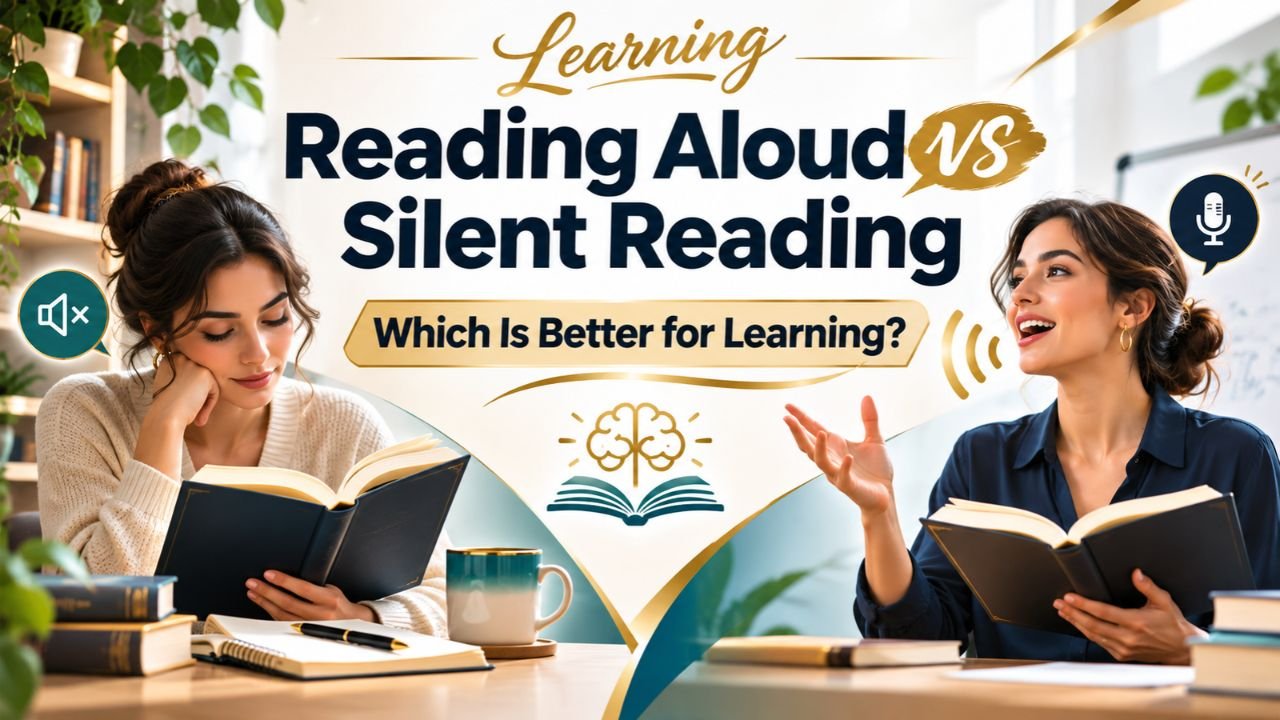
Reading Aloud vs Silent Reading: Which Is Better for Learning and Understanding?
Have you ever wondered whether you should read a book silently or speak the words aloud to understand the content better?
Perhaps you have experienced a situation where you read several pages of a book, understood everything at that moment, but struggled to explain what you had learned a few hours later.
You know the concept. You remember some keywords. You even understand its meaning. But when someone asks you to explain it, you struggle to find the right words.
Why does this happen?
Because reading, understanding, remembering and expressing information are interconnected but different skills.
If your objective is to learn faster, understand deeply, remember longer and communicate confidently, you need to understand how different learning methods serve different purposes.
In this article, we will explore reading aloud versus silent reading and discover a practical learning framework that can transform the way you acquire, retain and express knowledge.
1. What Is Silent Reading?
Silent reading is the process of reading written information without physically speaking the words aloud.
During silent reading, your attention can move through the content without being restricted by your physical speaking speed.
You may still experience an internal voice while reading. This is natural and does not necessarily interfere with effective learning.
Benefits of silent reading
- Helps you read more information in less time.
- Allows flexible reading speed.
- Helps you focus on the meaning of the content.
- Makes it easier to pause and reflect.
- Requires less physical effort.
- Can be practised almost anywhere.
Silent reading is particularly useful when you are reading books, studying professional material, exploring new concepts or conducting research.
However, silent reading has a potential limitation.
You may develop a sense of familiarity with the information without developing the ability to retrieve it independently.
Recognizing information when you see it is different from remembering it when you need it.
2. What Is Reading Aloud?
Reading aloud involves physically speaking the words while reading written information.
Instead of simply processing the written content, you also engage speech production and auditory feedback.
You see the words, pronounce them and hear your own voice.
This additional activity can make certain information more memorable.
Benefits of reading aloud
- Can improve the recall of specific information.
- Helps develop pronunciation and articulation.
- Improves awareness of speech patterns.
- Helps practise unfamiliar vocabulary.
- Supports voice modulation and reading fluency.
- Can help maintain attention when the mind is wandering.
However, reading aloud is generally slower than silent reading because your reading speed is limited by your speaking speed.
It may also require additional mental effort, particularly when the material is complex.
Therefore, reading aloud does not automatically guarantee better understanding.
3. Silent Reading vs Reading Aloud: A Detailed Comparison
| Learning Factor | Silent Reading | Reading Aloud |
|---|---|---|
| Reading speed | Generally faster | Generally slower |
| Understanding | Effective for processing meaning | Effective, but not necessarily superior |
| Memory retention | Depends on learning approach | Can improve recall of specific material |
| Mental effort | Usually lower | Usually higher |
| Pronunciation | Limited practice | Helpful |
| Articulation | Limited practice | Helpful |
| Voice modulation | Not directly practised | Can be practised |
| Learning large amounts of content | More suitable | More time-consuming |
| Spontaneous communication | Limited direct development | Limited if simply reading |
| Learning flexibility | High | Depends on environment |
Both methods have advantages.
The important question is not which method is universally better, but which method serves your particular learning objective.
4. What Does Science Say About Reading Aloud and Silent Reading?
Several principles from cognitive psychology can help us understand how to learn more effectively.
A. The Production Effect
Research by psychologist Colin MacLeod and his colleagues has demonstrated a phenomenon known as the Production Effect.
The Production Effect suggests that information spoken aloud can sometimes be remembered better than information read silently.
Producing the words creates an additional distinguishing feature in memory.
However, remembering a word or sentence is not necessarily the same as understanding the underlying concept.
Reading aloud can support memory, but it should not be treated as a guaranteed method for deeper comprehension.
B. Active Recall
Active recall, also known as retrieval practice, involves retrieving information from memory without looking at the original learning material.
For example, after reading a chapter, close the book and ask yourself:
- What did I just learn?
- What were the most important concepts?
- Can I remember the main principles?
- Can I explain them without looking?
Research on retrieval practice indicates that actively recalling information can improve long-term retention compared with simply rereading the same material.
Every successful retrieval provides another opportunity to strengthen access to that knowledge.
C. Self-Explanation
Self-explanation involves explaining a concept to yourself in your own words.
Instead of repeating the author’s sentences, you attempt to construct your own understanding.
This encourages you to identify relationships, connect ideas, recognize gaps in your knowledge and develop a meaningful mental representation of the subject.
You can practise self-explanation silently, in writing or by speaking aloud.
Speaking aloud provides the additional benefit of practising verbal expression.
5. Reading Aloud and Explaining Aloud Are Not the Same
This is one of the most important distinctions in effective learning.
Many people believe that reading a book aloud will automatically improve their ability to communicate what they have learned.
However, there is a fundamental difference between reading existing sentences and generating your own sentences.
Reading aloud
When you read aloud, the words, sentences and structure have already been created by someone else.
Your primary responsibility is to recognize and pronounce them.
Explaining aloud
When you explain something in your own words, you have to:
- Retrieve relevant information.
- Organize your thoughts.
- Find appropriate words.
- Construct meaningful sentences.
- Connect different ideas.
- Generate relevant examples.
- Communicate the concept clearly.
This makes verbal self-explanation particularly valuable for developing spontaneous communication skills.
Reading aloud helps you practise speaking existing words.
Explaining aloud helps you practise creating your own expression.
6. The Two Directions of Learning and Communication
Understanding and communication involve two complementary processes.
The receptive process: Words → Ideas → Meaning
When you read a book or listen to someone, you receive information and interpret its meaning.
You convert external language into internal understanding.
This develops your receptive skills.
The expressive process: Meaning → Ideas → Words → Expression
When you communicate, you start with your internal understanding and attempt to express it through language.
You convert thoughts, ideas and experiences into meaningful words.
This develops your expressive skills.
A person can have strong receptive skills but comparatively less developed expressive skills.
Such a person may understand complex concepts, possess considerable knowledge and have valuable ideas, yet struggle to express them spontaneously.
If you experience this challenge, simply consuming more information may not be sufficient.
You also need to practise converting your existing knowledge into expression.
Reading develops your ability to convert words into meaning. Explaining develops your ability to convert meaning into words.
7. The Five-Step Effective Learning Framework
Instead of choosing between silent reading and reading aloud, you can combine different learning methods into a structured five-step process.
Step 1: Read — Acquire Information
Begin by reading the content silently.
Focus on understanding the central message rather than memorizing every sentence.
Identify the main concepts, important keywords and supporting ideas.
Ask yourself: What is the author trying to communicate?
Step 2: Reflect — Develop Understanding
Pause after reading a meaningful section.
Think about the information you have just consumed.
Ask yourself:
- What does this concept actually mean?
- Why is it important?
- How does it work?
- How is it connected to what I already know?
- Where have I experienced something similar?
Reflection helps you move from information consumption towards meaningful understanding.
Step 3: Recall — Retrieve Information
Close your book or remove the learning material from your view.
Attempt to remember the important ideas without taking any assistance.
Do not worry about remembering the exact words.
Focus on retrieving the meaning, principles, structure and important keywords.
This step helps develop independent access to knowledge.
Step 4: Explain — Convert Knowledge Into Expression
Now explain the concept aloud in your own words.
Imagine that you are teaching someone who has never encountered the topic before.
Use simple language, examples, analogies and logical connections.
If you get stuck, identify the missing information, revisit the relevant section and explain it again.
Do not memorize a complete script. Practise generating your own sentences.
This step develops both understanding and communication.
Step 5: Apply — Integrate Knowledge Into Life
Finally, identify how the knowledge can be applied practically.
Ask yourself:
- Where can I use this knowledge?
- How can it solve a real-life problem?
- How can I demonstrate this concept?
- How can I use it in my personal or professional life?
- How can I help someone else understand it?
Application helps transform theoretical knowledge into practical understanding.
The complete learning cycle is:
Read → Reflect → Recall → Explain → Apply
8. A Practical 30-Minute Learning Routine
You do not necessarily need to spend several hours studying to learn effectively.
You can begin with a focused 30-minute learning session.
| Activity | Duration | Objective |
|---|---|---|
| Silent reading | 12 minutes | Acquire new information |
| Deep reflection | 3 minutes | Understand and connect ideas |
| Active recall | 3 minutes | Retrieve information independently |
| Verbal self-explanation | 8 minutes | Develop understanding and expression |
| Application and verification | 4 minutes | Apply knowledge and correct mistakes |
| Total | 30 minutes | Integrated learning |
This is a suggested routine rather than a scientifically established ideal time distribution. You can adjust it according to the complexity of the subject and your learning objectives.
The purpose is to balance information consumption with information processing, retrieval and expression.
9. A Practical Example of Effective Learning
Suppose you are learning about the Growth Mindset.
Instead of reading an entire chapter repeatedly, follow these five steps.
Read: Understand the meaning of a growth mindset and how it differs from a fixed mindset.
Reflect: Think about situations in which you believed your abilities could not improve.
Recall: Close the book and remember the main characteristics of both mindsets.
Explain: Speak for two or three minutes as if you are teaching a student about the growth mindset.
Apply: Identify one area of your life where you can respond to challenges with a greater willingness to learn.
After completing the process, revisit the original material to check whether your understanding and explanation were accurate.
You are no longer simply reading about a growth mindset. You are understanding, expressing and applying the concept.
10. How Speaking Aloud Can Improve Communication Skills
If you want to become a confident communicator, public speaker, teacher, trainer or coach, verbal self-explanation can become a valuable daily practice.
It gives you an opportunity to develop several communication abilities simultaneously.
Word retrieval
Regular verbal explanation helps you practise accessing relevant vocabulary when you need it.
Sentence formation
You develop experience in converting thoughts into meaningful sentences without depending on a written script.
Logical thinking
When explaining a topic, you learn to organize ideas in a sequence that another person can understand.
Idea expansion
You practise expanding a single concept into explanations, examples, comparisons and practical insights.
Spontaneous expression
Speaking without a script helps you become more comfortable generating your responses in real time.
Teaching ability
Explaining complex concepts in simple language helps you develop the skills required to teach, train and guide others.
These abilities develop through repeated practice, feedback and real-world communication experience.
11. When Should You Read Aloud?
Reading aloud is particularly useful when you want to:
- Improve pronunciation.
- Practise articulation.
- Develop voice modulation.
- Learn unfamiliar vocabulary.
- Remember important definitions.
- Practise a speech or presentation.
- Improve reading fluency.
- Maintain attention during certain learning tasks.
You can selectively read important passages aloud rather than speaking every word of every book.
12. When Should You Read Silently?
Silent reading is generally more suitable when you want to:
- Read large amounts of information.
- Learn new concepts efficiently.
- Study complex theoretical material.
- Conduct research.
- Compare multiple sources of information.
- Reflect deeply on a subject.
- Explore different perspectives.
- Complete professional or academic reading.
However, if long-term retention is important, combine silent reading with retrieval practice and periodic revision.
13. Common Learning Mistakes You Should Avoid
Mistake 1: Measuring learning by the number of pages
Reading 50 pages does not necessarily mean you have understood more than someone who deeply studied five pages.
Measure learning through understanding, retrieval and application.
Mistake 2: Confusing familiarity with mastery
Information may look familiar because you have read it several times.
But can you explain it without looking?
That is a more useful test of independent understanding.
Mistake 3: Memorizing sentences instead of understanding concepts
Remembering exact sentences can be useful in some situations, but conceptual learning requires understanding the meaning behind those sentences.
Mistake 4: Consuming information without producing anything
Reading books, attending seminars and watching educational videos are valuable activities.
However, without reflection, retrieval, expression or application, much of that information may become difficult to access later.
Mistake 5: Expecting perfect expression immediately
When you begin explaining concepts aloud, you may experience hesitation, repetition or difficulty finding words.
Treat these moments as opportunities to practise rather than reasons to stop.
Gradually work towards greater clarity, structure and fluency.
Mistake 6: Not revising what you have learned
A single learning session may not be sufficient for long-term retention.
Revisit important concepts after a day, a few days and again after a week.
Try recalling them before rereading your notes.
This combines retrieval practice with spaced learning.
14. Frequently Asked Questions
Is reading aloud better than silent reading?
Reading aloud can improve memory for certain types of information, while silent reading is generally faster. Neither method is universally superior for every learning objective.
Does silent reading improve understanding?
Yes. Silent reading can be highly effective for understanding, especially when combined with reflection, questioning and connecting new information with existing knowledge.
Should I read every book aloud?
No. Reading every book aloud can unnecessarily slow down your learning. Use reading aloud selectively and spend more time explaining important concepts in your own words.
Can speaking aloud improve memory?
Speaking aloud can support memory through the Production Effect. Retrieving and explaining information aloud without looking at the original material can provide additional learning benefits.
What is the fastest way to learn and remember something?
There is no single method that works best for every subject. Combining focused reading, active recall, self-explanation and spaced revision is a useful evidence-informed approach.
How can I improve my ability to express what I know?
Choose a concept you already understand and explain it aloud for two to five minutes without reading from a script. Practise regularly, check your accuracy and gradually improve your clarity and structure.
Is it normal to hear an internal voice while reading silently?
Yes. Internal speech or subvocalization is a common part of reading. You do not need to eliminate it forcibly to become an effective learner.
Conclusion: Learn to Understand, Remember and Express
Effective learning is not simply about reading more books, consuming more information or completing more courses.
It is about developing knowledge that you can understand, retrieve, express and apply whenever you need it.
Silent reading helps you acquire information efficiently.
Reflection helps you develop deeper understanding.
Active recall helps you strengthen access to knowledge.
Verbal self-explanation helps you develop your ability to communicate.
Practical application helps you connect knowledge with real life.
Therefore, rather than choosing between silent reading and reading aloud, adopt a learning approach that combines the strengths of different methods.
Remember this simple learning principle:
Read silently. Think deeply. Recall independently. Explain aloud. Apply practically.
The next time you read a book, complete a course or learn a new concept, close your learning material and ask yourself:
Can I explain what I have learned in my own words?
Because the real value of knowledge is not merely in possessing it, but in being able to access it, express it and use it to create meaningful change.
Take the Next Step in Your Personal Transformation
Do you often find yourself overthinking, struggling to organize your thoughts or facing difficulty expressing your ideas confidently?
Developing a calm mind, clear thinking, confident expression, and consistent action can help you move towards your personal and professional goals.
Explore more articles on mindset, communication, NLP, and personal transformation on this website, and take your next step towards becoming a more confident and resourceful version of yourself.
Scientific References
- MacLeod, C. M., et al. (2010). The Production Effect: Delineation of a Phenomenon. Journal of Experimental Psychology: Learning, Memory, and Cognition, 36(3), 671–685.
- Roediger, H. L., & Karpicke, J. D. (2006). Test-Enhanced Learning: Taking Memory Tests Improves Long-Term Retention. Psychological Science, 17(3), 249–255.
- Chi, M. T. H., et al. (1994). Eliciting Self-Explanations Improves Understanding. Cognitive Science, 18(3), 439–477.
- Dunlosky, J., et al. (2013). Improving Students’ Learning With Effective Learning Techniques. Psychological Science in the Public Interest, 14(1), 4–58.
Continue Your Growth Journey
If this article helped you understand yourself at a deeper level, here are a few ways you can continue learning and growing with me:
→ Book a Complimentary 1-to-1 Mind Transformation Session
Identify the thinking, communication, confidence, or behavioural patterns currently limiting your leadership.
→ Download the Free Guide: Overthinking to Focused Action
Learn practical ways to quiet mental noise, make clearer decisions, and take consistent action.
→ Learn How NLP and Mind Transformation Work
Explore how thinking patterns, beliefs, communication, and mental rehearsal can influence behaviour.
→ Read: How to Stop Overthinking Before Making Important Decisions
Especially useful if decision-making is currently one of your biggest leadership challenges.
→ Watch NLP & Mind Transformation Videos on YouTube
→ Connect With Rakesh Inani on LinkedIn