
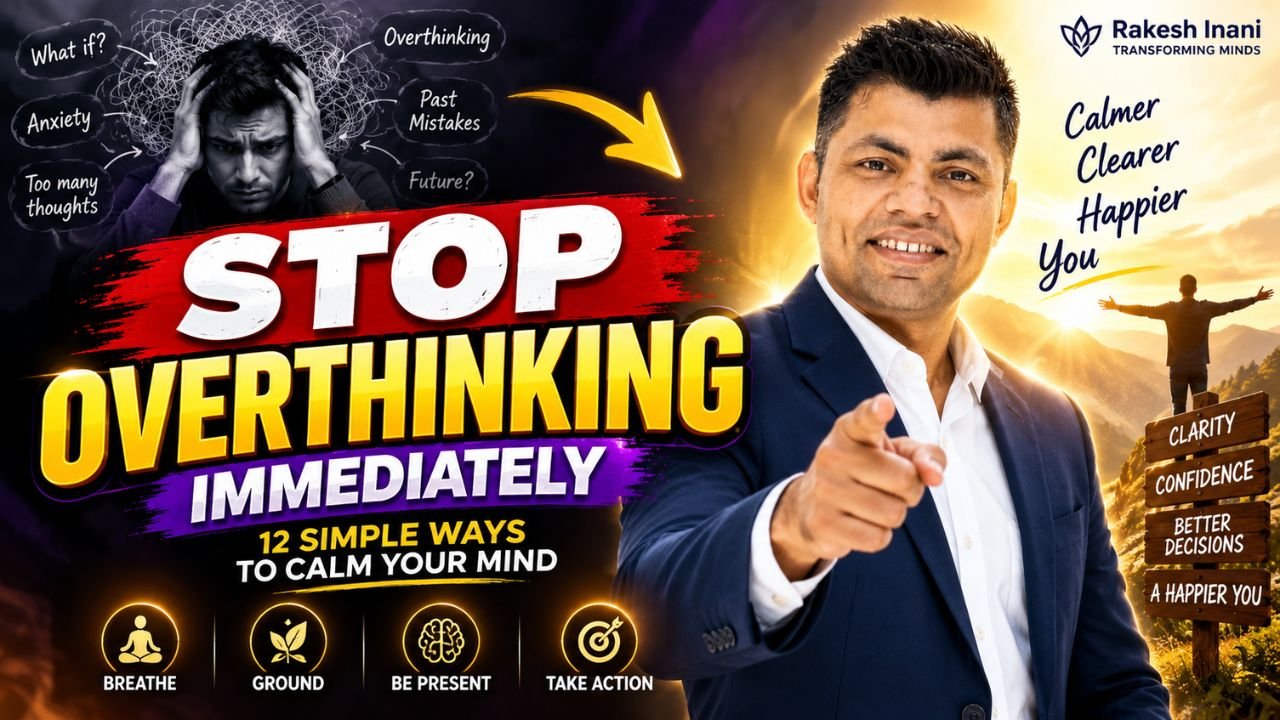
How to Stop Overthinking Immediately: 12 Simple Ways to Calm Your Mind
Your mind starts racing.
One question becomes five questions.
One small concern becomes a complete negative future.
You try to stop thinking, but the harder you try, the louder the thoughts become.
Perhaps you are replaying something you said.
Perhaps you are waiting for an important reply.
Perhaps you need to make a decision.
Or perhaps nothing specific has happened, but your mind still feels busy.
At that moment, you may ask, “How can I stop overthinking immediately?”
You probably want a switch that can turn every thought off.
However, the mind does not work like a machine that can be switched off on command.
In fact, trying to force a thought away may make you focus on it even more.
Therefore, the goal is not to create a completely empty mind.
The goal is to reduce the intensity of the mental loop, return your attention to the present, and choose a useful response.
Quick answer: To stop overthinking immediately, pause, relax your body, slow your breathing, name the thought, separate facts from assumptions, and choose one small action within your control. You do not need to solve the entire situation. You only need to interrupt the loop and return to the present.
In this guide, I will show you practical techniques you can use when overthinking begins.
Some exercises take only 30 to 60 seconds.
Others help you manage a thought that keeps returning throughout the day.
These tools may not remove every difficult thought instantly. However, they can help you create space between the thought and your response.
That space is important.
Because when you create space, you create choice.
What Should You Do When You Start Overthinking?
When overthinking begins, many people make one common mistake.
They try to solve the thought while they are emotionally tense.
However, when your body is tense and your attention is trapped inside a fear, clear thinking may become more difficult.
Therefore, do not begin with a long mental debate.
Begin by changing your state.
Use this order:
- Pause the automatic reaction.
- Regulate your body.
- Return your attention to the present.
- Name what your mind is doing.
- Separate facts from mental stories.
- Choose one useful action.
This order matters.
You cannot always think your way out of a state created by too much thinking.
Sometimes, the body must settle before the mind can see the situation clearly.
The World Health Organization includes grounding and “unhooking” from difficult thoughts among the practical skills in its stress-management guide, Doing What Matters in Times of Stress. The guide explains that these tools take practice and do not need to consume much time. Read the WHO stress-management guide.
First, Stop Fighting the Thought
Suppose your mind says:
“What if I fail?”
You may respond:
“I must not think negatively.”
Now you are fighting the original thought.
Then another thought appears:
“Why can’t I control my mind?”
Now you have two problems:
- The fear of failure
- The fear that you cannot control your thoughts
Therefore, instead of fighting the thought, notice it.
Say:
“I notice that I am having the thought that I may fail.”
This language creates distance.
You are not saying that the thought is true.
You are also not trying to prove that it is false.
You are simply observing it.
Name What Is Happening
Give the pattern a simple name.
You may say:
- “This is overthinking.”
- “This is a future prediction.”
- “This is mental replay.”
- “This is my mind asking for certainty.”
- “This is a fear story.”
- “This is a decision loop.”
Naming the pattern helps you step out of it.
For example, there is a difference between saying:
“Everything will go wrong.”
And saying:
“I notice that my mind is creating a worst-case story.”
The first statement treats the thought as reality.
The second statement treats it as a mental event.
Move Attention From the Mind to the Body
Overthinking keeps your attention inside your head.
Therefore, one of the fastest ways to interrupt it is to notice your body.
Ask:
- Are my shoulders tight?
- Am I clenching my jaw?
- Am I holding my breath?
- Are my hands closed?
- Am I sitting in a tense position?
- Is my breathing fast or shallow?
Then make one small physical change.
Lower your shoulders.
Unclench your jaw.
Open your hands.
Place both feet on the floor.
Take one gentle breath.
The goal is not to force relaxation.
The goal is to show your mind that you are here, in the present moment.
The 60-Second Overthinking Reset
When your mind is moving quickly, you may not want a long exercise.
Therefore, use this simple 60-second reset.
You can practise it at your desk, before a meeting, after receiving a difficult message, or while sitting in your car.
Do not use it while driving or doing something that requires your complete attention.
Step 1: Pause
Stop typing, checking, explaining, or reacting for a moment.
Do not send the emotional message immediately.
Do not make the decision while your thoughts are racing.
Simply pause.
The pause may last only a few seconds.
However, it interrupts the automatic movement from thought to reaction.
Step 2: Feel Your Feet
Place both feet on the floor.
Notice the contact between your feet and the ground.
If you are standing, notice the weight of your body.
This gives your attention a real, present target.
Step 3: Exhale Gently
Take a comfortable breath.
Then let your exhalation become slightly slower and longer than usual.
Do not pull in a very large breath.
Do not force the breathing.
Simply breathe in a gentle and comfortable way.
If focused breathing makes you dizzy, uncomfortable, or more anxious, return to your normal breathing and use a different grounding tool.
Step 4: Relax One Part of Your Body
Choose one area:
- Jaw
- Shoulders
- Hands
- Forehead
- Stomach
Allow that area to soften slightly.
You do not need to relax your complete body.
One small release is enough to interrupt the tension pattern.
Step 5: Name the Thought
Complete this sentence:
“My mind is telling me that…”
For example:
“My mind is telling me that the client has rejected me.”
“My mind is telling me that I will forget everything.”
“My mind is telling me that one mistake will destroy the result.”
Step 6: Identify One Fact
Ask:
“What is one fact I know?”
For example:
“The client has not replied yet.”
“I have prepared my three main points.”
“I made one mistake, but the task is not over.”
Step 7: Choose One Small Action
Ask:
“What is one useful action I can take now?”
The action may be:
- Wait until the agreed time.
- Send a clear follow-up.
- Practise the opening once.
- Write the first sentence.
- Ask one direct question.
- Return to the current task.
- Take a short break.
This seven-step reset does not solve your complete life in 60 seconds.
However, it moves you from automatic fear toward conscious action.
Use the 5-4-3-2-1 Grounding Exercise
Grounding means bringing your attention back to your current surroundings.
When you overthink, your attention may be trapped in the past or future.
Grounding reminds you:
“I am here now.”
The WHO explains that grounding can be useful during stressful situations and can also be practised during ordinary daily activities. Explore the WHO grounding guidance.
One popular sensory exercise is the 5-4-3-2-1 method.
Notice Five Things You Can See
Look around slowly.
Name five things you can see.
For example:
- A blue chair
- A window
- A notebook
- A light
- A plant
Try to notice small details.
What shape is the object?
What colour is it?
Is it bright or dark?
You are not trying to judge the object.
You are simply observing it.
Notice Four Things You Can Feel
Notice four physical sensations.
For example:
- Your feet touching the floor
- Your back touching the chair
- The fabric of your clothes
- Air touching your skin
You can also touch a safe object and notice its texture.
Is it smooth, rough, warm, cool, hard, or soft?
Notice Three Things You Can Hear
Listen for three sounds.
Perhaps you hear:
- A fan
- Traffic
- Birds
- People talking
- Your own breathing
Do not search for a special or peaceful sound.
Notice what is already present.
Notice Two Things You Can Smell
You may notice:
- Tea
- Coffee
- Soap
- Food
- Fresh air
- A familiar room
If you cannot notice two smells, simply imagine two safe and pleasant smells you know well.
Notice One Thing You Can Taste
Notice the taste already in your mouth.
Alternatively, take a sip of water and pay attention to the experience.
Why This Exercise Can Help
The exercise gives your attention a structured task.
Instead of following every thought, you begin noticing direct sensory information.
The thought may still be present.
However, it is no longer receiving all your attention.
If the full exercise feels too long, use a shorter version:
- Name three things you can see.
- Feel both feet on the floor.
- Notice one sound.
- Take one gentle breath.
Grounding is not meant to prove that your concern is unimportant.
It simply helps you become present enough to respond wisely.
Separate Facts From Mental Stories
Overthinking often mixes facts, assumptions, predictions, and emotions.
When these become mixed together, a possibility may feel like a certainty.
Therefore, one of the most powerful immediate tools is to separate what you know from what your mind is adding.
Draw two columns on a page.
Write:
| Facts | Mental story |
| What I can observe or confirm | What I am assuming, predicting, or imagining |
Example 1: An Unanswered Message
Fact: The person has not replied for six hours.
Mental story: They are angry, they no longer respect me, and the relationship is ending.
The story may contain a possible explanation.
However, it is not the only explanation.
Example 2: A Presentation
Fact: I have a presentation tomorrow, and I feel nervous.
Mental story: I will forget everything, people will laugh, and my reputation will be damaged.
Feeling nervous is real.
The predicted disaster is not yet a fact.
Example 3: A Business Decision
Fact: I must choose between two marketing strategies.
Mental story: If I choose wrongly, I will waste the whole year and never reach my goal.
The decision may be important.
However, it may also be adjustable.
Ask Four Fact-Finding Questions
When you feel trapped in a mental story, ask:
- What do I know for certain?
- What am I assuming?
- What am I predicting?
- What can I verify?
These questions do not guarantee a positive answer.
Instead, they create a more accurate view.
Ask Better Questions
The quality of your question directs the quality of your attention.
An overthinking question often has no useful answer.
For example:
“Why does this always happen to me?”
“How can I make sure nobody judges me?”
“What if every option is wrong?”
“How can I become completely confident?”
These questions create more mental searching.
A better question creates direction.
Replace “What If?” With “What Now?”
Instead of:
“What if I fail?”
Ask:
“What can I do now to prepare?”
Instead of:
“What if they reject me?”
Ask:
“How can I communicate clearly and respect the answer?”
Instead of:
“What if I make the wrong choice?”
Ask:
“What information would meaningfully improve this decision?”
Instead of:
“What if I feel nervous?”
Ask:
“What will help me act even if some nervousness remains?”
“What if?” pulls you into an imagined future.
“What now?” brings you back to useful action.
Replace “Why Am I Like This?” With “What Is Happening?”
“Why am I like this?” often creates self-judgment.
It may lead to answers such as:
“Because I am weak.”
“Because I cannot control myself.”
“Because something is wrong with me.”
Instead, ask:
“What triggered this pattern?”
“What am I afraid may happen?”
“What does my mind believe it is protecting me from?”
“What do I need right now?”
These questions study the pattern without attacking your identity.
Replace “What Is the Perfect Answer?” With “What Is Good Enough for Now?”
Perfection keeps decisions open.
Therefore, ask:
“What is a responsible choice with the information I have?”
You may not need the best possible answer in the complete world.
You may need a useful answer for your current situation.
Use the Control Question
Many overthinking loops focus on things you cannot fully control.
You cannot control another person’s thoughts.
You cannot control the past.
You cannot control every result.
You cannot control every future event.
However, you can often control a response.
Ask:
“Is this within my control, partly within my influence, or outside my control?”
Within My Control
- My preparation
- My behaviour
- My words
- My boundaries
- My next step
- How I use my time
Within My Influence
- A conversation
- A team decision
- A relationship
- A client’s understanding
- The response to my work
Outside My Control
- Another person’s private thoughts
- The complete future
- The past
- Every outside condition
- Universal approval
- A guaranteed result
Once you identify what is within your control, give your energy to that area.
Set a Worry Time
Sometimes, a concern keeps returning because your mind does not want you to forget it.
You try to focus on work, but the thought says:
“Do not forget this problem.”
You tell it to go away.
A few minutes later, it returns.
A “worry time” gives the thought a planned place instead of allowing it to take over the complete day.
The NHS includes worry time in its self-help guidance for managing worries and recommends separating problems you can act on from worries outside your control. Read the NHS guide to tackling worries.
How to Use Worry Time
Choose a short period each day.
For example, you may choose 15 minutes at 6:30 p.m.
Avoid choosing a time immediately before bed if worry tends to disturb your sleep.
During the day, when a thought appears, write it down in one sentence.
Then say:
“I have recorded this. I will review it during my worry time.”
Return to the present task.
What to Do During Worry Time
Review each concern and place it in one of two groups:
Problems I Can Act On
For these concerns, decide:
- What is the next step?
- When will I do it?
- Do I need information or support?
- Can the action be placed on my calendar?
Worries I Cannot Control Right Now
For these concerns, remind yourself:
“I cannot solve this through more thinking today.”
Then return your attention to something meaningful in the present.
Worry Time Is Not a Time to Create More Fear
Do not use the complete session to imagine worst-case outcomes.
Use it to organize concerns.
The goal is to turn solvable problems into actions and place unsolvable uncertainty back where it belongs.
Use a Thought Parking Page
If formal worry time does not suit you, create a thought parking page.
Keep a small notebook or digital note with three headings:
- Thought
- Action needed
- Review time
For example:
Thought: What if the client does not accept the proposal?
Action needed: Follow up on Monday.
Review time: Monday at 10:00 a.m.
Once the action is scheduled, you do not need to solve it repeatedly today.
You have not ignored the concern.
You have organized it.
Change Your Physical State
Overthinking is not only a thinking event.
It may also include a physical state.
You may become still, tense, closed, and focused inward.
Therefore, changing your physical state may help interrupt the pattern.
Stand Up and Move
If you have been sitting for a long time, stand up.
Walk slowly around the room.
Stretch your arms.
Roll your shoulders gently.
Look at something farther away.
The movement changes your sensory experience.
Moreover, it gives your attention a new target.
Wash Your Face or Hands
Notice the temperature of the water.
Feel the water on your skin.
Pay attention to the movement of your hands.
This ordinary action can become a grounding exercise when you perform it with attention.
Step Into a Different Space
If possible, move to another room.
Step outside.
Look at the sky, a tree, or the space around you.
A different environment may interrupt the connection between the location and the mental loop.
Widen Your Visual Attention
Overthinking often creates narrow focus.
You may stare at one screen or one point while mentally repeating the problem.
Try this:
Look straight ahead.
Without moving your head, notice what is present at the edges of your vision.
Notice the complete room rather than one object.
Do not strain your eyes.
Simply allow your attention to become wider.
Use a Neutral Activity
Choose a short activity that requires gentle attention.
For example:
- Fold clothes
- Organize your desk
- Water plants
- Walk slowly
- Prepare tea
- Wash a few dishes
- Write a short list
The purpose is not to avoid the problem forever.
It is to lower the mental intensity so you can return with more clarity.
Use the “One Next Step” Method
Overthinking often tries to solve the complete problem at once.
For example, if you want to start a business, your mind may try to solve:
- The niche
- The offer
- The brand
- The website
- The content strategy
- The sales process
- The future income
- The competition
- Every possible risk
Naturally, this feels heavy.
Instead, ask:
“What is the next visible action?”
A visible action is something another person could see you doing.
“Work on my business” is not specific.
“Write the first version of my offer statement” is specific.
“Improve my speaking” is not specific.
“Record a two-minute explanation and review it once” is specific.
“Fix my relationship” is not specific.
“Ask for a calm conversation this evening” is specific.
Make the Action Smaller Than the Fear
If the action still feels heavy, make it smaller.
Instead of recording a 20-minute video, record one minute.
Instead of writing the full article, write the first heading.
Instead of making five sales calls, make one call.
Instead of solving the complete disagreement, express one concern calmly.
Small action does not mean small ambition.
It means creating movement without waiting for perfect confidence.
Use a Two-Minute Decision Limit for Small Choices
Not every decision deserves equal time.
Choosing a life partner and choosing what to eat for lunch are not the same kind of decision.
However, overthinking may treat both choices as if they have permanent consequences.
For small and reversible decisions, set a short time limit.
You may give yourself two minutes.
Then choose and move forward.
Examples include:
- Which simple task to do first
- Which shirt to wear
- Which title version to test
- Which healthy meal to prepare
- Which time to make a routine call
This practice builds decision confidence.
You teach yourself that not every choice needs complete certainty.
Use a Written Decision Sentence
When you make a decision, write it in one clear sentence.
For example:
“I will use this title for the first version and review its performance after publication.”
This sentence includes both commitment and flexibility.
It tells the mind:
“The decision is complete for now.”
If the mind reopens the decision without new information, remind yourself:
“I have already decided. I will review it at the planned time.”
This is especially useful for decisions that can be tested and adjusted.
Speak to Yourself Like a Calm Coach
Your inner language affects your emotional experience.
When overthinking begins, avoid harsh commands such as:
“Stop being stupid.”
“Why are you doing this again?”
“You always create problems.”
These statements add shame to the original concern.
Instead, use calm and direct language.
Say:
“I can see that this feels important.”
“I do not need to solve every possibility.”
“I can handle one step at a time.”
“Uncertainty does not mean danger.”
“I can feel uncomfortable and still respond wisely.”
“I need facts, not another mental story.”
“I will focus on what I can do now.”
The goal is not forced positivity.
You do not need to say, “Everything will be perfect.”
A balanced statement is stronger:
“I do not know the complete result, but I can prepare and respond.”
Try the STOP Method
Use the word STOP as a simple memory tool.
S — Stop the Automatic Reaction
Pause before checking, replying, avoiding, or asking for reassurance.
T — Take a Gentle Breath
Feel your feet and allow your breathing to settle naturally.
O — Observe
Notice:
- What thought appeared?
- What emotion is present?
- What is happening in your body?
- What is a fact?
- What is an assumption?
P — Proceed With Purpose
Choose the most useful next response.
You may communicate, act, wait, rest, or ask for suitable support.
The purpose of STOP is not to remove the thought.
It is to prevent the thought from automatically controlling your behaviour.
What Not to Do During an Overthinking Episode
Knowing what not to do can be as important as knowing what to do.
Do Not Search Endlessly for Reassurance
You may feel tempted to ask many people:
“Do you think everything is okay?”
One answer may provide short-term relief.
However, if you continue asking, you may become more dependent on reassurance.
Ask for information or support when needed.
However, notice when you are repeating the same question because you want a guarantee nobody can provide.
Do Not Treat Every Thought as a Warning
Thoughts are not always instructions.
They are not always predictions.
They are not always facts.
The thought “I may fail” does not mean failure is approaching.
It may simply mean the situation matters to you.
Do Not Make a Major Decision at the Peak of Emotion
When possible, avoid making major decisions while you are highly afraid, angry, or mentally exhausted.
First, regulate your state.
Then collect the necessary information.
After that, decide according to your values and practical needs.
Of course, some urgent situations require quick action.
However, many overthinking decisions are not true emergencies.
Do Not Force an Instant Perfect Answer
Some problems need time.
Some conversations need more information.
Some decisions become clearer after rest.
Calming your mind does not mean you must immediately know what to do.
Sometimes, the wisest answer is:
“I do not need to decide this tonight.”
Do Not Use Scrolling as Your Only Escape
Social media may distract you for a short time.
However, endless scrolling may leave the original thought unresolved and make your mind more stimulated.
Instead, choose a clear reset activity.
Walk, stretch, write the thought down, drink water, or complete one simple task.
Do Not Judge Yourself for Overthinking
Self-judgment creates another loop.
You begin with:
“What if I made a mistake?”
Then you add:
“Why am I always like this?”
Now you are worried about the situation and ashamed of your response.
Replace judgment with observation.
Say:
“My mind has entered a familiar pattern. I can practise a different response.”
Choose the Right Tool for the Right Type of Overthinking
Different thoughts require different responses.
If You Are Replaying the Past
Ask:
- Is there a lesson?
- Is there something to repair?
- Is there an action I can take?
- If not, can I let the event remain complete?
Take the lesson once.
Do not repeatedly punish yourself after finding it.
If You Are Predicting the Future
Ask:
- What is most likely?
- What can I prepare for?
- What is outside my control?
- What can I do today?
Prepare for realistic concerns.
Then return to the present.
If You Are Overthinking a Decision
Ask:
- Is the decision reversible?
- What three criteria matter most?
- What information would change my choice?
- When is the decision deadline?
Do not compare options forever.
If You Are Overthinking a Relationship
Ask:
- What did I observe?
- What meaning am I adding?
- Do I need direct communication?
- Am I asking for clarity or a guarantee?
When appropriate, ask the person instead of guessing.
If You Are Overthinking Performance
Ask:
- What do I need to prepare?
- What have I already prepared?
- What is my first clear step?
- How can I focus on serving instead of judging myself?
Prepare before the event.
During the event, return your attention to the message.
A Five-Minute Emergency Reset for Mental Overload
Use this when your mind feels crowded but you are physically safe.
Minute 1: Orient Yourself
Look around.
Name where you are, what day it is, and what you are doing.
For example:
“I am sitting in my office. It is Monday morning. I am preparing for a meeting.”
Minute 2: Ground Through Your Senses
Name:
- Three things you see
- Two things you feel
- One thing you hear
Minute 3: Write the Main Thought
Write one sentence:
“My main concern is…”
Do not write ten concerns.
Choose the central one.
Minute 4: Separate Fact and Story
Write:
“The fact is…”
“The story I am adding is…”
Minute 5: Choose Your Response
Complete:
“The next useful action is…”
Then do that action or schedule it.
This reset reduces a large mental cloud into one clear concern and one response.
What If the Thought Keeps Coming Back?
A returning thought does not mean the technique failed.
Overthinking is often a repeated habit.
Therefore, your response may also need repetition.
Each time the thought returns, you can say:
“I have noticed this.”
“I have recorded it.”
“I know the next step.”
“I will return to the present.”
You do not need to create a new answer every time.
If the thought returns 20 times, you can give it the same calm response 20 times.
Over time, you are training your mind not to treat every return as a new emergency.
When Quick Techniques Are Not Enough
Grounding, breathing, journaling, and practical action can be helpful.
However, they are not a replacement for professional care.
Consider speaking with a qualified mental-health professional if repeated thoughts:
- Cause strong or ongoing distress
- Regularly disturb your sleep
- Interfere with work, study, or relationships
- Lead to repeated checking or rituals that feel difficult to control
- Cause you to avoid necessary activities
- Come with panic, deep hopelessness, or major emotional changes
- Include thoughts of self-harm or feeling unsafe
If you feel at immediate risk of harming yourself or someone else, contact local emergency services or a crisis support service immediately. Also, contact a trusted person who can stay with you.
Frequently Asked Questions About Stopping Overthinking
How Can I Stop Overthinking Immediately?
Pause, feel your feet, relax one part of your body, take a gentle breath, name the thought, identify one fact, and choose one small action. The goal is to interrupt the loop rather than force your mind to become blank.
What Is the Fastest Way to Calm an Overactive Mind?
A short sensory grounding exercise can help redirect attention toward the present. Notice what you can see, feel, and hear. Then identify the main fact and your next useful action.
Does the 5-4-3-2-1 Method Help With Overthinking?
It may help some people by moving attention away from repeated thoughts and toward current sensory information. It is a grounding tool, not a cure, and different techniques work for different people.
How Do I Stop Thinking About Something I Cannot Control?
Write the concern down, identify what is outside your control, and ask whether any action is available. If no useful action is possible now, schedule a review time and return to the present task.
Should I Ignore My Thoughts?
No. Ignoring every thought may cause you to miss a real problem. Instead, notice the thought, check whether it contains useful information, and decide whether you need action, communication, support, or temporary acceptance.
Why Does Trying to Stop a Thought Make It Stronger?
Trying to force a thought away keeps your attention focused on whether the thought is still present. A more helpful response may be to notice it without automatically following it.
Can Breathing Stop Overthinking?
Gentle breathing may help some people settle physical tension and return attention to the present. However, breathing alone may not solve the concern. After settling, identify the fact and choose a practical response.
What Should I Say to Myself When I Am Overthinking?
Use calm, balanced language:
“I notice this thought.”
“I do not need complete certainty.”
“I will focus on the facts.”
“I can take one step at a time.”
“I can respond even if the result is imperfect.”
How Do I Stop Overthinking at Work?
Write the concern down, decide whether it requires action, schedule the action, and return to one priority. Use a short focus period and avoid reopening the concern until the planned review time.
How Do I Stop Overthinking a Text Message?
Separate the fact from your interpretation. The fact may be that the person has not replied. Your interpretation may be that they are upset. Wait for a reasonable period and communicate directly when clarity is needed.
Can I Permanently Stop Overthinking?
A more realistic goal is to recognize overthinking earlier, reduce its intensity, and return to useful action faster. With regular practice, the pattern may become less controlling.
Final Takeaway
When overthinking begins, you do not need to solve your complete future.
You do not need to remove every thought.
You do not need to find the perfect answer.
First, pause.
Then return to your body.
Notice what is happening.
Separate facts from mental stories.
Identify what is within your control.
Finally, choose one small and useful action.
Remember this simple sequence:
Pause → Ground → Name → Check → Act
Pause before reacting.
Ground yourself in the present.
Name the thought pattern.
Check the facts.
Act on what is within your control.
As an NLP and Mind Transformation Coach, I have observed that people often try to defeat overthinking with more thinking.
However, the real shift begins when you regulate your state and move from an imagined problem to a present response.
You may still feel uncertain.
That is okay.
You do not need complete certainty to take a wise next step.
You only need enough calm to see the step and enough courage to take it.
In the next blog of this series, we will explore how to change negative thoughts without fighting your mind. You will learn how to challenge mental predictions, recognize common thinking errors, and create balanced thoughts that support action.
Author: Rakesh Inani
NLP & Mind Transformation Coach
This article is educational and does not diagnose or treat a mental-health condition. If repeated thoughts create severe distress or interfere with sleep, work, relationships, or daily functioning, consult a qualified mental-health professional.
Read Previous Blog Posts in This Series:
What Is Overthinking? Why Your Mind Won’t Stop and How to Recognize the Pattern
Why Do I Overthink Everything? 12 Hidden Causes of Overthinking Explained
Transform Your Mind: JOIN MIND TRANSFORMATION COMMUNITY
Learn More:
Real Leaders Know This ONE Secret to Influencing Without Speaking
7 Day Manifestation- NLP Guided Meditation for Success
The Complete Success Formula: 6 Steps to Turn Goals into Consistent Action