
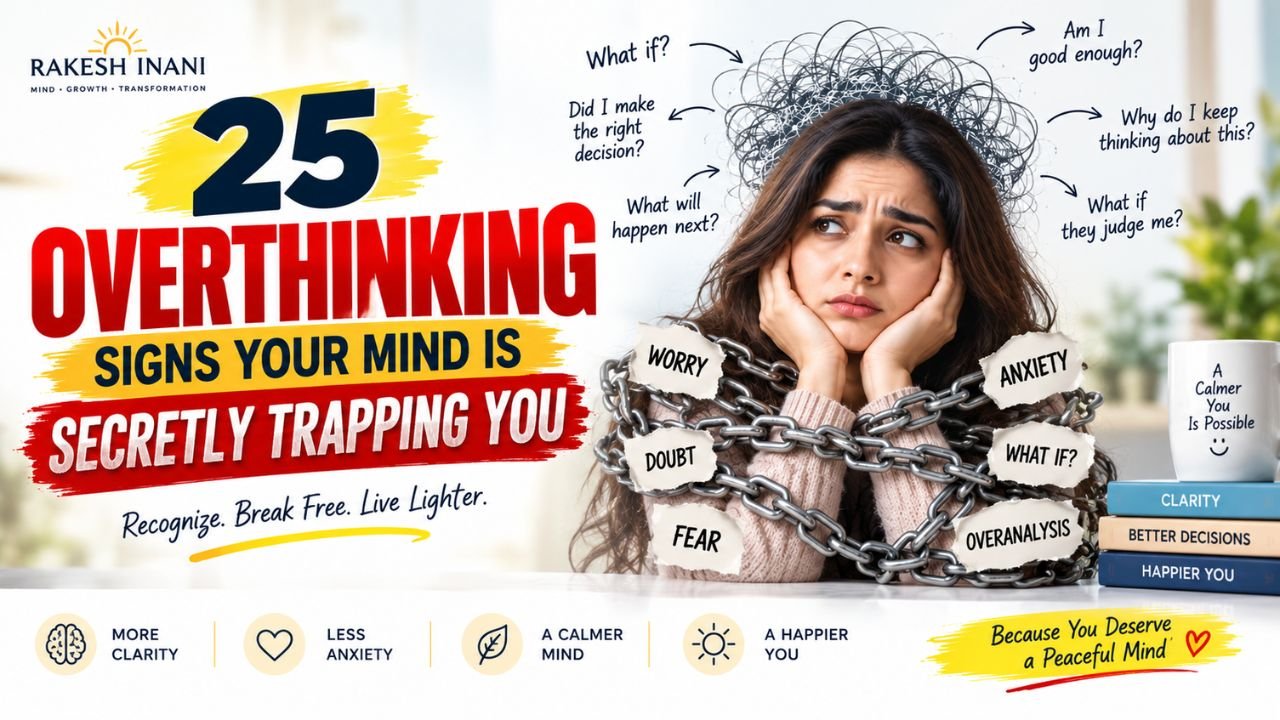
Am I Overthinking? 25 Overthinking Signs, Symptoms, and Common Types of Overthinking
Have you ever asked yourself, “Am I overthinking, or am I simply being careful?”
Perhaps you keep returning to the same decision.
You collect information, compare choices, and ask people for advice. Still, you do not feel ready to decide.
Or perhaps you replay a conversation in your mind.
You remember what you said, how the other person looked, and what their short reply may have meant. Although the conversation ended hours ago, it continues inside your mind.
Sometimes, overthinking is easy to recognize.
At other times, it may look like planning, responsibility, intelligence, preparation, or concern.
Therefore, many people live with an overthinking pattern without clearly seeing it.
They know that their mind feels busy. They know that they feel mentally tired. However, they may not understand what is creating the pressure.
Recognizing the pattern is important because you cannot change something that remains invisible.
Once you identify your signs, triggers, and type of overthinking, you can respond more clearly.
You can stop treating every thought as an emergency.
Moreover, you can begin separating useful thinking from mental repetition.
Quick answer: Common signs of overthinking include replaying conversations, imagining worst-case outcomes, doubting decisions, seeking repeated reassurance, delaying action, struggling to stay present, feeling mentally tired, and finding it hard to sleep. Overthinking becomes a problem when thinking produces more confusion and distress instead of clarity and action.
In this guide, I will help you recognize the common signs, symptoms, and different types of overthinking.
Most importantly, you will learn how to map your personal pattern so you can understand what happens before, during, and after an overthinking episode.
What Are the Common Signs of Overthinking?
Overthinking does not always appear as a fast or noisy mind.
Sometimes, it appears as silence.
You may become quiet because you are carefully examining what to say.
Sometimes, it appears as procrastination.
You may delay a task because you are still searching for the perfect approach.
Sometimes, it appears as repeated research.
You may believe that one more article, video, opinion, or comparison will finally make you feel certain.
Therefore, you must look beyond the thought itself.
You need to notice how the thinking affects your emotions, decisions, behaviour, body, and daily life.
Let us begin with the most common signs.
Sign 1: You Replay Past Conversations
One of the clearest signs of overthinking is repeatedly replaying a conversation.
You may remember:
- What you said
- What the other person said
- Their facial expression
- Their tone of voice
- How quickly they replied
- What you should have said differently
- What they may now be thinking about you
At first, you may believe you are learning from the interaction.
However, after a point, you are no longer discovering anything new.
You are simply repeating the emotional experience.
The “I Should Have Said” Loop
You may think:
“I should have explained myself better.”
“I should not have shared that.”
“I should have answered more confidently.”
“I should have stayed quiet.”
The mind creates an imaginary version of the conversation in which you say everything perfectly.
However, the real conversation has already ended.
Therefore, if there is no lesson to apply and no repair to make, repeated replay cannot change the event.
A useful question is:
“Is there something I need to learn, communicate, apologize for, or correct?”
If the answer is yes, choose an action.
If the answer is no, the replay may be an overthinking loop.
Sign 2: You Imagine the Worst Possible Outcome
Another common symptom of overthinking is expecting the worst.
A small uncertain event may quickly become a major future problem.
For example, your client does not reply.
Your mind may say:
“They did not like my work.”
Then:
“They will cancel the project.”
Then:
“I will lose the income.”
Finally:
“My business will never grow.”
Notice how quickly the mind moves from one unanswered message to complete business failure.
This pattern is often called catastrophizing.
It means the mind jumps toward a highly negative outcome without enough evidence.
Possibility Is Not Probability
Many negative events are possible.
However, possible does not mean likely.
It is possible that a person has not replied because they disliked your work.
It is also possible that they are busy, travelling, unwell, waiting for approval, or simply forgot to reply.
An overthinking mind often selects the most painful possibility and treats it as the most likely truth.
Therefore, ask:
“What are three other realistic explanations?”
This does not guarantee a positive answer.
Instead, it stops one fearful explanation from becoming the only explanation.
Sign 3: You Keep Doubting Decisions You Have Already Made
You make a decision.
For a moment, you feel relieved.
Then your mind asks:
“What if the other option was better?”
You reopen the decision.
Next, you remember a benefit of the option you rejected.
Therefore, you change your mind.
Soon, you begin doubting the new decision too.
This repeated reopening is a major sign of decision overthinking.
Why Completed Decisions Feel Unfinished
A decision may remain mentally open when you expect complete certainty.
Even after making a reasonable choice, some uncertainty remains.
An overthinking mind may treat this uncertainty as proof that the choice is wrong.
However, uncertainty is not always a warning.
Sometimes, it is simply part of making a decision.
Instead of asking, “Do I feel completely certain?” ask:
“Did I use a reasonable process with the information available to me?”
That question focuses on the quality of the process instead of demanding a guaranteed outcome.
Sign 4: You Ask for Reassurance Repeatedly
It is normal to ask someone for advice or emotional support.
However, repeated reassurance-seeking may be a sign of overthinking.
You may ask:
“Do you think everything will be fine?”
“Are you sure I did not upset them?”
“Do you think I made the right decision?”
“Do I look foolish?”
“Was my presentation okay?”
Someone gives you a kind and reasonable answer.
You feel calm for a few minutes.
Then the doubt returns.
You ask again, or you ask another person.
Why Reassurance Does Not Last
Reassurance can provide short-term relief.
However, if you do not learn to handle uncertainty, the mind soon creates another question.
For example:
“They said my presentation was good, but what if they were only being polite?”
Therefore, the real need may not be another answer.
The real need may be greater self-trust and comfort with uncertainty.
Sign 5: You Delay Action While Waiting for Clarity
You may tell yourself:
“I will begin when I know exactly what to do.”
“I will record the video when I feel confident.”
“I will launch the program when everything is perfect.”
“I will make the call when I know what to say.”
At first, the delay may feel responsible.
However, if you already have enough information for the first step, more thinking may be protecting you from the discomfort of action.
Clarity Often Comes Through Action
You cannot think your way into knowing exactly how every action will feel.
Sometimes, you must begin.
For example, you can plan a video carefully. However, you will learn more about your delivery by recording one video than by imagining fifty possible problems.
Therefore, if you have been thinking about the same action for a long time, ask:
“What is the smallest version of this action I can complete today?”
Sign 6: You Research Far Beyond What You Need
Research is valuable.
However, repeated research can become a form of overthinking.
You read one article.
Then you read ten more.
You watch several videos.
You compare many opinions.
Instead of becoming clearer, you discover more differences.
Now you feel that you need even more information.
Information Can Create More Options
Every new piece of information may add another possibility.
Therefore, if you do not define what information you need, research may never end.
Before beginning, ask:
- What question am I trying to answer?
- What information would change my decision?
- How much research is enough?
- When will I stop researching and act?
A stopping rule protects useful research from turning into avoidance.
Sign 7: You Read Hidden Meaning Into Small Things
Someone uses a different tone.
A friend does not use an emoji.
A colleague walks past without speaking.
A family member seems quiet.
Your mind immediately asks:
“Did I do something wrong?”
This is called interpretation.
The mind takes a small observation and gives it a larger meaning.
The observation may be correct.
The meaning, however, may be an assumption.
Observation and Meaning Are Different
An observation is:
“They gave me a short reply.”
A meaning is:
“They are angry with me.”
An observation is:
“My video received fewer views than expected.”
A meaning is:
“People do not value my content.”
An observation is:
“I made one mistake during the presentation.”
A meaning is:
“I am a bad speaker.”
When you separate observation from meaning, you can respond more calmly.
Sign 8: You Find It Hard to Stay in the Present
Your body may be in one place while your mind is somewhere else.
You may be eating with your family, but you are mentally replaying a meeting.
You may be working, but your mind is worried about tomorrow.
You may be trying to sleep, but your mind is solving next month’s problems.
As a result, you may struggle to enjoy ordinary moments.
Even when something good is happening, part of your attention is searching for what could go wrong.
The Present Moment Feels Too Quiet
For some people, mental activity has become so familiar that quietness feels strange.
When the mind is not solving a visible problem, it searches for another concern.
Therefore, staying present is not simply a matter of telling yourself to relax.
It is a skill that may need practice.
Sign 9: You Feel Mentally Tired but Have Made Little Progress
Overthinking is exhausting because the mind is performing a great deal of internal work.
It is reviewing, predicting, comparing, judging, rehearsing, and checking.
Therefore, you may feel tired even though you have taken little visible action.
You may spend two hours thinking about writing an article but write only the title.
You may spend a full day planning a difficult conversation but never make the call.
You may compare several choices but avoid choosing any of them.
The mental effort is real.
However, effort without direction may not create progress.
Sign 10: You Struggle to Sleep Because Your Mind Becomes Active
Many people experience overthinking at night.
During the day, work, conversations, responsibilities, and technology keep the mind occupied.
At night, outside activity becomes quiet.
Therefore, unfinished thoughts become louder.
You may think about:
- Tomorrow’s responsibilities
- Past mistakes
- Unanswered messages
- Financial concerns
- Relationship problems
- Health worries
- Future plans
- Things you forgot to do
You may feel physically tired but mentally active.
If this happens often, nighttime overthinking can affect sleep quality and daytime energy.
Persistent sleep problems deserve attention from a qualified healthcare professional.
Sign 11: You Prepare for Conversations That May Never Happen
You may mentally rehearse an argument before anyone has disagreed with you.
You imagine what the other person may say.
Then you prepare your answer.
Next, you imagine their response to your answer.
Soon, you are having a complete emotional conversation inside your mind.
However, the real conversation has not happened.
Rehearsal Versus Imaginary Conflict
Healthy rehearsal prepares one clear message.
For example:
“I want to explain my concern calmly and ask for a solution.”
Overthinking creates many imaginary versions of the conversation.
As a result, you may enter the real conversation already upset or defensive.
You may respond to what you imagined instead of what the person actually says.
Sign 12: You Judge Yourself for Having Unwanted Thoughts
An unwanted thought appears.
Then you become worried about what the thought means.
For example:
“Why did I think that?”
“Does this thought make me a bad person?”
“What if I cannot control my mind?”
Now you are not only experiencing the original thought.
You are also judging yourself for having it.
This creates a second layer of distress.
Thoughts can appear automatically.
A thought is not the same as an intention, identity, decision, or action.
If unwanted thoughts are severe, highly distressing, or difficult to manage, a qualified mental-health professional can provide appropriate support.
Sign 13: You Turn Small Mistakes Into Identity Judgments
You make one mistake and think:
“I always ruin everything.”
You forget one detail and think:
“I am careless.”
One person disagrees with you and you think:
“I am not a good communicator.”
This pattern changes an event into an identity.
Instead of studying what happened, you attack who you are.
Behaviour Can Change
A behaviour is specific.
An identity judgment is broad.
For example:
“I did not prepare enough for this meeting” is specific.
“I am completely unprofessional” is broad.
Specific language creates room for improvement.
Broad self-judgment creates shame.
Therefore, describe the behaviour without turning it into your complete identity.
Sign 14: You Feel Responsible for Other People’s Feelings
You may watch other people’s moods closely.
If someone is quiet, you assume you caused it.
If someone is disappointed, you believe you must immediately fix the feeling.
If someone disagrees with your decision, you begin to question yourself.
Caring about people is healthy.
However, believing you must control everyone’s emotional experience creates impossible pressure.
You are responsible for communicating respectfully.
You are not responsible for preventing every person from ever feeling uncomfortable.
Sign 15: You Avoid Opportunities Because You Feel Unprepared
An opportunity appears.
Part of you feels excited.
However, your mind begins to list everything you do not know.
You think:
“I need more experience.”
“I need another course.”
“I need better communication skills.”
“I need a bigger audience.”
“I need to become more confident.”
Preparation can be valuable.
Nevertheless, if the standard for readiness keeps moving, you may never begin.
Sometimes, readiness grows after you accept the opportunity.
What Are the Different Types of Overthinking?
Overthinking can focus on different areas of life.
Recognizing your type is useful because each pattern needs a slightly different response.
You may experience one main type.
However, many people move between several types depending on the situation.
Type 1: Overthinking the Past
Past-focused overthinking is the repeated review of something that has already happened.
You may replay:
- A mistake
- A lost opportunity
- An argument
- An embarrassing moment
- A painful relationship
- A decision you regret
- Something you said or failed to say
The mind may believe that repeated review will help it understand or correct the past.
However, the past cannot be changed through mental replay.
Healthy Reflection Versus Rumination
Healthy reflection asks:
“What happened?”
“What can I learn?”
“What will I do differently?”
Rumination asks:
“Why did I do that?”
“What if everything had been different?”
“How could I have been so foolish?”
Healthy reflection creates a lesson.
Rumination creates repeated emotional pain.
How to Recognize Past-Focused Overthinking
You may be overthinking the past if:
- You repeatedly imagine alternative versions of an old event.
- You punish yourself after identifying the lesson.
- You feel the same emotional pain each time you remember.
- You compare your current life with an imagined past.
- You keep trying to answer a question that has no new information.
The useful goal is not to erase the memory.
It is to take the lesson without repeatedly living inside the event.
Type 2: Overthinking the Future
Future-focused overthinking is repeated worry about what might happen.
The mind creates possible problems and tries to prepare for all of them.
You may worry about:
- Career
- Business
- Money
- Health
- Relationships
- Children
- Social judgment
- Major life decisions
Why Future Overthinking Feels Like Preparation
Preparing for the future can be useful.
However, useful preparation leads to a plan.
Future overthinking leads to another “what if?”
For example:
“What if my presentation technology fails?”
A useful response is to keep a backup copy.
However, after creating the backup, your mind may ask:
“What if the backup also fails?”
Then:
“What if I forget my words?”
Then:
“What if the audience becomes bored?”
Because the future contains endless possibilities, the mind can continue forever.
The Key Question
Ask:
“Is there something useful I can prepare for, or am I trying to control an unknowable future?”
Prepare for realistic concerns.
Then allow the remaining uncertainty to exist.
Type 3: Decision Overthinking
Decision overthinking happens when you struggle to choose because you fear making the wrong decision.
You may compare options repeatedly.
You may seek too many opinions.
You may delay even small choices.
You may make a decision and then reopen it.
This pattern is sometimes called analysis paralysis.
Common Decision Thoughts
- What if I regret this?
- What if the other option is better?
- What if I miss an important detail?
- What if people disagree with me?
- What if this choice changes my future?
Decision overthinking often becomes stronger when you treat every choice as permanent.
However, many decisions can be adjusted.
Before spending hours on a choice, ask:
“Is this decision reversible?”
If the answer is yes, you may not need complete certainty.
Type 4: Social Overthinking
Social overthinking focuses on how other people see you.
You may think carefully before speaking.
After speaking, you may examine whether you sounded intelligent, interesting, confident, or polite.
You may fear:
- Embarrassment
- Criticism
- Exclusion
- Rejection
- Misunderstanding
- Looking weak
- Saying the wrong thing
Signs of Social Overthinking
You may:
- Rehearse simple conversations.
- Avoid meeting new people.
- Stay silent even when you have something useful to say.
- Replay social events afterward.
- Study facial expressions for signs of disapproval.
- Compare your social skills with others.
- Assume that people notice every small mistake.
Most people are more focused on themselves than on examining every detail of your behaviour.
Moreover, a small awkward moment does not define your personality.
Type 5: Relationship Overthinking
Relationship overthinking focuses on love, connection, trust, and emotional safety.
You may examine:
- Message response time
- Changes in tone
- Social media activity
- Small differences in behaviour
- Words that could have several meanings
- Whether the person still cares
- Whether the relationship will continue
Facts and Stories in Relationships
Suppose your partner is quiet.
That is an observation.
Your mind may create the story:
“They are losing interest in me.”
However, they may be tired, stressed, busy, unwell, or focused on another concern.
A healthier response is direct and respectful communication.
For example:
“You seem quieter than usual today. Is something on your mind?”
This question creates more clarity than silently creating ten possible explanations.
When Relationship Overthinking Becomes Harmful
Relationship overthinking can lead to:
- Repeated reassurance-seeking
- Excessive checking
- Unnecessary conflict
- Emotional withdrawal
- Testing the other person
- Making accusations without evidence
- Ignoring your own needs
Trust does not mean ignoring real warning signs.
Instead, it means examining patterns and communicating clearly instead of treating every uncertain moment as proof of danger.
Type 6: Performance Overthinking
Performance overthinking appears before or during tasks in which you may be evaluated.
It may happen when you:
- Speak publicly
- Give a presentation
- Record a video
- Attend an interview
- Teach a class
- Sell a product
- Perform on stage
- Participate in a competition
- Lead a meeting
You may focus so strongly on doing everything correctly that natural performance becomes difficult.
Trying to Control Every Detail
During a presentation, you may think:
“Am I standing correctly?”
“Is my voice strong enough?”
“Did I use the right word?”
“Are people paying attention?”
“What should I say next?”
Your attention moves away from your message and toward constant self-monitoring.
As a result, speaking may feel less natural.
Preparation and Presence
Preparation happens before the performance.
Presence happens during the performance.
If you continue mentally correcting yourself during the event, you cannot fully connect with the audience or task.
Therefore, prepare the structure, but allow some natural expression.
Type 7: Health Overthinking
Health overthinking happens when you repeatedly worry about physical symptoms or possible illness.
You may notice a normal body sensation and imagine a serious condition.
Then you search online.
The search results introduce many possibilities.
Instead of feeling calmer, you become more afraid.
You may repeatedly check your body, seek reassurance, or move between doctors without lasting relief.
Responsible Health Attention Versus Repeated Fear
It is important to respond responsibly to genuine symptoms.
Seeking qualified medical advice is not overthinking.
However, repeated online searching, body checking, or reassurance-seeking may increase fear when it does not provide lasting clarity.
If health worries are frequent or strongly affect your daily life, speak with an appropriate healthcare or mental-health professional.
Do not use an online article to diagnose yourself.
Type 8: Perfectionistic Overthinking
Perfectionistic overthinking happens when you believe something must be flawless before it is complete.
You may repeatedly edit, check, improve, or delay your work.
You may think:
- This is not good enough.
- I need to make one more improvement.
- People will notice the smallest weakness.
- I cannot release this until it is perfect.
- My first attempt should look professional.
The Standard Keeps Moving
You complete one improvement.
Then the mind finds another weakness.
You fix that weakness.
Then the mind creates a higher standard.
As a result, you may never feel finished.
Perfectionistic overthinking is common in content creation, business, study, public speaking, and creative work.
The answer is not careless work.
The answer is a clear completion standard.
Ask:
“What does useful, accurate, and complete look like for this version?”
Physical Signs of Overthinking
Overthinking happens in the mind, but it can also affect the body.
When your mind repeatedly imagines danger or pressure, your body may respond with tension.
Possible physical signs include:
- Tight shoulders
- A tense jaw
- Headaches
- Restlessness
- Faster breathing
- Feeling warm or sweaty
- A heavy feeling in the chest
- Stomach discomfort
- Physical tiredness
- Difficulty relaxing
- Trouble falling asleep
- Waking during the night
These signs can have many possible causes.
Therefore, do not assume that every physical symptom is caused by overthinking.
If you have persistent, severe, or concerning physical symptoms, seek qualified medical advice.
Why the Body Matters
Trying to solve overthinking only through more thought may not always work.
Sometimes, your body first needs a signal of safety.
Slow breathing, gentle movement, stretching, rest, hydration, or stepping into a quieter space may help you settle before examining the thought.
This does not solve every problem.
However, it may create a calmer state from which you can think more clearly.
Emotional Signs of Overthinking
Overthinking may also affect your emotional experience.
You may notice:
- Anxiety
- Irritation
- Guilt
- Shame
- Fear
- Confusion
- Frustration
- Emotional sensitivity
- Helplessness
- Reduced confidence
- Feeling mentally trapped
- Difficulty enjoying good moments
One Thought Can Create Many Emotions
Imagine that a person does not reply to your message.
You think:
“They are ignoring me.”
That thought may create hurt.
Then you think:
“I must have done something wrong.”
That may create guilt.
Next, you think:
“They may leave the relationship.”
That may create fear.
The unanswered message is one event.
However, the meanings added by the mind create several emotions.
This is why identifying the thought behind the feeling is important.
Behavioural Signs of Overthinking
Your actions may reveal overthinking even when your thoughts are difficult to explain.
Behavioural signs may include:
- Delaying decisions
- Avoiding conversations
- Cancelling opportunities
- Repeated checking
- Constant research
- Asking for reassurance
- Changing plans repeatedly
- Overpreparing
- Difficulty completing work
- Seeking approval
- Staying busy without finishing
- Withdrawing from people
- Scrolling to escape your thoughts
- Avoiding rest because silence feels uncomfortable
Behaviour shows what the thought is doing to your life.
Therefore, ask:
“What do I do after this thought appears?”
That question often reveals the real pattern.
Identify Your Personal Overthinking Pattern
You do not need to analyse every thought you have.
Instead, identify the pattern that repeats most often.
Use this five-part method:
Step 1: Identify the Trigger
A trigger is the event that starts the pattern.
Common triggers include:
- An unclear message
- A mistake
- A decision
- Criticism
- A new opportunity
- A deadline
- A social interaction
- A physical sensation
- An unexpected change
- A quiet moment at night
Write exactly what happened.
Avoid adding meaning yet.
For example:
“My client did not reply for two days.”
Step 2: Identify the First Thought
The first thought may appear quickly.
For example:
“They did not like my proposal.”
Try to write the thought in the exact words your mind uses.
Step 3: Identify the Emotion
Ask what you feel after believing the thought.
You may feel:
- Fear
- Shame
- Anger
- Sadness
- Confusion
- Pressure
- Rejection
- Helplessness
You can also rate the feeling from 0 to 10.
Step 4: Identify Your Response
What do you do next?
Perhaps you:
- Check your email repeatedly.
- Rewrite the proposal.
- Ask someone for reassurance.
- Search for possible reasons.
- Avoid following up.
- Stop working on other tasks.
Step 5: Identify the Result
What does your response create?
Perhaps you feel short-term relief.
However, after some time, the uncertainty returns.
You may also lose focus and delay other work.
Now the complete pattern becomes visible:
Trigger → Thought → Emotion → Response → Result
For example:
Trigger: The client has not replied.
Thought: They rejected my proposal.
Emotion: Fear and disappointment.
Response: I check my email every few minutes and keep reviewing the proposal.
Result: I lose focus, feel more anxious, and complete no new work.
Once you can see the pattern, you can change one part of it.
Create Your Overthinking Pattern Map
Use the following questions in a journal:
What Usually Triggers Me?
Is it uncertainty, silence, criticism, mistakes, important decisions, relationships, health concerns, or performance?
What Thought Appears First?
What is the first conclusion your mind makes?
What Result Am I Afraid Of?
Are you afraid of failure, rejection, judgment, loss, regret, conflict, or losing control?
What Meaning Do I Give That Result?
Would failure mean you are not capable?
Would rejection mean you are not lovable?
Would criticism mean you have no value?
The meaning often creates more fear than the event itself.
What Do I Do to Feel Safe?
Do you check, avoid, research, rehearse, ask for reassurance, or delay?
Does That Response Help in the Long Term?
Some responses create quick relief but make the pattern stronger.
For example, avoiding a presentation may reduce fear today.
However, it may increase fear before the next presentation.
What Would a Healthier Response Look Like?
You may need to:
- Ask a clear question
- Accept temporary uncertainty
- Take one small action
- Set a research limit
- Communicate directly
- Define a completion standard
- Rest before deciding
- Seek qualified support
A One-Minute Overthinking Test
When you are unsure whether your thinking is useful, ask:
- Am I learning anything new?
- Am I working with facts or assumptions?
- Is this thought leading to an action?
- Am I searching for complete certainty?
- Do I feel clearer or more confused?
- Have I already answered this question?
- Is this issue within my control?
- What is one useful step I can take?
If you are repeating the same question, working mainly with assumptions, and becoming more confused, you are probably overthinking.
When Should You Seek Professional Support?
Occasional overthinking is common.
However, professional support may be helpful when repeated thoughts:
- Cause severe or ongoing distress
- Regularly disturb your sleep
- Make it difficult to work or study
- Harm your relationships
- Lead to repeated checking or rituals
- Cause you to avoid normal activities
- Create panic or strong physical symptoms
- Feel impossible to manage
- Come with deep hopelessness
- Include thoughts of self-harm or feeling unsafe
A qualified professional can help you understand whether anxiety, depression, obsessive patterns, trauma-related concerns, or another condition may be involved.
If you feel at immediate risk of harming yourself or someone else, contact local emergency services or a crisis support service immediately. Also, contact a trusted person who can stay with you.
Frequently Asked Questions About Overthinking Signs
How Do I Know If I Am Overthinking?
You may be overthinking if your thoughts repeat without creating new information, clarity, a decision, or action. Other signs include mental exhaustion, repeated doubt, reassurance-seeking, and difficulty staying present.
What Are the Most Common Symptoms of Overthinking?
Common symptoms include replaying conversations, imagining negative outcomes, doubting decisions, overpreparing, delaying action, feeling tense, and struggling to sleep.
Is Replaying Conversations a Sign of Overthinking?
It can be. Reviewing a conversation once to learn or prepare may be useful. However, repeated replay without a new lesson or action is often an overthinking pattern.
Why Do I Always Imagine the Worst?
Your mind may believe that imagining danger will help you prepare or avoid pain. Stress, past experiences, fear, and difficulty with uncertainty may strengthen this pattern.
Is Overthinking a Sign of Anxiety?
Overthinking may occur with anxiety, but it does not automatically mean you have an anxiety disorder. Consider how often it happens, how strong it feels, and how much it affects daily life.
Can Overthinking Cause Physical Symptoms?
Mental stress may be connected with tension, restlessness, sleep difficulty, or tiredness. However, physical symptoms can have many causes, so seek medical advice for persistent or concerning symptoms.
What Is the Difference Between Worry and Overthinking?
Worry usually focuses on possible future problems. Overthinking is broader and may include future worry, past rumination, decision doubt, social concerns, and perfectionistic checking.
Why Do I Overthink Small Things?
A small event may connect with a larger emotional fear. For example, a short message may activate fear of rejection, while a small mistake may activate fear of judgment.
What Type of Overthinker Am I?
Notice the main subject of your repeated thoughts. They may focus on the past, future, decisions, social situations, relationships, performance, health, or perfection.
Can I Have More Than One Type of Overthinking?
Yes. You may experience different types in different situations. For example, you may overthink performance at work and relationships at home.
Final Takeaway
Overthinking is not always loud.
Sometimes, it looks like research.
Sometimes, it looks like preparation.
Sometimes, it looks like responsibility.
Sometimes, it looks like perfection.
However, the result often reveals the pattern.
If your thinking creates clarity, a decision, learning, or action, it may be useful.
If it repeatedly creates confusion, doubt, emotional pressure, and delay, it may be overthinking.
The most common signs include:
- Replaying the past
- Predicting negative outcomes
- Doubting completed decisions
- Seeking repeated reassurance
- Delaying action
- Reading hidden meaning into small events
- Feeling mentally tired
- Struggling to stay present
- Losing sleep
- Judging yourself harshly
However, do not use these signs to attack yourself.
Use them to understand yourself.
As an NLP and Mind Transformation Coach, I believe that awareness should not become another form of overthinking. You do not need to examine every thought all day.
Instead, notice the repeating pattern.
Identify the trigger.
Name the thought.
Recognize the emotion.
Observe your response.
Then choose one small, useful action.
The moment you can observe the pattern, you are no longer completely controlled by it.
You have created a space between the thought and your response.
Inside that space, you can begin building clarity, self-trust, and focused action.
In the next blog post of this series, we will explore how overthinking affects your mind, body, relationships, decision-making, work, and overall quality of life.
Author: Rakesh Inani
NLP & Mind Transformation Coach
This article is educational and does not diagnose or treat a mental-health condition. If repeated thoughts create severe distress or interfere with sleep, work, relationships, or daily functioning, consult a qualified mental-health professional.
Read Previous Blog Posts in This Series:
What Is Overthinking? Why Your Mind Won’t Stop and How to Recognize the Pattern
Why Do I Overthink Everything? 12 Hidden Causes of Overthinking Explained
Transform Your Mind: JOIN MIND TRANSFORMATION COMMUNITY
Learn More:
Real Leaders Know This ONE Secret to Influencing Without Speaking
7 Day Manifestation- NLP Guided Meditation for Success
The Complete Success Formula: 6 Steps to Turn Goals into Consistent Action