
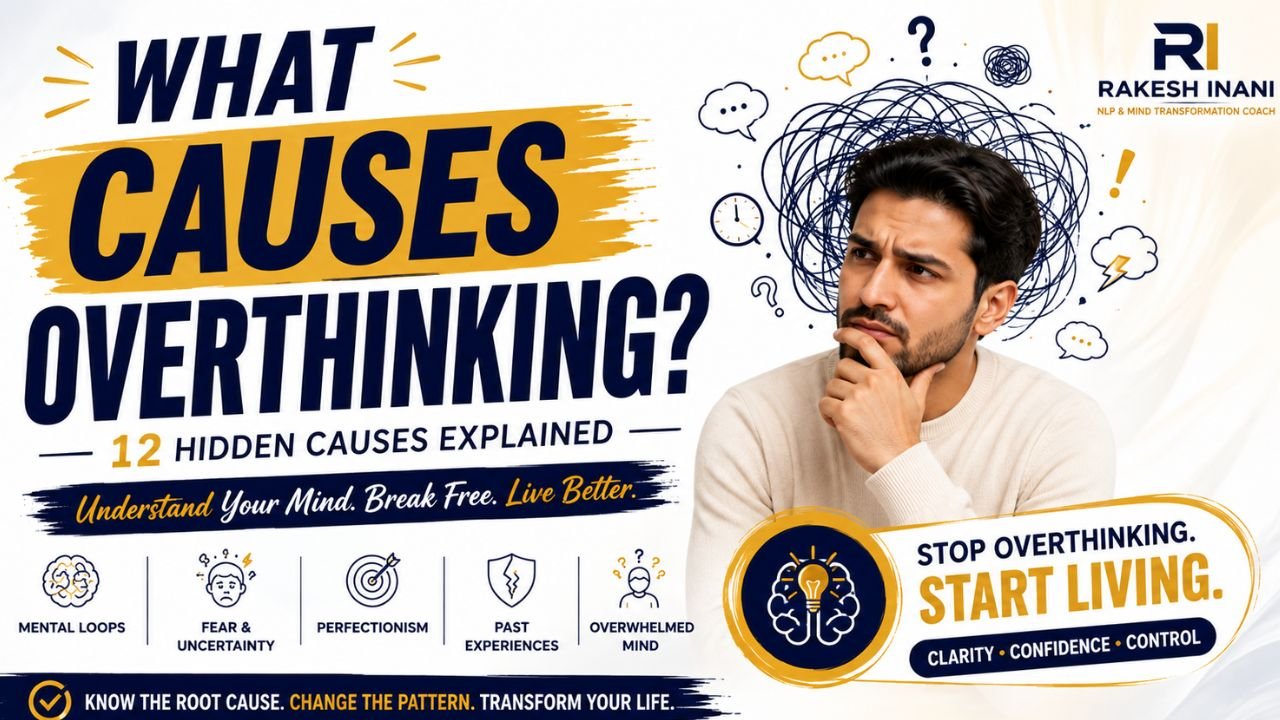
Why Do I Overthink Everything? 12 Hidden Causes of Overthinking Explained
Have you ever asked yourself, “Why do I overthink everything, even small things?”
Perhaps one simple decision takes hours.
One short conversation stays in your mind all day.
One small mistake makes you question your complete ability.
Even when everything appears fine, your mind may search for a possible problem.
You may tell yourself, “Just stop thinking about it.”
However, your mind does not stop.
Instead, it gives you another question, another possibility, or another reason to worry.
This can become frustrating.
You may wonder why other people can decide quickly while you need to examine every detail. You may even blame yourself for being too emotional, too sensitive, or mentally weak.
However, overthinking is rarely a sign of weakness.
In many cases, it is a protection pattern.
Your mind is trying to keep you safe from failure, rejection, regret, uncertainty, pain, or loss of control. Nevertheless, the strategy it uses—repeated thinking—may create more stress instead of more safety.
Therefore, if you want to understand what causes overthinking, do not begin by fighting your thoughts.
Begin by understanding what those thoughts are trying to do for you.
Quick answer: Overthinking is often caused by fear, uncertainty, perfectionism, low self-trust, past experiences, emotional stress, too many choices, or a strong need to control outcomes. The mind keeps thinking because it believes more thinking will prevent pain or produce certainty.
In this guide, I will explain the hidden causes of overthinking in easy language. As a result, you will be able to recognize why your mind creates repeated thoughts and what emotional need may be hiding behind them.
Why Does the Mind Overthink?
The mind does not usually overthink without a reason.
Even when the pattern feels irrational, it may have a protective purpose.
Suppose you have to make an important decision.
Your mind may begin to examine every possible result because it wants to protect you from making a mistake.
Similarly, after an uncomfortable conversation, your mind may replay every word because it wants to protect you from rejection or conflict.
Before a presentation, your mind may imagine everything that could go wrong because it wants you to prepare.
Therefore, the intention behind overthinking may be positive.
The problem is the method.
The mind believes that if it continues thinking, it will eventually remove every risk. However, because life always contains some uncertainty, the mind never receives the complete guarantee it wants.
Consequently, it keeps thinking.
Your Mind Has a Natural Safety System
Your mind is always taking in information.
It notices facial expressions, voices, changes, memories, possibilities, and signs of danger.
This natural ability is useful.
For example, if you notice a vehicle moving toward you, you step away. If you remember that a particular road is unsafe at night, you choose another route.
Therefore, your mind’s ability to notice risk is not the enemy.
However, sometimes the safety system becomes overactive.
Instead of responding only to a real and present problem, it may respond to an imagined future, an unclear message, or a painful memory.
For example, imagine that you have to speak in front of twenty people.
There is no physical danger.
Still, your mind may interpret possible judgment as a threat.
It may say:
- What if I forget my words?
- What if people laugh?
- What if I cannot answer a question?
- What if they think I am not knowledgeable?
- What if this damages my reputation?
Your mind is trying to protect your social image.
However, because it cannot predict everyone’s reaction, it keeps producing more possibilities.
The Mind Tries to Predict Danger
Prediction helps human beings prepare.
If dark clouds appear, you may predict rain and carry an umbrella.
If an important deadline is close, you may predict pressure and begin working early.
These predictions are useful because they produce action.
Overthinking begins when prediction becomes endless.
You do not simply ask, “What might happen?”
Instead, you ask:
“What is every possible thing that might happen, and how can I make sure that none of the bad possibilities ever happen?”
That question has no complete answer.
Therefore, the mind becomes trapped in prediction.
Why Uncertainty Feels Uncomfortable
Uncertainty means you do not know exactly what will happen.
For example:
- You do not know whether someone will accept your proposal.
- You do not know whether your business idea will succeed.
- You do not know how people will respond to your video.
- You do not know whether a relationship will continue.
- You do not know whether your decision will be perfect.
Although uncertainty is a normal part of life, the mind may treat it like a problem that must be solved immediately.
Therefore, it begins thinking.
The hidden belief may be:
“If I think long enough, I will know what will happen.”
However, thinking can improve preparation. It cannot reveal the complete future.
As a result, the mind continues to search for an answer that does not exist.
What Causes Overthinking?
There is rarely only one cause of overthinking.
Usually, several patterns work together.
For example, a person may fear failure, expect perfection, and struggle to trust their judgment. Together, these patterns can turn one normal decision into hours of mental debate.
Let us explore the most common causes.
1. Fear of Failure
Fear of failure is one of the strongest causes of overthinking.
When you believe failure will be painful, embarrassing, or permanent, your mind tries to prevent it.
Therefore, before taking action, you may imagine every way the action could go wrong.
You may think:
- What if my idea fails?
- What if I lose money?
- What if nobody supports me?
- What if I look foolish?
- What if this proves that I am not capable?
At first, this may look like careful planning.
However, if the thoughts continue without creating a useful plan, fear has taken control of the thinking process.
When Failure Becomes Personal
A major problem begins when you do not see failure as an event.
Instead, you see it as a statement about your identity.
There is a big difference between these two thoughts:
“My attempt did not produce the result I wanted.”
“I am a failure.”
The first thought describes an outcome.
The second thought judges the complete person.
If you believe one unsuccessful attempt can define you, naturally, you will feel pressure to avoid every mistake.
Therefore, you may keep researching, checking, preparing, and delaying.
You are not only trying to protect the project.
You are trying to protect your identity.
How Fear of Failure Creates Inaction
Fear says, “Do not act until you know you will succeed.”
However, success can rarely be guaranteed before action.
Therefore, you wait.
The longer you wait, the bigger the action feels.
The bigger the action feels, the more you think.
The more you think, the less confident you feel.
Soon, the fear of failure creates the very problem it wanted to prevent: no progress.
A healthier belief is:
“I will prepare responsibly, take a manageable step, learn from the result, and improve.”
This belief does not celebrate failure.
Instead, it removes the idea that failure must be avoided at any cost.
2. Fear of Rejection
Human beings naturally value connection and belonging.
Therefore, rejection can feel painful.
If you fear rejection strongly, you may constantly examine other people’s words, actions, expressions, and messages.
For example, if someone replies with only “Okay,” your mind may begin to ask:
- Are they angry?
- Did I say something wrong?
- Why did they not use an emoji?
- Are they losing interest?
- Should I send another message?
- Will another message make me look needy?
The word “Okay” is small.
However, the emotional meaning your mind gives it may be very large.
Why Rejection Creates Mental Replay
The mind may believe that if it studies the conversation carefully, it can discover what the other person truly thinks.
Therefore, it replays the interaction.
However, without direct communication, you still do not have new information.
You only have more interpretations.
As a result, the replay does not create certainty.
It creates more stories.
Rejection Can Feel Like a Judgment of Worth
Sometimes, the fear is not simply that a person may say no.
The deeper fear is:
“If they reject me, it means I am not good enough.”
This belief gives another person’s response too much power over your identity.
A person may say no for many reasons.
They may not be ready. They may have different needs. They may have another priority. They may lack time, money, interest, or emotional ability.
Therefore, rejection is information about a situation.
It is not always a final judgment about your worth.
3. Fear of Judgment
Fear of judgment can make you overthink how you speak, dress, work, post, teach, sell, or express yourself.
You may prepare one social media post and then read it twenty times.
You may record a video and delete it because your voice sounds different from what you expected.
You may stay silent during a meeting even though you have a useful idea.
The hidden questions may be:
- What will people think?
- What if they disagree?
- What if someone criticizes me?
- What if I do not sound intelligent?
- What if people compare me with someone better?
Because you cannot control everyone’s opinion, the mind has no stopping point.
Living Inside Imagined Opinions
When you fear judgment, you may begin making decisions based on conversations that have not happened.
You imagine what one person may say.
Then you imagine how another person may react.
Next, you imagine how you will feel if they do not approve.
Before you take any action, you have already lived through ten imaginary judgments.
This makes the action feel heavier than it truly is.
The Impossible Goal of Universal Approval
No message, decision, idea, or personality will receive approval from everyone.
Even respected experts have critics.
Therefore, if your mind requires universal approval before action, it will always find a reason to stop you.
A more useful question is:
“Does this action match my values, responsibilities, and meaningful goals?”
This does not mean ignoring feedback.
Instead, it means separating helpful feedback from the impossible need to please everyone.
4. Perfectionism
Perfectionism is not simply wanting to do good work.
Healthy standards can support growth.
Perfectionism becomes a problem when you believe your work, decision, or performance must be flawless before it can be accepted.
You may think:
- I must find the perfect topic.
- I must say everything correctly.
- I must create the perfect plan.
- I must make the perfect decision.
- I must feel fully ready before I begin.
Because perfection has no clear finish line, the mind continues checking.
There is always another detail to improve.
Perfectionism Creates Moving Standards
Suppose you decide that your presentation needs ten slides.
You create ten slides.
Then your mind says the design is not professional enough.
You improve the design.
Next, your mind says the examples are not powerful enough.
You change the examples.
Then it says your delivery is not smooth enough.
Therefore, you practise again and again.
Each time you reach the standard, the standard moves.
This is why perfectionism creates exhaustion.
You are running toward a finish line that keeps moving away.
Perfectionism Is Often Fear Wearing Good Clothes
Perfectionism may look like discipline, ambition, or high quality.
However, underneath it, you may find fear.
You may fear criticism.
You may fear being seen as average.
You may fear making a visible mistake.
You may fear that people will discover you are not as capable as they believe.
Therefore, ask yourself:
“Am I improving this because the improvement is useful, or because I am afraid to let the work be seen?”
That question can reveal whether quality or fear is controlling the process.
Excellence and Perfection Are Different
Excellence says:
“I will do my best with the time, information, and resources I have.”
Perfectionism says:
“My work must have no weakness, and everyone must approve.”
Excellence supports completion.
Perfectionism often delays completion.
Therefore, you do not need to lower your standards.
You need to create standards that allow progress.
5. Low Self-Trust
Low self-trust means you do not feel confident in your ability to choose, respond, learn, or recover.
Therefore, every decision may feel dangerous.
You may believe other people know better than you.
As a result, you ask many people for advice.
However, each person gives you a different answer.
Now, instead of having two choices, you have ten opinions.
Your confusion becomes even stronger.
Why Low Self-Trust Creates Repeated Checking
When you do not trust yourself, one answer never feels enough.
You make a decision.
Then you check it.
You ask someone.
Then you search online.
Next, you compare your decision with what other people are doing.
Finally, you change the decision.
A few hours later, you question the new decision too.
The real problem may not be a lack of information.
The real problem may be a lack of trust in your ability to handle the result.
Self-Trust Does Not Mean Always Being Right
Trusting yourself does not mean believing you will never make a mistake.
It means believing:
“I can make the best choice available to me, and if new information appears, I can adjust.”
Self-trust includes flexibility.
It includes learning.
It includes the ability to say, “I did not know that earlier, but now I can respond differently.”
Therefore, self-trust is not perfect prediction.
It is confidence in your ability to respond.
6. The Need to Control Every Outcome
Overthinking often becomes stronger when you try to control things that are outside your control.
You can control your preparation.
However, you cannot completely control the result.
You can control how honestly you communicate.
However, you cannot control how another person understands your words.
You can control the quality of your content.
However, you cannot control exactly how many people watch it.
You can control your effort.
However, you cannot control every external condition.
Why Control Feels Safe
Control gives the mind a sense of protection.
If you believe you can control every detail, you may believe you can avoid pain.
Therefore, the mind tries to plan everything.
However, when life behaves differently from the plan, the mind feels threatened.
It may then work even harder to control the next situation.
Divide the Situation Into Three Parts
Whenever you overthink an outcome, divide the situation into three areas:
What I Can Control
- My preparation
- My effort
- My words
- My boundaries
- My behaviour
- My next action
What I Can Influence
- A conversation
- A relationship
- A team decision
- The response to my work
- The quality of cooperation
What I Cannot Control
- Another person’s thoughts
- The past
- Every future event
- Other people’s reactions
- Unexpected changes
- The final result of every effort
This separation gives your energy a clear direction.
You stop trying to control the complete world and begin managing your response.
7. Past Painful Experiences
The mind learns from experience.
If you have experienced rejection, criticism, embarrassment, betrayal, loss, or failure, your mind may try to prevent the same pain from happening again.
Therefore, a present situation may activate an old warning.
For example, perhaps someone criticized you strongly during a presentation years ago.
Now, before every presentation, your mind may imagine criticism.
The present audience may be supportive.
Still, your mind remembers the earlier pain.
The Past Can Become a Prediction
One painful event may create a belief such as:
- People cannot be trusted.
- Speaking publicly is dangerous.
- Mistakes lead to humiliation.
- If I take a risk, I will lose everything.
- If someone becomes quiet, they are preparing to leave.
- I must stay alert to avoid being hurt.
These beliefs may not always operate consciously.
However, they can influence how you understand new situations.
Similar Does Not Mean the Same
A new situation may remind you of the past, but it is not automatically the same as the past.
The people may be different.
You may have more knowledge.
You may have more resources.
You may now be able to set boundaries.
You may have skills that you did not have before.
Therefore, ask:
“What is similar to the past, and what is different now?”
This question helps your mind update its understanding.
8. Emotional Stress and Mental Overload
Sometimes, you overthink because your mind is already tired.
When you are managing work, family, money, health, relationships, and many unfinished tasks, your mental space becomes crowded.
Then, even a small problem may feel large.
For example, choosing what to eat may normally be easy.
However, after a stressful day, even that choice may feel difficult.
The problem is not the food.
The problem is mental overload.
Too Many Open Mental Loops
An open loop is something your mind believes is unfinished.
It may be:
- An unanswered message
- An incomplete task
- A delayed decision
- An unresolved conversation
- A bill that must be paid
- A promise you made
- An idea you do not want to forget
When many open loops remain in your mind, your attention moves between them.
As a result, you may find it difficult to focus.
Mental Rest Is Not Laziness
A tired mind often needs rest before it needs another solution.
However, many people respond to mental overload by pushing themselves harder.
They consume more information.
They create longer plans.
They continue working late at night.
Consequently, their thinking becomes less clear.
Rest does not solve every problem.
Nevertheless, it may help you return to the problem with a more balanced state.
Sometimes, the question is not:
“How can I think better?”
The question is:
“Have I allowed my mind and body to recover?”
9. Too Many Choices
Having choices can feel like freedom.
However, too many choices can create pressure.
Suppose you want to buy a phone.
You begin with five options.
Then you watch reviews and discover twenty more options.
Each phone has different strengths.
One has a better camera.
Another has better battery life.
Another is less expensive.
Another has better performance.
Instead of becoming clearer, you become more confused.
This is sometimes called choice overload.
Every Choice Includes a Loss
When you choose one option, you also let go of other options.
An overthinking mind may focus strongly on what it could lose.
Even after making a good choice, it may ask:
“What if the other option was better?”
Therefore, you continue comparing after the decision.
Create Decision Criteria Before Comparing
Before studying every option, decide what matters most.
For example:
- Budget
- Main purpose
- Three required features
- Acceptable weaknesses
- Decision deadline
Now, instead of searching for the “best” option in the world, you search for the option that fits your needs.
This reduces unnecessary thinking.
10. Information Overload
Today, you can find endless information about almost any subject.
You can watch videos, read articles, compare opinions, join communities, download guides, and ask artificial intelligence tools.
This access can be helpful.
However, it can also make your mind feel that one more piece of information may reveal the perfect answer.
Therefore, you keep consuming.
Learning Can Become Avoidance
You may tell yourself:
“I need to learn more before I start.”
Sometimes, that is true.
However, learning becomes avoidance when you already know enough to take the next step, but you continue consuming information because action feels uncomfortable.
For example, you may complete ten courses about public speaking but avoid giving one short speech.
You may watch fifty videos about content creation but avoid publishing one post.
You may study business models for months but avoid speaking with one customer.
Knowledge is useful when it enters behaviour.
Otherwise, it can become another hiding place for fear.
11. Habitual Negative Thinking
The mind learns through repetition.
If you repeatedly search for problems, predict failure, or question your ability, these thought pathways may become more familiar.
After some time, negative thinking may feel automatic.
You may wake up and immediately think about what could go wrong.
You may finish one problem and quickly find another.
You may receive a compliment but focus on the one critical comment.
Familiar Does Not Mean True
A repeated thought can feel believable simply because you have thought it many times.
For example:
“I always make mistakes.”
“Nobody understands me.”
“I cannot trust myself.”
“Something will go wrong.”
These thoughts may feel like facts.
However, repetition is not evidence.
Therefore, instead of asking, “How strongly do I feel this?” ask:
“What facts support it, and what facts do not support it?”
This begins to separate habit from truth.
12. A Strong Sense of Responsibility
Responsible people may overthink because they care deeply about the results of their actions.
They want to help others.
They want to make good decisions.
They do not want to create problems.
These are valuable qualities.
However, responsibility becomes unhealthy when you begin feeling responsible for everything.
You may feel responsible for:
- Other people’s emotions
- Everyone’s comfort
- Every possible future problem
- Outcomes you cannot control
- Preventing all disagreements
- Making every person happy
This creates impossible pressure.
Responsibility Needs Boundaries
You can be responsible for your behaviour.
You are not responsible for controlling every person’s response.
You can communicate with care.
You cannot guarantee that nobody will feel disappointed.
You can support someone.
You cannot live their life for them.
Healthy responsibility says:
“I will do my part with care.”
Unhealthy responsibility says:
“I must control the complete result.”
That second belief often creates overthinking.
How Childhood Experiences Can Shape Overthinking
Not every overthinking pattern begins in childhood.
However, early experiences can influence how you respond to mistakes, uncertainty, emotions, and approval.
This is not about blaming parents, teachers, or family members.
Most people act from their own understanding and circumstances.
The purpose is to understand what you may have learned.
Growing Up With Strong Criticism
If mistakes regularly brought harsh criticism, you may have learned to check everything carefully.
You may now believe:
“I must not make a mistake.”
Before speaking, you mentally prepare every sentence.
Before sending a message, you read it repeatedly.
Before taking action, you examine every possible weakness.
This habit may have helped you avoid criticism earlier.
However, it may now prevent natural expression and action.
Being Afraid of Making Mistakes
Some children learn that good performance brings love, attention, or approval.
Therefore, they may connect achievement with worth.
As adults, they may feel that making a mistake will reduce their value.
This can create perfectionism and overthinking.
A healthier message is:
“My performance can improve, but my human worth is not decided by one result.”
Feeling Responsible for Other People’s Emotions
If you often had to keep peace, avoid upsetting someone, or predict another person’s mood, you may have learned to watch people closely.
As an adult, you may examine small changes in voice, expression, or behaviour.
You may ask:
“Are they upset because of me?”
This awareness may once have helped you feel safer.
However, now it may lead you to assume responsibility for emotions that are not yours to control.
Learning to Seek Approval
If your choices were often questioned, you may have learned to seek permission before trusting yourself.
Therefore, as an adult, you may need many people to approve your decision.
However, different people have different values.
So, collecting more opinions may not create more clarity.
Part of building self-trust is learning to listen to advice without giving away your complete authority.
How Past Failure Creates Future Overthinking
A painful failure can become a mental warning.
Suppose you invested in a project and lost money.
The next time you see an opportunity, your mind may immediately show you the previous loss.
It may say:
“Be careful. This could happen again.”
This warning can be useful.
You may need to study the risks, create a budget, or ask an expert.
However, the warning becomes overthinking when the mind treats every new opportunity as the old failure.
One Mistake Can Become a General Rule
The mind may create broad rules such as:
“I failed once, so I will fail again.”
“One person rejected me, so people will reject me.”
“One relationship ended, so relationships are unsafe.”
“One video received low views, so my content is not valuable.”
These rules ignore context.
They take one event and turn it into a permanent prediction.
Avoidance Makes Fear Stronger
When you avoid an action, you may feel short-term relief.
For example, if you fear public speaking and cancel a presentation, your anxiety may reduce immediately.
However, your mind may learn:
“I escaped because speaking was dangerous.”
Therefore, the next presentation may feel even more threatening.
Small, safe, and gradual action can create new evidence.
You may begin by speaking for one minute.
Then you may speak to a small group.
Next, you may record a short video.
Each action teaches the mind:
“I can experience discomfort and still respond effectively.”
Why Do Intelligent and Responsible People Overthink?
Many intelligent people overthink because they can see several possibilities.
They notice details.
They understand that decisions can have consequences.
They can imagine different points of view.
These abilities are valuable.
However, without a clear stopping rule, the same strengths may produce mental overload.
Seeing Too Many Possibilities
An intelligent mind may quickly create many outcomes.
For every solution, it sees a weakness.
For every opportunity, it sees a risk.
For every opinion, it sees another point of view.
This ability supports strategy.
However, it becomes unhelpful when every possibility receives equal attention.
Not every possibility is equally likely.
Therefore, intelligent thinking also needs prioritization.
Ask:
- Which outcome is most likely?
- Which risk is most important?
- Which risk can I prepare for?
- Which possibility is only imagination?
- What information would meaningfully change my decision?
Feeling Responsible for Every Result
Responsible people may believe they should predict every problem in advance.
If something goes wrong, they may say:
“I should have known.”
However, this belief is unfair.
You can make thoughtful decisions without predicting everything.
Wisdom includes preparation.
It also includes accepting the limits of prediction.
Confusing Mental Activity With Preparation
Because overthinking uses energy, it can feel productive.
You may spend hours thinking and feel that you worked hard.
You did work hard mentally.
However, effort and progress are not always the same.
Ask:
“What has this thinking produced?”
If it produced a plan, decision, question, or action, it may have been useful.
If it only produced more fear, create a stopping point.
Why Do I Overthink Even When Everything Is Fine?
Some people notice that when one problem ends, their mind quickly finds another.
This can feel confusing.
You may say:
“My life is fine. Why am I still overthinking?”
There are several possible reasons.
Your Mind May Be Used to Scanning for Problems
If you have lived with ongoing stress, your mind may become used to staying alert.
Even when the situation becomes calm, the habit of scanning may continue.
Your mind may ask:
“What am I missing?”
“What could go wrong?”
“Why does this feel too easy?”
Calmness may feel unfamiliar.
Therefore, the mind creates a concern because concern feels more familiar than peace.
Calmness Can Feel Unsafe
If you have experienced sudden disappointment in the past, you may believe that relaxing will leave you unprepared.
You may think:
“If I stop worrying, something bad will happen.”
However, worrying does not control events.
It only keeps your body and mind in a state of preparation.
You can remain responsible without remaining mentally tense.
The Mind May Create a New Concern
When one issue is solved, an overthinking habit may move to another subject.
First, you worry about work.
When work becomes stable, you worry about your relationship.
When the relationship feels calm, you worry about health.
This suggests that the main problem may not be any one topic.
The deeper pattern may be discomfort with uncertainty.
Therefore, solving each subject separately may not be enough.
You may need to practise allowing small amounts of uncertainty without immediately trying to remove them.
Discover the Cause Behind Your Overthinking
The same overthinking behaviour can have different causes.
Two people may both delay publishing a video.
However, one may fear criticism, while the other may fear making an imperfect first impression.
Therefore, you need to understand your personal pattern.
Complete these statements:
- I begin overthinking when…
- The result I fear most is…
- If that result happened, I believe it would mean…
- I keep thinking because I hope it will…
- What I actually need is…
- One part of this situation I can control is…
- One small action I can take is…
For example:
“I begin overthinking when I have to share my work publicly.”
“The result I fear most is criticism.”
“If that happened, I believe it would mean that I am not capable.”
“I keep thinking because I hope I can make the work impossible to criticize.”
“What I actually need is a realistic completion standard and greater comfort with feedback.”
“One part I can control is the quality of my preparation.”
“One small action I can take is publishing a useful first version.”
This exercise moves you from the visible thought to the hidden fear.
Once you understand the fear, you can choose a better response.
What Should You Do After Finding the Cause?
Understanding the cause is powerful, but understanding alone is not enough.
You also need a response.
Use this simple process:
Recognize the Trigger
Notice what happened before the overthinking started.
Identify the Fear
Ask what your mind is trying to prevent.
Separate Fact From Prediction
Write what you know and what you are imagining.
Identify the Real Need
Do you need information, reassurance, rest, communication, boundaries, or action?
Choose One Response
Take one small step that meets the real need.
For example, if the problem is missing information, collect one specific fact.
If the problem is an unclear relationship issue, plan an honest conversation.
If the problem is exhaustion, rest before deciding.
If the problem is perfectionism, define what “good enough” means.
If the problem is fear of action, take the smallest safe step.
Frequently Asked Questions About the Causes of Overthinking
What Is the Main Cause of Overthinking?
There is no single cause for everyone. However, fear and uncertainty are common roots. The mind may continue thinking because it wants to prevent failure, rejection, regret, or loss of control.
Why Do I Overthink Small Things?
A small decision may represent a larger fear. For example, choosing what to say in a message may connect with fear of rejection. Therefore, the situation looks small, but its emotional meaning feels large.
Why Does My Brain Expect Something Bad?
Past stress, painful experiences, habitual worry, or a strong need for certainty may train your attention to look for possible problems. This does not mean the feared event will happen. It means your mind has become highly focused on risk.
Is Overthinking Caused by Low Confidence?
Low confidence can contribute to overthinking because you may doubt your ability to choose or handle the result. However, overthinking can also be connected with perfectionism, stress, past experiences, and other factors.
Why Do I Overthink After Talking to People?
You may fear judgment, rejection, misunderstanding, or conflict. Therefore, your mind replays the conversation to search for signs of a problem. Direct communication and separating facts from assumptions can be more useful than repeated guessing.
Why Do I Overthink When Making Decisions?
Decisions include uncertainty and the loss of other options. If you fear regret or believe you must choose perfectly, your mind may keep comparing even after it has enough information.
Does Perfectionism Cause Overthinking?
Yes, perfectionism can cause overthinking because the mind keeps searching for weaknesses and improvements. Since perfection has no clear finish line, the thinking may continue indefinitely.
Can Childhood Experiences Cause Overthinking?
Childhood experiences may influence overthinking, especially if mistakes brought strong criticism, approval felt conditional, or you learned to monitor other people’s moods. However, not every overthinking pattern begins in childhood.
Can Stress Make Overthinking Worse?
Yes. When you are mentally or physically tired, it may become harder to organize thoughts and manage uncertainty. Therefore, small concerns may feel larger during periods of stress.
Why Do I Overthink When My Life Is Going Well?
Your mind may be used to scanning for danger. Calmness may feel unfamiliar, especially after a long period of stress. As a result, the mind may search for a new problem even when no immediate problem is present.
Final Takeaway
So, why do you overthink everything?
You may overthink because your mind is trying to protect you.
It may want to prevent failure.
It may want to avoid rejection.
It may want to create certainty.
It may want to control the future.
It may want to stop past pain from happening again.
The intention is protection.
However, endless thinking is often the wrong strategy.
More thinking cannot guarantee success.
More thinking cannot control other people.
More thinking cannot rewrite the past.
More thinking cannot remove every risk.
What it can do is help you prepare—up to a point.
After that point, you need a different response.
You may need to accept some uncertainty.
You may need to trust yourself.
You may need to communicate.
You may need to rest.
You may need to take one small action.
Therefore, the goal is not to punish your mind for overthinking.
The goal is to show your mind that safety can also come from preparation, boundaries, self-trust, flexibility, and action.
When overthinking begins, ask yourself:
“What is my mind trying to protect me from, and what would be a healthier way to respond?”
That question can change the complete direction of your thinking.
In the next blog of this series, we will explore the signs, symptoms, and different types of overthinking. You will learn how to recognize past-focused rumination, future worry, decision overthinking, social overthinking, relationship overthinking, and performance overthinking.
Author: Rakesh Inani
NLP & Mind Transformation Coach
This article is for educational purposes and does not diagnose or treat a mental-health condition. If repeated thoughts cause severe distress or interfere with sleep, relationships, work, or daily functioning, consult a qualified mental-health professional.
Transform Your Mind: JOIN MIND TRANSFORMATION COMMUNITY
Learn More:
Real Leaders Know This ONE Secret to Influencing Without Speaking
7 Day Manifestation- NLP Guided Meditation for Success
The Complete Success Formula: 6 Steps to Turn Goals into Consistent Action