
Active Recall and Spaced Repetition: Remember What You Learn
Have you ever studied a chapter, understood it clearly, and then forgotten most of it a few days later?
You may have read the page again and again. You may also have highlighted the best lines. However, when you needed the answer in a test, meeting, or conversation, your mind went blank.
This experience is common. More importantly, it does not always mean that your memory is weak.
Often, the problem is the way you review.
Here is the direct answer: Active recall means trying to bring information back from memory without first looking at the answer. Spaced repetition means reviewing that information again after growing gaps of time. Together, these methods help you practise remembering before the learning fades too far.
In simple words, you first pull the idea out of your mind. Then, you repeat that effort over time.
This is different from only rereading.
Rereading puts the answer in front of you. Active recall asks your brain to find it.
Therefore, if you want to know how to remember information for a long time, this pair of methods is a strong place to begin.
In this guide, I will help you use both methods in a simple, calm, and practical way. You will learn how to revise books, lessons, meetings, speeches, and professional knowledge without turning every day into a long exam.
Why Rereading Is Not Always Enough
Rereading is not useless.
Your first reading helps you meet the information. A second reading may help you notice something you missed. However, repeated reading can become passive very quickly.
The words begin to look familiar. Since they look familiar, you feel that you know them.
Yet familiarity can fool you.
When the book is open, the answer seems obvious. When the book is closed, the answer may disappear.
Recognition Is Not the Same as Recall
Recognition means seeing an answer and knowing that you have seen it before.
Recall means producing the answer from memory.
For example, imagine that you are learning the capital of Australia.
If you see four options and choose Canberra, you are using recognition.
If somebody asks the question with no options and you say Canberra, you are using recall.
Both abilities have value. However, daily life often demands recall.
You must remember a client’s need without reading the whole email. You must explain an idea without copying a book. You must speak during a meeting without seeing every answer on a screen.
Therefore, your practice should include the same basic act: bringing knowledge back without first seeing it.
Why Smooth Reading Can Feel Like Learning
Each rereading becomes easier because the material is no longer new.
That easy feeling can produce confidence. However, confidence is not proof of durable learning.
To check your understanding, close the source and ask:
- What was the main idea?
- What were the key points?
- Can I give an example?
- Can I explain it in my own words?
- Can I use it in a new situation?
If you struggle, do not judge yourself.
You have discovered where learning needs work.
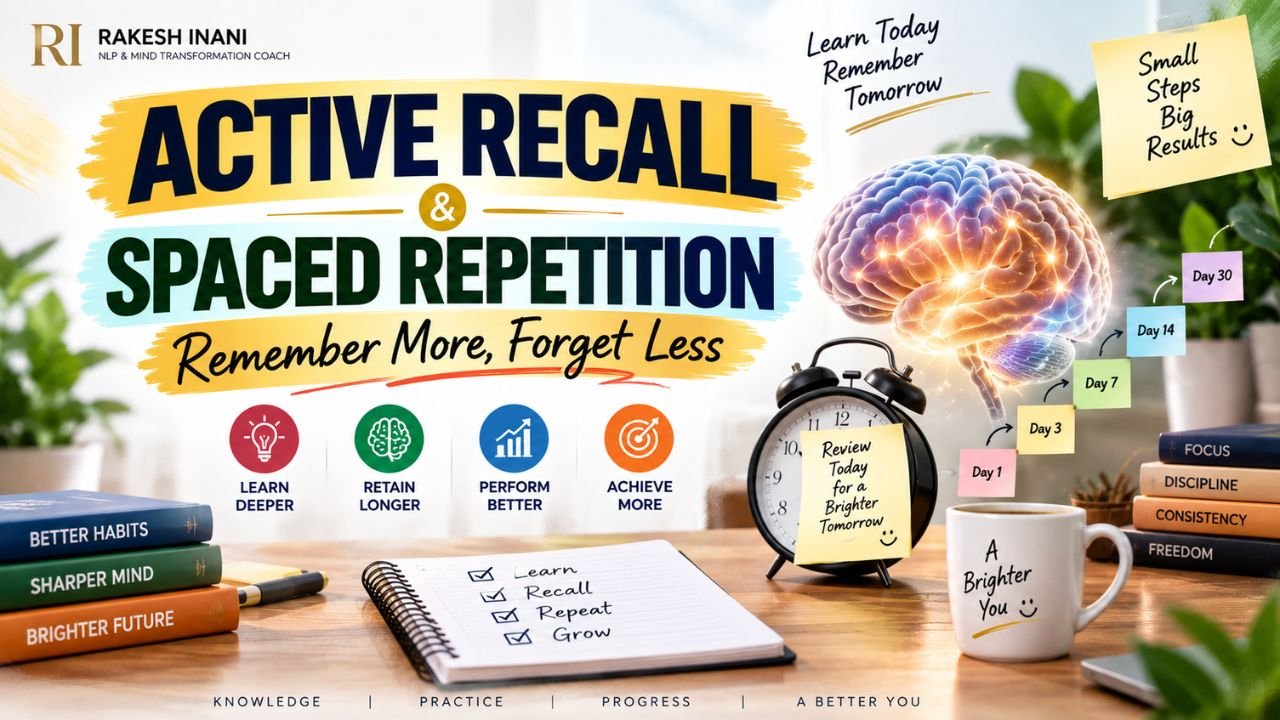
What Is Active Recall?
Active recall is the practice of deliberately retrieving learned information from memory before checking the answer.
It is sometimes called retrieval practice or practice testing.
However, the word “testing” can sound stressful. So, remember that active recall does not need marks, pressure, or competition.
It can be one gentle question after a page of reading.
It can also be a two-minute voice note in which you explain what you learned.
The important action is this: look away from the source and try to remember.
Active Recall Is More Than a Memory Test
A normal test often measures what you know.
Active recall can also help strengthen what you know.
When you attempt to retrieve an answer, you practise finding the path to that answer. Then, when you check and correct your response, you make the learning more accurate.
Research reviews have found that retrieval practice can improve long-term retention compared with repeated study in many learning situations. You can explore the science in this review on the role of retrieval practice in long-term retention.
Still, active recall is not magic.
It works best when you first understand the material, ask suitable questions, give yourself a real chance to answer, and use feedback to correct mistakes.
How Recall Strengthens Learning
Imagine that a memory is a place in a large city.
Reading gives you the address.
Retrieval makes you travel the route.
Each successful trip can make the route easier to follow later. Even an imperfect attempt can reveal where you became lost.
Retrieval Shows What You Truly Know
While looking at notes, you may believe that every point is clear.
After closing the notes, you may remember the first point but confuse the next two.
That gap is useful information.
Now you can spend time on the weak part instead of reading everything equally.
Retrieval Helps Organise Knowledge
When you explain a topic from memory, you must find its structure.
You decide what comes first, which ideas belong together, and which example makes the meaning clear.
As a result, recall can become more than repeating facts. It can help you build an organised understanding.
The Effort Should Be Challenging but Possible
If the answer appears instantly every time, the practice may be too easy.
However, if you remember nothing and receive no helpful cue, the practice may be too difficult.
Aim for useful effort.
Pause. Search your memory. Write what you can. Then check the answer and learn from the difference.
Simple Active Recall Methods
You do not need a special app.
You can practise active recall with a book, paper, notebook, phone recorder, or conversation partner.
The best method is one you will use regularly.
Close the Book and Explain
Read one short part.
Then close the book and explain the idea as if you were talking to a beginner.
Use this simple pattern:
- What is it?
- Why does it matter?
- How does it work?
- What is one example?
Next, open the book and compare.
Do not only ask, “Was I right?” Also ask, “What important part did I leave out?”
Write Everything You Remember
Take a blank page.
Write the topic at the top. Then write every important idea you can remember without looking.
This method is sometimes called a brain dump or free recall.
Afterward, check the source with a different colour. Add missing points and correct errors.
Because the correction is visible, you can quickly see what needs another review.
Answer Practice Questions
Turn headings into questions.
For example, change “Benefits of Active Recall” into “What are the benefits of active recall?”
Then answer without looking.
Use different question types:
- Definition: What does this term mean?
- Reason: Why does this happen?
- Process: How does it work?
- Comparison: How are these two ideas different?
- Example: What is a real example?
- Application: How would I use this in a new situation?
Application questions are especially useful because they test whether you can use the knowledge, not simply repeat it.
Use Flashcards Correctly
A flashcard has a prompt on one side and an answer on the other.
First, read the prompt. Next, answer aloud or in writing. Only then should you turn the card over.
Do not flip the card after two seconds because the answer feels difficult.
Give yourself enough time to search.
However, do not stare at one card for ten frustrating minutes. Make an honest attempt, check the answer, understand the correction, and return to the card later.
Teach Someone Else
Choose one person who is willing to listen.
Explain the lesson without reading from your notes.
If the person asks a question, notice whether you can answer clearly. Their confusion may show that your explanation needs better structure.
If nobody is available, teach an imaginary learner.
The memory benefit comes from retrieving and organising the idea, not from having a large audience.
Record a Voice Summary
After a lesson, record a one-minute summary without looking.
Say:
- The main idea
- Three key points
- One example
- One next action
Then compare the recording with your notes.
This works well after a webinar, podcast, meeting, or audiobook because you can practise immediately.
What Is Spaced Repetition?
Spaced repetition is a review method in which you return to information across separate sessions instead of reviewing it many times in one sitting.
The gaps usually grow as your memory becomes stronger.
For example, you might review a lesson today, tomorrow, three days later, one week later, and two weeks later.
The exact schedule can change.
The main idea stays the same: review after time has passed, when remembering requires some effort.
Spacing Is Different From Simple Repetition
Repetition means doing something again.
Spacing means placing time between those repetitions.
Reading one sentence ten times in five minutes is repetition, but it has very little spacing.
Recalling the sentence today, tomorrow, and next week uses repetition with space.
Large research reviews have found a general advantage for distributed, or spaced, practice over massed practice in many verbal-learning tasks. See this major review of distributed practice in verbal recall.
However, there is no perfect spacing calendar for every learner and every goal.
If you need the knowledge next week, your gaps will be shorter. If you need it next year, you will eventually use longer gaps.
Why Cramming Creates Short-Lived Memory
Cramming means packing a large amount of study into a short period, often just before a test or deadline.
It can sometimes raise performance for the next morning.
However, short-term performance is not the same as long-term retention.
During cramming, the material stays fresh because you have seen it many times recently. Therefore, recall feels easy.
After several days, that freshness fades.
Why People Still Cram
Cramming gives a fast feeling of progress.
You can finish many pages in one night. In contrast, spaced practice asks you to plan, return, and tolerate a little forgetting.
That process may feel slower.
Yet if your goal is to remember what you study for a long time, a series of shorter sessions is often more useful than one exhausting session.
What to Do When Time Is Short
Sometimes a deadline is close.
In that case, do not spend the whole night passively rereading.
Instead:
- Choose the most important ideas.
- Understand each idea.
- Close the source and recall it.
- Check the answer.
- Take a short break.
- Recall it again later.
Even within one day, separate recall rounds are more active than one endless reading session.
Then, if the knowledge matters beyond the deadline, continue reviewing it afterward.
A Simple Spaced-Repetition Schedule
If you are new to spaced repetition, use this beginner schedule:
- First review: later the same day
- Second review: the next day
- Third review: after three days
- Fourth review: after one week
- Fifth review: after two weeks
- Sixth review: after one month
This is a starting example, not a medical or scientific prescription.
Adjust it according to your results.
When to Shorten the Gap
Review sooner when:
- You could not recall the answer
- You confused two similar ideas
- The information is new or difficult
- The deadline is close
- Accuracy is especially important
For example, if you forgot a card today, you may see it again later in the same session or the next day.
When to Lengthen the Gap
Wait longer when:
- You recalled the answer correctly
- Your explanation was clear
- You could apply the idea to a new example
- The answer has remained easy across several reviews
You do not need to review strong material every day.
The growing gap saves time and preserves useful difficulty.
Use a Review Calendar
Write the next review date beside each topic.
For example:
“Client discovery questions—review September 8.”
After the review, choose the next date based on performance.
This simple system prevents good notes from disappearing into a notebook forever.
Combine Active Recall With Spaced Repetition
Spacing tells you when to return.
Active recall tells you what to do when you return.
Used together, they create a complete learning loop.
The Six-Step Learning Loop
- Learn: Read, watch, or listen with full attention.
- Close: Remove the answer from sight.
- Recall: Say, write, draw, or demonstrate what you remember.
- Check: Compare your response with the source.
- Correct: Fix missing or inaccurate parts.
- Review later: Return after a suitable gap.
Then repeat the loop.
A Real Study Example
Suppose a student is learning the water cycle.
First, she reads a clear explanation of evaporation, condensation, precipitation, and collection.
Next, she closes the book and draws the cycle from memory.
Then, she checks the diagram. She notices that she forgot condensation, so she corrects it.
The next day, she draws it again.
Three days later, she answers a new question: “Why do clouds form?”
Now she is not merely repeating labels. She is retrieving and applying the process over time.
A Work Example
Suppose you attend training on handling client objections.
After the session, list the main objection types from memory.
The next day, explain the response process aloud.
Three days later, practise with a sample client question.
One week later, review a real conversation and decide which method would fit.
Because the practice grows more realistic, the knowledge becomes easier to use at work.
How to Make Effective Flashcards
Flashcards can support active recall and spaced repetition.
However, badly written cards create extra work.
The goal is not to copy your notes onto hundreds of small cards.
The goal is to create clear prompts that make you retrieve one useful answer.
Put One Main Question on Each Card
Weak card:
“Explain active recall, spaced repetition, cramming, flashcards, memory, attention, and learning.”
This card is too large.
Better card:
“What is active recall?”
Another card can ask:
“How is spaced repetition different from cramming?”
Small cards make mistakes easier to find and correct.
Keep the Answer Short but Complete
Avoid copying a full paragraph when one or two sentences will do.
For example:
Question: “What is spaced repetition?”
Answer: “It is reviewing information across separate sessions, usually with longer gaps as recall improves.”
If the topic needs steps, use a short numbered list.
Use Your Own Words
When possible, write the answer in language you understand.
However, preserve exact wording when exact wording matters, such as a legal term, formula, safety rule, or required definition.
Understanding and accuracy must work together.
Add Examples and Reverse Questions Carefully
One card may ask for a definition.
Another may show an example and ask you to name the concept.
For instance:
“Reviewing a topic today, tomorrow, and next week is an example of what method?”
Answer: “Spaced repetition.”
These different directions create more than one route to the idea.
Avoid Meaningless Pictures and Decorations
A useful image can strengthen a card.
However, too many colours, icons, and animations can steal attention.
Use design to explain, not simply to decorate.
Digital Versus Paper Flashcards
Both formats can work.
Choose based on your habits, learning task, and environment.
Benefits of Digital Flashcards
Digital systems can:
- Schedule reviews automatically
- Carry many cards on one device
- Include sound and images
- Track difficult cards
- Make editing fast
However, your phone may also contain notifications and distractions.
Turn on focus mode during review.
Benefits of Paper Flashcards
Paper cards can:
- Remove screen distractions
- Make drawing and handwriting easy
- Support physical sorting
- Feel simple and direct
However, paper cards do not schedule themselves. You must organise review piles or dates.
Which Type Is Better?
The better type is the one that helps you retrieve honestly and review consistently.
Digital automation is useful, but it cannot replace attention.
Handwriting can feel engaging, but beautiful paper cards are not helpful if you never review them.
How to Review Without Becoming Bored
Memory training should require effort, but it should not feel like punishment.
If every session becomes long and dull, consistency will fall.
Keep Sessions Short
Begin with ten to twenty minutes.
Stop before your attention completely disappears.
Several short reviews across a week can be more sustainable than one giant session.
Mix the Question Types
Use definitions, examples, comparisons, drawings, problems, and explanations.
For instance, do not only ask, “What is active recall?”
Also ask, “How would I use active recall after a business meeting?”
Change the Form, Not the Core Idea
Recall the same knowledge in different useful forms.
You can write it today, explain it tomorrow, draw it after three days, and apply it next week.
The idea stays stable while the practice becomes more flexible.
Use Real-Life Challenges
Practise names after networking.
Recall key points after a client call.
Summarise a chapter during a walk.
When learning connects with real life, review feels more meaningful.
Track What You Know and What You Do Not Know
You do not need a complex dashboard.
Use three simple groups:
Strong
You recall the answer accurately, explain it clearly, and use it in a new example.
Review this material after a longer gap.
Developing
You remember the main idea but miss an important detail or need a small cue.
Review this material after a medium gap.
Weak
You cannot recall the idea, confuse it, or do not understand it.
Return to the explanation, rebuild the meaning, and review sooner.
Move Cards Based on Evidence
Do not mark a topic “strong” because you like it.
Mark it strong because you retrieved it successfully.
Likewise, do not label yourself as “bad at memory” because one card was difficult.
The card is weak today. That is all the result means.
Common Active-Recall Mistakes
Active recall is simple, yet small mistakes can reduce its value.
Looking at the Answer Too Quickly
If you turn the card over immediately, you practise recognition instead of recall.
Pause and make a real attempt.
Making Cards Too Long
A card that contains an entire chapter becomes tiring and unclear.
Break large topics into focused questions.
Reviewing Everything Equally
Strong and weak material do not need the same schedule.
Spend more time on developing and weak areas.
Avoiding Difficult Questions
People naturally enjoy the cards they already know.
However, easy success can hide important gaps.
Face difficult questions in short, calm rounds.
Memorising Before Understanding
Active recall cannot repair a concept you never understood.
If an answer feels meaningless, return to the source. Find a simple explanation and example, then try again.
Recalling a Wrong Answer Without Feedback
Practice needs correction.
After each attempt, check the answer. Otherwise, you may repeat an error confidently.
Building Hundreds of Cards and Reviewing None
Card creation can feel productive.
However, the real value comes from later retrieval.
Create fewer, better cards and schedule the next review.
Treating Every Detail as Equally Important
Do not memorise a book word for word unless exact wording is truly required.
Choose core ideas, important facts, useful processes, and common errors.
Section Action Exercise: Build a Seven-Day Recall Plan
Choose one topic that matters to you.
It could be a chapter, professional process, speech, training lesson, or set of names.
Keep the topic small enough to review in fifteen minutes.
Day 1: Learn and Recall
Study the topic for ten to fifteen minutes.
Then close the source and write everything you remember.
Check your answer. Mark missing points, and create five to ten clear questions.
Day 2: Answer Without Looking
Answer every question aloud or in writing.
Sort the questions into strong, developing, and weak groups.
Review weak answers after checking the source.
Day 3: Explain the Topic
Give a two-minute explanation without notes.
Include the main idea, three key points, and one example.
Then check your accuracy.
Day 4: Apply the Knowledge
Answer one new question or solve one realistic problem.
For example, if the topic is active listening, explain how you would use it with an upset client.
Day 5: Review Only the Weak Parts
Do not reread everything.
Recall the developing and weak questions first. Check, correct, and schedule them again.
Day 6: Use a Different Format
Draw a map, record a voice summary, teach a friend, or write a short example.
Keep the meaning accurate.
Day 7: Complete a Final Recall
Without looking, write:
- The main idea
- Five important points
- One example
- One way you will use the knowledge
Then compare this answer with Day 1.
Notice what became easier and what still needs practice.
Finally, schedule the next review for one or two weeks later.
Key Takeaways
Active recall means bringing information back without first looking at the answer.
Spaced repetition means repeating that recall across separate sessions over time.
Together, the methods help you move beyond passive familiarity.
Remember this learning loop:
- Learn.
- Close the source.
- Recall.
- Check.
- Correct.
- Review later.
Start with short sessions.
Ask one clear question at a time. Give yourself enough time to answer. Then use feedback and adjust the next review gap based on how well you remembered.
Most importantly, do not treat forgetting as proof that you cannot learn.
Treat it as information about what to practise next.
Frequently Asked Questions
What Is Active Recall?
Active recall is the practice of trying to retrieve learned information from memory before looking at the answer.
Examples include answering questions, explaining a topic with closed notes, drawing a diagram from memory, or writing everything you remember.
How Does Spaced Repetition Work?
Spaced repetition places time between review sessions.
As recall becomes stronger, the gaps can grow. If you forget or confuse the answer, you shorten the gap and review it sooner.
Is Active Recall Better Than Rereading?
For long-term retention, research often finds retrieval practice more effective than repeated passive study.
However, rereading still has a role when you need to understand or correct the material. A useful sequence is read, recall, check, and correct.
What Is the Best Way to Revise?
A strong revision method combines understanding, active recall, feedback, and spaced review.
Instead of only reading notes, close them and answer questions. Then check errors and return after a suitable time gap.
How Long Should an Active-Recall Session Be?
There is no perfect length for everyone.
Beginners can start with ten to twenty focused minutes. The quality of retrieval matters more than sitting for many tired hours.
What Is a Good Spaced-Repetition Schedule?
A simple starting schedule is later the same day, the next day, three days later, one week later, two weeks later, and one month later.
Adjust the gaps based on difficulty, accuracy, your deadline, and how long you need to retain the knowledge.
Can I Use Active Recall Without Flashcards?
Yes.
You can close a book and explain, write a brain dump, answer practice questions, draw a process, teach someone, or record a voice summary.
Flashcards are only one tool.
Should I Use Paper or Digital Flashcards?
Both can work.
Digital cards offer automatic scheduling and easy tracking. Paper cards reduce screen distraction and support quick drawing. Choose the format you will use consistently.
What Should I Do When I Cannot Remember an Answer?
First, make a genuine attempt.
Then check the answer, understand it, and explain it in your own words. Review it again after a shorter gap. Do not simply read the answer and move on.
Can Adults Use Active Recall and Spaced Repetition?
Yes. These are learning methods, not school-only tricks.
Adults can use them for professional knowledge, names, languages, presentations, certifications, books, meetings, and daily skills.
Your Next Step
Choose one useful topic today.
Write five questions about it.
Close the source and answer those questions from memory. Check your answers, correct the gaps, and place the next review date on your calendar.
Do not wait for the perfect app or the perfect study plan.
Begin with one honest act of recall.
I am Rakesh Inani, an NLP & Mind Transformation Coach.
I help working professionals and entrepreneurs move from overthinking and inner barriers toward clarity, confidence, and consistent action through practical, responsible mind-transformation tools.
Next, continue with Section 6:
How Sleep Improves Memory, Learning and Mental Clarity
It will explain why sleep supports attention and learning, and how a calmer bedtime routine can support clearer thinking.
Remember:
You do not strengthen memory only by putting information in.
You strengthen it by bringing information back—and returning to it at the right time.
References and Further Reading
- Roediger and Butler: The Critical Role of Retrieval Practice in Long-Term Retention
- Roediger and Karpicke: Test-Enhanced Learning
- Cepeda and Colleagues: Distributed Practice in Verbal Recall Tasks
- Cepeda and Colleagues: Spacing Effects in Learning
- Dunlosky and Colleagues: Improving Students’ Learning With Effective Learning Techniques
- Institute of Education Sciences: Organizing Instruction and Study to Improve Student Learning
Transform Your Mind: JOIN MIND TRANSFORMATION COMMUNITY
Learn More:
Real Leaders Know This ONE Secret to Influencing Without Speaking
7 Day Manifestation- NLP Guided Meditation for Success
The Complete Success Formula: 6 Steps to Turn Goals into Consistent Action
