
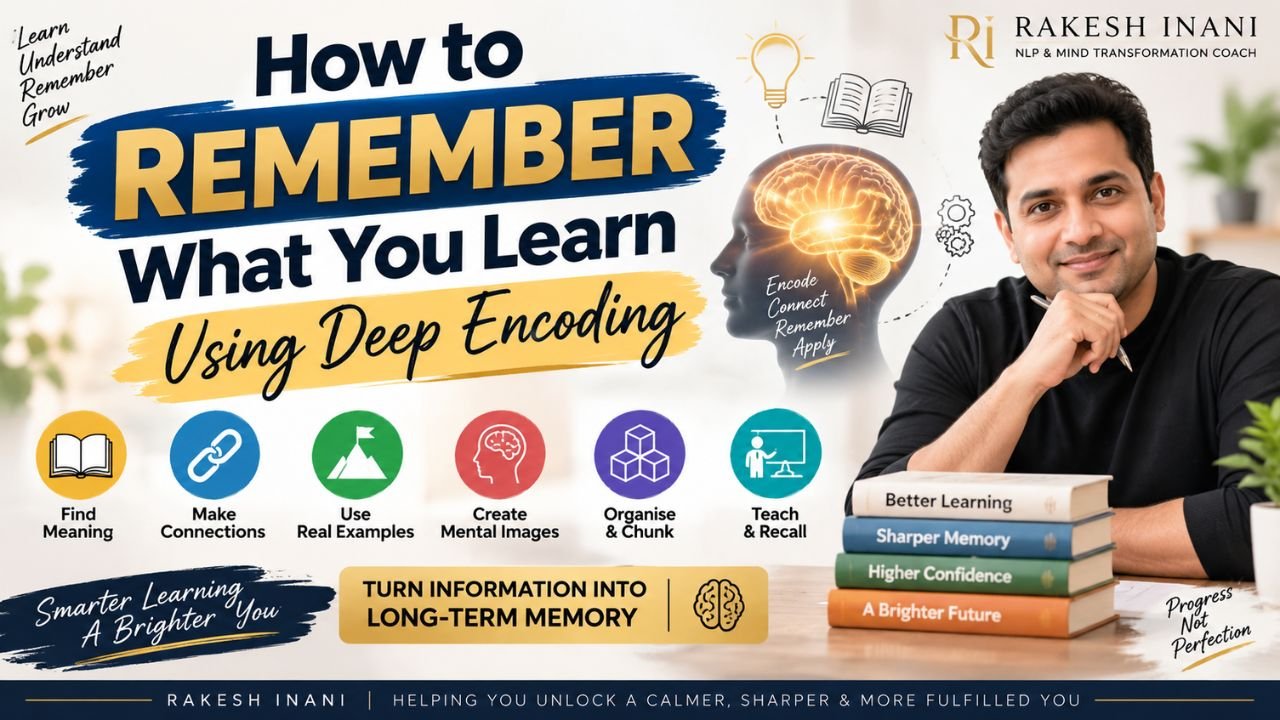
How to Remember What You Learn Using Deep Encoding
You read a useful chapter.
While reading, every idea feels clear.
You highlight several lines. You even think, “This is excellent.”
However, the next day, somebody asks what you learned.
Suddenly, you can remember the colour of the highlighter—but not the lesson.
Why does this happen?
Often, you saw the information but did not process it deeply enough.
Here is the direct answer to the question, “How can I remember what I learn?”
To remember what you learn, do more than read or repeat it. Understand its meaning, connect it with what you already know, relate it to your life, create useful examples or images, organise it into chunks, explain it in simple words, and later practise recalling it without looking.
This process begins with encoding.
Encoding is how information enters a form your memory system can use.
Weak, shallow encoding creates fragile learning.
Deeper encoding creates more meaningful connections and more possible routes for later recall.
However, deep encoding does not mean making learning complicated.
In fact, it often means making the idea simpler, clearer, and more personal.
This guide will show you how.
What Does Encoding Mean?
Encoding is the process of taking in information and changing it into a usable mental form.
In simple language, encoding is what happens when information begins to become a memory.
Suppose someone tells you:
“The meeting has moved to Tuesday at 4:00 p.m.”
If you are distracted, you may hear the sound but create a weak memory.
If you pause, repeat “Tuesday at four,” connect it with your Tuesday schedule, and add it to your calendar, the information receives stronger processing.
The event did not become more dramatic.
Your mind simply did more useful work with it.
Encoding can involve sound, visual form, meaning, movement, context, emotion, and existing knowledge.
For most complex learning, meaning is especially important.
Encoding Is Not the Same as Storage
Encoding is the initial transformation of information.
Storage refers to retaining information over time.
Retrieval means bringing the information back when you need it.
These processes are connected.
Stronger encoding can support later storage and retrieval, but it does not guarantee perfect memory.
Sleep, interference, review, cues, and recall practice also matter.
Therefore, this section focuses on making the first memory stage stronger.
Later sections will show you how to strengthen retrieval and spaced review.
Why Shallow Learning Creates Weak Memory
Shallow learning happens when you interact with the surface of information without building much meaning.
Examples include:
- Reading while mentally distracted
- Copying a paragraph word for word
- Highlighting without summarising
- Repeating a definition you do not understand
- Watching a lesson without pausing
- Memorising isolated facts without context
These actions can create familiarity.
The words look known.
The page feels known.
The teacher’s explanation sounds known.
However, familiarity is not the same as usable knowledge.
You discover the difference when the source disappears.
Can you explain the idea without the page?
Can you give an example?
Can you use it to solve a problem?
If not, the learning may be shallow.
The Highlighting Illusion
Highlighting can be useful when it helps you select key information.
However, colouring a sentence does not automatically encode its meaning.
You can highlight an entire page and still remember very little.
Use highlighting as the beginning of thinking—not the end.
After highlighting one idea, write a five-to-ten-word note in your own language.
For example:
Highlighted idea:
“Working memory has limited capacity.”
Your note:
“Mental desk becomes crowded quickly.”
Now you have translated the idea into a meaningful model.
The Rereading Illusion
Rereading makes information easier to recognise.
Therefore, each reading feels smoother.
That smoothness can create the belief, “I know this.”
Yet when you try to recall the idea without looking, you may struggle.
So, after one careful reading, close the source and retrieve the main point.
Difficulty during recall is not failure.
It shows you what needs strengthening.
Meaning Is the Foundation of Memory
Meaning answers questions such as:
- What is this?
- Why does it matter?
- How does it work?
- Where does it fit?
- When would I use it?
Information becomes easier to remember when it has a clear place inside your understanding.
Classic levels-of-processing research suggests that thinking about meaning can produce better later memory than focusing only on surface features such as the appearance or sound of a word.
Research has continued to study how deeper cognitive operations during encoding shape what is remembered.
A useful overview is this study on what makes deeply encoded items memorable.
The practical lesson is not that one type of encoding always wins in every situation.
The lesson is that useful thought creates useful memory routes.
Turn Information Into a Clear Answer
Suppose you learn the term “cognitive reframing.”
You can memorise a formal definition.
Or you can say:
“Cognitive reframing means looking at the same situation from a more useful and realistic angle.”
Then create an example:
“Instead of saying, ‘I failed, so I am useless,’ I can say, ‘This attempt showed me what I need to improve.’”
Now the term has meaning and a practical situation.
It is no longer a floating phrase.
Connect New Information With What You Already Know
New information becomes easier to understand when it connects with an existing mental structure.
Imagine trying to hang a coat in a room with no hooks.
The coat falls to the floor.
Existing knowledge provides hooks.
When you connect a new idea with something familiar, you give it a place.
Use the “This Is Like…” Technique
After learning a new concept, complete this sentence:
“This is like __________ because __________.”
For example:
“Working memory is like a small desk because it can hold only a limited amount of active material.”
“A retrieval cue is like a door handle because it gives you a way to enter a stored memory.”
“Spaced repetition is like watering a plant regularly instead of flooding it once.”
The comparison does not need to be scientifically perfect.
It must clarify the useful relationship.
Then ask where the comparison breaks down.
This step prevents you from taking the analogy too literally.
Connect the Idea With Prior Knowledge
Ask:
- What does this remind me of?
- Which earlier lesson does it support?
- How is it different from what I already know?
- Where have I seen this pattern before?
For example, if you learn about single-tasking, you may connect it with your experience of closing extra browser tabs and finishing work faster.
Now the new concept has personal evidence.
Create a Personal Connection
Information related to the self often receives richer processing.
Research on the self-reference effect has repeatedly found memory benefits when people connect information with themselves.
Studies suggest that self-referential encoding can support memory for both general information and details.
See this review and experiment on self-referencing and memory.
However, personal connection is not simply asking, “Do I like this?”
It means connecting the idea with your experiences, goals, choices, and responsibilities.
Ask Personal Encoding Questions
Try these questions:
- Where does this appear in my life?
- When have I experienced this?
- Which current problem could this help me solve?
- How would this change one decision?
- What do I agree or disagree with?
- Who could benefit if I applied this?
Suppose you are learning about overthinking.
Instead of keeping the lesson general, recall one recent decision you delayed while waiting for complete certainty.
Now identify how the lesson applies.
The concept becomes connected with a real event, emotion, and possible action.
Do Not Force False Personal Stories
Personalisation should remain truthful.
If you have never experienced something, do not invent a memory.
Instead, connect it with a realistic future situation or someone you have observed.
Meaning becomes stronger through honesty, not drama.
Use Questions to Deepen Learning
Questions turn reading into a conversation.
Without questions, information can pass before your eyes.
With questions, your mind searches, compares, and organises.
Use these seven questions for almost any idea:
- What does this mean?
- Why is it important?
- How does it work?
- Where can I use it?
- What would happen without it?
- What is one example?
- How would I teach it simply?
The Question Ladder
Begin with a basic question:
“What is attention?”
Then go deeper:
“Why does attention affect memory?”
Next, make it practical:
“Where does divided attention weaken my learning?”
Finally, make it actionable:
“What will I change during my next reading session?”
This ladder moves information from definition to use.
Answer Before Looking Again
Do not immediately search for the answer each time.
First, attempt an answer from your current understanding.
Then check the source and correct yourself.
This exposes gaps and begins retrieval practice.
Turn Abstract Ideas Into Mental Pictures
Abstract words can be difficult to hold because they have no obvious shape.
Mental imagery gives them a visible form.
For example, you can imagine mental overload as a small desk covered with files.
You can imagine distraction as ten people pulling one rope in different directions.
You can imagine a goal as a lighthouse guiding a boat.
Research shows that visual imagery and memory interact in meaningful ways, although imagery ability differs between people.
For a scientific overview, see this review of mental imagery mechanisms.
Make Images Easy to Notice
A useful memory image can be:
- Large
- Colourful
- Unusual
- Moving
- Emotional
- Connected with the meaning
Suppose you need to remember that the hippocampus plays an important role in forming certain memories.
You might imagine a hippo stamping new memory cards at the entrance of a library.
The image is silly, but it connects the sound “hippo” with memory formation.
Accuracy Comes Before Entertainment
An image should help you recall the correct idea.
If the image is exciting but points to the wrong meaning, it is not useful.
After creating an image, ask:
“What exact information will this picture remind me of?”
What If You Do Not See Clear Mental Images?
People differ in their imagery experience.
Some people see detailed pictures.
Others have faint images or think more through words, space, sound, or feeling.
You do not need cinema-quality images.
Use a sketch, diagram, spoken description, physical object, or spatial arrangement instead.
The goal is a useful representation, not a visualisation contest.
Use Multiple Senses With Purpose
Learning can become more active when you combine useful forms of input and output.
You might:
- Read a definition
- Say it aloud
- Write it in simple words
- Draw a small diagram
- Use a gesture
- Practise the action
However, “more senses” does not automatically mean “more memory.”
If every colour, sound, and movement is unrelated, you create distraction.
Each element should support the same meaning.
Match the Method to the Skill
If you are learning pronunciation, hearing and speaking matter.
If you are learning a yoga posture, seeing and performing the movement matter.
If you are learning a speech, saying the ideas and using natural gestures matter.
If you are learning a diagram, drawing the relationships may help.
The method should resemble the future use.
Learn by Doing When Possible
Reading about a skill creates knowledge about the skill.
Performing the skill creates experience.
If you are learning coaching questions, practise asking them in a realistic conversation.
If you are learning software, use the feature.
If you are learning a recipe, cook it.
Action creates sensory, motor, and contextual cues that passive observation may not provide.
The Power of Emotion and Novelty
Emotion and novelty can make information stand out.
You may remember your first presentation, an unexpected compliment, or a surprising mistake more clearly than an ordinary Tuesday.
However, strong emotion does not guarantee perfect accuracy.
It can make the central event memorable while narrowing attention to other details.
Therefore, use emotion to create meaning—not fear.
Add Healthy Emotional Relevance
Ask:
- Why do I care about this?
- Who benefits when I use it?
- What becomes possible if I understand it?
- What problem can I reduce?
For example, remembering active-listening skills matters because it can help a client feel understood.
Now the lesson connects with contribution and professional responsibility.
Use Novelty Without Making Everything Ridiculous
An unusual example or image can help information stand out.
However, if every point becomes a wild story, the stories may compete.
Use novelty for difficult or easily confused information.
Keep simple information simple.
Organise Information Into Categories
Unorganised information feels heavier than organised information.
Imagine a shopping list with fifteen random items.
Now organise those items into vegetables, dairy, grains, cleaning products, and personal care.
The number of items has not changed.
The structure has.
Categories help you understand where information belongs and provide cues for recall.
Build a Simple Knowledge Map
For any topic, identify:
- Main idea
- Key parts
- Examples
- Common mistakes
- Practical steps
For example, a lesson on memory may contain:
- Attention
- Encoding
- Storage
- Retrieval
- Lifestyle support
This map gives each detail a mental address.
The Chunking Method
Chunking means grouping separate pieces of information into larger meaningful units.
For example, the number 1-9-4-7 can become one meaningful date: 1947.
Similarly, the letters N-L-P become one familiar unit when you understand what NLP represents.
Chunking does not magically expand memory without limit.
It makes better use of existing knowledge and structure.
Chunk a Long Lesson
Suppose a lesson has twelve points.
Instead of memorising twelve isolated points, group them into three categories of four.
For example:
- Prepare
- Learn
- Recall
Then place the detailed steps under these three headings.
You first remember the larger route.
The route then helps you retrieve the details.
Chunk Names, Numbers, and Actions
A phone number can be grouped into smaller sets.
A project can be grouped into planning, creation, review, and delivery.
A speech can be grouped into problem, insight, method, example, and action.
Useful chunks carry meaning.
Random breaks are less helpful.
Use Analogies and Metaphors
An analogy explains one thing through its useful similarity with another.
A metaphor gives an idea a memorable form.
For example:
“Attention is the doorway to memory.”
“Working memory is a mental desk.”
“A retrieval cue is a path back to information.”
These comparisons reduce complexity.
Build Your Own Analogy
Use this pattern:
“Concept A is like familiar thing B because both __________.”
Then add:
“However, the comparison has a limit because __________.”
The second sentence protects accuracy.
For example:
“Long-term memory is like a library because it holds information that is not all visible at once. However, it is not a perfect library because human memories can change and retrieval can fail.”
Now the analogy is memorable and responsible.
Learn by Teaching
Teaching forces you to organise information for another mind.
You must identify the main idea, remove unnecessary words, choose an example, and respond to confusion.
These actions can deepen your own learning.
Research on learning by teaching suggests that explaining to others may support learning partly through retrieval and elaboration.
However, the exact mechanisms and conditions continue to be studied.
See this review of the retrieval-practice hypothesis in learning by teaching.
You Do Not Need a Real Classroom
You can teach:
- A colleague
- A friend
- A family member
- An imaginary beginner
- Your phone camera
- A blank page
The learner does not need to be an expert.
Your job is to make the idea understandable.
Use the Two-Minute Teaching Test
Close the source.
Teach the idea for two minutes using:
- A simple definition
- One example
- One reason it matters
- One practical action
Then check the source.
Notice where you became vague.
That vague point needs more understanding.
The Feynman-Inspired Explanation Method
Physicist Richard Feynman became famous for clear explanation and deep understanding.
Today, many learners use a “Feynman Technique” inspired by that spirit.
Different versions exist, so treat it as a practical learning method rather than one rigid historical formula.
Step 1: Choose One Concept
Do not choose an entire book.
Choose one idea, such as working memory, overthinking, or active recall.
Step 2: Explain It in Simple Language
Write as if you are explaining the concept to an intelligent twelve-year-old.
Remove jargon or define it immediately.
Step 3: Find the Gaps
Notice where you use vague words, repeat the source, or cannot give an example.
Those are your learning gaps.
Step 4: Return to the Source
Study only the missing part.
Then close the source again.
Step 5: Simplify and Connect
Create one analogy, example, or diagram.
Then explain the complete idea once more.
A Feynman-Inspired Example
Concept: Encoding.
Simple explanation:
“Encoding is the process that helps new information begin to become a memory. If I pay attention, understand the meaning, and connect the idea with something I know, I create a stronger starting point for remembering it later.”
Example:
“Repeating a new person’s name and connecting it with their job encodes it more deeply than hearing it while looking at my phone.”
That explanation shows understanding without unnecessary complexity.
Section Action Exercise: The Five-Layer Encoding Practice
Choose one useful idea you want to remember.
It may come from a book, course, meeting, or this article.
Then process it through five layers.
Layer 1: Meaning
Write the idea in one simple sentence.
Ask:
“What does this actually mean?”
Layer 2: Connection
Complete:
“This connects with __________ because __________.”
Use prior knowledge, an experience, or a related concept.
Layer 3: Image or Analogy
Create one mental picture, sketch, or comparison.
Make sure it points to the correct meaning.
Layer 4: Personal Relevance
Answer:
“Where can I use this during the next seven days?”
Choose a real situation.
Layer 5: Explanation
Close the source and teach the idea aloud for two minutes.
Include the meaning, one example, and one action.
Check Your Encoding
After one hour, recall:
- The main idea
- The connection
- The image or analogy
- The application
Then check the source.
Repeat the recall the next day.
Deep encoding creates the routes.
Retrieval practice helps keep those routes usable.
Common Mistakes While Using Deep Encoding
Making Every Idea Complicated
Deep does not mean difficult.
If your explanation becomes more confusing than the source, simplify it.
Creating Images With No Clear Meaning
A funny image is useful only when it leads back to the correct information.
Copying Instead of Translating
Writing the author’s sentence again may not reveal whether you understand it.
Use your own words.
Forcing Too Many Techniques at Once
You do not need a picture, song, dance, story, diagram, and acronym for every fact.
Choose the smallest method that makes the idea clear.
Confusing Personal Opinion With Accurate Understanding
Relate the idea to yourself, but still check the original meaning.
Personal relevance should enrich accuracy, not replace it.
Encoding Without Retrieval
Deep study helps, but you must still practise bringing information back.
Close the source and recall.
Key Takeaways
Encoding is how information begins to become a memory.
Shallow exposure creates familiarity, but deep encoding builds meaning and connections.
To remember what you learn:
- Understand the idea.
- Connect it with prior knowledge.
- Make it personally relevant.
- Ask deeper questions.
- Create a useful image or analogy.
- Organise it into categories and chunks.
- Practise or demonstrate the skill.
- Explain it in simple words.
Then close the source and retrieve the information.
The goal is not to decorate information.
The goal is to make it meaningful, organised, and usable.
Frequently Asked Questions
What Is Encoding in Memory?
Encoding is the process of taking in information and changing it into a form the memory system can use.
Attention, meaning, connections, imagery, and context can all influence encoding.
Why Do I Forget Information After Reading?
You may have read passively, understood only the surface, or relied on familiarity.
After reading a short section, close the source and explain its meaning, example, and application without looking.
How Can I Store Information in Long-Term Memory?
Begin with focused, meaningful encoding.
Then use retrieval practice, spaced review, sleep, and real application.
No single encoding technique guarantees permanent memory.
Does Visualisation Help Memory?
Visual imagery can help when the image is clear and connected with the correct meaning.
However, imagery ability differs.
A sketch, diagram, spatial layout, or verbal analogy can also work.
What Is Semantic Encoding?
Semantic encoding means processing information through its meaning.
For example, instead of noticing only how a word looks, you consider what it means, how it works, and where it fits.
What Is the Chunking Method?
Chunking means grouping separate pieces into larger meaningful units.
For example, twelve lesson points can be organised under three main categories, making the overall structure easier to remember.
Does Teaching Help You Learn?
Explaining an idea can help because it requires retrieval, organisation, and elaboration.
The benefit depends on how actively and accurately you explain, so check the source afterward and correct any gaps.
What Is the Best Way to Remember What I Study?
Use focused attention, explain the meaning, connect it with prior knowledge, create an example, organise it, and recall it without looking.
Review it again after a delay rather than depending only on rereading.
Your Next Step
Choose one idea from this article and complete the Five-Layer Encoding Practice today.
Do not choose ten ideas.
Choose one idea and process it deeply.
Understand it.
Connect it.
Picture it.
Personalise it.
Teach it.
I am Rakesh Inani, an NLP & Mind Transformation Coach.
I help working professionals and entrepreneurs move from overthinking and inner barriers toward clarity, confidence, and consistent action through practical, responsible mind-transformation tools.
In the next blog post in this blog series, we will explore
Active Recall and Spaced Repetition: Remember What You Learn
It will show you how to retrieve information and review it at useful intervals so learning lasts longer.
Remember:
Information becomes memorable when it stops being only something you read and becomes something you understand, connect, and use.
References and Further Reading
- Galli and Colleagues: What Makes Deeply Encoded Items Memorable?
- Jackson and Colleagues: The Self-Reference Effect in Younger and Older Adults
- Serbun and Colleagues: Memory for Details With Self-Referencing
- Pearson and Colleagues: Mental Imagery—Functional Mechanisms
- Brady and Colleagues: The Role of Meaning in Visual Memory
- Kobayashi: The Retrieval-Practice Hypothesis in Learning by Teaching
- Roediger and Butler: The Critical Role of Retrieval Practice in Long-Term Retention
Transform Your Mind: JOIN MIND TRANSFORMATION COMMUNITY
Learn More:
Real Leaders Know This ONE Secret to Influencing Without Speaking
7 Day Manifestation- NLP Guided Meditation for Success
The Complete Success Formula: 6 Steps to Turn Goals into Consistent Action