
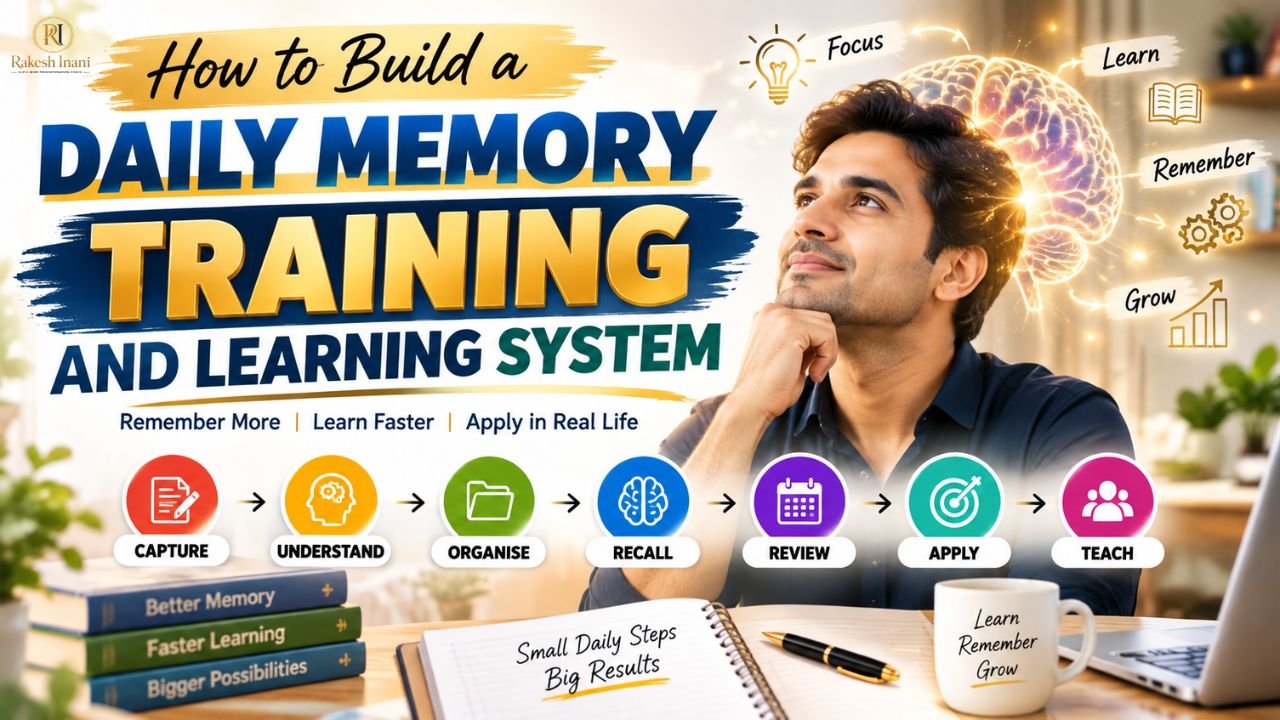
How to Build a Daily Memory Training and Learning System
You may know several powerful memory techniques.
You may understand association, visualisation, chunking, active recall, spaced repetition, the peg system, the Phonetic Major System, and the memory palace.
However, knowing these techniques does not automatically improve your daily memory.
A technique becomes valuable only when you use it regularly.
For example, you may learn how a memory palace works today. Still, if you never build one, fill it, recall it, and review it, the technique remains an interesting idea.
In the same way, reading about active recall is not the same as practising active recall.
Therefore, this section will help you turn individual memory techniques into a complete daily learning system.
Here is the direct answer:
A daily memory training system is a repeatable process for capturing useful information, understanding it, organising it, recalling it without looking, reviewing it over time, applying it, and teaching it. A simple system helps you remember more without trying to memorize everything.
The goal is not to carry every detail inside your head.
Instead, the goal is to know:
- What deserves your attention
- What needs to be remembered
- What should be written down
- How to retrieve important knowledge
- When to review it
- Where to apply it
- How to turn information into wisdom
A good memory system should make your life simpler.
It should not become another heavy responsibility.
Why Memory Improves Through a System, Not a Single Trick
One memory trick may help you remember a shopping list.
Another may help you remember a speech.
A third may help you remember names.
However, your daily life contains many different memory tasks.
You may need to remember:
- What you read
- What a client said
- The main points of a meeting
- Ideas for future content
- Professional knowledge
- Names and faces
- Dates and commitments
- Lessons from your mistakes
- Important numbers
- Actions you promised to take
No single technique can manage all these tasks equally well.
Therefore, you need a system.
A System Reduces Dependence on Motivation
Motivation changes.
On some days, you may feel excited to learn. On other days, you may feel tired, distracted, or busy.
If memory training depends only on motivation, your practice will become irregular.
However, a small routine can continue even when motivation is low.
For example, you may not feel ready for one hour of study. Still, you may be able to complete a focused twenty-minute learning session.
Consistency makes the process more dependable.
A System Reduces Mental Clutter
Without a system, your mind may try to hold everything.
You remember that you must call someone. At the same time, you are trying to recall a book idea, tomorrow’s meeting, an unpaid bill, and a promise made to a client.
As a result, your working memory becomes crowded.
A trusted calendar, task list, and note system can hold responsibilities outside your mind.
This does not weaken your memory.
Instead, it allows you to use your mental energy for understanding, problem-solving, creativity, and meaningful recall.
A System Helps You Find Knowledge Again
Collecting information is easy.
Finding and using it later is harder.
You may have hundreds of screenshots, saved posts, videos, PDFs, notebooks, and voice notes. However, when you need one useful idea, you may not know where it is.
A personal learning system gives information a path.
It moves from:
Capture → Understand → Organise → Recall → Review → Apply → Teach
This path prevents useful knowledge from becoming digital waste.
Stop Trying to Remember Everything
A sharper memory does not mean memorizing every piece of information you meet.
That would be exhausting and unnecessary.
Instead, improve your selection.
Ask:
- Is this information important?
- Will I use it again?
- Does it support one of my goals?
- Must I remember it accurately?
- Can I easily find it later?
- Would remembering it improve my work or life?
These questions protect your attention.
Information You Should Usually Remember
You may benefit from remembering:
- Core ideas in your profession
- Names of important people
- Lessons you use regularly
- Frameworks you teach
- Key steps in repeated processes
- Important personal insights
- Stories you use in communication
- Principles that guide decisions
- Knowledge that helps you solve problems
Information You Should Usually Record
Some information is better stored safely outside your mind:
- Appointment dates
- Payment deadlines
- Addresses
- Medical instructions
- Legal details
- Exact financial figures
- Passwords
- Account information
- Long reference lists
- Information you rarely use
You can still understand these details.
However, you should not depend only on memory for information where one small error could create a serious problem.
Information You Can Let Go
You do not need to remember every social media post, random headline, advertisement, or opinion.
Your attention is limited.
Therefore, deciding what to ignore is part of memory improvement.
A strong learning system is also a filtering system.
Create Your Personal Knowledge System
Your personal knowledge system does not need expensive software.
You can begin with:
- One notebook
- One notes application
- One calendar
- One task list
- One review page
The tool matters less than your ability to use it consistently.
Your system should contain seven stages:
- Capture
- Understand
- Organise
- Recall
- Review
- Apply
- Teach
Let us examine every stage.
Stage 1: Capture Useful Information
Capture means recording information that may deserve your future attention.
You might capture:
- An idea from a book
- A question from a client
- A lesson from a meeting
- A content idea
- A personal insight
- A useful quotation
- An unfamiliar term
- A problem you want to study
- An action you need to complete
However, capture is only the entrance to your system.
It is not learning.
Use One Main Capture Point
Many people lose ideas because they use too many capture locations.
One idea goes into WhatsApp.
Another goes into a paper notebook.
A third becomes a phone screenshot.
A fourth remains inside an email.
A fifth is saved in a browser tab.
Later, they cannot find anything.
Choose one main inbox for new ideas.
For example, you may use one note called “Learning Inbox.”
You can still write on paper when needed. However, move important items into your main system during your daily or weekly review.
Capture Keywords, Not Entire Worlds
Do not copy a full page when one sentence will preserve the idea.
For example, instead of saving five paragraphs about attention, write:
Attention is the entry gate of memory. If I do not notice information clearly, I cannot expect to recall it clearly.
This short note preserves the lesson.
You can also record the source if you may need to verify or quote it later.
Record Why the Information Matters
Beside every useful idea, write one reason for saving it.
For example:
- Use in a YouTube video
- Apply during client questioning
- Add to memory workshop
- Discuss with my team
- Practise before next presentation
- Explore for future article
This small line gives the information direction.
Avoid Endless Collection
Collecting can feel productive because it creates visible activity.
However, saving fifty videos does not mean you learned fifty lessons.
Before saving something, ask:
“Will I process this?”
If the honest answer is no, let it go.
Stage 2: Understand the Information
You cannot reliably use information that you do not understand.
Therefore, do not rush from capture to memorization.
First, make the idea clear.
Explain It in Simple Language
Ask:
“How would I explain this to a ten-year-old?”
If your explanation becomes more complicated than the original lesson, your understanding may still be weak.
Use ordinary words.
For example:
“Retrieval practice strengthens learning” may become:
“After learning, I close the book and try to bring the answer back without looking.”
The second sentence is easier to use.
Ask Six Understanding Questions
For any important idea, ask:
- What does this mean?
- Why does it matter?
- How does it work?
- Where can I use it?
- What is one example?
- What could I misunderstand?
These questions move you beyond surface reading.
Separate Facts From Interpretation
Suppose a report contains a number.
The number is a fact taken from a particular source.
Your opinion about why the number changed is an interpretation.
Keep these separate.
Otherwise, you may later remember your explanation as if it came directly from the research.
Find a Concrete Example
Abstract ideas become clearer through examples.
Suppose you are learning about mental overload.
A concrete example could be:
“You are reading an email while answering a call, checking WhatsApp, and trying to remember a meeting time. Because your attention keeps switching, you miss important details.”
Now the idea has a real-life shape.
Connect It With What You Already Know
Ask:
“What is this like?”
For example:
- Working memory is like a small desk.
- Attention is like a spotlight.
- A memory cue is like a search keyword.
- Spaced review is like watering a plant at useful intervals.
- A memory palace is like placing information at known addresses.
A familiar comparison gives new information a starting point.
Stage 3: Organise Your Knowledge
Unorganised notes become difficult to review.
Therefore, every important item should have a clear home.
Organise by Purpose
Do not create too many folders.
Instead, begin with a few useful areas, such as:
- Personal growth
- Professional knowledge
- Client insights
- Content ideas
- Stories and examples
- Frameworks
- Questions
- Current projects
Your categories should reflect how you use information.
Organise by Project When Action Matters
Some information belongs to a specific outcome.
For example:
- Memory workshop
- Overthinking video series
- Counselling framework
- New course
- Website articles
- Client follow-up process
Project-based organisation makes the next action visible.
Use Clear Note Titles
“Good idea” is a weak title.
“Three reasons people forget what they read” is clearer.
A useful title tells you what is inside the note before you open it.
Keep One Main Idea in One Note
A note containing thirty unrelated ideas is hard to search and review.
Instead, separate important ideas.
For example:
- Attention before memory
- How active recall works
- Spaced-review schedule
- Client story about overthinking
- Five speech-opening patterns
Smaller notes are easier to connect and reuse.
Add Links Between Related Ideas
Knowledge becomes more useful when you see relationships.
For example, link:
- Attention with encoding
- Stress with working-memory overload
- Active recall with spaced review
- Memory palace with speech preparation
- Client questions with listening skills
You do not need advanced software.
You can simply write:
“Related: active recall, concentration, spaced review.”
Create a One-Page Topic Map
For every large topic, create one overview page.
Suppose the topic is memory.
Your overview may contain:
- How memory works
- What weakens memory
- Attention
- Encoding
- Active recall
- Sleep
- Nutrition
- Exercise
- Stress
- Memory techniques
- Daily learning system
- Thirty-day plan
This map becomes your entry point.
Stage 4: Practise Recall
Recall means bringing information back without looking at the source.
This is different from recognition.
When you reread a page, the words may feel familiar. However, familiarity does not prove that you can explain the lesson without the page.
Research has repeatedly found that retrieving information can strengthen later retention more than repeated study alone. Retrieval works best as a learning activity when you also check your answer and correct errors. PubMed: The critical role of retrieval practice in long-term retention.
Use the Close-and-Recall Method
After reading a short section:
- Close the book or hide the screen.
- Ask, “What was the main idea?”
- Explain it aloud.
- Write the key points.
- Reopen the source.
- Compare your answer.
- Correct missing or inaccurate parts.
This simple method can be used with books, videos, meetings, courses, and conversations.
Use Free Recall
Free recall means writing everything you remember without prompts.
Take a blank page and write:
“What do I remember about active recall?”
Do not worry about perfect order.
First, bring out what you know.
Then organise it.
Use Question-Based Recall
Turn notes into questions.
For example:
- What is working memory?
- Why does attention come before recall?
- What is the difference between recognition and retrieval?
- How does chunking help?
- When should I use a memory palace?
Questions give your mind a clear search target.
Use Keyword Recall
Write five keywords from a lesson.
Then cover the explanation.
Use each keyword to rebuild the full idea.
This method is especially useful for speeches and teaching.
Use Drawing Recall
If the material has structure, draw it from memory.
You can recreate:
- A mind map
- A process
- A timeline
- A diagram
- A framework
- A comparison table
Afterward, compare your drawing with the source.
Accept the Small Struggle
Recall may feel difficult.
That does not always mean it is failing.
The effort to search for an answer can be part of the learning process.
However, do not struggle endlessly.
If you cannot retrieve anything after a reasonable attempt, check the answer, understand it again, and create a clearer cue.
Stage 5: Review at Spaced Intervals
One successful recall does not guarantee permanent memory.
Information can become harder to retrieve over time.
Therefore, review it again after a gap.
Spacing your learning over time is supported by educational research and practice guidance. The exact best interval depends on what you are learning, how well you know it, and how long you need to retain it. Institute of Education Sciences study guide.
Use a Simple Beginner Review Schedule
Try this flexible schedule:
- First recall: immediately after learning
- Second recall: later the same day
- Third recall: the next day
- Fourth recall: after three days
- Fifth recall: after one week
- Sixth recall: after two weeks
- Seventh recall: after one month
You do not need to follow these intervals perfectly.
Review weak material sooner.
Review strong material after a longer gap.
Recall Before You Review
Do not begin by opening your notes.
First, ask yourself what you remember.
Then compare.
The order should be:
Recall → Check → Correct
not:
Look → Look again → Feel familiar
Use Three Memory Levels
Mark your knowledge as:
- Strong: You recall and explain it accurately.
- Developing: You remember the main idea but miss details.
- Weak: You cannot recall it or misunderstand it.
Review weak knowledge more often.
This makes your time more efficient.
Avoid Reviewing Everything Every Day
Daily review of every note will soon become impossible.
Instead, review according to need.
Your system should become lighter as knowledge becomes stronger.
Stage 6: Apply What You Learn
Application turns information into usable knowledge.
Ask:
“Where can I use this?”
For example, if you learn active listening, practise it in your next conversation.
If you learn a speaking framework, use it in your next video.
If you learn a memory technique, apply it to a real list.
If you learn a questioning method, test it during a practice counselling session.
Create One Action From Every Important Lesson
Write:
Because I learned this, I will…
Examples:
- Ask one question before reading.
- Close the book after every two pages and recall.
- Keep my phone outside the room during a focus block.
- Review new client names at the end of the day.
- Use a three-part chunk for my presentation.
- Add appointments to my calendar immediately.
An idea with an action is more likely to influence your behaviour.
Use Knowledge in Different Situations
Do not apply an idea only where you learned it.
Suppose you learn chunking while studying.
You can also use it to:
- Organise a speech
- Plan a project
- Summarise a meeting
- Structure a video
- Remember a process
- Explain a problem to a client
Using knowledge in several contexts makes it more flexible.
Record the Result
After applying the idea, ask:
- What worked?
- What felt difficult?
- What changed?
- What will I adjust?
- What did I learn from the result?
Now experience becomes part of the learning cycle.
Stage 7: Teach the Knowledge
Teaching reveals whether your understanding is clear.
You may feel that you understand something while reading it.
However, when you try to explain it, gaps become visible.
Teach It in Simple Words
Imagine explaining the idea to one person who is intelligent but new to the topic.
Avoid unnecessary jargon.
Use:
- A simple definition
- One reason it matters
- One example
- One practical action
Use the Four-Minute Teaching Test
Set a timer for four minutes.
Teach one topic without notes.
For example:
“How does spaced repetition work?”
Afterward, check:
- Did I define it?
- Did I explain why it matters?
- Did I give an example?
- Did I offer an action?
- Did I make any inaccurate claim?
Teach Through Different Formats
You can teach by:
- Speaking to a friend
- Recording a private video
- Writing a short post
- Creating a voice note
- Drawing a mind map
- Answering a question
- Teaching a workshop segment
- Explaining the idea to a client
You do not need an audience every time.
A private explanation can still test your knowledge.
Do Not Teach Beyond Your Evidence
Confidence is not the same as accuracy.
Before teaching medical, psychological, legal, financial, or scientific information, verify your claims.
Explain limitations.
Also, separate professional education from diagnosis or treatment.
The Complete Personal Learning Cycle
Your complete system now looks like this:
- Capture: Save useful information.
- Understand: Explain what it means.
- Organise: Give it a clear home.
- Recall: Retrieve it without looking.
- Review: Return after useful time gaps.
- Apply: Use it in real life.
- Teach: Explain it clearly to someone else.
You do not need to complete all seven stages for every small fact.
However, important knowledge should move through the full cycle.
A 20-Minute Daily Memory Training Routine
You do not need hours of daily brain training.
A focused twenty-minute routine can help you build consistency.
Minutes 1–2: Calm Your Attention
Sit comfortably.
Place your phone away from reach.
Take a slow breath.
Ask:
“What am I learning during these twenty minutes?”
Choose one clear outcome.
For example:
“I will understand and recall the five stages of this framework.”
Minutes 3–7: Learn One Small Block
Read, watch, or listen to one small section.
Do not rush.
Look for:
- The main idea
- Supporting points
- One example
- One useful application
Avoid switching between several sources.
Minutes 8–12: Recall Without Looking
Close the source.
Write or say everything you remember.
Ask:
- What was the main idea?
- What were the key points?
- What example was used?
- What remains unclear?
Allow yourself to think.
Minutes 13–15: Check and Correct
Reopen the source.
Compare it with your recall.
Mark:
- Correct points
- Missing points
- Confused points
- Extra claims not supported by the source
Correct your notes.
Minutes 16–18: Organise and Connect
Place the lesson inside your knowledge system.
Give it a useful title.
Add:
- One category
- One related idea
- One memory cue
- One question for future review
Minutes 19–20: Apply or Teach
Finish one sentence:
“Today I will use this by…”
Alternatively, record a one-minute explanation.
The session is now complete.
A 10-Minute Routine for Busy Days
Some days will be crowded.
Do not abandon your system.
Use this shorter version:
- One minute: Choose the learning goal
- Three minutes: Learn
- Three minutes: Recall
- Two minutes: Check
- One minute: Choose one action
A smaller session protects continuity.
A 30-Minute Routine for Deeper Study
When you have more time, use:
- Three minutes: Prepare
- Ten minutes: Learn
- Seven minutes: Recall
- Five minutes: Check and correct
- Three minutes: Organise
- Two minutes: Apply
Longer is not always better.
Stop when your attention becomes too weak to process information properly.
How to Remember What You Read
Many people ask:
“Why do I forget what I read?”
Often, the problem is not reading ability.
The problem is the method.
If you move your eyes across a page without questioning, pausing, recalling, or applying, the information may remain shallow.
Use this eight-step reading system.
Step 1: Preview
Before reading, look at:
- The title
- Headings
- Subheadings
- Summary
- Diagrams
- Questions
- Bold terms
This gives you a mental map.
Step 2: Set a Purpose
Ask:
“Why am I reading this?”
Possible goals include:
- Understand one concept
- Solve one problem
- Prepare for a meeting
- Learn a skill
- Create content
- Teach someone
- Make a decision
Purpose guides attention.
Step 3: Create Questions
Turn headings into questions.
For example:
“How to practise active recall” becomes:
“What are the steps of active recall?”
Now you are reading to find an answer.
Step 4: Read in Small Blocks
Read one short section.
Do not continue for twenty pages without stopping.
The size of the block depends on the difficulty.
For simple material, it may be three to five pages.
For difficult material, it may be one paragraph.
Step 5: Pause
Stop after one complete idea.
Ask:
“What did that mean?”
If you cannot answer, reread slowly.
Step 6: Recall
Close or cover the page.
Explain the idea in your own words.
Do not try to repeat every sentence.
Focus on meaning.
Step 7: Record a Small Note
Write:
- One main idea
- Three supporting points
- One example
- One action
- One question
This creates a usable summary.
Step 8: Review and Apply
Review the note later.
Then use the idea in a conversation, project, decision, video, or exercise.
The One-Page Reading Note
Use this structure for important articles or chapters:
Title:
What did I read?
Purpose:
Why did I read it?
Core idea:
What is the main message?
Three important points:
What supports the main message?
Best example:
Which example made it clear?
My connection:
What does this remind me of?
My question:
What is still unclear?
My action:
Where will I use it?
Review dates:
When will I recall it again?
This one-page structure prevents note-taking from becoming copying.
How to Remember an Entire Book
You do not need to remember every line of a book.
Instead, remember its structure, central message, most useful ideas, examples, and applications.
Before Reading the Book
Ask:
- Why did I choose this book?
- What problem may it help me solve?
- What do I already know about the topic?
- What do I want to remember after one month?
Write your answer inside the first page or a reading note.
After Each Chapter
Record:
- The chapter’s central idea
- Three supporting insights
- One useful example
- One question
- One application
Then close the book and explain the chapter aloud.
Build a Chapter Map
Create one keyword or image for each chapter.
If the book has ten chapters, place ten keywords along a memory-palace route.
Alternatively, build a mind map.
The map gives you the structure.
Your chapter notes provide the details.
Write a Book Summary From Memory
After finishing the book, do not immediately reread your notes.
First, write:
- The book’s central message
- The main chapter ideas
- The most useful examples
- What you agree with
- What you question
- What you will apply
Then check your notes.
Create a Thirty-Day Application
Choose one idea from the book.
Use it for thirty days.
A book remembered through action becomes more valuable than ten books remembered only as titles.
How to Remember Online Courses
Online courses create a special problem.
It is easy to watch lesson after lesson and feel productive.
However, watching is not the same as learning.
Stop Automatic Video Progress
After one lesson, pause.
Do not allow the next video to begin immediately.
Ask:
- What did I learn?
- What were the steps?
- Can I demonstrate them?
- What must I practise?
Use a Lesson Note
For every lesson, write:
- Lesson title
- Main outcome
- Key steps
- Example
- Exercise
- My question
- My action
- Review date
Practise Before Watching More
If the lesson teaches a skill, practise it.
For example, if the lesson teaches a questioning framework, write your questions and conduct a short role-play.
One practised lesson may be more valuable than five watched lessons.
Create a Course Completion Project
Use the course knowledge to produce something real:
- A presentation
- A workshop
- A case study
- A personal experiment
- A process document
- A video
- A client exercise
- A written guide
A project forces you to combine the lessons.
How to Remember Meetings
Meetings contain decisions, questions, explanations, and actions.
Trying to write every word may reduce your listening.
Instead, capture the structure.
Before the Meeting
Write:
- Purpose
- Desired outcome
- Three main questions
- Information you must provide
- Decisions you need
This prepares your attention.
During the Meeting
Listen for:
- Problem
- Evidence
- Options
- Decision
- Owner
- Deadline
Use keywords.
Do not write full sentences unless exact wording is important.
Use the P-D-A Framework
A simple meeting-memory framework is:
- P—Problem: What are we discussing?
- D—Decision: What did we decide?
- A—Action: Who will do what, and by when?
This framework will not capture every detail.
However, it protects the information most likely to affect work.
Recall Before Reading Your Notes
Immediately after the meeting, take two minutes.
Without looking, ask:
- What was the main issue?
- What decision was made?
- What did I promise?
- What must happen next?
- What remains unclear?
Then check your notes.
Send or Record a Clear Summary
Write:
- Decision
- Action
- Owner
- Deadline
Written confirmation reduces misunderstandings.
Do not rely only on memory when several people are responsible for an important outcome.
How to Remember Conversations
A conversation is not an examination.
You do not need to memorize every sentence.
Instead, remember what matters to the person.
Listen for Meaning
Ask:
- What is the person feeling?
- What problem are they describing?
- What outcome do they want?
- What have they already tried?
- What matters most to them?
Paraphrase Naturally
Say:
“If I understand you correctly, the main problem is not lack of ideas. It is that you keep questioning every idea before you act. Is that right?”
Paraphrasing checks your understanding.
It also strengthens your memory of the conversation.
Connect the Person With Three Keywords
After an important conversation, record three respectful keywords.
For example:
“Anita—promotion—fear of judgement—presentation.”
Later, those keywords may help you rebuild the context.
Recall the Conversation Soon Afterward
Ask yourself:
- Who was involved?
- What mattered most?
- What emotion was present?
- What action was agreed?
- What follow-up is needed?
Then verify any commitment.
Protect Privacy
Do not record sensitive personal information without appropriate care.
Use secure systems.
Avoid placing private client details inside casual notes or public tools.
Memory support must include ethical responsibility.
How to Remember Names and Professional Details
Use a simple five-part process:
- Hear the name correctly.
- Repeat it naturally.
- Create a respectful association.
- Connect it with the person’s role or topic.
- Recall it after the conversation.
For example:
“Meera—marketing—content planning—met at workshop.”
Later, try to recall the name before checking your contact list.
How to Remember Daily Responsibilities
Important responsibilities should not depend only on memory.
Use a trusted external system.
Use a Calendar for Time
Place appointments, meetings, and deadlines in your calendar.
Include:
- Date
- Time
- Location
- Preparation
- Reminder
- Related document
Use a Task List for Action
A calendar tells you when something happens.
A task list tells you what you must do.
Write actions clearly.
“Workshop” is vague.
“Prepare the first five slides for Saturday’s memory workshop” is actionable.
Use Environmental Cues
Place an item where it will be noticed at the right time.
For example:
- Keep the document beside your work bag.
- Place medicine according to professional instructions and in a safe, consistent location.
- Keep a reusable bottle on your desk.
- Put your reading book on your pillow if bedtime reading is your plan.
- Place a written question beside your laptop before a client call.
Use Habit Links
Connect a new action with an existing routine.
For example:
- After morning tea, review five flashcards.
- After lunch, recall one lesson.
- After every meeting, write decisions and actions.
- Before closing work, review tomorrow’s calendar.
- Before sleep, write unfinished thoughts.
The existing habit becomes a cue.
Do Not Use Memory as a Measure of Character
Forgetting one task does not mean you are lazy, careless, or incapable.
It may mean the task had no clear cue, time, location, or system.
Instead of judging yourself, repair the process.
How to Build a Weekly Memory Review
Daily practice handles small learning.
A weekly review protects the whole system.
Choose one fixed time each week.
For example, Sunday evening or Monday morning.
Review Your Learning Inbox
Ask:
- What did I capture?
- What deserves processing?
- What can I delete?
- What needs action?
- What belongs in a project?
Review Your Weak Knowledge
Look at topics marked “weak.”
Choose only a few for deeper practice.
Review Your Applications
Ask:
- What did I use?
- What result did I observe?
- What will I continue?
- What needs adjustment?
Review Your Upcoming Needs
Look at the next seven days.
Ask:
- Which meeting requires preparation?
- Which names should I review?
- Which knowledge will I need?
- Which presentation should I rehearse?
- Which deadlines need external reminders?
Choose One Learning Priority
Do not choose ten.
Select one main topic for the next week.
Focused learning reduces fragmentation.
Create Your Weekly Memory Scorecard
A scorecard should guide you, not punish you.
Rate each area from 0 to 2:
- 0: Not completed
- 1: Partly completed
- 2: Completed well
| Memory-supporting behaviour | Monday | Tuesday | Wednesday | Thursday | Friday | Saturday | Sunday |
|---|---|---|---|---|---|---|---|
| Focused learning session | |||||||
| Recall without looking | |||||||
| Spaced review | |||||||
| Applied one idea | |||||||
| Organised useful notes | |||||||
| Protected attention | |||||||
| Prepared tomorrow’s tasks |
At the end of the week, do not focus only on the total.
Ask:
- Which behaviour helped most?
- Where did the system break?
- Was my routine too large?
- Which time of day worked best?
- What is one adjustment for next week?
How to Measure Real Memory Improvement
Do not test yourself every hour.
Memory improvement becomes visible through practical changes.
Look for signs such as:
- You can explain ideas without notes.
- You remember more from books.
- You lose fewer meeting actions.
- You remember names more often.
- You prepare speeches more quickly.
- You connect new knowledge with older ideas.
- You use what you learn.
- You notice weak understanding sooner.
- You depend less on last-minute cramming.
- You feel calmer about learning.
Measure Recall, Not Confidence Alone
You may feel confident and still recall incorrectly.
Therefore, use simple tests.
For example:
- Recall ten keywords.
- Summarise a chapter.
- Rebuild a mind map.
- Teach a concept for four minutes.
- Answer five practice questions.
- Recall a meeting before checking notes.
Then compare with the source.
Measure Application
Ask:
“What did this knowledge help me do?”
Application may include:
- Making a better decision
- Explaining an idea clearly
- Improving a conversation
- Completing a task
- Solving a problem
- Producing useful content
- Changing one repeated behaviour
Knowledge becomes valuable when it supports action.
Digital Tools Versus Paper
Both can work.
Choose according to the task.
Advantages of Paper
Paper can help when you want:
- Fewer digital distractions
- Flexible drawings
- Handwritten mind maps
- Quick free recall
- A visible daily page
- A slower thinking process
Advantages of Digital Tools
Digital tools can help when you need:
- Search
- Tags
- Links
- Reminders
- Easy editing
- Access across devices
- Spaced-repetition software
- Storage for large projects
Use a Hybrid System
You may learn and recall on paper.
Then store the final useful notes digitally.
For example:
- Read a chapter.
- Recall it on paper.
- Correct your understanding.
- Save the final summary inside your digital knowledge system.
- Add review questions to a flashcard tool.
The best system is the one you can maintain.
Common Daily Memory-System Mistakes
Collecting More Than You Process
A large information inbox creates pressure.
Delete aggressively.
Keep only what supports a real purpose.
Creating Too Many Categories
Twenty folders may look organised.
However, they may slow down every decision.
Begin with a few broad categories.
Add another only when the need becomes clear.
Writing Notes Without Questions
Statements are easy to reread passively.
Questions invite retrieval.
Turn:
“Attention is required for encoding”
into:
“Why does attention come before memory?”
Copying Instead of Thinking
Copying a page may create a complete-looking note.
However, it may contain little personal understanding.
Summarise in your own words.
Reviewing Before Recalling
Do not open your note first.
Try to remember.
Then check.
Using Flashcards for Everything
Flashcards are useful for clear questions and answers.
However, they may be poor tools for complex arguments, creative skills, or complete projects.
Match the method to the task.
Making Flashcards Too Long
One card should usually test one main point.
A full paragraph on the back encourages rereading.
Never Applying the Knowledge
Information may remain available but inactive.
Choose one action.
Use the idea in real life.
Building an Impressive but Heavy System
Your system should save time.
If maintaining it takes longer than learning, simplify it.
Missing One Day and Giving Up
A missed day is one event.
It does not erase your progress.
Restart with the smallest version of the routine.
A Seven-Day Personal Learning and Recall Schedule
Use one topic that matters to you.
It may be a professional framework, book chapter, coaching concept, course lesson, or presentation.
Day 1: Choose and Capture
Select one learning goal.
Write:
- What do I want to learn?
- Why does it matter?
- Where will I use it?
- How will I test myself?
Learn one small section.
Then record the main idea.
Day 2: Understand and Explain
Review the topic without trying to memorize exact words.
Answer:
- What does it mean?
- Why does it matter?
- How does it work?
- What is one real example?
Explain it in simple language.
Day 3: Organise and Connect
Divide the topic into three to five chunks.
Create a mind map or overview page.
Connect it with knowledge you already have.
Day 4: Recall Without Looking
Close all sources.
Write everything you remember.
Answer practice questions.
Then check and correct your response.
Day 5: Apply the Lesson
Use the idea in a real task.
For example:
- Practise it in a conversation.
- Include it in a video.
- Use it during a meeting.
- Solve a work problem.
- Build a small demonstration.
Record what happened.
Day 6: Teach It
Give a four-minute explanation without notes.
Include:
- Definition
- Importance
- Example
- Application
Review your explanation.
Correct unclear or inaccurate parts.
Day 7: Review and Plan
Recall the whole topic one more time.
Compare your understanding with Day 1.
Then decide:
- What is strong?
- What is developing?
- What is weak?
- What will I review next?
- How will I continue using it?
Section Action Exercise: Build Your Personal Memory System
Take one blank page.
Divide it into seven areas.
Area 1: Capture
Write where new ideas will go.
Example:
“My main capture point is one note called Learning Inbox.”
Area 2: Understand
Write the questions you will ask.
Example:
“What does it mean, why does it matter, and where can I use it?”
Area 3: Organise
Write your main categories.
Keep them limited.
Area 4: Recall
Choose two recall methods.
For example:
- Blank-page recall
- Question cards
Area 5: Review
Choose your review schedule.
Keep it realistic.
Area 6: Apply
Write:
“Every important lesson must produce one action.”
Area 7: Teach
Choose your teaching format.
It may be:
- A private video
- A written summary
- A conversation
- A social media post
- A workshop explanation
Now place this page where you study.
Use the system for seven days before changing it.
Frequently Asked Questions
How Can I Train My Memory Every Day?
Use a short daily routine.
Learn one small block, close the source, recall the main ideas, check your answer, organise the lesson, and choose one application.
Consistency matters more than completing a long session once.
What Is the Best Daily Memory Routine?
A useful beginner routine is:
- Two minutes to focus
- Five minutes to learn
- Five minutes to recall
- Three minutes to check
- Three minutes to organise
- Two minutes to apply or teach
Adjust the time according to your needs.
How Can I Remember What I Read?
Preview the material, set a question, read in small blocks, pause, recall without looking, write a short summary, review later, and apply one useful idea.
Reading alone may create familiarity. Retrieval shows what you can actually remember.
How Can I Retain Knowledge From Books?
Remember the book’s central message, chapter structure, best examples, and applications.
After every chapter, close the book and summarise it.
At the end, build a book map and use one lesson in real life.
Should I Take Notes While Reading?
Yes, but avoid copying every sentence.
Capture keywords, main ideas, examples, questions, and applications.
Then recall before looking at your notes.
Is Active Recall Better Than Rereading?
Retrieval practice often produces stronger long-term retention than repeated studying alone. However, you still need the source for initial learning, understanding, checking, and correcting errors.
Use both in the right order:
Learn, recall, check, and correct.
How Often Should I Review What I Learn?
Review difficult information sooner and strong information after longer gaps.
A beginner schedule may include later the same day, the next day, three days later, one week later, two weeks later, and one month later.
Adjust the intervals according to your recall and goal.
Do Notes Weaken My Memory?
No.
A trusted note system reduces the need to hold every responsibility in working memory.
However, copying without thinking may create weak learning. Use notes for storage and organisation, then practise recall without looking.
Should I Use Paper or a Digital Note System?
Use the format you can maintain.
Paper can reduce distraction and support drawing. Digital tools can improve search, linking, reminders, and storage.
A hybrid system often works well.
How Can I Remember Meetings Better?
Prepare the meeting purpose, listen for problems and decisions, take keyword notes, recall the discussion immediately afterward, and record every action with an owner and deadline.
How Can I Improve Memory for Work?
Focus on knowledge you use repeatedly.
Organise it by role or project, turn important points into questions, review them at spaced intervals, and apply them during real work.
Also, use calendars and task systems for commitments.
What Should I Do If My Memory Still Feels Weak?
First, check attention, sleep, stress, workload, learning method, and the amount of information you are trying to manage.
Use a trusted external system for responsibilities.
However, if memory changes are sudden, worsening, affecting daily life, or accompanied by confusion, weakness, speech difficulty, severe headache, or other concerning symptoms, seek qualified medical advice promptly.
Final Summary
Memory improvement is not only about tricks.
It is about building a repeatable relationship with information.
First, choose what deserves your attention.
Next, capture it clearly.
Then understand and organise it.
After that, recall it without looking.
Check your accuracy.
Review it over time.
Apply it in real life.
Finally, teach it in simple language.
Your personal memory system is:
Capture → Understand → Organise → Recall → Review → Apply → Teach
You do not need a perfect application, a complicated notebook, or a two-hour study routine.
You need a clear system you can trust and repeat.
Start with twenty minutes.
Learn one small idea.
Close the source.
Bring the idea back.
Correct your gaps.
Then use what you learned.
That is how information slowly becomes knowledge.
Moreover, that is how knowledge becomes part of your thinking, speaking, decisions, and actions.
I am Rakesh Inani, an NLP and Mind Transformation Coach. My goal is to help you move from mental overload and passive information consumption toward clarity, confident learning, and consistent action.
In the next section, 30-Day Memory Improvement Plan: Train Your Brain Every Day, you will bring the complete memory system together through one practical thirty-day journey.
References and Further Reading
- The critical role of retrieval practice in long-term retention
- Taking memory tests improves long-term retention
- Organizing instruction and study to improve learning
- Repeated testing and long-term retention
- The effectiveness of spaced learning, interleaving, and retrieval practice
Transform Your Mind: JOIN MIND TRANSFORMATION COMMUNITY
Learn More:
Real Leaders Know This ONE Secret to Influencing Without Speaking
7 Day Manifestation- NLP Guided Meditation for Success
The Complete Success Formula: 6 Steps to Turn Goals into Consistent Action