
10 Powerful Memory Techniques to Remember Almost Anything
Let me begin with a small test.
Read these ten words once:
Book, mango, key, elephant, candle, train, mirror, shoe, cloud, and cup.
Now look away and try to say them in the same order.
You may remember the first two words. You may also remember “elephant” because it stands out. However, some words may disappear or move to the wrong position.
Now imagine this strange scene.
A giant book opens, and a ripe mango falls out. The mango carries a golden key. The key unlocks a cage containing a dancing elephant. The elephant lights a huge candle and places it on top of a moving train.
Next, the train crashes gently into a silver mirror. A red shoe jumps from the mirror, flies into a white cloud, and lands inside a tea cup.
Now try the list again.
The second attempt may feel easier because the words are no longer separate. Instead, they have become one connected experience.
That is the basic power of memory techniques.
Here is the direct answer to the question, “What are the best memory techniques?”
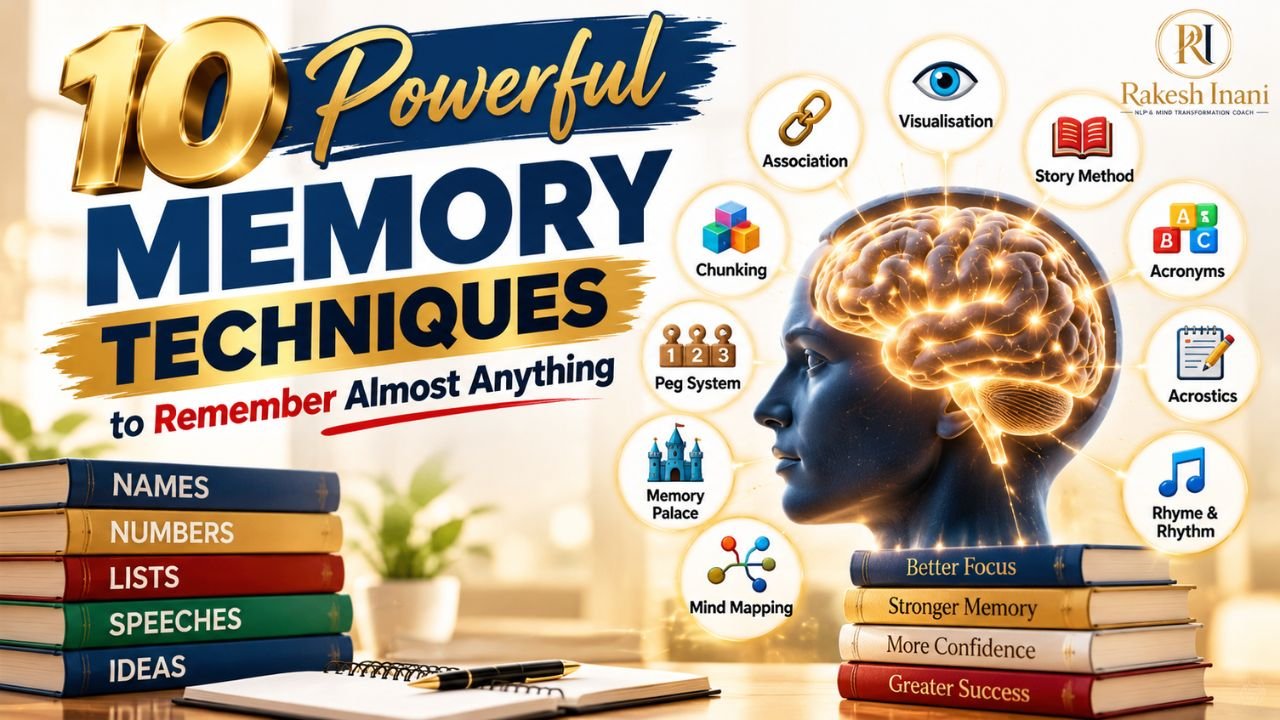
The most useful memory techniques include association, visualisation, the story method, acronyms, acrostics, rhyme and rhythm, chunking, the peg system, the memory palace, and mind mapping. These methods make information more memorable by adding meaning, structure, sound, imagery, order, or location.
However, the phrase “remember almost anything” needs a responsible explanation.
These methods cannot give you perfect memory. They cannot guarantee that you will remember every detail forever. Moreover, they cannot cure dementia, brain injury, attention disorders, or another medical condition.
Instead, memory techniques give your mind better cues.
They help you encode information in a richer way and find it again later.
Therefore, think of these methods as handles.
Information without a handle may be difficult to pick up. Once you add an image, story, category, rhyme, or location, your mind has something to hold.
In this detailed guide, I will explain each memory technique in the same structured way:
- What the technique means
- Why it may work
- How to use it step by step
- A complete example
- The best situations for using it
- Common mistakes to avoid
- A short practice exercise
By the end, you will not only know ten techniques. You will know which technique to choose for names, numbers, lists, books, speeches, meetings, courses, and daily life.
Why Powerful Memory Techniques Work
Memory techniques work because they change how you process information. They add meaning and useful retrieval cues instead of asking you to repeat harder.
For example, a new name may feel like a random sound. When you connect the name “Gulab” with a rose, the name gains a familiar image. The rose can then lead you back to the name.
Unusual images are also easier to notice than ordinary details. A book resting on a table may blend into the background. However, a book jumping on a trampoline while singing is harder to miss.
Meanwhile, chunking, mind maps, acronyms, and speech routes organise loose details. They work like labelled folders for scattered papers.
Most importantly, these methods require active participation. You create, connect, organise, and later retrieve the information. That deeper processing can make the material more meaningful.
Not Every Technique Works Equally Well for Every Task
This point is important.
A story may help you remember a shopping list. However, it may not help you understand a difficult business model.
A mind map may show the structure of a book. However, it may not preserve the exact order of twenty unrelated words.
Likewise, imagery can be useful in some learning situations, but it does not have the same broad evidence across all study tasks as active recall and spaced practice. A major review of learning methods explains these differences in effective learning techniques.
Therefore, choose the technique according to the information.
Then combine it with understanding, active recall, feedback, and spaced repetition.
How to Use This Guide
Do not try to master all ten techniques in one sitting.
First, learn one method. Next, practise it with five to ten items. Then use it in a real situation.
Once that method feels natural, add another.
Use the Four-Part Memory Formula
For every technique, follow this formula:
- Understand: Know what the information means.
- Transform: Turn it into a useful image, story, sound, group, or location.
- Retrieve: Close the source and recall it.
- Review: Return after a suitable time gap.
The technique improves encoding.
Meanwhile, retrieval and review help the memory remain accessible.
Check Accuracy Every Time
An unforgettable mistake is still a mistake.
Therefore, compare your recalled answer with the original source.
This matters especially for medical, legal, financial, technical, safety, and examination content.
Memory Technique 1: Association
Association is the foundation under many other memory methods.
You connect something new with something already familiar.
What Is Association?
Association is a memory technique in which you link new information with a familiar person, place, image, sound, meaning, experience, or idea. The familiar item then becomes a cue for recalling the new information.
For example, suppose your new colleague is named Kiran.
Because “kiran” can mean a ray of light, you imagine a bright ray shining above your colleague’s name badge.
The light becomes the association.
Why Association Can Help Memory
Random information has few connections.
Connected information has context.
When you attach a new fact to existing knowledge, you give it a mental address.
Later, thinking about the familiar idea may bring the new fact back.
For example, imagine that you meet a person named Rose. The name may already create a picture of a red flower.
However, you can make the link stronger. Imagine the person politely holding a giant red rose while saying her name.
Later, the person’s face may activate the flower image. The flower may then bring back the name Rose.
How to Use Association Step by Step
- Notice the new information clearly. Do not create an association before confirming what you heard or read.
- Search for something familiar. Look for a similar sound, meaning, shape, person, place, or experience.
- Create a direct link. Make the familiar and new items interact.
- Make the connection specific. Ask what exact fact the association must recall.
- Test it immediately. Look away and bring the answer back.
- Review later. Recall it again after a time gap.
Detailed Example: Remembering a Name
You meet a business owner named Mr. Deepak.
First, listen carefully and confirm the name.
Next, connect “Deepak” with a glowing lamp, or deepak.
Then imagine a small golden lamp placed respectfully beside his business card.
Also connect the name with one real detail: “Deepak runs a furniture business.”
Your complete cue becomes:
“Golden lamp—Deepak—furniture business.”
After the conversation, recall his face, the lamp, his name, and the business.
The next morning, test yourself again.
Detailed Example: Remembering a Concept
You want to remember that attention comes before memory.
Think of a camera.
If the camera does not focus clearly, the picture will be unclear. In the same way, if your attention does not capture the information, later recall may be weak.
Your association becomes:
“Attention is the camera focus of memory.”
Now, when you see a camera, you may remember the principle.
Detailed Example: Learning a New Word
Suppose you are learning the Spanish word pan, which means bread.
The sound “pan” may make you think of a cooking pan. Therefore, imagine a loaf of bread jumping into a frying pan.
Now create a simple sentence:
“The bread is dancing in the pan.”
The pan helps you recall the sound. The bread helps you recall the meaning.
Afterward, cover the answer and ask yourself two questions:
- What does pan mean?
- What is the Spanish word for bread?
Testing both directions creates a more useful connection.
Use Personal Associations When Possible
Your personal experiences already carry meaning.
Suppose you need to remember that a new client lives in Jaipur. If you once visited Jaipur and clearly remember the Hawa Mahal, use that personal image.
Imagine the client standing in front of the building and waving.
This connection may be stronger for you than a random picture suggested by someone else.
Best Uses for Association
Association works well for:
- Names
- Vocabulary
- Definitions
- Foreign-language words
- People and professions
- New concepts
- Places and events
- Short facts
Common Association Mistakes
Do not choose an association that is insulting or based on a sensitive personal feature.
Also, avoid a connection that is too general.
For example, connecting every new name with “a person” adds no useful cue.
Finally, do not use a sound link while ignoring meaning. If two words sound similar but mean very different things, make the distinction clear.
Association Practice Drill
Choose five objects near you.
Then connect each object with one idea from this article.
For example:
- Door—attention opens memory
- Chair—stable study routine
- Clock—spaced repetition
- Window—new perspective
- Bottle—hydration and focus
After one hour, look at the objects and recall the ideas.
Memory Technique 2: Visualisation
Visualisation turns information into a mental picture or scene.
It is especially useful when the original information is abstract, plain, or difficult to notice.
What Is Visualisation for Memory?
Visualisation for memory means representing information as a clear mental image. The image may include colour, size, movement, sound, emotion, and interaction so that the information becomes easier to notice and retrieve.
The image does not need to look realistic.
In fact, an impossible image can sometimes be more memorable.
Why Visualisation Can Help
Many words describe things you can see.
When you create an image, you give the information form and location.
Moreover, an active image can connect several details in one scene.
For example, the word “apple” already creates an object. However, a giant purple apple rolling through your front door is more noticeable than an ordinary apple.
Visualisation can also represent abstract ideas.
You cannot physically see confidence, stress, growth, or communication. Still, you can create symbols for them.
You might represent confidence with a crown, stress with a heavy bag, growth with a rising plant, and communication with a telephone.
However, people differ in their ability to experience mental imagery. Therefore, you can use sketches, diagrams, gestures, or spoken descriptions when internal pictures are weak.
The Six Features of a Strong Memory Image
Make your image:
- Large: Increase its size beyond normal.
- Colourful: Use one or two strong colours.
- Active: Make something move or interact.
- Unusual: Break an ordinary expectation.
- Emotional: Add humour, surprise, warmth, or curiosity.
- Accurate: Make sure the image points back to the right fact.
You do not need to use all six features every time.
Instead, select the ones that make the image clear and memorable.
How to Visualise Step by Step
- Choose the exact word or idea you must remember.
- Ask, “What object could represent this?”
- Make the object unusually large or active.
- Add one clear location.
- Add sound, texture, or emotion if it helps.
- Say what the image means in one sentence.
- Close your eyes, if comfortable, and recall it.
- Test whether the image returns the correct answer.
Detailed Example: Remembering an Appointment
You need to remember a dentist appointment on Friday at 4:00 p.m.
Imagine a giant toothbrush standing at the entrance of your Friday calendar.
The toothbrush has four large clock hands.
It shouts, “Friday at four!”
Now say the meaning clearly:
“The toothbrush represents my dentist appointment on Friday at 4:00 p.m.”
Still, place the real appointment in your calendar.
Use visualisation as an extra cue, not as the only system for an important commitment.
Detailed Example: Remembering an Abstract Idea
You want to remember that working memory has limited capacity.
Imagine a very small desk.
Five large files are already covering it. Then ten more files fall from the ceiling, and everything slides onto the floor.
The picture represents mental overload.
Your explanation becomes:
“Working memory is like a small desk. Too many active items create crowding.”
Now, when you think about working memory, the small desk may help the idea return.
Detailed Example: Remembering a Daily Task
Suppose you must take a document to work tomorrow.
Imagine the document growing arms and blocking your front door.
The document refuses to let you leave without it.
Next, place the real document near your bag or another safe exit cue.
The physical cue and mental picture now support each other.
Use Interaction Instead of Placement
A cup beside a shoe is a weak image.
A cup pouring hot tea into a dancing shoe is stronger because the two objects interact.
Ask:
- What is moving?
- What is changing?
- What is touching?
- What is making a sound?
- What feels surprising?
Interaction connects the pieces.
What If You Cannot See Images Clearly?
Do not force yourself.
Instead:
- Draw the scene on paper
- Arrange real objects
- Describe the picture aloud
- Use a hand movement
- Create a simple symbol
- Write the relationship as an analogy
- Imagine the sound or movement instead of the appearance
The aim is not perfect visual detail.
The aim is a reliable representation.
Best Uses for Visualisation
Visualisation works well for:
- Concrete words
- Shopping lists
- Vocabulary
- Processes
- Speech points
- Names with image-friendly meanings
- Abstract ideas that can become metaphors
- Remembering where an item belongs
Common Visualisation Mistakes
Do not make the image so detailed that building it takes ten minutes.
Also, avoid decorative details that do not support recall.
Most importantly, check whether the image leads to the exact information. A beautiful elephant image is useless if you cannot remember what the elephant represents.
Visualisation Practice Drill
Visualise these five words:
Pen, mountain, mobile phone, milk, and umbrella.
Make each image large and active.
Then connect each word with one location in your room.
After ten minutes, mentally inspect the locations and recall the words.
Memory Technique 3: The Story Method
The story method connects separate items through one continuous chain of action.
Each item leads to the next.
What Is the Story Method?
The story method is a mnemonic technique in which you place the information you want to remember inside one unusual, connected story. You later replay the story to retrieve the items in sequence.
It is simple, fast, and useful for beginners.
Why the Story Method Works
Unrelated items are difficult to hold because they have no order or connection.
A story supplies both.
The first image causes the second action. The second leads to the third. Therefore, every scene becomes a cue for what follows.
Stories also create movement.
Instead of seeing eight still objects, you experience a short mental event. As a result, recalling one action may help activate the next action.
The Five Rules of a Strong Memory Story
- Use every target item.
- Keep the original order.
- Make each item interact with the next.
- Use clear and unusual action.
- Keep the story short enough to replay.
The story does not need to be realistic.
However, it must be clear.
How to Build a Story Step by Step
- Read the full list once.
- Turn the first item into a visible object.
- Make it act upon the second item.
- Let the second item interact with the third.
- Continue without opening a separate plot.
- Replay the complete story once.
- Recall the items without viewing the list.
- Check the order and correct errors.
Detailed Example: Remembering a Shopping List
You need to buy rice, soap, tomatoes, a notebook, bananas, toothpaste, tea, and batteries.
Create this story:
A mountain of rice falls into a giant bar of soap. The soap begins blowing red tomatoes instead of bubbles. One tomato opens into a notebook.
Next, yellow bananas jump out of the notebook and squeeze a tube of toothpaste. The toothpaste fills a cup of tea, and the cup begins running on two large batteries.
Now replay the story.
Rice leads to soap. Soap leads to tomatoes. Tomatoes lead to notebook. The chain continues until batteries.
Detailed Example: Remembering a Work Process
Suppose your client-call process is:
Prepare, connect, question, listen, summarise, propose, and follow up.
Imagine preparing a large file. The file grows arms and shakes hands to connect.
Then it fires a giant question mark. The question mark becomes a huge ear that listens.
The ear writes a one-line summary, places it inside a gift box containing a proposal, and sends the box through a follow-up email.
The story preserves the order.
After recall, explain what each step means in real work.
Detailed Example: Remembering Historical Events
The story method can also help you remember a short sequence of events.
Suppose you must remember:
Discovery, conflict, agreement, growth, and reform.
Imagine a detective making a discovery. The discovery begins a loud conflict. Two people then sign an agreement.
A plant grows out of the agreement to represent growth. Finally, a teacher trims and reshapes the plant to represent reform.
However, history also requires dates, causes, evidence, and different viewpoints. Therefore, use the story as an order cue and keep accurate notes for the complete lesson.
Use a Beginning and an Ending
A clear opening prevents you from forgetting where the story starts.
A clear ending tells you when the list is complete.
For example, begin at your front door and end with an object exploding into fireworks. The fireworks signal the final item.
How Long Should a Memory Story Be?
For beginners, five to fifteen items may be enough.
If your story becomes too long, divide the material into chunks. Create one small story for each group.
For example, divide twenty items into four groups of five. Give each story a different location or theme.
This prevents one endless story from becoming confusing.
Best Uses for the Story Method
Use it for:
- Short ordered lists
- Shopping items
- Process steps
- Speech points
- Daily errands
- Vocabulary sets
- Historical sequences
- A chain of actions
Common Story-Method Mistakes
Do not mention items without making them interact.
“I saw rice, soap, tomatoes, and a notebook” is weak because it feels like another list.
Also, do not create a long film with unnecessary characters.
Finally, avoid using the story as a replacement for understanding. The image “ear writes a summary” is only a cue. You must still know how to summarise a client’s concern.
Story-Method Practice Drill
Memorise these seven items:
Clock, tiger, pillow, bicycle, orange, doctor, and river.
Build one connected story.
Recall it forward after five minutes. Then try it again after one hour.
Memory Technique 4: Acronyms
Acronyms compress several words into one memorable label.
They are useful when you already understand the full ideas but need a cue for the list.
What Is an Acronym?
An acronym is a word or pronounceable label created from the first letters of several items. Each letter reminds you of one part of the original information.
For example, HOMES is commonly used to recall the Great Lakes:
- Huron
- Ontario
- Michigan
- Erie
- Superior
Why Acronyms Help
Five separate labels become one chunk.
Instead of searching for all five items independently, you remember one word and then unpack its letters.
The acronym acts like a small suitcase.
However, a suitcase is helpful only if you know what you packed inside.
How to Create an Acronym Step by Step
- List only the important items.
- Take the first letter of each item.
- Keep the original order when order matters.
- Look for a real or pronounceable word.
- Add vowels only as private helpers if they do not create confusion.
- Write the meaning beside every letter.
- Practise expanding the acronym without looking.
Detailed Example: A Learning Process
Suppose your learning process contains:
- Preview
- Question
- Read
- Recall
- Review
The first letters create PQRRR.
This is not a smooth word. Therefore, you might say it as “P-Q-triple-R.”
However, if you want a cleaner private label, you could design a related process whose letters create a word:
- Capture
- Understand
- Recall
- Apply
This becomes CURA.
Now practise:
“C—Capture. U—Understand. R—Recall. A—Apply.”
Detailed Example: Preparing for a Meeting
Suppose you want to remember:
- Purpose
- Outcome
- People
- Evidence
- Next step
The initials form POPEN.
You might rearrange them into OPEN only if one item can be removed or combined without damaging the process:
- Outcome
- People
- Evidence
- Next step
Now “OPEN” becomes the meeting cue.
Before changing order or content, ask whether the original sequence matters.
Detailed Example: Building Your Own Acronym
Imagine that you want a checklist for reviewing an important email.
Your checks are:
- Clear subject
- Accurate information
- Respectful tone
- Exact attachment
The first letters spell CARE.
This is a useful acronym because it is a real word and matches the purpose.
Before sending the email, ask:
- C: Is the subject clear?
- A: Is the information accurate?
- R: Is the tone respectful?
- E: Is the exact attachment included?
The acronym is easy to remember because “care” is also the attitude you want while checking your message.
Use Acronyms Without Losing Meaning
After recalling the letters, explain each part.
For example, knowing that R stands for Recall is not enough. You should be able to say:
“Recall means closing the source and bringing the main idea back without looking.”
If you cannot explain the full item, the acronym may be hiding weak understanding.
When Should You Create an Acronym?
Use an acronym when:
- The list is short.
- The first letters are different enough.
- A real or pronounceable word is available.
- The items belong together.
- Remembering the group would be useful.
Do not spend twenty minutes building an acronym for information you only need once.
Best Uses for Acronyms
Acronyms work well for:
- Categories
- Checklists
- Short processes
- Academic lists
- Presentation structures
- Safety sequences when formally verified
- Professional frameworks
Common Acronym Mistakes
Do not create an acronym longer than the original list.
Do not rearrange letters when the sequence matters.
Also, avoid using one acronym for several different frameworks if that creates interference.
Finally, never trust a homemade acronym for high-stakes information until you verify every item.
Acronym Practice Drill
Choose one five-part process from your work.
Write the first letters. Create a short word or pronounceable label. Then explain every part from memory.
Test it again tomorrow.
Memory Technique 5: Acrostics
Sometimes initials do not form an easy word.
In that case, you can turn them into a sentence.
What Is an Acrostic?
An acrostic is a memory sentence in which the first letter of each word represents an item you want to remember. The sentence preserves the original order while making the initials easier to recall.
An acronym gives you one word.
An acrostic gives you one sentence.
Why Acrostics Help
A random string of letters may be difficult to pronounce.
A sentence adds grammar, rhythm, meaning, and sometimes humour.
These features create stronger cues.
How to Build an Acrostic Step by Step
- Write the target items in order.
- Circle the first letter of each item.
- Create a new word beginning with each letter.
- Make the sentence clear, unusual, or funny.
- Keep it short.
- Practise moving from the sentence back to the real list.
- Verify the original order.
Detailed Example: Remembering Directions
Suppose the sequence is north, east, south, and west.
The initials are N, E, S, W.
You can use:
“Never Eat Soggy Waffles.”
The sentence creates a cue for the compass order.
However, remember that the sentence is not teaching geography. It only preserves the initials.
Detailed Example: Remembering a Speaking Routine
Suppose your routine is:
- Pause
- Organise
- Include an example
- Name the action
- Tell the takeaway
The initials are P, O, I, N, T.
They spell POINT, which is an acronym.
However, if the letters were P, O, N, and T, you might create an acrostic such as:
“Patient Owls Notice Truth.”
This example shows an important rule:
Use an acronym when the letters already create a clean word. Use an acrostic when a sentence is easier.
Detailed Example: Remembering a Five-Item List
Suppose the items begin with B, R, A, I, and N.
Create:
“Bright Readers Ask Interesting Questions.”
Now each word acts as an initial cue.
To use the sentence properly, connect each initial with the exact real item. Otherwise, you may remember the acrostic and forget what B, R, A, I, and N represent.
How to Make an Acrostic Personal
A personal sentence may be easier to recall than a general sentence.
Suppose you need the letters M, R, S, and T.
A random acrostic might be:
“Many Rabbits Sing Together.”
However, if your children are named Meera, Rahul, Seema, and Tarun, you might use their names.
Personal meaning can make the sequence stronger.
Still, make sure the sentence does not create confusion with the real information.
Best Uses for Acrostics
Use acrostics for:
- Ordered categories
- Scientific sequences
- Music notes
- School facts
- Speech structures
- Procedure steps
- Lists whose initials do not form a word
Common Acrostic Mistakes
Do not create a sentence with difficult or unfamiliar words.
Do not make it so long that you need another mnemonic to remember it.
Also, practise unpacking it. Many learners remember the funny sentence but cannot recall the real information.
Acrostic Practice Drill
Choose six ordered items from a topic you are learning.
Take the first letters and create one simple sentence.
Then cover the original list and rebuild it from the sentence.
Technique 6: Use Rhymes and Rhythm to Make Words Stick
What Are Rhymes and Rhythm in Memory?
Rhymes use words with matching sounds. Rhythm places words into a steady beat. Together, they turn plain information into a sound pattern that is easier to repeat and notice.
You already know how powerful this can be.
A short song from childhood may return after many years, even when you have not tried to remember it. The tune, beat, and repeated sound give your mind several retrieval clues.
However, you do not need to write a perfect song. A simple line with a clear beat is enough.
Why Does Rhythm Help You Remember?
Normal speech changes all the time.
However, a rhythmic line is more organised. Therefore, when one part of the line starts, the pattern often helps the next part arrive.
Rhyme also narrows the possible answer.
If you remember that the missing word must rhyme with “light,” your mind has fewer places to search.
Even so, sound should support meaning. A catchy line that teaches the wrong fact is worse than no mnemonic at all.
How to Build a Useful Memory Rhyme
First, reduce the information to its most important meaning.
Second, choose a short keyword for the main fact.
Third, find an easy word that rhymes with it.
Fourth, write one or two short lines. Keep the beat natural.
Fifth, say the rhyme aloud several times. Then explain the fact without using the rhyme.
That last step matters.
The rhyme is the key, while understanding is the room it opens.
Detailed Example: Remembering a Decision Rule
Imagine that you often send messages while feeling angry.
You want to remember a simple rule: pause before pressing Send.
You could use this line:
When feelings rise, pause and revise.
Now add a beat.
Tap once on “feelings,” “pause,” and “revise.”
When you feel upset, the word “rise” may bring back “pause and revise.”
The rhyme does not solve the disagreement. However, it gives you a fast cue at the exact moment you need it.
Detailed Example: Remembering a Study Rule
Suppose you want to remember that testing yourself is more useful than only looking at your notes.
Try this line:
Close the page, recall with care; then look back and repair.
The first half tells you to retrieve the information.
The second half tells you to check and correct your answer.
Now explain the meaning in ordinary words:
“I should close the source, recall what I know, compare my answer, and fix any gaps.”
The rhyme is short, but the explanation keeps it accurate.
Add Movement to Strengthen the Pattern
You can tap your fingers, clap softly, walk at a steady speed, or use small hand movements.
Movement gives the rhythm a physical pattern as well as a sound pattern.
For example, use one finger for each step in “stop, breathe, choose.”
Later, the three finger movements may help you retrieve the three words.
Keep gestures simple and respectful. The purpose is to create a cue, not to perform a dance every time you need the information.
Best Uses for Rhymes and Rhythm
Use this method for:
- Short rules
- Safety reminders
- Spelling patterns
- Children’s learning
- Language phrases
- Ordered steps
- Presentation lines
- Habits you want to remember at the right moment
Common Rhyme and Rhythm Mistakes
Do not force a rhyme that changes the truth.
Do not hide a long paragraph inside a song. The best sound cues are short.
Also, do not depend only on silent reading. If the technique uses sound, say it aloud and hear its rhythm.
Rhyme and Rhythm Practice Drill
Choose one useful rule from your work or study.
Reduce it to fewer than twelve words. Add a rhyme or steady beat.
Say it five times, wait ten minutes, and then recall both the line and its real meaning.
Technique 7: Use Chunking to Manage Long Information
What Is Chunking in Memory?
Chunking means placing many small pieces of information into a few meaningful groups.
Instead of trying to hold ten separate items, you may hold three organised chunks.
For example, 1-9-4-7 can feel like four unrelated digits. If 1947 is a meaningful year to you, it becomes one unit.
Chunking does not magically make working memory unlimited.
Rather, it helps you use its limited space more wisely.
Why Does Chunking Work?
Imagine carrying twelve loose oranges.
It is difficult because each orange requires attention.
Now place four oranges in each of three bags. You still have twelve oranges, but you only need to manage three bags.
Memory can work in a similar way.
A good chunk binds details with one label, pattern, or purpose.
However, a chunk only becomes useful when you know what is inside it.
An expert chess player sees meaningful board patterns because of experience. A beginner may still see separate pieces.
Therefore, understanding creates better chunks.
How to Chunk Information Step by Step
First, look for natural groups. These may be topics, dates, locations, stages, or functions.
Second, keep each group reasonably small.
Third, give every group a clear name.
Fourth, learn the group names before learning every detail.
Fifth, practise opening each group and recalling its contents.
Finally, reconstruct the full order without looking.
Detailed Example: Remembering a Long Number
Consider this number:
202609081530
As twelve separate digits, it looks unfriendly.
Now divide it like this:
2026 | 09 | 08 | 15:30
It can now mean 8 September 2026 at 3:30 p.m.
You have not removed any digits. Instead, you have organised them into year, month, day, and time.
If this date matters, add meaning:
“My September meeting is on the eighth at half past three.”
Meaning and chunks now work together.
Detailed Example: Chunking a Chapter
Suppose a chapter contains twelve ideas about better learning.
Do not try to remember twelve equal bullets.
Instead, create three groups:
- Prepare: Goal, questions, environment, focus
- Learn: Connect, visualise, organise, explain
- Remember: Recall, check, space, apply
You now remember three larger stages.
Each stage opens into four smaller actions.
To test yourself, first say:
“Prepare, Learn, Remember.”
Next, unpack each chunk.
Finally, explain how the whole process flows.
Detailed Example: Chunking a Business Update
You need to give your team nine updates.
Group them under three headings:
- Progress: What finished, what improved, what you learned
- Problems: Delay, cost, client concern
- Plan: Next step, owner, deadline
During the meeting, you only need to hold three large headings at the top of your mind.
Each heading then cues three details.
Build Layers of Chunks
A long topic may need more than one level.
For example, imagine a course with four modules. Each module contains three lessons. Each lesson contains three key points.
Begin with the four module names.
Next, open one module and recall its three lessons.
Finally, open one lesson and explain its three points.
This is much easier than trying to hold all thirty-six points as one flat list.
When Chunking Becomes Too Much
Some people create a group for everything.
Soon, they have seven groups with seven items in each group. That is still difficult.
Use layers.
Start with three to five large chunks. Then place a few related details inside each one.
Also, use labels that describe the content.
“Part One” is weaker than “Prepare.”
A meaningful label gives you a better retrieval path.
Best Uses for Chunking
Chunking is helpful for:
- Phone numbers and dates
- Book chapters
- Course lessons
- Speeches
- Project plans
- Procedures
- Vocabulary families
- Long lists with clear categories
Common Chunking Mistakes
Do not group items only because they sit beside one another. Look for a real relationship.
Do not make every chunk a different size if order matters. Uneven groups can be harder to scan.
Most importantly, do not stop after naming the chunks. Practise recalling the details within them.
Chunking Practice Drill
Take twelve items from a real topic.
Place them into three or four meaningful groups.
Give each group a short label.
Cover the source, recall the labels, and then unpack every group. If one item does not fit, change the structure instead of forcing it.
Technique 8: Use the Peg System for Ordered Recall
What Is the Peg System?
The peg system is a memory method in which you first learn a permanent set of mental hooks.
You then attach new information to those hooks with vivid associations.
A common number-rhyme set is:
- One is a bun.
- Two is a shoe.
- Three is a tree.
- Four is a door.
- Five is a hive.
- Six is sticks.
- Seven is heaven.
- Eight is a gate.
- Nine is a vine.
- Ten is a hen.
These pegs remain the same.
Only the items attached to them change.
Why Does the Peg System Work?
An ordinary list has few built-in retrieval points.
If item four disappears, you may need to start from the beginning.
The peg system gives every position an address.
If you want item four, you go to the door. If you want item eight, you go to the gate.
Therefore, it supports forward recall, backward recall, and direct recall by number.
Learn the Pegs Before Adding Information
First, memorise the ten pegs in both directions.
Ask:
“What is six?”
Answer:
“Sticks.”
Then ask:
“Sticks belong to which number?”
Answer:
“Six.”
Next, test the pegs in random order.
Do not attach a real list until these hooks feel automatic. Otherwise, you will struggle to remember both the hook and the new item.
How to Attach an Item to a Peg
Create one active picture in which the peg and item affect each other.
Do not merely place the objects side by side.
Make them collide, stretch, melt, shout, or move.
For example, if item one is milk, do not picture a bun beside a milk bottle.
Instead, picture a giant bun drinking milk until it becomes white and soggy.
The interaction creates the link.
Detailed Example: A Ten-Item Shopping List
Suppose you need to remember milk, apples, soap, rice, tea, onions, bread, salt, batteries, and yoghurt.
Attach each item to its peg:
- Bun–milk: A bun drinks a river of milk and swells like a balloon.
- Shoe–apples: Red apples march out of a large shoe.
- Tree–soap: A tree blows soap bubbles instead of growing leaves.
- Door–rice: You open a door and a mountain of rice falls out.
- Hive–tea: Bees sit around a hive drinking hot tea.
- Sticks–onions: Two sticks slice a huge onion and begin to cry.
- Heaven–bread: Warm loaves float through the clouds in heaven.
- Gate–salt: The gate is frozen inside a sparkling wall of salt.
- Vine–batteries: Batteries grow from a vine like grapes.
- Hen–yoghurt: A hen swims in a bowl of yoghurt.
Now ask for item seven.
Heaven should bring back floating bread.
Next, ask for item three.
The tree should bring back soap bubbles.
This ability to jump directly to a position is the special strength of the peg system.
Detailed Example: Remembering Five Coaching Questions
Suppose your first five coaching questions cover:
- Goal
- Present situation
- Obstacle
- Options
- First action
Place a golden goal medal inside a bun.
Next, put the present situation on the sole of a talking shoe.
Then see a huge obstacle blocking a tree.
After that, watch many options fly through a door.
Finally, imagine bees taking their first action by building a hive.
Before a session, recall bun, shoe, tree, door, and hive.
The questions can then return in order.
Recall the List Backward and Randomly
The peg system is different from an ordinary story because you do not always need to begin with item one.
Ask yourself:
- What was item eight?
- What was item two?
- Which item was attached to the vine?
- Which number held the bread?
This strengthens the links in both directions.
How to Clear and Reuse Your Pegs
Old images can interfere with a new list.
Therefore, use the list for its purpose and allow it to fade. When you attach a new list, make the new pictures fresh and clearly different.
If two lists must remain for a long time, use separate peg sets or add a clear context.
For example, make work images blue and shopping images red.
For permanent knowledge, spaced recall is still needed.
Pegs help you find information. Review helps the information last.
Best Uses for the Peg System
Use pegs for:
- Ordered lists
- Numbered talking points
- Daily priorities
- Short procedures
- Items you may need to recall by position
- Quick demonstrations of memory skill
Common Peg-System Mistakes
Do not keep changing your permanent pegs.
Do not use passive pictures. Interaction is the glue.
Do not begin with fifty pegs. Learn ten well, and expand only when you need more.
Also, do not confuse a peg with the information itself. Recall the item, explain its meaning, and use it.
Peg-System Practice Drill
Learn the ten number-rhyme pegs.
Test them forward, backward, and randomly.
Then attach ten items from your room.
Ask someone to call random numbers from one to ten, and name the matching items without starting from number one.
Technique 9: Build a Memory Palace
What Is a Memory Palace?
A memory palace, also called the method of loci, is a technique that places mental images along a familiar route.
You recall the information by mentally walking through the locations in a fixed order.
In simple words, you turn a place you know into a set of memory addresses.
Research has found promising benefits for ordered recall, although study quality and results vary. Therefore, treat the memory palace as a practical tool, not as proof that everyone will gain perfect memory.
Why Does a Memory Palace Work?
You probably know the layout of your home without trying to recite it.
You know where the front door, sofa, table, kitchen, and bedroom are.
These stable locations give you an organised route.
When you place a vivid image at each location, the place becomes a retrieval cue.
The method combines space, order, association, and visualisation. That makes it especially useful for lists and speeches that must follow a sequence.
Step 1: Choose a Place You Know Well
Start with your home, office, school, or daily walking route.
Do not begin with an imaginary castle containing one hundred rooms.
A small, familiar place is easier.
Step 2: Select Fixed Locations
Choose ten clear locations that do not overlap.
For example:
- Front gate
- Main door
- Shoe rack
- Sofa
- Television
- Dining table
- Kitchen sink
- Refrigerator
- Bed
- Wardrobe
These are called loci, which simply means places.
Step 3: Fix One Route
Always travel through the locations in the same order.
Do not jump from the gate to the bedroom one day and from the gate to the kitchen the next.
A stable route protects the sequence.
Walk through it physically once, if possible.
Notice the shape, colour, position, and size of each location.
Step 4: Turn Information Into Images
Abstract words do not sit naturally on a sofa.
Therefore, translate them.
For “confidence,” you might see a bright gold crown.
For “growth,” you might see a plant shooting upward.
For “communication,” you might see a giant telephone.
Choose the image that makes sense to you.
Personal meaning is more useful than someone else’s clever picture.
Step 5: Make Each Image Interact With Its Location
Do not imagine a crown floating vaguely somewhere in the room.
Instead, see a huge crown crushing the sofa while it loudly says, “I can do this.”
Let the location and image touch.
Add action, sound, colour, size, and feeling.
Step 6: Walk, Recall, and Check
Take a mental walk immediately.
Name each item.
Then check the original source.
Correct missing or weak images.
Walk again after a short gap, later that day, the next day, and at suitable spaced intervals if you need long-term retention.
Detailed Example: A Seven-Part Speech
Suppose your speech has these parts:
- Opening question
- Problem
- Cause
- Personal story
- Three-part solution
- Proof
- Call to action
Place them in a seven-location home route.
At the front gate, see a giant question mark ringing the bell. This cues your opening question.
At the main door, see a huge crack that will not let the door close. This is the problem.
At the shoe rack, see roots growing from every shoe. Roots represent the cause.
On the sofa, see a small version of yourself telling your personal story through a microphone.
On the television, see three tools—a torch, a map, and a key—breaking through the screen. These cue the three parts of your solution.
On the dining table, see a judge examining a pile of evidence. This cues your proof.
At the kitchen sink, see a giant hand pressing a bright “ACT NOW” button. This cues your call to action.
During the speech, you mentally move from the gate to the sink.
You remember the ideas, but you speak in natural words.
Detailed Example: Learning a Seven-Part Process
Suppose you want to remember:
Attention, encoding, storage, consolidation, retrieval, review, and application.
At the front gate, see a giant eye paying attention.
At the main door, see a printer encoding a message into symbols.
At the shoe rack, see a locked box storing information.
On the sofa, see wet cement becoming hard to represent consolidation.
At the television, see a fishing rod retrieving a glowing book.
On the dining table, see a teacher reviewing the lesson.
At the kitchen sink, see two hands applying the lesson by building something.
Now do more than recite the seven words.
At each location, explain the concept in one sentence. This joins mnemonic recall with true understanding.
How Much Information Should Go at One Location?
Beginners should place one main idea at each location.
Later, you can place a small scene containing two or three related details.
However, overcrowding creates confusion.
If the sofa contains seven unrelated objects, it stops being a clear address.
When a topic is large, use one palace for the main sections and smaller linked routes for the details.
Can You Reuse a Memory Palace?
Yes, but do it with care.
For short-term information, allow old scenes to fade before installing new ones. You can also mentally clean each location.
For knowledge you need for months or years, keep that palace dedicated to the topic.
Revisit it through spaced recall.
Then create a different route for temporary lists.
Best Uses for a Memory Palace
The method is especially useful for:
- Speeches and lessons
- Ordered lists
- Historical timelines
- Process stages
- Key points from a chapter
- Sets of facts that can become images
- Long material divided across several locations
Common Memory-Palace Mistakes
Do not choose locations that look too similar.
Do not change the route while recalling.
Do not place weak, still images in the middle of a room. Make each image interact with a fixed object.
Do not memorise every sentence of a speech. Store keywords and ideas so you can speak naturally.
Finally, do not mistake a successful first walk for permanent learning. Test later without looking.
Memory-Palace Practice Drill
Choose a route with ten locations.
Write them down once and memorise the order.
Place ten unrelated words along the route.
Recall them forward, backward, and by location.
The next day, walk through the route again before checking your answers.
Technique 10: Use Mind Mapping to See the Whole Idea
What Is a Mind Map?
A mind map is a visual structure that starts with one central topic and spreads into connected branches.
It shows how large ideas and smaller details relate.
Unlike a straight page of notes, a mind map presents a whole topic as a pattern.
It is most useful for organising and understanding. It can also support recall when you rebuild the map from memory.
Why Can Mind Mapping Support Memory?
Related ideas are easier to recall when they are organised.
A map makes categories, levels, and links visible.
Keywords reduce the load of long sentences.
Meanwhile, colour and small images can create extra cues. Branch positions also give each idea a location.
However, copying a beautiful map is not enough.
The strongest learning happens when you make decisions, explain links, and redraw the structure without looking.
How to Create a Memory-Friendly Mind Map
First, place the main topic in the centre.
Second, add three to seven main branches. Use strong category words.
Third, add smaller branches containing one keyword or short phrase each.
Fourth, use colour consistently. For example, sleep may always be blue, while attention may always be orange.
Fifth, add simple images only where they clarify meaning.
Sixth, explain the map aloud.
Finally, hide it and rebuild it on a blank page.
Detailed Example: Mapping “Sharpen Your Memory”
Write “Sharper Memory” in the centre.
Create five main branches:
- Attention
- Encoding
- Recall
- Lifestyle
- Techniques
Under Attention, add single-tasking, listening, and distraction control.
Under Encoding, add meaning, association, images, and organisation.
Under Recall, add practice questions, flashcards, and spaced review.
Under Lifestyle, add sleep, movement, food, hydration, and stress.
Under Techniques, add stories, chunks, pegs, palaces, and maps.
Now close the source.
Point to each branch and teach it in your own words.
The map acts as the frame, while your explanation supplies the meaning.
Detailed Example: Mapping a Client Project
Place the client’s goal at the centre.
Use four main branches:
- People
- Work
- Time
- Results
Under People, add decision-maker, users, and project owner.
Under Work, add research, design, delivery, and testing.
Under Time, add milestones and final date.
Under Results, add success measures and feedback.
Before a meeting, look at the map for one minute.
Then turn it over and draw its main branches.
This helps you enter the meeting with the whole project in mind.
Mind Map Versus Ordinary Notes
Ordinary notes are useful when exact wording, detailed evidence, or a clear sequence matters.
A mind map is useful when relationships and overview matter.
You can combine them.
Keep detailed notes for accuracy. Then create a one-page map for structure and recall.
Best Uses for Mind Mapping
Use mind maps for:
- Planning a book or article
- Summarising a lesson
- Understanding a large topic
- Preparing a presentation
- Brainstorming
- Connecting related ideas
- Reviewing before an examination or meeting
Common Mind-Mapping Mistakes
Do not write full paragraphs on every branch.
Do not decorate so much that the content becomes hard to read.
Do not use random colours with no purpose.
Most importantly, do not only look at the completed map.
Recreate it from memory and explain the links.
Mind-Mapping Practice Drill
Choose one chapter you understand.
Build a map with no more than six main branches.
Study it briefly, turn it over, and redraw the structure.
Compare the two maps.
Then explain every missing branch in simple words.
How to Remember Names and Faces
Forgetting a name is often an attention problem before it becomes a memory problem.
You may be planning your reply while the person introduces themselves.
As a result, the name never receives clear attention.
Use this seven-step process to remember names and faces more easily.
Step 1: Be Present During the Introduction
Look at the person respectfully and listen for the name.
Stop preparing your next sentence for one moment.
Your first goal is not to impress the person.
Your first goal is to hear the name correctly.
Step 2: Confirm the Name
If you did not hear clearly, ask at once:
“Did you say Kavita?”
This is better than pretending.
If the name is unfamiliar, you may politely ask:
“How do you pronounce your name?”
Correct attention prevents you from building a memory around the wrong sound.
Step 3: Repeat It Naturally
Say:
“It is nice to meet you, Kavita.”
Repetition gives the name another pass through your attention.
However, do not use the name in every sentence. That can feel unnatural.
One or two respectful repetitions are enough during a short conversation.
Step 4: Notice One Respectful Feature or Context
Notice something stable enough to help:
- Glasses
- Voice
- Role
- Meeting location
- Company
- Topic you discussed
- Where you were introduced
Avoid cruel or embarrassing labels.
A memory cue should never reduce a person to a joke.
Context is often safer and more useful than physical appearance.
Step 5: Create a Personal Association
Connect the name to its meaning, sound, a person you know, or a clear image.
For Kavita, you might think of a poem because “kavita” means poem in Hindi.
Picture a gentle ribbon of poetry flowing from the conference notebook she holds.
The image connects:
- Her face
- Her name
- The meeting place
- The conversation
Step 6: Use the Name in Meaningful Conversation
Connect the person and the discussion:
“Kavita works in customer research and asked about interviews.”
Meaning strengthens the association.
Now, you are not trying to remember only a sound. You are remembering a complete person in a real context.
Step 7: Recall the Name After You Separate
When the conversation ends, look away and ask:
“What was her name?”
“What did we discuss?”
“Where did we meet?”
This short act of retrieval is stronger than simply seeing the name again.
If the relationship is important, review the name later that day.
Detailed Networking Example
You meet Arjun near a display of travel photographs.
He tells you that he leads a sales team.
You hear “Arjun,” repeat it once, and imagine an archer because the name reminds you of the famous archer Arjuna.
In your image, he shoots an arrow toward a sales target shown inside one of the travel photographs.
Later, you recall three connected clues:
- Arjun
- Sales leader
- Travel-photo display
The association does not need to be historically complete or shared aloud.
It only needs to bring you respectfully back to the correct person.
Detailed Workplace Example
A new colleague introduces herself as Neha. She works in finance and sits near the blue meeting room.
First, repeat her name naturally.
Next, connect Neha with a familiar person or meaning that is respectful and clear to you.
Then imagine her checking numbers on a bright blue calculator near the blue meeting room.
Your final cue becomes:
“Neha—finance—blue room—blue calculator.”
At the end of the day, recall her name without checking the company directory.
Then verify it.
Common Mistakes When Remembering Names
Do not create the association before hearing the correct name.
Do not connect the name only to clothing that may change.
Do not repeat the person’s name in an unnatural way.
Do not announce a silly private association.
Finally, do not tell yourself, “I am terrible with names.”
That statement encourages you to stop paying attention before you even begin.
Instead, say:
“I will listen, connect, and recall.”
How to Remember Numbers More Easily
Numbers can be difficult because they often lack natural meaning.
Therefore, begin by asking whether a number can be grouped or connected to something known.
Use Meaningful Chunks
Divide a long number into dates, times, codes, or familiar patterns.
For example:
15081947
can become:
15 | 08 | 1947
The meaning creates three clear chunks.
The first chunk is the day.
The second is the month.
The third is the year.
Instead of remembering eight separate digits, you remember one meaningful date.
Notice Genuine Patterns
The number 2468 becomes:
“Even numbers rising by two.”
The number 122436 becomes:
“12, 24, 36.”
The number 555123 may become:
“Three fives followed by 123.”
Patterns can reduce mental effort.
However, do not invent a pattern that changes the number. Always check the original.
Turn Digits Into Simple Images
You may choose stable images based on shape:
- 0 is a ball
- 1 is a candle
- 2 is a swan
- 3 is a pair of lips
- 4 is a sailing boat
- 5 is a hook
- 6 is an elephant’s trunk
- 7 is a walking stick
- 8 is a snowman
- 9 is a balloon on a string
For 1208, imagine a candle riding a swan that kicks a ball into a snowman.
This can help with a short number.
However, a formal number system may be better if you need to memorise large amounts of numeric data.
Connect Numbers With Meaning
Suppose you must remember room 215.
You might divide it into:
2—two people
15—your birthday date
Now imagine two people carrying a birthday cake into room 215.
This is only useful if those details already mean something to you.
Say Numbers in Groups
Sound supports visual chunks.
For example, instead of reading 98450 as five separate digits, you might say:
“Ninety-eight, four-fifty.”
Use a grouping that is accurate and meaningful in your context.
Then write the number and check it.
Memory methods reduce error risk only when you verify important details.
Detailed Example: Remembering a Meeting Code
Suppose your meeting code is 4826.
Divide it into 48 and 26.
Now imagine a large gate shaped like the number four, with a snowman shaped like eight standing beside it. Behind them, a swan-shaped two pulls an elephant-trunk six.
Alternatively, connect the numbers with real meaning if 48 and 26 already represent something familiar.
Next, recall the number.
Finally, verify it before entering an important meeting.
Protect Private Numbers
Do not use real passwords, bank PINs, or security codes as public practice examples.
Also, do not build passwords from facts that other people can guess.
For important financial, medical, or legal numbers, use a secure record and confirm the digits.
A mnemonic can support access, but it should not replace safe storage or verification.
How to Remember a Speech Without Memorising Every Word
Word-for-word memorisation can make a speaker sound stiff.
It can also create panic. If one sentence disappears, the next sentence may disappear with it.
Instead, remember the route of ideas.
Build a Keyword Route
Use seven parts:
- Opening
- Main idea
- Point one
- Point two
- Point three
- Example or proof
- Call to action
Write one keyword for each part.
Then connect the keywords through chunks, pegs, a story, or a memory palace.
Detailed Example: A Talk About Focus
Your ten-minute talk contains these keywords:
- Door: Opening story about forgetting why you entered a room
- Spotlight: Attention selects information
- Phone: Distraction breaks focus
- Clock: Use a twenty-minute focus block
- Breath: Reset attention
- Book: Close and recall what you read
- Path: Practise for seven days
Place these images along a familiar route.
At the front door, imagine yourself entering and forgetting why.
On the sofa, see a large spotlight.
On the television, see a phone firing noisy notifications.
On the dining table, see a giant twenty-minute clock.
At the kitchen sink, feel one slow breath.
On the bed, see a book closing itself.
At the wardrobe, see a path continuing for seven days.
Rehearse by looking at each location in your mind, naming the keyword, and explaining that part in fresh words.
The first and last sentences may be memorised more closely because they shape confidence and clarity.
However, the middle should remain flexible.
Memorise Ideas, Not Paragraphs
Suppose your second point explains how notifications weaken attention.
Do not memorise a full paragraph.
Instead, remember three smaller cues:
- Sound
- Switch
- Cost
“Sound” reminds you of the notification.
“Switch” reminds you that you move away from the current task.
“Cost” reminds you that returning to the original task takes mental effort.
You can now explain the idea naturally.
Use Transition Cues
Speakers often remember their main points but forget how to move between them.
Therefore, create a short bridge for each transition.
For example:
- “Now that we understand the problem, let us look at the cause.”
- “So, what can you do about it?”
- “This brings us to the final step.”
You do not need to memorise every transition word for word.
Instead, remember the purpose of the bridge.
Practise Recovery, Not Only Perfection
During rehearsal, stop on purpose and ask:
“What is my next location?”
If you lose one detail, move to the next main point.
Your audience does not know the private script in your head.
Also, practise in different settings.
Stand up, sit down, rehearse with mild noise, and speak once without slides.
This makes the speech less dependent on one perfect situation.
Use Slides as Support, Not as a Script
A slide can carry one image or keyword for the current point.
It should not contain every sentence you plan to say.
When the slide, memory route, and message all share the same structure, you have several ways to recover.
Rehearse at Increasing Time Gaps
Begin with one immediate rehearsal.
Then practise again after a short break.
Later, rehearse the same day, the next day, and before the event.
Each time, try to recall the structure before looking at your notes.
Afterward, check your accuracy and repair weak links.
Which Memory Technique Should You Use?
No technique is best for every task.
Use the simplest method that matches the information.
| Memory task | Best starting technique | Helpful support | Example |
|---|---|---|---|
| One new name | Association | Visualisation and later recall | Kavita linked with a poem |
| Short unordered list | Story method | Visualisation | Eight shopping items in one strange story |
| Ordered list by number | Peg system | Association | Ten numbered meeting points |
| Long ordered talk | Memory palace | Keyword chunks | Seven speech sections across a home route |
| Long number | Chunking | Pattern or digit images | Date divided into day, month, and year |
| Initial letters form a word | Acronym | Explanation | CURA for four process stages |
| Initial letters do not form a word | Acrostic | Rhythm | A sentence built from the initials |
| Short rule | Rhyme and rhythm | Gesture | “When feelings rise, pause and revise” |
| Large connected topic | Mind map | Active recall | A chapter shown through five main branches |
| Abstract concept | Association and visualisation | Personal example | Working memory as a small desk |
Choose the Simplest Useful Technique
A common mistake is using an advanced technique because it looks impressive.
However, the simplest useful method is usually better.
If you need to remember four related points, one acronym may be enough.
If you need to remember ten ordered points and their positions, use pegs.
If you need to remember a twenty-minute speech, a memory palace may be more suitable.
If you need to understand an entire course, use chunks and mind maps before adding images.
Match the Method to the Type of Information
Ask four questions:
- Is the information ordered?
- Is it concrete or abstract?
- Do I need exact words or main ideas?
- Do I need it for ten minutes or several years?
Your answers will guide your choice.
For example, a temporary shopping list may need one quick story.
However, professional knowledge you need for years requires understanding, active recall, spaced review, and application.
How to Combine Memory Techniques
The strongest practical system often uses more than one technique.
However, each method should have a clear job.
First, use chunking to organise the material.
Second, use association or visualisation to make each main idea memorable.
Third, use a peg system or memory palace when order matters.
Fourth, use active recall to test yourself.
Finally, use spaced review if the knowledge must last.
Combined Example: Learning a Five-Part Framework
Suppose the framework is:
Attention, Meaning, Image, Recall, and Review.
First, chunk it into two phases:
- Build the memory: Attention, Meaning, Image
- Strengthen the memory: Recall, Review
Next, turn the five words into images:
- Attention—a giant eye
- Meaning—a dictionary
- Image—a camera
- Recall—a fishing hook
- Review—a returning arrow
Then place those images at five locations in your room.
Finally, walk through the route and explain each idea.
Review the framework tomorrow and three days later.
Now organisation, imagery, location, explanation, retrieval, and spacing are working as one system.
Combined Example: Remembering a Book
Suppose you have finished a book with five main chapters.
First, write one clear sentence that explains the book’s central message.
Next, create five chunks—one for each chapter.
Then turn each chapter’s main idea into an image.
Place the five images along a familiar route.
Afterward, close the book and walk through that route.
At each location, explain:
- The chapter’s main idea
- One supporting example
- One action you can take
Finally, draw a mind map showing how the five chapters connect.
This process helps you remember more than chapter titles. It helps you rebuild the meaning of the book.
Section Action Exercise: Remember Ten Unrelated Words
Use these words:
Book, mango, key, elephant, candle, train, mirror, shoe, cloud, cup.
Round 1: Test Your Starting Point
Read the list once for thirty seconds.
Cover it and write what you remember.
Record the number of correct items and whether their order is correct.
This is your starting score, not a judgement of your intelligence.
Round 2: Build a Story
Imagine a giant book opening.
A mango jumps out.
You cut it with a key, and the key unlocks a tiny elephant.
The elephant blows out a candle.
Smoke from the candle becomes a train.
The train crashes gently through a mirror.
From the mirror falls a shoe.
The shoe flies into a cloud, and the cloud rains into a cup.
Close your eyes and replay the story.
Then recall the list.
Round 3: Use the Peg System
Attach the items to the ten number-rhyme pegs:
- Bun—book
- Shoe—mango
- Tree—key
- Door—elephant
- Hive—candle
- Sticks—train
- Heaven—mirror
- Gate—shoe
- Vine—cloud
- Hen—cup
Now make every interaction vivid.
See a bun reading a book.
See a shoe crushing a mango.
See keys growing from a tree.
See an elephant breaking through a door.
See bees lighting a candle beside their hive.
Continue until a hen drinks from a cup.
Then ask yourself for item four, item nine, item two, and item seven.
Notice how the pegs support direct access.
Round 4: Use a Memory Palace
Place the same ten objects along a ten-location route.
For example:
- Front gate—book
- Main door—mango
- Shoe rack—key
- Sofa—elephant
- Television—candle
- Dining table—train
- Kitchen sink—mirror
- Refrigerator—shoe
- Bed—cloud
- Wardrobe—cup
Make each object touch or change its location.
Perhaps the book is biting the front gate. Mango juice may be pouring down the door. A golden key may be growing from the shoe rack.
An elephant may be sitting on the sofa. A candle may melt over the television. A train may circle the dining table.
Continue until a giant cup fills the wardrobe.
Recall the objects forward.
Then walk backward.
Finally, name the object at each location in random order.
Round 5: Test Later
Wait several hours before testing again.
Test yourself the next day as well.
Do not look until you have made a real effort to retrieve the words.
Then check, correct, and strengthen the weak images.
This exercise shows an important truth:
A method may create fast first recall, but delayed recall still needs retrieval and review.
Compare the Three Methods
Ask yourself:
- Was the story easiest to create?
- Did the pegs make random recall easier?
- Did the memory palace make backward recall easier?
- Which images stayed clear?
- Which links became weak?
- Which method felt natural to you?
There is no need to choose one method forever.
Different information may need different tools.
A Seven-Day Memory-Technique Training Plan
Day 1: Association and Visualisation
Learn ten names, terms, or objects by making clear personal links.
Test yourself after ten minutes.
Then test again later in the day.
Day 2: Story Method
Turn twelve unrelated items into one active story.
Recall them forward.
Next, try to reconstruct the story backward.
Day 3: Acronyms, Acrostics, and Rhythm
Create one useful example of each method.
Then explain the real information behind every cue.
Day 4: Chunking
Take one page of notes and organise it into three to five groups.
Recall the labels first.
Then open each group and recall its details.
Day 5: Peg System
Learn ten pegs and attach a fresh list.
Test forward, backward, and random positions.
Day 6: Memory Palace
Create a ten-location route.
Use it for a short lesson, process, or speech.
Day 7: Mind Map and Review
Map everything you learned during the week.
Rebuild the map from memory.
Then decide which method felt best for each kind of task.
Common Mistakes Across All Memory Techniques
Trying to Memorise Before Understanding
A perfect image cannot repair a confused idea.
Ask what the information means before transforming it.
If you do not understand the lesson, slow down.
Read a simpler explanation, ask a question, or find an example.
Then create your memory cue.
Making Weak, Passive Images
Two objects sitting beside each other create a weak link.
Make them interact.
Let one object change, damage, carry, chase, feed, or transform the other.
Using Someone Else’s Association Without Meaning
The best cue is often personal.
If an image means nothing to you, change it.
You are not being tested on the creativity of the mnemonic. You are trying to retrieve accurate information.
Building a Technique That Is Harder Than the Information
Do not create a ten-room palace for three easy items.
Match the effort to the task.
A quick acronym may be enough for a short list.
Looking Instead of Retrieving
Feeling familiar with an answer is not the same as recalling it.
Cover the source and test yourself.
Give your mind enough time to search before looking.
Checking the Answer Too Quickly
Retrieval may feel uncomfortable.
However, that small struggle can be useful.
Wait a moment. Try the first letter, image, category, or location.
Then check the answer.
Skipping Delayed Review
Immediate success feels good, but long-term memory needs later retrieval.
Review after a gap.
The correct schedule depends on the information, your goal, and how well you remember it.
Reviewing Every Item Equally
Some information is already strong.
Other information is weak.
Spend more time repairing weak links instead of repeating everything equally.
Using Vague Images
“Something big near a door” may not lead to one exact answer.
Choose clear objects and actions.
For example:
“A green elephant kicks open my front door.”
That image has a specific object, colour, action, and location.
Fearing Strange Images
Your mental image does not need to make sense in real life.
It only needs to be safe, respectful, and useful.
A flying mango or singing book can work because it breaks your normal expectation.
Expecting Perfect Recall
Memory is influenced by:
- Attention
- Existing knowledge
- Sleep
- Stress
- Health
- Environment
- Practice
- Time
- The quality of the cue
Techniques improve your chances.
They do not make you error-proof.
How to Make Memory Techniques Work in Daily Life
Use Them While Reading
Before reading, preview the chapter.
Next, ask what you want to learn.
After a small section, close the book and recall the main point.
Then create an association, image, or chunk for information that matters.
At the end, build a small mind map.
Use Them in Meetings
Listen for the main goal, problem, decision, owner, and deadline.
You might use the acronym GP-DOD as a private note cue. However, a clearer set of headings may be better:
- Goal
- Problem
- Decision
- Owner
- Date
After the meeting, close your notes and recall these five areas.
Then check your accuracy.
Use a calendar and written task system for commitments. Do not trust a mnemonic alone for an important deadline.
Use Them While Studying
Begin with understanding.
Next, create questions.
Use chunking to organise the chapter.
Use an acronym or acrostic for a short set.
Use a memory palace for an ordered sequence.
Then answer practice questions without looking.
Finally, review the material over spaced intervals.
Use Them for Professional Learning
Suppose you attend a workshop with six main ideas.
Write one keyword for each idea.
Turn each keyword into a picture.
Place the pictures along a familiar route.
After the workshop, mentally walk through the route.
Then explain how each idea applies to your work.
Application makes the information more useful and meaningful.
Use Them for Everyday Responsibilities
Memory techniques can support daily life, but they should work beside reliable systems.
Use:
- A calendar for appointments
- A written task list for commitments
- A safe place for important documents
- Alarms for time-sensitive actions
- Labels for stored items
- Visual or location cues for routines
Your mind does not need to carry every responsibility without support.
External systems free your attention for thinking, creating, and connecting.
Key Takeaways
Powerful memory techniques make information easier to retrieve by adding meaning, images, sound, structure, or location.
Association creates a link.
Visualisation makes the link noticeable.
A story creates a sequence.
Acronyms and acrostics compress initials.
Rhythm builds a sound pattern.
Chunking organises details.
Pegs provide numbered hooks.
A memory palace creates spatial addresses.
Mind mapping reveals the whole structure.
However, the complete learning process is larger than any mnemonic.
Understand first.
Transform the information.
Recall it without looking.
Check your answer.
Review it over time.
Then use or teach it.
Frequently Asked Questions
What Are the Best Memory Techniques?
The best technique depends on the task.
Use association for names, chunking for long information, stories for short lists, pegs for numbered items, a memory palace for ordered material, and a mind map for connected ideas.
Active recall and spaced review can help any method last longer.
What Is the Fastest Way to Remember a List?
For a short list, create a vivid linked story.
If you need the exact numbered position, use pegs.
If the list is longer and order matters, place images along a familiar memory-palace route.
How Does a Memory Palace Work?
A memory palace connects images with fixed locations in a familiar place.
You retrieve the information by mentally travelling through the locations in order.
Clear locations and vivid interactions make the route easier to recall.
Can Adults Learn Memory Techniques?
Yes.
Adults can learn association, chunking, pegs, memory palaces, mind maps, and other memory strategies.
Begin with a small amount of information and practise regularly.
However, results will differ according to attention, health, knowledge, sleep, stress, and practice.
Why Do I Remember the Mnemonic but Forget the Real Answer?
This happens when the link between the cue and the fact is weak.
Practise moving in both directions:
- Cue to answer
- Answer to cue
Also explain the meaning rather than repeating only the mnemonic.
For example, do not stop at “R means Recall.” Explain what recall means and how you use it.
Is Visualisation Necessary for Every Technique?
No.
Some people form strong mental pictures, while others rely more on words, space, sound, movement, or meaning.
Use the clearest cues available to you.
A rough image can still work. It does not need to look like a photograph.
How Long Does It Take to Learn the Peg System?
Many people can learn ten basic pegs in a short practice session.
However, smooth random recall takes more repetition.
Learn the pegs first.
Test them in both directions.
Only then attach new information.
Should I Memorise a Speech Word for Word?
Usually, remember the structure, keywords, examples, and transitions.
You may learn the opening and closing more closely.
This creates a clear talk while allowing natural language and easier recovery.
Can Memory Techniques Help Me Remember What I Study?
Yes, especially when the material suits the method.
Still, mnemonics should support understanding, practice questions, feedback, and spaced review.
They are retrieval tools, not replacements for learning.
Can Memory Techniques Treat Memory Loss?
These techniques are learning strategies, not medical treatments.
If forgetfulness is sudden, worsening, unsafe, or interfering with ordinary responsibilities, seek professional medical advice.
Urgent symptoms such as sudden confusion, weakness, speech trouble, or a severe new headache need prompt medical attention.
Your Next Step
Choose one technique today and use it on information that genuinely matters to you.
Keep the first task small.
Test yourself without looking.
Fix weak links.
Then return to the information later.
In the next section, How to Build a Daily Memory Training and Learning System, you will learn how to turn these individual tools into a simple routine for reading, meetings, work, study, and everyday responsibilities.
I am Rakesh Inani, an NLP and Mind Transformation Coach. My goal is to help you use your attention and thinking patterns with greater purpose.
Memory grows more useful when you stop judging yourself, choose the right tool, and practise it with patience.
References and Further Reading
- Systematic review of the method of loci and serial recall
- Review of effective learning techniques, including practice testing and distributed practice
- Research on retrieval practice and long-term retention
- Research on mnemonic training and durable memory
- Application of the method of loci in medical learning
Transform Your Mind: JOIN MIND TRANSFORMATION COMMUNITY
Learn More:
Real Leaders Know This ONE Secret to Influencing Without Speaking
7 Day Manifestation- NLP Guided Meditation for Success
The Complete Success Formula: 6 Steps to Turn Goals into Consistent Action