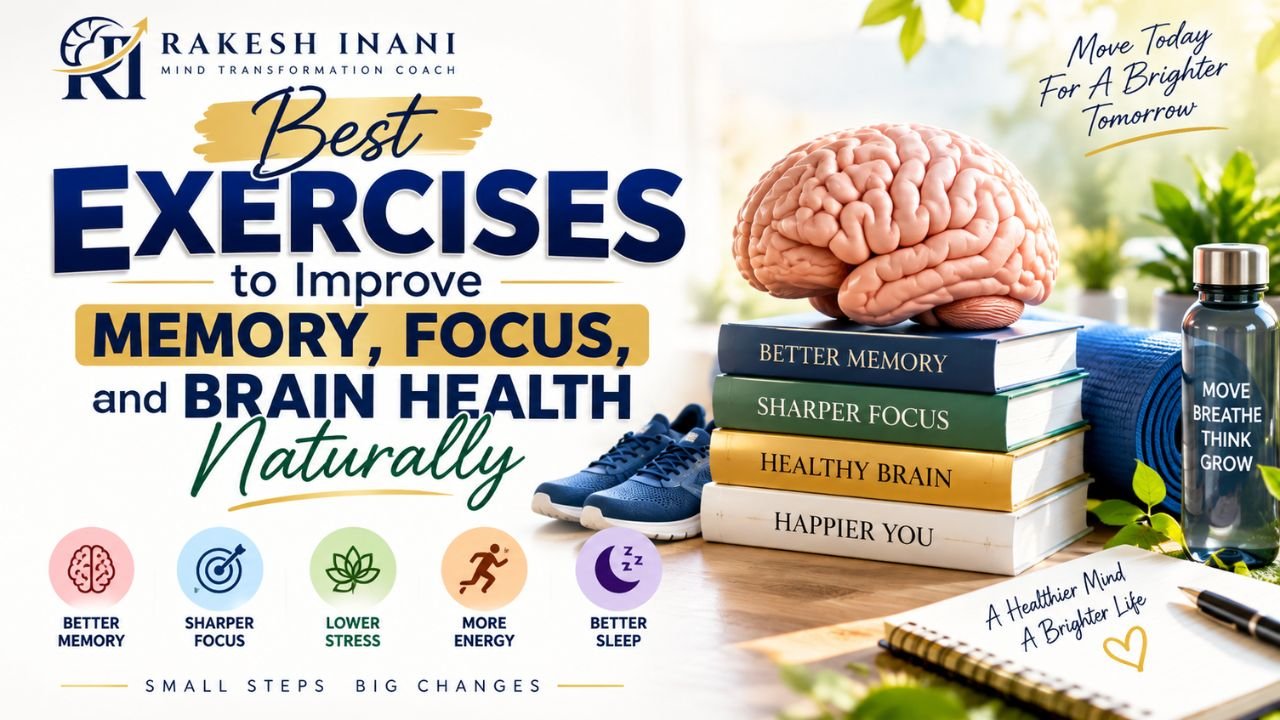
Best Exercises to Improve Memory, Focus, and Brain Health Naturally
You sit at your desk because you want to learn more.
Then you remain there for three hours. Your shoulders become tight. Your eyes feel heavy. Moreover, the same paragraph starts looking like a secret code.
So, you push harder.
You may think that leaving the chair will waste time. However, your body is not separate from your learning mind.
Here is the direct answer:
Regular physical activity can support brain health, thinking, mood, sleep, and energy. Useful options include brisk walking, cycling, dancing, strength exercises, yoga, coordination activities, and short movement breaks. You do not need one special “brain exercise,” but you do need movement that is safe and regular.
In simple words, move your body to support the conditions in which your mind works.
Still, exercise is not a guaranteed cure for forgetfulness, dementia, depression, or any medical condition.
It is one part of a wider memory-supporting lifestyle that includes sleep, nutrition, stress care, focused attention, active recall, and suitable medical care.
In this guide, I will show you how exercise affects memory, which movements you can do without a gym, and how to build a realistic weekly routine.
What Does Exercise Have to Do With Memory?
Movement can support memory through several connected pathways.
Physical activity supports heart and blood-vessel health. It may also improve sleep, reduce short-term feelings of anxiety, and support thinking skills.
These effects matter because a tired, stressed, or physically inactive person may find it harder to pay attention and learn.
The Centers for Disease Control and Prevention explains that some brain-health benefits can appear after a single session of moderate-to-vigorous activity. Regular activity can also help keep thinking, learning, and judgement skills sharp with age. See the CDC overview of the benefits of physical activity.
Exercise Supports the Learning Environment
Exercise does not place facts directly into your memory.
You still need to read, understand, practise, and recall.
However, movement may help create a more alert and balanced state for those actions.
For example, a short walk may help you return to a difficult task with fresher attention.
Likewise, regular activity may support better sleep, and sleep is part of memory consolidation.
Therefore, exercise helps the learner—not only the lesson.
Short-Term and Long-Term Benefits Are Different
A single activity session may temporarily support attention, mood, or thinking after recovery.
Regular physical activity supports broader health over time.
Do not confuse these two ideas.
One walk can be useful, but one walk cannot replace a consistent lifestyle.
At the same time, consistency begins with one walk.
You Do Not Need a Gym to Become More Active
A gym can provide equipment, coaching, and structure.
However, it is not the only path to movement.
You can be active at home, in a park, on stairs, in a corridor, or through daily tasks.
Everyday Movement Counts
Useful activity can include:
- Walking to a nearby shop
- Taking stairs when safe
- Cleaning the home
- Gardening
- Playing with children
- Dancing to music
- Carrying suitable groceries
- Standing and moving during breaks
- Walking while making a phone call
Not every movement has the same intensity or benefit.
Still, replacing some sitting time with movement is a strong beginning.
Remove the “Workout or Nothing” Belief
Many people think exercise must last one hour, cause heavy sweating, and happen in special clothes.
Therefore, when one hour is unavailable, they do nothing.
Replace that belief with:
“Some movement is useful, and I can build from here.”
A ten-minute walk is not a failed sixty-minute workout.
It is ten real minutes of activity.
Walking for Mental Clarity
Walking is simple, low-cost, and easy to adjust.
You can change the speed, distance, surface, and duration based on your ability.
For many people, brisk walking is a practical form of moderate-intensity aerobic activity.
How to Recognise Moderate Intensity
Use the talk test.
During moderate activity, you are breathing faster but can still speak in full sentences. During vigorous activity, you may only manage a few words before taking another breath.
This is a general guide, not a medical measurement.
Medicines, health conditions, temperature, and fitness can change your response.
Turn a Walk Into a Mental Reset
Before walking, name the problem you are working on.
Then stop forcing an answer.
Notice your steps, breathing, sounds, and surroundings. After several minutes, return gently to the question.
You may not receive a brilliant idea every time.
However, the change of state and environment can interrupt mental stuckness.
Walk Without Digital Overload
You do not need to fill every walk with a podcast.
Sometimes quiet walking gives your mind a break from constant input.
On other days, audio learning may fit.
Choose the purpose before you begin: movement, recovery, learning, or reflection.
Make Walking Safe
Use a safe route, suitable footwear, and visible clothing when needed.
Stay aware of traffic, uneven ground, animals, heat, rain, and air quality.
Do not wear sound-blocking headphones where awareness matters.
Aerobic Exercise for Brain and Body Health
Aerobic activity raises your breathing and heart rate for a period of time.
Examples include:
- Brisk walking
- Cycling
- Dancing
- Jogging
- Swimming
- Skipping
- Stair climbing
- Low-impact aerobic routines
The right choice depends on your health, joints, fitness, balance, environment, and enjoyment.
How Much Aerobic Activity Is Recommended?
Current U.S. public-health guidance states that adults generally gain the most health benefits by doing 150–300 minutes of moderate-intensity aerobic activity each week, or 75–150 minutes of vigorous activity, or a suitable combination.
The guidance also says that adults should move more and sit less, and that some activity is better than none. See the official Physical Activity Guidelines questions and answers.
This is a population guideline, not a personal order.
If you currently do very little, do not jump immediately to the top of the range.
Break the Weekly Goal Into Small Pieces
One hundred and fifty minutes can sound large.
However, it can become:
- Thirty minutes on five days
- Twenty-five minutes on six days
- Three ten-minute walks on five days
- A mixture of longer and shorter sessions
Your plan does not need to look like another person’s plan.
It needs to fit your life and remain safe.
Choose Enjoyment Where Possible
The “best” exercise is not useful if you hate it so much that you stop after three days.
Try walking, dance, cycling, a sport, swimming, or a home routine.
Enjoyment is not a small detail.
It supports consistency.
Strength Training for a Stronger Daily Life
Strength training asks your muscles to work against resistance.
The resistance may come from your body weight, bands, machines, dumbbells, or suitable household objects.
Public-health guidance generally recommends muscle-strengthening activity on at least two days each week for adults.
Beginner-Friendly Strength Movements
Depending on your ability, examples may include:
- Standing up from a chair
- Wall push-ups
- Supported squats
- Calf raises
- Resistance-band rows
- Light overhead presses
- Carrying suitable objects
- Step-ups on a stable low step
Technique matters more than showing off.
If you are unsure about form, work with a qualified trainer, physiotherapist, or healthcare professional.
Strength Training and Memory
Strength exercise should not be marketed as a direct memory cure.
Its value is broader.
It supports physical function, independence, balance, and the ability to stay active. A stronger body can make regular movement easier, and regular movement supports overall health.
Therefore, include strength work as part of a complete routine—not as a secret brain hack.
Breathe During the Movement
Do not hold your breath while lifting or pushing.
Use smooth breathing, manageable resistance, and controlled motion.
Stop when form breaks down.
Pain is not proof that an exercise is working.
Coordination Exercises for the Brain and Body
Coordination activities require your senses, attention, and movement to work together.
They can also make a routine more interesting.
Examples include:
- Dancing to changing steps
- Throwing and catching a soft ball
- Following a simple movement pattern
- Walking heel to toe near support
- Marching while touching the opposite hand to the knee
- Playing table tennis or badminton
- Learning a safe new skill
Why Coordination Is Useful
Coordination practice requires you to notice timing, position, direction, and feedback.
It may challenge attention and motor learning while also providing physical activity.
However, do not call every cross-body movement a miracle “brain integration” exercise.
Use it because it is active, engaging, and skill-based—not because of exaggerated claims.
Keep Balance Exercises Safe
Stand near a wall, strong chair, or another suitable support.
Clear objects from the floor. Use stable footwear or a safe surface.
If you have a fall history, dizziness, severe balance difficulty, or a neurological condition, seek professional guidance.
Yoga and Mindful Movement
Yoga can combine movement, strength, flexibility, balance, breathing, and attention.
For some people, it also creates a calmer transition into learning or work.
However, yoga should not be presented as a guaranteed treatment for poor memory.
Its role may be supportive.
Can Yoga Improve Concentration?
Yoga asks you to notice posture, breathing, and present-moment movement.
Therefore, it can become a form of attention practice.
If it helps you feel calmer and less physically restless, you may find it easier to begin a focused task afterward.
Yet results vary, and yoga does not replace evidence-based treatment for a medical or mental health condition.
Choose Simple, Suitable Practices
A beginner routine might include:
- Gentle joint movement
- Cat-cow movement
- Child’s pose if comfortable
- A supported standing pose
- Slow sun-salutation steps at a suitable level
- Comfortable seated breathing
- Final relaxation
Avoid forcing deep bends, extreme twists, or difficult inversions.
Yoga is not a flexibility competition.
Respect Health Conditions
Some positions may be unsuitable during pregnancy or for people with glaucoma, uncontrolled blood pressure, joint injuries, osteoporosis, balance problems, or other conditions.
Ask a qualified professional for appropriate modifications.
Stop if you feel sharp pain, dizziness, chest discomfort, or unusual breathlessness.
Exercise Breaks During Learning
Long sitting can make the body stiff and the mind dull.
A short movement break can change your state without ending the learning session.
Try the Three-Minute Movement Reset
After a focused study block:
- Stand up safely.
- Roll your shoulders gently.
- Walk for one minute.
- Stretch without pain.
- Take several comfortable breaths.
- State the next learning goal.
Then return to work.
This break should refresh attention, not become a thirty-minute social-media visit.
Match Breaks to the Task
If you have been reading, look away from the screen and walk.
If you have been sitting in a meeting, stand and stretch.
If you feel mentally overloaded, use quiet movement rather than more information.
If you have a physical condition that limits standing, use suitable seated movement.
Can You Learn While Moving?
Yes, some forms of learning can combine well with movement.
However, not every task should be done while walking.
Simple recall and spoken review may work well. Difficult reading, detailed calculations, and precise writing usually need a stable environment.
Walking Recall
Choose a safe, quiet route.
Recall the main points of a chapter while you walk.
For example, say:
“The four parts were attention, encoding, storage, and retrieval.”
Then build each point from memory.
Gesture-Based Learning
Connect a simple gesture with each main idea.
For a three-step model, use one hand position for each step.
The gesture should support the structure, not distract from it.
This method can be useful when preparing a presentation because natural movements become recall cues.
Practise a Speech While Walking
Do not memorise every sentence.
Instead, recall the route:
- Opening
- Problem
- Main insight
- Three points
- Example
- Action
- Closing
Walk slowly in a safe area and explain each part.
Then practise again while standing still, because that may be closer to the real speaking setting.
Safety Comes First
Do not study from your phone while crossing roads, cycling, driving, using gym equipment, or walking in unsafe places.
Learning while moving is useful only when the environment allows full safety.
Create a Safe Weekly Movement Routine
A balanced routine can include aerobic activity, strength work, coordination or balance, mobility, and recovery.
You do not need to complete every type every day.
A Beginner-Friendly Weekly Example
Monday: Twenty-minute brisk walk and five minutes of mobility.
Tuesday: Fifteen minutes of basic strength exercises.
Wednesday: Twenty-minute walk with a short recall practice.
Thursday: Gentle yoga or mobility session.
Friday: Fifteen minutes of strength plus a short easy walk.
Saturday: Enjoyable activity such as dancing, cycling, swimming, gardening, or a longer walk.
Sunday: Light movement and recovery.
This is only an example.
Change the duration, intensity, and movements according to your starting point and health.
Add Movement to an Existing Habit
Link activity with something you already do.
For example:
- Walk after lunch
- Stretch after a work call
- Do chair stands before tea
- Practise mobility after brushing your teeth
- Take a family walk after dinner
The existing habit becomes a reminder.
Include Recovery
Rest does not mean complete inactivity forever.
It means giving the body suitable time to recover from effort.
Alternate harder and easier days. Sleep well, eat adequately, and notice unusual pain or fatigue.
Start Small and Build Gradually
The greatest beginner mistake is trying to become an athlete on Monday.
After months of low activity, a person suddenly runs, skips, lifts, and performs fifty squats.
By Tuesday, everything hurts. By Friday, the routine is over.
Use the Minimum Reliable Step
Ask:
“What amount can I repeat three times this week?”
Perhaps the answer is a ten-minute walk.
Begin there.
After a week or two, you might add five minutes, increase the pace slightly, or add one strength session.
Change one part at a time.
Increase Frequency, Duration, or Intensity Carefully
You can progress by changing:
- Frequency: how often you move
- Duration: how long you move
- Intensity: how hard you work
- Complexity: how difficult the skill is
Do not increase everything at once.
Gradual progress reduces unnecessary injury risk and makes confidence more realistic.
The National Institute on Aging recommends starting with lower-intensity activities suited to your current fitness and increasing gradually over weeks or months. See its tips for getting and staying active.
Medical and Safety Considerations
Most people can do some form of physical activity.
However, the safest type and amount may differ.
Talk with a healthcare professional when you have a chronic condition, recent injury or surgery, unexplained symptoms, pregnancy-related concerns, or a long period of inactivity combined with health risks.
The NIA explains that people with chronic conditions can often be active, but should create a suitable plan and build slowly. Its guide to exercising with chronic conditions provides examples.
Stop and Seek Help for Warning Signs
Stop exercising if you experience:
- Chest pain or pressure
- Severe or unusual shortness of breath
- Fainting or near-fainting
- New confusion
- Sudden weakness
- Severe dizziness
- A new irregular or racing heartbeat with illness
- Sharp or severe pain
Seek urgent medical care when symptoms could indicate an emergency.
Do not try to “push through” serious warning signs.
Prepare for Heat and Weather
In hot Indian weather, choose cooler times of day, use shade, wear suitable clothing, and take appropriate fluids.
However, follow medical advice if you have a fluid restriction.
During poor air quality, extreme heat, heavy rain, or unsafe outdoor conditions, choose suitable indoor movement.
Use Proper Equipment
Wear footwear that suits the activity and surface.
Use a helmet while cycling. Check that chairs, steps, bands, and weights are stable.
Keep children and pets away from moving equipment.
Simple exercise still deserves simple safety.
Section Action Exercise: Seven-Day “Move and Remember” Experiment
This experiment helps you observe how movement affects your attention and recall.
It is not a medical test.
Use movements suitable for your health and ability.
Choose One Learning Topic
Select a short lesson, article, speech outline, or professional process.
Keep the material similar across the week so you can observe patterns.
Day 1: Create a Starting Point
Study for fifteen minutes without a movement break.
Then recall the main points.
Rate your attention and energy from one to five.
Day 2: Walk Before Learning
Take a ten-minute comfortable or brisk walk.
Then study for fifteen minutes and complete the same recall check.
Day 3: Use Movement Breaks
Study for two ten-minute blocks.
Between them, complete a three-minute movement reset.
Record attention and recall.
Day 4: Practise Walking Recall
Study the topic while seated.
Later, walk in a safe place and explain the key points from memory.
Check the source afterward.
Day 5: Add Strength Work
Complete a short, safe strength routine.
After recovery, study and recall.
Notice your energy without expecting a guaranteed improvement.
Day 6: Use Yoga or Mindful Movement
Complete ten to fifteen minutes of suitable gentle movement and comfortable breathing.
Then begin a focused learning session.
Record how easy or difficult it was to settle your attention.
Day 7: Review the Pattern
Ask:
- Which movement helped me feel most alert?
- Which movement was easiest to repeat?
- Did a break help me return with clearer attention?
- Did I enjoy quiet walking or audio learning more?
- Did any activity cause pain or excessive fatigue?
- What will I keep next week?
Choose one aerobic habit, one strength habit, and one study-break habit.
Common Exercise Mistakes When Trying to Improve Memory
Expecting One Perfect Brain Exercise
No single movement guarantees a powerful memory.
Use a varied and consistent routine.
Exercising Too Hard Too Soon
Pain and exhaustion do not prove progress.
Begin at your current level and build gradually.
Doing Only Cardio
Walking and other aerobic activities are valuable.
However, strength, balance, mobility, and coordination also support a capable body.
Sitting All Day After One Workout
A morning workout is helpful, but long periods of sitting still deserve attention too.
Add short movement moments throughout the day.
Using Exercise to Replace Sleep
Movement can support sleep, but it cannot erase chronic sleep loss.
Support both habits.
Ignoring Pain and Warning Signs
Modify activity and seek guidance when needed.
Your long-term health matters more than finishing one session.
Key Takeaways
Physical activity supports the conditions in which memory and learning work.
It may help through better overall brain health, mood, sleep, energy, and thinking.
A complete movement routine can include:
- Aerobic exercise such as brisk walking, dancing, cycling, or swimming
- Strength work on suitable days
- Coordination and balance practice
- Yoga or mindful movement
- Short breaks during long study or work sessions
- Recovery and adequate sleep
General adult guidance recommends working toward 150–300 minutes of moderate aerobic activity each week, or an equivalent amount of vigorous activity, plus strength work on two days.
However, your starting point matters.
Begin safely. Build gradually. Choose activities you can repeat.
Frequently Asked Questions
Which Exercise Is Best for Memory?
No single exercise is best for everyone.
Aerobic activity has strong evidence for general brain and body health, while strength, balance, and coordination also belong in a complete routine. Choose safe activities you can do consistently.
Does Walking Improve Brain Power?
Walking supports physical activity, heart health, mood, and mental freshness.
It may also support thinking and attention, but it does not create instant “brain power.” Regular brisk walking can form part of a healthy activity plan.
Can Yoga Improve Concentration?
Yoga can train attention through posture, movement, and breathing.
It may help some people enter a calmer state before focused work. However, it is not a guaranteed treatment for memory or concentration problems.
How Does Exercise Affect Memory?
Exercise can support memory indirectly through brain health, sleep, mood, energy, and attention.
Some research also finds short-term cognitive benefits after a session and possible long-term benefits from regular activity.
How Much Exercise Is Needed for Brain Health?
General adult guidelines recommend 150–300 minutes of moderate aerobic activity weekly, or 75–150 minutes of vigorous activity, plus muscle strengthening on at least two days.
People who are inactive should begin with smaller amounts and build gradually.
Can I Exercise at Home Without Equipment?
Yes.
Walking, dancing, chair stands, wall push-ups, supported squats, mobility work, yoga, and stair walking may require little or no equipment. Choose movements appropriate for your ability and environment.
Should I Exercise Before or After Studying?
Both can work.
A short walk before studying may help you feel alert. Movement breaks can refresh a long session, while walking recall afterward can help you retrieve what you learned. Test what suits you.
Can I Listen to Lessons While Walking?
Yes, when the route is safe and the material does not require visual attention.
However, quiet walking may sometimes provide better mental recovery. Never let audio reduce awareness near traffic or hazards.
Is Ten Minutes of Exercise Worth Doing?
Yes.
Some movement is better than none, and short sessions can add up across the week. Ten minutes can also become the foundation of a longer routine.
When Should I Speak With a Doctor Before Exercising?
Seek advice if you have a chronic condition, recent surgery or injury, severe pain, fainting, unexplained symptoms, pregnancy-related concerns, or uncertainty about safe activity.
Stop and seek urgent help for chest pain, fainting, new confusion, sudden weakness, or severe breathing difficulty.
Your Next Step
Do not wait for a gym membership.
Stand up safely and take a ten-minute walk today.
Afterward, recall three important ideas from something you recently learned.
Then place your next movement session on the calendar.
I am Rakesh Inani, an NLP & Mind Transformation Coach.
I help working professionals and entrepreneurs move from overthinking and inner barriers toward clarity, confidence, and consistent action through practical and responsible mind-transformation tools.
Next, continue with Section 9:
How to Reduce Stress and Overthinking for a Sharper Memory
It will explain how mental clutter occupies attention and how simple calming, writing, breathing, and reframing practices can help you return to the present task.
Remember:
Your brain does not live in a jar.
When you move your body with care and consistency, you support the whole system that learns, focuses, and remembers.
References and Further Reading
- CDC: Benefits of Physical Activity
- CDC: Physical Activity Boosts Brain Health
- U.S. Department of Health and Human Services: Physical Activity Guidelines Questions and Answers
- National Institute on Aging: Cognitive Health and Older Adults
- National Institute on Aging: Tips for Getting and Staying Active
- National Institute on Aging: Three Types of Exercise
- National Institute on Aging: Exercising With Chronic Conditions
Transform Your Mind: JOIN MIND TRANSFORMATION COMMUNITY
Learn More:
Real Leaders Know This ONE Secret to Influencing Without Speaking
7 Day Manifestation- NLP Guided Meditation for Success
The Complete Success Formula: 6 Steps to Turn Goals into Consistent Action
