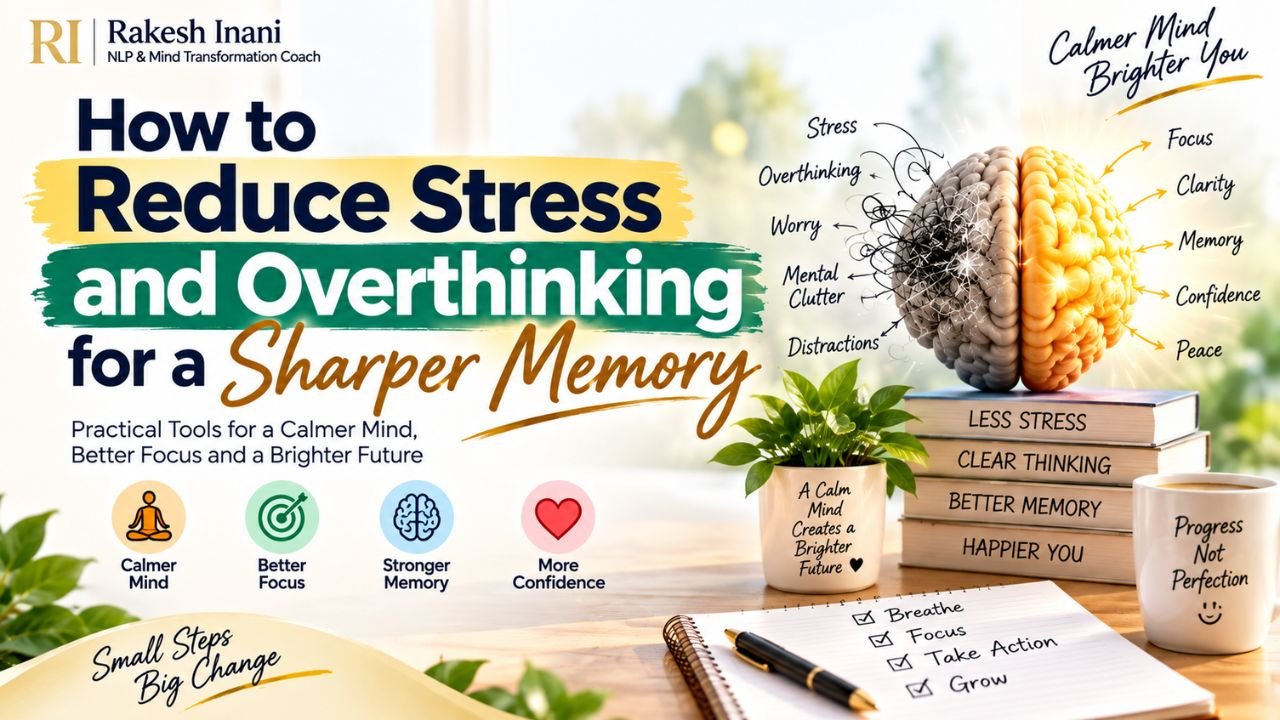
How to Reduce Stress and Overthinking for Sharper Memory
You enter an important meeting fully prepared.
You know the answer. You reviewed your notes. Moreover, you explained the idea perfectly at home.
Then somebody asks you a direct question.
Suddenly, your heart beats faster. Your mind becomes blank. The answer feels locked behind a door.
Later, when the pressure is gone, the answer returns.
Has this ever happened to you?
Here is the direct answer:
Stress and overthinking can make concentration and recall harder by filling your attention with worry, inner conversations, and possible threats. A calmer state may help you notice, understand, and retrieve information more clearly. Brief breathing, writing, movement, realistic reframing, and focused routines can support this process.
However, this does not mean that every memory problem comes from stress.
Sleep disorders, medicines, depression, anxiety disorders, thyroid problems, vitamin deficiencies, neurological conditions, and other health issues can also affect memory.
Therefore, use the tools in this guide as practical support—not as a replacement for medical or psychological care.
Why a Busy Mind Struggles to Remember
Working memory is the small mental space you use to hold and work with information right now.
For example, you use working memory when you keep a phone number in mind, follow a set of instructions, solve a problem, or decide what to say next.
Now imagine that this mental space is a desk.
The current task needs space on the desk. However, worry places files everywhere.
One file says, “What if I make a mistake?”
Another says, “Why did she speak to me like that?”
A third says, “I must not forget anything.”
The desk is not broken. It is crowded.
Mental Activity Competes for Attention
When you replay the past, predict the future, and monitor yourself at the same time, fewer mental resources remain for the present task.
As a result, you may:
- Read without absorbing the meaning
- Forget what somebody just said
- Lose your place while speaking
- Enter a room and forget why
- Make simple mistakes
- Struggle to choose between options
- Feel that your memory is suddenly weak
The U.S. Centers for Disease Control and Prevention lists trouble concentrating and making decisions among possible effects of stress. See its current guidance on managing stress.
Busyness Is Not Always Productivity
A mind can produce hundreds of thoughts and still move nowhere.
Thinking becomes useful when it helps you understand, decide, plan, or act.
When thought keeps circling without creating new information or action, it may become overthinking.
Therefore, do not measure mental progress by the number of thoughts.
Measure it by clarity and the next useful step.
Useful Thinking Versus Overthinking
Useful thinking has a purpose.
It examines facts, considers options, reaches a reasonable decision, and moves toward action.
Overthinking repeats the same problem without gaining useful clarity.
It often demands impossible certainty.
Signs of Useful Thinking
Useful thinking sounds like:
- What facts do I have?
- What information is missing?
- Which choice fits my values?
- What risk can I manage?
- What is the next action?
- When will I review the result?
This thinking has a direction.
Signs of Overthinking
Overthinking sounds like:
- What if everything goes wrong?
- What if people judge me?
- What if I forget one point?
- Why did I say that three years ago?
- I must find a decision with zero risk.
- I should think for one more day.
The mind keeps opening new questions but closes none.
Overthinking Can Pretend to Be Preparation
Preparation creates a plan.
Overthinking often creates more preparation for the preparation.
For example, you may keep editing a presentation because you fear forgetting one sentence.
Yet the extra editing reduces practice time and sleep.
In this way, the attempt to prevent forgetting can create the conditions that make recall harder.
How Stress Changes Your Attention
Stress is not always harmful.
A short stress response can help you respond to a challenge or danger. It may increase energy and narrow attention toward what feels urgent.
However, that narrowed attention may not match the task you want to perform.
If your mind is scanning for judgement, it has less room to listen to the question.
If it is watching your shaking hands, it may stop following your speech outline.
Stress and Memory Have a Complex Relationship
Stress does not affect every memory in the same way.
The result can depend on when stress occurs, how strong it is, what you are learning, and whether the material is emotional.
A large research review found that acute stress just before or during retrieval tended to impair episodic-memory retrieval. However, effects across memory stages and situations were more complex. See the meta-analysis on acute stress and episodic memory.
Therefore, avoid the simple claim that “stress destroys memory.”
A more accurate statement is: stress can change attention and memory performance, and high pressure may make retrieval harder in some situations.
Chronic Stress Can Affect Daily Function
When stress continues for a long time, it may affect sleep, energy, appetite, mood, concentration, and health habits.
Each of these changes can influence learning.
For example, worry may delay sleep. Poor sleep may reduce attention. Weak attention may produce weak encoding. Later, weak recall increases worry.
This creates a loop.
Breaking even one part of the loop can help.
Emotional State and Memory
Emotion influences what you notice.
You may remember an embarrassing mistake more easily than ten ordinary successes. Likewise, fear may pull attention toward possible danger, while excitement may make one event stand out.
However, emotional memory is not always perfectly accurate.
A vivid memory can still contain missing or changed details.
Why Your Mind Goes Blank Under Pressure
When you feel watched or judged, part of your attention may turn inward.
You begin monitoring every word:
“Am I sounding intelligent?”
“Why can’t I remember?”
“Everyone can see that I am nervous.”
This self-monitoring adds more mental work at the exact moment you need simplicity.
Calm Does Not Mean Zero Emotion
You do not need to remove every feeling before you speak, study, or act.
That goal can create more pressure.
Instead, aim to become regulated enough to continue.
You can feel nervous and still use one clear sentence.
You can feel uncertain and still take one thoughtful step.
The Stop–Breathe–Notice Method
This method is a short pause for moments when thoughts begin moving faster than the task.
It does not solve the whole problem.
It helps you return to what is happening now.
Step 1: Stop
Pause the automatic action for a moment.
Do not send the angry message. Do not open another browser tab. Do not begin another round of mental debate.
Step 2: Breathe Comfortably
Take one gentle breath in.
Then let the breath out slowly and comfortably.
Avoid forcing a very deep breath if that feels unpleasant.
Step 3: Relax One Area
Release your jaw, lower your shoulders, or soften your hands.
You do not need to relax your entire body perfectly.
One small physical shift is enough to begin.
Step 4: Name What Is Happening
Use simple words:
“I am predicting.”
“I am replaying.”
“I am trying to control the future.”
“I am afraid of forgetting.”
Naming the process creates a little distance from it.
Step 5: Return to One Task
Ask:
“What needs my attention in the next two minutes?”
Then do only that.
This question changes the goal from solving your whole life to completing one present action.
Box Breathing for a Calmer Mind
Box breathing uses four equal parts:
- Breathe in gently.
- Pause comfortably.
- Breathe out gently.
- Pause comfortably.
Some people use a count of four for each part.
However, the count is optional.
Use Comfort, Not Competition
Do not take the largest possible breath.
Do not hold until you feel strain.
If a four-count feels uncomfortable, use a shorter count or remove the pauses. You can simply breathe gently and make the exhale a little slower.
Stop if you feel dizzy, faint, panicked, numb, or short of breath.
People with respiratory, heart, panic-related, pregnancy-related, or other health concerns should ask a qualified professional about suitable breathing practices.
What Breathing Can and Cannot Do
Breathing may help interrupt a stress response and guide attention toward the present moment.
However, it does not remove the cause of every stressor. It also does not treat every anxiety, trauma, or medical condition.
The National Center for Complementary and Integrative Health describes deep breathing and progressive relaxation among common relaxation techniques. It also notes that research varies by condition and that some people can experience increased anxiety or intrusive thoughts. See its overview of relaxation techniques.
Write Thoughts Down Instead of Carrying Them
Writing creates an external place for information.
Instead of using working memory to hold ten reminders, you can store them in a trusted system.
This does not weaken memory.
It protects attention for what needs thinking now.
Use a Brain Dump
Take five minutes and write every open thought.
Do not organise while writing.
Include tasks, worries, decisions, ideas, reminders, and questions.
Then stop.
Turn the Dump Into Categories
Mark each item as:
- Act: I can take a clear next step.
- Plan: I need to schedule it.
- Ask: I need another person or more information.
- Release: No useful action is available now.
The goal is not to complete everything immediately.
The goal is to stop treating every thought as equally urgent.
Create a Worry List
Write the worry in one line.
Then answer:
- What fact supports this worry?
- What fact does not support it?
- What is under my control?
- What is one useful action?
- When will I review this again?
If no action is possible tonight, schedule a short “worry review” for tomorrow.
Create a Decision Page
For one decision, write:
- The decision I am making
- The outcome I want
- The facts I know
- The information I still need
- The main options
- The acceptable risks
- The decision deadline
- The next action
This turns a cloud of thinking into a visible structure.
Keep an Idea Notebook
Creative thoughts can also disturb focus when you fear losing them.
Write the idea in one sentence and return to your task.
You do not need to develop every idea the moment it arrives.
Use External Systems Without Weakening Memory
Some people believe that using notes, calendars, and reminders makes the brain lazy.
That is too simple.
Human beings have always used tools to extend memory—from lists and maps to books and calendars.
The important question is how you use the tool.
What to Store Outside Your Mind
Use external systems for:
- Appointments
- Deadlines
- Addresses
- Payment dates
- Shopping lists
- Detailed project steps
- Information where accuracy matters
This reduces avoidable mental load.
What to Practise Inside Your Mind
Practise remembering:
- Core ideas
- Important names
- Your speaking structure
- Professional principles
- Knowledge you must use quickly
- Personal learning goals
Use active recall and spaced repetition for these items.
Build One Trusted System
Do not place one task in WhatsApp, another on paper, a third in email, and a fourth only in your head.
Choose one main calendar and one main task list.
Review them at fixed times.
A system becomes trustworthy when you consistently return to it.
Reframe the Fear of Forgetting
The thought “My memory is weak” can become a mental command.
Each time you forget a name, you use it as proof. Meanwhile, every successful memory goes unnoticed.
This creates a one-sided story.
Replace Identity Labels With Specific Observations
Instead of saying:
“I have a terrible memory,”
say:
“I forgot this name because I was distracted when I heard it.”
Instead of:
“My mind always goes blank,”
say:
“Under pressure, I sometimes lose the next point. I can use a keyword cue.”
The new statement is not fake positivity.
It is more precise and more actionable.
Build Confidence From Evidence
At the end of each day, write three things you remembered.
They might include a task, a person’s need, a lesson, or an important detail.
Then write one thing you forgot and its likely cause.
This creates a balanced record.
NLP-Informed Memory Reframing
NLP-informed reflection may help you notice how internal pictures, inner speech, and learned associations affect your present response.
However, NLP should not be presented as a medical treatment or as a scientifically proven cure for memory problems.
Use this exercise for self-awareness and practical rehearsal.
Step 1: Notice the Internal Picture
When you think about an upcoming presentation, what do you imagine?
Do you see yourself forgetting everything?
Do you picture the audience judging you?
Notice the image without treating it as a prediction.
Step 2: Notice the Inner Voice
What are you saying to yourself?
Perhaps the voice says:
“Do not make a mistake.”
“You must remember every word.”
“If you pause, people will think you are weak.”
Write the exact sentence.
Step 3: Check the Evidence
Ask:
- Is this thought fully true?
- What am I assuming?
- What has happened in past situations?
- What would I tell a respected friend?
- What is a more accurate statement?
Step 4: Create a Useful Mental Rehearsal
Imagine a realistic version of the situation.
See yourself pausing, checking a keyword, and continuing calmly.
Do not imagine perfection.
Rehearse recovery.
Step 5: Choose a Behavioural Cue
Use one physical action as a reminder:
- Place both feet on the floor
- Look at the main keyword
- Take one comfortable breath
- Say the opening sentence slowly
The cue connects the mental rehearsal with real behaviour.
Create a Calm Learning State
You do not need a silent mountain to learn.
However, you do need enough stability to give the material genuine attention.
Prepare Your Posture
Sit or stand in a position that supports alertness.
Avoid becoming so comfortable that you fall asleep or so rigid that your body becomes tense.
Settle Your Breathing
Take two or three comfortable breaths.
Do not turn this into a long ritual.
The purpose is to arrive—not to delay the work.
State One Clear Intention
Say:
“For the next twenty minutes, I will understand this one concept.”
A clear goal gives attention a direction.
Reduce Environmental Noise
Silence unnecessary notifications.
Close extra tabs. Keep the phone away from your hand. Place only the needed material on the desk.
Each removed distraction reduces one invitation to switch tasks.
Finish With Recall
After the learning block, close the source.
Recall the main idea, three supporting points, and one application.
Then check your answer.
A calm state helps attention, while retrieval strengthens learning.
Mental Recovery and Quiet Time
Constant input can leave no room to process experience.
You move from a podcast to messages, from messages to a meeting, from the meeting to social media, and from social media to a video before sleep.
The mind receives information all day but gets little quiet time.
Create Small Input-Free Spaces
Try:
- Five quiet minutes after a meeting
- A walk without audio
- A meal without scrolling
- Ten minutes before bed without news
- A pause before responding to messages
Quiet time is not empty.
It allows reflection, recovery, and choice.
Do Not Use Quiet Time to Force Solutions
If you sit silently while demanding a great idea, the pause becomes another performance task.
Instead, let your attention rest on ordinary experience.
Notice your surroundings, breathing, or movement.
When an idea appears, write it down. When it does not, allow the quiet to remain quiet.
When Stress and Overthinking Need Professional Help
Self-help tools have limits.
Speak with a qualified mental health professional or doctor when worry, rumination, panic, low mood, trauma symptoms, or sleep problems persist, worsen, or interfere with work, relationships, health, or daily responsibilities.
Also seek help if you rely on alcohol, drugs, or unsafe behaviour to manage stress.
If you have thoughts of harming yourself or someone else, contact local emergency services or an appropriate crisis service immediately.
Memory Changes Also Deserve Attention
Do not assume that every memory change is “just stress.”
Seek medical advice when forgetfulness is sudden, worsening, affecting daily independence, or joined by confusion, speech difficulty, weakness, severe headache, fainting, or major personality change.
Urgent symptoms require urgent care.
Section Action Exercise: Seven-Day Five-Minute Mental Reset
Practise this reset before one learning or work session each day.
Keep the session small and repeatable.
Minute 1: Stop and Notice
Ask:
“What is occupying my mind right now?”
Name the main thought or feeling.
Minute 2: Breathe and Soften
Take several comfortable breaths.
Relax your jaw, shoulders, and hands.
Stop if breathing practice feels uncomfortable.
Minute 3: Write the Mental Clutter
Write every unfinished thought in short phrases.
Do not solve them yet.
Minute 4: Choose the Next Task
Write:
“For the next twenty minutes, I will __________.”
Make the task clear and small.
Minute 5: Rehearse the First Action
Imagine yourself opening the correct page, reading the first paragraph, and recalling the main idea.
Then begin immediately.
Track the Result
After the session, record:
- Stress before: one to five
- Stress after: one to five
- Attention quality: one to five
- Main idea recalled: yes or no
- One change for tomorrow
After seven days, look for patterns.
The purpose is not to prove that stress disappears.
The purpose is to learn which small actions help you return.
Common Mistakes When Calming the Mind
Trying to Stop Every Thought
Thoughts are not light switches.
Aim to change your relationship with the thought and return attention to the task.
Using Relaxation as Avoidance
Breathing for two minutes can prepare you to act.
Breathing for two hours to avoid one email may continue the problem.
Demanding Instant Calm
Regulation does not always feel dramatic.
A ten-percent reduction in tension may be enough to take the next step.
Turning Reframing Into Fake Positivity
Do not replace “Everything will fail” with “Everything will be perfect.”
Use a grounded statement such as, “I cannot control every result, but I can prepare and respond.”
Carrying Every Task in Your Head
Use a reliable calendar and task system.
Memory should support your life, not carry every deadline alone.
Ignoring Persistent Symptoms
Stress tools are not substitutes for professional care.
Seek help when symptoms continue or disrupt daily life.
Key Takeaways
Stress and overthinking can crowd attention and make learning or recall harder.
However, this does not mean your memory is permanently weak.
To create a calmer learning state:
- Separate useful thinking from repetitive overthinking
- Pause with the Stop–Breathe–Notice method
- Use comfortable breathing without forcing it
- Write tasks, worries, and decisions down
- Build one trusted external system
- Replace identity labels with specific observations
- Rehearse realistic recovery instead of perfection
- Reduce unnecessary input and distraction
- Finish learning with active recall
- Seek professional support when symptoms persist
The goal is not an empty mind.
The goal is a mind that can notice a thought and still choose where to place attention.
Frequently Asked Questions
Can Stress Cause Forgetfulness?
Yes, stress can contribute to forgetfulness by disrupting concentration, sleep, learning, or retrieval.
However, forgetfulness has many possible causes. Persistent, sudden, or worsening changes deserve professional assessment.
Does Overthinking Weaken Memory?
Overthinking can fill working memory with repeated worry and inner conversation.
As a result, less attention remains for understanding or recalling the present task. It does not automatically mean that the memory system is damaged.
How Can I Calm My Mind and Improve Concentration?
Pause, breathe comfortably, name the main thought, write open tasks down, remove one distraction, and choose one small action.
Then work for a short period and recall what you learned.
Why Does My Mind Go Blank Under Pressure?
Pressure can shift attention toward fear, self-monitoring, or possible judgement.
That extra mental load may make retrieval harder. A keyword cue, slow opening, and brief pause can support recovery.
Can Breathing Exercises Improve Focus?
Breathing exercises may help some people reduce immediate arousal and return attention to the present.
However, results vary, and they are not treatments for every condition. Stop if you feel dizzy, panicked, or uncomfortable.
Is Box Breathing Safe for Everyone?
Box breathing is generally simple, but breath holds or fixed counts can feel uncomfortable for some people.
Use gentle breathing, shorten the count, or remove pauses. Seek professional advice when you have relevant heart, lung, panic-related, pregnancy-related, or other health concerns.
Does Writing Worries Down Help Memory?
Writing can reduce the need to hold every reminder in working memory.
It also helps you separate actions, plans, questions, and concerns that you cannot control right now.
Will Using a Calendar Make My Memory Lazy?
No. A calendar protects accuracy for dates and responsibilities.
You can then train internal memory for core ideas, names, speaking points, and professional knowledge.
Can NLP Cure Stress-Related Memory Problems?
No responsible practitioner should promise that NLP cures stress or memory disorders.
NLP-informed reflection may help you notice inner pictures, self-talk, and behavioural patterns, but it does not replace medical or psychological care.
When Should I Seek Professional Help?
Seek help when stress, worry, panic, low mood, trauma symptoms, sleep problems, or memory changes persist or disrupt daily life.
Seek urgent care for sudden confusion, speech problems, weakness, severe headache, fainting, or thoughts of self-harm.
Your Next Step
Before your next important task, take five minutes.
Stop.
Breathe comfortably.
Write down the mental clutter.
Choose one action.
Then begin before your mind opens another debate.
I am Rakesh Inani, an NLP & Mind Transformation Coach.
I help working professionals and entrepreneurs move from overthinking and inner barriers toward clarity, confidence, and consistent action through practical and responsible mind-transformation tools.
Next, continue with Section 10:
10 Powerful Memory Techniques to Remember Almost Anything
It will show you how to use association, visualisation, stories, acronyms, chunking, pegs, memory palaces, and mind maps for names, numbers, speeches, and lists.
Remember:
A sharper memory does not always begin by pushing your mind harder.
Sometimes it begins by giving your attention enough space to work.
References and Further Reading
- CDC: Managing Stress
- NCCIH: Stress
- NCCIH: Relaxation Techniques—What You Need to Know
- NCCIH: Five Things to Know About Relaxation Techniques for Stress
- NCCIH: Meditation and Mindfulness—Effectiveness and Safety
- Shields, Sazma, and Yonelinas: The Effects of Acute Stress on Episodic Memory
- Porcelli and Delgado: Stress and Decision-Making
Transform Your Mind: JOIN MIND TRANSFORMATION COMMUNITY
Learn More:
Real Leaders Know This ONE Secret to Influencing Without Speaking
7 Day Manifestation- NLP Guided Meditation for Success
The Complete Success Formula: 6 Steps to Turn Goals into Consistent Action