
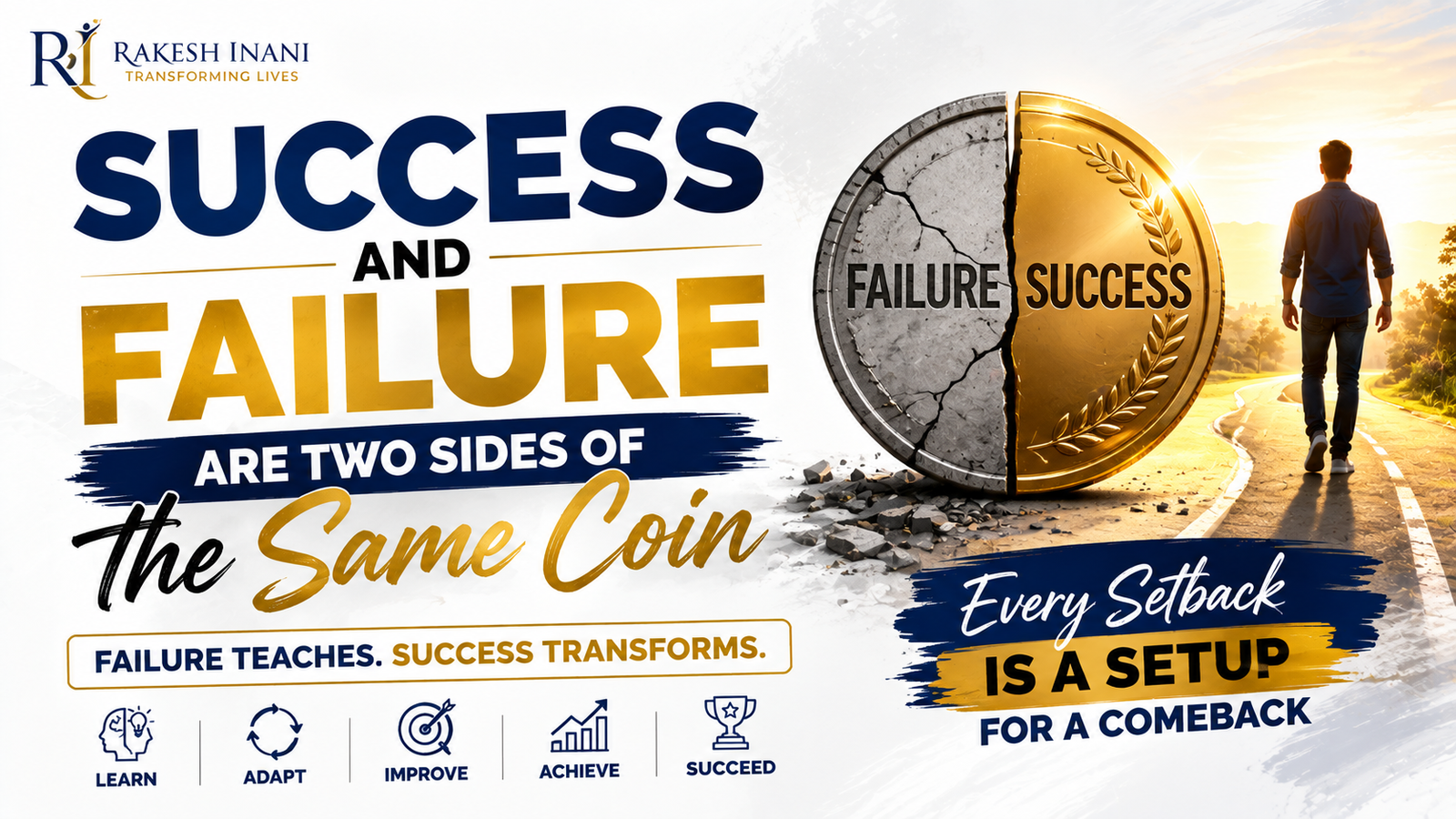
Success and Failure Are Two Sides of the Same Coin
You want to succeed.
You want your hard work to produce results. You want your plans to work. Moreover, you want to feel that your life is moving in the right direction.
However, you probably do not want failure.
You may want success without rejection, growth without discomfort, and achievement without mistakes. Unfortunately, life rarely works that way.
Every meaningful goal includes uncertainty. When you try something new, you cannot control every result. Sometimes you will make the right decision. At other times, you will discover that your plan needs improvement.
That discovery is what we often call failure.
However, failure does not always mean that your dream is impossible. Instead, it may mean that your current method, skill, timing, or strategy needs to change.
Therefore, success and failure are not always enemies. They are often two parts of the same learning process.
Is Failure Necessary for Success?
Failure is not something you must purposely create. However, mistakes and setbacks are a natural part of trying to achieve a difficult goal.
Whenever you enter a new area, you begin with limited experience. As a result, you may make poor decisions, miss important details, or expect quick results.
That does not make you incapable.
It makes you a learner.
A child does not learn to walk by reading about walking. The child stands, loses balance, falls, and tries again.
Each attempt teaches the body something new.
In the same way, you often learn business by testing ideas. You learn communication by speaking with people. You learn confidence by taking action while feeling uncertain.
Therefore, you do not need to celebrate failure itself. Instead, you need to value the lesson hidden inside it.
The goal is not to fail repeatedly in the same way.
The goal is to learn, adjust, and improve.
Why Do We Want Success but Fear Failure?
Most people do not fear failure only because of the failed result.
They fear what that result may mean.
You may think:
“What will people say about me?”
“What if I lose money?”
“What if I look foolish?”
“What if this proves that I am not talented?”
“What if I never become successful?”
Therefore, the real fear is often connected to shame, judgement, rejection, or loss of identity.
You may not simply fear that your business idea will fail. You may fear that the failure will prove you are not good enough.
You may not only fear that your video will receive few views. You may fear that people will ignore you.
You may not only fear hearing “no” from a potential client. You may fear feeling rejected as a person.
However, a result cannot define your complete identity.
A failed attempt means that a particular action did not create the expected result under specific conditions.
It does not mean that you are a failure.
This difference may sound small, but it can change the way you respond to setbacks.
Failure Is an Event, Not Your Identity
Suppose you launch a program and nobody joins.
One interpretation could be:
“I am not a good coach.”
However, that conclusion is too broad.
Many other explanations may be possible:
- The right people did not see the offer.
- The promise was unclear.
- The audience did not trust the offer yet.
- The price did not match the perceived value.
- The timing was unsuitable.
- The sales message did not address the real problem.
- You did not speak with enough potential clients.
- The program needed a stronger structure.
Therefore, the launch gave you information. It did not provide a final judgement about your ability.
When you turn one unwanted result into a statement about your identity, you make improvement much more difficult.
Instead of studying the situation, you begin attacking yourself.
You may say:
“I always fail.”
“I am not made for business.”
“I cannot communicate.”
“Nothing works for me.”
These sentences feel true when emotions are strong. However, they are rarely complete or accurate.
A better statement would be:
“This attempt did not create the result I expected. I need to understand why.”
This statement keeps the problem specific.
More importantly, it keeps improvement possible.
Failure as Feedback: A Better Way to Think
What does “failure is feedback” really mean?
It means that an unwanted result gives you information about the difference between what you expected and what actually happened.
For example, imagine that you planned to exercise every morning for 30 days. However, you stopped after four days.
You could say, “I have no discipline.”
Alternatively, you could study the pattern.
Perhaps you were sleeping too late. Maybe the exercise plan was too difficult. Perhaps you had no fixed starting signal. Or maybe you expected yourself to complete a long workout every day.
Now the failure becomes useful.
It shows you where the system became weak.
As a result, you can improve the next plan:
- Sleep earlier.
- Prepare your clothes at night.
- Begin with ten minutes.
- Exercise at a fixed time.
- Track each completed day.
- Create a smaller version for busy days.
This is how failure becomes feedback.
The failed result does not disappear. However, it gives you information that can improve your next attempt.
What Is Failure Trying to Teach You?
Failure can teach different lessons in different situations.
Therefore, do not use the same explanation for every setback.
Sometimes failure teaches you that you need a new skill.
For instance, your coaching service may be valuable, but you may need to improve sales communication.
At other times, failure teaches you that your expectations were unrealistic.
You may expect a new YouTube channel to grow quickly. However, building trust, improving content, and understanding the audience can take time.
Sometimes failure shows that your strategy is weak.
You may be working hard, but your action may not be connected to the result you want.
In other situations, failure shows that you are not taking enough action.
You may speak with two potential clients, receive two rejections, and decide that the offer does not work. However, two conversations may not provide enough information.
Failure can also show that your emotional response needs attention.
Perhaps you understand what to do, but fear makes you delay the important action.
Therefore, after a setback, ask:
- Is this a knowledge problem?
- Is this a skill problem?
- Is this a strategy problem?
- Is this a consistency problem?
- Is this an emotional problem?
- Is this a timing problem?
- Is this an environment problem?
These questions help you find a useful lesson instead of choosing a painful label.
Why Do I Keep Failing at the Same Goal?
If you repeatedly fail at the same goal, it may mean that you are repeating the same pattern.
A new goal does not automatically create a new behaviour.
For example, every month you may decide to create content consistently.
During the first few days, you feel excited. You create several posts. Then, your energy becomes low.
Next, you miss one day. After that, you miss another day.
Finally, you stop completely and wait for a new month to begin again.
The problem may not be your content knowledge.
The problem may be that your system depends on motivation.
Similarly, you may repeatedly decide to wake up early. However, you continue sleeping late.
In that case, the real problem may not exist in the morning. It may begin with your night routine.
Therefore, recurring failure often comes from recurring causes.
The same trigger creates the same thought. The same thought creates the same emotion. The same emotion produces the same behaviour. Finally, the same behaviour creates the same result.
To change the result, you must interrupt this pattern.
Do not only make a stronger promise.
Study the complete loop.
The Failure Pattern Loop
A common failure loop looks like this:
- You set a big goal.
- You feel excited.
- You create a difficult plan.
- You take action for a few days.
- A challenge appears.
- Motivation becomes weak.
- You miss the planned action.
- You judge yourself.
- You avoid the goal.
- Later, you start again with another big promise.
This loop does not prove that you lack potential.
Instead, it shows that your method of starting and continuing needs improvement.
A healthier loop would look like this:
- Choose one clear goal.
- Identify the smallest useful action.
- Create a realistic schedule.
- Track your action.
- Expect difficulty.
- Review what went wrong.
- adjust the plan.
- Restart quickly.
- Continue until you collect enough feedback.
- Improve the action as your ability grows.
The second loop is less exciting at the beginning. However, it is more likely to create lasting progress.
How Can Failure Lead to Success?
Failure can lead to success only when you process it correctly.
Failure by itself does not guarantee growth.
If you repeat the same action without reflection, you may continue getting the same result.
Therefore, four steps are needed.
Step 1: Accept the Result
First, admit what happened.
Do not hide the numbers. Do not make excuses. Moreover, do not change the story to protect your ego.
If you planned to publish ten videos and published two, accept that result.
If you expected twenty sales and made one sale, record the actual number.
Acceptance is not defeat.
It is the starting point of honest improvement.
Step 2: Separate Facts from Interpretation
Next, write the facts.
A fact may be:
“My video received 100 views.”
An interpretation may be:
“Nobody likes my content.”
A fact may be:
“Three people declined my offer.”
An interpretation may be:
“I am terrible at sales.”
Facts help you think clearly.
Interpretations may be useful, but they must be examined. Otherwise, one emotional conclusion can stop your progress.
Step 3: Find the Main Cause
Now ask what most likely produced the result.
Perhaps the video title was weak. Maybe the topic did not match the audience’s current problem. Perhaps the opening did not hold attention.
Likewise, your sales offer may have been unclear. The price may not have been the main problem at all.
Look for the cause that created the greatest effect.
Step 4: Design the Next Test
Finally, decide what you will change.
Do not change everything at once. If you change the audience, offer, message, platform, price, and design together, you will not know what caused the next result.
Instead, improve one important variable.
Then, test again.
This approach turns failure into a learning system.
The Difference Between Quitting and Correcting
Many people think they have only two choices:
Continue exactly as before or quit completely.
However, there is a third choice.
You can correct your approach.
Suppose you want to build a business, but your first offer does not sell.
Continuing blindly may waste time. Quitting immediately may end a meaningful journey too early.
Correcting means studying the problem and changing the right part.
You may keep the larger goal while improving the offer.
You may keep the audience while changing the message.
You may keep the habit while reducing the daily target.
You may keep the destination while choosing a better road.
Therefore, persistence does not mean repeating a poor strategy forever.
True persistence combines commitment with learning.
When Should You Persist and When Should You Change?
This is one of the most important questions in goal achievement.
You should consider persisting when:
- The goal is still meaningful.
- The goal matches your values.
- You are developing useful skills.
- You have not tested the approach long enough.
- Your progress is slow but visible.
- Feedback suggests that improvement is possible.
- The main problem can be corrected.
However, you should consider changing the method when:
- The same approach repeatedly creates the same poor result.
- Reliable feedback shows a clear weakness.
- The method causes unnecessary harm.
- Your assumptions have proved incorrect.
- A better approach is available.
- The plan no longer matches your present reality.
In some cases, you may also need to reconsider the goal itself.
A goal may have been chosen to impress other people. It may no longer match your values. It may also demand a cost you are no longer willing to pay.
Changing such a goal is not always failure.
Sometimes it is clarity.
The key is to make the decision from careful reflection, not from temporary discomfort.
How Successful People Respond to Setbacks
People who grow through setbacks usually do several things differently.
First, they allow themselves to feel disappointed without making a permanent decision during that emotional moment.
Second, they study the event.
Third, they ask for useful feedback.
Fourth, they identify what was under their control.
Finally, they return to action with a better understanding.
This does not mean they never feel fear or sadness.
It means they do not allow one emotion to write the complete story of their future.
You can practise the same response.
After an unwanted result, tell yourself:
“This is painful, but it is specific.”
“This result is information.”
“I can study what happened.”
“I can improve one part.”
“I can choose my next action.”
These statements do not deny reality.
Instead, they help you respond to reality with greater strength.
How to Overcome the Fear of Failure
The fear of failure becomes smaller when the meaning of failure changes.
If failure means “I am worthless,” every attempt feels dangerous.
However, if failure means “I received information,” action becomes safer.
You can also reduce the fear of failure through practical steps.
Make the First Attempt Smaller
Do not begin with the biggest possible risk.
Test your idea on a smaller scale.
For example, before recording a complete course, conduct a live workshop. Before creating a complex program, work with a few clients. Before giving a long speech, practise a five-minute talk.
A smaller test gives you feedback with less pressure.
Define Success in More Than One Way
The final result matters. However, it should not be your only measure.
Suppose you conduct a webinar but do not make a sale.
The event may still help you:
- Improve your presentation
- Understand audience questions
- Discover weak parts of your offer
- Build confidence
- Collect content ideas
- Develop your follow-up process
The sale is important. Nevertheless, learning also has value.
Prepare for Possible Problems
Fear often grows when the mind imagines an unknown disaster.
Therefore, write the possible problems and your response to each one.
If nobody attends, what will you learn?
If the technology fails, what is your backup?
If someone says no, what will you ask?
A response plan gives your mind a greater sense of safety.
Practise Emotional Recovery
You cannot control every result. However, you can improve how quickly you return to useful action.
Take a short break. Speak with a trusted person. Write down the lesson. Then, choose your next step.
The goal is not to become emotionless.
The goal is to recover without abandoning yourself.
Stop Comparing Your Difficult Stage with Someone Else’s Success
Comparison can make failure feel much worse.
You may see someone’s successful business, large audience, confident speaking, or impressive income. Then, you may compare that visible result with your current struggle.
However, you do not see their complete journey.
You may not know:
- How long they have been practising
- How many attempts failed
- What support they received
- What resources they used
- What mistakes they made
- What advantages they had
- What sacrifices they made
Therefore, comparison often uses incomplete information.
Instead of asking, “Why am I not where they are?” ask:
“What can I learn from their process?”
This question turns comparison into education.
Your journey does not need to look exactly like another person’s journey.
You need a process that fits your goal, resources, responsibilities, values, and present stage.
How to Turn Failure into a Practical Lesson
Use this five-part reflection whenever something does not work.
1. What Did I Expect?
Write the result you wanted.
Be specific.
For example:
“I expected five people to join my coaching program.”
2. What Actually Happened?
Write only the facts.
For example:
“One person joined after I spoke with twelve people.”
3. What Was Under My Control?
Possible answers may include:
- The number of conversations
- The clarity of the offer
- The follow-up process
- The questions you asked
- The way you explained the result
- The evidence you provided
- Your preparation
4. What Did I Learn?
Perhaps the audience understood the problem but did not understand the program.
Maybe you spoke too much and listened too little.
Perhaps you contacted too few people.
Write the lesson in one clear sentence.
5. What Will I Change Next?
Choose one improvement.
For example:
“During the next ten conversations, I will ask more questions before explaining my offer.”
Now the failed result has become a useful experiment.
The Failure Feedback Sheet
Complete this exercise with one recent setback.
My goal was:
The result I expected was:
What actually happened was:
The facts are:
The story I told myself was:
The part that was under my control was:
The skill or knowledge I may be missing is:
The main lesson is:
One thing I will change is:
My next action and deadline are:
Do not complete this exercise only inside your mind.
Write the answers.
Writing slows your thoughts and helps you see the situation more clearly.
Frequently Asked Questions About Failure and Success
Does Failure Mean I Am on the Wrong Path?
Not always.
Failure may mean that your method needs improvement. However, repeated evidence may also show that a strategy or goal needs to be reconsidered.
Study the feedback before deciding.
Can You Become Successful Without Failure?
You may avoid some failures by learning from experienced people and preparing carefully. However, mistakes, rejection, uncertainty, and setbacks are common when pursuing meaningful goals.
The aim is not to avoid every mistake. The aim is to learn without repeating preventable mistakes.
Why Do I Lose Confidence After Failure?
You may be connecting the failed result to your identity.
Instead of saying, “I failed, so I am incapable,” describe the event accurately. Then, identify what can be learned and improved.
Confidence grows when you see yourself responding to difficulty with useful action.
How Do I Start Again After a Big Failure?
Begin by accepting your emotions and reviewing the facts.
Next, identify the main lesson. Then, choose one small action that helps you re-enter the process.
Do not wait until all fear disappears. Begin with a manageable step.
What If I Keep Making the Same Mistake?
A repeated mistake often means the underlying pattern has not changed.
Look at the trigger, thought, emotion, behaviour, environment, and reward connected with the mistake. You may need a different system, stronger support, or a missing skill.
Is Quitting Always a Sign of Failure?
No.
Leaving a harmful, meaningless, or unsuitable goal can be a wise decision. The important question is whether you are leaving because of clear evidence or only escaping temporary discomfort.
Your Next Step After Failure
Think about one area where you currently feel unsuccessful.
Perhaps your business is not growing.
Maybe you are unable to remain consistent.
Perhaps you have delayed creating content, speaking in public, improving your health, or starting an important project.
Now, do not ask:
“What is wrong with me?”
Ask:
“What is this result showing me?”
That question changes your mental position.
It moves you from judgement to curiosity.
It moves you from helplessness to responsibility.
Most importantly, it moves you from emotional pain toward practical learning.
Failure may close one attempt. However, it does not have to close your future.
You can pause.
You can study the result.
You can develop the missing skill.
You can improve the strategy.
Then, you can take the next action with greater awareness.
Final Thoughts: Use Failure, but Do Not Become It
Success and failure are two sides of the same coin because both belong to the process of growth.
Success shows you what worked.
Failure shows you what needs attention.
Therefore, do not allow failure to become your identity. At the same time, do not ignore the lesson it offers.
Listen carefully to the feedback.
Correct what can be corrected.
Learn what must be learned.
Release what no longer serves you.
Then, move forward with a better plan.
The most successful response to failure is not pretending that it did not hurt.
It is deciding that the pain will teach you something valuable.
Your failed attempt is part of your history. However, it does not have to become your destiny.
The next chapter of your journey will be shaped by what you learn and what you do next.
Learn More: 7 Day Manifestation- NLP Guided Meditation for Success
Why Some People Succeed While Others Stay Stuck: The 6-Step Success Process