
How to Stop Overthinking and Start Taking Action
You know what you need to do.
You need to make the call.
You need to record the video.
You need to publish the article.
You need to begin the project.
You need to have the conversation.
However, instead of taking action, you keep thinking about the action.
You think about the best method.
You search for more information.
You compare your plan with other people’s plans.
You imagine possible problems.
You wait to feel confident.
At the end of the day, your mind is tired, but the task is still incomplete.
This is one of the most frustrating forms of overthinking.
You are not confused about the goal.
You are stuck between knowing and doing.
You may even blame yourself.
You may say:
“I am lazy.”
“I have no discipline.”
“I always procrastinate.”
However, procrastination is not always a lack of effort.
Sometimes, it is an emotional protection pattern.
The task may create fear, uncertainty, boredom, pressure, or the possibility of judgment.
Therefore, your mind keeps planning because planning feels safer than doing.
Quick answer: To stop overthinking and start taking action, define the smallest visible step, give it a clear time and place, work for a short period, and allow the first version to be imperfect. Action creates real information. Real information produces the clarity that overthinking keeps trying to create through imagination.
In this guide, I will show you how to move from mental activity to focused action.
You will learn how to recognize when planning becomes avoidance, make large goals feel smaller, overcome perfectionism, and build confidence through completed behaviour.
Most importantly, you will learn how to turn “I should do this” into “I have started.”
Why Does Overthinking Stop Action?
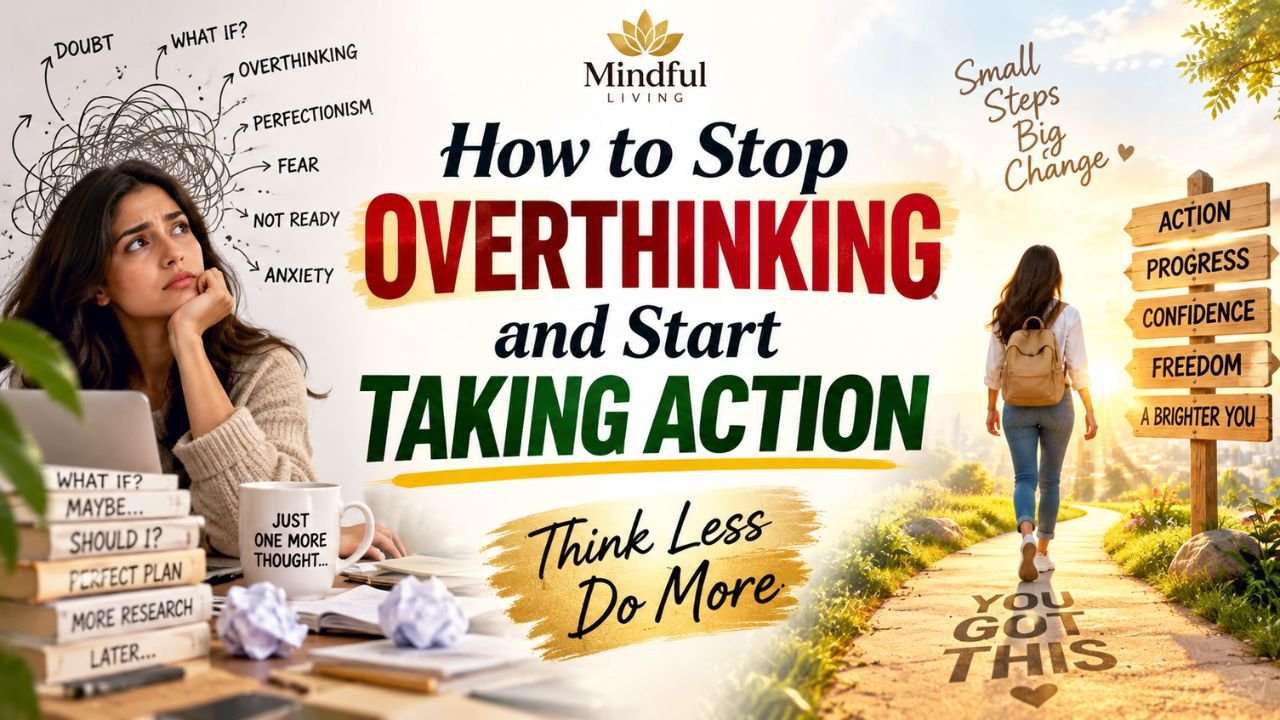
Overthinking and inaction often form a cycle.
You want to act.
However, the action contains uncertainty.
Therefore, you think more.
More thinking creates more possibilities.
More possibilities create more doubt.
More doubt makes the action feel more difficult.
As a result, you delay.
The delay reduces your confidence.
Now the action feels even more threatening than before.
The cycle looks like this:
Goal → Uncertainty → Overthinking → Delay → Lower confidence → More overthinking
To break the cycle, you do not need to answer every mental question.
You need to interrupt the pattern with a manageable action.
Thinking Gives a Temporary Feeling of Control
Thinking feels safe because nothing has been tested yet.
Inside your mind, you can imagine different plans without risking failure.
You can change direction without explaining anything.
You can prepare without being judged.
However, action creates contact with reality.
When you act:
- Someone may disagree.
- The result may be imperfect.
- You may discover a weakness.
- You may need to adjust.
- You may feel nervous.
- You may receive feedback.
Therefore, the mind may prefer thinking because thinking delays exposure to the result.
Action Includes Uncertainty
You cannot know exactly how an action will work before taking it.
You may prepare a video, but you cannot know exactly how the audience will respond.
You may create an offer, but you cannot predict every buyer’s decision.
You may prepare for a conversation, but you cannot control the other person’s words.
You may choose a strategy, but you cannot guarantee its result.
An overthinking mind says:
“Do not act until uncertainty is gone.”
However, uncertainty usually reduces through experience, not imagination.
Perfectionism Raises the Starting Point
A small task becomes difficult when you believe the first attempt must be excellent.
For example:
“Record one short video” becomes:
“Record a professional video that proves my expertise, receives high engagement, creates leads, and makes everyone respect me.”
Now the task is carrying too much pressure.
You are no longer recording one video.
You are trying to prove your complete identity through one performance.
Naturally, starting becomes difficult.
Large Goals Create Mental Pressure
A large goal may feel inspiring when you first imagine it.
However, when it is time to act, the complete goal may feel overwhelming.
For example:
“Build a successful coaching business” includes:
- Niche
- Audience
- Offer
- Content
- Branding
- Technology
- Sales
- Delivery
- Community
- Systems
If your mind tries to solve everything at once, you may feel stuck.
A goal gives direction.
However, only a specific action creates movement.
The Difference Between Planning and Avoidance
Planning is useful.
In fact, action without any plan can waste time and energy.
However, planning becomes overthinking when it no longer improves your next step.
Healthy Planning Produces a Clear Action
After useful planning, you should know:
- What you will do
- When you will do it
- Where you will do it
- What you need
- How you will know it is complete
For example:
“I will outline the first three points of my video at 9:00 p.m. at my desk. I will work for 20 minutes.”
That is a plan.
Avoidance Produces More Questions
Avoidance may sound productive:
“I need to study more.”
“I need a better system.”
“I need to understand every possibility.”
“I need to feel more confident.”
“I need to see what other people are doing.”
These statements may be true in some situations.
However, if they repeat for days or weeks without action, they may be protecting you from discomfort.
Use the Planning-or-Avoidance Test
Ask:
- What decision has my planning produced?
- What is my next visible action?
- When will I perform it?
- What new information am I still collecting?
- Will that information meaningfully change the next step?
- Am I planning because the task requires it, or because action feels uncomfortable?
If you cannot name the next action, your planning may be too broad.
If you know the next action but keep researching, your planning may have become avoidance.
The Research Stop Question
Ask:
“Do I need more information to take the first step, or do I need experience?”
For example, before performing a medical procedure, a professional needs suitable training and information.
However, before recording a simple practice video, you may need experience more than another tutorial.
Use good judgment.
Preparation is important for high-risk tasks.
For low-risk and reversible actions, begin with a safe test.
Use the Smallest-Action Method
When a task feels heavy, do not ask:
“How can I complete the whole goal?”
Ask:
“What is the smallest visible action that will move this forward?”
A visible action is something another person could observe.
“Work on my business” is not visible.
“Write the first version of my offer statement” is visible.
“Improve my communication” is not visible.
“Record a two-minute explanation and review it once” is visible.
“Become healthy” is not visible.
“Take a ten-minute walk after lunch” is visible.
Make the Action Smaller Than the Fear
Suppose your action is:
“Record a 20-minute video.”
You still feel stuck.
Make it smaller:
“Record the first three minutes.”
Still stuck?
Make it smaller:
“Open the camera and speak the first line.”
The action may look too small to matter.
However, the first movement changes your state.
You are no longer waiting to start.
You have started.
Use the Five-Minute Rule
Commit to working for only five minutes.
The purpose is not to complete everything.
The purpose is to reduce the mental barrier to beginning.
An Oxford Health NHS resource recommends starting an avoided task for five minutes and dividing complex work into smaller parts. Read the Oxford Health guidance on de-procrastination.
After five minutes, you may choose to continue.
If you stop, you have still created movement and information.
Define the First Physical Movement
Ask:
“What is the first physical movement required?”
For example:
- Open the document.
- Put the book on the desk.
- Dial the number.
- Wear your walking shoes.
- Open the presentation.
- Place the camera on the stand.
- Write the person’s name.
- Create the payment link.
- Put the form on the website.
Thinking stays inside your mind.
A physical movement begins the behaviour.
Action Creates Evidence
Before action, your mind has predictions.
After action, you have evidence.
Suppose your mind says:
“I cannot explain this topic clearly.”
You can think about that belief for hours.
Or you can record a two-minute explanation.
After recording, you may discover:
- Your main idea is clear.
- Your example needs improvement.
- You speak too quickly.
- Your voice sounds better than expected.
- You need a stronger opening.
- You can explain the subject without memorizing.
Now you have real information.
Real Feedback Corrects Imagined Fear
An imagined fear is often broad.
“I will fail.”
Real feedback is specific.
“My opening was unclear, but the main example worked.”
Specific feedback is useful because it tells you what to improve.
Broad fear only tells you to avoid.
Action Reveals the Real Problem
You may believe the problem is confidence.
However, after taking action, you discover that the real problem is preparation.
You may believe the problem is your business idea.
However, after speaking with customers, you discover that the real problem is your message.
You may believe the problem is discipline.
However, after tracking your behaviour, you discover that the task is too large and unclear.
Action makes the hidden obstacle visible.
Repetition Builds Self-Trust
Each completed action gives your mind evidence:
“I can begin.”
“I can continue while uncomfortable.”
“I can learn.”
“I can correct mistakes.”
“I can complete something.”
“I can respond to feedback.”
Self-trust does not grow only through positive statements.
It grows when your behaviour supports those statements.
Use the Progress-Before-Confidence Principle
Many people wait for confidence before they begin.
They think:
“When I feel confident, I will speak.”
“When I feel motivated, I will exercise.”
“When I feel ready, I will publish.”
However, confidence often appears after repeated action.
Confidence Is Built From Evidence
Imagine that you want to speak publicly.
Before your first speech, you have little evidence that you can handle the experience.
Therefore, nervousness is understandable.
After one speech, you have some evidence.
After ten speeches, you have more evidence.
You have learned:
- How to begin
- How to recover after forgetting
- How audiences respond
- How to use pauses
- How to answer questions
- How nervousness changes after starting
Confidence grows because uncertainty becomes experience.
Nervousness Does Not Prevent Action
You do not need to remove nervousness before beginning.
Use this statement:
“I can feel nervous and still take the next step.”
This is stronger than:
“I must become completely confident.”
The first statement supports behaviour.
The second creates another condition that must be met before behaviour.
Start Before You Feel Fully Ready
Starting before you feel fully ready does not mean being careless.
It means identifying the level of preparation the task truly requires.
For a low-risk practice video, basic preparation may be enough.
For a legal, medical, financial, or safety-sensitive task, suitable training and expert guidance may be required.
Match preparation to risk.
Do not use “take action” as a reason to ignore safety or professional standards.
How to Stop Perfectionism From Blocking Action
Perfectionism is not simply wanting good quality.
Healthy standards support growth.
Perfectionism becomes a barrier when you believe your work must be flawless before it can be completed or seen.
Define Version One
Before beginning, say:
“This is version one.”
Version one has a job:
- Test the idea
- Create feedback
- Build experience
- Establish the structure
- Show what needs improvement
Version one does not need to become the final form.
Create Before Correcting
Do not try to create and judge every sentence at the same time.
During creation, produce the rough material.
During correction, improve it.
For example:
Creation Stage
Write the full first draft without correcting every line.
Correction Stage
Review the structure, clarity, accuracy, and language.
Completion Stage
Check whether it meets the defined standard.
If you judge every word while writing, the inner critic interrupts the creative flow.
Set a Completion Standard
Ask:
“What must be true for this task to be complete?”
For an article, the standard may be:
- Answers the main search question
- Contains accurate information
- Uses clear headings
- Includes practical examples
- Has been edited once
- Has a clear conclusion
The standard should not be:
“Nothing can ever be improved.”
Almost every piece of work can be improved.
Completion means it is ready for its current purpose.
Limit the Number of Reviews
Set a review limit.
For example:
- One content review
- One grammar review
- One final formatting check
After the planned reviews, publish.
Without a limit, perfectionism will continue finding small changes.
Use the Good-Enough Question
Ask:
“Is this useful, accurate, clear, and complete enough for this stage?”
Good enough does not mean poor quality.
It means the quality is suitable for the purpose.
Separate Your Work From Your Worth
A piece of work can need improvement without meaning you are not capable.
Say:
“This result is feedback about the work, not a final judgment of me.”
This reduces the emotional weight of publishing.
Use If–Then Plans to Turn Intention Into Action
A goal says what you want.
An if–then plan explains when and how you will act.
The structure is:
If situation X happens, then I will perform action Y.
For example:
“If it is 9:00 p.m., then I will sit at my desk and outline tomorrow’s video.”
“If I notice myself researching after I have enough information, then I will close the browser and work for ten minutes.”
“If I feel nervous before making a call, then I will read my opening sentence and dial the number.”
Research calls these plans implementation intentions. A meta-analysis found that specific if–then plans can support goal achievement, including in samples experiencing mental-health difficulties, though no planning method guarantees action for everyone. Read the PubMed summary of the meta-analysis.
Make the Trigger Specific
Weak trigger:
“When I have time…”
Strong trigger:
“After breakfast…”
“At 9:00 p.m.…”
“When I sit at my desk…”
“When I close the client meeting…”
A clear cue makes the behaviour easier to remember.
Keep the Action Small
Weak action:
“I will work on my entire business.”
Strong action:
“I will write three offer bullets.”
Prepare for Common Obstacles
Create if–then plans for barriers.
“If my phone distracts me, then I will place it in the other room.”
“If I miss my morning session, then I will complete 20 minutes at 9:00 p.m.”
“If I feel stuck, then I will write a rough version instead of stopping.”
The goal is not to predict every problem.
Choose the two or three barriers that occur most often.
Build a Daily Focus System
Overthinking becomes stronger when you face too many priorities at once.
Therefore, create a simple daily system.
Step 1: Choose One Main Priority
Ask:
“If I complete only one meaningful task today, which task will move my goal forward most?”
This is your main priority.
You may still complete other tasks.
However, one priority receives your best attention.
Do Not Choose Five Main Priorities
If everything is the main priority, nothing is the main priority.
Choose one main task and two smaller supporting tasks.
Step 2: Define the Weekly Output
A broad goal such as “create content” is difficult to measure.
A weekly output is clear:
- Publish one blog post
- Record three videos
- Conduct five calls
- Complete one course module
- Practise speaking three times
- Create one lead magnet
A clear output helps you decide what matters today.
Step 3: Create a Focus Block
A focus block is a planned period for one task.
For example:
“From 9:00 p.m. to 9:45 p.m., I will outline and record the first part of my video.”
During this block:
- Keep one task open.
- Remove unnecessary tabs.
- Put away the phone.
- Avoid unrelated research.
- Write distracting thoughts on a parking page.
- Return to the task.
Use a Short Block When Resistance Is High
If 45 minutes feels too difficult, begin with ten minutes.
The best focus block is one you will actually start.
Step 4: Remove One Major Distraction
Do not try to create a perfect environment.
Remove the strongest distraction.
For example:
- Put the phone away.
- Close social media.
- Use one browser tab.
- Tell family you need 20 focused minutes.
- Prepare water before beginning.
- Keep the necessary file open.
Environment design reduces the number of decisions required during action.
Step 5: Define “Done”
Before starting, write:
“This task is complete when…”
For example:
“This task is complete when I have written the first 500 words.”
“This task is complete when I have recorded one rough video.”
“This task is complete when I have contacted three leads.”
A clear finish line prevents perfectionism from extending the task forever.
Step 6: Review the Behaviour
At the end of the block, ask:
- Did I begin at the planned time?
- What did I complete?
- What interrupted me?
- What is the next visible step?
- What will I change tomorrow?
Review the process without attacking yourself.
Use the Thought-to-Action Question
Whenever you notice overthinking, ask:
“Can I solve this through more thinking, or do I need information, communication, rest, support, or action?”
This question identifies the real need.
When You Need Information
Collect the specific missing fact.
Do not begin unlimited research.
When You Need Communication
Ask the person.
Do not continue guessing inside your mind.
When You Need Rest
Stop trying to force high-quality work from an exhausted state.
Choose recovery and schedule the task.
When You Need Support
Ask for guidance, accountability, or professional help.
When You Need Action
Stop creating new plans.
Take the smallest visible step.
When You Need Acceptance
Some uncertainty cannot be solved now.
Recognize what is outside your control and return to the present.
The Ten-Minute Mind-to-Action Reset
Use this process when you feel mentally stuck.
Minute 1: Name the Goal
“What am I trying to move forward?”
Example:
“I want to create this week’s video.”
Minute 2: Name the Fear
“What am I trying to avoid?”
“I am afraid the video will not be good enough.”
Minutes 3–4: Separate Need From Perfection
“What does the task truly require?”
“A useful topic, three points, one example, and a clear action step.”
Minutes 5–6: Define the Smallest Action
“Write the three points.”
Minutes 7–10: Begin
Do the action immediately.
Do not spend the final four minutes improving the plan.
The reset works only when thinking moves into behaviour.
Use the One-Tab Action Rule
When working online, open only what the current task needs.
For example, if writing:
- Open the document.
- Open only the necessary reference.
- Close unrelated tabs.
Every open tab can represent another possible direction.
A simpler visual environment supports a simpler mental environment.
If you need to research something later, place it on a research list.
Do not follow every new question immediately.
Use the Action Ladder
An action ladder breaks a large goal into levels.
Suppose your goal is to speak confidently on camera.
Level 1
Speak for one minute without recording.
Level 2
Record one minute and do not review it.
Level 3
Record two minutes and review one strength.
Level 4
Record five minutes and identify one improvement.
Level 5
Publish a short video.
Level 6
Record a complete educational video.
Each level creates new evidence.
You do not need to jump from complete avoidance to a major performance.
Match the Action to Your Current State
Focused action does not mean ignoring your physical and emotional condition.
Ask:
“What action is realistic from my current state?”
High-Energy State
Use it for:
- Recording
- Teaching
- Strategic work
- Difficult conversations
- Creative production
Medium-Energy State
Use it for:
- Writing
- Editing
- Research with limits
- Planning
- Calls
Low-Energy State
Use it for:
- Organizing notes
- Scheduling
- Preparing materials
- Simple administration
- Rest and recovery when needed
A realistic action plan reduces the all-or-nothing pattern.
Create an Anti-Overthinking Action Card
Write the following on a card or note:
My Goal
What am I moving toward?
My Next Step
What is the smallest visible action?
My Start Time
When will I begin?
My Time Limit
How long will I work?
My Completion Standard
How will I know this version is done?
My Response to Fear
What balanced sentence will I use?
Example:
Goal: Publish a useful article.
Next step: Write the introduction.
Start time: 9:00 p.m.
Time limit: 25 minutes.
Done: A rough introduction of 300 words.
Response: “The first version needs to exist before it can improve.”
How to Turn Overthinking Into Action at Work
Suppose you need to prepare a presentation.
Overthinking may say:
“I need to understand every possible question.”
Action says:
“I will define the three messages the audience must remember.”
Overthinking may say:
“The design must be world-class.”
Action says:
“I will create a clear first version before improving the design.”
Overthinking may say:
“I need to feel confident.”
Action says:
“I will rehearse the opening three times.”
Work Action Formula
Outcome → Three Tasks → First Task → Start Time
Example:
Outcome: Complete the presentation.
Three tasks:
- Define the message.
- Create the slides.
- Rehearse.
First task: Write the three key points.
Start time: Today at 4:00 p.m.
How to Turn Overthinking Into Action in Business
Suppose you want to launch a coaching offer.
Overthinking tries to build the complete business before testing the offer.
You may think about:
- Website
- Logo
- Course platform
- Payment system
- Community
- Advertising
- Automation
- Certificates
However, the first question may be:
“Does the audience want help with this problem?”
Begin With Real Contact
Take actions such as:
- Speak with five people from the audience.
- Ask what they are struggling with.
- Describe the proposed result.
- Invite people to a pilot session.
- Collect real objections and questions.
Real conversations give you information that planning alone cannot provide.
Test Before Building
Create a small version.
For example:
- One workshop instead of a full course
- A five-person pilot instead of a large launch
- One landing page instead of a complete website
- One content series instead of a year-long plan
A test reduces financial and emotional risk while increasing learning.
How to Turn Overthinking Into Action in Content Creation
Content creators often overthink:
- Topic
- Title
- Hook
- Script
- Camera
- Background
- Voice
- Editing
- Audience response
Use this simple workflow:
Step 1: Choose One Problem
“What specific problem am I helping the viewer solve?”
Step 2: Write One Promise
“What will the viewer understand or do after watching?”
Step 3: Create Three Points
Do not write 30 points.
Step 4: Add One Example
Make the idea easy to understand.
Step 5: Give One Action
Tell the viewer what to do next.
Step 6: Record Version One
Do not wait for perfect confidence.
Step 7: Review One Improvement
Improve one important part in the next video.
How to Turn Overthinking Into Action in Communication
Suppose you need to have a difficult conversation.
Overthinking rehearses every possible reply.
Action prepares only what you control.
Write:
- What happened
- How you feel
- What matters
- What you are requesting
Then choose a suitable time.
You cannot write the other person’s part of the conversation.
You can only prepare to listen and respond.
Build Motivation Through Momentum
Many people wait for motivation.
However, motivation may increase after you begin.
The NHS provides task-management guidance that includes choosing a productive time and place, planning rewards, and alternating harder and more enjoyable activities. Read the NHS guide to tackling a to-do list.
Use Your Prime Time
Identify when your energy is usually strongest.
Schedule important action during that period when possible.
For you, it may be early morning.
For someone else, it may be late evening.
Do not use your best energy only for low-value tasks.
Prepare the Place
Keep the necessary tools ready.
A prepared place reduces the effort required to start.
Use a Simple Reward
After completing the focus block, choose a healthy and reasonable reward.
For example:
- Tea
- A short walk
- Music
- A relaxing conversation
- A few minutes of enjoyable reading
The reward should support the habit rather than create another long distraction.
Celebrate Completion, Not Mental Struggle
You may spend hours worrying about a task and believe you worked hard.
The mental struggle was real.
However, if you reward only the struggle, you may continue associating pressure with productivity.
Instead, record completed behaviour.
At the end of the day, ask:
- What did I complete?
- What did I begin?
- What did I publish?
- What conversation did I have?
- What decision did I act on?
- What did I learn from real experience?
This builds an action-based identity.
Use an Evidence Log
Write one sentence each day:
“Today, I created evidence that I am a person who takes action by…”
For example:
“Today, I recorded the video even though I felt nervous.”
“Today, I made the call instead of rehearsing it all day.”
“Today, I published the useful version instead of waiting for perfection.”
“Today, I returned to the task after becoming distracted.”
Identity grows through repeated evidence.
What to Do When You Still Cannot Start
Sometimes, making the task smaller is not enough.
Ask which barrier is present.
Barrier 1: The Task Is Unclear
Solution:
Define the next physical action.
Barrier 2: The Task Is Too Large
Solution:
Divide it until one part feels manageable.
Barrier 3: You Lack Necessary Information
Solution:
Identify the exact information needed and set a research limit.
Barrier 4: You Fear Judgment
Solution:
Create a low-risk version and focus on helping one person.
Barrier 5: You Expect Perfection
Solution:
Define version one and create a completion standard.
Barrier 6: You Are Exhausted
Solution:
Rest or choose a lower-energy task. Then schedule the important action for a stronger period.
Barrier 7: The Goal Does Not Matter to You
Solution:
Ask whether the goal matches your values or only another person’s expectations.
Barrier 8: You Need Support
Solution:
Ask for guidance, accountability, training, or professional care.
Create a Weekly Mind-to-Action Review
At the end of each week, answer:
What Did I Plan?
List the main intended outputs.
What Did I Complete?
Record visible evidence.
Where Did I Overthink?
Identify the tasks you kept researching, changing, or delaying.
What Was I Protecting Myself From?
Was it judgment, failure, uncertainty, boredom, conflict, or responsibility?
What Small Step Worked?
Notice what helped you begin.
What Will I Repeat Next Week?
Keep the useful method.
What Will I Remove?
Remove one distraction, unnecessary task, or unrealistic expectation.
The purpose of review is not to criticize yourself.
It is to improve the system.
A Seven-Day Action-Building Practice
Day 1: Notice the Gap
Write one thing you know you should do but keep delaying.
Day 2: Make It Visible
Define the first physical action.
Day 3: Use Five Minutes
Work on the task for five minutes.
Day 4: Remove One Distraction
Create a simpler action environment.
Day 5: Create an If–Then Plan
“If it is 9:00 p.m., then I will work on the task for 20 minutes.”
Day 6: Finish One Imperfect Version
Complete something you can improve later.
Day 7: Review the Evidence
Write what you learned about your fear, ability, and next step.
This is not a complete life transformation in seven days.
It is practice in moving from thought to behaviour.
When Should You Seek Professional Support?
Occasional overthinking and procrastination are common.
However, consider speaking with a qualified professional if inaction:
- Seriously affects your work, study, relationships, or health
- Is connected with ongoing anxiety or low mood
- Makes basic daily tasks difficult
- Causes strong shame or hopelessness
- Is connected with repeated checking or rituals
- Appears alongside major attention or concentration difficulties
- Continues despite your best efforts
- Includes thoughts of self-harm or feeling unsafe
Behavioural Activation is one evidence-based treatment that helps people become more engaged with meaningful and rewarding activities, particularly in the treatment of depression. However, it is a structured therapeutic approach and should not be reduced to “just push yourself.” Read the U.S. Department of Veterans Affairs overview of Behavioral Activation.
If you feel at immediate risk of harming yourself or someone else, contact local emergency or crisis support immediately. Also, contact a trusted person who can stay with you.
Frequently Asked Questions About Overthinking and Action
How Do I Stop Overthinking and Start Doing?
Identify the smallest visible action, set a specific time, work for a short period, and allow the first version to be imperfect. Begin before answering every possible question.
Why Does Overthinking Cause Procrastination?
Overthinking can make a task feel risky, large, or impossible to complete perfectly. Planning then becomes a way to delay the emotional discomfort of action.
How Do I Know if I Am Planning or Procrastinating?
Planning produces a next action, start time, and completion standard. Procrastination produces more research, comparison, and delay without meaningful progress.
What Is the Smallest-Action Method?
It means reducing a goal to the smallest visible behaviour that moves it forward, such as opening the document, writing one paragraph, or making one call.
Can Action Reduce Overthinking?
Action can create real information, which may reduce imagined uncertainty. However, action does not remove every thought, and some concerns require communication, rest, information, or professional support.
How Can I Take Action Without Motivation?
Use a small starting step, clear time, prepared environment, and short work period. Motivation may increase after you begin.
How Do I Overcome Perfectionism?
Define version one, separate creating from editing, set a clear completion standard, limit reviews, and focus on usefulness rather than flawlessness.
How Can I Build Confidence Through Action?
Choose manageable challenges, complete them, review what you handled, and gradually increase the difficulty. Confidence grows from repeated evidence.
What Is an If–Then Plan?
It is a specific statement connecting a situation with an action: “If it is 9:00 p.m., then I will write for 20 minutes.”
What Should I Do if the Task Feels Too Big?
Divide it into smaller parts until the next action can be completed in a short period. Focus only on that step.
Is Taking Fast Action Always Good?
No. High-risk decisions and tasks involving health, safety, law, or major finances may require careful preparation and professional advice. Take faster action on small, safe, and reversible steps.
Why Do I Keep Researching Instead of Starting?
Research may feel safer than exposing your work to real feedback. Decide what information is essential, set a limit, and identify when experience is the information you now need.
How Can I Stop Being Afraid of Publishing?
Create a useful first version, define a review limit, and focus on helping one person. Publishing gradually builds evidence that you can handle feedback and improve.
What if I Start but Do Not Finish?
Reduce the scope, define “done,” and schedule the next work block. Also, identify whether perfectionism, distraction, low energy, or an unclear goal interrupted completion.
Can Small Actions Really Change a Habit?
Small actions provide repeatable evidence and reduce the barrier to starting. Their value comes from consistency and connection to a meaningful goal.
Final Takeaway
Overthinking often tells you that clarity must come before action.
However, in many parts of life, action creates clarity.
You do not learn to speak only by thinking about speaking.
You speak.
You listen.
You review.
You improve.
You do not fully understand your audience only by imagining them.
You communicate.
You observe.
You learn.
You do not build confidence by waiting for fear to disappear.
You take a manageable step while some fear remains.
Therefore, when you notice overthinking, ask:
“Do I need more thought, or do I need one real action?”
If you need information, collect the specific fact.
If you need communication, ask the question.
If you need rest, recover and schedule the action.
If you need support, request it.
However, if you already know the next step, stop building another plan.
Begin.
Remember this Mind-to-Action sequence:
Clarify → Simplify → Schedule → Start → Review → Repeat
Clarify what you want to move forward.
Simplify it into one visible action.
Schedule the action at a clear time.
Start before perfect confidence arrives.
Review the real evidence.
Repeat what works.
As an NLP and Mind Transformation Coach, I believe the most important identity shift is not:
“I am a person who never overthinks.”
A more useful identity is:
“I am a person who notices overthinking and returns to purposeful action.”
You do not need to defeat every thought before living your life.
You only need to stop allowing every thought to delay your next meaningful step.
Start small.
Start imperfectly.
Start with what you have.
Then let action teach you what thinking alone cannot.
In the next article, we will explore NLP-informed exercises and mind-training tools for overthinking. You will learn how to work with mental pictures, inner dialogue, observer position, pattern interrupts, resource anchoring, and future rehearsal.
Author: Rakesh Inani
NLP & Mind Transformation Coach
This article is educational and does not diagnose or treat a mental-health condition. If overthinking, procrastination, or difficulty completing daily tasks causes severe distress or significantly affects your life, consult a qualified mental-health professional.

Read Previous Blog Posts of This Series:
What Is Overthinking? Why Your Mind Won’t Stop and How to Recognize the Pattern
Why Do I Overthink Everything? 12 Hidden Causes of Overthinking Explained
25 Overthinking Signs Your Mind Is Secretly Trapping You
Shocking Effects of Overthinking on Mind, Body and Life
How to Stop Overthinking Immediately: 12 Simple Ways to Calm Your Mind
How to Change Negative Thoughts Without Fighting Your Mind
Transform Your Mind: JOIN MIND TRANSFORMATION COMMUNITY
Learn More:
Real Leaders Know This ONE Secret to Influencing Without Speaking
7 Day Manifestation- NLP Guided Meditation for Success
The Complete Success Formula: 6 Steps to Turn Goals into Consistent Action