
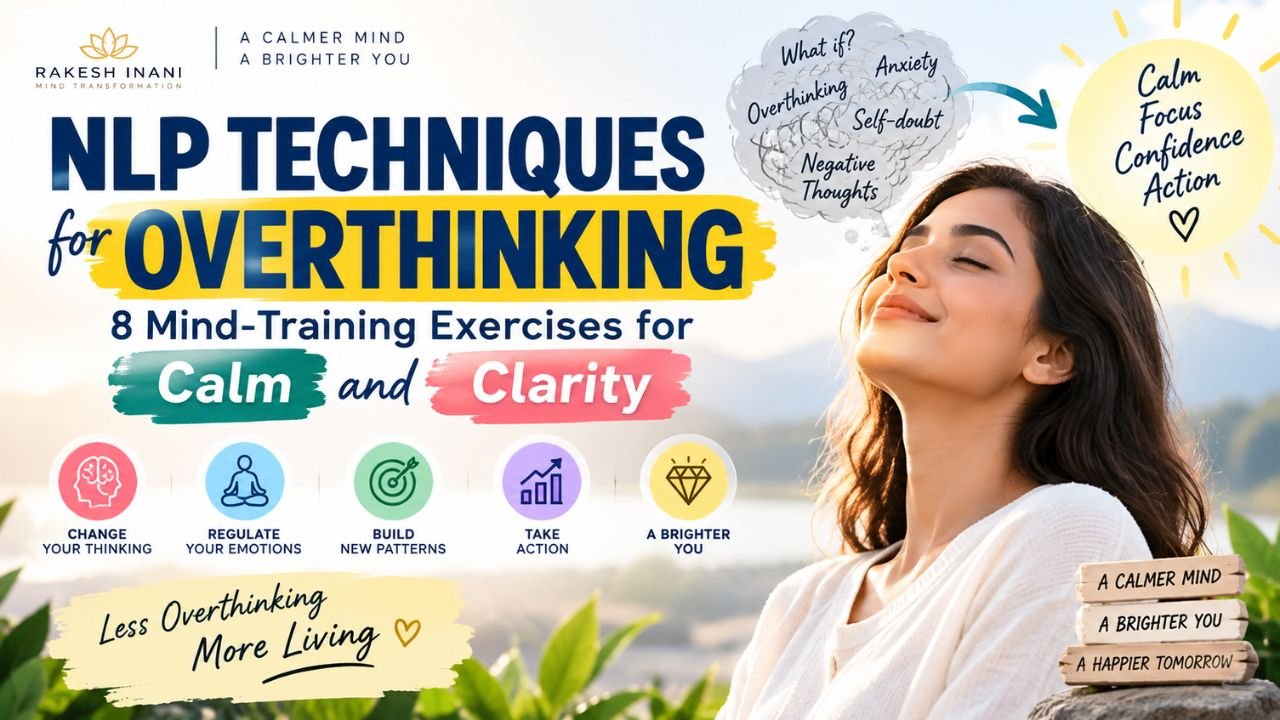
NLP Techniques for Overthinking: 8 Mind-Training Exercises for Calm and Clarity
You know that you are overthinking.
You understand that your thoughts may not be completely accurate.
You may even know what you should do.
However, the mental picture, inner voice, or uncomfortable feeling still appears.
For example, before a presentation, you may see an image of yourself forgetting your words.
You may hear an inner voice saying:
“You are not ready.”
Then you may feel pressure in your chest or stomach.
The image, voice, and feeling begin supporting one another.
The picture creates fear.
The fear makes the inner voice sound more believable.
The inner voice makes the imagined failure appear more real.
Soon, you are no longer responding to the real presentation.
You are responding to a mental experience of the presentation.
This is where NLP-informed mind-training exercises may be useful as coaching and self-reflection tools.
NLP stands for Neuro-Linguistic Programming.
In simple language, NLP explores how internal experiences, language, attention, and learned patterns may influence behaviour.
However, we need to be responsible with this subject.
NLP should not be presented as a medical cure, a proven method for treating every mental-health condition, or a replacement for evidence-based psychological care.
A systematic review found little high-quality evidence that NLP interventions improve health-related outcomes. The authors explained that this conclusion reflected the limited quality and amount of research available. Read the systematic review summary on PubMed.
Therefore, in this article, I will describe these practices as NLP-informed mind-training exercises.
You can use them to explore your mental pictures, inner language, attention, and rehearsed responses.
However, do not use them to diagnose or treat a mental-health condition.
Quick answer: NLP-informed exercises may help you notice how you picture a problem, hear your inner dialogue, and rehearse a more useful response. You can experiment with changing an image, softening an inner voice, observing the situation from a distance, creating a calming cue, and mentally practising your next action.
In this guide, I will take you through eight practical exercises.
You do not need to perform all eight at once.
Choose one exercise that fits your current pattern.
Practise it gently.
Then observe whether it helps you become calmer, clearer, or more able to take action.
Can NLP Help With Overthinking?
NLP-informed exercises may be useful for some people as tools for awareness, coaching, communication, and behavioural rehearsal.
For example, they may help you notice:
- The mental images connected with a fear
- The words used by your inner voice
- The viewpoint from which you remember an event
- The physical state connected with a thought
- The future response you repeatedly rehearse
- The behaviour you want to practise instead
However, noticing a change during an exercise does not prove that a mental-health condition has been treated.
It also does not mean the exercise will work for everyone.
Use NLP as an Experiment, Not a Promise
A responsible exercise begins with curiosity.
Say:
“I will experiment with this and notice what changes.”
Do not say:
“This technique must remove my problem.”
The first statement creates openness.
The second creates pressure.
Focus on What You Can Observe
After an exercise, ask:
- Did the image feel less intense?
- Did my body feel slightly calmer?
- Did I become more able to focus?
- Did I identify a useful next step?
- Did I take action?
- Did the effect continue outside the exercise?
Your real behaviour matters more than having an interesting experience with your eyes closed.
Mind Training Should Lead to Life Training
You may feel calm during a visualization.
However, the deeper question is:
“Can I use this state to respond differently in real life?”
For example:
- Can you make the call?
- Can you speak during the meeting?
- Can you set the boundary?
- Can you publish the useful version?
- Can you return to sleep?
- Can you stop checking the message?
- Can you make a decision?
Mind training becomes valuable when it supports observable behaviour.
Before You Begin: Create Safe Conditions
Choose a place where you feel physically safe.
Do not practise an eyes-closed exercise while driving, operating equipment, walking near traffic, or doing anything that requires full attention.
You may keep your eyes open.
You may stop at any time.
You remain in control of the exercise.
Do Not Force an Emotion
You do not need to create a powerful emotional state.
A small change is enough.
For example, fear may reduce from 8 out of 10 to 6.
That is still information.
Avoid Working Alone With Traumatic Memories
Do not deliberately intensify a traumatic memory, abuse experience, panic episode, or severe phobia without suitable professional support.
If an exercise causes flashbacks, panic, a sense of losing contact with reality, or strong distress, stop.
Open your eyes.
Look around.
Feel your feet.
Name where you are.
Seek help from a qualified mental-health professional if needed.
Work With a Mild or Moderate Example First
Choose a situation such as:
- A delayed message
- A small presentation
- A routine decision
- A common work concern
- Mild performance nervousness
- A task you keep delaying
Do not begin with your most painful memory.
You are learning the method first.
Exercise 1: Change the Mental Picture
Overthinking often uses mental pictures.
You may see:
- Yourself failing
- Another person rejecting you
- A past mistake
- A future disaster
- An embarrassing moment
- A difficult conversation
The picture may feel large, close, bright, or highly detailed.
In NLP, qualities such as size, distance, brightness, and movement are often called submodalities.
You do not need to remember that word.
Simply notice how your mind represents the experience.
Step 1: Identify the Image
Think about a mild overthinking situation.
Ask:
“What picture appears when I think about this?”
Perhaps you see yourself standing on stage and forgetting your words.
Perhaps you see a person reading your message and becoming angry.
Perhaps you see a project failing.
Step 2: Notice the Picture’s Qualities
Ask:
- Is the picture close or far away?
- Is it large or small?
- Is it bright or dark?
- Is it still or moving?
- Is it coloured or black and white?
- Is it clear or unclear?
- Are you inside the scene or watching yourself?
- Does it have a border?
- Does it repeat?
Do not analyse why the image has these qualities.
Just notice them.
Step 3: Move the Image Farther Away
Imagine moving the picture slowly away from you.
Perhaps it moves across the room.
Then farther away.
Notice what happens to the emotional intensity.
It may reduce.
It may remain the same.
Either response is okay.
Step 4: Make It Smaller
Imagine the picture becoming smaller.
Reduce it until it looks like a small photograph or a thumbnail on a screen.
Again, notice your response.
Step 5: Reduce Brightness and Detail
Make the image slightly darker or softer.
Allow the details to become less sharp.
You are not trying to erase a real event.
You are experimenting with the way attention is attached to the image.
Step 6: Stop the Repetition
If the image moves like a repeated film, imagine pressing a pause button.
Let it become still.
Then place it at a comfortable distance.
Step 7: Return to the Present
Look around the real room.
Notice three objects.
Feel your feet.
Ask:
“What is the next action available to me now?”
Example: Presentation Overthinking
Original image:
You see a large, bright image of yourself forgetting your words while everyone looks disappointed.
New representation:
The picture becomes smaller and farther away.
Then you create a second image of yourself looking at your notes, pausing, and continuing with the next point.
The goal is not to guarantee a perfect presentation.
The goal is to stop rehearsing only failure.
Important Limitation
Changing an image does not change external reality.
If you are unprepared, you still need to prepare.
Use the calmer state to practise your opening, organize your main points, and take action.
Exercise 2: Change the Inner Voice
Overthinking often has a sound.
You may hear an inner voice saying:
“You will fail.”
“You should not have said that.”
“You are not good enough.”
“Something bad will happen.”
“You must solve this now.”
The voice may sound like you.
It may remind you of someone who criticized you.
It may sound loud, fast, harsh, or urgent.
Step 1: Notice the Exact Words
Write the sentence exactly as you hear it.
For example:
“If you make one mistake, people will stop respecting you.”
Do not write only:
“I feel negative.”
The exact words reveal the mental instruction.
Step 2: Notice the Voice’s Qualities
Ask:
- Is it loud or quiet?
- Fast or slow?
- Harsh or calm?
- Close or far away?
- Does it come from one side?
- Does it repeat?
- Does it sound like a command?
- Whose voice does it resemble?
Step 3: Lower the Volume
Imagine turning down the volume slightly.
Do not try to make it disappear.
Move it from 10 out of 10 to 7.
Then notice whether the feeling changes.
Step 4: Slow the Speed
Allow the voice to speak more slowly.
Urgent thoughts often feel believable because they move quickly.
A slower voice may create more space.
Step 5: Change the Location
If the voice feels close to your head, imagine moving it farther away.
Perhaps it moves to the other side of the room.
Notice what changes.
Step 6: Replace Criticism With Calm Instruction
Do not replace the thought with unrealistic praise.
Change it into useful guidance.
Harsh voice:
“You are going to embarrass yourself.”
Calm coaching voice:
“You feel nervous. Begin with the first point and speak slowly.”
Harsh voice:
“You always ruin conversations.”
Calm coaching voice:
“You are replaying one moment. Take the lesson and communicate if repair is needed.”
Harsh voice:
“You must solve everything tonight.”
Calm coaching voice:
“Write the concern down. Tomorrow has a place for it.”
Step 7: Choose Your Coaching Sentence
Create one sentence that is:
- Short
- Believable
- Calm
- Action-focused
Examples:
“I can take one step at a time.”
“Facts first, story second.”
“I do not need certainty to begin.”
“Pause, breathe, and respond.”
“I can learn without attacking myself.”
Why the Coaching Voice Matters
The goal is not to become your own cheerleader every second.
The goal is to replace an unhelpful command with an instruction you can use.
Exercise 3: Use the Observer Position
When you remember a difficult event, you may experience it from inside your own eyes.
You may hear the words again.
You may feel the original emotion.
This viewpoint can make the event feel immediate.
The observer-position exercise asks you to imagine watching the situation from a neutral distance.
This is sometimes called self-distancing.
Step 1: See the Situation From Your Own Viewpoint
Think briefly about a mild event.
Notice what you saw, heard, and felt.
Do not stay there for long.
Step 2: Imagine Stepping Outside the Scene
Now imagine that you are sitting in a safe theatre.
The event is playing on a screen.
You can see yourself and the other person.
You are not inside the scene.
You are watching it.
Step 3: Lower the Emotional Intensity
Make the screen smaller if needed.
Reduce the sound.
Keep the scene at a safe distance.
Step 4: Observe Without Taking Sides
Ask:
- What actually happened?
- What was each person trying to communicate?
- What facts are visible?
- What assumptions did I make?
- What did I handle well?
- What could I improve?
- What was outside my control?
Step 5: Imagine a Wise Observer
Imagine a calm, fair, and compassionate person sitting beside you.
Ask:
“What might this wise observer notice?”
They may say:
“You were nervous, but you still expressed your concern.”
“You made a mistake, but you corrected it.”
“The other person’s silence does not reveal their complete thoughts.”
“You need a conversation, not another replay.”
Step 6: Return With One Lesson
Return your attention to the present.
Take only one lesson.
For example:
“Next time, I will ask a clear question before assuming.”
When Not to Use Observer Position Alone
If watching yourself increases feelings of unreality, detachment, or distress, stop the exercise.
Ground yourself in the present.
Professional support may be more appropriate for trauma-related or dissociative experiences.
Exercise 4: Use a Pattern Interrupt
An overthinking loop may follow a familiar sequence:
Trigger → Mental story → Emotional reaction → Checking or avoidance
A pattern interrupt creates a deliberate pause before the usual response.
It does not erase the thought.
It interrupts automatic behaviour.
Step 1: Identify Your Early Signal
Your early signal may be:
- Reopening the same message
- Moving between options
- Searching for another opinion
- Replaying a conversation
- Feeling tension in your jaw
- Asking “what if?” repeatedly
- Opening another browser tab
Step 2: Choose a Pause Word
Use one word:
“Pause.”
“Present.”
“Check.”
“Enough.”
“Now.”
Say it calmly.
Do not shout at yourself.
Step 3: Change Your Posture
Sit or stand differently.
Lower your shoulders.
Open your hands.
Feel your feet.
This physical change marks the interruption.
Step 4: Orient Through the Senses
Name:
- Three things you can see
- Two things you can feel
- One thing you can hear
The World Health Organization includes grounding and “unhooking” from difficult thoughts among its evidence-informed stress-management skills. These broader approaches help people notice difficult experiences and return attention to the present and their values. Explore the WHO guide, Doing What Matters in Times of Stress.
Step 5: Ask the Action Question
“What does this situation need now?”
Possible answers include:
- One fact
- One conversation
- One decision
- One action
- Rest
- Acceptance
- Professional support
Example: Message Checking
Trigger:
The person has not replied.
Old pattern:
Check the phone every three minutes.
Interrupt:
Say “Pause,” put the phone away, feel your feet, and set a planned checking time.
The thought may remain.
However, the behaviour changes.
Exercise 5: Create a Resource Anchor
In NLP, an anchor is a cue linked with a particular internal state.
The cue may be:
- A small hand gesture
- Touching two fingers together
- A word
- A posture
- A visual symbol
- A piece of music
It is often compared with a learned association.
However, do not present an anchor as a guaranteed neurological switch.
The scientific evidence for NLP anchoring as a clinical intervention is limited.
Use it as a personal reminder that helps you recall and practise a useful state.
Step 1: Choose the Resource
What state would help?
Choose one:
- Calm
- Clarity
- Courage
- Focus
- Patience
- Self-trust
- Determination
Do not try to create every state at once.
Step 2: Recall a Genuine Memory
Remember a real time when you experienced some of that quality.
The memory does not need to be dramatic.
Perhaps you felt calm while walking.
Perhaps you felt focused while completing a difficult task.
Perhaps you felt courageous during an honest conversation.
Step 3: Strengthen the Memory Gently
Notice:
- What you saw
- What you heard
- What you felt
- How you were breathing
- How your body was positioned
- What you believed in that moment
Do not force the emotion.
Let the state become clear enough to recognize.
Step 4: Apply the Cue
When the state feels present, use your chosen cue.
For example, gently touch your thumb and finger together.
Hold the cue for a few seconds.
Then release it.
Step 5: Break the State
Look around.
Move your body.
Think about something neutral.
Step 6: Repeat With Other Genuine Memories
Recall two or three additional moments connected with the same resource.
Apply the same cue each time.
Step 7: Test the Cue
After a short break, use the cue.
Notice whether it reminds you of the resource.
It may create a strong response.
It may create a small response.
It may only help you remember the instruction.
All three results are acceptable.
Step 8: Connect the Anchor With Behaviour
Imagine an upcoming situation.
Use the cue.
Then see yourself performing the useful behaviour.
For example:
- Pausing before replying
- Beginning the presentation
- Making the call
- Returning to the task
- Asking a clear question
The anchor should support action, not replace it.
Exercise 6: Use Future Rehearsal
Overthinking is already a form of rehearsal.
Unfortunately, it usually rehearses failure, rejection, confusion, or loss.
Future rehearsal means deliberately practising a more useful response.
You are not predicting that everything will go perfectly.
You are rehearsing what you will do if discomfort appears.
Step 1: Choose One Future Trigger
For example:
- Presenting tomorrow
- Receiving criticism
- Waiting for a reply
- Making a decision
- Publishing content
- Going to bed
- Starting a difficult task
Step 2: Imagine the Trigger Realistically
See the place.
Hear the sounds.
Notice the beginning of the familiar thought.
Keep the intensity manageable.
Step 3: Rehearse the Pause
Imagine yourself noticing the thought.
You say:
“This is the old pattern.”
You relax your shoulders.
You feel your feet.
Step 4: Rehearse the New Language
Hear yourself say:
“I do not need complete certainty.”
“I will work with the facts.”
“I can handle one step.”
Step 5: Rehearse the Behaviour
See yourself taking the action.
For example:
- Looking at your first presentation point
- Sending one clear follow-up
- Closing the extra browser tabs
- Publishing the video
- Writing the concern down and returning to bed
Step 6: Rehearse a Small Difficulty
Do not imagine a completely perfect situation.
Imagine one small challenge.
Perhaps you forget one word.
Perhaps someone asks a difficult question.
Perhaps you still feel nervous.
Then rehearse recovery.
You pause.
You check your notes.
You ask for clarification.
You continue.
This is more useful than imagining perfection because real life contains variation.
Step 7: Take the Real Action
Mental rehearsal is preparation.
It is not completion.
After rehearsing, schedule the real behaviour.
Exercise 7: Use Outcome Framing
Overthinking often focuses on what you do not want.
“I do not want to fail.”
“I do not want people to judge me.”
“I do not want to feel nervous.”
“I do not want to make a mistake.”
These statements give your mind a problem but not a direction.
Outcome framing asks:
“What do I want instead?”
Question 1: What Do I Want?
Make the outcome positive and specific.
Instead of:
“I want to stop overthinking.”
Say:
“I want to recognize the thought, return to facts, and take one useful action.”
Question 2: Why Is It Important?
Connect the outcome with a value.
“For me, this matters because I value growth, contribution, and focused action.”
Question 3: What Is Within My Control?
You can control your preparation and behaviour.
You cannot control every result or opinion.
Question 4: What Will I See, Hear, and Feel?
Make the outcome observable.
“I will see myself opening the document.”
“I will hear myself explain the first point slowly.”
“I will feel my feet on the floor.”
Question 5: What Is the First Action?
Choose one small step.
Question 6: How Will I Know I Am Progressing?
Use behavioural evidence.
- Fewer repeated checks
- Faster recovery from a thought
- More completed tasks
- More direct conversations
- More decisions acted upon
- Better sleep routines
Question 7: What Could Get in the Way?
Identify realistic barriers.
Then create a response.
“If I begin researching again, I will return to the first action.”
Outcome-Framing Example
Problem: “I want to stop being afraid of recording videos.”
Outcome: “I want to record one clear five-minute teaching video each week.”
Value: “Contribution and communication.”
Control: “My preparation, practice, and publishing.”
First action: “Write three speaking points.”
Progress evidence: “One video recorded and reviewed each week.”
Exercise 8: Keep an Evidence Journal
Overthinking often repeats old evidence.
It remembers:
- Mistakes
- Rejection
- Awkward moments
- Poor decisions
- Unfinished tasks
- Fearful predictions
It may ignore:
- Problems you handled
- Decisions that worked
- Support you received
- Actions you completed
- Fears that did not happen
- Mistakes you corrected
An evidence journal creates a more complete record.
Use Six Columns
| Trigger | Automatic thought | New response | Action | Actual result | Lesson |
|---|
Example
Trigger: I need to speak in a meeting.
Automatic thought: I will forget everything.
New response: I can speak from three points and pause if needed.
Action: Shared one idea.
Actual result: I felt nervous, but the team listened and asked a useful question.
Lesson: Nervousness did not prevent communication.
Record Evidence Daily
Write one example each day.
It may be small.
“Today, I stopped checking my phone for 20 minutes.”
“Today, I made a decision without asking five people.”
“Today, I caught the inner voice and changed the instruction.”
“Today, I acted while feeling uncertain.”
Review Weekly
At the end of the week, ask:
- Which trigger appeared most often?
- Which response worked?
- Which action created useful evidence?
- What still needs support?
- What will I practise next week?
The journal helps your new identity grow through facts.
Combine the Exercises Into a Five-Minute Overthinking Reset
Use this short sequence when you notice a mild overthinking loop.
Minute 1: Ground
Look around.
Feel your feet.
Relax your jaw and shoulders.
Name where you are.
Minute 2: Name the Representation
Ask:
“What am I seeing or hearing inside my mind?”
Identify the picture or inner voice.
Minute 3: Change One Quality
Move the picture farther away.
Or lower the voice.
Do not attempt ten changes.
Change one quality and observe.
Minute 4: Access a Resource
Recall a moment of clarity or courage.
Use your chosen cue if you have practised one.
Hear your calm coaching sentence.
Minute 5: Rehearse and Act
See yourself taking the next small action.
Then open your eyes and perform the real action.
Remember:
Regulate → Represent → Reframe → Resource → Respond
This sequence fits naturally with your larger transformation process:
- Recognise the pattern
- Regulate your state
- Reframe the meaning
- Rehearse the new response
- Respond with action
- Reinforce through evidence
Use the Right Exercise for the Right Pattern
If You See a Negative Mental Picture
Use the mental-picture exercise.
If You Hear Harsh Inner Dialogue
Use the inner-voice exercise.
If You Keep Reliving a Conversation
Use the observer position.
If You Check or Avoid Automatically
Use a pattern interrupt.
If You Need Calm or Courage Before Action
Use a resource cue.
If You Predict Failure
Use future rehearsal.
If You Focus Only on What You Do Not Want
Use outcome framing.
If You Forget Your Progress
Use an evidence journal.
Common Mistakes When Using Mind-Training Exercises
Mistake 1: Trying to Force a Dramatic Change
You do not need an intense emotional experience.
A small shift that supports behaviour is useful.
Mistake 2: Using the Exercise Instead of Taking Action
Visualizing a confident conversation is not the same as having it.
Rehearse, then act.
Mistake 3: Repeating Positive Words You Do Not Believe
Use balanced language.
Instead of:
“I am completely fearless.”
Say:
“I can feel nervous and still respond.”
Mistake 4: Ignoring a Real Problem
Do not shrink a mental picture to avoid:
- A genuine safety concern
- Abuse
- A legal responsibility
- A medical symptom
- A financial risk
- A necessary boundary
Change exaggerated fear while still solving the real problem.
Mistake 5: Treating the Technique as a Cure
An exercise may help you feel different in the moment.
That does not mean a mental-health condition has been cured.
Mistake 6: Practising Only During a Crisis
Practise with mild situations first.
Then the exercise becomes easier to remember under pressure.
Mistake 7: Ignoring Your Response
Not every technique suits every person.
If imagery makes you more distressed, choose grounding, writing, or direct problem-solving instead.
How Often Should You Practise?
Short and regular practice may be more useful than one long session followed by no real action.
You may choose:
- Five minutes each morning
- One exercise before an important task
- One journal entry each evening
- Three future rehearsals each week
- One weekly evidence review
Do not turn practice into another perfection project.
You do not need to perform every technique every day.
Choose one pattern and one response.
A Seven-Day NLP-Informed Overthinking Practice
Day 1: Notice the Mental Picture
Identify the image connected with one mild worry.
Day 2: Notice the Inner Voice
Write its exact words and create a calmer instruction.
Day 3: Use Observer Position
Review one small event from a neutral distance and take one lesson.
Day 4: Create a Pattern Interrupt
Choose your pause word and one grounding action.
Day 5: Build a Resource Cue
Connect one simple cue with a real memory of calm or clarity.
Day 6: Rehearse a Future Response
Imagine one trigger, one pause, and one useful action.
Day 7: Review Evidence
Write what changed in your thoughts, state, and behaviour.
The practice is not successful only because you felt calm.
Ask:
“Did I become more able to act according to my values?”
When NLP-Informed Exercises Are Not Enough
These exercises are not substitutes for assessment or treatment.
Consider professional support if overthinking:
- Causes severe or ongoing distress
- Regularly disturbs sleep
- Makes work, study, or daily tasks difficult
- Leads to repeated checking or rituals
- Is connected with trauma or panic
- Causes strong avoidance
- Harms relationships
- Includes unusual perceptions or a loss of contact with reality
- Includes thoughts of self-harm or feeling unsafe
Evidence-based options may include cognitive behavioural therapy and other treatments recommended by a qualified professional, depending on the person’s needs.
The World Health Organization’s public stress guide includes grounding, unhooking from difficult thoughts, values-based action, making room for emotions, and self-kindness. Read the WHO guide.
If you feel at immediate risk of harming yourself or someone else, contact local emergency or crisis support immediately. Also, reach out to a trusted person who can stay with you.
Frequently Asked Questions About NLP and Overthinking
Can NLP Help With Overthinking?
NLP-informed exercises may help some people explore mental images, inner language, attention, and rehearsed responses. However, evidence for NLP as a clinical treatment is limited, so it should not replace evidence-based mental-health care.
What Is the Best NLP Technique for Overthinking?
There is no single best technique. Use imagery work for mental pictures, inner-dialogue work for harsh self-talk, observer position for replay, pattern interrupts for automatic behaviour, and future rehearsal for performance fears.
What Are NLP Submodalities?
Submodalities are qualities of an internal experience, such as an image’s size, distance, brightness, movement, or colour, or a voice’s volume, speed, and location.
How Do I Change a Negative Mental Picture?
Notice its qualities, then gently experiment with moving it farther away, making it smaller, reducing its brightness, or pausing its movement. Return to the present and take a useful action.
How Can I Change My Inner Dialogue?
Write the exact words, lower the voice’s volume, slow it down, and replace harsh criticism with calm, believable instruction.
What Is the Observer Position in NLP?
It is an exercise in which you imagine viewing an event from a safe, neutral distance rather than reliving it entirely from inside your own viewpoint.
What Is NLP Anchoring?
Anchoring is the practice of pairing a cue, such as a word or gesture, with a remembered state. Scientific support for NLP anchoring is limited, so use it as a personal reminder rather than a guaranteed neurological switch.
Can Visualization Stop Overthinking?
Visualization may help direct attention and rehearse a new response. However, it does not guarantee the removal of thoughts and should lead to real behaviour.
How Do I Use Future Rehearsal?
Imagine a realistic future trigger, notice the familiar thought, rehearse your pause and balanced language, then see yourself taking the desired action and recovering from a small difficulty.
Can I Use NLP on Myself?
You can experiment with mild self-reflection exercises. Stop if you become distressed, and seek qualified support for severe anxiety, trauma, panic, or another mental-health concern.
How Long Does an NLP Exercise Take?
Some exercises may take two to five minutes. The length matters less than using the exercise safely and connecting it with a practical response.
Does NLP Reprogram the Brain?
Claims that a simple NLP exercise “reprograms the brain” are stronger than current evidence supports. It is more accurate to say that practice may help you experiment with attention, language, imagery, and behaviour.
Is NLP Scientifically Proven?
Research on NLP as a complete clinical approach is limited and mixed. A systematic review found little evidence for improved health outcomes because the available studies were few and often low quality.
Can NLP Cure Anxiety?
NLP should not be presented as a cure for anxiety. If anxiety is persistent, severe, or affects daily functioning, consult a qualified mental-health professional.
What Should I Do if an Exercise Makes Me Feel Worse?
Stop the exercise. Open your eyes, notice the room, feel your feet, and return to normal activity. If distress continues, contact a qualified professional.
Final Takeaway
Overthinking is not only a collection of words.
It may include:
- A large mental picture
- A harsh inner voice
- A remembered scene
- A tense body state
- A rehearsed failure
- An automatic behaviour
Therefore, you can explore more than the content of the thought.
You can notice how your mind represents the experience.
Then you can experiment.
Move the picture.
Soften the voice.
Change the viewpoint.
Interrupt the automatic pattern.
Recall a useful resource.
Rehearse a better response.
Frame a clear outcome.
Record real evidence.
However, remember the most important rule:
The purpose of mind training is not to escape life. It is to respond to life more effectively.
A smaller mental picture is useful only if it helps you return to the present.
A calmer inner voice is useful only if it helps you act wisely.
An anchor is useful only if it reminds you of a resource you can express through behaviour.
A visualization is useful only if it prepares you for real action.
As an NLP and Mind Transformation Coach, my aim is not to make exaggerated claims about controlling the mind.
My aim is to help you become more aware of your patterns, more flexible in your response, and more capable of moving from thought to action.
Use the exercises as experiments.
Observe the result.
Keep what genuinely helps.
Stop what increases distress.
Seek qualified support when self-help is not enough.
Most importantly, let your external behaviour confirm your internal transformation.
In the next article, we will bring the complete series together through a 30-day plan to break the overthinking cycle. You will learn how to recognise, regulate, reframe, rehearse, respond, and reinforce a healthier pattern.
Author: Rakesh Inani
NLP & Mind Transformation Coach
This article is educational and does not diagnose, treat, or cure a mental-health condition. NLP-informed exercises should not replace evidence-based therapy, medical care, or crisis support. If overthinking creates severe distress or disrupts daily functioning, consult a qualified mental-health professional.
Read Previous Blog Posts of This Series:
What Is Overthinking? Why Your Mind Won’t Stop and How to Recognize the Pattern
Why Do I Overthink Everything? 12 Hidden Causes of Overthinking Explained
25 Overthinking Signs Your Mind Is Secretly Trapping You
Shocking Effects of Overthinking on Mind, Body and Life
How to Stop Overthinking Immediately: 12 Simple Ways to Calm Your Mind
How to Change Negative Thoughts Without Fighting Your Mind
Transform Your Mind: JOIN MIND TRANSFORMATION COMMUNITY
Learn More:
Real Leaders Know This ONE Secret to Influencing Without Speaking
7 Day Manifestation- NLP Guided Meditation for Success
The Complete Success Formula: 6 Steps to Turn Goals into Consistent Action