
What Is Stopping You from Achieving Your Goals? Find the Hidden Success Gap
You have a goal.
You may want to earn more money, build a successful business, improve your health, become confident, or create a better career.
You may also have a plan.
Still, something is stopping you from reaching the result you want.
You try harder. You watch more videos. You buy another course. You create a new plan. However, after some time, you find yourself facing the same problem again.
Why does this happen?
The simple answer is that your goal may not be the real problem.
A hidden gap may exist between where you are today and where you want to be. Until you identify that gap, more effort may only make you tired.
Therefore, if you are wondering, “What is stopping me from achieving my goals?” begin by finding the real barrier—not by making another big promise.
Read More: Why Some People Succeed While Others Stay Stuck: The 6-Step Success Process
Your Goal May Not Be the Real Problem
Suppose your goal is to earn ₹1 lakh per month through your coaching business.
You may think, “My problem is that I am not earning enough.”
However, low income is usually the result. It is not always the root problem.
The real problem may be that your audience does not understand your offer.
Perhaps you are not speaking with enough potential clients.
Maybe you know how to coach, but you do not know how to sell your coaching service.
Or perhaps you are working on your logo, website, course, social media, and YouTube channel at the same time. As a result, no single activity receives enough focus.
Therefore, “I am not earning enough” describes your present outcome.
It does not explain why that outcome exists.
The same principle applies to other goals.
If you cannot lose weight, the deeper problem may be irregular eating, poor sleep, emotional eating, or an unrealistic exercise plan.
If you cannot speak confidently, the deeper problem may be limited practice, fear of judgement, weak preparation, or negative self-talk.
If you cannot remain consistent, the deeper problem may be that your daily target is too large or your routine depends on motivation.
Consequently, before solving a problem, you must correctly define it.
What Is a Success Gap?
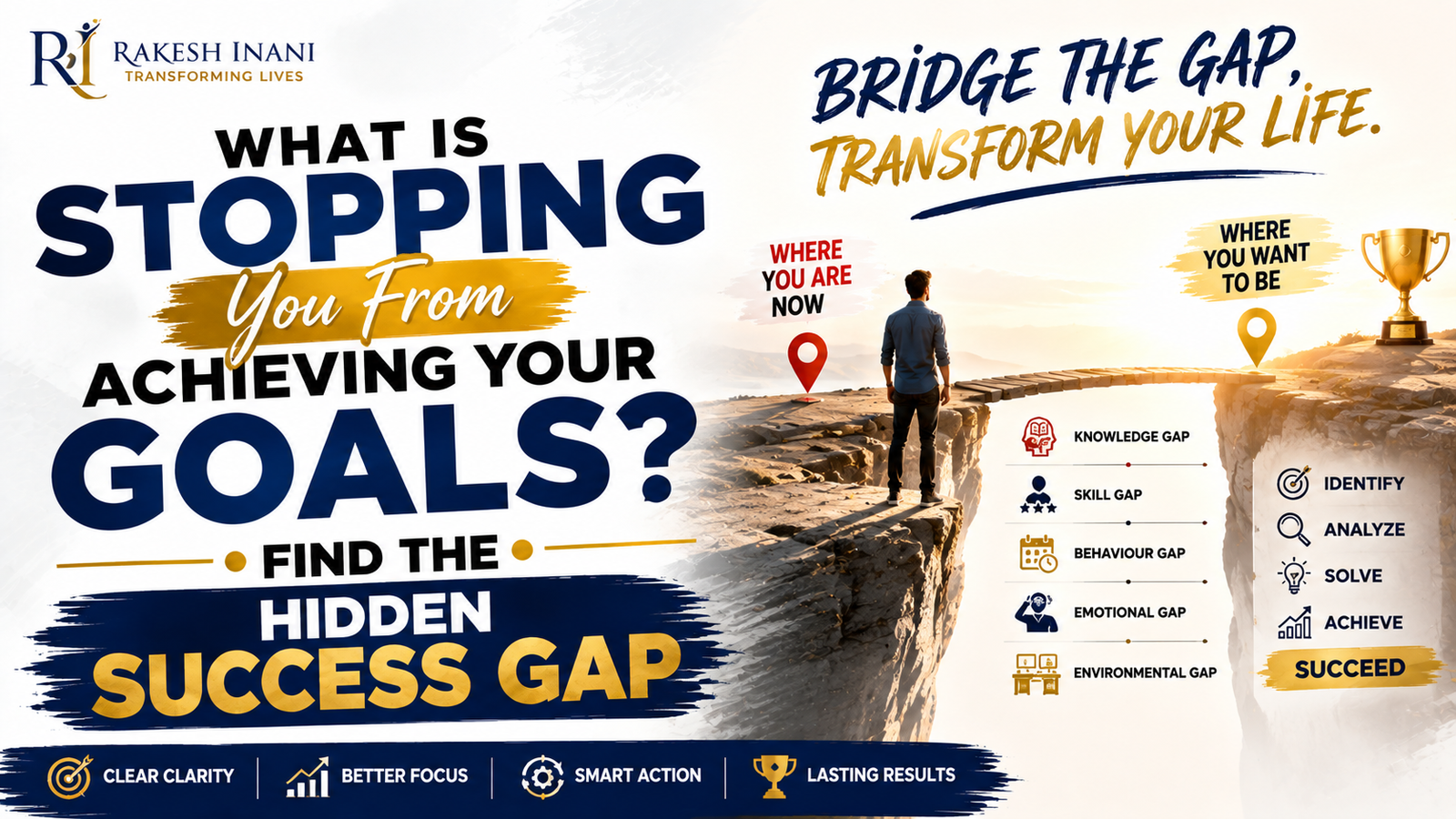
A success gap is the difference between your present reality and your desired result.
It includes whatever is missing, weak, unclear, or misaligned between these two points.
For example:
Present reality: You have knowledge but no paying clients.
Desired result: You want ten regular coaching clients.
Possible success gap: You cannot yet communicate your offer, reach suitable people, or conduct effective sales conversations.
Here is another example:
Present reality: You read regularly but forget most of what you learn.
Desired result: You want to speak and teach the ideas naturally.
Possible success gap: You are consuming information but not recalling, explaining, practising, or applying it.
Therefore, the success gap is not always a lack of desire.
It may be a missing skill, weak system, emotional block, unclear strategy, or distracting environment.
When you identify the correct gap, your next action becomes clearer.
Why Do People Work on the Wrong Problem?
People often work on the wrong problem because the visible symptom receives all their attention.
For example, low sales are visible.
However, the unclear message behind those low sales is less visible.
Procrastination is visible.
However, the fear, confusion, or task overload behind procrastination may remain hidden.
A lack of confidence is visible.
However, limited preparation and negative self-talk may be the deeper causes.
Additionally, surface problems are easier to describe.
It is easy to say, “I need more money.”
It is harder to say, “I avoid sales conversations because I fear rejection.”
It is easy to say, “I need more followers.”
It is harder to admit, “My content does not solve one clear audience problem.”
Therefore, honest self-observation is required.
You must move beyond what is happening and ask why it is happening.
Symptoms Versus Root Causes
A symptom is the visible sign of a problem.
A root cause is the deeper condition creating that symptom.
For example:
| Visible symptom | Possible root cause |
|---|---|
| Low income | Weak offer, poor sales skill or too few conversations |
| Inconsistent content | No simple system, perfectionism or fear of judgement |
| Lack of focus | Too many priorities or unclear goals |
| Procrastination | Fear, confusion, overwhelm or low energy |
| Poor confidence | Limited practice or harmful inner dialogue |
| Low engagement | Unclear audience or content that lacks relevance |
| Missed deadlines | Poor planning or unrealistic workload |
| Repeated quitting | Dependence on motivation instead of a routine |
However, one symptom can have several possible causes.
That is why copying another person’s solution may not work for you.
Two people may both procrastinate. Yet, one may procrastinate because the task is unclear, while the other may procrastinate because they fear being judged.
The first person needs clarity.
The second person may need emotional support and gradual exposure.
Therefore, a correct solution begins with a correct diagnosis.
The Five Main Barriers That Block Progress
Most success gaps can be understood through five broad categories:
- Knowledge gaps
- Skill gaps
- Behaviour gaps
- Emotional gaps
- Environmental gaps
Sometimes you may have only one main gap.
At other times, two or more gaps may work together.
Let us understand each one.
1. The Knowledge Gap: You Do Not Know What to Do
A knowledge gap exists when you do not have the information needed to make a good decision.
For example, you may want to start a coaching business, but you do not know:
- Which audience to serve
- Which problem to solve
- How to structure an offer
- How to price your service
- Where to find potential clients
- How to conduct a discovery call
In this situation, learning is necessary.
You may need a book, course, mentor, coach, guide, or trusted source.
However, be careful.
People often assume that every problem is a knowledge problem. As a result, they keep learning even when they already know enough to take the next step.
You may know how to record a video, but you are still watching tutorials about video creation.
You may know how to call a potential client, but you continue searching for the perfect script.
At that stage, more knowledge may not be the answer.
The real gap may be action or confidence.
How to Identify a Knowledge Gap
Ask yourself:
- Do I clearly know the next three steps?
- Do I understand the basic process?
- Am I missing essential information?
- Would one specific answer help me move forward?
- Have I already learned this but failed to apply it?
If you genuinely do not know what to do, learn the missing information.
However, learn with a clear purpose.
Do not collect knowledge without turning it into action.
2. The Skill Gap: You Know What to Do but Cannot Do It Well Yet
A skill gap exists when you understand the action, but your present ability is not strong enough.
For example, you may know that you need to speak confidently during a webinar.
However, knowing that does not automatically give you:
- Voice control
- Clear structure
- Powerful storytelling
- Engaging body language
- Emotional stability
- Audience interaction
- A confident closing
These abilities require practice.
Similarly, you may understand the importance of sales. However, you may not yet know how to ask the right questions, listen carefully, handle objections, or explain your offer.
Therefore, knowledge tells you what to do.
Skill allows you to do it effectively.
Common Skills Needed for Success
Depending on your goal, you may need:
- Communication
- Sales
- Marketing
- Writing
- Public speaking
- Leadership
- Decision-making
- Emotional regulation
- Time management
- Technology
- Relationship building
- Problem-solving
How to Close a Skill Gap
First, name the exact skill.
Do not say, “I need to improve my business.”
Instead, say, “I need to improve discovery-call conversations.”
Next, break the skill into smaller parts.
For discovery calls, these parts may include:
- Building rapport
- Asking open questions
- Understanding the client’s problem
- Exploring the cost of the problem
- Explaining the solution
- Presenting the offer
- Responding to concerns
- Asking for a decision
Then, practise one part at a time.
A skill becomes stronger through repetition, feedback, correction, and more repetition.
3. The Behaviour Gap: You Know and Can, but Do Not Act Consistently
A behaviour gap exists when you have enough knowledge and ability, but you are not doing the required action regularly.
You may know how to create content.
You may even create good content.
However, you publish only when you feel motivated.
You may know how to exercise.
Still, you exercise for three days and then stop for two weeks.
You may know how to contact potential clients.
However, fear or distraction prevents you from doing it consistently.
In this situation, another course may not solve the problem.
You need a better behaviour system.
Signs of a Behaviour Gap
- You plan more than you execute.
- You begin strongly but stop quickly.
- You wait for motivation.
- You regularly miss your own deadlines.
- You keep changing your routine.
- You know the next action but avoid it.
- Your progress depends on your mood.
How to Close a Behaviour Gap
Start by making the action smaller.
Instead of saying, “I will create content for three hours every day,” begin with one useful post or 30 focused minutes.
Next, connect the action to a fixed time or event.
For example:
“After breakfast, I will write for 30 minutes.”
Then, track completion.
Finally, review your system every week.
Consistency becomes easier when the action is clear, small, scheduled, and visible.
4. The Emotional Gap: Your Feelings Stop Your Action
An emotional gap exists when fear, shame, self-doubt, anxiety, anger, or discomfort controls your behaviour.
You may know what to do.
You may also have the ability to do it.
Still, something inside you says:
“What if people judge me?”
“What if I fail?”
“What if nobody responds?”
“What if I am not good enough?”
As a result, you delay the action.
Then, to explain the delay, you may say that you need more preparation.
However, the real problem is not preparation.
It is emotional avoidance.
Common Emotional Barriers
- Fear of failure
- Fear of rejection
- Fear of success
- Fear of visibility
- Perfectionism
- Imposter feelings
- Low self-worth
- Past embarrassment
- Need for approval
- Discomfort with uncertainty
These emotions are not proof that you should stop.
They are signals that you need to work with your internal state.
How to Close an Emotional Gap
First, name the emotion.
Say, “I feel afraid of being judged,” instead of, “I am not ready.”
Next, identify the thought behind the emotion.
Perhaps you believe one imperfect video will damage your image.
Then, question that belief.
Is it completely true? What would you say to a friend in the same situation?
Finally, take a smaller action that feels challenging but manageable.
You do not always need to remove fear before acting.
Sometimes action teaches your mind that the situation is safer than it imagined.
5. The Environmental Gap: Your Surroundings Work Against You
An environmental gap exists when your physical or digital surroundings make the desired behaviour difficult.
For example, you may want to focus, but your phone remains beside you with every notification turned on.
You may want to eat healthy food, but your kitchen is filled with tempting choices.
You may want to write every morning, but you do not have a fixed place, time, or prepared workspace.
In these situations, the problem is not only willpower.
Your environment is repeatedly inviting the unwanted behaviour.
Common Environmental Barriers
- Phone notifications
- Constant social media access
- A noisy workspace
- Unclear working hours
- Interruptions from other people
- Too many open tabs
- Tools that are difficult to use
- Lack of accountability
- Easy access to distractions
- No visual reminder of the goal
How to Close an Environmental Gap
Make the desired action easier.
Also, make the distracting action harder.
For example:
- Keep your phone in another room.
- Turn off unnecessary notifications.
- Open only the file needed for the present task.
- Prepare your workspace before sleeping.
- Use a website blocker during focus time.
- Tell family members your working hours.
- Keep your daily goal visible.
- Create a fixed place for important work.
A supportive environment reduces the number of decisions you must make.
As a result, useful behaviour becomes easier to repeat.
How Different Gaps Can Work Together
Your problem may involve more than one gap.
Suppose you want to create YouTube videos consistently.
First, you may have a knowledge gap because you do not understand what your audience wants.
Second, you may have a skill gap because speaking to a camera feels difficult.
Third, you may have an emotional gap because you fear negative comments.
Fourth, you may have a behaviour gap because you do not have a recording schedule.
Finally, you may have an environmental gap because setting up your equipment takes too long.
Therefore, one solution may not be enough.
You may need to:
- Research your audience
- Practise speaking
- Reframe the fear of judgement
- Set a weekly recording time
- Keep your equipment ready
The goal is the same, but several bridges may need to be built.
Why More Motivation Does Not Always Solve the Problem
When people feel stuck, they often search for motivation.
Motivation can create energy. However, it cannot replace missing knowledge, skill, systems, or emotional healing.
Imagine that you do not know how to swim.
A motivational speech may make you excited to enter the water. Nevertheless, it cannot replace swimming instruction and practice.
Likewise, if your business offer is unclear, stronger motivation may only help you communicate an unclear offer more often.
Therefore, before seeking more motivation, ask:
“What exactly is missing?”
You may not need more energy.
You may need a more accurate plan.
How to Find the Root Cause of Your Problem
Begin with the result you want.
Then, work backward.
Suppose your goal is to get five coaching clients each month.
Ask:
“What must happen before I can get five clients?”
You may answer:
“I need to have enough suitable sales conversations.”
Then ask:
“What must happen before I can have those conversations?”
You may answer:
“I need to connect with suitable leads.”
Continue asking until you find the broken step.
This method helps you move from a broad goal to a specific barrier.
Use the “Why” Ladder Carefully
Start with the visible problem.
“I am not getting clients.”
Ask why.
“Because I am not having enough sales conversations.”
Ask why again.
“Because I avoid contacting potential clients.”
Ask why again.
“Because I feel uncomfortable and fear rejection.”
Now you have moved from an income symptom to an emotional barrier.
However, do not force yourself to ask “why” endlessly.
The goal is to find a useful cause that you can address—not to create an overly complicated story.
What Skills Do I Need to Achieve My Goal?
Every goal has a price.
The price is not always money.
Often, the price includes learning, practice, discomfort, patience, and personal growth.
If you want to become a successful coach, you may need coaching skills and business skills.
If you want to become a speaker, you may need content knowledge and presentation skills.
If you want to become a leader, you may need vision, decision-making, communication, and emotional control.
Therefore, ask:
- What does this goal require?
- Which of those abilities do I already have?
- Which ability is weakest?
- Which skill would create the greatest improvement?
- How can I practise that skill this week?
Do not try to master everything at once.
Choose the skill that is currently limiting your progress the most.
The Success Gap Audit
Use this exercise to identify your most important barrier.
Step 1: Write Your Goal
My most important goal is:
Make it specific.
Instead of writing, “I want more money,” write, “I want to earn ₹1 lakh per month from my coaching services by a specific date.”
Step 2: Write Your Present Reality
My current situation is:
Use facts instead of judgement.
For example:
“I currently have two paying clients and earn ₹20,000 per month.”
Step 3: Measure the Gap
The difference between my present reality and my goal is:
Step 4: Identify Possible Barriers
Rate each area from 1 to 10:
- Knowledge: ___
- Skill: ___
- Behaviour: ___
- Emotional readiness: ___
- Environment: ___
A low score may point toward an important barrier.
Step 5: Find the Main Constraint
Complete this sentence:
If I improve only one area during the next 30 days, the area most likely to improve my result is:
Step 6: Choose the Next Action
The smallest useful action I can complete within 24 hours is:
Your next action should be specific and visible.
“Work on my business” is unclear.
“Speak with two potential clients before 5:00 p.m.” is clear.
Frequently Asked Questions
What Is Stopping Me from Achieving My Goals?
You may be facing a knowledge, skill, behaviour, emotional, or environmental gap. Study your current actions and results to identify which barrier is creating the greatest limitation.
Why Do I Know What to Do but Still Do Not Do It?
You may be facing a behaviour or emotional gap.
The action may feel too large, unclear, uncomfortable, or disconnected from a routine. Make the task smaller, schedule it clearly, and examine the feeling that appears when you try to begin.
How Do I Identify My Biggest Weakness?
Look for the point where your progress regularly stops.
Then, ask whether the cause is missing knowledge, weak skill, inconsistent behaviour, emotional resistance, or an unsupportive environment.
Should I Work on My Weaknesses or Use My Strengths?
Use your strengths wherever possible. However, if one weakness is blocking the entire goal, you must improve it enough to move forward.
You do not need to become excellent at everything.
You need to strengthen the constraint that currently limits your progress.
Can a Coach or Mentor Help Me Find My Success Gap?
Yes.
A skilled coach or mentor may notice patterns you cannot easily see. However, the support should help you understand and act—not make you dependent.
How Long Does It Take to Close a Success Gap?
The time depends on the size of the gap, the complexity of the skill, your available resources, and the consistency of your practice.
Instead of asking only how long it will take, ask what measurable progress you can create this week.
Stop Chasing the Goal and Start Building the Bridge
Your desired result may feel far away.
However, you do not need to solve your entire future today.
You need to identify the next gap and build the next part of the bridge.
If knowledge is missing, learn the essential information.
If skill is missing, practise deliberately.
If behaviour is inconsistent, create a simple system.
If fear is controlling you, work with the emotion and take a smaller courageous step.
If your environment is distracting you, redesign it.
Then, measure what changes.
Your present result is not proof that you cannot succeed.
Instead, it shows what your current approach is producing.
Therefore, do not only increase your effort.
Improve the direction of your effort.
Final Thoughts
When you focus only on the goal, the distance can feel overwhelming.
However, when you identify the hidden success gap, the journey becomes more practical.
You stop saying, “I am unsuccessful.”
Instead, you say:
“I need to improve this skill.”
“I need a clearer system.”
“I need to take this action more consistently.”
“I need to work through this emotional barrier.”
“I need to remove this distraction.”
Now the problem is no longer your whole identity.
It becomes one specific area that can be understood and improved.
So, take a moment and complete this statement:
My goal is ________. My present reality is ________. The main gap is ________. My next action is ________.
That one honest sentence can give you more direction than another week of random motivation.
Do not keep staring at the destination.
Find the missing bridge—and begin building it today.
Conclusion
Every meaningful goal creates a gap between where you are today and where you want to be. Most people spend years trying to close that gap by working harder, consuming more information, or searching for more motivation. However, lasting progress begins only when you identify the real barrier standing in your way.
Perhaps you need more knowledge. Perhaps you need to strengthen a specific skill. Maybe your greatest challenge is inconsistent behaviour, emotional resistance, or an environment that constantly pulls you away from your priorities. Whatever the gap may be, remember that it is not a permanent limitation. It is simply the next bridge you need to build.
Instead of asking, “Why am I not achieving my goals?”, ask a better question: “What is the one success gap that is preventing my next level of growth?” Once you identify that gap, your actions become focused, your efforts become more effective, and your progress becomes measurable.
Success is rarely created by dramatic breakthroughs. It is built by identifying one obstacle, solving it, and then moving to the next. Every bridge you build brings you one step closer to the life you truly want.
If you want to master your mindset, overcome hidden mental barriers, and learn practical strategies to accelerate your personal and professional growth, explore more articles on this website and join the Mind Transformation Community. Together, we will transform knowledge into action, action into results, and results into lasting success.