

How to Communicate Your Value Clearly and Confidently
You may have valuable knowledge.
You may be able to solve real problems. Moreover, you may genuinely want to help people.
However, if people do not understand what you do, whom you help, or why your work matters, they may not take the next step with you.
This does not mean that your knowledge has no value.
It may mean that your value has not been communicated clearly.
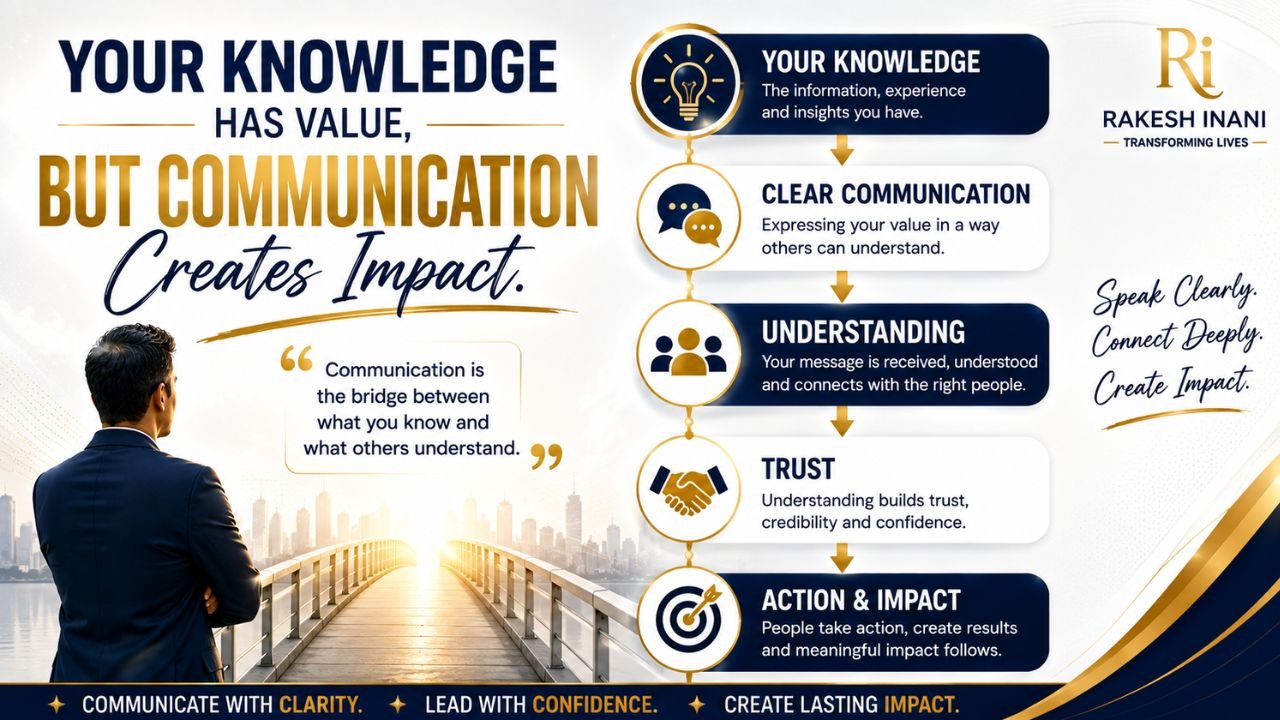
Communication is the bridge between what you know and what another person understands.
It helps you share ideas, build relationships, understand needs, solve problems, create trust, and invite action.
Effective communication means expressing and receiving ideas in a way that creates clear understanding.
It is not only about speaking more.
It is about helping the right message reach the other person in a way they can understand and use.
Why Is Communication Important for Success?
Most meaningful goals involve other people.
If you are a coach, you need to understand your clients and explain how you can help.
If you are a business owner, you need to communicate with customers, team members, partners, and service providers.
If you are a leader, you need to share direction, listen to concerns, and guide action.
If you are an employee, you need to explain ideas, ask questions, provide updates, and manage disagreements.
Even in personal relationships, communication helps people express feelings, understand needs, and solve problems together.
Therefore, communication is not an optional extra.
It is part of how your knowledge becomes useful in the world.
Communication Is More Than Speaking
Many people believe that good communication means speaking fluent English or using impressive words.
However, communication is much bigger than vocabulary.
It includes:
- Listening
- Asking questions
- Choosing clear words
- Using an appropriate tone
- Organizing ideas
- Observing body language
- Understanding context
- Checking understanding
- Responding with respect
- Adjusting your message
You can use perfect grammar and still create confusion.
On the other hand, you can use simple language and create deep understanding.
Therefore, the goal is not to sound complicated.
The goal is to become clear.
Why Do People Fail to Understand Your Value?
People may fail to understand your value for several reasons.
Your Message Is Too Broad
You may say:
“I help people transform their lives.”
This sounds positive.
However, the listener may still wonder:
“Which people?”
“What part of life?”
“What kind of transformation?”
“How do you help?”
A more specific message could be:
“I help working professionals reduce overthinking, gain emotional clarity, and take consistent action using NLP-informed mind coaching.”
Now the listener has more information.
You Focus Too Much on Your Method
You may talk about NLP, coaching models, exercises, modules, worksheets, and support calls.
However, the listener may be thinking:
“How will this improve my life?”
Your method matters.
Still, people usually become interested when they understand the problem you solve and the result you help create.
You Use Language the Audience Does Not Use
Experts often use technical words because those words are familiar to them.
However, the audience may describe the same problem differently.
A coach may say “cognitive overload.”
The audience may say:
“My mind does not stop.”
A coach may say “limiting belief.”
The audience may say:
“I know what to do, but something inside me holds me back.”
Good communication begins with the listener’s language.
You Speak Before You Understand
If you explain your solution before understanding the other person’s problem, your message may feel irrelevant.
Therefore, listening must come before explaining.
The Three Parts of a Clear Message
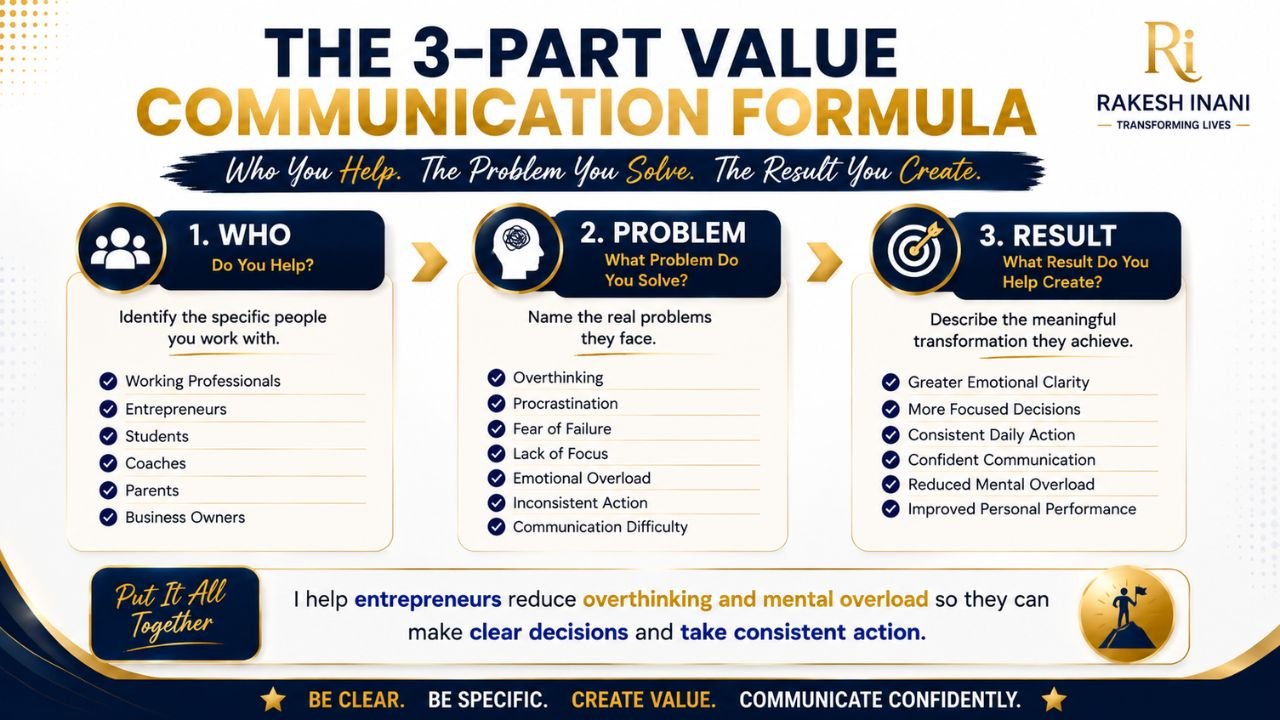
A useful message usually answers three simple questions.
1. Who Is This For?
Identify the person you help.
For example:
- Working professionals
- Entrepreneurs
- Students
- Coaches
- Parents
- Business owners
The more clearly you understand the person, the easier it becomes to choose useful language.
2. What Problem Do You Help Solve?
Name a problem the audience recognizes.
Examples include:
- Overthinking
- Procrastination
- Fear of failure
- Lack of focus
- Emotional overload
- Inconsistent action
- Communication difficulty
3. What Result Do You Help Create?
Describe the useful outcome.
Examples include:
- Greater emotional clarity
- More focused decisions
- Consistent daily action
- Confident communication
- Reduced mental overload
- Improved personal performance
Combine all three parts:
“I help entrepreneurs reduce overthinking and mental overload so they can make clear decisions and take consistent action.”
This sentence is simple.
More importantly, it helps the listener understand the value.
Communicate Benefits, Not Only Features
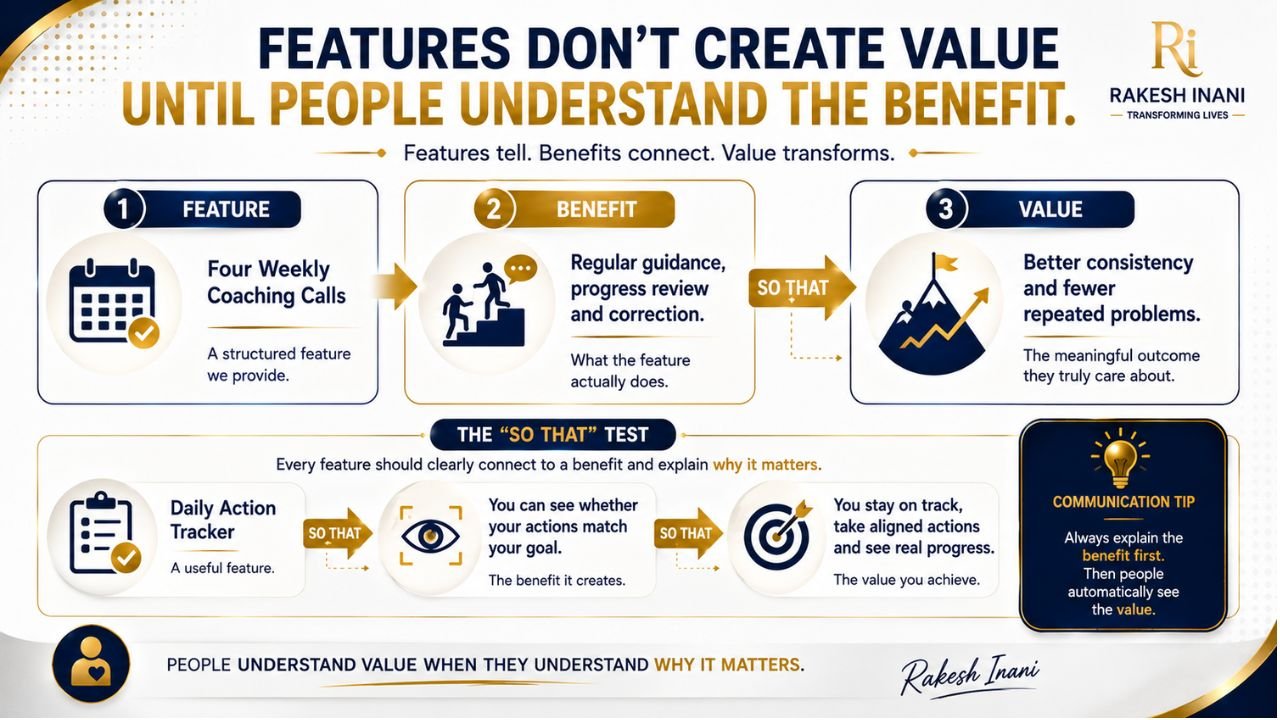
A feature describes what is included.
A benefit explains why it matters.
For example:
Feature: Four weekly coaching calls.
Benefit: You receive regular guidance, review your progress, and correct patterns before they become repeated problems.
Feature: Daily action tracker.
Benefit: You can see whether your actions match your goal and rebuild consistency.
Feature: NLP-informed exercises.
Benefit: You explore the thoughts, inner language, and patterns that may be influencing your behaviour.
People may need to know the features.
However, benefits help them understand the practical value.
Use the “So That” Test
Take any feature and add the words “so that.”
For example:
“You receive a weekly coaching call so that you can review challenges, gain clarity, and choose the next action.”
The words after “so that” often reveal the benefit.
Words, Voice, and Body Language Work Together
When you communicate, people receive more than your words.
They also notice your voice, expression, posture, pace, and presence.
However, avoid using fixed percentages to claim that one part always matters more than another. Communication changes according to the situation.
In a written contract, words are extremely important.
During an emotional conversation, tone and body language may strongly influence how those words are received.
Therefore, instead of searching for one universal percentage, aim for alignment.
Your words, voice, and body language should support the same message.
Choose Clear Words
Use words the listener can understand.
Shorter and simpler language is often more powerful than complicated language.
Instead of saying:
“I facilitate cognitive restructuring for enhanced behavioural congruence,”
you could say:
“I help you notice unhelpful thought patterns and build actions that match your goals.”
The second version is easier to understand.
Use Your Voice Intentionally
Your voice communicates:
- Confidence
- Warmth
- Urgency
- Calmness
- Interest
- Uncertainty
- Respect
Pay attention to:
- Volume
- Pace
- Pauses
- Tone
- Clarity
- Variation
Speaking too quickly may make the listener feel rushed.
Speaking without variation may reduce attention.
A thoughtful pause can give an important idea more weight.
Use Supportive Body Language
Helpful body language may include:
- Comfortable eye contact
- Open posture
- Natural hand movements
- A calm facial expression
- Balanced breathing
- Facing the person
- Avoiding constant fidgeting
Do not force every movement.
Instead, become present in the conversation.
Natural body language often improves when your attention moves away from judging yourself and toward understanding the other person.
Listening Is a Core Communication Skill
Many people listen only until they find a chance to speak.
However, effective listening means trying to understand the other person’s meaning.
This requires attention.
While listening, avoid preparing your complete answer too early.
Instead, notice:
- What is the person saying?
- What emotion may be present?
- What seems most important to them?
- What have they not explained clearly?
- What assumption might I be making?
Listening helps you communicate a relevant response.
It also helps the other person feel respected.
Use Reflective Listening
Reflective listening means restating the meaning in your own words.
For example:
“If I understand correctly, you know what actions to take, but overthinking makes it hard to begin. Is that right?”
This gives the other person a chance to confirm or correct your understanding.
Do Not Pretend to Understand
If something is unclear, ask.
You can say:
“Could you explain what you mean by that?”
“Can you give me an example?”
“What happens when you try to take action?”
“What part feels most difficult?”
A clear question is better than a confident assumption.
Ask Better Questions
Good questions help people think.
They also help you discover the real problem.
Open Questions
Open questions invite a fuller answer.
Examples include:
- What would you like to change?
- What is happening at present?
- How is this problem affecting you?
- What have you already tried?
- What result would feel meaningful?
- What usually stops you?
Clarifying Questions
Clarifying questions make vague statements more specific.
If someone says, “I lack confidence,” ask:
- In which situations?
- What happens in those moments?
- What do you say to yourself?
- What would confidence look like in behaviour?
Avoid Turning Every Question into an Interrogation
Ask one question at a time.
Then, listen.
Do not ask five questions before the person has answered the first one.
Good communication feels like a conversation, not an interview checklist.
Connect Before You Try to Influence
People are more open to a message when they feel understood.
Therefore, before giving advice, show that you understand the person’s present experience.
You might say:
“It sounds as if you have been trying hard, but your mind becomes overloaded when you have too many options.”
This statement does not automatically mean that you agree with every conclusion.
It means that you are acknowledging their experience.
Connection can be created through:
- Genuine attention
- Respect
- Appropriate warmth
- Relevant questions
- Patient listening
- Honest responses
- Avoiding unnecessary judgement
Influence without understanding can feel like pressure.
Understanding creates the foundation for useful guidance.
Explain Your Ideas Simply
If you understand an idea deeply, you should be able to explain it in simple words.
This does not mean removing all depth.
It means building depth step by step.
Use this structure:
- State the main idea.
- Explain why it matters.
- Give a simple example.
- Show how to apply it.
- Check understanding.
For example:
“Consistent action means repeating a useful action even when motivation changes. This matters because most important results take time. For instance, one video will not build a complete audience, but useful weekly videos can build trust. Therefore, choose a realistic publishing schedule you can maintain. Does that idea fit your present situation?”
The message is easy to follow because it moves in a clear order.
Use Stories to Make Ideas Easier to Understand
Stories help people see an idea in action.
For example, instead of only saying, “Too many options reduce focus,” tell a short story:
“A coach begins building a course. After three days, he discovers podcasting and changes direction. A week later, he begins studying paid advertising. After one month, he has many notes but no completed offer.”
The listener can now picture the pattern.
A useful story often includes:
- A person
- A goal
- A problem
- A choice
- A result
- A lesson
Keep stories relevant.
The story should support the message rather than become a distraction from it.
Communicating in Coaching
Coaching communication requires more than giving advice.
A coach needs to:
- Create a safe and respectful conversation
- Listen without rushing
- Ask useful questions
- Notice repeated language
- Clarify the desired outcome
- Avoid making assumptions
- Support responsibility
- Explain tools honestly
- Maintain appropriate boundaries
- Stay within their competence
A coach should not promise guaranteed transformation.
Additionally, coaching should not be presented as a replacement for qualified medical or mental-health care when such care is needed.
Clear communication includes being honest about what your service can and cannot provide.
Communicating in Sales
Sales communication is often misunderstood.
Many people believe sales means convincing someone to buy.
However, responsible sales communication begins with understanding fit.
You need to discover:
- What problem does the person want to solve?
- How important is it?
- What have they already tried?
- What result do they want?
- Can your service realistically help?
- Are they ready and suitable for the process?
If there is a good fit, explain the offer clearly.
If there is no fit, do not force the sale.
A Simple Sales Explanation
Use this order:
- Restate the person’s problem.
- Confirm the desired outcome.
- Explain your approach.
- Describe what is included.
- Clarify the expected responsibilities.
- State the investment.
- Invite questions.
- Ask whether they want to proceed.
This approach keeps the conversation clear and respectful.
Communicating in Leadership
A leader must communicate both direction and expectations.
A team may struggle when the leader says:
“Do this quickly.”
What does quickly mean?
What result is expected?
Who is responsible?
When is the deadline?
A clearer instruction could be:
“Please complete the first draft of the five-slide presentation by 3:00 p.m. today. Use the approved brand template and include the client’s three main results. Send it to me for review before final export.”
Clear leadership communication includes:
- The desired result
- The reason it matters
- Ownership
- Resources
- Deadline
- Quality standard
- Review method
Clear instructions reduce avoidable confusion.
Communicating During Disagreement
Disagreement does not automatically mean disrespect.
Two people may have different information, needs, values, or interpretations.
During disagreement:
- Slow down.
- Describe the specific issue.
- Avoid attacking the person’s identity.
- Ask what they understand.
- Explain your concern clearly.
- Look for shared goals.
- Agree on the next step.
Instead of saying:
“You never listen to me,”
say:
“When I was explaining the concern, I was interrupted three times. I would like two minutes to finish, and then I will listen to your response.”
The second statement describes the behaviour and requests a clear change.
How to Speak with More Confidence
Confidence in communication does not mean having no nervousness.
It means being able to express yourself even when some nervousness is present.
Prepare the Structure
Do not memorize every word.
Instead, know:
- Your opening
- Your main points
- Your examples
- Your closing
- Your call to action
A clear structure reduces mental pressure.
Practise Out Loud
Thinking about speaking is not the same as speaking.
Practise with your voice.
Record yourself. Listen without harsh judgement. Then, improve one part at a time.
Slow Down
Nervousness can make you speak quickly.
Pause after important ideas.
Allow yourself to breathe.
A calm pace helps both you and the listener.
Accept Small Mistakes
You may forget a word.
You may pause.
You may need to correct a sentence.
These moments do not destroy your message.
Continue.
Confidence grows when you learn that you can recover.
Focus on Service
When your attention remains on yourself, you may think:
“How do I look?”
“What will people think?”
“Am I speaking perfectly?”
Instead, ask:
“What does this person need to understand?”
Service shifts attention from performance to contribution.
The Six-Step Clear Communication Framework
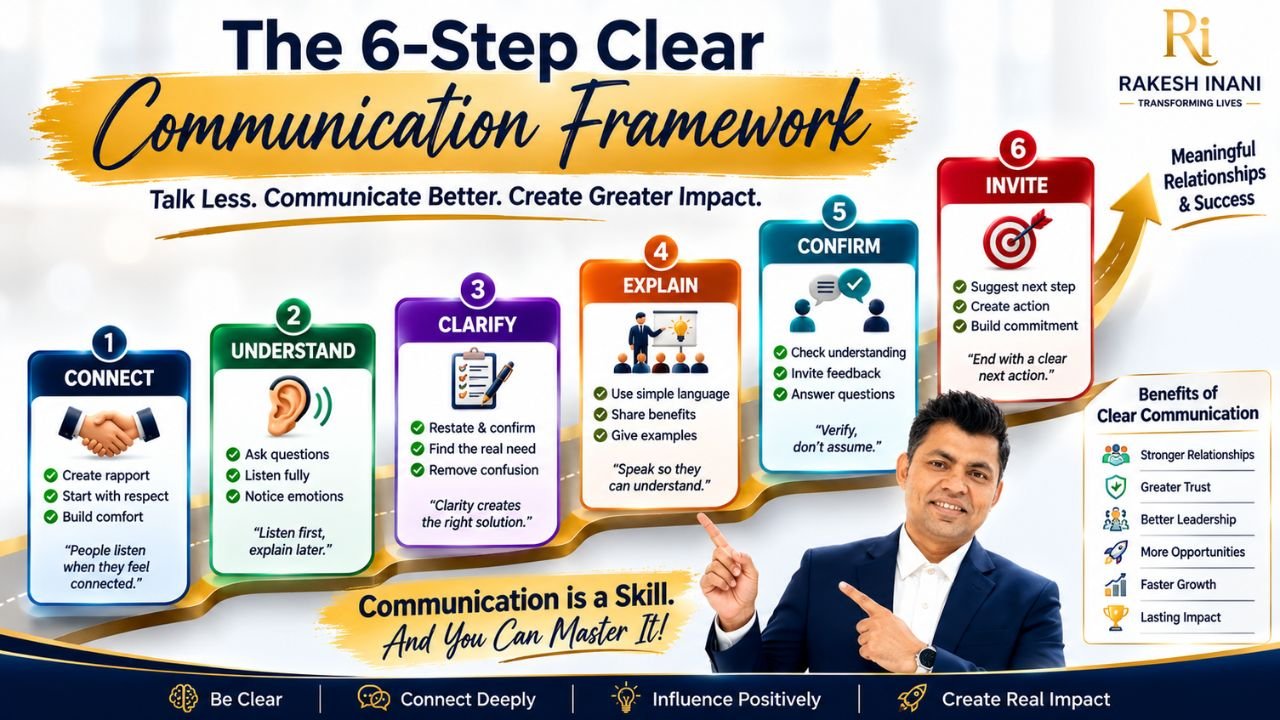
Use this framework in coaching, leadership, sales, or important conversations.
1. Connect
Create a respectful beginning.
Use the person’s name, acknowledge the context, and give full attention.
2. Understand
Ask questions and listen.
Do not rush to explain your solution.
3. Clarify
Restate what you understood.
Confirm the main problem, need, goal, or request.
4. Explain
Present your message in simple language.
Use examples when necessary.
5. Confirm
Check whether the person understood.
Ask:
“How does that sound?”
“What questions do you have?”
“Is any part unclear?”
6. Invite
Suggest a clear next step.
For example:
“Would you like to schedule the next conversation?”
“Can we agree to complete this by Friday?”
“Would you like to explore whether this program is suitable for you?”
This creates a natural movement from connection to action.
Create Your Personal Value Statement
Use this formula:
I help [specific audience] overcome [specific problem] so they can achieve [meaningful result] through [your approach].
Example:
I help entrepreneurs and working professionals reduce overthinking, break limiting mental patterns, and take consistent action through NLP-informed mind transformation coaching.
Now test the statement.
Ask:
- Is the audience clear?
- Is the problem recognizable?
- Is the result meaningful?
- Is the language easy?
- Can I say it naturally?
- Does it avoid exaggerated promises?
Improve the statement until it feels clear and true.
Practise Explaining Your Work at Four Levels
One Sentence
Explain what you do in one clear sentence.
Thirty Seconds
Add the audience’s problem and desired result.
Two Minutes
Explain your approach, the problem you solve, and one simple example.
One Story
Share a short story showing the journey from problem to progress while protecting client privacy.
If you can explain your work at different lengths, you will be more prepared for different conversations.
The Seven-Day Communication Practice
Day 1: Listen Without Interrupting
During one conversation, give your complete attention.
Day 2: Ask Three Open Questions
Use questions that help the other person explain their experience.
Day 3: Simplify One Complex Idea
Explain an idea in language a young learner could understand.
Day 4: Record Your Value Statement
Say it aloud five times. Improve the wording until it sounds natural.
Day 5: Observe Your Voice
Record a two-minute explanation. Notice pace, volume, clarity, pauses, and tone.
Day 6: Observe Your Body Language
Record a short video. Look for posture, expression, hand movement, and visible tension.
Day 7: Have One Meaningful Conversation
Use the complete framework:
Connect → Understand → Clarify → Explain → Confirm → Invite
Afterward, write what worked and what you want to improve.
Frequently Asked Questions About Communication
Why Are Communication Skills Important for Success?
Communication helps you express ideas, understand people, build trust, solve problems, create relationships, and show the value you provide.
How Can I Improve My Communication Skills?
Practise listening, asking clear questions, organizing ideas, using simple words, speaking aloud, requesting feedback, and reviewing real conversations.
How Can I Communicate My Value Without Sounding Proud?
Focus on the problem you solve and the result you support.
Use clear evidence, honest language, and genuine service instead of exaggerated claims.
Why Do People Misunderstand Me?
Your message may be vague, too complex, poorly timed, or based on assumptions.
Clarify your words, listen carefully, and ask the person to explain what they understood.
How Can I Speak Confidently?
Prepare a simple structure, practise aloud, slow your pace, accept small mistakes, and focus on helping the listener understand.
Is Body Language More Important Than Words?
The importance of words and nonverbal signals changes according to the situation.
Instead of relying on a fixed percentage, make sure your words, voice, expression, and behaviour support the same message.
How Can a Coach Explain a Service Clearly?
State whom you help, the problem you address, the result you support, how the process works, what is included, what the client must do, and what the service cannot guarantee.
What Is the Most Important Communication Skill?
No single skill works in every situation.
However, attentive listening is a strong foundation because it helps you understand what message is actually needed.
Your Communication Action Plan
Complete these statements:
The people I want to help are:
The main problem they experience is:
The result they want is:
My simple value statement is:
One technical term I need to simplify is:
One listening habit I need to improve is:
One conversation I have been avoiding is:
The first question I will ask is:
The next step I want to invite is:
Final Thoughts: Your Knowledge Creates Value When It Creates Understanding
You may have years of knowledge.
You may have powerful ideas.
You may also have a genuine desire to help.
However, the other person cannot directly see what is inside your mind.
You must build a bridge.
That bridge is communication.
Begin by listening.
Understand the person before presenting your solution.
Then, use clear words, a supportive voice, natural body language, and relevant examples.
Finally, check understanding and invite a practical next step.
Remember this simple sequence:
Connect → Understand → Clarify → Explain → Confirm → Invite
Do not try to impress people with complexity.
Help them understand through simplicity.
Do not speak only to be heard.
Listen so that you can respond meaningfully.
Do not hide your value because you fear appearing proud.
Communicate it honestly, responsibly, and with the intention to serve.
When your message becomes clear, the right people can finally understand how your knowledge may help them.
And that is when communication begins turning value into real impact.
JOIN MIND TRANSFORMATION COMMUNITY
Learn More:
7 Day Manifestation- NLP Guided Meditation for Success
Why Some People Succeed While Others Stay Stuck: The 6-Step Success Process