
How to Focus on One Goal Without Constantly Changing Direction
You have many goals.
You want to grow your business, improve your health, learn new skills, create content, earn more money, and spend meaningful time with your family.
All these goals may be important.
However, when you try to work on everything at the same time, your energy becomes divided.
You begin one project. Then, another idea looks more exciting.
You move toward the new idea. However, as soon as that work becomes difficult, your mind starts searching for another path.
As a result, you remain busy but fail to create deep progress in any one direction.
This is not always a lack of ability.
Often, it is a lack of focus.
Focus means giving your best available attention and energy to one clear priority for a planned period.
Focus does not mean ignoring every other area of life. Instead, it means deciding what matters most right now and staying with it long enough to produce meaningful progress.
Why Is Focus Important for Achieving Goals?
Most meaningful goals need time.
You cannot build a strong business in one day.
You cannot master public speaking after one practice session.
You cannot create a healthy body after one workout.
Likewise, you cannot build trust with an audience through one piece of content.
Progress requires repeated effort in the same direction.
However, when your energy moves toward a different goal every few days, each project receives only a small amount of effort.
You repeatedly return to the beginning.
Therefore, focus allows your learning, practice, feedback, and improvement to build on each other.
The first attempt teaches you something.
The second attempt uses that lesson.
The third attempt becomes better.
Over time, small improvements begin creating larger results.
Without focus, you often leave before this growth becomes visible.

Focus Is the Bridge Between Clarity and Results
Clarity tells you what you want.
Focus helps you remain connected to it.
For example, clarity may help you decide:
“I want to launch one coaching program during the next 90 days.”
Focus then helps you say:
“For the next 90 days, I will give my main business energy to understanding my audience, building this program, testing it, and enrolling suitable clients.”
Without focus, you may begin designing the program but quickly move to:
- Starting a podcast
- Building a new website
- Creating a second course
- Learning advanced video editing
- Testing a new business model
- Joining another training program
These activities may be useful one day.
However, they may not be useful now.
Therefore, clarity chooses the destination.
Focus protects that choice.
What Happens When Your Energy Is Divided?
Imagine that you have ten plants but only one small container of water.
If you give a few drops to every plant, none of them may receive enough water to grow well.
Your time and mental energy work in a similar way.

When you spread yourself across too many major projects:
- Progress becomes slow.
- Decisions become harder.
- Tasks remain unfinished.
- Learning stays shallow.
- Feedback becomes confusing.
- Mental pressure increases.
- Motivation becomes weaker.
- You begin doubting your ability.
Then, because progress is slow, you may decide that the goal is wrong.
However, the goal may not be the real problem.
The problem may be that it never received enough focused effort.
Why Do I Keep Changing My Goals?
You may keep changing your goals for several reasons.
You Love the Excitement of Starting
A new goal feels full of possibility.
At the beginning, you imagine the reward without experiencing the full difficulty.
Therefore, the new goal feels exciting.
However, after some time, the work becomes ordinary.
Now you need repetition, patience, and discipline.
If you are emotionally dependent on excitement, you may search for another new beginning.
You Fear Missing Better Opportunities
You may think:
“What if another path is better?”
“What if I am wasting time?”
“What if this new idea can produce faster results?”
As a result, you keep every option open.
However, keeping every option open can prevent you from fully choosing any option.
You Avoid Difficult Emotions
Your present goal may create fear, boredom, confusion, rejection, or uncertainty.
Instead of working through that discomfort, you may move to another project.
The new goal provides temporary emotional relief.
You Expect Fast Results
You may believe that a good strategy should work quickly.
Therefore, when results are slow, you assume the strategy has failed.
However, many goals need enough attempts before you can judge the method fairly.
You Lack a Clear Review System
If you review your direction based on daily emotions, your decision may change constantly.
A structured weekly or monthly review helps you make choices based on evidence instead of mood.
The Start–Struggle–Switch Loop
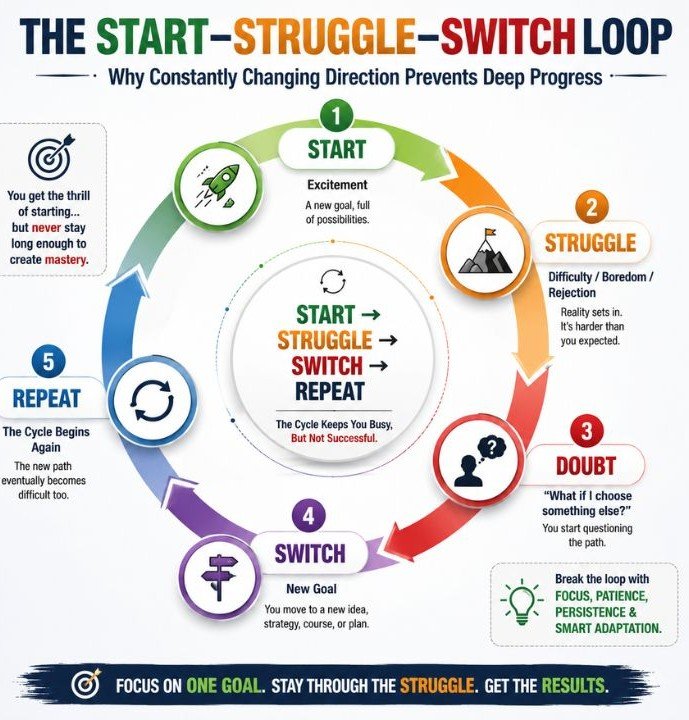
Many people become trapped in a repeated cycle.
Stage 1: Start
You discover a new opportunity.
You feel excited and create a large plan.
Stage 2: Struggle
The work becomes difficult.
You face confusion, boredom, rejection, slow results, or a missing skill.
Stage 3: Doubt
You begin asking:
“Is this really right for me?”
“Why is this not working?”
“Maybe I should do something else.”
Stage 4: Switch
You move to a new strategy, goal, course, platform, or business model.
Stage 5: Repeat
The new path eventually creates its own difficulties.
Then, you switch again.
This is the start–struggle–switch loop.
The loop feels productive because you are always beginning something.
However, you rarely stay long enough to complete the difficult middle stage.
Why Your Mind Looks for an Easier Option
Your mind naturally prefers safety, ease, and quick rewards.
This is not a personal failure.
It is part of being human.
A difficult task may offer a valuable reward in the future.
However, a distraction offers relief now.
For example, recording a video may help build your business over time.
Still, checking social media gives you immediate stimulation.
Making a sales call may create a new client.
However, organizing your files feels safer because nobody can reject you.
Therefore, your mind may guide you toward the easier action.
Focus requires you to notice this pattern and make a conscious choice.
Ask:
“Is this new option truly better, or is it only more comfortable right now?”
That question can prevent many unnecessary changes in direction.
How Novelty Becomes a Form of Avoidance
New things can be useful.
New learning, ideas, tools, and opportunities can create growth.
However, novelty becomes a problem when you use it to escape depth.
For example, you may keep learning new content strategies because publishing creates fear.
You may keep redesigning your program because selling it feels uncomfortable.
You may keep planning new videos because recording the first video feels difficult.
In these situations, the new activity looks productive.
However, its hidden purpose may be avoidance.
Therefore, ask:
- What important action am I avoiding?
- What emotion appears when I think about that action?
- Is this new task helping my goal or helping me escape discomfort?
- What small part of the original task can I complete now?
You do not need to reject every new idea.
You need to understand why you are following it.
Should You Focus on Only One Thing at a Time?
You have different areas of life.
You may need to care for your health, family, work, finances, and personal growth.
Therefore, focusing on one goal does not mean abandoning every responsibility.
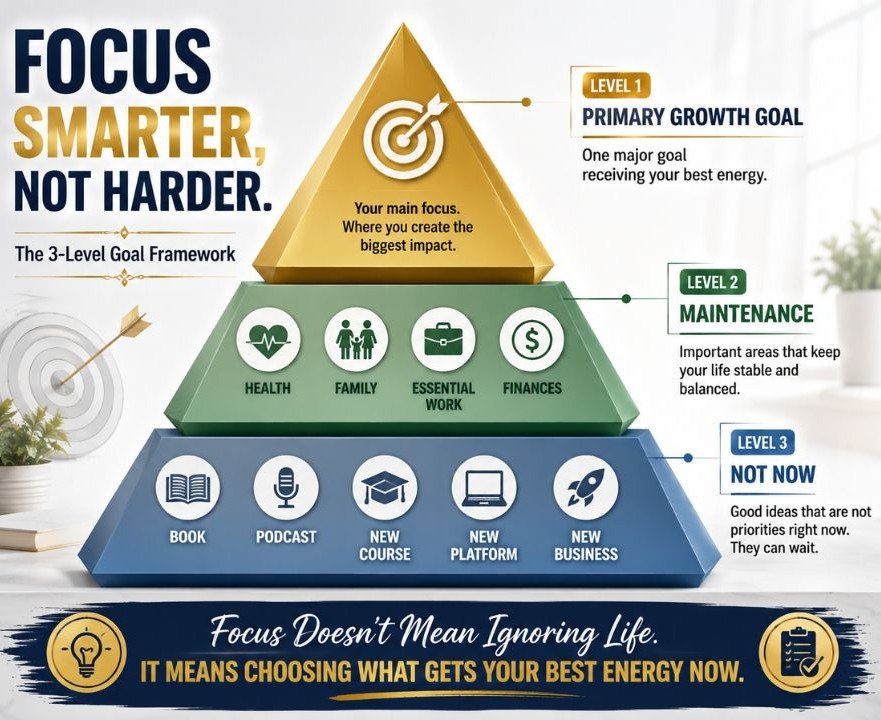
Instead, use three levels of priority.
Level 1: Primary Growth Goal
This is the main area where you want to create significant progress.
For example:
“Build and launch one coaching program in the next 90 days.”
Level 2: Maintenance Responsibilities
These are important areas that must remain stable.
Examples include:
- Family time
- Regular exercise
- Essential professional work
- Financial management
- Basic spiritual practice
Level 3: Not-Now Goals
These are valuable ideas you will consider later.
Examples may include:
- Starting a podcast
- Writing a book
- Creating a second course
- Learning a new platform
- Building another business
This structure allows you to protect one growth goal without neglecting your life.
How to Choose Your One Primary Goal
If you have many goals, use these questions.
Which Goal Matters Most Right Now?
Do not ask which goal matters for your entire life.
Ask which goal deserves extra attention during the present period.
Which Goal Will Create the Greatest Positive Effect?
Perhaps improving health will increase your energy for every other area.
Maybe building one strong offer will create income and business clarity.
Perhaps developing communication will improve your coaching, content, speaking, and sales.
Which Goal Has a Real Deadline?
A meaningful deadline may make one goal more urgent.
However, separate a real deadline from pressure you created without reason.
Which Goal Matches My Present Resources?
Consider your available time, energy, money, knowledge, and support.
A goal can be meaningful but unsuitable for your present stage.
Which Goal Am I Willing to Practise?
Do not choose only the reward.
Also choose the process.
If you want to become a speaker, are you willing to practise speaking?
If you want a coaching business, are you willing to understand clients, communicate your value, and conduct sales conversations?
A goal becomes real when you accept its required actions.
How Long Should You Stay Focused on One Goal?
There is no single time period for every goal.
However, you need a defined focus window.
A focus window is a planned period during which you commit to one primary direction before making a major change.
Depending on the goal, you may choose:
- 30 days for building a daily habit
- 60 days for testing a simple system
- 90 days for a focused business project
- Six months for developing a major skill
- One year for a larger transformation
The exact number is less important than the commitment.
During the focus window, you can improve your method.
However, avoid changing the main goal every time you feel uncomfortable.
Create a Review Date
Choose a date when you will review:
- Actions completed
- Skills developed
- Feedback received
- Progress created
- Problems discovered
- Changes needed
Until that date, continue collecting useful evidence.
This protects you from making long-term decisions based on one difficult day.
Persistence Versus Stubbornness
Focus does not mean repeating the same ineffective action forever.
You should stay committed to the goal while remaining flexible about the method.
For example, your goal may be to enrol ten coaching clients.
If one type of content is not creating engagement, you can improve the topics, message, platform, or format.
You are changing the strategy, not automatically abandoning the goal.
Persistence says:
“This goal still matters. I will study the feedback and improve my approach.”
Stubbornness says:
“I will continue doing exactly the same thing even though clear evidence shows that it does not work.”
Therefore, focused people are not blind.
They remain committed while continuing to learn.
When Should You Change Direction?
Changing direction can be wise when:
- The goal no longer matches your values.
- The cost has become harmful or unacceptable.
- Reliable evidence shows that the main assumption was wrong.
- Your life circumstances have changed greatly.
- A more suitable goal clearly supports your larger purpose.
- You have tested the approach for a fair period.
- Qualified feedback repeatedly points toward a major problem.
- Continuing would create serious financial, physical, legal, or emotional harm.
However, avoid changing direction only because:
- The work feels boring.
- Results are slower than expected.
- Someone criticized you.
- A new idea looks exciting.
- You made one mistake.
- You experienced one rejection.
- You had one unproductive week.
Difficulty does not always mean the direction is wrong.
Sometimes difficulty means you are entering the learning stage.
How to Build Deep Focus
Deep focus does not require a perfect mind.
It requires a supportive system.
Define One Clear Task
Do not begin with:
“Work on my business.”
Instead, choose:
“Write the promise and structure of my coaching offer.”
A clear task gives your attention a target.
Define What “Done” Means
For example:
“By the end of this session, I will complete a one-page offer draft.”
Now your mind knows the finish line.
Create a Focus Block
Choose a period when you will work only on the selected task.
You may begin with 30 minutes.
Later, you can increase the period based on your ability and the type of work.
Remove Visible Distractions
Before beginning:
- Put your phone away.
- Close unrelated tabs.
- Clear your desk.
- Turn off notifications.
- Keep only the required materials.
- Tell other people when you will be available.
Capture Unrelated Thoughts
Your mind may suddenly remember another task.
Instead of following it, write it on a piece of paper.
Then, return to your present work.
This reassures your mind that the idea will not be forgotten.
Take Planned Breaks
Focus is not endless force.
After a meaningful work period, stand, stretch, drink water, or rest your eyes.
Then, return if another work block is planned.
Create a “Not Now” List
A “not now” list protects your present goal from attractive ideas.
Whenever a new project appears, write:
- The idea
- Why it may be useful
- When you will review it
- What milestone must be completed first
For example:
Idea: Start a podcast.
Possible value: Build trust with the audience.
Review date: After completing the first 20 YouTube videos.
Now the idea has a safe place.
You do not need to pursue it today.
Use a Daily One-Thing Question
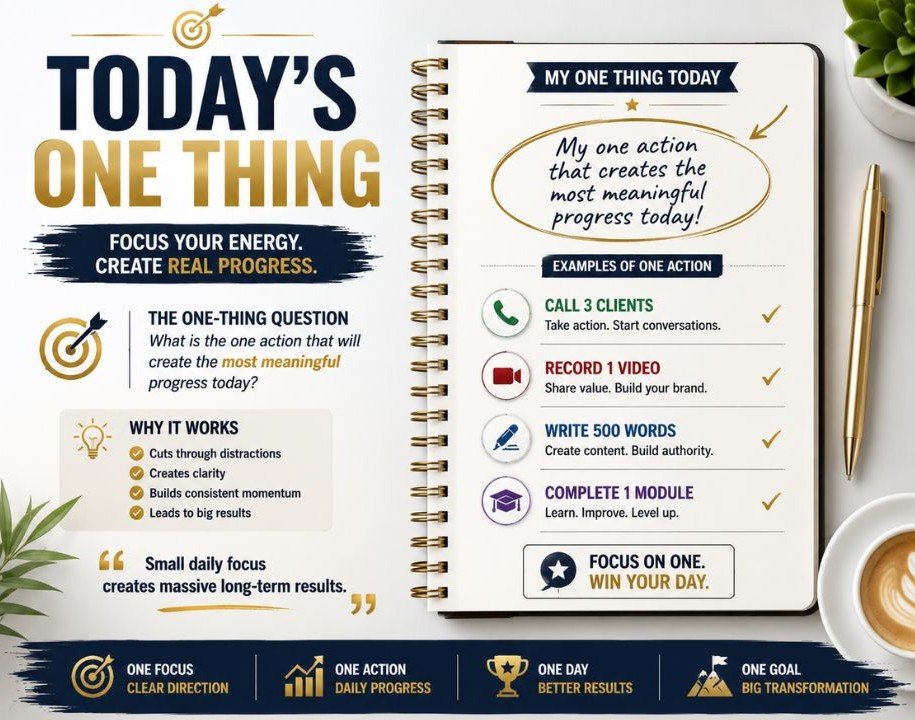
At the beginning of each day, ask:
“What is the one action that would create the most meaningful progress today?”
Your answer should connect with your primary goal.
Examples include:
- Call three potential clients.
- Record one video.
- Complete the first program module.
- Practise the presentation twice.
- Write 500 words.
- Review client feedback.
- Create the webinar registration page.
Complete this action before giving your best energy to smaller tasks whenever possible.
You may still have other responsibilities.
However, finishing the one important action ensures that the day contains real progress.
What to Do When Motivation Falls
Motivation will not remain high every day.
Therefore, prepare for low-motivation days before they arrive.
Create a Minimum Action
Decide the smallest version of your important behaviour.
For example:
- Write 100 words.
- Practise speaking for five minutes.
- Contact one person.
- Record one short practice clip.
- Read one page.
- Work for ten minutes.
The minimum action keeps you connected with the goal.
Reconnect with Your Reason
Read why the goal matters.
Remember the person you want to help, the life you want to create, or the ability you want to build.
Reduce the Size, Not the Commitment
If you cannot complete the full action, complete a smaller version.
Do not turn one difficult day into complete abandonment.
Begin Before You Feel Ready
Action can create motivation.
Sometimes waiting for motivation keeps you stuck.
Begin with five minutes and allow movement to change your state.
How to Stop Jumping from One Idea to Another
Use this four-question check whenever you want to change direction.
- What challenge appeared in my present goal?
- What feeling did that challenge create?
- Does the new idea solve the real problem?
- Would I still choose the new idea if my present work felt easy?
These questions can reveal whether the change is strategic or emotional.
Then, wait before making a major decision.
You can create a 24-hour rule for small changes and a seven-day reflection period for larger changes.
This pause prevents temporary emotion from controlling long-term direction.
Your 30-Day One-Goal Focus Plan
Use this system to build focused progress.
Step 1: Choose One Goal
Write:
During the next 30 days, my primary goal is ________________.
Step 2: Define the Result
Write:
By the end of 30 days, I will have completed __________________.
Choose a result you can measure.
Step 3: Select One Lead Action
A lead action is a behaviour likely to move the goal forward.
Examples include:
- Daily writing
- Weekly video publishing
- Sales conversations
- Speaking practice
- Exercise sessions
- Client research
Write:
My main repeated action is ____________________.
Step 4: Set a Minimum Action
Write:
Even on a difficult day, I will complete at least ____________________.
Step 5: Create a Focus Time
Write:
I will work on this goal at ______________________.
Step 6: Remove Three Distractions
Write:
- I will remove __________________________.
- I will reduce __________________________.
- I will delay __________________________.
Step 7: Build a “Not Now” List
Store every non-priority idea until the 30-day review.
Step 8: Track Daily Action
Use a simple calendar or checklist.
Mark whether the lead action was completed.
Step 9: Review Weekly
Ask:
- What did I complete?
- What created progress?
- What distracted me?
- What skill is missing?
- What should I improve next week?
Step 10: Review After 30 Days
At the end of the period, decide whether to:
- Continue the same direction
- Improve the strategy
- Increase the action
- Reduce unnecessary work
- Choose the next milestone
- Change direction based on clear evidence
Frequently Asked Questions About Focus
How Can I Focus on One Goal?
Choose one primary goal for a defined period.
Connect it with one repeated action, schedule focus time, remove distractions, and place other ideas on a “not now” list.
Why Do I Keep Changing My Goals?
You may be attracted to novelty, afraid of missing opportunities, avoiding discomfort, expecting fast results, or lacking a clear review system.
Identify the reason before choosing another direction.
Is It Better to Focus on One Thing at a Time?
For complex work, one clear task at a time usually supports deeper progress.
You can maintain several life responsibilities while choosing one primary growth goal.
How Do I Know Whether to Persist or Quit?
Review the goal’s meaning, the evidence you have collected, the actions completed, the feedback received, and the cost of continuing.
Do not decide only from temporary discomfort.
What If My Goal Stops Feeling Exciting?
Excitement naturally changes.
Reconnect with your reason, study whether the goal still matters, and use a simple system rather than depending on emotion.
Can I Change My Strategy Without Changing My Goal?
Yes.
You can improve your method, message, schedule, tools, support, or learning process while remaining committed to the larger goal.
How Long Should I Focus on One Goal?
Choose a realistic focus window based on the goal.
For many projects, 30 or 90 days can provide a useful review period. Larger goals may require much longer.
How Can I Stay Focused When Work Becomes Difficult?
Make the next action clear and small.
Remove distractions, work for a planned period, ask for feedback, and treat difficulty as information about what you need to learn.
Your One-Goal Commitment
Complete this statement:
For the next ______ days, my primary goal is ____________.
The main reason this goal matters is ___________________.
The result I will measure is __________________________.
The repeated action that will move me forward is _____________.
I will complete this action at ___________________.
Even on a difficult day, I will complete at least ________________.
The three distractions I will remove are ________________.
New ideas will be placed on ________________.
I will review my progress on ________________.
Sign and date your commitment.
Then, complete the first action within the next 24 hours.
Final Thoughts: Focus Is Choosing Again and Again
Focus is not one decision you make at the beginning of a goal.
It is a choice you repeat.
You choose the goal.
Then, you choose it again when the work becomes difficult.
You choose it again when a new idea appears.
You choose it again when motivation becomes weak.
You choose it again when progress feels slow.
However, focus does not mean blindly following the wrong path.
You should observe, learn, and improve.
Still, do not confuse the normal discomfort of growth with proof that you must quit.
Your energy becomes powerful when it moves in one clear direction.
Therefore, stop asking:
“Which new thing should I begin?”
Instead, ask:
“Which important thing deserves to be completed?”
Choose one goal.
Protect it from unnecessary noise.
Stay with it through the difficult middle.
Then, allow your repeated effort to create the depth, skill, and results that constant switching can never produce.
JOIN MIND TRANSFORMATION COMMUNITY
Learn More:
7 Day Manifestation- NLP Guided Meditation for Success
Why Some People Succeed While Others Stay Stuck: The 6-Step Success Process