
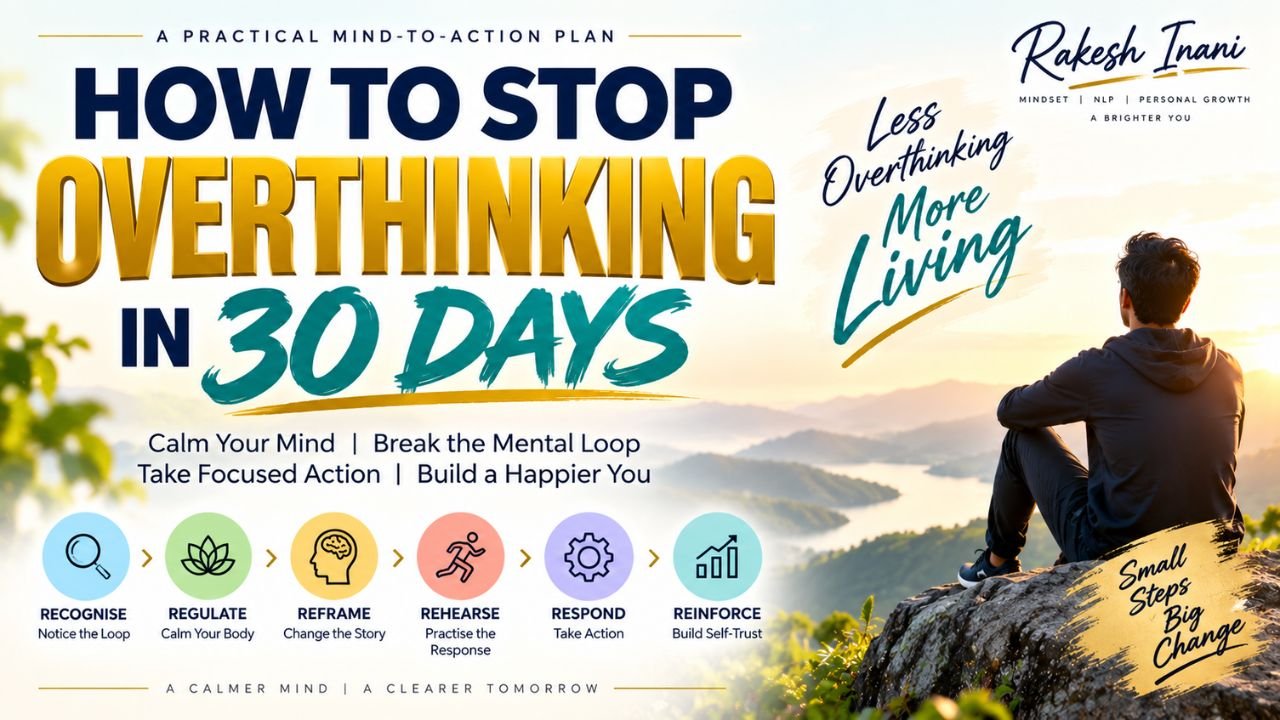
30-Day Plan to Stop Overthinking and Take Action
You have learned a lot about overthinking throughout this series.
You now know why your mind repeats thoughts.
You also know how overthinking affects your decisions, sleep, work, confidence, and relationships.
However, knowing what to do is only the first step.
Next, you need to practise it.
That is why I created this practical 30-day plan to stop overthinking.
This plan will help you notice overthinking sooner. Then, it will help you calm your body, question the story in your mind, and take one useful action.
Most importantly, this plan will help you rebuild trust in yourself.
Quick answer: You can reduce overthinking by following a daily process of noticing the mental loop, calming your body, checking your thoughts, and taking a small useful action. You may not remove every unwanted thought, but you can stop those thoughts from controlling your day.
You do not need to follow this plan perfectly.
Instead, you only need to return to it whenever you lose your way.
Some days will feel easy. Meanwhile, other days may feel messy.
That is normal.
Real change does not mean that you never struggle again. Rather, it means that you know what to do when the struggle returns.
Can You Stop Overthinking Permanently?
Many people search online for questions such as:
“Can I stop overthinking forever?”
“How long does it take to stop overthinking?”
“Why does my overthinking keep coming back?”
These are honest questions.
However, the goal is not to create a mind that never produces a worried, repeated, or doubtful thought.
Your mind is built to think.
In addition, it is built to look for danger, solve problems, and learn from the past.
Therefore, an unwanted thought may still appear.
A difficult event may still trigger you.
Likewise, you may still have a night when your mind feels busy.
The real goal is different.
You want to notice the loop earlier.
Then, you want to reduce the power it has over you.
Finally, you want to return to useful action faster.
Progress Is Not a Completely Empty Mind
Imagine that you once spent four hours thinking about a short conversation.
After practising the tools in this plan, you may notice the loop after 20 minutes.
Then, you may calm yourself and return to your work.
That is progress.
Later, you may notice the loop within five minutes.
That is even more progress.
Therefore, do not only ask, “Did I overthink today?”
Instead, ask:
“How quickly did I notice it?”
“How strongly did I believe the thought?”
“How long did the loop last?”
“What useful action did I take?”
These questions will show your real growth.
Thirty Days Is a Starting Point
A 30-day plan cannot promise a complete cure.
However, 30 days can give you enough time to learn a new response and repeat it.
At first, the process may feel slow.
Next, it may begin to feel more natural.
Eventually, you may start using it without needing to remind yourself of every step.
Therefore, treat these 30 days as training.
You are not taking a test.
You are teaching your mind a new way to respond.
The Six-Step Mind-to-Action Process
Throughout this plan, you will use a simple six-step process.
The steps are:
- Recognise
- Regulate
- Reframe
- Rehearse
- Respond
- Reinforce
Each step has a clear purpose.
Together, they help you move from mental noise to useful action.
Step 1: Recognise
First, notice what is happening.
Name the trigger, thought, feeling, body signal, and behaviour.
For example, you may say:
“I received a short reply from my client.”
“Now I am thinking that the client is unhappy.”
“My chest feels tight.”
“I want to read the message again.”
Recognition creates space between you and the thought.
Instead of saying, “This is true,” you can say, “This is a thought my mind is producing.”
Step 2: Regulate
Next, help your body feel safer.
You can feel your feet on the floor.
You can relax your jaw.
You can take a slow, gentle breath.
You can also look around and name things that you see.
This step matters because it is hard to think clearly when your body believes that you are in danger.
The World Health Organization includes grounding and other short daily practices in its guide for managing stress. These methods are designed to help people reconnect with the present moment during difficult thoughts and feelings. WHO: Doing What Matters in Times of Stress
Step 3: Reframe
Then, check the meaning you have given to the event.
Ask:
“What are the facts?”
“What am I assuming?”
“Is there another possible meaning?”
“What would I tell someone I care about?”
Reframing does not mean forcing yourself to think positively.
Instead, it means choosing a thought that is fair, useful, and based on the available facts.
The NHS describes a similar process as “catch it, check it, change it.” NHS: Reframing Unhelpful Thoughts
Step 4: Rehearse
After that, picture the response you want to practise.
See yourself speaking calmly.
Imagine yourself making the decision.
Picture yourself finishing the task without checking it ten more times.
This short mental rehearsal prepares you for action.
However, rehearsal should lead to action.
Otherwise, it can become another form of overthinking.
Step 5: Respond
Now, take one clear and useful action.
Send the message.
Write the first paragraph.
Ask the direct question.
Make the small decision.
Return to your main task.
The action does not need to solve your whole life.
It only needs to move you one step forward.
Step 6: Reinforce
Finally, notice what you did well.
You may write:
“I felt unsure, but I still made the call.”
“I noticed my overthinking sooner today.”
“I did not ask for reassurance a second time.”
“I completed the task even though it was not perfect.”
This evidence helps build self-trust.
Moreover, it teaches your mind that you can feel uncertain and still act wisely.
What You Need Before Starting the 30-Day Plan
You do not need expensive equipment.
You also do not need a complicated app.
Instead, you need a notebook, a pen, and about 10 to 20 minutes each day.
You may also use your phone’s notes app.
However, keep the process simple.
If you spend an hour designing the perfect tracker, overthinking may quietly take control of the plan.
Choose One Main Overthinking Pattern
Before Day 1, choose one pattern to work on.
For example, you may focus on:
- Replaying conversations
- Worrying about business decisions
- Fear of making mistakes
- Overthinking what people think about you
- Checking messages repeatedly
- Thinking too much before starting a task
- Worrying at night
- Seeking reassurance from other people
You may have several patterns.
However, start with one.
Once you understand one loop, you can use the same process for the others.
Create a Simple Daily Scoreboard
At the end of each day, give yourself one point for each action you completed:
- I noticed the loop.
- I regulated my body.
- I checked the thought.
- I took one useful action.
- I recorded one piece of progress.
The highest score is five.
However, your goal is not to score five every day.
Your goal is to stay aware and keep practising.
A score of two is better than giving up because you could not achieve five.
Week 1: Understand Your Overthinking Pattern
During the first week, you will not fight your thoughts.
Instead, you will study them.
You will learn what starts the loop, what keeps it active, and what you usually do next.
This awareness is important because you cannot change a pattern that you cannot see.
Day 1: Name Your Main Overthinking Loop
Today, write down the main loop you want to change.
Keep it clear and simple.
For example:
“I replay conversations after meetings.”
“I delay business decisions because I want certainty.”
“I imagine everything that could go wrong before I post online.”
Next, complete this sentence:
“My overthinking often starts when…”
You may write:
“My overthinking often starts when someone takes a long time to reply.”
Or:
“My overthinking often starts when I need to make a decision that other people may judge.”
Finally, write why you want to change this pattern.
Perhaps it is stealing your time.
Perhaps it is hurting your sleep.
Perhaps it is stopping you from growing your business.
A clear reason gives your practice meaning.
Day 2: Find Your Main Triggers
Today, list three situations that often start your mental loop.
A trigger may be an event.
However, it may also be a memory, feeling, place, person, or time of day.
Common triggers include:
- Receiving a short message
- Making a mistake
- Waiting for an answer
- Being criticised
- Seeing someone else succeed
- Having too many choices
- Feeling tired
- Going to bed
- Speaking in front of people
- Posting content online
Next, rate each trigger from zero to ten.
Zero means it does not affect you much.
Ten means it creates a very strong reaction.
This rating is not a judgment.
Instead, it helps you understand where you need the most support.
Day 3: Write the Exact Thought
Today, catch the exact sentence your mind repeats.
Do not write only, “I feel bad.”
Instead, write the thought behind the feeling.
For example:
“They must think I am foolish.”
“I am going to lose this client.”
“If I make the wrong choice, everything will fail.”
“I should have said something different.”
“I will never be successful.”
Then, place these words before the thought:
“I am having the thought that…”
For example:
“I am having the thought that my client is angry.”
This small change can create helpful distance.
The thought may still feel uncomfortable.
However, you are now observing it instead of treating it as a proven fact.
Day 4: Notice Your Body Signals
Overthinking does not only happen in the mind.
Your body often reacts too.
Therefore, notice where you feel the stress.
You may feel:
- Tightness in your chest
- Pressure in your head
- A heavy stomach
- Fast breathing
- A tight jaw
- Raised shoulders
- Restless legs
- Heat in your face
Today, pause three times and scan your body.
Ask:
“What is my body doing right now?”
Next, relax one area gently.
Do not force the feeling to disappear.
Instead, give your body a signal of safety.
Day 5: Separate Facts From Stories
Today, draw a line down the middle of a page.
On the left, write “Facts.”
On the right, write “My Story.”
Suppose someone has not replied to your message.
The fact is:
“I sent the message at 10 a.m., and I have not received a reply.”
The story may be:
“They are angry.”
“They do not respect me.”
“I said something wrong.”
“They will never work with me again.”
Your story may turn out to be true.
However, right now, it is not confirmed.
Therefore, use a balanced sentence:
“I do not know why they have not replied. There may be several reasons.”
This sentence is not falsely positive.
Instead, it is honest.
Day 6: Notice What You Do After the Thought
Today, study your behaviour.
After an overthinking thought appears, what do you usually do?
Perhaps you:
- Read the same message many times
- Ask different people for advice
- Search online for hours
- Delay making a choice
- Avoid the task
- Rewrite your work again and again
- Check social media
- Stay in bed
- Send too many follow-up messages
Next, ask:
“What short-term benefit does this behaviour give me?”
For example, checking may give you a few seconds of relief.
However, it may also teach your mind that you cannot handle uncertainty without checking.
Understanding this short-term reward helps you see why the loop continues.
Day 7: Create Your Overthinking Pattern Map
Today, bring the first six days together.
Write your pattern in this order:
Trigger → Thought → Feeling → Body signal → Behaviour → Result
For example:
Trigger: My client sends a short reply.
Thought: The client is unhappy with my work.
Feeling: Fear.
Body signal: Tight chest.
Behaviour: I read the message repeatedly and ask a friend what it means.
Result: I lose an hour and become more doubtful.
Now, add one healthier response:
New response: Ground myself, check the facts, and ask a direct question only if one is truly needed.
You have now created a map of your loop.
Therefore, during the next week, you will learn how to interrupt it.
Week 2: Calm Your Mind and Body
During Week 2, you will practise regulation.
This means helping your body move from high alert toward a steadier state.
You are not trying to erase every feeling.
Instead, you are making enough space to choose your next response.
Day 8: Feel Your Feet on the Ground
Today, practise a simple grounding exercise.
Place both feet on the floor.
Next, notice the pressure under your heels and toes.
Then, look around and name three things you see.
After that, notice two sounds.
Finally, name one thing you can physically feel, such as the chair under you.
Use this exercise when your mind starts racing.
You can also say:
“I am here.”
“This is the present moment.”
“I can handle the next small step.”
Practise it once when you feel calm.
Then, it will be easier to remember when you feel stressed.
Day 9: Use Gentle Breathing
Today, focus on a slow and comfortable breath.
Breathe in gently.
Then, breathe out a little more slowly.
Repeat this for one or two minutes.
Do not force a very deep breath.
For some people, forced breathing can feel uncomfortable.
Therefore, keep it light.
As you breathe out, relax your shoulders.
You may also use a simple phrase:
“Breathing in, I notice.”
“Breathing out, I soften.”
The goal is not to make every thought disappear.
Instead, the goal is to become steady enough to choose your next action.
Day 10: Release Physical Tension
Today, choose three areas of your body that often become tight.
For many people, these areas are the jaw, shoulders, and hands.
First, tighten one area gently for a few seconds.
Then, release it.
Notice the difference.
After that, repeat the process with the next area.
You can also stretch, take a short walk, or shake out your hands.
Physical movement can interrupt the frozen feeling that often comes with overthinking.
However, do not turn movement into avoidance.
After your short physical reset, return to one useful task.
Day 11: Use the 5-4-3-2-1 Grounding Method
Today, practise this sensory exercise:
Name five things you can see.
Then, name four things you can feel.
Next, name three things you can hear.
After that, name two things you can smell.
Finally, name one thing you can taste or appreciate.
This method brings attention back to your present surroundings.
It can be useful when your mind is travelling into an imagined future or replaying the past.
However, it is not a magic trick.
You may still have uncomfortable thoughts afterward.
That is okay.
The exercise gives you a pause. Then, you can use that pause to take a wise action.
Day 12: Create a Scheduled Worry Time
Today, choose a daily 15-minute period for worry.
For example, your worry time may be from 6:30 p.m. to 6:45 p.m.
When a worry appears earlier, write it down.
Then, say:
“I have recorded this. I will look at it during my worry time.”
During the scheduled period, review your list.
Ask whether each worry is a problem you can act on or a situation you cannot control right now.
If you can act, write one next step.
If you cannot act, practise allowing uncertainty and return to the present.
Scheduled worry time is a recognised self-help approach for managing worries rather than letting them take over the full day. NHS: Tackling Your Worries
Day 13: Reduce Mental Stimulation
Today, notice what makes your mind noisier.
It may be:
- Constant notifications
- Too much news
- Endless short videos
- Checking email late at night
- Drinking too much caffeine
- Working without breaks
- Reading advice from too many people
Choose one source of extra stimulation and reduce it.
For example, turn off non-essential notifications for the day.
Alternatively, keep your phone outside the bedroom.
You are not running away from life.
Instead, you are reducing unnecessary input so your mind can process what is already there.
Day 14: Build Your Two-Minute Reset
Today, combine your favourite regulation tools into one short routine.
Your routine may look like this:
- Put both feet on the floor.
- Take three gentle breaths.
- Relax your shoulders and jaw.
- Name the thought.
- Ask, “What is the next useful step?”
Practise the routine twice today.
First, practise when you feel calm.
Then, use it when you notice a small trigger.
Your two-minute reset should be easy enough to use at work, before a meeting, in your car, or while waiting for a reply.
Week 3: Reframe Thoughts and Take Action
During Week 3, you will work on the thoughts that keep the loop active.
However, you will not stop with a better thought.
You will connect the new thought to a real action.
This link matters.
Without action, reframing can become another long conversation inside your head.
Day 15: Catch, Check, and Change One Thought
Today, choose one repeated thought.
First, catch it.
Write the exact thought down.
Next, check it.
Ask:
“What facts support this thought?”
“What facts do not support it?”
“Am I treating a possibility as a certainty?”
Finally, change it.
Create a more balanced thought.
For example:
Old thought: “My presentation must be perfect, or everyone will think I am incapable.”
Balanced thought: “I want to prepare well, but one imperfect moment does not define my ability.”
Read the balanced thought slowly.
Then, take one action that matches it.
Day 16: Name the Thinking Error
Today, look for the thinking style behind your worry.
You may notice:
Mind reading: “I know what they think about me.”
Catastrophising: “One mistake will ruin everything.”
All-or-nothing thinking: “If it is not perfect, it is useless.”
Fortune-telling: “I know this will fail.”
Personalising: “Their mood must be because of me.”
Emotional reasoning: “I feel afraid, so danger must be present.”
When you name the pattern, do not attack yourself.
Instead, say:
“My mind is using fortune-telling.”
This gentle label helps you step back and review the thought more fairly.
Day 17: Write a Balanced Thought
Today, create a thought that is realistic, kind, and useful.
A balanced thought should not sound fake.
For example, if you are nervous about a meeting, do not force yourself to say:
“Everything will be perfect.”
Instead, say:
“I may feel nervous, but I can prepare and respond one step at a time.”
If you worry about a decision, you may say:
“I cannot know every result. However, I can make a reasonable choice using what I know today.”
Write your balanced thought on a small card or in your phone.
Then, read it before taking action.
Day 18: Choose the Smallest Useful Action
Today, ask:
“What is the smallest action that would move this situation forward?”
If you are overthinking a large project, open the document and write the first three lines.
If you are worried about a conversation, write the main point you need to express.
If you are delaying a decision, list the two most important factors.
If you are avoiding an email, draft the first sentence.
Small action reduces mental pressure.
Moreover, action gives you new information.
Once you have real information, your mind has less need to create endless imagined stories.
Day 19: Set a Decision Deadline
Today, choose one small or medium decision you have been delaying.
Next, set a reasonable deadline.
For example:
“I will decide by 4 p.m. today.”
“I will spend 20 minutes comparing these options.”
“I will ask one qualified person, and then I will choose.”
Before the deadline, decide which facts truly matter.
Then, stop collecting extra information when the deadline arrives.
You may still feel uncertain.
However, confidence often grows after a decision, not before it.
Therefore, make the best reasonable choice you can and move forward.
Day 20: Practise Good-Enough Completion
Today, choose one task you often try to make perfect.
Decide what “good enough” means before you begin.
For example:
“This email needs to be clear, respectful, and free from major errors.”
That is enough.
It does not need to be the most impressive email ever written.
Complete the task within a fixed amount of time.
Then, review it once and send it.
Notice any urge to check it again.
Allow the urge to be present without obeying it immediately.
This practice teaches your mind that completion can be safe even when perfection is missing.
Day 21: Combine Reframing With Action
Today, use the full sequence:
Trigger: What happened?
Thought: What did your mind say?
Regulation: How did you steady your body?
Reframe: What was a fairer thought?
Action: What did you do next?
For example:
Trigger: I made a mistake in a report.
Thought: “My manager will think I am careless.”
Regulation: I felt my feet and relaxed my shoulders.
Reframe: “I made one mistake. I can correct it and communicate clearly.”
Action: I fixed the error and informed my manager.
At the end of the day, write what you learned.
You are now showing yourself that a thought does not have to control your behaviour.
Week 4: Build Self-Trust and a New Daily Identity
During Week 4, you will focus on who you are becoming.
However, identity is not built through big statements alone.
It is built through repeated evidence.
Each time you keep a small promise, make a reasonable choice, or act while feeling unsure, you build self-trust.
Day 22: Keep One Small Promise
Today, make one small promise to yourself.
It should be clear and easy to measure.
For example:
“I will work on my main task for ten minutes.”
“I will take a five-minute walk after lunch.”
“I will put my phone away at 10 p.m.”
“I will send the message before 3 p.m.”
Then, keep the promise.
Do not add five more promises.
One completed promise builds more trust than ten exciting plans that you never follow.
At night, write:
“I said I would do this, and I did it.”
Day 23: Start an Evidence Log
Today, create a page called “Evidence That I Can Handle Things.”
Write at least five examples from the last three weeks.
For example:
“I noticed a trigger before it became a long loop.”
“I made a choice without asking four people.”
“I calmed myself before replying.”
“I completed a task without making it perfect.”
“I felt worried and still attended the meeting.”
Your overthinking mind may collect evidence of danger, failure, and rejection.
Therefore, your evidence log gives your mind a fuller view.
Read this page whenever your mind says, “You cannot handle this.”
Day 24: Rehearse the Response You Want
Today, choose one situation that often triggers you.
Close your eyes, if that feels comfortable.
Then, picture the situation beginning.
Imagine noticing your body signal.
Next, see yourself using your two-minute reset.
Picture yourself choosing a balanced thought.
Finally, see yourself taking one clear action.
Keep the practice short.
Two or three minutes is enough.
The purpose is not to control the future.
Instead, it is to make your chosen response easier to remember when the real situation appears.
Day 25: Use Direct Communication
Today, notice whether you are trying to guess what another person thinks.
Instead of building a story, ask whether direct communication would help.
For example, you may say:
“Could you please tell me what you meant by that point?”
“I noticed the deadline changed. What should I focus on first?”
“I may be misunderstanding your message. Can you clarify it?”
Direct communication can replace hours of guessing.
However, ask once and listen to the answer.
Repeatedly asking the same question for reassurance may keep the loop active.
Therefore, aim for useful clarity, not perfect certainty.
Day 26: Practise a Small Amount of Uncertainty
Today, allow one low-risk situation to remain slightly uncertain.
For example:
Send a normal message without reading it five times.
Choose a meal without checking every review.
Finish a small task without asking another person to approve it.
Wait ten extra minutes before checking for a reply.
Start with a safe and manageable situation.
Then, notice the discomfort.
Say:
“I do not like this uncertainty, but I can allow it.”
The aim is not to enjoy uncertainty.
Instead, the aim is to learn that you can carry it without letting it control every action.
Day 27: Take One Confidence-Building Action
Today, do one useful thing before you feel fully ready.
Make the call.
Share the idea.
Ask the question.
Publish the post.
Apply for the opportunity.
Begin the first lesson.
Confidence is not always a feeling that arrives before action.
Often, confidence is the memory of actions you completed while feeling unsure.
Therefore, choose one manageable step.
Afterward, do not only judge the result.
Also notice the courage it took to act.
Day 28: Build Your Daily Prevention System
Today, create a simple morning, midday, and evening routine.
Morning Check-In
Ask:
“What matters most today?”
“What might trigger overthinking?”
“What is one action I will complete?”
Midday Reset
Ask:
“What is happening in my body?”
“Am I solving a real problem or repeating a fear?”
“What is the next useful step?”
Evening Closure
Ask:
“What did I handle well?”
“Is there any action I need to schedule?”
“What can I release until tomorrow?”
Keep each check-in short.
A useful system should support your life, not become another task to overthink.
Day 29: Create Your Overthinking Return Plan
Overthinking may return.
A stressful week, poor sleep, conflict, uncertainty, or a major change may make the old pattern feel strong again.
Therefore, prepare a plan now.
Complete these sentences:
“My early warning signs are…”
“My common triggers are…”
“The regulation tool that helps me most is…”
“The balanced thought I want to remember is…”
“The person I can speak to is…”
“The professional support I can contact is…”
“The first useful action I will take is…”
A return of overthinking does not mean that your work failed.
It simply means that you need to use your tools again.
Day 30: Review Your Growth and Choose the Next Step
Today, review the full month.
Do not only look for perfect days.
Instead, look for changes.
Ask:
“Do I notice my overthinking sooner?”
“Do I understand my triggers better?”
“Can I calm my body more easily?”
“Am I making decisions faster?”
“Do I spend less time checking or seeking reassurance?”
“Am I taking more useful action?”
Next, compare your current pattern with your Day 1 pattern.
Perhaps the thoughts still appear.
However, maybe you believe them less.
Maybe the loop ends sooner.
Maybe you now have a process.
Finally, choose one practice to continue for the next 30 days.
For example:
“I will keep using my two-minute reset.”
“I will review my evidence log every Sunday.”
“I will continue practising good-enough completion.”
“I will use a decision deadline for important choices.”
Change becomes stronger when it continues beyond the first month.
How to Measure Whether the 30-Day Plan Is Working
Do not measure progress only by counting your thoughts.
The number of thoughts may change from day to day.
Instead, track these five areas once a week.
1. Detection Speed
How quickly do you notice the loop?
Perhaps it once took three hours.
Now, it may take 30 minutes.
That is meaningful progress.
2. Thought Intensity
Rate the thought from zero to ten.
A thought that once felt like a ten may now feel like a six.
The thought is still present.
However, it has less power.
3. Recovery Time
How long does it take to return to your task, conversation, rest, or sleep routine?
Faster recovery shows that your skills are becoming easier to use.
4. Reassurance and Checking
Notice how often you ask the same question, review the same work, or check the same message.
You do not need to count every action perfectly.
Instead, look for the overall direction.
5. Useful Action
Count the small actions you completed even though you felt unsure.
This may be the most important measure.
After all, the goal is not only to feel calmer.
The goal is also to live, decide, communicate, and move forward.
What Should You Do When Overthinking Comes Back?
First, do not say, “I am back at the beginning.”
You are not at the beginning.
You now know more about your pattern.
In addition, you have tools that you did not have before.
Therefore, treat the return as a signal.
Check the Trigger
Ask what changed recently.
Are you tired?
Are you facing a major decision?
Did someone criticise you?
Have you been sleeping poorly?
Are you carrying too many tasks?
Sometimes the return of overthinking is a sign that your system is under pressure.
Reduce the Pressure
Next, make the plan smaller.
You do not need to repeat all 30 days immediately.
Instead, return to one basic step.
Ground your body.
Write the exact thought.
Separate facts from assumptions.
Take one small action.
A small reset is easier to use than a perfect recovery plan.
Review Your Evidence
Then, read your evidence log.
Remind yourself of situations you have already handled.
Your current feeling may be strong.
However, it does not erase your earlier progress.
Restart Without Shame
Finally, begin again.
You can restart at Day 1, Day 8, Day 15, or whichever step you need.
Restarting is not a sign of weakness.
It is part of building a steady practice.
Common Mistakes During the 30-Day Plan
Even a helpful plan can become another source of pressure.
Therefore, watch for these common mistakes.
Trying to Perform Every Exercise Perfectly
You may miss a day.
You may forget to complete the tracker.
You may overthink during an exercise.
That is okay.
Simply continue with the next day or repeat the missed practice.
Consistency matters more than perfection.
Using the Plan to Push Feelings Away
The goal is not to order yourself to stop feeling worried.
Instead, the goal is to make room for the feeling while choosing a useful response.
You can feel fear and still speak.
You can feel doubt and still decide.
You can feel uncomfortable and still finish the task.
Turning Journaling Into More Overthinking
Writing can create clarity.
However, writing for hours about the same thought can keep the loop active.
Therefore, set a time limit.
Ten or fifteen minutes is often enough.
End each entry with one next action or one decision to pause.
Collecting Tools Without Practising Them
You may save videos, books, posts, and breathing exercises.
However, more information is not always the answer.
Choose one or two tools and practise them often.
A simple method you use is more valuable than twenty methods you only understand.
Expecting Every Day to Feel Better
Growth is rarely a straight line.
You may feel calm on Day 10 and deeply worried on Day 11.
That does not mean you are failing.
Instead, ask whether you are responding differently.
A hard day handled with awareness can be a strong day of growth.
When Should You Seek Professional Help for Overthinking?
Self-help tools can be useful.
However, professional help may be important when overthinking is causing serious or lasting distress.
Consider speaking with a qualified mental-health professional if:
- Your thoughts regularly stop you from sleeping
- You cannot focus on normal daily responsibilities
- You avoid important places, people, or tasks
- You experience frequent panic
- You feel depressed or hopeless
- You repeat checking or mental rituals that feel hard to control
- Past trauma is strongly affecting your current life
- Your relationships or work are suffering
- Your worries feel impossible to manage alone
- Your symptoms continue or become worse
A trained professional can help you understand whether anxiety, depression, obsessive-compulsive symptoms, trauma, or another condition may be involved.
Likewise, coaching can support goals, habits, clarity, and action, but it should not replace licensed mental-health care when clinical support is needed.
If you feel that you may hurt yourself or someone else, contact your local emergency service or crisis service immediately. Also, reach out to a trusted person who can stay with you and help you access support.
Frequently Asked Questions About Stopping Overthinking
Is Overthinking Normal?
Yes, most people overthink sometimes.
It often happens during uncertainty, stress, conflict, change, or important decisions.
However, it becomes a problem when it repeatedly harms your sleep, health, work, confidence, or relationships.
Can Overthinking Be Stopped Completely?
You may not be able to stop every repeated or worried thought.
However, you can change how you respond.
With practice, you can notice thoughts sooner, believe them less, and return to useful action faster.
Is Overthinking a Sign of Anxiety?
Overthinking can happen with anxiety.
However, not everyone who overthinks has an anxiety disorder.
If your worry is strong, frequent, hard to control, or affects daily life, speak with a qualified professional for a proper assessment.
How Long Does It Take to Stop Overthinking?
There is no single timeline.
Some people notice small changes within days.
Meanwhile, deeper patterns may take weeks or months of regular practice.
The length of time may depend on your stress level, environment, habits, health, past experiences, and access to support.
What Is the Fastest Way to Calm Overthinking?
First, stop trying to solve every thought at once.
Then, ground your body with a gentle breath, relaxed shoulders, and attention to your surroundings.
Next, write the exact thought and ask whether it is a fact, an assumption, or a possibility.
Finally, choose one useful action.
This may not remove the thought instantly.
However, it can interrupt the loop.
Does Meditation Help With Overthinking?
Meditation may help some people notice thoughts without following every one of them.
However, it is a skill that usually improves with practice.
Start with one or two minutes.
If sitting quietly makes you more uncomfortable, try walking, sensory grounding, or guided practice instead.
Does Journaling Help With Overthinking?
Yes, journaling can help you move thoughts from your mind onto paper.
It can also help you separate facts from fears.
However, use a time limit and finish with a clear next step.
Otherwise, journaling may become another place where you repeat the same story.
How Can I Stop Replaying Conversations?
First, identify what you are trying to gain from replaying the conversation.
Are you trying to find certainty?
Are you hoping to change the past?
Are you guessing what the other person thinks?
Next, write down any real lesson once.
If repair or clarification is needed, take direct action.
If no useful action is available, remind yourself:
“I have reviewed this. Replaying it again will not change it.”
Then, return your attention to your present activity.
How Can I Stop Overthinking at Night?
Keep a notebook beside your bed.
Before sleeping, write down unfinished tasks, worries, and tomorrow’s first action.
Next, reduce bright screens and work-related messages before bedtime.
If a thought appears, remind yourself that nighttime is not the best time to solve every problem.
You can say:
“This matters, and I will review it tomorrow.”
If sleep problems continue, seek medical or mental-health guidance.
How Do I Help Someone Who Overthinks?
First, listen without saying, “Just stop thinking.”
That phrase may make the person feel misunderstood.
Instead, ask:
“Would you like me to listen, or would you like help finding a next step?”
You can also help the person separate facts from assumptions.
However, avoid becoming their constant source of reassurance.
If the problem is seriously affecting their life, encourage them to speak with a qualified professional.
Your Personal Overthinking Prevention System
After completing the 30 days, keep your system simple.
Every Morning
Choose your most important action.
Then, notice any likely trigger.
Finally, decide how you want to respond.
During the Day
Use your two-minute reset when you notice tension, checking, delay, or repeated thoughts.
Ask:
“Is this useful thinking, or am I repeating the same fear?”
Every Evening
Close open mental loops.
Write tomorrow’s first step.
Then, record one thing you handled well.
Every Week
Review your triggers, actions, and progress.
Keep what helps.
Change what does not help.
Most importantly, begin the next week without judging the last one.
From Overthinking to Focused Action
Overthinking often makes you believe that you need complete certainty before you can move.
However, life rarely offers complete certainty.
You usually learn by acting, observing, and adjusting.
Therefore, your new goal is not to know everything before you begin.
Your goal is to take the wisest next step using the information you have.
You can pause without becoming stuck.
You can reflect without replaying everything.
You can prepare without trying to control every result.
You can make a mistake without making it your identity.
You can also feel uncertain without losing trust in yourself.
This is the shift from overthinking to focused action.
A Final Message for You
If you have been overthinking for years, please do not expect yourself to change the full pattern in one perfect month.
Be patient with yourself.
Your mind may have learned overthinking as a way to protect you from mistakes, rejection, shame, or uncertainty.
Therefore, you do not need to fight your mind.
Instead, teach it a new response.
Recognise what is happening.
Regulate your body.
Reframe the story.
Rehearse a useful response.
Respond with one clear action.
Then, reinforce your progress.
Each small action becomes evidence.
Each piece of evidence strengthens trust.
Eventually, you may still hear the voice of doubt, but you will no longer have to obey it.
You will be able to say:
“I notice this thought.”
“I understand why it is here.”
“I do not need complete certainty.”
“I can take the next step.”
That is how you begin to break the overthinking cycle.
Not through one huge moment.
Instead, you do it through small, calm, repeated acts of courage.
Ready to Continue Your Mind-to-Action Journey?
If you want guided support, my 30-Day Mind-to-Action Reset is designed to help entrepreneurs reduce overthinking and build a more consistent daily action routine.
Together, we focus on practical awareness, useful reframing, emotional regulation, clearer decisions, and focused action.
The goal is not to turn you into a different person.
Instead, the goal is to help you remove the inner barriers that keep the capable person inside you from moving forward.
Your next step does not need to be perfect.
It only needs to begin.
Author: Rakesh Inani
NLP & Mind Transformation Coach
Disclaimer: This article is for general education and personal development. It is not medical advice, diagnosis, psychotherapy, or a replacement for care from a qualified mental-health professional. If overthinking is causing severe distress or affecting your daily life, please seek appropriate professional support.
Read Previous Blog Posts of This Series:
What Is Overthinking? Why Your Mind Won’t Stop and How to Recognize the Pattern
Why Do I Overthink Everything? 12 Hidden Causes of Overthinking Explained
25 Overthinking Signs Your Mind Is Secretly Trapping You
Shocking Effects of Overthinking on Mind, Body and Life
How to Stop Overthinking Immediately: 12 Simple Ways to Calm Your Mind
How to Change Negative Thoughts Without Fighting Your Mind
Transform Your Mind: JOIN MIND TRANSFORMATION COMMUNITY
Learn More:
Real Leaders Know This ONE Secret to Influencing Without Speaking
7 Day Manifestation- NLP Guided Meditation for Success
The Complete Success Formula: 6 Steps to Turn Goals into Consistent Action