
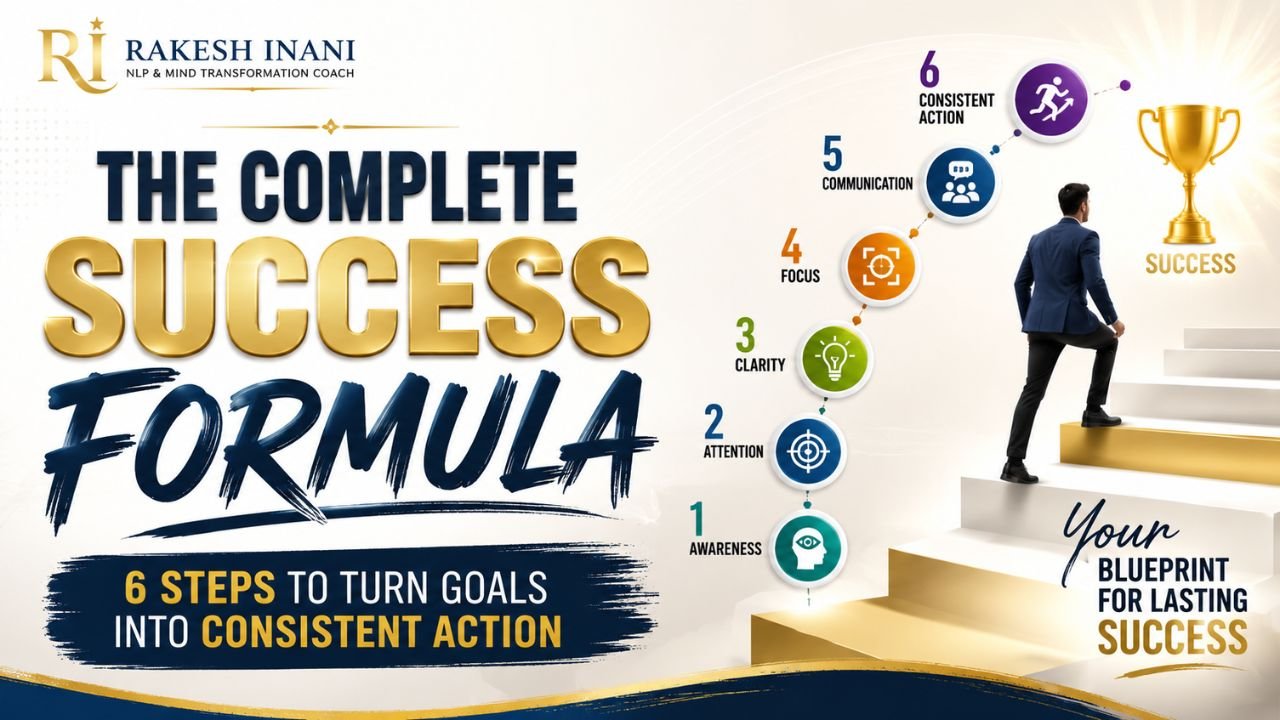
The Complete Success Formula: 6 Steps to Turn Goals into Consistent Action
By Rakesh Inani, NLP & Mind Transformation Coach
You have a goal.
Perhaps you want to build a successful business, earn more money, become a confident speaker, improve your health, create better relationships, or finally turn your knowledge into meaningful work.
You may already be working hard. You may watch useful videos, read books, attend workshops, make plans, and start new routines.
Still, the result you want may feel far away.
So, naturally, you begin asking: Why am I not successful even though I am trying? What is stopping me from achieving my goals? Is there a practical success formula I can follow?
The short answer is yes—but it is not a magic trick.
Success usually develops when six important abilities work together:
Awareness → Attention → Clarity → Focus → Communication → Consistent Action → Success
First, you need to understand your present patterns. Next, you must direct your attention toward what matters. Then, you need a clear outcome, focused effort, effective communication, and repeated action.
If one part remains weak, the complete process can slow down.
For example, you may take action without clarity. Therefore, you work hard in the wrong direction.
You may have clarity without focus. As a result, distractions and new ideas keep pulling you away.
You may have focus without communication. Consequently, people never understand the value you provide.
Or you may have an excellent plan but take action only when you feel motivated.
This complete guide will help you diagnose the missing part and create a practical path forward.
What Is the Success Formula?
The success formula is a step-by-step framework for moving from desire to sustained action.
It does not promise that every goal will be easy or guaranteed. External conditions, timing, resources, health, other people’s choices, and unexpected events can influence results.
However, the formula helps you strengthen the part that remains under your influence: how you observe, choose, prepare, communicate, act, learn, and continue.
| Step | Meaning | Main question |
|---|---|---|
| Awareness | See your present reality and patterns | What is happening within and around me? |
| Attention | Choose what deserves your energy | What matters most right now? |
| Clarity | Define the goal and requirements | What exactly do I want, and what will it require? |
| Focus | Stay with one priority | What will I work on without constantly switching? |
| Communication | Create understanding within and around you | What must I understand, express, ask, or explain? |
| Consistent action | Repeat useful behaviour and learn | What will I continue doing when motivation changes? |
The order matters.
Awareness shows you the situation. Attention selects the important part. Clarity chooses a direction. Focus protects that direction. Communication connects you with yourself and other people. Finally, consistent action turns the plan into progress.
If you want a deeper overview before applying each stage, read the complete explanation of the six-step success formula for achieving your goals.
Why Do Some People Succeed While Others Stay Stuck?
Success is not reserved only for the smartest or most talented person.
Talent can help. Resources can help. Timing and opportunity can also help.
However, a person still needs to convert those advantages into meaningful behaviour.
Two people may want the same result. Both may possess useful knowledge. Yet, one repeatedly applies, reviews, and improves that knowledge while the other keeps waiting for the perfect time.
One person begins with an imperfect version and learns from the response. The other person continues preparing because beginning feels risky.
One stays with a meaningful direction through the difficult middle. The other starts a new project every time the excitement falls.
Therefore, the difference is often not desire alone. It is the pattern that follows desire.
Desire Is Not Direction
“I want to become successful” is a desire.
“I will build one coaching offer for one audience and speak with five suitable people every working day” is a direction.
Desire creates emotional energy. Direction gives that energy a path.
Similarly, “I want to become confident” is meaningful but broad.
“I will practise speaking for 15 minutes each morning and deliver one live talk every week” creates behaviour.
Therefore, if you feel stuck, do not only ask how strongly you want the result.
Also ask whether your daily actions have a clear connection with it.
Busyness Is Not Always Progress
You may spend the day answering messages, changing designs, organizing files, researching tools, watching training, and creating plans.
At night, you feel tired.
However, did you complete the one action that moved your main goal forward?
Activity means you did something. Progress means the action created movement, learning, or useful feedback.
If your goal is to find coaching clients, changing a logo may be an activity. Speaking with a suitable potential client may create progress.
If your goal is to become a speaker, collecting another list of speaking tips may be useful. Still, speaking aloud and reviewing the recording creates direct practice.
Sometimes we remain busy because important work creates discomfort. Planning feels safer than publishing. Learning feels safer than selling. Perfecting feels safer than receiving feedback.
Recognizing this pattern is not a reason for shame. It is a reason to choose more honestly.
For a deeper diagnosis of this common pattern, explore why some people succeed while others stay stuck.
Success and Failure Are Part of the Same Journey
Most people want success without failure.
They want growth without discomfort, confidence without practice, and progress without uncertainty.
However, meaningful goals usually contain situations you cannot fully predict.
You may test an offer that does not sell. You may publish content that receives little response. You may deliver a talk that does not go as planned.
These results can hurt. Nevertheless, they do not automatically prove that you are incapable.
They provide information about your current approach under particular conditions.
Failure Is an Event, Not Your Identity
Suppose your first webinar does not create a sale.
You might say, “I am not a good coach.”
However, that conclusion is much broader than the event.
Other explanations may be possible:
- The right people did not attend.
- The promise was unclear.
- The audience did not understand the offer.
- You explained the method but not the benefit.
- You did not create enough trust before the invitation.
- The follow-up process was missing.
The event is specific: the webinar did not create the expected sales result.
Your identity is much larger than that event.
Therefore, use accurate language.
Instead of saying, “I am a failure,” say, “This attempt did not produce the result I expected. I need to understand why.”
The second statement protects honesty and possibility at the same time.
Turn Failure into Feedback
Failure becomes useful when you process it through four steps:
- Accept the actual result.
- Separate facts from emotional interpretation.
- Find the most likely cause.
- Design the next test.
For example, “Only 100 people watched my video” is a fact.
“Nobody wants my knowledge” is an interpretation.
The video may need a clearer title, stronger opening, more relevant problem, better distribution, or simply more time and consistent publishing.
Therefore, do not celebrate failure blindly. Learn from it accurately.
The goal is not to repeat the same mistake with positive thinking. The goal is to improve the next action.
Use the complete failure-to-feedback process for turning setbacks into success whenever a plan does not create the expected result.
Find the Hidden Gap Between Your Goal and Reality
You may know the result you want.
However, the result itself does not show you what is missing.
For example, “I want to earn ₹1 lakh per month” describes an outcome.
It does not tell you whether the present barrier is your offer, sales ability, audience understanding, consistency, confidence, or business model.
This missing element is your success gap.
A success gap is the most important difference between your present ability, behaviour, or situation and the result you want to create.
Five Common Success Gaps
1. Knowledge Gap
You do not yet understand what to do.
For example, you may not know how to define your audience or structure an offer.
In this situation, focused learning can help.
2. Skill Gap
You know what to do, but you cannot do it well yet.
For example, you know that sales conversations matter, but you struggle to ask questions, listen, or explain your offer.
This needs practice and feedback.
3. Behaviour Gap
You know what to do and possess the basic skill, but you do not act regularly.
For example, you can create content but publish only when motivation is high.
This requires a better action system.
4. Emotional Gap
Fear, shame, self-doubt, overwhelm, or uncertainty keeps interrupting the action.
For example, you avoid speaking with potential clients because rejection feels personal.
This requires emotional awareness, supportive inner communication, and manageable action.
5. Environmental Gap
Your surroundings make the useful behaviour harder.
For example, notifications, interruptions, an unprepared workspace, or unclear working hours repeatedly break your attention.
This requires environmental design.
Diagnose Before You Prescribe
Two people can show the same visible problem but need different solutions.
Both may procrastinate.
However, one person procrastinates because the task is unclear. The other procrastinates because the task creates fear of judgement.
The first needs clarity. The second may need to work with emotional avoidance and gradual practice.
Therefore, do not keep applying random solutions.
Diagnose the barrier first.
Use this simple statement:
My goal is ________. My present reality is ________. The main gap is ________. My next action is ________.
For the full five-gap audit, read how to find the hidden barrier stopping you from achieving your goals.
Step 1: Build Awareness Before Trying to Change
Awareness is the ability to notice what is happening within you and around you without immediately judging yourself.
It includes your:
- Thoughts
- Emotions
- Physical signals
- Habits
- Triggers
- Strengths
- Weaknesses
- Environment
- Repeated results
You cannot intentionally change a pattern you have not yet noticed.
Awareness Is Not Overthinking
Awareness observes:
“I notice that I feel nervous before recording.”
Overthinking repeats:
“Why am I always nervous? What if I make a mistake? What will people think? Maybe I should prepare for another month.”
Awareness moves toward a useful question:
“What thought is creating this feeling, and what small action can I take?”
Overthinking circles the same uncertainty without reaching a decision.
Therefore, awareness should lead toward choice.
Use the Three-Level Awareness Check
Pause during the day and ask:
- What am I thinking?
- What am I feeling?
- What am I doing because of it?
Suppose you plan to make a call.
You notice the thought, “They may reject me.”
That thought creates nervousness. Then, the nervousness leads you to watch another training video.
Now you can see the pattern:
Trigger → Thought → Emotion → Behaviour → Result
The pattern has moved from unconscious repetition to conscious observation.
Observe Without Attacking Yourself
Avoid saying, “I am lazy.”
Instead, say, “I planned to write for 30 minutes, but I opened social media after five minutes.”
The first statement attacks your identity.
The second identifies a behaviour that can be studied and changed.
Awareness should produce accurate information, not shame.
You can develop this skill through the complete guide to building self-awareness before changing your life.
Step 2: Protect Your Attention in a Distracted World
Awareness may show you many problems and opportunities.
However, you cannot give equal energy to everything.
Attention helps you choose what matters now.
Every day, messages, notifications, new ideas, news, worries, and other people’s requests compete for your mind.
If all of them receive immediate access, your main goal receives only what remains.
Attention Is a Choice About Energy
Suppose your goal is to enrol five coaching clients.
You may have many possible tasks:
- Improve your website
- Redesign your logo
- Create a complete course
- Start a podcast
- Publish content
- Speak with potential clients
- Improve your offer
All may have value.
However, if suitable people already show interest but do not understand the offer, communication and sales conversations may deserve attention first.
Attention asks:
Which action matters most at this stage?
Opportunity Can Become Distraction
Not every distraction looks useless.
Some distractions look like excellent opportunities—a new platform, course, collaboration, business model, or content idea.
The question is not only, “Is this a good opportunity?”
Also ask, “Is this the right opportunity for my present priority?”
A good idea at the wrong time can divide your energy.
Use the Five-Part Attention Filter
Before accepting a new task or opportunity, ask:
- Does this support my main goal?
- Will it create meaningful value?
- Is it important now?
- What will receive less time if I say yes?
- Should I do it, delay it, delegate it, reduce it, or reject it?
Keep a “not now” list for valuable ideas that do not belong to the present stage.
This protects your goal without forcing you to forget future possibilities.
For a complete distraction audit and attention-reset process, use the guide on how to protect your attention in a distracted world.
Step 3: Create Clarity About What You Want
Attention chooses what deserves energy.
Clarity defines the destination and the path.
A vague goal creates vague action.
“I want to become successful” sounds positive, but it does not tell you what to do today.
“I want to enrol ten clients in my coaching program during the next 90 days” gives your mind a clearer target.
Clarity Is Not Complete Certainty
You may be waiting to know whether the goal will definitely work.
However, complete certainty is rarely available before action.
You often discover the correct message by speaking with people. You discover the right content by publishing and observing. You discover your strengths through real practice.
Therefore, clarity means:
This direction is meaningful enough to test, and I understand the next useful step.
You do not need to see the entire road.
You need enough light to move through the next part.
Combine Outcome and Process Goals
An outcome goal describes the result:
“Enrol ten clients in 90 days.”
A process goal describes the repeated behaviour:
“Begin five suitable conversations each working day and conduct a weekly review.”
The outcome gives direction.
The process gives you an action under your influence.
You need both.
Create a Clear Goal Statement
Use this format:
By [date], I will achieve [specific outcome], measured by [evidence], because [meaningful reason]. To move toward it, I will repeatedly complete [process actions].
Then, identify:
- Your present reality
- The main gap
- The required skill
- The first milestone
- The next physical action
- The review date
Clarity also requires a “not now” list. If every goal remains a top priority, none of them receives clear direction.
Use the full one-page framework in how to get clarity in life and set achievable goals.
Step 4: Focus on One Goal Long Enough to Progress
Clarity chooses the direction.
Focus keeps you connected with it.
Focus does not mean ignoring your family, health, or responsibilities.
Instead, it means choosing one primary growth goal for a planned period while maintaining essential areas of life.
Escape the Start–Struggle–Switch Loop
Many people follow this pattern:
- Discover a new idea.
- Feel excited.
- Begin working.
- Face difficulty.
- Doubt the path.
- Find another exciting idea.
- Switch direction.
- Repeat.
This is the start–struggle–switch loop.
You remain busy because you are always beginning something. However, you rarely stay long enough to develop mastery or collect meaningful feedback.
New ideas feel attractive because you can see their possible reward without yet experiencing their difficulty.
Your current project is different. You already know where it feels confusing, repetitive, or uncomfortable.
Therefore, before changing direction, ask:
“Is this new idea truly better, or does it only feel easier because I have not reached its difficult stage?”
Persistence Does Not Mean Blind Repetition
Focus does not require you to repeat a weak method forever.
Stay committed to the meaningful goal while remaining flexible about the strategy.
For example, if your content is not connecting, you may improve the topic, opening, format, examples, or platform.
You are adjusting the method, not automatically abandoning the mission.
Create a focus window of 30, 60, or 90 days. Then, choose a review date.
During the focus window, collect evidence. At the review, decide whether to continue, adjust, expand, pause, or change direction.
For a complete one-goal system, read how to focus on one goal without constantly changing direction.
Step 5: Communicate Your Value Clearly
Most meaningful goals involve other people.
You may need to understand clients, guide a team, share an idea, conduct a sales conversation, repair a relationship, or teach an audience.
Therefore, communication connects your inner knowledge with the outer world.
Effective communication means expressing and receiving ideas in a way that creates clear understanding.
It includes words, listening, questions, voice, body language, context, and confirmation.
Start with Understanding
Many people explain their solution before understanding the problem.
This creates a message that may sound impressive but feel irrelevant.
Instead, ask:
- What would you like to change?
- What is happening now?
- How is this affecting you?
- What have you already tried?
- What usually stops you?
- What result would feel meaningful?
Then, reflect what you understood:
“If I understand correctly, you know the action you should take, but overthinking makes it difficult to begin. Is that right?”
This gives the other person a chance to confirm or correct you.
Explain Value, Not Only Features
A feature describes what is included.
A benefit explains why it matters.
“Four weekly coaching calls” is a feature.
“Regular guidance helps you review progress and correct unhelpful patterns before they repeat” explains the benefit.
Use the “so that” test:
“You receive a weekly action review so that you can identify what is blocking progress and choose the next step.”
Use the Six-Step Communication Framework
Connect → Understand → Clarify → Explain → Confirm → Invite
Connect respectfully.
Understand through listening.
Clarify the real need.
Explain in simple language.
Confirm understanding.
Invite a clear next step.
For practical scripts and exercises, use how to communicate your value clearly and confidently.
Master Your Inner Communication and Personal Energy
Communication does not happen only with other people.
Your longest conversation is often the one inside your own mind.
You may say:
“I can learn this.”
Or:
“I always fail.”
You may say:
“I will complete the next step.”
Or:
“I will wait until I feel motivated.”
Inner language does not magically control every event. However, it can influence the meaning you give to events, the emotions that follow, and the action you choose.
Use Truthful, Useful Self-Talk
Helpful self-talk does not require fake positivity.
If you feel nervous before speaking, repeating “I am completely fearless” may not feel believable.
A more useful statement is:
“I feel nervous because this matters. I can slow down, use my notes, and explain one point at a time.”
This statement acknowledges reality and gives a practical instruction.
Replace closed statements with useful questions:
| Automatic statement | Better question |
| I cannot do this | What part can I learn first? |
| I do not have time | What can I reduce or schedule? |
| I am not confident | What would one confident action look like? |
| It is too difficult | How can I divide it into smaller steps? |
| I am not ready | What is the minimum preparation needed to test it? |
Understand Personal Energy Responsibly
“Personal energy” can refer to different things:
- Physical energy
- Mental energy
- Emotional energy
- Social energy
- Motivation
- Spiritual connection
Therefore, if you feel low in energy, ask which type feels depleted.
The answer may point toward sleep, movement, fewer decisions, emotional support, healthy boundaries, rest, prayer, meditation, or another suitable response.
Some people understand prayer, intention, visualization, gratitude, or connection with the universe through a spiritual lens. These practices can hold personal meaning.
However, spiritual intention should not be presented as a guarantee that a particular external result will appear automatically.
Intention becomes more practical when it supports planning, skill, action, feedback, and responsibility.
Explore the full process for mastering inner communication and aligning your personal energy.
Step 6: Turn Action into Consistent Action
Many people can take action once.
They begin a routine on Monday, publish one video, complete one workout, or contact one potential client.
However, meaningful results usually require repeated action.
Consistent action means repeating the right behaviour at a realistic level for long enough to create learning, progress, and results.
Motivation Is Helpful but Unstable
Motivation often rises when the goal is new.
At that moment, you imagine the reward but have not experienced the complete effort.
After several days, the work becomes ordinary. Results may be slow. Repetition may feel boring.
If your plan works only when motivation is high, the routine begins breaking.
A system must answer:
- What will I do?
- When and where will I do it?
- What is the normal version?
- What is the minimum version?
- How will I track it?
- What will I do after missing a session?
- When will I review the strategy?
Create a Minimum Action
Your minimum action is the smallest useful version you can complete on a difficult day.
Examples include:
- Write 100 words.
- Practise speaking for five minutes.
- Contact one suitable lead.
- Read two pages.
- Exercise for ten minutes.
- Draft one useful content idea.
The minimum action is a safety floor, not your permanent ceiling.
Complete the full action on normal days. Use the minimum version when life becomes difficult.
Build a Recovery Rule
Consistency is not perfection.
You may miss a session because of illness, travel, family needs, low energy, or an unexpected responsibility.
Do not turn one missed action into an identity statement.
Ask what caused the interruption. Adjust the system if needed. Then, return as soon as reasonably possible.
A useful rule is:
Avoid missing twice in a row whenever reasonably possible.
This is not punishment. It is a recovery plan.
Use the full guide on how to take consistent action when motivation disappears to build your schedule, tracker, and consistency contract.
How All Six Steps Work Together: A Coaching Business Example
Suppose you want to build a successful coaching business.
Awareness
You notice that you spend most of your time learning and designing but very little time speaking with potential clients.
Attention
You stop chasing every new course, tool, and platform. Instead, you give attention to audience problems and real conversations.
Clarity
You choose one audience, one urgent problem, one offer, one measurable outcome, and one review period.
Focus
You work on this offer for 90 days instead of starting three different programs.
Communication
You listen to potential clients, use their natural language, explain the value clearly, and invite a suitable next step.
Consistent Action
You create useful content, begin relevant conversations, follow up, deliver value, collect feedback, and improve each week.
Now your goal is no longer only a dream.
It has become a system.
The same formula can support health, speaking, learning, career development, relationships, and personal growth. The exact strategy changes, but the sequence remains useful.
Your 30-Day Success Implementation Plan
You do not need to strengthen every part in one day.
Use the next 30 days to apply the formula in stages.
Days 1–5: Awareness
- Record your present reality.
- Notice repeated thoughts.
- Track emotions and triggers.
- Observe daily behaviour.
- Identify one limiting pattern and one strength.
Days 6–9: Attention
- Complete an attention audit.
- Turn off unnecessary notifications.
- Create a “not now” list.
- Protect one important work block.
Days 10–13: Clarity
- Define one specific outcome.
- Write why the goal matters.
- Identify the main success gap.
- Create a one-page goal map.
Days 14–18: Focus
- Select one primary growth goal.
- Choose one lead action.
- Pause competing projects.
- Build a daily focus system.
- Prepare for boredom, doubt, and new ideas.
Days 19–22: Communication
- Improve one repeated inner statement.
- Create your simple value statement.
- Practise listening and questions.
- Explain one idea in one sentence, 30 seconds, two minutes, and one story.
Days 23–30: Consistent Action
- Define the normal and minimum action.
- Connect it with a time and place.
- Prepare your environment.
- Track the action.
- Create a recovery rule.
- Review the strategy.
- Collect evidence of progress.
- Choose the next 30-day milestone.
For daily instructions, worksheets, review questions, and the final checklist, follow the complete 30-day success action plan.
How to Know Which Step Is Weakest
Rate yourself from 1 to 10.
Awareness
How clearly do I understand my thoughts, emotions, habits, strengths, and present results?
Score: ___ / 10
Attention
How well do I protect my energy from distraction?
Score: ___ / 10
Clarity
How clearly have I defined my outcome, reason, measure, process, and next action?
Score: ___ / 10
Focus
How well do I stay with one priority without constantly changing direction?
Score: ___ / 10
Communication
How effectively do I listen, explain, guide myself, and communicate value?
Score: ___ / 10
Consistent Action
How regularly do I complete the behaviour required by my goal?
Score: ___ / 10
Your lowest score may reveal the present bottleneck.
Do not try to repair all six stages at once.
Strengthen the weakest important stage and observe what changes.
Frequently Asked Questions About the Success Formula
What is the best formula for success?
A practical formula is awareness, attention, clarity, focus, communication, and consistent action. However, no formula guarantees every result. Your strategy, skills, resources, timing, health, external conditions, and other people’s choices can also matter.
What is the first step toward success?
The first step is awareness. You need to understand your present reality, repeated patterns, strengths, and main obstacle before choosing the most useful action.
Why am I not successful even though I work hard?
Hard work can remain ineffective when it is directed toward the wrong action. You may be facing a clarity gap, missing skill, divided attention, weak communication, emotional resistance, or inconsistent execution. Diagnose the real barrier before simply increasing effort.
What is the difference between attention and focus?
Attention selects what deserves your mental energy. Focus helps you remain with that selected priority for a planned period.
What is the difference between clarity and focus?
Clarity defines what you want, why it matters, and what the goal requires. Focus protects that direction from distraction and unnecessary switching.
Why is communication part of success?
Communication helps you understand people, express ideas, build trust, explain value, solve problems, and invite action. Inner communication also affects the meaning you give to events and the behaviour you choose next.
Is motivation necessary for consistent action?
Motivation can help you begin, but it naturally changes. A fixed trigger, small minimum action, prepared environment, tracker, and recovery rule can help you continue when motivation becomes weaker.
How long should I stay focused on one goal?
The correct period depends on the goal. Choose a focus window and review date. During that period, collect enough evidence to improve the strategy rather than changing direction after one difficult day.
Can failure really help me succeed?
Failure can help only when you study it accurately. Accept the result, separate facts from interpretation, find the likely cause, and design a better next test. Repeating the same mistake without reflection is not growth.
Can NLP help me achieve my goals?
NLP-informed questions may help you notice inner language, mental images, emotional states, and communication patterns. However, NLP should not be presented as a guaranteed solution or a replacement for qualified medical or mental-health care when that support is needed.
Final Success Checklist
Before leaving this guide, confirm that you can answer these questions:
- What is my one primary goal?
- Why does it matter?
- What is my present reality?
- What is the main success gap?
- Which skill needs improvement?
- What deserves my attention now?
- Which projects belong on my “not now” list?
- What is my lead action?
- What is my minimum action?
- When and where will I complete it?
- How will I communicate my value?
- How will I track progress?
- What is my recovery rule?
- When will I review the strategy?
If one answer is missing, that may be the next area to clarify.
Final Thoughts: Strengthen the Process Behind the Goal
You may not need a bigger dream.
You may need a stronger process behind the dream.
Success begins when you honestly observe your present reality.
Then, you protect your attention from unnecessary noise.
You define a clear outcome and focus on one important direction.
You communicate with yourself and others in a way that creates understanding.
Finally, you repeat the right action, learn from feedback, and return after interruption.
Remember the complete sequence:
Awareness → Attention → Clarity → Focus → Communication → Consistent Action → Success
Do not wait until you feel completely ready.
Choose the weakest part of your current process.
Then, complete one useful action within the next 24 hours.
Your future will not be built by one perfect day.
It will be built through many ordinary days in which your attention, choices, words, and actions begin moving in one meaningful direction.
JOIN MIND TRANSFORMATION COMMUNITY
Learn More: